Kimi K3 + Blender MCP: 可视化构建与修复3D场景 ✍ Rina🕐 2026-07-24📦 11.2 KB 🟢 已读 𝕏 文章列表 本文介绍了 Kimi K3 结合 Blender MCP 的工作流,它不仅生成3D资产,还能通过Python代码操作真实项目。AI能构建场景、检查渲染图并自主修复错误,将繁琐的准备工作自动化,让艺术家专注于视觉打磨。 Kimi K3BlenderMCP3DAI代理视觉反馈Python自动化工具与效率 # Kimi K3 + Blender MCP: The AI That Can Build a 3D Scene, Look at It, and Fix Its Own Mistakes **作者**: Rina **日期**: 2026-07-24T07:06:40.000Z **来源**: [https://x.com/irinatoxi/status/2080550212913725446](https://x.com/irinatoxi/status/2080550212913725446) --- 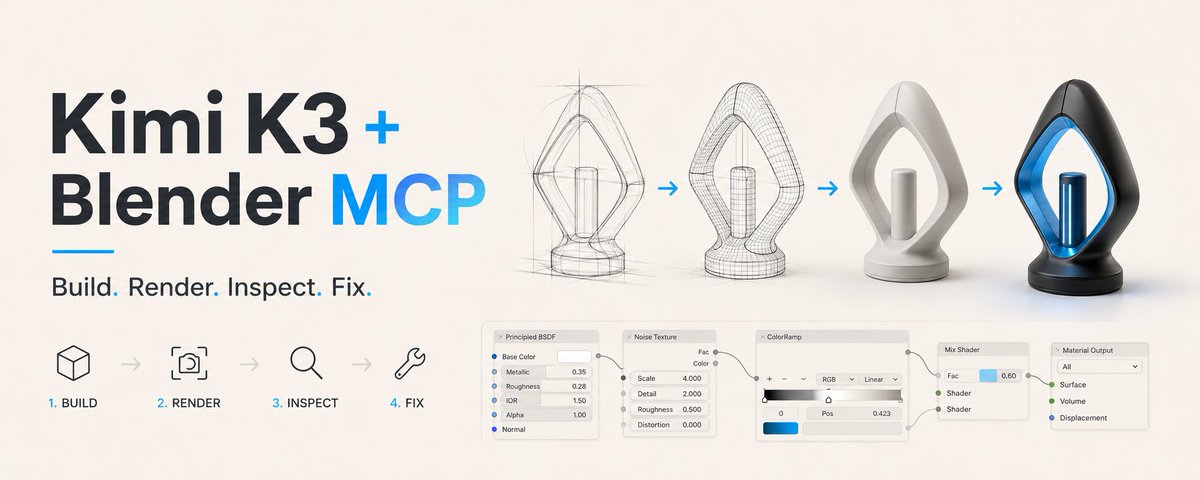 Most AI-generated 3D demos look more magical than they really are because the tedious part usually happens off camera. You see the original prompt and then a polished final render. You do not see the broken geometry, missing textures, misplaced camera, strange lighting, failed scripts, or the fifteen attempts required to make the result presentable. Kimi K3 connected to Blender through MCP does not completely remove that process. What it changes is who performs most of the repetitive work between the first idea and the first usable Blender scene. ## This is not another text-to-3D generator Kimi K3 does not generate a finished 3D asset inside its chat window and send you a mysterious file that cannot be edited properly. Through Kimi Code, the model can connect to external MCP servers and use the tools they expose. BlenderMCP gives an AI agent access to Blender operations such as creating objects, changing materials, moving cameras, managing lights, rendering previews, inspecting the scene, and executing Python inside Blender. Kimi Code officially supports MCP servers through local stdio, HTTP, and SSE connections. That means Kimi can operate the actual Blender project instead of merely giving you instructions like “select the cube, open the modifiers tab, and add a bevel.” You describe what you want, Kimi translates that description into Blender operations or Python code, Blender executes it, and the agent can continue modifying the same scene. ## Why Kimi K3 makes sense for Blender Blender is an unusually difficult environment for an AI model because the model needs more than decent code generation. It has to understand three-dimensional space, keep track of dozens of objects, preserve naming and scene structure, reason about visual composition, interpret screenshots, modify Python scripts, and remember what happened several steps earlier. Kimi K3 was specifically designed around long-horizon coding, native visual understanding, tool use, and a context window of up to one million tokens. Moonshot also demonstrates K3 iterating between code and live screenshots in what it calls a “vision in the loop” workflow. That matters because a Blender agent is only useful when it can do more than generate the first version. A model that creates a city scene but forgets every previous decision after the next prompt is basically an overcomplicated asset generator. A useful agent needs to preserve the scene, inspect the output, identify problems, and continue making changes without rebuilding everything from scratch. ## What the workflow could actually look like Imagine asking Kimi to create a cinematic cyberpunk street with wet asphalt, a small noodle shop, animated signs, volumetric fog, and a camera moving slowly between the buildings. The first step would probably be a rough blockout. Kimi could create simple buildings from cubes, place the road, generate the shop structure, add temporary materials, position the lights, and set up a camera path. That first result would almost certainly look bad. The buildings might be too evenly spaced, the shop could disappear into the background, the camera might move too quickly, and the fog could make the entire scene look like someone spilled milk inside the renderer. This is where the connection becomes more interesting than normal prompt-based generation. Kimi can inspect a viewport screenshot or render, compare the result with the request, modify the Blender scene, and run another iteration. Blender MCP implementations expose scene controls, rendering, viewport screenshots, object manipulation, materials, cameras, and Python scripting, while K3 is designed to combine visual feedback with code execution. The model is not simply producing another image. It is editing the underlying objects, materials, lights, animation curves, and scripts that created the image. ## The code is part of the workflow Kimi does not need a separate MCP command for every tiny Blender operation because Blender itself can be controlled through Python. For example, the model could generate a script like this to create several simple buildings, apply an emissive material, and prepare the first version of a neon street: ``` import bpy import random # Remove the default scene objects bpy.ops.object.select_all(action="SELECT") bpy.ops.object.delete(use_global=False) # Create a dark building material building_mat = bpy.data.materials.new("BuildingMaterial") building_mat.diffuse_color = (0.025, 0.03, 0.05, 1.0) # Create a neon material neon_mat = bpy.data.materials.new("NeonMaterial") neon_mat.use_nodes = True nodes = neon_mat.node_tree.nodes principled = nodes.get("Principled BSDF") principled.inputs["Base Color"].default_value = (0.05, 0.3, 1.0, 1.0) principled.inputs["Emission Color"].default_value = (0.05, 0.3, 1.0, 1.0) principled.inputs["Emission Strength"].default_value = 8.0 # Generate two rows of buildings for side in (-1, 1): for index in range(8): width = random.uniform(2.5, 4.5) depth = random.uniform(3.0, 5.0) height = random.uniform(6.0, 18.0) bpy.ops.mesh.primitive_cube_add( location=(side * 6.0, index * 5.5, height / 2) ) building = bpy.context.object building.name = f"Building_{side}_{index}" building.scale = (width / 2, depth / 2, height / 2) building.data.materials.append(building_mat) # Add a simple neon sign bpy.ops.mesh.primitive_cube_add( location=(side * 5.4, index * 5.5, height * 0.65) ) sign = bpy.context.object sign.name = f"NeonSign_{side}_{index}" sign.scale = (0.08, 1.2, 0.35) sign.data.materials.append(neon_mat) # Add the street bpy.ops.mesh.primitive_cube_add(location=(0, 19, -0.15)) street = bpy.context.object street.name = "Street" street.scale = (4.5, 24, 0.15) street.data.materials.append(building_mat) ``` This is not impressive 3D art by itself. It creates a crude starting point, which is exactly why it is useful. After Blender executes the script, Kimi can inspect the result and make targeted changes. It could vary the silhouettes, move specific buildings, replace the signs with text objects, add windows through Geometry Nodes, create wet-road reflections, or change the camera angle without regenerating the entire scene. The code also remains visible and editable. A human artist can inspect it, correct it, reuse parts of it, or tell Kimi to modify only one function instead of trusting an invisible generation process. ## The blank Blender scene becomes less painful The most valuable part of this workflow is probably not the final render. It is the amount of preparation Kimi can handle before the artist starts doing serious visual work. A typical scene requires object collections, sensible names, initial geometry, camera placement, lighting tests, materials, imports, modifiers, render settings, and scripts for repetitive operations. None of these tasks is individually difficult, but together they consume a large amount of time before the scene becomes interesting enough to evaluate. Kimi can take a rough description and turn it into an editable Blender project that already contains enough structure to criticize. Instead of staring at the default cube and deciding where to begin, the artist receives a flawed environment with actual geometry, lights, cameras, materials, and code. Fixing a mediocre first version is often much easier than creating the entire structure from nothing. ## It still does not have taste Kimi K3 can help with scene construction, but it cannot reliably decide what makes a shot visually good. You can ask it to make the composition more cinematic, but “cinematic” could mean a lower camera, stronger contrast, slower movement, wider lenses, more atmospheric depth, or simply another unnecessary neon sign. The model might understand the technical request while missing the aesthetic reason behind it. A practical workflow would therefore keep the human responsible for direction while letting Kimi execute the repetitive changes. The artist decides that the shop should dominate the frame, the camera should move more slowly, the signs should feel less clean, and the fog should separate the foreground from the background. Kimi then adjusts the scene, changes the relevant parameters, renders another preview, and repeats the process. This division is less impressive than saying the AI created an entire movie from one prompt, but it is also much closer to something people could actually use. ## The agent can also break things faster Giving an AI model direct control of Blender creates a new problem: the model can make unwanted changes with the same speed it makes useful ones. An ambiguous request like “clean up the project” could lead the agent to rename objects, delete unused materials, reorganize collections, replace scripts, or remove assets it incorrectly believes are unnecessary. Kimi Code includes permissions for MCP tool calls and warns users to review high-risk operations such as file modification and command execution. Its documentation also advises against automatically approving every MCP tool unless the server is completely trusted. For Blender projects, basic precautions would include saving incremental versions, using version control for scripts, separating generated assets into collections, restricting automatic approvals, and telling the model exactly which objects or files it may modify. The more autonomy the agent receives, the more important these boundaries become. ## The real shift is not automatic 3D art Kimi K3 connected to Blender does not replace an experienced 3D artist, and it probably will not turn a vague prompt into a polished cinematic sequence without significant human direction. What it can replace is part of the distance between an idea and an editable first version. It can create the blockout, write the repetitive scripts, place initial lights, build camera movements, inspect previews, correct obvious problems, and continue working inside the same Blender project. That is more useful than generating a pretty image because the result is not trapped inside the final pixels. The geometry can be changed, the materials can be rebuilt, the animation can be refined, and the code can be inspected. AI image generators gave people finished outputs that were difficult to control. Kimi K3 connected through Blender MCP gives them an unfinished production system that can keep responding to feedback. It sounds less magical, but it is probably much closer to how AI will actually enter professional 3D workflows. ## 相关链接 - [Rina](https://x.com/irinatoxi) - [@irinatoxi](https://x.com/irinatoxi) - [49K](https://x.com/irinatoxi/status/2080550212913725446/analytics) - [Upgrade to Premium](https://x.com/i/premium_sign_up) - [3:06 PM · Jul 24, 2026](https://x.com/irinatoxi/status/2080550212913725446) - [49.3K Views](https://x.com/irinatoxi/status/2080550212913725446/analytics) --- *导出时间: 2026/7/24 20:32:51* --- ## 中文翻译 # Kimi K3 + Blender MCP:能够构建 3D 场景、观察它并自我修正的 AI **作者**: Rina **日期**: 2026-07-24T07:06:40.000Z **来源**: [https://x.com/irinatoxi/status/2080550212913725446](https://x.com/irinatoxi/status/2080550212913725446) ---  大多数 AI 生成的 3D 演示看起来比实际情况要神奇得多,因为枯燥乏味的部分通常发生在镜头之外。 你看到的是最初的提示词和打磨好的最终渲染图。你看不到破碎的几何体、缺失的纹理、错位的相机、奇怪的灯光、失败的脚本,或者为了使结果看起来像样而进行的十五次尝试。 通过 MCP 连接到 Blender 的 Kimi K3 并没有完全消除这一过程。它改变的是,在从最初的想法到第一个可用的 Blender 场景之间,由谁来执行大部分重复性的工作。 ## 这不是又一个“文本生成 3D”的工具 Kimi K3 不会在其聊天窗口内生成一个完整的 3D 资产,然后发送给你一个无法正确编辑的神秘文件。 通过 Kimi Code,模型可以连接到外部 MCP 服务器,并使用它们暴露的工具。BlenderMCP 赋予了 AI 代理访问 Blender 操作的能力,例如创建物体、更改材质、移动相机、管理灯光、渲染预览、检查场景以及在 Blender 内部执行 Python。Kimi Code 通过本地 stdio、HTTP 和 SSE 连接正式支持 MCP 服务器。 这意味着 Kimi 可以操作实际的 Blender 项目,而不仅仅是给你像“选中立方体,打开修改器选项卡,并添加倒角”这样的指令。 你描述你想要的东西,Kimi 将该描述转化为 Blender 操作或 Python 代码,Blender 执行它,代理可以继续修改同一个场景。 ## 为什么 Kimi K3 适合 Blender 对于 AI 模型来说,Blender 是一个异常困难的环境,因为模型需要的不仅仅是像样的代码生成能力。 它必须理解三维空间,跟踪数十个物体,保持命名和场景结构,推理视觉构图,解释截图,修改 Python 脚本,并记住几步之前发生的事情。 Kimi K3 是专门围绕长视距编码、原生视觉理解、工具使用以及高达一百万 token 的上下文窗口设计的。Moonshot 还展示了 K3 在代码和实时截图之间进行迭代的工作流程,该流程被称为“视觉在回路”(vision in the loop)。 这一点很重要,因为只有当 Blender 代理能够做的不仅仅是生成第一个版本时,它才具有实用性。 一个创建了城市场景但在下一个提示词后就忘记之前所有决定的模型,基本上就是一个过于复杂的资产生成器。一个有用的代理需要保留场景,检查输出,识别问题,并继续进行更改,而无需从头开始重建所有内容。 ## 工作流实际上可能是什么样的 想象一下,让 Kimi 创建一个电影感的赛博朋克街道,有潮湿的沥青路、一家小面馆、动态的招牌、体积雾,以及在建筑物之间缓慢移动的相机。 第一步可能是一个粗略的布局。Kimi 可以用立方体创建简单的建筑物,放置道路,生成店铺结构,添加临时材质,定位灯光,并设置相机路径。 第一个结果几乎肯定看起来很糟糕。 建筑物可能排列得太整齐,店铺可能会消失在背景中,相机可能移动得太快,雾气可能让整个场景看起来像有人在渲染器里打翻了牛奶。 这就是为什么这种连接比普通的基于提示词的生成更有趣的地方。Kimi 可以检查视口截图或渲染图,将结果与请求进行比较,修改 Blender 场景,并运行另一次迭代。Blender MCP 实现暴露了场景控制、渲染、视口截图、物体操作、材质、相机和 Python 脚本,而 K3 的设计正是为了结合视觉反馈与代码执行。 模型不仅仅是生成另一张图像。它正在编辑创建该图像的底层物体、材质、灯光、动画曲线和脚本。 ## 代码是工作流的一部分 Kimi 不需要为每一个微小的 Blender 操作都使用单独的 MCP 命令,因为 Blender 本身可以通过 Python 进行控制。 例如,模型可以生成像这样的脚本来创建几个简单的建筑物,应用自发光材质,并准备霓虹街道的第一个版本: ``` import bpy import random # 移除默认场景物体 bpy.ops.object.select_all(action="SELECT") bpy.ops.object.delete(use_global=False) # 创建深色建筑物材质 building_mat = bpy.data.materials.new("BuildingMaterial") building_mat.diffuse_color = (0.025, 0.03, 0.05, 1.0) # 创建霓虹材质 neon_mat = bpy.data.materials.new("NeonMaterial") neon_mat.use_nodes = True nodes = neon_mat.node_tree.nodes principled = nodes.get("Principled BSDF") principled.inputs["Base Color"].default_value = (0.05, 0.3, 1.0, 1.0) principled.inputs["Emission Color"].default_value = (0.05, 0.3, 1.0, 1.0) principled.inputs["Emission Strength"].default_value = 8.0 # 生成两排建筑物 for side in (-1, 1): for index in range(8): width = random.uniform(2.5, 4.5) depth = random.uniform(3.0, 5.0) height = random.uniform(6.0, 18.0) bpy.ops.mesh.primitive_cube_add( location=(side * 6.0, index * 5.5, height / 2) ) building = bpy.context.object building.name = f"Building_{side}_{index}" building.scale = (width / 2, depth / 2, height / 2) building.data.materials.append(building_mat) # 添加一个简单的霓虹招牌 bpy.ops.mesh.primitive_cube_add( location=(side * 5.4, index * 5.5, height * 0.65) ) sign = bpy.context.object sign.name = f"NeonSign_{side}_{index}" sign.scale = (0.08, 1.2, 0.35) sign.data.materials.append(neon_mat) # 添加街道 bpy.ops.mesh.primitive_cube_add(location=(0, 19, -0.15)) street = bpy.context.object street.name = "Street" street.scale = (4.5, 24, 0.15) street.data.materials.append(building_mat) ``` 这本身并不算是令人印象深刻的 3D 艺术。它创建了一个粗略的起点,而这正是它有用的原因。 在 Blender 执行脚本后,Kimi 可以检查结果并进行有针对性的更改。它可以改变轮廓,移动特定的建筑物,用文本对象替换招牌,通过几何节点添加窗户,创建湿路面的反射,或者在不重新生成整个场景的情况下更改相机角度。 代码也保持可见和可编辑。人类艺术家可以检查它,修正它,重用其中的一部分,或者告诉 Kimi 只修改一个函数,而不是信任一个不可见的生成过程。 ## 空白的 Blender 场景不再那么令人痛苦 这个工作流最有价值的部分可能不是最终渲染图。 它是 Kimi 在艺术家开始进行严肃的视觉工作之前所能处理的准备工作量。 一个典型的场景需要物体集合、合理的命名、初始几何体、相机放置、灯光测试、材质、导入、修改器、渲染设置和用于重复操作的脚本。这些任务都不是单独很难,但它们加在一起消耗了大量的时间,直到场景变得足够有趣以进行评估。 Kimi 可以获取一个粗略的描述,并将其转化为一个可编辑的 Blender 项目,该项目已经包含足够多的结构以供评判。 艺术家不再是盯着默认的立方体并决定从哪里开始,而是收到一个有缺陷的环境,其中包含实际的几何体、灯光、相机、材质和代码。修复一个平庸的第一个版本往往比从头创建整个结构要容易得多。 ## 它仍然没有品味 Kimi K3 可以帮助场景构建,但它无法可靠地决定是什么让镜头在视觉上变得好看。 你可以要求它让构图更具电影感,但“电影感”可能意味着更低的相机、更强的对比度、更慢的移动、更广的镜头、更多的大气深度,或者仅仅是另一个不必要的霓虹招牌。 模型可能理解技术要求,却错过了其背后的美学原因。 因此,一个实用的工作流将由人类负责方向,同时让 Kimi 执行重复性的更改。艺术家决定店铺应该主导画面,相机应该移动得更慢,招牌应该感觉不那么干净,雾气应该将前景与背景分离开来。然后 Kimi 调整场景,更改相关参数,渲染另一个预览,并重复该过程。 这种分工不如说 AI 从一个提示词创建了一整部电影那么令人印象深刻,但它也更接近人们实际可以使用的东西。 ## 代理也能更快地破坏东西 赋予 AI 模型对 Blender 的直接控制会产生一个新问题:模型可以以与进行有用更改相同的速度做出不需要的更改。 像“清理项目”这样模棱两可的请求可能会导致代理重命名物体、删除未使用的材质、重新组织集合、替换脚本或删除它错误地认为不必要的资产。 Kimi Code 包含对 MCP 工具调用的权限,并警告用户审查高风险操作,例如文件修改和命令执行。其文档还建议,除非服务器完全受信任,否则不要自动批准每个 MCP 工具。 对于 Blender 项目,基本的预防措施将包括保存增量版本、对脚本使用版本控制、将生成的资产分离到集合中、限制自动批准,以及告诉模型它确切可以修改哪些物体或文件。 代理获得的自主权越多,这些界限就越重要。 ## 真正的转变不是自动化的 3D 艺术 连接到 Blender 的 Kimi K3 并不能取代经验丰富的 3D 艺术家,如果没有大量的人工指导,它可能也无法将一个模糊的提示词转化为打磨好的电影序列。 它能取代的是从一个想法到一个可编辑的第一个版本之间的部分距离。 它可以创建布局,编写重复性的脚本,放置初始灯光,构建相机移动,检查预览,纠正明显的问题,并继续在同一个 Blender 项目中工作。 这比生成一张漂亮的图像更有用,因为结果没有被困在最终的像素中。几何体可以更改,材质可以重建,动画可以细化,代码可以检查。 AI 图像生成器给了人们难以控制的最终输出。 通过 Blender MCP 连接的 Kimi K3 给了他们一个可以继续响应反馈的未完成的生产系统。 这听起来不那么神奇,但这可能更接近 AI 实际进入专业 3D 工作流的方式。 ## 相关链接 - [Rina](https://x.com/irinatoxi) - [@irinatoxi](https://x.com/irinatoxi) - [49K](https://x.com/irinatoxi/status/2080550212913725446/analytics) - [Upgrade to Premium](https://x.com/i/premium_sign_up) - [3:06 PM · Jul 24, 2026](https://x.com/irinatoxi/status/2080550212913725446) - [49.3K Views](https://x.com/irinatoxi/status/2080550212913725446/analytics) --- *导出时间: 2026/7/24 20:32:51*
G GPT-5.6 + blender MCP: describe the thing, the model builds it and fixes itself 本文探讨了 GPT-5.6 结合 Blender MCP 的应用,模型能根据描述自动构建 3D 场景并通过渲染自我修正。该工具不仅降低了 Blender 的使用门槛,还拓展了产品可视化、建筑场景和 3D 打印等应用领域。尽管模型能快速完成初步构建,但在精度、有机复杂度和动画细节上仍需人工干预。 技术 › 工具与效率 ✍ explos1ve🕐 2026-07-20 GPT-5.6BlenderMCP3D建模自动化AI工具产品可视化3D打印Python自我修正
百 百度网盘 + 闲鱼 MCP 一键发布实战指南 本文介绍了如何通过 MCP 协议将百度网盘与闲鱼连接,利用 AI Agent 自动化完成从网盘选取资料、生成文案到闲鱼发布商品的流程。文章详细讲解了环境配置、接口接入及常见坑点,帮助读者建立自动变现系统。 技术 › Agent ✍ mousepotato🕐 2026-07-27 MCP自动化闲鱼百度网盘AgentPython实战教程
使 使用 Hermes Agent Blender MCP 免费构建 3D 产品模型 文章介绍了 Hermes Agent Blender MCP 工具,它能将文字描述直接转化为可编辑的 Blender 3D 场景。用户无需深入学习 Blender 的复杂节点和参数,只需描述想法,Agent 即可自动完成建模、材质、灯光和渲染。这种方式大大降低了 3D 创作门槛,特别适合产品模型快速制作。 技术 › Hermes ✍ Julian Goldie SEO🕐 2026-07-18 3D建模BlenderAgentAI设计产品渲染自动化HermesMCP创意工具工作流
如 如何构建价值万美元的定制 MCP 服务器:完整课程 本文是一份关于如何从零开始构建并销售定制 MCP(模型上下文协议)服务器的完整指南。文章指出,当前市场对能解决实际业务问题的 MCP 服务器需求巨大,自由职业者单次开发收入可达 5000 至 15000 美元。内容分为三个月的学习路径:首月掌握协议并搭建首个服务器;次月聚焦解决企业内部工具、数据管道等痛点;第三月通过自由职业、产品化销售或企业合同实现变现。文章强调这不仅是技术开发,更是高价值的商业解决方案。 技术 › Agent ✍ Khairallah AL-Awady🕐 2026-05-06 MCPClaudeAI Agent商业模式副业PythonTypeScriptAnthropicAPI自动化
安 安卓手机运行 Hermes Agent 教程 本文详细介绍了如何在安卓手机上通过 Termux 安装并运行 Hermes Agent。文章提供了 F-Droid 下载链接及一键安装与手动安装两种方式,涵盖了环境配置、API Key 设置及常见报错解决方案。同时分析了手机端支持的图片语音交互、文件读写等核心功能,并指出了暂不支持 Docker 和后台持久化等限制。 技术 › Hermes ✍ 一🕐 2026-04-21 安卓TermuxAI Agent移动端安装教程代码自动化LLM工具与效率Python
1 15分钟构建完整 Claude Code 开发环境指南 本文详细介绍了如何将 Claude Code 从基础安装配置为全能开发环境。通过配置 CLAUDE.md 项目记忆文件、安装 TDD 和代码审查等核心技能、设置 Git 防护钩子以及连接 MCP 服务器,用户可在 15 分钟内获得一个替代 Cursor、Copilot 等工具链的高效开发系统。 技术 › Claude Code ✍ Guri Singh🕐 2026-04-18 Claude Code开发环境配置MCPLLM工具与效率自动化Git Hooks技能
我 我把 TikTok 运营塞进了 Codex:选品、拆账号、找达人,一句话跑完整个流程 作者将 TikTok 运营工作流封装成 Codex Agent Skill,结合达人精灵 MCP 数据,实现选品、账号诊断、类目研究和增长规划的自动化。文章详细介绍了四个核心技能的安装、配置及具体 Prompt 使用方法,解决了 AI 运营中的幻觉与流程混乱问题。 技术 › Agent ✍ Aron厚玉🕐 2026-07-28 TikTok运营CodexSkillMCP自动化选品达人营销Agent技能工作流数据分析
C Claude + Obsidian,你数百条死笔记,瞬间变成帮你思考的第二大脑 本文介绍了一种结合 Claude 和 Obsidian 的知识管理方案,通过自动化提取、链接和归档,将死笔记转化为可交互的第二大脑,支持全文检索和引用,帮助知识复利增长。 技术 › 工具与效率 ✍ 老白(每日 AI 干货)🕐 2026-07-22 ClaudeObsidian知识管理第二大脑笔记MCP自动化LLMMarkdown效率
如 如何用 Obsidian 和 Claude 构建永久记忆系统 文章介绍了一种结合 Claude Desktop 和 Obsidian 的 AI 工作流,通过构建本地知识库和配置 MCP,实现一次输入、永久记忆。这不仅解决了重复向 AI 解释背景的痛点,还能自动整理笔记、链接知识,并通过定时任务实现信息管理的自动化。 技术 › 工具与效率 ✍ kai🕐 2026-07-19 ObsidianClaudeAI工作流知识管理自动化MCP提示词个人知识库生产力工具
C Claude Skills: 如何通过 Anthropic 的新功能节省 Token 并提升效率 文章介绍了 Anthropic 推出的 Claude Skills 功能,通过文件夹和 YAML 配置实现渐进式披露,显著减少 Token 消耗和重复解释。详细说明了技能的构建规则、命名规范、测试方法及分发策略,帮助用户将聊天机器人转化为高效的专业工程团队。 技术 › Skill ✍ Mr. Buzzoni🕐 2026-07-17 ClaudeSkillTokenAnthropicDevOps工具与效率LLMMCPAgent
自 自动驾驶公司:Replit如何通过AI代理实现自我运营 Replit通过引入AI代理实现了公司运营模式的变革。工程师代码输出增长近三倍,代码审查时间保持稳定,质量指标提升。代理系统处理生产事故、代码审查、数据分析等任务,形成自动驾驶公司。员工专注于战略决策,AI执行具体步骤,显著提升生产力和效率。 技术 › Agent ✍ Amjad Masad🕐 2026-07-17 ReplitAI代理自动驾驶公司生产力提升代码审查自我学习自动化企业转型技术变革
自 自媒体“爆款竞品拆解”—WorkBuddy全自动 B 站行业研究工作流教程 文章介绍了一套基于 WorkBuddy 的全自动 B 站竞品拆解流水线。通过集成 Node.js、Python、B 站搜索技能及 NotebookLM,将原本耗时 2 小时的手动拆解工作缩短至 5 分钟。该系统能自动生成包含爆款文案公式、弹幕情绪分析及内容盲区的深度报告,极大提升了自媒体选题与研究效率。 技术 › 工具与效率 ✍ 蔡文彬CyberBin🕐 2026-07-15 自媒体WorkBuddy工作流B站AINotebookLM竞品分析效率提升Python自动化