# The Path to $250,000 ETH: Ethereum and the Era of Productive Money
**作者**: Etherealize
**日期**: 2026-04-21T12:24:27.000Z
**来源**: [https://x.com/Etherealize_io/status/2046565729558811064](https://x.com/Etherealize_io/status/2046565729558811064)
---

To download this report as a PDF and learn more about the "Productive Money" thesis, visit productivemoney.org
As of April 2026, the combined monetary premium of gold and Bitcoin is approximately $31 trillion. If Ethereum captured that premium—distributed across roughly 121 million ETH in circulation—the implied price of one ETH would be north of $250,000. Today it trades around $2,300. This report argues that the repricing is not only possible, but logically consistent given the monetary properties of ETH.
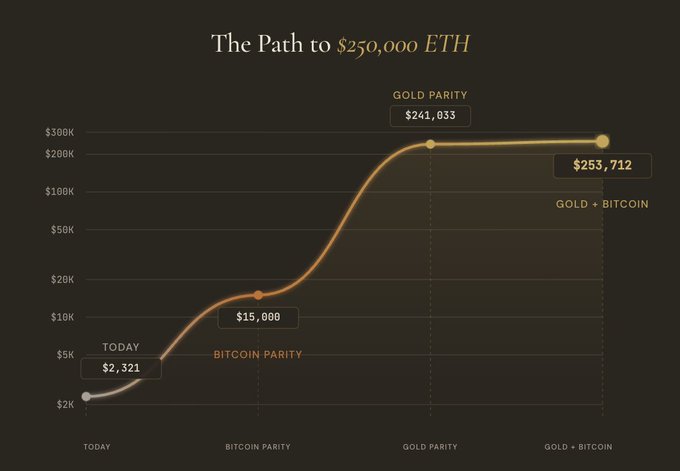
Gold monetary premium estimated at 90% of total market capitalization, with the remainder attributable to industrial and decorative utility. Bitcoin's entire market cap is treated as monetary premium. All milestone prices include ETH's current market cap as the base.
For most of human history, the best money was the most inert. Gold was valuable because it did nothing—it didn't rot, didn't corrode, and its supply didn't increase much. The same logic animates Bitcoin: 21 million coins, no governance, no surprises. Just sit there and hold value.
This logic made sense in a world where the best monetary commodity we could find was the most scarce. But it has a shortcoming, and Warren Buffett identified it in his 2011 letter to Berkshire Hathaway shareholders:
> “Gold, however, has two significant shortcomings, being neither of much use nor procreative. True, gold has some industrial and decorative utility, but the demand for these purposes is both limited and incapable of soaking up new production. Meanwhile, if you own one ounce of gold for an eternity, you will still own one ounce at its end.”
Buffett was making a narrow point about gold, but he described the fundamental limitation of every monetary asset humans have ever used—and every cryptocurrency modeled on gold. Bitcoin has the same shortcoming: it doesn't compound. If you own one bitcoin for an eternity, you will still own one bitcoin at its end.
Buffett's objection was never about scarcity. He acknowledged gold was scarce. His objection was that scarcity without productivity is economically sterile. He would rather own all the farmland in America than all the gold in the world. Over a long enough time horizon, productive assets outperform non-productive ones, because productive assets compound.
For most of financial history, you had to choose. You could hold money (stable, unproductive) or invest it into productive assets (risky, wealth-generating). The two categories were mutually exclusive.
ETH dissolves this distinction. It generates a return simply from being held and staked. One ETH staked today will be more than one ETH a year from now. That alone disqualifies it from Buffett's criticism of gold. The question is whether this property, combined with ETH's other monetary attributes, is sufficient to capture the $31 trillion monetary premium currently held by gold and Bitcoin. The rest of this report makes the case that it is.
Better Money by Every Measure
In 1892, Carl Menger—the founder of the Austrian school of economics and the author of the most influential theory of money's origins ever written—argued that certain goods naturally emerge as money because they are more “saleable” than others. By saleable, Menger simply meant easier to sell to a wide number of people, at a fair price, whenever you want. The determinant of saleability was not a single property but a composite: a good becomes money when it excels across a range of attributes simultaneously. The most important was resistance to supply dilution. Gold became money mostly because when its price rose, the world could not easily produce more of it. The existing stock dwarfed annual production, and no miner could flood the market or dilute existing holders.
Beyond scarcity, Menger identified fungibility, divisibility, portability, durability, verifiability, and low carrying cost as other important monetary attributes. Modern analyses of monetary goods have added two more: censorship resistance and established history. ETH matches or exceeds gold and Bitcoin on every one except established history.
- Scarcity: ETH's issuance is capped at roughly 1.5% annually, and its burn mechanism actively destroys ETH in proportion to network usage, making the effective supply potentially deflationary. Unlike gold, where a sustained price increase could incentivize more mining, ETH's issuance rate is fixed by protocol regardless of price, and its burn rate actually increases with demand.
- Fungibility: Every ETH is identical at the protocol level. Like Bitcoin, public blockchain traceability means specific coins can be traced to illicit origins and rejected by exchanges or counterparties—a weakness relative to gold, where provenance is effectively untraceable once melted. However, Ethereum's active research into privacy, particularly ZK-proof-based privacy pools, gives it a credible path to fungibility that rivals physical gold. Bitcoin's ossified development culture makes equivalent privacy features unlikely.
- Divisibility: ETH is divisible to 18 decimal places—far beyond any physical commodity or any practical need.
- Portability: ETH can be transferred anywhere on Earth in seconds.
- Durability: Gold gets its security from the laws of physics – it does not rot, corrode, or degrade, which is why a coin minted two thousand years ago still trades at bullion value today. ETH is arguably more durable than Bitcoin because its security model strengthens as its value grows. Proof-of-stake security scales with the economic value staked, meaning the network becomes harder to attack as it becomes more valuable. Bitcoin's security depends on a block subsidy that halves every four years and will eventually reach zero, which is a structural vulnerability explored later in this report.
- Verifiability: Every ETH balance is publicly auditable on-chain. Counterfeit gold bars exist. Counterfeit ETH does not.
- Censorship resistance: ETH arguably has the strongest property rights of any asset in the world. No government, bank, or intermediary can prevent a transaction from being processed: forced inclusion mechanisms in the protocol ensure that even those who wish to censor specific transactions cannot block them. No authority can confiscate it: a million dollars in ETH can be stored in a memorized twelve-word phrase and carried across any border on Earth. Gold cannot match either property at scale: large transfers require physical transport that governments can intercept, and when Franklin D. Roosevelt confiscated American citizens' gold in 1933, the government simply ordered people to surrender their metal. Bitcoin's censorship resistance is weakening as mining becomes increasingly concentrated and the network lacks protocol-level inclusion guarantees equivalent to Ethereum's.
- Established History: This is the one axis on which ETH is genuinely weakest. Gold has functioned as money for over 3,000 years. Bitcoin for 17. Ethereum for 10, and its proof-of-stake design has existed only since 2022. A sophisticated investor is right to weight this against ETH. The Lindy Effect – Nassim Taleb’s observation that the longer a technology exists, the longer it can be expected to persist – currently favors gold overwhelmingly and Bitcoin materially. But this is precisely why ETH has not yet accrued a monetary premium commensurate with its other properties. Ethereum has spent the last decade sacrificing short-term stability for long-term viability (e.g. migration to proof-of-stake, zkEVM and post-quantum roadmaps, privacy, etc.). The market has correctly priced this uncertainty, but as the protocol ossifies, that discount should close.
By Menger's criteria, ETH already qualifies as a superior monetary good before the conversation turns to yield. It wins on the attributes that matter most—scarcity, durability, censorship resistance—and matches its competitors on every other axis save the one that time itself will resolve. This is where the opportunity lies. The market has priced ETH as a technology in flux; it has not yet priced ETH as money. The path to $250,000 begins here.
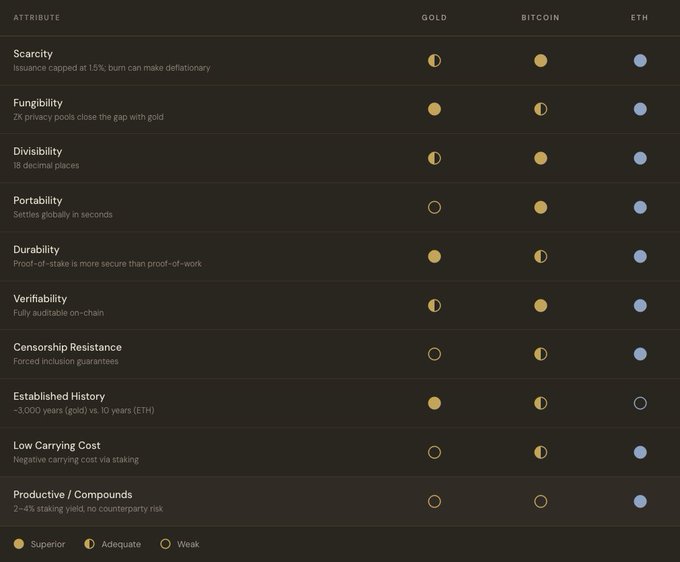
Monetary Attributes: Gold vs. BTC vs. ETH
The Carrying Cost Breakthrough
Menger's framework identified what makes good money. Buffett asked, “Why would I hold any of them when they generate nothing?”
Money can earn a return through lending, but that requires converting it into a credit instrument—a loan, a bond, a deposit—and accepting counterparty risk. A gold coin in a vault earns nothing. In fact, you usually have to pay someone to store it (e.g. vault fees, insurance, transport). To earn yield on dollars, you have to give them up entirely. And giving them up means trusting that the bank will not fail, the borrower will not default, and the government will not debase.
ETH breaks this tradeoff. When you stake ETH, you are not lending it. There is no borrower, no bank, no counterparty. You lock ETH into the Ethereum protocol's consensus mechanism and earn yield from the issuance rewards and transaction fees the network generates. The ETH remains yours. You can unstake and withdraw. The yield is not compensation for counterparty risk—it is compensation for providing security to the network and accepting protocol risk (validators who act maliciously are slashed and lose a portion of their stake). It is capital at risk, but the risk is transparent, algorithmically enforced, and does not depend on the solvency or honesty of any counterparty.
The current staking yield sits between 2% and 4% annually. A portion comes from organic transaction fees paid by users; the remainder from protocol-level issuance. In practice, net issuance has hovered around 0.8% because a portion of all fees is permanently burned. A sophisticated reader might raise an objection here: isn't staking yield just inflation? If the protocol issues new ETH to pay stakers, non-stakers are being diluted — the same way a company issuing new shares to fund a dividend isn't generating a return, just transferring value. This objection is wrong for two reasons. First, issuance is offset by Ethereum's burn mechanism: every transaction destroys ETH, and when usage is high enough, burns exceed issuance and the total supply shrinks (similar to funding share buybacks with profits). Second, a meaningful portion of staking yield is funded by transaction fees (similar to funding dividends with profits). And unlike a corporation or central bank, ETH issuance is capped by the protocol at 1.5% and cannot be changed by any individual, board, or committee.
This is the categorical change. ETH does not need the carrying cost argument to qualify as money—it qualifies on the traditional attributes alone. The negative carrying cost is what makes it strictly better money: a monetary good that matches its competitors on every traditional attribute and then compounds without counterparty risk. No monetary good in history has offered this. The path to $250,000 depends on this being understood: ETH is not a technology bet. It is a superior monetary asset with an economic property that gold and Bitcoin strictly cannot replicate: it compounds.
The Toll Road to Tokenization
Buffett loves businesses that sit at a chokepoint of economic activity and collect a fee on everything that passes through. “In an inflationary world,” he has said, “a toll bridge would be a great thing to own because you've laid out the capital costs. You built it in old dollars and you don't have to keep replacing it.” BlackRock—the world's largest asset manager, with $14 trillion under management—has adopted the same metaphor for Ethereum, with CEO Larry Fink calling it “the toll road to tokenization” in a presentation at Davos [1].
Ethereum is the largest toll road in decentralized finance. More than 65% of all tokenized real-world assets [2] —money market funds, equities, credit—are issued on Ethereum, because institutions choose the most secure settlement layer for assets that matter. In 2025, Ethereum settled over $18.8 trillion in stablecoin transactions alone [3], which is more than Visa processes annually. Every transaction pays a fee. A portion is burned, and the rest goes to stakers. The more assets issued, the more traffic, the more ETH earns, and the scarcer it becomes.
But ETH is not just the toll road—it is also the collateral that the financial system on the other side of the bridge runs on. Across lending protocols, derivatives markets, and liquidity pools, ETH is the dominant asset that borrowers post, that liquidity providers deposit, that the system demands as its margin of safety. It is the most widely used collateral on Aave, the primary asset backing decentralized stablecoins like DAI, and the base pair for the majority of decentralized exchange liquidity. The bigger the system grows, the more ETH gets locked up.
Gold can serve as collateral, but the process is slow, expensive, and dependent on trusted intermediaries. You cannot programmatically liquidate a gold position in twelve seconds. You cannot compose gold into layered financial instruments that settle atomically. You cannot use gold as collateral simultaneously in three different lending markets without physically moving it. ETH does all of this natively. It is programmable collateral. And because every operation consumes gas, the collateral function and the value accrual function are the same loop.
In total, ETH has three independent sources of structural demand that remove it from free circulation. Staking demand: ~32% of all ETH is locked to secure the network [4]. Collateral demand: the decentralized financial system uses ETH as foundational collateral given that it's the only asset native to the network without counterparty risk. Gas demand: every transaction requires ETH, and a portion is permanently burned.
Other monetary assets have demand drivers that lock up supply—gold sits in central bank vaults and temple jewelry. But ETH's demand drivers are different in three ways. First, they are native to its monetary function: you need ETH because it is the money of the system. Second, they scale proportionally with the financial system built on Ethereum. Third, one of them permanently destroys supply. Gold jewelry can be melted down. Central bank reserves can be sold. But burned ETH is gone forever.
Why Not Just Buy the S&P 500?
If the goal is a productive asset, why not buy the S&P 500? It yields more than 3%, and it has a far longer track record.
Because the S&P 500 is not money. Every dollar of S&P 500 value is a claim on a counterparty—a corporation that can go bankrupt, a broker that can fail, a clearinghouse that can freeze your shares, a government that can restrict your access. Money is a bearer instrument—whoever holds it, owns it. A stock is a registered claim—you own it only because institutions agree you own it. The entire value proposition of gold and Bitcoin rests on this distinction: no counterparty risk.
For all of human history, this created an inescapable tradeoff. You could hold money (a bearer asset with no counterparty risk) and earn nothing. Or you could hold a financial asset (a claim on a counterparty) and earn a return.
ETH presents a third option: self-custodied, censorship-resistant, dependent on no corporation, broker, or government—and it compounds without counterparty risk. The S&P 500 is a wonderful productive asset. But it is not money. ETH is the first asset in history that is both (with the possible exception of livestock, which was productive but lost the monetary competition precisely because it failed on every other attribute Menger identified). This is why the $31 trillion in gold and Bitcoin monetary premium is the relevant comparison, not the S&P 500's market cap. People hold gold and Bitcoin precisely because they want bearer assets without counterparty risk. ETH offers the same thing, plus compounding.
The Intrinsic Value Floor
Satoshi Nakamoto described Bitcoin's value proposition clearly: “As a thought experiment, imagine there was a base metal as scarce as gold but with the following properties: boring grey in colour, not a good conductor of electricity… and one special, magical property: can be transported over a communications channel.” Creating a commodity as scarce as gold that you can teleport was a genuine breakthrough, but the value proposition is purely monetary. There is no economic activity underneath, and if confidence wavers, there's nothing to catch it.
ETH has something underneath. Decentralized finance (DeFi) generates billions of dollars in annual fees, all paid in ETH. As long as people want to invest, lend, borrow, trade, and save—as humans have done for thousands of years—and Ethereum is the most secure way to do that, there will be demand for ETH. Billions of people don't have access to brokerage accounts or yield-bearing savings products. For them, on-chain finance already works better than anything else available. And this floor is strengthening as Ethereum increasingly settles activity that has nothing to do with crypto-native finance: tokenized treasury funds from BlackRock and Franklin Templeton, global stablecoin payments, private credit, and real-world assets like commodities and real estate. If confidence in ETH as a monetary asset were to waver, the DeFi activity would not disappear. The floor holds because the demand is real.
The ideal monetary asset does not rely on faith alone. The monetary premium of gold and Bitcoin is largely social consensus. But ETH has DeFi: a global, permissionless financial system that generates real economic activity, burns real ETH, and creates structural demand independent of any monetary premium. The monetary premium is the upside, and the intrinsic value floor is the downside protection. The path to $250,000 does not require speculative faith. It requires only that the on-chain financial system continues to grow. The DeFi floor ensures ETH retains substantial value even if the monetary premium takes decades to fully materialize.
But there is a further consequence. Because ETH has downside protection that gold and Bitcoin lack, speculation on ETH's future as a monetary good is lower-risk. And speculation is the mechanism by which monetary goods are adopted. Acquiring a good in hopes that it will be demanded as money hastens its adoption for that very purpose. This circularity is actually a feedback loop that drives society to quickly converge on a single monetary good (“Nash Equilibrium” in game-theoretic terms). ETH's intrinsic value floor does not merely protect the downside. It accelerates the path to $250,000 by making the bet less risky—which makes more people willing to take it—which makes the outcome more likely.
The Lesson of Silver
If better money displaces inferior money, what does the transition look like?
For thousands of years, gold and silver coexisted as monetary goods. Silver was the money of everyday commerce—worth less per unit, it was practical for buying bread, paying wages, and settling small debts. Gold was the money of kings, merchants, and international trade—too valuable per unit for daily use, but superior in scarcity and density for storing large amounts of wealth.
The demonetization of silver began in the 1870s, driven by a convergence of forces. Massive silver deposits discovered in the American West were flooding the market with new supply, undermining silver's scarcity. Germany abandoned silver for a gold standard after its unification in 1871, dumping its reserves onto global markets. The United States followed with the Coinage Act of 1873. Advances in banking and telecommunications then eliminated silver's last remaining advantage: paper banknotes and telegraphic transfers backed by gold made it practical for everyday settlement, removing the need to physically divide it for small transactions. One by one, the major economies coordinated on gold, and silver's monetary premium collapsed. The gold-to-silver ratio went from 1:15 to 1:80.
The consequences for nations that held the wrong money were catastrophic. China had used silver as its monetary standard for centuries and did not follow the West's transition to gold. As silver's monetary premium evaporated over the following decades, China's currency lost over 80% of its international purchasing power. The country could no longer service its foreign debts, which were denominated in gold. In 1935, China was forced to abandon silver entirely and introduce a fiat currency, just as it was entering two devastating wars. The government printed money to fund the military, hyperinflation followed [5], and it became clear to the world that you cannot insulate yourself from the consequences of others holding better money than yours.
Monetary standards are Nash equilibria. The cost of remaining on an inferior standard rises as adoption of the superior standard grows. Silver holders in the 1870s couldn't simply decide to keep using silver. Once enough of the world moved to gold, silver's monetary premium vanished whether you believed in silver or not.
Today, Bitcoin is widely accepted as “digital gold” and ETH is the challenger. Bitcoin's advantage is brand and first-mover status. ETH's advantages are structural: native compounding, demand-responsive supply, collateral utility, a security model that scales with value, and an intrinsic value floor from DeFi. Silver's demonetization looked slow for decades, and then its monetary premium collapsed rapidly. The same convergence of forces is building against Bitcoin: deteriorating security economics, a superior competitor gaining institutional legitimacy, and structural advantages that compound with every dollar of value that is tokenized.
Bitcoin's Structural Weakness
Bitcoin's security depends on miners compensated through block rewards that halve every four years and will eventually reach zero. In the long run, security will be funded entirely by transaction fees. However, Bitcoin's small-block design caps throughput at three to seven transactions per second, structurally limiting fee revenue.
Either fees rise dramatically per transaction, making Bitcoin expensive to use, or the security budget shrinks, making it cheaper to attack. This is problematic because the more valuable Bitcoin becomes, the more profitable it is to attack it.
This is not a theoretical concern. What matters for a monetary network is not absolute security but relative security: security as a proportion of the value being secured. It's similar to why countries of all sizes maintain roughly similar military budgets as a percentage of GDP. A $20 trillion Bitcoin network would attract nation-state-level adversaries, yet its proof-of-work security budget when the block reward reaches zero will be a fraction of what it is today. The cost of attack divided by market cap is the correct measure, and on that measure, Bitcoin's security deteriorates with every halving.
The vulnerability is even more stark when measured by hardware cost. The cost to attack Bitcoin is not the annual security budget but the cost to acquire sufficient mining hardware to control 51% of the network's hashrate. At current hash rates and ASIC prices, the total replacement cost of all Bitcoin mining hardware is estimated at roughly $6.3 billion [6]. For context, several individual technology companies now spend more than that in a single quarter on computing infrastructure alone. As Bitcoin's block reward continues to halve, the cost of attack may stagnate—even as the value it is supposed to protect grows.
Ethereum's security model works differently. Attacking Ethereum would require acquiring roughly a third of all staked ETH—currently about $30 billion [7]—and the attacker's stake would be slashed, meaning the capital is destroyed in the attempt. This cost scales directly with the network's value: if ETH's market cap doubles, the cost to attack it doubles. Bitcoin has no equivalent mechanism. If Bitcoin's market cap doubles, the cost to attack it stays the same until miners independently invest in more hardware—which they will only do if the economics justify it, and the halving schedule is making the economics worse every four years. Where Bitcoin burns energy, Ethereum deploys capital productively. One model inefficiently destroys resources, while the other compounds them. For a monetary asset competing for a monetary premium worth $31 trillion, the durability of the security model is the foundation on which the entire value proposition rests.
If Bitcoin's fee revenue does not grow by several orders of magnitude, there are two candidate solutions: add tail issuance, which breaks the 21 million cap, or switch to proof of stake. Both are cultural non-starters for the Bitcoin community. As Vitalik Buterin observed in his reflections on the block size war:
> “The ultimate diffuser of political tension is not compromise, but rather new technology: the discovery of fundamentally new approaches that give both sides more of what they want at the same time. When an ecosystem stops embracing new technology, it inevitably stagnates, and becomes more contentious at the same time. [8]“
Bitcoin chose ossification because it values near-term stability more than long-term viability.
And there is a final irony. If Bitcoin ever did break its commitment to ossification and adopt proof-of-stake to solve its security crisis, the case for stopping there would be incoherent. Once you've decided the protocol must evolve to survive, you should adopt the best available design. And the best available design includes smart contracts—Satoshi himself foresaw the need, writing on the Bitcointalk forum in 2010: “Escrow transactions, bonded contracts, third party arbitration, multi-party signature, etc. If Bitcoin catches on in a big way, these are things we'll want to explore in the future.” But adding proof-of-stake and smart contracts to Bitcoin would essentially be reinventing Ethereum, a decade late.
Looming beyond the security budget crisis is quantum computing, which threatens the elliptic curve cryptography underpinning Bitcoin's wallet security. Ethereum's active development culture has already produced a concrete roadmap for quantum resistance; Bitcoin's commitment to ossification makes equivalent adaptation unlikely.
The Path to $250,000
Gold's monetary premium: ~$29.7 trillion. Bitcoin's: ~$1.5 trillion. Together, they represent roughly $31.1 trillion held by people who want money outside the control of governments. ETH's current market cap is ~$280 billion—less than 1% of that combined premium.
The market still treats ETH as a technology bet, but if the arguments in this report are correct—if ETH is superior money by the criteria of Menger on saleability and Buffett on productivity—then the logical endpoint is that ETH captures the monetary premium currently held by both gold and Bitcoin. The arithmetic: $31 trillion divided by ~121 million ETH yields an implied price north of $250,000 per ETH. Gold and Bitcoin would likely retain some residual value, just as silver did. But the vast majority of the monetary premium migrates to the superior asset.
The addressable market is also growing. The United States carries over $38 trillion in national debt, with interest payments approaching $1 trillion annually. The debt-to-GDP ratio has risen from 56% in 2000 to roughly 125% today [9]. Every fiat currency in history has followed the same arc: initial stability, then moderate inflation, then ruinous debasement. The dollar is 55 years into that arc. As the fiat system deteriorates, the total addressable market for non-sovereign money expands with every trillion in new debt.
$31 trillion may be conservative. A significant portion of the value embedded in global real estate, government bonds, and equities is not productive value but monetary premium in disguise. A Manhattan apartment trading at a 2% cap rate is not being priced as a rental business; it is being priced as a store of value with a small yield attached. The “convenience yield” on U.S. Treasuries exists because trillions in demand comes from institutions that need safe collateral, not yield. If a superior monetary asset emerged—scarce, productive, self-custodied, without counterparty risk—some fraction of that embedded premium, measured in the tens of trillions, would migrate. Enough to make $31 trillion look like a floor.
The number is not a prediction. It is a statement about what ETH would look like if the market agreed with the argument of this report. The principal risks are regulatory (governments could restrict DeFi), competitive (a superior smart contract platform could emerge), and technical (a critical protocol bug could undermine confidence). And whether the repricing happens in five years or twenty is unknowable. But what is knowable is the direction: productive money will outcompete dead capital. The only question is how long it takes the rest of the world to figure that out.
Endnotes
[1] Larry Fink presented a slide at the World Economic Forum in Davos stating "Ethereum is the toll road to tokenization." Recounted by Joseph Chalom (formerly BlackRock) on Unchained podcast. (March 2026).
[2] Tokenized real-world asset market share data. RWA.xyz, accessed March 2026.
[3] Ethereum stablecoin settlement volume, 2025 annual figure. Artemis, accessed March 2026.
[4] Ethereum staking data. beaconcha.in/charts/staked_ether, accessed April 2026.
[5] On the collapse of China's silver-backed monetary system and subsequent hyperinflation, see Burdekin, Richard C.K., China's Monetary Challenges: Past Experiences and Future Prospects, Cambridge University Press, 2008.
[6] Author's calculation of Bitcoin mining hardware replacement cost as of March 2026, based on network hashrate of ~940 EH/s (CoinWarz) and Antminer S23 Hyd unit cost of $6,695 per PH/s (ASIC Miner Value). Calculation: 940 x 1,000 x $6,695 ≈ $6.3 billion.
[7] Staked ETH value calculated from total staked ETH (~38.9M) and current ETH price. beaconcha.in, accessed April 2026.
[8] Buterin, Vitalik, "Some reflections on the Bitcoin block size war," May 2024.
[9] U.S. national debt and debt-to-GDP data. Federal Reserve Bank of St. Louis (FRED), series GFDEGDQ188S; U.S. Treasury Fiscal Data, accessed April 2026.
Disclaimer
This report is for informational purposes only and does not constitute investment advice, a solicitation, or a recommendation to buy or sell any asset. The views expressed are those of Etherealize Research and do not represent the views of any affiliated organization. Cryptocurrency investments involve substantial risk, including the possible loss of principal. Past performance is not indicative of future results. Readers should conduct their own research and consult with qualified financial advisors before making investment decisions. Etherealize and its affiliates may hold positions in the assets discussed.
## 相关链接
- [Michael McGuiness reposted](https://x.com/mikemcg0)
- [Etherealize](https://x.com/Etherealize_io)
- [@Etherealize_io](https://x.com/Etherealize_io)
- [28K](https://x.com/Etherealize_io/status/2046565729558811064/analytics)
- [productivemoney.org](https://productivemoney.org/)
- [Recounted by Joseph Chalom (formerly BlackRock) on Unchained podcast](https://www.youtube.com/watch?v=1ILDA3hs_W4)
- [RWA.xyz](https://rwa.xyz/)
- [Artemis](https://app.artemis.xyz/stablecoins)
- [beaconcha.in/charts/staked_ether](https://beaconcha.in/charts/staked_ether)
- [CoinWarz](https://www.coinwarz.com/mining/bitcoin/hashrate-chart)
- [ASIC Miner Value](https://www.asicminervalue.com/)
- [beaconcha.in](https://beaconcha.in/)
- [Some reflections on the Bitcoin block size war](https://vitalik.eth.limo/general/2024/05/31/blocksize.html)
- [Federal Reserve Bank of St. Louis (FRED), series GFDEGDQ188S](https://fred.stlouisfed.org/series/GFDEGDQ188S)
- [Upgrade to Premium](https://x.com/i/premium_sign_up)
- [8:24 PM · Apr 21, 2026](https://x.com/Etherealize_io/status/2046565729558811064)
- [28.7K Views](https://x.com/Etherealize_io/status/2046565729558811064/analytics)
- [View quotes](https://x.com/Etherealize_io/status/2046565729558811064/quotes)
---
*导出时间: 2026/4/21 22:03:32*