# How to Turn NotebookLM Into Your Personal MIT Professor
**作者**: Ihtesham Ali
**日期**: 2026-05-01T15:35:19.000Z
**来源**: [https://x.com/ihtesham2005/status/2050237641631871273](https://x.com/ihtesham2005/status/2050237641631871273)
---
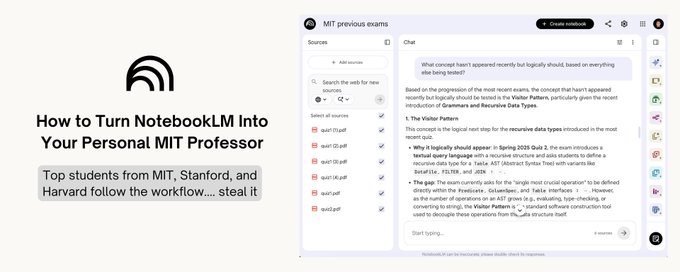
The students winning with NotebookLM are not using it the way you think.
They are not summarizing textbooks. They are not generating flashcards. They are not making podcast versions of their reading.
They are running it as a Socratic tutor, a research advisor, and a synthesis engine simultaneously, and it costs them nothing.
I spent the last 6 months reverse engineering what these students are actually doing differently. The system underneath it is shockingly repeatable, and almost nobody outside a small circle of self-taught learners has figured it out yet.
Here is exactly how it works.
Most people upload a textbook and ask it to summarize chapters.
That is the equivalent of buying a Ferrari and using it to deliver pizza.
NotebookLM is not a summarization tool. It is a synthesis engine. It can hold dozens of sources in context simultaneously and answer questions across all of them at once. The students winning with it understand one thing the rest of us missed: the point is not to compress information. The point is to make information argue with itself until something new comes out.
Once you internalize that, every prompt you write changes.
Step 1: Build the curriculum before you start learning
This is the move that changes everything.
Most students learn linearly. They open the textbook on page one and grind through to page 800. The good students do the same thing but with better notes. The result is the same. They retain almost nothing six months later because the brain stores connections, not pages.
The students winning with NotebookLM invert the entire process.
Before they open a single book, they build the curriculum they want to learn from.
For every subject (calculus, physics, chemistry, computer science, history of science) they upload into a single NotebookLM notebook:
- The most-recommended textbook in the field
- Two alternative textbooks that disagree with the first one
- 5 to 10 foundational papers in the subject
- 3 to 5 lecture transcripts from MIT OCW or Stanford Online
- Any Wikipedia deep-dive on the topic
- 1 or 2 popular books written for non-specialists
That is roughly 15 to 20 sources per notebook.
Then they run this prompt:
---
Across every source I have uploaded, identify the 12 core concepts a beginner needs to understand before anything else in this field makes sense. For each concept:
1. Explain it as if I am intelligent but new to the field
2. List which sources cover it best
3. List which sources contradict each other on this concept
4. Tell me the single biggest misconception people bring into this subject from the outside
Do not list more than 12. The goal is the irreducible foundation, not a comprehensive overview.
---
The output of this prompt is the syllabus.
You spend 2 to 3 hours per subject just running this one prompt and refining the output. By the end, you have a learning roadmap that no textbook would ever give you because no textbook author has the perspective of 20 sources at once.
Step 2: The Feynman prompt that builds real understanding
This is the part that does most of the work.
Once you have your 12 core concepts, you do not read about them. You explain them.
For every single concept on your syllabus, run this prompt:
---
I am about to try to explain [CONCEPT] in my own words. I will type my explanation below.
Your job is to:
1. Identify every place my explanation is technically wrong
2. Identify every place I am using the right words but missing the actual mechanism
3. Identify every place a domain expert would push back
4. Tell me the one underlying principle I have not yet grasped that would make this concept click
Do not be polite. Be precise.
Here is my explanation:
[Type your explanation from memory, no matter how rough]
---
This is the Feynman technique forced into a conversation.
Most students think they understand something because they can recognize it. NotebookLM destroys that illusion in 30 seconds. You type your explanation. It tells you exactly where the gaps are. You go back, re-read the relevant sources, and try again.
Run this loop 3 to 5 times per concept until NotebookLM has nothing left to push back on.
That is when you actually understand it.
Step 3: The contradiction prompt that makes you think like a researcher
This is the prompt that separates a student from a thinker.
After you understand a concept individually, run this:
---
Across all my uploaded sources, find every place where the authors disagree about [CONCEPT].
For each disagreement:
1. State the position of each author
2. Explain what evidence each one is using to support their position
3. Tell me which side has stronger empirical support and why
4. Tell me what question I would need to answer to settle the disagreement myself
Do not soften the disagreements. The point is to find them, not smooth them over.
---
Most students learn subjects as if they are settled.
The textbook gives one answer. They memorize it. They move on. Real fields are not like that. Every interesting subject has live disagreements at the frontier, and the ability to see those disagreements is what separates someone who knows the material from someone who can do something with it.
NotebookLM surfaces them in seconds.
The students who win at top universities are not the ones who memorized the most. They are the ones who learned to identify which arguments inside their field are still open. This prompt teaches you to do that automatically, on every subject you study, for the rest of your life.
Step 4: The teaching prompt that locks it in
The final move for every concept is this:
---
I want to teach [CONCEPT] to a curious 12-year-old who has never heard of this subject.
Generate 5 questions that 12-year-old would most likely ask me within the first 2 minutes of my explanation.
Then for each question, tell me:
1. What the most accurate but accessible answer would be
2. What analogy or example I should use
3. What follow-up confusion is most likely to come from my answer
---
The protégé effect is one of the most replicated findings in cognitive science.
Your brain encodes information dramatically more deeply when it believes it will have to teach the material to someone else. NotebookLM lets you simulate the student you never had.
By the end of every subject, you have effectively taught it 12 times.
That is why it sticks.
Step 5: The weekly synthesis ritual
This is the prompt almost nobody runs.
Every Sunday, across every notebook you built that week:
---
Across every concept I learned this week, identify:
1. The 3 strongest connections between concepts in different subjects
2. The single insight that unifies the most material
3. The one question I should be carrying into next week that would deepen my understanding of multiple subjects at once
4. Anything I learned this week that contradicts something I learned last week
Be ruthless. Most weekly reviews are useless because they list everything. I only want what compounds.
---
Most students learn subjects in silos.
Math here. Physics there. Computer science somewhere else. The students who break out of mediocrity are the ones who notice that the same idea shows up in three fields under three different names.
NotebookLM finds those connections automatically the moment you give it the right instruction.
This is the prompt that builds polymath thinking.
Run it for 6 months and the way you think changes permanently. You stop seeing subjects as separate. You start seeing the underlying patterns that show up everywhere. That is what people are talking about when they describe someone as intellectually mature. It is not knowledge. It is connection density.
What this actually teaches you
The tool is not the point.
The point is that for the first time in human history, a self-taught student anywhere in the world has access to the same intellectual infrastructure as a graduate student at MIT. Not the same teachers. The same depth of inquiry. The same ability to put 20 sources in conversation, find contradictions, force precision in their own explanations, and build understanding that compounds across subjects.
The MIT professor who would have charged $200,000 to teach you does not exist in your life.
What exists is a free notebook that does most of what that professor would have done if you ask the right prompts.
That is the actual unlock.
Most people are still using NotebookLM to summarize PDFs they will never look at again.
The students who will run the next decade are the ones who figured out it is a synthesis engine, a Socratic tutor, and a research advisor in one interface.
Open one notebook. Upload 15 sources on something you care about.
Run the first prompt.
You will understand what I mean within an hour.
What subject would you upload 20 sources on first if you tried this today?
## 相关链接
- [Ihtesham Ali](https://x.com/ihtesham2005)
- [@ihtesham2005](https://x.com/ihtesham2005)
- [29K](https://x.com/ihtesham2005/status/2050237641631871273/analytics)
- [11:35 PM · May 1, 2026](https://x.com/ihtesham2005/status/2050237641631871273)
- [29.9K Views](https://x.com/ihtesham2005/status/2050237641631871273/analytics)
- [View quotes](https://x.com/ihtesham2005/status/2050237641631871273/quotes)
---
*导出时间: 2026/5/2 23:00:38*
---
## 中文翻译
# 如何将 NotebookLM 变成你的个人 MIT 教授
**作者**: Ihtesham Ali
**日期**: 2026-05-01T15:35:19.000Z
**来源**: [https://x.com/ihtesham2005/status/2050237641631871273](https://x.com/ihtesham2005/status/2050237641631871273)
---

那些用 NotebookLM 取得胜利的学生,并没有按照你以为的方式在使用它。
他们不是在用它总结课本。不是在用它生成抽认卡。也不是在用它制作播客版的有声读物。
他们是在把它当作苏格拉底式的导师、研究顾问和综合引擎来同时运行,而且这一切对他们来说是免费的。
在过去的 6 个月里,我一直在逆向工程这些学生究竟做对了什么。这背后的系统惊人地可复制,而且除了自学圈子里的一小群人外,几乎还没人搞懂它。
这就是它具体的运作方式。
大多数人上传一本教科书,然后要求它总结章节。
这相当于买了一辆法拉利,却只用来送外卖。
NotebookLM 不是总结工具。它是一个综合引擎。它可以同时在上下文中容纳几十个来源,并跨所有来源回答问题。那些善用它的人理解了我们其余人忽略的一点:重点不在于压缩信息。而在于让信息相互“博弈”,直到产生新的见解。
一旦你内化了这一点,你写的每一个提示词都会随之改变。
第一步:在学习开始之前构建课程体系
这才是改变全局的关键操作。
大多数学生的学习是线性的。他们翻开课本第一页,然后硬啃到第 800 页。好一点的学生的学习方式也是如此,只是笔记做得更好。结果是一样的。六个月后,他们几乎什么都记不住,因为大脑存储的是连接,而不是页面。
善用 NotebookLM 的学生则彻底颠覆了整个过程。
在他们打开一本书之前,他们会先构建自己想学习的课程体系。
对于每一个学科(微积分、物理、化学、计算机科学、科学史),他们都会上传到同一个 NotebookLM 笔记本中:
- 该领域最受推荐的教科书
- 两本与第一本观点相左的替代教科书
- 5 到 10 篇该学科的基础论文
- 3 到 5 份来自 MIT OCW 或 Stanford Online 的讲座逐字稿
- 关于该主题的任何 Wikipedia 深度文章
- 1 到 2 本写给非专业人士的畅销书
这大约是每个笔记本 15 到 20 个来源。
然后,他们运行这个提示词:
---
**在我上传的所有来源中,找出一个初学者在理解该领域其他任何内容之前必须掌握的 12 个核心概念。对于每个概念:**
1. **假设我很聪明但对该领域陌生,请解释它。**
2. **列出哪些来源对它的覆盖最好。**
3. **列出哪些来源在这个概念上存在相互矛盾。**
4. **告诉我人们从外部带入该学科时最大的单一误区是什么。**
**不要列出超过 12 个。目标是建立不可精简的基础,而不是全面的概述。**
---
这个提示词的输出就是教学大纲。
你在每个学科上花费 2 到 3 小时,仅仅是为了运行这一个提示词并优化输出。到了最后,你就拥有了一份学习路线图,这是任何教科书都无法给你的,因为没有哪本教科书的作者能同时具备 20 个来源的视角。
第二步:建立真正理解的费曼提示词
这是完成大部分工作的环节。
一旦你有了你的 12 个核心概念,不要去阅读它们。要去解释它们。
对于你大纲上的每一个概念,运行这个提示词:
---
**我准备尝试用我自己的话来解释 [概念]。我将在下面输入我的解释。**
**你的任务是:**
1. **找出我解释中所有技术性错误的地方。**
2. **找出我所有用词正确但未触及实际机制的地方。**
3. **找出领域专家会反驳的所有地方。**
4. **告诉我那个我尚未掌握的、能让这个概念豁然开朗的根本原则。**
**不要客气。要精准。**
**以下是我的解释:**
[凭记忆输入你的解释,无论多么粗糙]
---
这就是被强制转化为对话形式的费曼技巧。
大多数学生以为自己理解了某事,因为他们能认出它。NotebookLM 能在 30 秒内粉碎这种幻觉。你输入你的解释。它准确地告诉你缺口在哪里。你回头重读相关来源,然后再试一次。
对每个概念运行这个循环 3 到 5 次,直到 NotebookLM 无从反驳。
那时你才是真正理解了它。
第三步:让你像研究者一样思考的矛盾提示词
这就是区分学生与思想者的提示词。
在你单独理解了一个概念后,运行这个:
---
**在我上传的所有来源中,找出作者们在 [概念] 上存在分歧的每一个地方。**
**对于每一个分歧:**
1. **陈述每位作者的立场。**
2. **解释每个人用来支持其立场的证据。**
3. **告诉我哪一方拥有更强的实证支持及其原因。**
4. **告诉我需要回答什么问题才能由我自己来平息这场分歧。**
**不要弱化这些分歧。重点在于发现它们,而不是掩盖它们。**
大多数学生学习科目时,仿佛它们都是既定定论。
教科书给一个答案。他们背下来。继续往下学。真正的领域不是那样的。每一个有趣的学科在其前沿都存在着活跃的争议,而看到这些分歧的能力,正是区分“懂材料的人”和“能用材料做点什么的人”的关键。
NotebookLM 能在几秒钟内将它们呈现出来。
在顶尖大学获胜的学生不是那些背得最多的。而是那些学会了识别自己领域内哪些论点仍有讨论空间的人。这个提示词教导你在余生中,对你学习的每一个学科都自动地做到这一点。
第四步:巩固知识的教学提示词
对于每个概念的最后一个操作是这个:
---
**我想把 [概念] 教给一个从未听说过该学科的、充满好奇心的 12 岁孩子。**
**生成 5 个这个 12 岁孩子在我的解释前两分钟内最可能问我的问题。**
**然后针对每个问题,告诉我:**
1. **最准确但易于理解的答案是什么。**
2. **我应该使用什么类比或例子。**
3. **我的回答最可能引发什么样的后续困惑。**
---
“小白鼠效应”(也就是教学相长)是认知科学中重复验证最多的发现之一。
当大脑认为它必须将材料传授给其他人时,它会对信息进行深得多的编码。NotebookLM 让你能够模拟那个你从未拥有过的学生。
在每个学科结束时,你实际上已经把它教了 12 遍了。
这就是它之所以能记住的原因。
第五步:每周综合仪式
这是几乎没人运行的提示词。
每个周日,在你本周建立的每个笔记本中运行:
---
**在我本周学习的每个概念中,找出:**
1. **不同学科概念之间最强的 3 个连接。**
2. **统一了最多内容的单一见解。**
3. **那个我该带入下周、能同时加深我对多个学科理解的问题。**
4. **我本周学到的任何与我上周所学相矛盾的内容。**
**要狠一点。大多数周回顾之所以没用,是因为它们罗列了一切。我只想要那些具有复利效应的内容。**
大多数学生在孤岛中学习学科。
数学在这里。物理在那里。计算机科学在别处。那些摆脱平庸的学生,是那些注意到同一个想法以三个不同的名字出现在三个领域的人。
NotebookLM 在你给出正确指令的那一刻,就会自动找到这些连接。
这就是构建“博学家思维”的提示词。
运行它 6 个月,你的思维方式将永久改变。你不再把学科看作分离的。你开始看到到处都在涌现的潜在模式。这就是人们形容某人“在心智上成熟”时所说的意思。它不是知识。它是连接密度。
这到底教会了你什么
工具并不是重点。
重点在于,人类历史上第一次,世界上任何地方的自学者都能获得与 MIT 研究生相同的知识基础设施。不是同样的老师。而是同样深度的探究。同样的能力,让 20 个来源相互对话,发现矛盾,强迫自己的解释做到精准,并建立跨学科复合增长的理解。
那个可能会收你 20 万美元来教你的 MIT 教授,并不存在于你的生活中。
存在的是一个免费的笔记本,只要你能提出正确的提示词,它就能完成那位教授大部分的工作。
这才是真正的解锁。
大多数人仍然在用 NotebookLM 总结那些他们再也不会看的 PDF。
未来十年将主导局面的人,是那些发现它是一个集综合引擎、苏格拉底式导师和研究顾问于一体的工具的人。
打开一个笔记本。上传 15 个关于你关心的内容的来源。
运行第一个提示词。
你会在一小时内明白我的意思。
如果你今天尝试这个,你会首先为哪个主题上传 20 个来源?
## 相关链接
- [Ihtesham Ali](https://x.com/ihtesham2005)
- [@ihtesham2005](https://x.com/ihtesham2005)
- [29K](https://x.com/ihtesham2005/status/2050237641631871273/analytics)
- [11:35 PM · May 1, 2026](https://x.com/ihtesham2005/status/2050237641631871273)
- [29.9K Views](https://x.com/ihtesham2005/status/2050237641631871273/analytics)
- [View quotes](https://x.com/ihtesham2005/status/2050237641631871273/quotes)
---
*导出时间: 2026/5/2 23:00:38*