# Hermes Agents Most Underrated Feature: AI Agents That Can Delegate
**作者**: Neo
**日期**: 2026-05-05T09:15:21.000Z
**来源**: [https://x.com/NeoAIForecast/status/2051591568696782935](https://x.com/NeoAIForecast/status/2051591568696782935)
---
Most people still use AI like a smarter search box.
They open one chat, dump in a complicated task, and hope the model can research, plan, write, debug, verify, and summarize everything inside one messy context window.
Sometimes it works.
But for serious work, this breaks down fast.
- The context gets noisy
- The reasoning gets tangled
- The assistant starts mixing roles.
And the final answer often feels like one model trying to cosplay an entire team.
Hermes Agent has a much better idea:
let the agent delegate. Not in the vague marketing sense.
In the practical sense: one parent agent can spin up focused child agents, give each one a scoped task, collect their results, and produce a cleaner final answer.
That is one of the features that makes Hermes feel less like a chatbot and more like an actual agent runtime.
## The problem: one agent becomes a bottleneck
A single AI assistant can do a lot. But complex work is rarely one task.
A real project usually contains multiple workstreams:
- research
- planning
- implementation
- debugging
- writing
- verification
- synthesis
When one assistant tries to do all of that in one uninterrupted chain, every part competes for the same context and attention.
The research pollutes the writing. The implementation details bury the strategy. The debugging logs drown out the decision-making.
The final summary becomes a compressed blur of everything that happened.
Hermes’ delegation model attacks this directly.
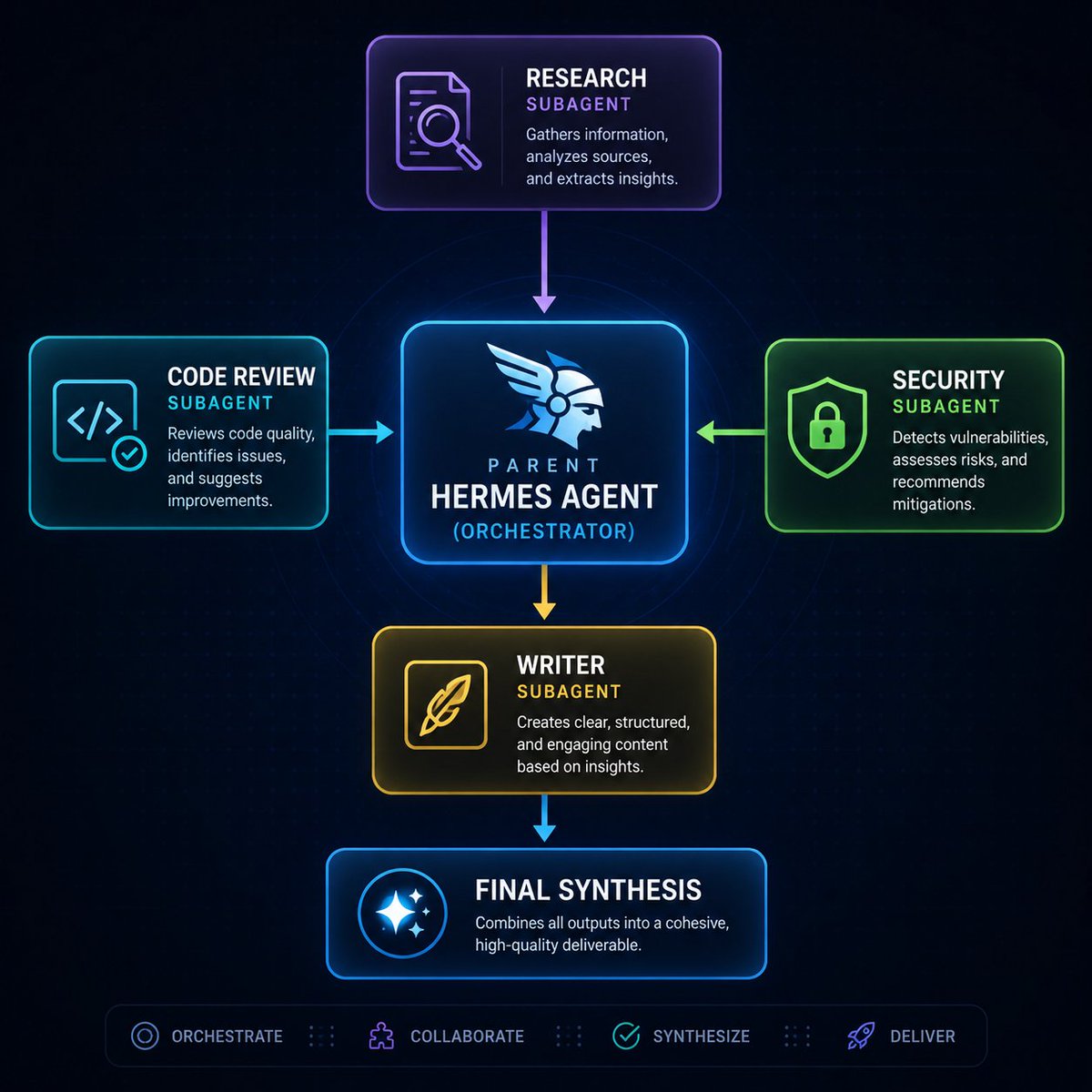
Instead of asking one agent to hold every thread at once, Hermes lets the parent agent split the problem into smaller jobs and run child agents in isolated contexts.
Takeaway: Serious agent work improves when tasks become workstreams, not one giant prompt.
## What delegation looks like in Hermes
The simplest mental model is:
Parent agent = project lead
Subagents = focused specialists
The parent decides what needs to happen. Then it can send independent tasks to child agents, such as:
- “Inspect this code path and identify likely bugs.”
- “Research the latest docs and summarize only verified changes.”
- “Review this implementation plan for missing edge cases.”
- “Compare these two approaches and recommend the safer one.”
- “Draft a concise explanation for a non-technical reader.”
Each subagent works in its own isolated context.
The parent does not need to flood its own working memory with every intermediate step. It receives the child agent’s final result, then decides what to do with it.
That is a subtle but important difference.
Hermes is not just asking one model to “think harder.”
It is giving the runtime a way to distribute cognitive load.
Takeaway: Delegation makes the main agent better because it no longer has to personally carry every detail.
## Why this feels different from normal chatbots
Most AI products are still built around a single conversational loop:
You ask > The model answers > You correct it > The model tries again.
Hermes is closer to an operating layer for agentic work.
You can use it from the terminal:
```
hermes
```
Then give it a high-level task that naturally benefits from decomposition:
```
Review this project, identify the riskiest areas, have one subagent inspect tests, another inspect security-sensitive code, and synthesize the top fixes.
```
The important part is not that Hermes can answer.
The important part is that Hermes can coordinate.
That shift matters because useful agents are not just answer generators. They are systems that can:
- decide what work should be separated
- isolate subtasks
- run focused investigations
- combine findings
- verify results
- report the final answer clearly
That is the difference between “chat with a model” and “operate an agent.”
Takeaway: Hermes feels more powerful because it turns one conversation into a managed workflow.
## The safety detail people miss
Here is the smart part:
Hermes does not treat multi-agent delegation as an unlimited free-for-all.
By default, delegation is controlled.
Child agents are typically leaf workers: they do their assigned job and report back. They are not automatically allowed to recursively spawn an infinite tree of more agents.
That matters.
Unbounded agent trees sound exciting in demos, but they can become expensive, confusing, and hard to supervise.
Hermes’ model is more operator-friendly:
- keep delegation flat by default
- isolate child-agent work
- return summarized results to the parent
- only unlock deeper orchestration intentionally
For advanced users, Hermes can support orchestrator-style children with settings like:
```
delegation:
max_spawn_depth: 2
```
And tool-level delegation can distinguish normal leaf workers from orchestrator children with a role like:
```
role="orchestrator"
```
The key point: Hermes makes deeper agent trees an explicit operator choice, not a hidden behavior.
That is exactly how agent infrastructure should work.
Takeaway: Powerful agent systems need control surfaces, not just more autonomy.
## A practical example: turn Hermes into a review team
Imagine you are working on a codebase and want a serious review.
The weak version is:
```
Review my code.
```
The better Hermes-style version is:
```
Review this branch like a small engineering team.
Use separate workstreams:
1. One subagent checks correctness and edge cases.
2. One subagent checks security-sensitive areas.
3. One subagent checks tests and coverage gaps.
4. Then synthesize the top issues into a prioritized action plan.
```
This is where delegation becomes obviously useful.
You are not just getting a longer answer.
You are getting parallel attention from isolated workers, each optimized around a narrower question.
That usually produces better outputs because each subagent can stay focused.
- No need for the security review to also narrate test strategy.
- No need for the test review to also explain product tradeoffs.
- No need for the parent agent to drown in raw inspection details.
The final answer can be cleaner because the work underneath was cleaner.
Takeaway: delegation is not about making AI sound more impressive. It is about making complex work easier to supervise.
## The save-worthy framework: when to use subagents
Use Hermes delegation when the task has separable workstreams.
A good rule:
Delegate when the task needs 2+ of these
1. Independent research
Multiple sources, docs, comparisons, or claims to verify.
2. Different expert lenses
Security, performance, UX, architecture, writing, debugging, etc.
3. Large code or document review
Too much context for one clean pass.
4. Parallel options
You want competing approaches evaluated before choosing.
5. Final synthesis
You need one polished answer after multiple investigations.
6. Lower context pollution
You want the parent agent to stay focused on decisions, not raw details.
Do not delegate just because it sounds cool.
For small tasks, one agent is enough.
For serious work, delegation gives Hermes a structure that feels closer to how real teams operate.
Takeaway: the best use of subagents is not “more agents.” It is cleaner division of labor.
## Why people will love this feature
People do not want “multi-agent systems” as a buzzword.
They want work to feel less overwhelming.
They want the agent to handle messy tasks without turning the conversation into a giant wall of half-finished reasoning.
That is why Hermes’ delegation model is so compelling.
It gives users a simple feeling:
“I can hand Hermes a complex job, and it knows how to break the job apart.”
That is the magic. Not because the agent becomes omniscient.
Because it becomes more organized. And for real work, organization often beats raw intelligence.
Takeaway: Hermes’ best feature is not that it can do more. It is that it can structure the work better.
## The bigger picture
The future of AI agents will not be one giant chatbot with a bigger context window.
It will look more like runtimes:
- memory
- skills
- tools
- schedules
- profiles
- messaging surfaces
- model routing
- subagent delegation
- operator controls
Hermes is interesting because it is already moving in that direction. Delegation is one of the clearest examples.
It shows that Hermes is not just trying to be another assistant.
It is trying to become an environment where agents can actually work.
A single chat can answer a question.
A delegated agent runtime can manage a workflow.
That is the leap. And once you feel that difference, it is hard to go back.
## 相关链接
- [Neo](https://x.com/NeoAIForecast)
- [@NeoAIForecast](https://x.com/NeoAIForecast)
- [2.8K](https://x.com/NeoAIForecast/status/2051591568696782935/analytics)
- [Upgrade to Premium](https://x.com/i/premium_sign_up)
- [5:15 PM · May 5, 2026](https://x.com/NeoAIForecast/status/2051591568696782935)
- [2,800 Views](https://x.com/NeoAIForecast/status/2051591568696782935/analytics)
---
*导出时间: 2026/5/6 00:16:12*
---
## 中文翻译
# Hermes 智能体最被低估的功能:能够委派任务的 AI 智能体
**作者**: Neo
**日期**: 2026-05-05T09:15:21.000Z
**来源**: [https://x.com/NeoAIForecast/status/2051591568696782935](https://x.com/NeoAIForecast/status/2051591568696782935)
---

大多数人仍然把 AI 当作一个更聪明的搜索引擎。
他们打开一个聊天窗口,丢进去一个复杂的任务,然后寄希望于模型能在一个杂乱的上下文窗口内完成调研、规划、写作、调试、验证和总结所有工作。
有时这招管用。
但对于严肃的工作,这种方式很快就会崩塌。
- 上下文变得嘈杂
- 推理变得纠缠不清
- 助手开始混淆角色。
最终的答案往往给人的感觉是,一个模型试图 Cosplay(扮演)整个团队。
Hermes Agent 有一个更好的主意:
让智能体去委派任务。不是那种含糊其辞的营销概念。
而是实际意义上的:一个父级智能体可以启动专注的子智能体,给每一个分配范围明确的任务,收集它们的结果,并生成一个更整洁的最终答案。
这正是让 Hermes 感觉不像是一个聊天机器人,而更像是一个真正的智能体运行时的原因之一。
## 问题所在:单一智能体成为瓶颈
一个单一的 AI 助手能做很多事。但复杂的工作很少只是一项任务。
一个真实的项目通常包含多条工作流:
- 调研
- 规划
- 实施
- 调试
- 撰写
- 验证
- 综合
当一个助手试图在一个不间断的链条中完成所有这些工作时,每个部分都在争夺同样的上下文和注意力。
调研干扰了写作。实施细节掩盖了策略。调试日志淹没了决策。
最终的总结变成了一切发生的压缩模糊版。
Hermes 的委派模式直接解决了这个问题。
Hermes 不要求一个智能体同时抓住所有线索,而是允许父级智能体将问题拆分为更小的工作,并在隔离的上下文中运行子智能体。
结论:严肃的智能体工作在任务转变为工作流(而非一个巨大的提示词)时会有所改善。
## 委派在 Hermes 中的实际表现
最简单的心理模型是:
父级智能体 = 项目主管
子智能体 = 专注的专家
父级决定需要做什么。然后它可以将独立的任务发送给子智能体,例如:
- “检查这段代码路径并识别可能的 Bug。”
- “研究最新的文档,并仅总结已验证的变更。”
- “审查这个实施计划,看是否有遗漏的边缘情况。”
- “比较这两种方法,并推荐更安全的一种。”
- “为非技术读者起草一份简明的解释。”
每个子智能体都在自己独立的上下文中工作。
父级不需要用每一个中间步骤来淹没自己的工作记忆。它接收子智能体的最终结果,然后决定如何处理。
这是一个微妙但重要的区别。
Hermes 不仅仅是要求一个模型“更努力地思考”。
它是为运行时提供了一种分配认知负荷的方法。

结论:委派让主智能体变得更好,因为它不再需要亲自承载每一个细节。
## 为什么这感觉与普通聊天机器人不同
大多数 AI 产品仍然围绕单一的对话循环构建:
你提问 > 模型回答 > 你纠正 > 模型重试。
Hermes 更像是智能体工作的操作层。
你可以通过终端使用它:
```
hermes
```
然后给它一个高层级任务,这个任务天然受益于分解:
```
审查这个项目,识别风险最高的区域,让一个子智能体检查测试,另一个检查安全敏感代码,并综合出首要修复方案。
```
重要的不是 Hermes 能回答。
重要的是 Hermes 能协调。
这种转变之所以重要,是因为有用的智能体不仅仅是答案生成器。它们是可以:
- 决定哪些工作应该被分离
- 隔离子任务
- 运行专注的调研
- 整合发现
- 验证结果
- 清晰地报告最终答案
的系统
这就是“与模型聊天”和“操作智能体”之间的区别。
结论:Hermes 感觉更强大,因为它把一场对话变成了一个受管理的工作流。
## 人们忽略的安全细节
这里有一个巧妙之处:
Hermes 并没有将多智能体委派视为一种无限制的自由放任。
默认情况下,委派是受控的。
子智能体通常是叶子节点工作者:它们完成分配的工作并汇报。它们不会被自动允许递归地生成无限的智能体树。
这很重要。
无限制的智能体树在演示中听起来令人兴奋,但在实际中可能变得昂贵、混乱且难以监管。
Hermes 的模型对操作者更友好:
- 默认保持委派结构扁平
- 隔离子智能体的工作
- 将汇总的结果返回给父级
- 仅在有意为之的情况下解锁更深层的编排
对于高级用户,Hermes 可以通过以下设置支持编排器风格的子智能体:
```
delegation:
max_spawn_depth: 2
```
并且工具级别的委派可以通过如下角色区分普通的叶子工作者和编排器子智能体:
```
role="orchestrator"
```
关键点:Hermes 让更深层的智能体树成为操作者的明确选择,而不是一种隐藏行为。
这正是智能体基础设施应有的工作方式。
结论:强大的智能体系统需要控制面,而不仅仅是更多的自主权。
## 一个实际例子:把 Hermes 变成一个审查团队
想象一下,你正在处理一个代码库,并希望进行一次严肃的审查。
弱版本是:
```
审查我的代码。
```
更好的 Hermes 风格版本是:
```
像一个小型工程团队一样审查这个分支。
使用独立的工作流:
1. 一个子智能体检查正确性和边缘情况。
2. 一个子智能体检查安全敏感区域。
3. 一个子智能体检查测试和覆盖范围缺口。
4. 然后将首要问题综合成一份优先级行动计划。
```
这就是委派变得明显有用的地方。
你得到的不仅仅是一个更长的答案。
你得到了来自隔离工作者的并行关注,每一个都针对一个更狭窄的问题进行了优化。
这通常会产生更好的输出,因为每个子智能体都能保持专注。
- 安全审查不需要旁白测试策略。
- 测试审查不需要解释产品权衡。
- 父级智能体不需要淹没在原始的检查细节中。
最终答案可以更清晰,因为底层的工作更清晰。
结论:委派不是为了为了让 AI 听起来更令人印象深刻。它是为了让复杂工作更容易监管。
## 值得保存的框架:何时使用子智能体
当任务具有可分离的工作流时,使用 Hermes 委派。
一个好的规则:
当任务需要以下 2 个以上条件时,进行委派
1. 独立调研
多个来源、文档、比较或需要验证的声明。
2. 不同的专家视角
安全、性能、用户体验(UX)、架构、写作、调试等。
3. 大型代码或文档审查
上下文太多,无法一次性干净通过。
4. 并行选项
你希望在做出决定前评估相互竞争的方法。
5. 最终综合
你需要一个经过多次打磨后的答案。
6. 降低上下文污染
你希望父级智能体专注于决策,而非原始细节。
不要仅仅因为它听起来很酷就进行委派。
对于小任务,一个智能体就够了。
对于严肃的工作,委派赋予 Hermes 一种结构,这种感觉更接近真实团队的运作方式。
结论:子智能体的最佳用途不是“更多智能体”。而是更清洁的劳动分工。
## 为什么人们会喜欢这个功能
人们不想要“多智能体系统”作为一个流行词。
他们希望工作感觉不那么让人不知所措。
他们希望智能体能处理杂乱的任务,而不把对话变成一堵半成品推理的巨大墙壁。
这就是 Hermes 的委派模式如此引人注目的原因。
它给用户一种简单的感觉:
“我可以把一件复杂的工作交给 Hermes,它知道如何把工作拆解。”
这就是魔力所在。不是因为智能体变得全知全能。
是因为它变得更有组织。而对于真实的工作,有条理往往胜过原始智力。
结论:Hermes 最好的功能不是它能做得更多。而是它能更好地构建工作结构。
## 更宏大的图景
AI 智能体的未来不会是一个拥有更大上下文窗口的巨型聊天机器人。
它看起来会更像运行时:
- 记忆
- 技能
- 工具
- 日程
- 档案
- 消息界面
- 模型路由
- 子智能体委派
- 操作员控制
Hermes 之所以有趣,是因为它已经在朝这个方向发展了。委派就是最明显的例子之一。
它表明 Hermes 不仅仅是试图成为另一个助手。
它正试图成为一个智能体可以真正工作的环境。
一个单一的聊天可以回答一个问题。
一个具有委派能力的智能体运行时可以管理工作流。
这就是飞跃。一旦你感受到了这种差异,就很难回去了。
## 相关链接
- [Neo](https://x.com/NeoAIForecast)
- [@NeoAIForecast](https://x.com/NeoAIForecast)
- [2.8K](https://x.com/NeoAIForecast/status/2051591568696782935/analytics)
- [Upgrade to Premium](https://x.com/i/premium_sign_up)
- [5:15 PM · May 5, 2026](https://x.com/NeoAIForecast/status/2051591568696782935)
- [2,800 Views](https://x.com/NeoAIForecast/status/2051591568696782935/analytics)
---
*导出时间: 2026/5/6 00:16:12*