Hermes Agent 会话管理指南 ✍ Neo🕐 2026-04-16📦 13.1 KB 🟢 已读 𝕏 文章列表 文章详细介绍了 Hermes Agent 的会话管理功能。Hermes 将对话视为持久化的会话,支持从 CLI、Telegram、Discord 等多平台恢复。文章阐述了会话作为“工作单元”的重要性,介绍了如何通过 ID 或标题恢复会话、利用分支功能探索不同路径,以及通过命名和整理习惯来优化工作流。 HermesAgent会话管理CLI工作流教程上下文恢复数据持久化 # Working With Sessions in Hermes Agent **作者**: Neo **日期**: 2026-04-15T20:35:47.000Z **来源**: [https://x.com/NeoAIForecast/status/2044515050057281808](https://x.com/NeoAIForecast/status/2044515050057281808) ---  A lot of AI tools give you a conversation. Hermes gives you a session you can actually manage. That sounds small at first, but it changes a lot. Because once sessions are persistent, searchable, renameable, resumable, exportable, and organizable, Hermes starts behaving less like a disposable chat window and more like a real working environment. If you are new to Hermes, understanding sessions is one of the fastest ways to get more value out of it. ## What a session is in Hermes In Hermes, every conversation is automatically saved as a session. That includes conversations from: - CLI - Telegram - Discord - Slack - WhatsApp - Signal - Matrix - cron jobs - API/server surfaces - other supported platforms A session is not just a transcript. It is the unit Hermes uses for continuity. It tracks things like: - the message history - the title - the source platform - model and config details - timestamps - parent session relationships when a session continues through compression That means when you come back later, Hermes is not guessing what happened before. It can resume from a real stored conversation history. Takeaway: A session is Hermes’ persistent container for a conversation, not a temporary chat tab. ## Why sessions matter Most new users treat AI chats as disposable. That works for one-off questions, but it falls apart when you are doing real work: - debugging over multiple passes - writing something over several sittings - revisiting research - managing a project thread - continuing work from one device or platform to another Sessions solve that. Instead of starting over every time, you can keep a thread alive, return to it later, organize it with a name, branch it into a new direction, and search older work when you need it. This is one of the practical differences between “chatting with a model” and “working with an agent runtime.” Takeaway: Sessions are what let Hermes support continuity instead of forcing restart-by-default behavior. ## How Hermes stores sessions Hermes tracks sessions in two complementary systems. First: SQLite database at ~/.hermes/state.db This stores the structured session data, including metadata and full-text search support. Second: JSONL transcripts under ~/.hermes/sessions/ These preserve raw conversation transcripts, including tool calls in the gateway flow. In practice, what matters for users is simple: Hermes keeps both the structure and the history. So you are not only getting a visible transcript. You are getting something Hermes can list, resume, search, filter, and manage. Takeaway: Hermes sessions are real stored objects with metadata and history, not just a UI convenience. ## How to resume sessions This is one of the first session workflows new users should learn. To continue your most recent CLI session: hermes --continue or hermes -c To resume a specific session by ID: hermes --resume 20250305_091523_a1b2c3d4 To resume by title: hermes -c "my project" This is especially useful once you start naming sessions properly. Hermes also supports lineage behavior. If your session became: - my project - my project #2 - my project #3 then: hermes -c "my project" will resume the most recent one in that line. That is a very practical feature, because it means you can think in terms of project names instead of memorizing IDs. Takeaway: For day-to-day work, resume by title is usually the cleanest session habit. ## What happens when you resume When you resume a session, Hermes reloads the prior conversation history and can show a compact recap before you continue. That recap is meant to quickly reorient you: - recent user messages - recent assistant responses - collapsed tool call summaries - truncated long content - hidden internal/system noise This matters because the resume experience is not just “open old log file.” It is designed to put you back into the working thread quickly. If you want a lighter resume display, Hermes also supports a minimal mode through config. Takeaway: Resume is built for re-entry, not just archival access. ## Why naming sessions matters If you do only one thing to improve your Hermes workflow, name your important sessions. Hermes can auto-generate titles after the first exchange, and that helps. But the real upgrade is setting intentional titles yourself. Inside a session, use: /title my research project 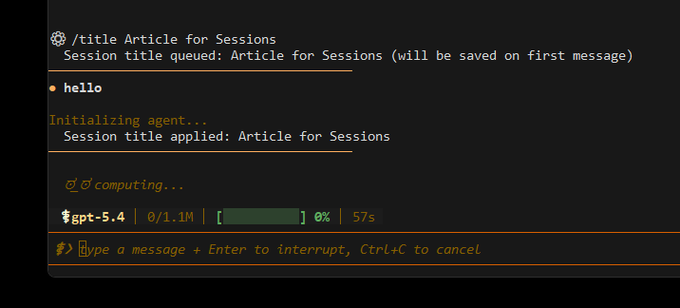 From the CLI, you can rename an existing session: hermes sessions rename 20250305_091523_a1b2c3d4 "debugging auth flow"  A good session title makes the session easier to: - resume later - distinguish from similar conversations - organize by project - search mentally before you even search technically Bad session habit: having 40 unnamed threads that all begin with “help me…” Better session habit: naming them by project, decision, or workstream. Examples: - auth migration plan - review tasks for PR - daily recap workflow - hermes sessions article draft Takeaway: Titles turn sessions from saved chats into manageable working threads. ## How to list and browse sessions Once you have more than a handful of sessions, listing and browsing becomes important. Use: hermes sessions list You can also filter by source: hermes sessions list --source telegram Or show more: hermes sessions list --limit 50 Hermes also has: hermes sessions browse  That is useful when you want a more deliberate session-picking workflow instead of remembering IDs manually. For new users, this is the practical pattern: - use sessions list when you roughly know what you want - use sessions browse when you want to inspect and choose Takeaway: Listing is for quick access. Browsing is for session management at scale. ## How to organize sessions well The simplest system is best. A good Hermes session organization strategy usually looks like this: 1. One session per real thread of work Do not pile unrelated topics into one giant conversation if you know they are separate projects. 2. Name durable threads early If the conversation will matter tomorrow, title it today. 3. Resume instead of restarting If you are continuing the same project, continue the same session. 4. Branch when you want to explore a different direction Do not wreck a clean thread just to test an alternative path. 5. Prune and export occasionally Keep your session store useful, not messy. This is less about neatness and more about keeping the agent context aligned with the work. Takeaway: Good session hygiene improves both your own recall and Hermes’ continuity. ## How branching works Branching is one of the most underappreciated session tools. Hermes includes: /branch also available as: /fork Its purpose is simple: take the current session and fork it into a new independent copy so you can explore a different path without losing the original thread. That is extremely useful when: - you want to try a different plan - you are comparing two implementations - you want a safer drafting branch - you are about to take the conversation in a very different direction Instead of mutating your main thread into a confusing hybrid, you create a branch and keep both paths clean. Takeaway: Use branch when the work is diverging, not just continuing. ## How compression affects sessions Hermes can compress context manually or automatically. When that happens, Hermes may create a continuation session in the same lineage. If the original session had a title, the follow-on sessions get numbered automatically: - my project - my project #2 - my project #3 This is important for two reasons. First, it preserves continuity without pretending the context window is infinite. Second, it keeps the lineage understandable. So if a long-running thread needs to keep going across compressed boundaries, Hermes gives you a structured continuation instead of a vague reset. Takeaway: Compression does not mean losing the thread. It means continuing it in an organized lineage. ## Best Practice for renaming sessions A few useful title rules: - titles must be unique - they are capped at 100 characters - Hermes sanitizes control characters and similar junk automatically The practical advice is: rename sessions based on the work they represent, not the first sentence you typed. Takeaway: Rename sessions around outcomes, projects, or threads of work, not random opening prompts. ## How to export sessions Sometimes you want portability, backup, or analysis. Hermes supports exporting all sessions, a filtered set, or one specific session. Examples: hermes sessions export backup.jsonl 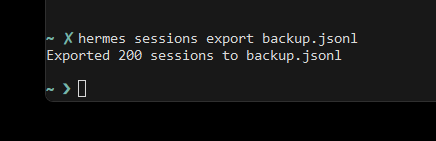 hermes sessions export telegram-history.jsonl --source telegram hermes sessions export session.jsonl --session-id 20250305_091523_a1b2c3d4 That gives you a structured record with metadata and messages. This is useful when you want to: - back up history - move data - inspect old work outside Hermes - build your own archive - preserve a project thread before cleanup Takeaway: Export is your backup and portability layer for session history. ## How to delete and prune sessions Not every session deserves to live forever. For one specific session: hermes sessions delete 20250305_091523_a1b2c3d4 For general cleanup: hermes sessions prune hermes sessions prune --older-than 30 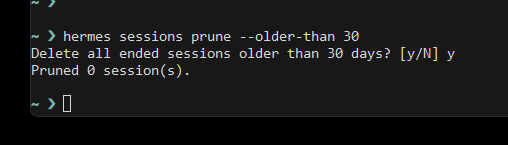 I had no older sessions than 30 days hermes sessions prune --source telegram --older-than 60 Important detail: pruning only deletes ended sessions. Active sessions are not pruned. That makes pruning safer than people often assume. The right mental model is not “delete everything old.” It is: remove stale finished threads so the session store stays manageable. Takeaway: Pruning is maintenance, not destruction. Use it to keep your session history useful. ## How to inspect session health at a high level Hermes also gives you: hermes sessions stats 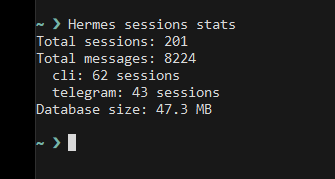 That helps you understand things like: - total sessions - total messages - source breakdown - database size This is especially useful once Hermes becomes part of your daily workflow and you want to understand how much history is accumulating. If you want deeper usage patterns, Hermes has separate insights tooling, but sessions stats is the first health check. Takeaway: Stats helps you understand the shape of your session history before it becomes invisible clutter. ## Sessions vs session_search New users often confuse these. A session is the stored conversation itself. session_search is the retrieval layer that helps Hermes look back across past conversations. So: - sessions are the underlying stored threads - session_search is how Hermes finds relevant prior threads when needed That distinction matters because good session organization improves both your manual workflow and Hermes’ ability to retrieve useful past context later. Takeaway: Sessions are the archive. session_search is the recall mechanism. ## What new Hermes users should do first If you are just starting with Hermes, these are the session habits worth building immediately: 1. Resume ongoing work instead of starting fresh every time Use: hermes -c or hermes -c "project name" 2. Name important sessions early Use: /title my project 3. Use one session per meaningful workstream Do not mix unrelated tasks into one endless thread. 4. Branch when exploring alternatives Use: /branch 5. List and prune occasionally Use: hermes sessions list hermes sessions prune These five habits alone make Hermes feel much more coherent over time. Takeaway: Session discipline is one of the easiest ways to make Hermes more useful without changing any model settings. ## Final takeaway If skills explain how Hermes stores reusable procedures, sessions explain how Hermes stores continuity. They are the working memory structure that lets Hermes act like an environment you return to, not a blank page you reopen. For a new user, learning how to create, name, resume, branch, export, prune, and organize sessions is not optional side knowledge. It is one of the core operational habits that makes Hermes feel powerful. ## 相关链接 - [Neo](https://x.com/NeoAIForecast) - [@NeoAIForecast](https://x.com/NeoAIForecast) - [21K](https://x.com/NeoAIForecast/status/2044515050057281808/analytics) - [Upgrade to Premium](https://x.com/i/premium_sign_up) - [4:35 AM · Apr 16, 2026](https://x.com/NeoAIForecast/status/2044515050057281808) - [21.4K Views](https://x.com/NeoAIForecast/status/2044515050057281808/analytics) - [View quotes](https://x.com/NeoAIForecast/status/2044515050057281808/quotes) --- *导出时间: 2026/4/16 17:07:10*
多 多模型整合指南:用 Hermes Desktop 统一管理 ChatGPT、Grok 与 DeepSeek 本文介绍如何使用 Hermes Desktop 将 ChatGPT、Grok、DeepSeek 和 MiniMax 等多个 AI 模型接入同一个桌面应用。文章详细讲解了通过图形界面一键配置模型账号、连接 Telegram/Discord 消息通道、以及设置 10 个实用的自动化工作流(如每日简报、竞品监控)的步骤,旨在无需编程即可实现多模型协同与自动化任务处理。 技术 › Hermes ✍ Wei🕐 2026-07-03 HermesAgentDeepSeekChatGPTGrok工作流教程自动化工具与效率多模型
零 零成本打造全模态 AI 工作流指南 本文介绍了如何利用 Agnes 平台的免费 API 和 Hermes Agent,零成本构建支持文本、图像和视频生成的全模态 AI 工作流。文章详细讲解了从部署环境、配置模型到自定义生图 Skill 的全过程,并展示了批量生成绘本等实际应用场景,验证了免费模型在高质量任务中的可用性。 技术 › Hermes ✍ AFei Liang🕐 2026-06-18 AI免费API全模态HermesAgnesAgent教程生图工作流
H Hermes Agent 入门指南:模型选择与 Skill 配置实战 本文是 Hermes Agent 的新手入门教程,通过 PPT 生成的实战对比测试,深入解析了“模型能力”与“Skill 技能”之间的乘数关系。文章指出,仅靠强模型或好 Skill 无法达到最佳效果,必须两者配合。作者介绍了 Ring-2.6-1T 模型在工具调用和多步规划上的优势,并强调了在使用 Hermes Agent 时“先规划(Plan)、后执行”的重要性。 技术 › Skill ✍ Lonely🕐 2026-05-18 HermesAgentLLM教程模型评测实战技巧Ring模型PPT生成工作流工具推荐
H Hermes Agent Masterclass: 安装、配置与基础命令 本文介绍了开源 AI Agent Hermes 的安装与基础配置。Hermes 由 Nous Research 开发,支持多种模型和终端运行,具有会话复用和技能积累的独特设计。文章详细讲解了在 Windows、macOS 和 Linux 上的安装步骤、设置向导流程以及如何配置推理提供商。 技术 › Agent ✍ tonbi🕐 2026-07-29 HermesAgentAI安装教程CLI工具与效率开源
G Graph Engineering:从 0 到 1 小白完整教程 文章介绍了 Graph Engineering,一种通过流程图协调多个 AI 协作完成复杂任务的方法。它将复杂任务拆解为节点、边和状态,解决了单 Loop 应对复杂任务时的局限性。文章详细解析了 Graph 的核心概念、与 Loop 的关系、四个核心模块及具体实践模板,并提供了新手学习路径。 技术 › Agent ✍ Adrian Punk🕐 2026-07-27 Graph EngineeringAgentLLMAI 协作工作流Loop Engineering教程节点设计状态管理AI 架构
构 构建超越单一模型的持久 AI 系统 文章指出,模型只是可随时替换的引擎,真正的价值在于构建围绕模型的系统。作者介绍了利用 Hermes 工具从简单的问答、一次性任务,进化到生成可共享的产物、封装可复用的技能,最终形成自动化运行的循环系统,以实现 AI 效用的复利增长。 技术 › Hermes ✍ ericosiu🕐 2026-07-25 AI系统HermesSkillAgent工作流自动化技能封装
M Miora从0到1小白教程 本文详细介绍了腾讯推出的智能体创意工作室Miora,涵盖其核心功能、界面操作及画布编辑等基础使用方法。文章重点解析了独特的“记忆功能”,指导用户如何通过设定和沉淀个人审美与设计规范,让AI越用越懂你,从而实现从随机生图到专业设计的高效转变。 技术 › 工具与效率 ✍ Adrian Punk🕐 2026-07-24 MioraAI设计教程记忆功能腾讯生图工具工作流创意Agent画布
3 30分钟把二次元老婆/老公搬上桌面!Codex 桌宠完整教程 本文介绍了如何利用一张 IP 设定图,在 Codex 中快速生成动态桌宠。文章详细讲解了从角色准备、生成包含多种状态和视角的动画图集,到最终打包安装的全流程,探讨了将 AI 工具个人化、使其成为工作伙伴的意义。 技术 › Codex ✍ Kimberly🕐 2026-07-21 Codex桌宠AI工具教程个性化IP设定动画Hatch PetAgent工作流
H Hermes Agent 大师课程:完整指南 本文是一份关于 Hermes Agent 的 12 部分系列课程汇总,涵盖了从工作流程、学习系统、技能管理到多平台集成、浏览器控制等核心功能,详细介绍了该系统的架构设计与最佳实践。 技术 › Hermes ✍ Tony Simons🕐 2026-07-20 AgentHermesLLM教程系统架构工具集成多代理自动化
H Hermes Agent 管理层详解:Profiles、Dashboard 与 API 文章介绍了 Hermes Agent 的管理层,包括 Profiles(运行时边界)、Dashboard(控制台)和 API Server(集成点)。Profiles 允许创建独立的代理实例,Dashboard 提供可视化管理界面,API Server 则支持通过 OpenAI 兼容接口进行集成。这些工具共同管理多个代理,提升操作效率。 技术 › Hermes ✍ Tony Simons🕐 2026-07-19 AgentHermesDashboardAPIProfilesOpenAI多代理管理CLI
使 使用 Hermes Agent Blender MCP 免费构建 3D 产品模型 文章介绍了 Hermes Agent Blender MCP 工具,它能将文字描述直接转化为可编辑的 Blender 3D 场景。用户无需深入学习 Blender 的复杂节点和参数,只需描述想法,Agent 即可自动完成建模、材质、灯光和渲染。这种方式大大降低了 3D 创作门槛,特别适合产品模型快速制作。 技术 › Hermes ✍ Julian Goldie SEO🕐 2026-07-18 3D建模BlenderAgentAI设计产品渲染自动化HermesMCP创意工具工作流
生 生财有术亦仁:未来十年最大机会是Agent|新手搭建全景实战教程 本文介绍了生财有术创始人亦仁关于Agent是未来十年最大机会的观点,并提供了从零开始搭建个人AI Agent的全景实战教程。文章对比了Coze等平台工具与自建方案的优劣,详细讲解了如何利用Hermes、飞书CLI和Codex三个核心工具构建具备记忆、执行和进化能力的Agent,帮助企业与个人重构工作流。 技术 › Agent ✍ aix阿乐🕐 2026-07-17 Agent实战教程Hermes飞书CLICodex工作流AI员工开源工具方法论