# How /background turns Hermes Agent into an actual working runtime
**作者**: Neo
**日期**: 2026-04-18T09:33:31.000Z
**来源**: [https://x.com/NeoAIForecast/status/2045435546865156348](https://x.com/NeoAIForecast/status/2045435546865156348)
---

Most AI tools assume one thing:
You stop what you’re doing, wait for the model, then continue.
That works for chat.
It does not work well for real tasks.
The moment you use an agent for research, repo analysis, log review, file processing, or any longer-running job, blocking the whole session becomes a bottleneck. You either sit there waiting, open another window manually, or lose your thread while the agent works.
Hermes solves that with /background.
It is one of the most practical single features in the product because it changes Hermes from “one conversation at a time” into something closer to a working runtime that can keep doing tasks while you keep doing yours.
That sounds like a small feature until you use it. Then you realize it changes the tempo of the whole product.
Takeaway: /background is not just a convenience command. It is one of the clearest examples of Hermes behaving like a real working environment instead of a single blocking chatbot loop.
## What problem this feature solves
Most AI chat interfaces are effectively single-threaded from the user’s point of view.
You ask > The model works > You wait > Then you continue.
That pattern starts to break the moment a task takes meaningful time.
Examples:
- researching a broad topic
- scanning a repo
- analyzing logs
- organizing files
- running a longer investigation
- launching multiple independent tasks at once
Without background execution, your choices are usually clumsy:
- wait and do nothing
- interrupt your current flow
- open another session manually
- copy context between windows yourself
- forget what the first task was doing
Hermes introduces a native fix for that problem.
Instead of forcing everything through one foreground loop, it gives you a command that starts a separate background session and leaves your current session free.
That design matters because it treats time as part of the interface.
Good agent systems should not only answer. They should also work without trapping the rest of the interaction.
Takeaway: Hermes treats waiting as a workflow problem, not just a user expectation.
## What /background actually does
In Hermes, you can run a prompt in a separate background session with:
Hermes immediately confirms the task and gives you back control of the session.
Hermes will show output like:
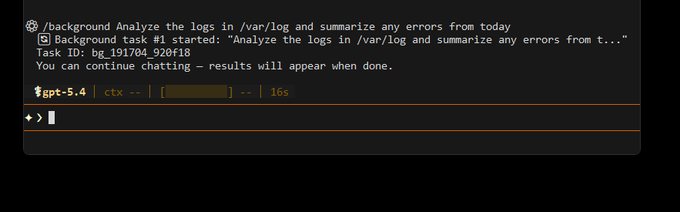
That is the key behavior.
Hermes does not force you to wait for the result before continuing your conversation. Your foreground session stays interactive while the task runs separately.
On messaging surfaces, the same command exists there too:
And when the task finishes, the result is delivered back into the same chat.
That makes /background a cross-surface feature, not just a terminal shortcut.
Takeaway: Hermes treats background execution as a first-class capability across both CLI and messaging.
## How it works in Hermes
In the CLI, each /background prompt spawns a completely separate agent session in a daemon thread.
The behavior includes four important properties:
- Isolated conversation - the background agent does not know your current session history
- Same configuration - it inherits your model, provider, toolsets, reasoning settings, and fallback model
- Non-blocking - your foreground session stays fully interactive
- Multiple tasks - you can run several background jobs simultaneously
This is the same basic model in similar terms: each /background prompt spawns a separate agent instance that runs asynchronously.
That is an important distinction.
Hermes is not merely queuing a follow-up inside the same chat loop. It is starting another working unit.
So the right mental model is not:
> Hermes will remember to do this later in the same thread.
It is:
> Hermes starts another agent session to handle that task while this one remains free.
That is a much more useful abstraction.
Takeaway: /background is session-based parallel work, not delayed chat continuation.
## Where /background helps most
There are several strong examples, and they point to the right usage pattern.
1. Long-running research
The CLI docs explicitly suggest prompts like:
That is a strong use case because research often takes long enough to be annoying in the foreground, but is still self-contained enough to launch in one prompt.
2. Repo-wide analysis
File processing and broad codebase inspection, like analyzing all Python files in a repo for security issues.
That is exactly the kind of task that benefits from separate execution while you keep discussing implementation details elsewhere.
3. Monitoring and infrastructure checks
That is a very Hermes-native use case because it combines:
- remote access surface
- asynchronous execution
- result delivery back to chat
4. Long builds and deployments
Long builds and deployment-style tasks. Those are almost definitionally poor fits for blocking chat loops.
5. Parallel investigations
Multiple background tasks to explore different angles simultaneously.
This is where the feature stops being merely ergonomic and starts becoming architectural.
You are not just avoiding wait time.
You are creating concurrent workstreams.
Takeaway: /background is best when a task is independent, clear, and time-consuming enough to deserve its own lane.
## How this differs from just opening another Hermes session
Someone could reasonably ask: why not just open another terminal and run Hermes again?
You can.
But /background matters because it packages that behavior into a native workflow.
Instead of:
- opening another shell
- starting a new session manually
- tracking it yourself
- checking back later manually
Hermes lets you do it inline from where you already are.
The runtime handles the session spawning, task tracking, and result return. That lower friction matters more than it sounds.
A feature becomes part of daily workflow when it is easy enough to use casually and often.
That is what /background does for parallel execution.
Takeaway: /background makes parallel work normal, not something you only do when you have time to babysit extra windows.
## A simple framework for deciding when to use /background
Here is the cleanest way to think about it.
Use the foreground when:
- you need back-and-forth interaction
- you expect to revise the task repeatedly
- the task depends heavily on current chat context
- you want close supervision
Use /background when:
- the task can be stated clearly in one prompt
- it may take a while
- it should not block your current work
- it is independent enough to run on its own
- you want multiple threads of work in parallel
That framework keeps the feature from becoming gimmicky.
/background is strongest when the task is self-contained but time-consuming.
Takeaway: If a task can run independently, Hermes gives it its own lane.
## Final takeaway
If you want one feature that shows Hermes is built for actual ongoing work, /background is a strong candidate.
It lets you:
- launch a separate agent session from inside your current session
- keep your foreground chat fully interactive
- run multiple tasks simultaneously
- get results back without manually juggling extra windows
- use the same pattern across CLI and messaging
That changes Hermes from “an assistant you wait on” into something closer to “an agent runtime that can keep working while you do other things.”
That is a meaningful shift.
The real power of /background is not that it runs tasks later. It is that it frees the rest of Hermes to stay live while work continues elsewhere.
## 相关链接
- [Neo](https://x.com/NeoAIForecast)
- [@NeoAIForecast](https://x.com/NeoAIForecast)
- [1.3K](https://x.com/NeoAIForecast/status/2045435546865156348/analytics)
- [Upgrade to Premium](https://x.com/i/premium_sign_up)
- [5:33 PM · Apr 18, 2026](https://x.com/NeoAIForecast/status/2045435546865156348)
- [1,339 Views](https://x.com/NeoAIForecast/status/2045435546865156348/analytics)
---
*导出时间: 2026/4/18 23:20:40*