# How to become "AI-Native"
**作者**: GREG ISENBERG
**日期**: 2026-05-11T14:23:53.000Z
**来源**: [https://x.com/gregisenberg/status/2053843542020063489](https://x.com/gregisenberg/status/2053843542020063489)
---
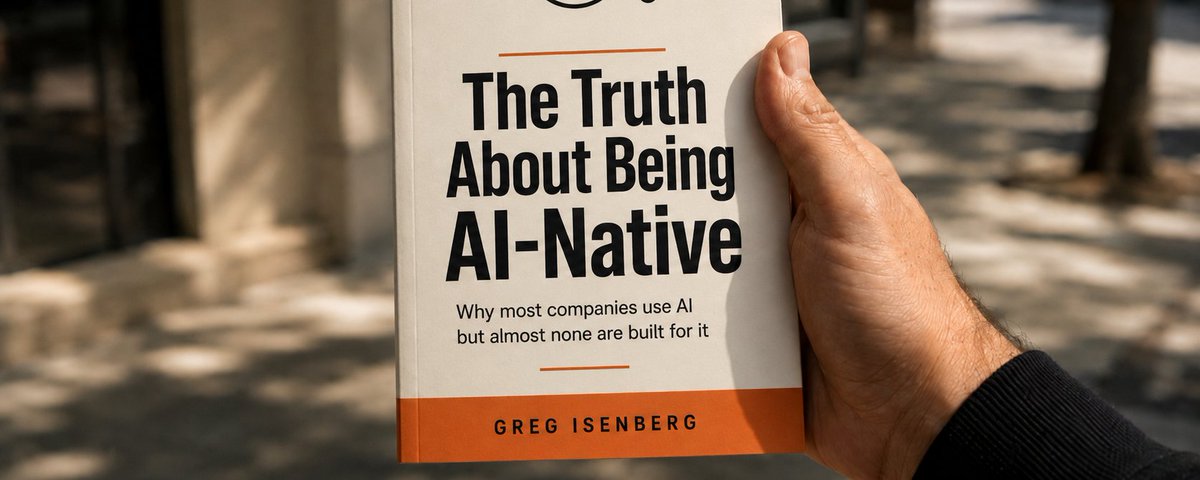
The truth about being AI native. I'll break it down.
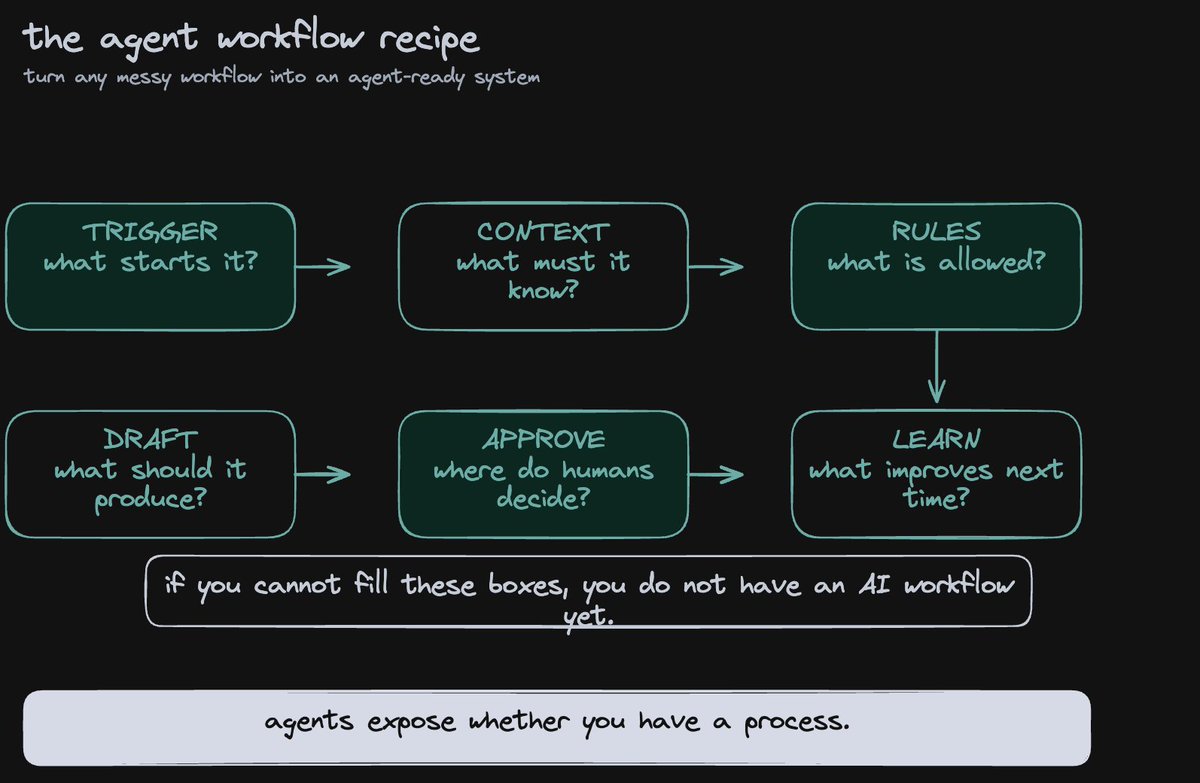
Thinking about AI workflows
Everyone is walking around saying they’re “AI-native” now, which mostly means someone on the team has a ChatGPT tab open and the head of marketing made a custom GPT called “Brand Voice Assistant.”
Cute.
Useful, even.
But not AI-native.
That’s the difference people keep missing. An AI-native company is not a company that uses AI. It is a company that has been rebuilt so AI can actually operate inside it. The business is structured, documented, permissioned, and instrumented in a way that agents can understand. The company has made itself legible to machines.
That sounds boring until you realize it might be the single biggest business advantage of the next decade.
Because most companies are not legible to machines. Most companies are barely legible to their own employees.
The CRM says one thing. The Slack thread says another. The real customer history lives in someone’s inbox. The pricing logic is in a spreadsheet called “Final_v7_NEW.” The refund policy is in a Notion doc nobody trusts. The sales process is “talk to Sarah, she knows how we do enterprise.” The onboarding flow is five tools, three humans, two approval steps, and one founder who still gets pulled into random edge cases because nobody ever turned judgment into a system.
Then these companies ask, “Why can’t AI do more for us?”
Because AI cannot run on vibes.
It can’t operate a business where the truth is scattered across people, tools, habits, exceptions, and institutional memory. Agents need context. They need clean inputs. They need rules. They need access. They need boundaries. They need to know what good looks like. They need to know when to act and when to ask.
Most companies have spent twenty years buying software, but they have not spent twenty years designing an operating system. They have a pile of tools, not a machine.
That is why the number of truly AI-native companies is probably shockingly small. My guess is there are maybe 1,000 companies on earth doing $5M+ ARR that are actually AI-native in the real sense. Not “we use copilots.” Not “we automated some emails.” I mean companies where the core workflows are designed for agents to execute and humans to supervise.
Maybe the number is 500. Maybe it’s 2,000. The exact number matters less than the conclusion.
Almost nobody is doing this yet.
Despite all the noise, despite all the funding announcements, despite every SaaS homepage being rewritten with the word “agentic,” the field is basically empty.
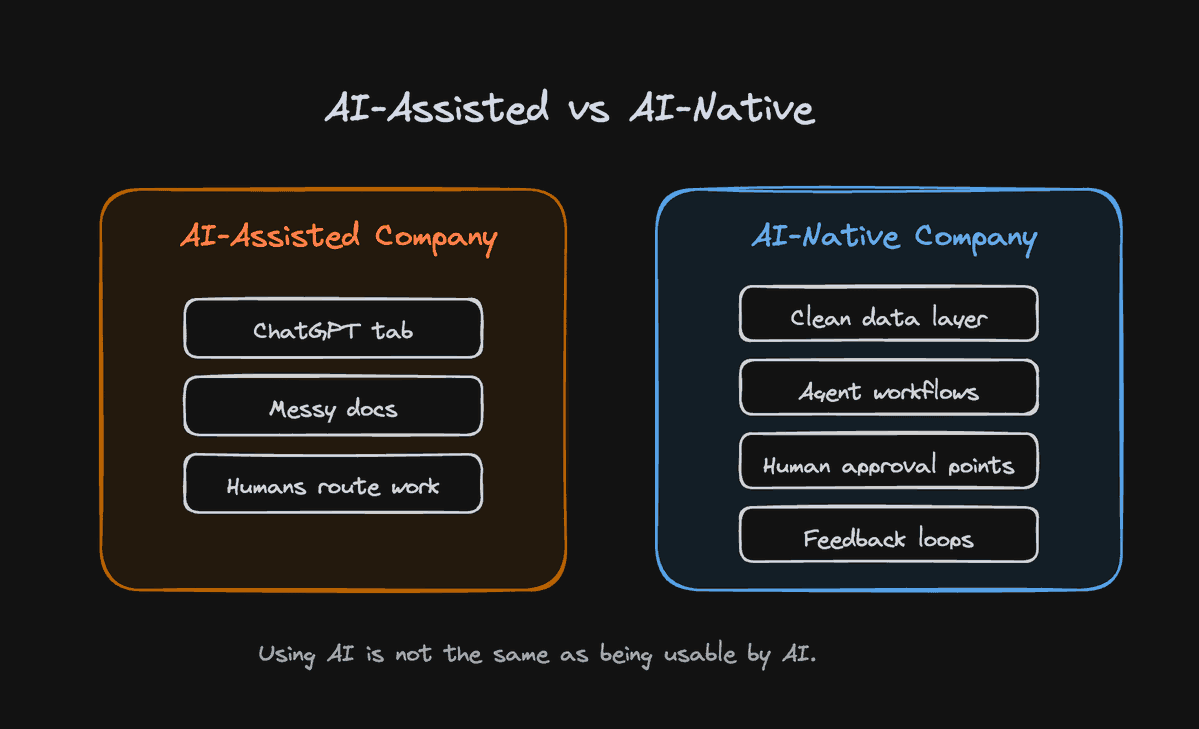
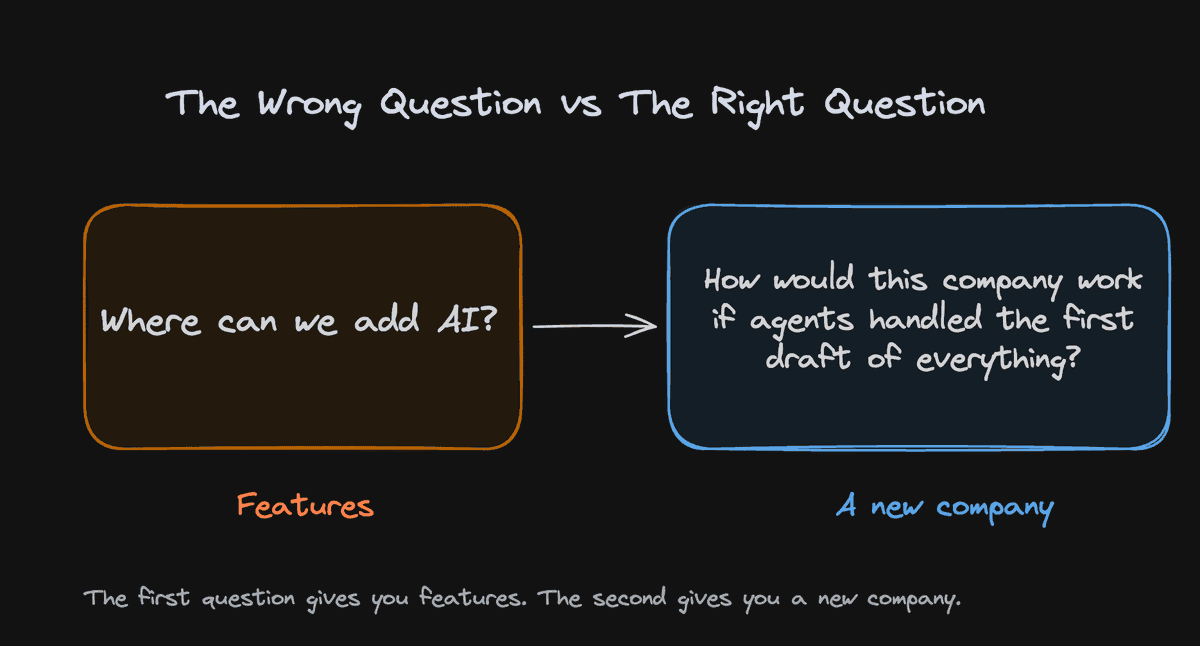
The first useful distinction is this: AI-assisted companies use AI at the edges. AI-native companies redesign the center.
An AI-assisted company asks, “Where can we add AI to save time?”
An AI-native company asks, “How should this workflow exist if agents are doing the first 80%?”
That second question changes everything.
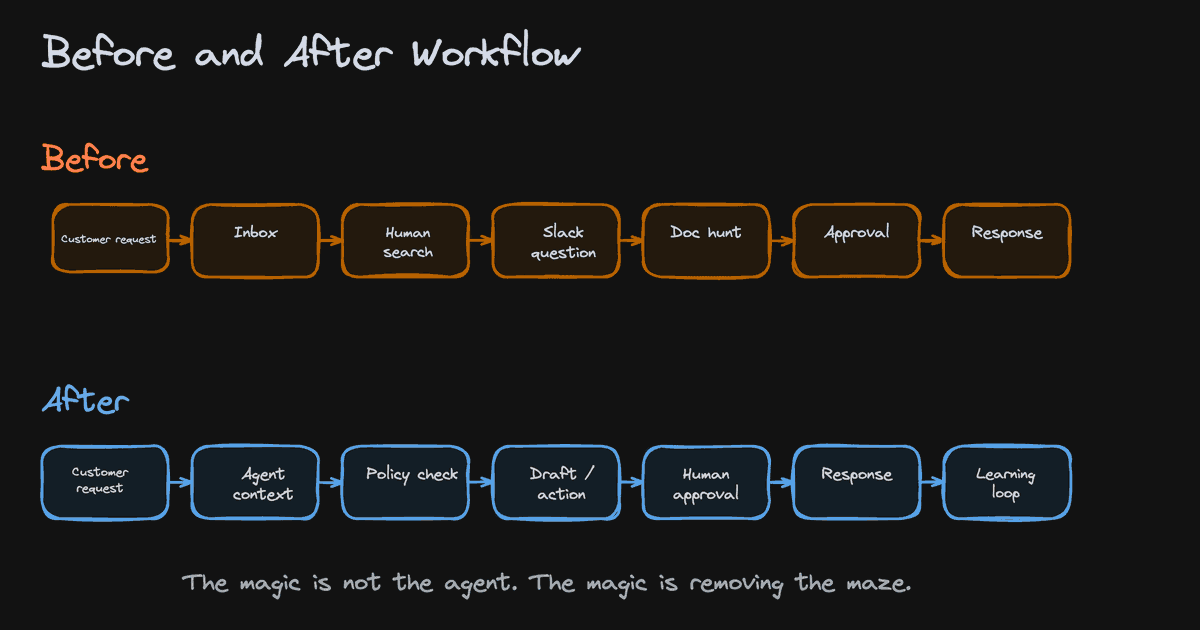
Take customer support. In a normal company, a support ticket arrives, a human reads it, searches for context, checks the account, remembers policy, writes a response, maybe asks engineering, maybe escalates, maybe forgets to tag the reason properly. It’s a human-driven process with software sprinkled around it.
In an AI-native company, the ticket enters a system an agent can understand. The agent reads the customer history, checks plan limits, reviews prior tickets, consults policy, drafts a response, recommends an action, and either resolves the issue or sends it to a human with the exact reason it needs judgment. The human is not the search engine, router, and copywriter. The human is the reviewer of ambiguity.
That is a very different company.
Now apply the same logic to sales. The old way is an SDR Googling a prospect, guessing at personalization, writing a mediocre email, updating Salesforce because their manager nags them, then passing half-context to an AE. The AI-native way is an agent that monitors buying signals, enriches accounts, maps stakeholders, drafts outreach, learns which hooks convert, updates the CRM automatically, and gives the human seller a prepared conversation instead of a blank page.
Legal is the same. Recruiting is the same. Finance is the same. Claims processing is the same. Account management is the same. Research is the same.
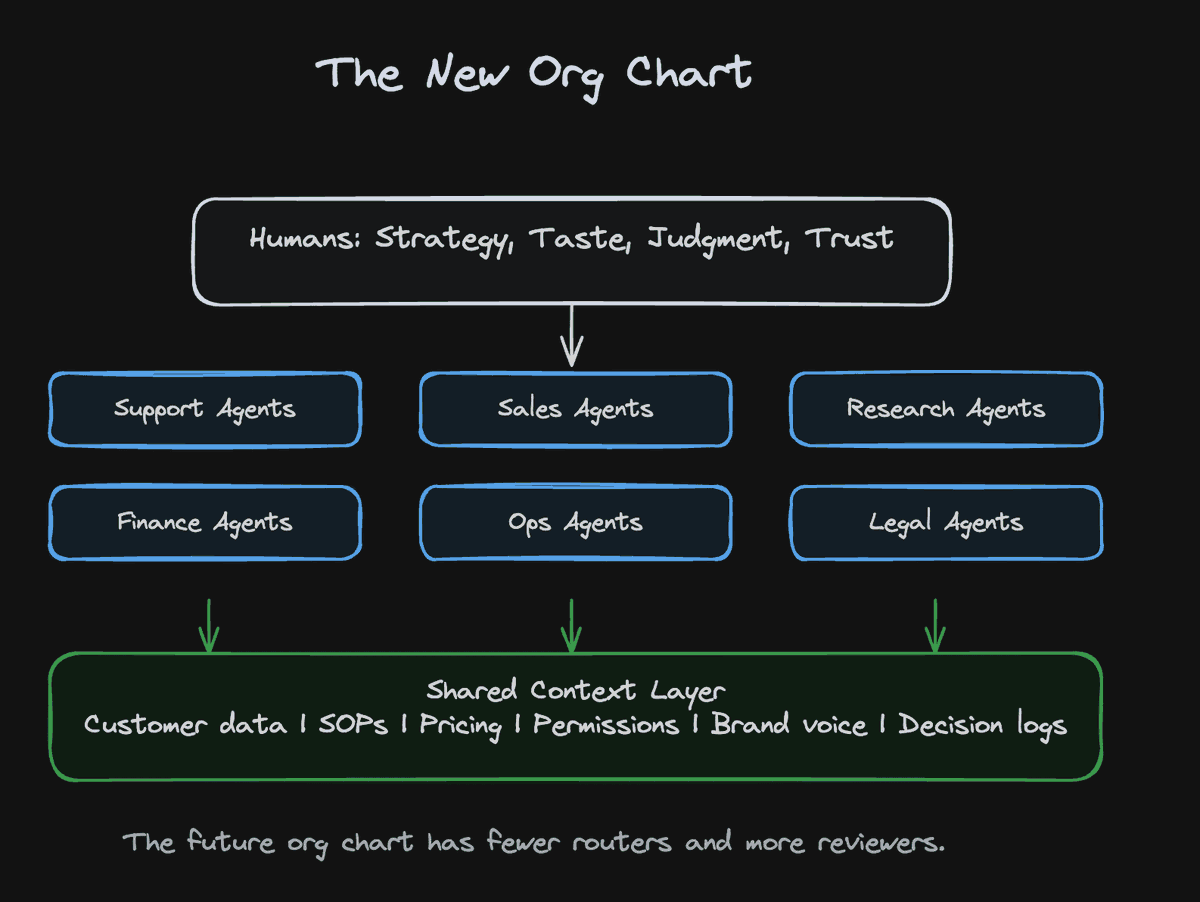
The pattern repeats everywhere: agents do the structured work, humans handle taste, trust, judgment, relationships, and exceptions.
That is not a small productivity improvement. That is a new management model.
For the last hundred years, the default way to scale a company was to hire more people, create departments, add managers, buy software, and invent processes to coordinate the mess. Every new layer solved one problem and created three more. The company got bigger, but it also got slower. More meetings. More handoffs. More “who owns this?” More internal gravity.
AI-native companies will scale differently.
They will not look like traditional companies with a chatbot bolted on. They will look like small teams operating large fleets of specialized agents. A 12-person company will do what used to require 80 people. A 40-person company will compete with a 400-person incumbent. Revenue per employee will become one of the clearest signals that a company is actually built for the new era.
This is where a lot of people get defensive. They hear “agents do the work” and assume it means humans disappear.
That’s not the point.
The better way to think about it is that modern companies have been wasting human intelligence on machine-shaped tasks. We use humans to move information between tools. We use humans to remember process. We use humans to search folders. We use humans to rewrite the same email. We use humans to chase approvals. We use humans to summarize calls, fill in fields, copy data, classify requests, and ask other humans where something lives.
A lot of work is not really “work.” It is organizational friction wearing a fake mustache.
AI-native companies strip that out.
They preserve the human parts that matter and automate the parts that only existed because software was too dumb to understand context. That means the human role becomes more leveraged, not less important. A great operator becomes the supervisor of ten workflows. A great salesperson becomes the closer of conversations agents helped create. A great support lead becomes the designer of escalation logic and customer experience quality. A great founder becomes the architect of how the company thinks.
That founder point is important.
The AI-native founder is not just building a product. They are designing a company that can be understood by agents.
That means the founder has to make the implicit explicit. What is our refund policy? When do we break it? What makes a lead qualified? What tone do we use with angry customers? What should never be automated? Which actions require approval? What is a good answer? What is a dangerous answer? Which data source is the source of truth? What do we do when two systems disagree? How does the agent learn from corrections?
This is the unsexy work that will separate real AI-native companies from LinkedIn theater.
Everyone wants the magic. Nobody wants to clean the kitchen.
But the kitchen is the company.
The companies that win will do boring, foundational things with unusual seriousness. They will clean their data. They will document their workflows. They will create agent-readable SOPs. They will build permissions and audit trails. They will structure customer records so context is not trapped in human memory. They will create evaluation loops so agents get better over time. They will turn every repeated decision into a decision system.
Then, once the operating layer is clean, they will move absurdly fast.
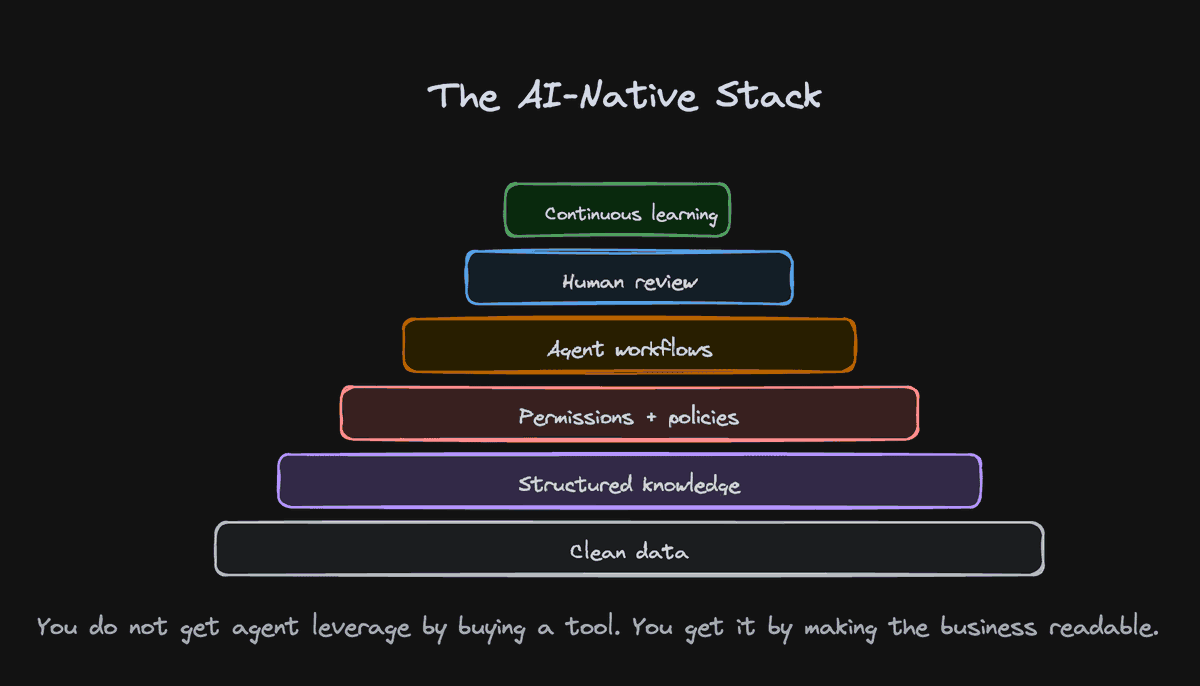
This is why “AI-native” is not really a tech label. It is an organizational label.
A company can use the best models in the world and still be structurally incapable of benefiting from them. If the agent has to guess where the truth lives, if it cannot access the right systems, if nobody has defined the decision rules, if every workflow depends on exceptions buried in someone’s head, then the AI will remain a toy. It will draft things. It will summarize things. It will make people feel faster. But it will not transform the business.
The transformation happens when agents become part of the operating fabric.
Imagine a home services company that is truly AI-native. Every inbound request is classified automatically. Every quote is generated from structured pricing rules. Every technician gets a job summary before arrival. Every customer receives proactive updates. Every review request is personalized. Every missed appointment creates an automatic recovery workflow. Every operational pattern feeds back into routing, pricing, and staffing.
Now imagine an insurance brokerage. Agents gather documents, pre-check submissions, compare policies, flag missing details, draft client explanations, prepare renewal options, and monitor accounts for changes. Humans build trust and handle complexity, but the machinery underneath is doing the repetitive intelligence work all day.
Now imagine a recruiting firm. Agents source candidates, enrich profiles, compare against role requirements, draft outreach, summarize interviews, check references, update pipelines, and alert humans when a candidate is unusually strong. The recruiter stops being a data janitor and becomes a relationship closer.
These are not sci-fi companies. These are normal businesses with the guts rebuilt.
That’s the opportunity people are underestimating. The obvious AI companies are crowded. Horizontal copilots, writing tools, meeting bots, code assistants, image generators, customer support wrappers. Fine businesses, but obvious. The less obvious opportunity is taking boring, profitable, fragmented industries and rebuilding the operating model around agents.
AI-native agencies. AI-native brokerages. AI-native law-adjacent services. AI-native accounting firms. AI-native compliance shops. AI-native healthcare admin companies. AI-native real estate operations. AI-native education services. AI-native logistics coordinators. AI-native BPOs that don’t look like BPOs.
The world is full of industries where customers pay for outcomes, but the provider’s cost structure is mostly repetitive knowledge work. That is exactly where AI-native companies can wedge in.
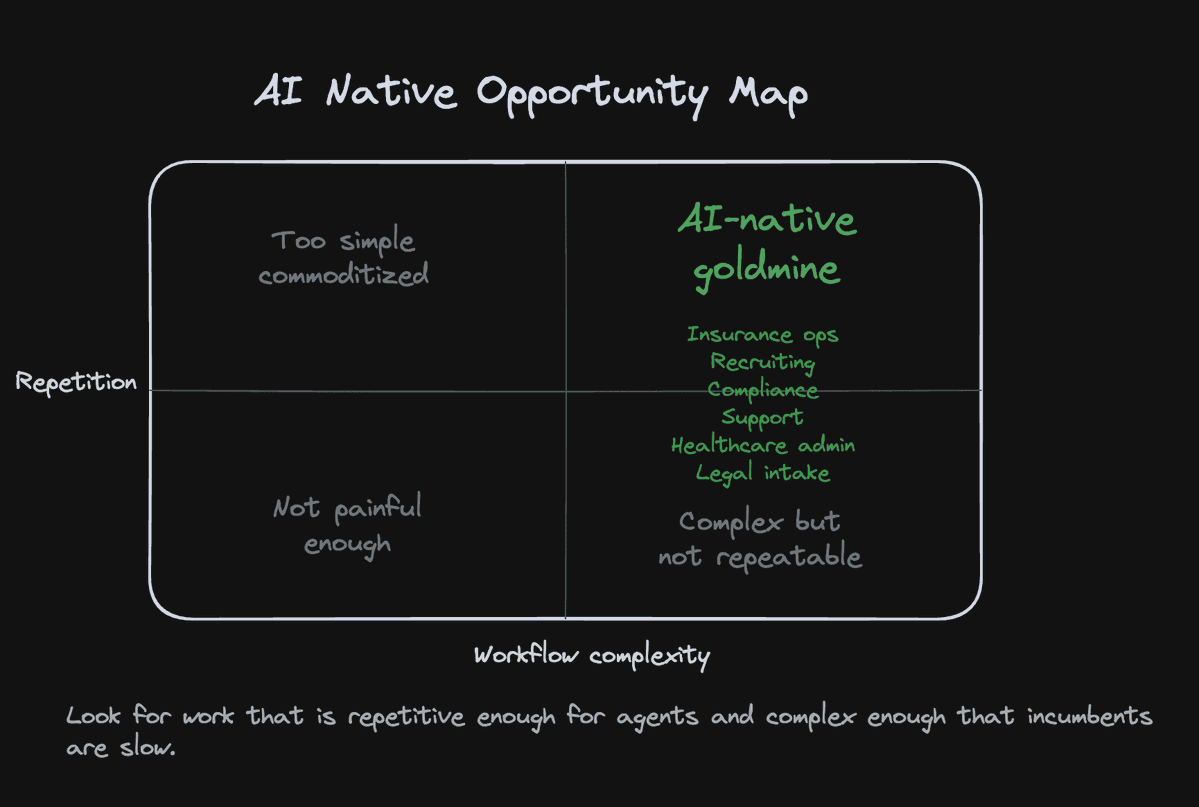
The best opportunities will not always look like software companies at first. Some will look like services businesses with software margins hiding inside. That will confuse investors and competitors, which is useful. While everyone else is looking for the next SaaS dashboard, the real winners may be quietly building AI-native service companies that produce better outcomes with dramatically lower labor intensity.
This is a very Greg thing to say, but I think the next wave of internet businesses may look less like “startups” and more like weird little money machines.
Small teams. Narrow markets. Proprietary workflows. High automation. High trust. Clear customer pain. Boring category. Beautiful margins.
Not sexy from the outside.
Extremely sexy in the bank account.
And because these companies are built differently from day one, incumbents will struggle to copy them. An old company cannot become AI-native by announcing an AI initiative. That is like trying to turn a cruise ship into a speedboat by buying a new steering wheel.
The hard part is not access to models. Everyone has that.
The hard part is that incumbents are full of old process debt. Their data is messy. Their policies conflict. Their teams protect turf. Their workflows were built around headcount. Their software stack is stitched together with duct tape and quarterly planning rituals. Their operating system assumes humans are the default processors of information.
A new company has the advantage of having no furniture to move.
It can start clean. It can build every process with the question: “Could an agent do the first pass on this?” It can document from day one. It can make every data object usable. It can design human review points before errors become disasters. It can build feedback loops before the company calcifies.
This is why the “only 1,000 companies” idea matters. It creates urgency, but it also creates permission.
The field is empty because most people are still mistaking AI adoption for AI architecture.
They think the game is prompt engineering. It’s not.
They think the game is picking the right model. It’s not.
They think the game is adding a chatbot to the website. It’s definitely not.
The game is redesigning the company so intelligence can flow through it.
There is a practical playbook here.
First, pick a narrow workflow with obvious economic value. Don’t start with “make the company AI-native.” That’s too abstract. Start with support resolution, outbound prospecting, onboarding, claims intake, document review, renewal management, or reporting. Choose a workflow where volume is high, rules exist, and humans are currently doing too much coordination.
Second, map the workflow like a machine. What triggers it? What data is needed? What decisions happen? Which decisions are reversible? Which require approval? What does success look like? Where do errors happen? What does a human know that the system does not?
Third, structure the knowledge. If the agent needs a policy, write the policy. If it needs pricing rules, make them explicit. If it needs customer history, clean the customer object. If it needs examples, create examples. If it needs tone, define tone. This is where most teams quit, because it feels like documentation. It is not documentation. It is infrastructure.
Fourth, put agents in the workflow with boundaries. Let them draft, classify, recommend, enrich, summarize, and prepare. Give them actions only where the risk is understood. Require approval where judgment matters. Log everything. Review outputs. Track quality. Improve the system.
Fifth, measure the business impact. Not “hours saved” in some fake spreadsheet. Measure resolution time, conversion rate, gross margin, revenue per employee, error rate, customer satisfaction, sales velocity, onboarding time, renewal rate. AI-native companies should show up in the numbers.
That is the part I’m most interested in. In a few years, “AI-native” will not be a vibe. It will be visible in the metrics.
Revenue per employee will look different.
Gross margins will look different.
Speed of execution will look different.
Customer experience will look different.
The best companies will feel strangely responsive, like the whole business is awake. Customers will get answers faster. Sales teams will follow up with better timing. Ops problems will surface earlier. Founders will see the business more clearly. Managers will spend less time asking for updates and more time improving the system.
The company will have less drag.
That is the real advantage.
Not AI as a party trick. AI as organizational metabolism.
So yes, there are probably only around 1,000 truly AI-native companies on earth doing meaningful revenue today.
And that should make you want to build one immediately.
Because when a market is loud, people assume it is mature. But noise is not maturity. Noise is usually what happens right before the real builders figure out what matters.
Right now, everyone is loud about AI.
Very few companies are structurally ready for it.
That is the gap.
That is the opportunity.
The next great companies will be the ones whose data, workflows, policies, and teams are rebuilt around agents from the inside out. They will look smaller than they should. They will move faster than makes sense. They will have fewer employees doing more valuable work. They will turn messy services into scalable systems. They will make incumbents look like they are running Windows 95 with a nicer login screen.
Most people are still asking, “How do I use AI at work?”
The better question is, “How do I build a company AI can work inside?”
That question is the doorway.
And right now, almost nobody has walked through it.
Despite what you read, the field is empty. Maybe consider sharing this with a friend.
I’m rooting for you.
- Greg Isenberg
Note: I don't know about it often because we're swamped, but my firm LCA is world class at helping companies go AI native. Because they do really good work. We work with Fortune 500s and your favorite brands on building AI native products and AI native orgs.
If your company wants to go AI native, consider contacting them up here.
And if you're looking for startup ideas, consider grabbing some validated ideas you can build with AI at Ideabrowser.com
## 相关链接
- [GREG ISENBERG](https://x.com/gregisenberg)
- [@gregisenberg](https://x.com/gregisenberg)
- [133K](https://x.com/gregisenberg/status/2053843542020063489/analytics)
- [$5M+](https://x.com/search?q=%245M%2B&src=cashtag_click)
- [Greg Isenberg](https://gregisenberg.com/)
- [LCA](https://1543b7c1.click.convertkit-mail4.com/27u6n9m9x6uoh8zozwpc3hg993d8ncghnog2w/6qheh8hlegekl2ho/aHR0cHM6Ly9sYXRlY2hlY2tvdXQuYWdlbmN5)
- [here](https://1543b7c1.click.convertkit-mail4.com/27u6n9m9x6uoh8zozwpc3hg993d8ncghnog2w/6qheh8hlegekl2ho/aHR0cHM6Ly9sYXRlY2hlY2tvdXQuYWdlbmN5)
- [Ideabrowser.com](https://ideabrowser.com/)
- [Upgrade to Premium](https://x.com/i/premium_sign_up)
- [10:23 PM · May 11, 2026](https://x.com/gregisenberg/status/2053843542020063489)
- [133.9K Views](https://x.com/gregisenberg/status/2053843542020063489/analytics)
- [View quotes](https://x.com/gregisenberg/status/2053843542020063489/quotes)
---
*导出时间: 2026/5/12 09:26:53*
---
## 中文翻译
# 如何成为“AI原住民”
**作者**: GREG ISENBERG
**日期**: 2026-05-11T14:23:53.000Z
**来源**: [https://x.com/gregisenberg/status/2053843542020063489](https://x.com/gregisenberg/status/2053843542020063489)
---

关于成为AI原住民的真相。我来拆解一下。

思考AI工作流
现在每个人都在四处说自己是“AI原住民”,这多半意味着团队里的某人开着ChatGPT标签页,而营销负责人做了一个叫“品牌语调助手”的自定义GPT。
挺可爱。
甚至有点用。
但这绝非AI原住民。
这是人们一直忽略的区别。一家AI原住民公司不是一家使用AI的公司。而是一家经过彻底重构,以便AI能真正在其中运作的公司。其业务结构、文档、权限和仪表化方式都是智能体所能理解的。这家公司让自己变得对机器“可读”。
这听起来很无聊,直到你意识到这可能是未来十年最大的商业优势。
因为大多数公司对机器来说是不可读的。大多数公司甚至对自己的员工来说都很难读懂。
CRM上是一回事。Slack讨论串里是另一回事。真正的客户历史活在某人的收件箱里。定价逻辑在一个叫“Final_v7_NEW”的电子表格里。退款政策在一份没人信任的Notion文档里。销售流程是“去跟Sarah谈谈,她知道咱们怎么搞大客户”。入职流程涉及五个工具、三个人、两个审批步骤,以及一个依然会被拉去处理随机边缘情况的创始人,因为从没有人把判断力变成系统。
然后这些公司问:“为什么AI不能为我们做更多事?”
因为AI无法靠“感觉”运行。
它无法经营一家真相散落在人员、工具、习惯、例外和组织记忆中的企业。智能体需要上下文。它们需要干净的输入。它们需要规则。它们需要权限。它们需要边界。它们需要知道“好”长什么样。它们需要知道何时行动,何时询问。
大多数公司花了二十年购买软件,但没有花二十年设计操作系统。他们拥有一堆工具,而不是一台机器。
这就是为什么真正的AI原生公司数量可能少得惊人。我的猜测是,地球上可能只有约1,000家年收入达到500万美元以上的公司,在真正意义上是AI原生的。不是“我们用了副驾驶”。不是“我们自动化了一些邮件”。我是指那些核心工作流被设计为由智能体执行、人类进行监督的公司。
也许这个数字是500。也许是2,000。确切的数字不如结论重要。
几乎还没人在做这件事。
尽管所有的喧嚣,尽管所有的融资公告,尽管每个SaaS首页都被重写并加上了“智能体”这个词,这片场地基本上是空的。

第一个有用的区别是这样的:AI辅助型公司在边缘使用AI。AI原住民公司则重新设计中心。
一家AI辅助型公司会问:“我们在哪里添加AI可以节省时间?”
一家AI原住民公司会问:“如果智能体来做前80%的工作,这个工作流应该是什么样的?”
第二个问题改变了一切。
以客户支持为例。在一家普通公司,支持工单进来,一个人去读它,搜索上下文,检查账户,回忆政策,写回复,也许问工程部,也许升级,也许忘了正确标记原因。这是一个以人为驱动的过程,上面撒了点软件。
在一家AI原住民公司,工单进入一个智能体可以理解的系统。智能体阅读客户历史,检查计划限制,查看先前的工单,查阅政策,起草回复,推荐操作,要么解决问题,要么将其发送给人类并附上确切的需要判断的理由。人类不是搜索引擎、路由器或文案。人类是模糊性的审核者。
这是一家完全不同的公司。
现在把同样的逻辑应用到销售上。老的方式是一个SDR(销售开发代表)去谷歌搜潜在客户,猜测个性化内容,写一封平庸的邮件,更新Salesforce因为经理催他们,然后把一半的上下文传给AE(客户经理)。AI原住民的方式是一个智能体监控购买信号,丰富账户信息,绘制利益相关者地图,起草外联邮件,学习哪些钩子能转化,自动更新CRM,并给人类销售者一个准备好的对话而不是一张白纸。
法律也是如此。招聘也是如此。金融也是如此。理赔处理也是如此。客户管理也是如此。研究也是如此。
这个模式到处重复:智能体做结构化的工作,人类处理品味、信任、判断、关系和例外。
这不仅仅是一个小的生产力提升。这是一种新的管理模式。
在过去的一百年里,扩展公司的默认方式是雇佣更多的人,建立部门,增加经理,购买软件,并发明流程来协调这一团乱麻。每一个新层级解决一个问题,却制造出三个新问题。公司变大了,但也变慢了。更多的会议。更多的交接。更多的“这是谁负责?”更多的内部阻力。
AI原住民公司将以不同的方式扩展。
它们看起来不会像传统公司那样在外面加个聊天机器人。它们看起来会像是操作大型专业智能体舰队的小团队。一个12人的公司将做以前需要80人做的事。一个40人的公司将与400人的老牌公司竞争。人均收入将成为一个公司真正为新时代而建的最明确信号之一。

这也是很多人开始防御的地方。他们听到“智能体做工作”就以为这意味着人类消失。
这不是重点。
思考这个问题的更好方式是,现代公司一直在机器形状的任务上浪费人类智能。我们用人类在工具之间移动信息。我们用人类记忆流程。我们用人类搜索文件夹。我们用人类重写同样的邮件。我们用人类追着审批跑。我们用人类总结通话,填写字段,复制数据,分类请求,并问其他人类某样东西在哪里。
很多工作并不是真正的“工作”。它是戴着假胡子的组织摩擦力。
AI原生公司剥离了这些。
它们保留了重要的人类部分,并自动化了那些仅仅因为软件太蠢无法理解上下文而存在的部分。这意味着人类角色变得杠杆率更高,而不是更不重要。一个伟大的运营者成为十个工作流的主管。一个伟大的销售人员成为智能体帮助创建的对话的成交者。一个伟大的支持负责人成为升级逻辑和客户体验质量的设计者。一个伟大的创始人成为公司思考方式的架构师。
那个创始人观点很重要。
AI原生创始人不仅仅是在构建产品。他们正在设计一家能被智能体理解的公司。
这意味着创始人必须把隐性的东西显性化。我们的退款政策是什么?我们什么时候打破它?什么让一个线索变得合格?我们对愤怒的客户使用什么语调?什么永远不应该被自动化?哪些操作需要批准?什么是好的答案?什么是危险的答案?哪个数据源是真相来源?当两个系统冲突时我们怎么做?智能体如何从纠正中学习?
这就是那些无聊的工作,它将把真正的AI原生公司与领英上的作秀区分开来。
每个人都想要魔法。没人想打扫厨房。
但厨房就是公司。
获胜的公司将以不同寻常的严肃态度去做无聊的基础性工作。它们将清理数据。它们将记录工作流。它们将创建智能体可读的SOP(标准作业程序)。它们将建立权限和审计追踪。它们将构建客户记录,使上下文不会被困在人类的记忆中。它们将创建评估循环,以便智能体随着时间的推移变得更好。它们将把每一个重复的决策变成决策系统。
然后,一旦操作层干净了,它们将以荒谬的速度移动。

这就是为什么“AI原住民”并不是一个真正的技术标签。它是一个组织标签。
一家公司可以使用世界上最好的模型,但在结构上仍然无法从中受益。如果智能体必须猜测真相在哪里,如果它无法访问正确的系统,如果没有人定义决策规则,如果每个工作流都依赖于埋在某个人脑子里的例外情况,那么AI将仍然是一个玩具。它会起草东西。它会总结东西。它会让人感觉更快。但它不会改变业务。
当智能体成为运行结构的一部分时,转型才会发生。
想象一家真正的AI原生家庭服务公司。每一个入站请求都被自动分类。每一个报价都来自结构化的定价规则。每一位技术人员在到达前都会收到工作摘要。每一位客户都会收到主动更新。每一个评论请求都是个性化的。每一个错过的预约都会触发一个自动恢复工作流。每一个运营模式都会反馈到路由、定价和人员配置中。
现在想象一家保险经纪公司。智能体收集文件,预检查提交,比较政策,标记缺失细节,起草客户解释,准备续保选项,并监控账户变化。人类建立信任并处理复杂性,但底层的机械装置整天都在做重复性的智能工作。
现在想象一家招聘公司。智能体寻找候选人,丰富资料,根据角色要求进行比较,起草外联邮件,总结面试,检查推荐信,更新管道,并在候选人异常强大时向人类发出警报。招聘人员不再是数据清洁工,而变成关系的促成者。
这些不是科幻公司。这些是重新构建了内脏的普通业务。
这就是人们低估的机会。显而易见的AI公司很拥挤。横向副驾驶、写作工具、会议机器人、代码助手、图像生成器、客户支持外壳。好生意,但显而易见。不那么显而易见的机会是接管那些无聊、有利可图、分散的行业,并围绕智能体重建运营模式。
AI原生代理公司。AI原生经纪公司。AI原生法律相关服务。AI原生会计师事务所。AI原生合规店。AI原生医疗管理公司。AI原生房地产运营。AI原生教育服务。AI原生物流协调公司。看起来不像BPO的AI原生BPO。
世界上充满了这样的行业:客户为结果付费,但提供者的成本结构主要是重复性的知识工作。这正是AI原住民公司可以切入的地方。

最好的机会起初看起来并不总是像软件公司。有些看起来像是里面藏着软件利润的服务型企业。这会迷惑投资者和竞争对手,这很有用。当其他人都在寻找下一个SaaS仪表盘时,真正的赢家可能正在悄悄构建AI原生的服务公司,以更低的劳动强度产生更好的结果。
这很像Greg会说的话,但我认为下一波互联网企业可能看起来不那么像“初创公司”,而更像奇怪的小型赚钱机器。
小团队。窄市场。专有工作流。高自动化。高信任。清晰的客户痛点。无聊的类别。漂亮的利润率。
外表看起来不性感。
银行账户里非常性感。
而且因为这些公司从第一天起就构建得不同,老牌公司将难以复制它们。一家老公司不能通过宣布一个AI计划就变成AI原生的。这就像试图通过买一个新方向盘将游轮变成快艇。
难的部分不是接触模型。大家都有。
难的部分是老牌公司充满了旧流程债务。他们的数据很乱。他们的政策冲突。他们的团队保护地盘。他们的工作流是围绕人头建立的。他们的软件栈是用胶带和季度规划仪式缝合在一起的。他们的操作系统假设人类是默认的信息处理器。
新公司的优势是没有家具需要移动。
它可以从头开始。它可以用这个问题构建每个流程:“智能体能做第一遍吗?”它可以从第一天起就记录。它可以让每个数据对象都可用。它可以在错误变成灾难之前设计人类审查点。它可以在公司僵化之前建立反馈循环。
这就是为什么“只有1000家公司”这个观点很重要。它创造了紧迫感,但也创造了许可。
场地是空的,因为大多数人仍然混淆了AI采用和AI架构。
他们认为游戏是提示工程。不是。
他们认为游戏是选择正确的模型。不是。
他们认为游戏是在网站上添加聊天机器人。绝对不是。
游戏是重新设计公司,让智能可以在其中流动。

这里有一个实用的行动手册。
首先,选择一个具有明显经济价值的狭窄工作流。不要从“让公司AI原生”开始。那太抽象了。从支持解决、外联拓客、入职、理赔接收、文件审查、续保管理或报告开始。选择一个量大、规则存在、人类目前做过太多协调工作的流程。
其次,像机器一样映射工作流。什么触发它?需要什么数据?发生什么决策?哪些决策是可逆的?哪些需要批准?成功是什么样子的?错误发生在哪里?人类知道哪些系统不知道的事情?
第三,结构化知识。如果智能体需要政策,写下政策。如果它需要定价规则,让它们明确化。如果它需要客户历史,清理客户对象。如果它需要例子,创建例子。如果它需要语调,定义语调。这是大多数团队退出的地方,因为这感觉像文档工作。这不是文档工作。这是基础设施。
第四,将智能体放入具有边界的工作流中。让它们起草、分类、推荐、丰富、总结和准备。只给它们那些风险已被理解的操作权。在需要判断的地方要求批准。记录一切。审查输出。追踪质量。改进系统。
第五,衡量商业影响。不是某个假电子表格里的“节省的小时数”。衡量解决时间、转化率、毛利率、人均收入、错误率、客户满意度、销售速度、入职时间、续保率。AI原生公司应该在数字中体现出来。
这是我最感兴趣的部分。几年后,“AI原住民”将不再是一种氛围。它将在指标中可见。
人均收入看起来会不同。
毛利率看起来会不同。
执行速度看起来会不同。
客户体验看起来会不同。
最好的公司感觉起来会有奇特的响应性,就像整个业务都是醒着的。客户会更快得到答案。销售团队会以更好的时机跟进。运营问题会更早浮现。创始人会更清楚地看到业务。经理会花更少的时间询问更新,花更多的时间改进系统。
公司将拥有更少的阻力。
这才是真正的优势。
不是AI作为聚会把戏。AI作为组织的新陈代谢。

所以是的,地球上可能只有大约1,000家真正的AI原生公司如今产生了可观的收入。
并且