# VIBE MANUFACTURING IS HERE
**作者**: GREG ISENBERG
**日期**: 2026-10-04T13:25:01.000Z
**来源**: [https://x.com/gregisenberg/status/2106737353431581132](https://x.com/gregisenberg/status/2106737353431581132)
---
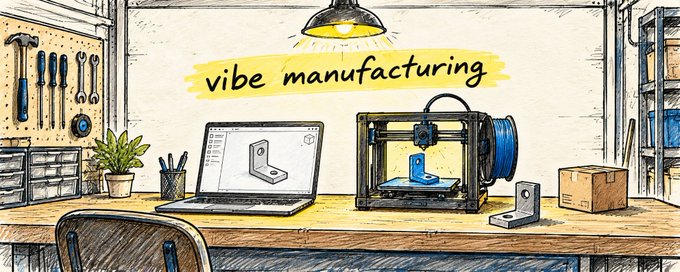
For the FIRST TIME in HISTORY, you can describe a physical product in one sentence and, a week later, hold it in your hands, cut from metal and built to your exact measurements.
That's VIBE MANUFACTURING, and it's about to do to physical products what vibe coding did to software. Maybe not today but over the next 24 months.
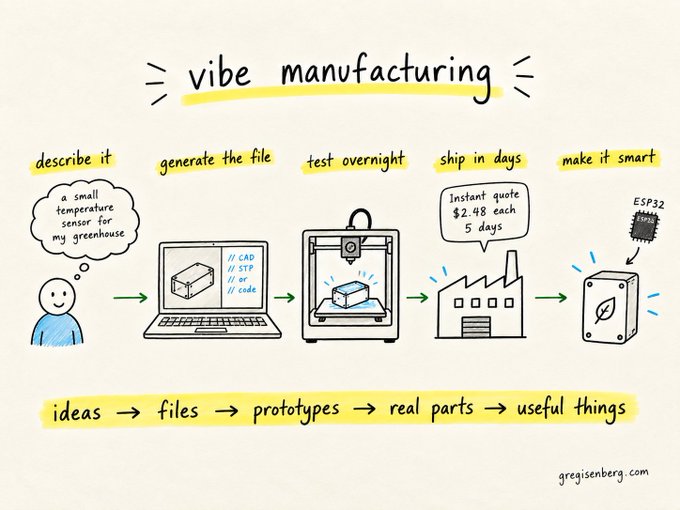
Vibe coding let people who had never written code build apps. Vibe manufacturing lets anyone make real things. You describe what you want. An AI turns it into a precise design file. A printer on your desk tests it overnight. A factory you found on a website quotes it in seconds and ships the parts in days. A $5 chip makes it smart, and your AI agent runs it.
It's already happening quietly. About 30,000 people now run a 3D printer for more than seven hours a day, according to Bambu Lab, the company that makes the most popular consumer printers in the world. That's a full-time job. They're running small factories out of spare bedrooms and garages, printing products, selling them on Etsy and TikTok Shop, and reprinting whatever sells. Bambu's design-sharing site, MakerWorld, has 10 million monthly users and 2.6 million original designs, and its users logged 290 million hours of printing in 2025. A hidden manufacturing economy is growing inside people's homes, and AI is about to pour gasoline on it.
This is the COMPLETE guide to vibe manufacturing. If you've ever wanted to make a physical product, or you're looking for the next big business opportunity in AI, it's for you. I'll cover what changed, how to make your first real product step by step, the business opportunities I'd go after, and how personal agents and things like Hugging Face fit in.
## Why hardware was so hard
There's an old line in Silicon Valley that hardware is hard, and for decades it was the truest thing anyone said. I have this line burned in my brain from so many VCs.
If you wanted to make a physical product in 2010, here's what you signed up for. You hired an industrial designer to sketch it and a mechanical engineer to turn the sketch into CAD files. You flew to Shenzhen, toured factories, and tried to figure out which ones would take a small order seriously. You paid tens of thousands of dollars for an injection mold before a single unit existed. You ordered 5,000 units because that was the minimum, stored them in a warehouse, and prayed people wanted all 5,000. If one measurement was wrong, you paid for the mold again.
The Kickstarter era cracked the door open. I remember when Pebble raised over $10 million for a smartwatch in 2012, and suddenly small teams could fund tooling with preorders. But a huge share of those projects shipped late, blew their budgets or died in the factory, because the hard parts were still hard. You still needed someone who spoke CAD, someone who understood how factories think, and a pile of cash tied up in inventory.
So hardware stayed a game for well-funded companies, and everybody else got the average product designed for the average customer.
## The four shifts that changed everything
Software went through the same thing and came out the other side. First you needed engineers. Then no code tools let non-engineers build simple little things. Then AI coding let almost anyone build almost anything. Hardware is getting its version of that moment right now, because 4 things happened at roughly the same time.
1/ Design turned into code.
There's a whole family of CAD tools, like OpenSCAD and CadQuery, where a part is written as a few lines of code instead of drawn with a mouse. A box with rounded corners and four screw holes is just a short script with numbers in it. In theory, any AI that writes code could write parts. In practice, for years the results were mostly toys.
Then OpenAI released GPT 6 Astra last month, and that was the moment a lot of people started believing AI could really do CAD (me included). OpenAI tested it on a new benchmark called BenchCAD, where the model looks at pictures of an object from several angles and has to rebuild it by writing CAD code. Astra scored 95.9%, far ahead of anything before it.
Within days, people were "vibe CADing." Someone on a FIRST Robotics forum connected Astra to Autodesk Inventor and had it design an entire robot intake in about 7 hours, gearboxes and folding linkages included. It still had gaps a human needed to fix, but a year ago that was days of work for a skilled engineer.
You can now describe a part in plain English, or show it a few photos, and get back a precise, editable design, pretty crazy.
And a wave of startups is racing to make it even easier. Zoo's Text-to-CAD turns a sentence into a real CAD file in one step. Adam, out of Y Combinator, raised a seed round last October and already has tens of thousands of users designing parts by chatting with them. Backflip, started by the founders of the 3D printer company Markforged, raised $30 million from NEA and a16z, and one of its best tricks is scan-to-CAD: point a 3D scan at a physical object and get back an editable CAD model.
It’s all early, but it’s begun.
2/ Factories turned into APIs.
Upload a design file to SendCutSend, Xometry, Protolabs or JLCPCB and you get an instant price, with no phone calls, no minimums and no relationship required. Parts usually ship within days, and you can order exactly one.
Xometry alone did $630 million of marketplace revenue in 2025, growing 30%, with about 5,000 factories and machine shops on the other side of its website. Think about what that means. There's now a cloud of factories you can rent by the part, the same way AWS lets you rent servers by the hour.
3/ Smart got cheap.
The ESP32 is a chip with wifi and Bluetooth that costs a few dollars and can run a motor, read a sensor, light an LED and talk to your phone. Twenty years ago, putting a connected computer inside a product was a project for a team of electrical engineers. Today it's a $5 part and probably 3 hours.
4/ Every home got a factory.
This is the shift people underrate. Bambu Lab made 3D printers that work out of the box, and by some estimates its sales roughly tripled last year. A $300 to $600 machine now prints parts that would have needed a professional shop a decade ago. That means you can test a design on your desk overnight, fix it in the morning and test again that night. Hardware iteration used to take months. It now runs closer to the speed of software.
I remember when I was in university (2009/2010 era), personal 3d printing was becoming a thing but it was expensive, and oh yeah, you needed so much to actually get it to print something valuable. Not in that era anymore.
Any one of these alone is interesting. All four together change who gets to make things.
## Products are turning into files
I keep thinking about this.
For all of history, a product was a physical object. The value lived in the inventory. If you made shelves, your business was the 5,000 shelves sitting in a warehouse, and your biggest risk was that nobody wanted them.
In vibe manufacturing, the product is a file. More specifically, it's a design written as code, with every important dimension stored as a variable at the top: the width, the height, the thickness, the hole spacing. Change one number and the whole design rebuilds itself. That file can produce a shelf for my wall and a slightly different shelf for yours, and neither one exists until somebody pays for it.
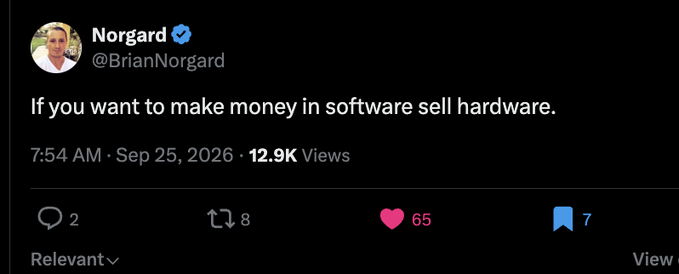
What’s really cool is it’s actually a completely different business model. Physical goods start to behave like software. The expensive part, the design, gets made once. Every copy after that is customized for free and manufactured on demand. There's no warehouse and no dead stock, and the margins start to look a lot more like a software company than a hardware company.
[https://x.com/BrianNorgard/status/2103453066372730924?s=20](https://x.com/BrianNorgard/status/2103453066372730924?s=20)
You can already see the early version of this. MakerWorld lets designers publish customizable models, where you type in your measurements and the site generates a file that fits. Large print farms offer APIs that plug into a Shopify store and print each order the moment it's placed. The pieces of a full stack, from design file to customized product to doorstep, already exist. They just haven't been stitched together for most categories yet.
The other thing that happens when products become files is that they become forkable, like open source code. The best example is Gridfinity, an opensource storage system built on a simple 42mm grid that a YouTuber named Zack Freedman released in 2022. Because the standard was open, thousands of people designed bins, tool holders and drawers that all snap into the same grid. It turned into a whole ecosystem with its own sellers, its own accessories and its own fans, built on top of one free file.
That's the pattern I'd bet on. Whoever creates a great open standard for a category gets a community that builds on top of it, and whoever makes the best products for that standard gets the customers.
## The gadgets nobody would build
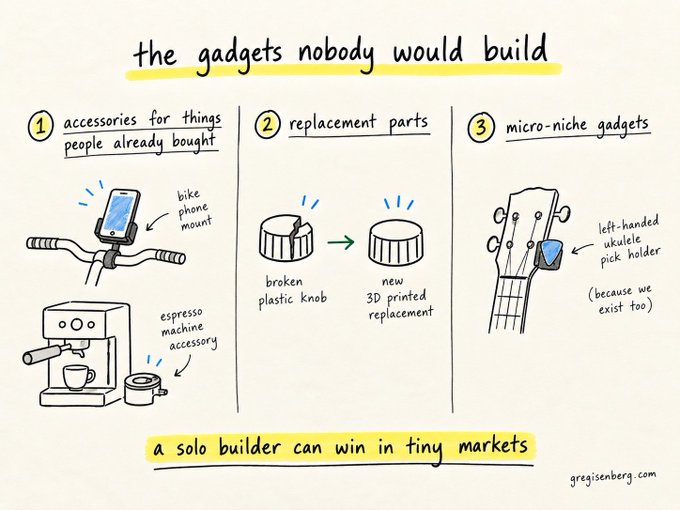
For a 100+ years, products had to be designed for the average customer, because the only way to make the math work was to make thousands of the same thing. You adjusted your house, your desk and your life to fit the product.
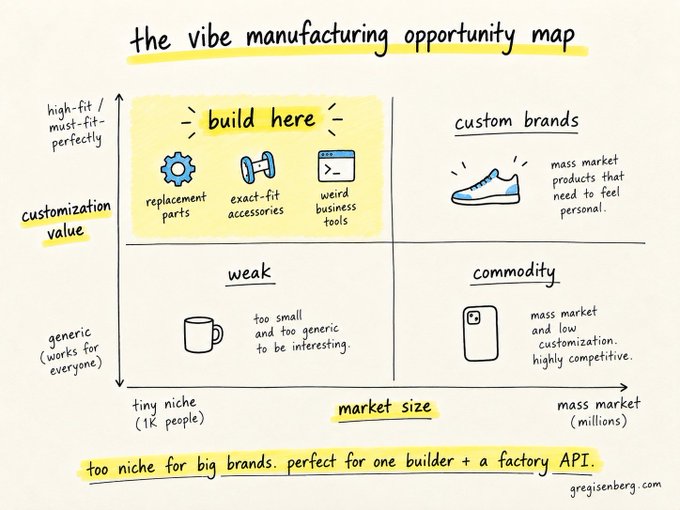
When the design is a file and the factory makes one at a time, the product can fit you instead. And that opens up a category I think of as the gadgets nobody would build. Products for a market of 500 people, or 50, or one. A big company would laugh at the market size. A solo builder can make a great living there, because a product that fits 500 people perfectly can charge whatever it wants.
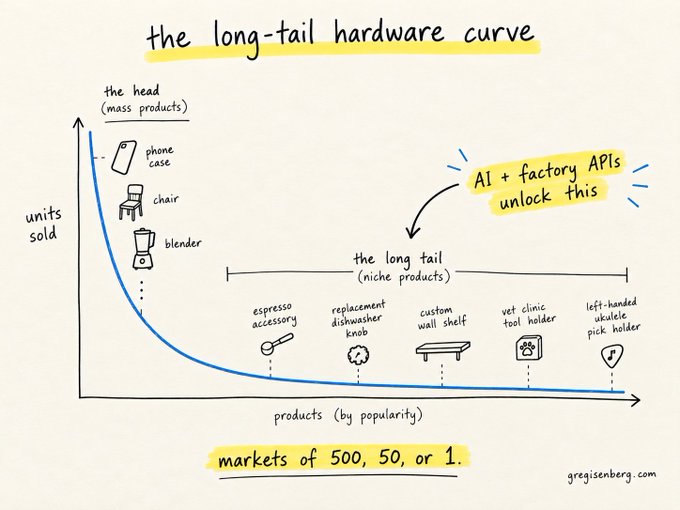
There are three places I'd look first.
1.Accessories for things people already bought. Every popular product creates a long tail of needs its maker will never address. Someone buys a specific e-bike, a specific espresso machine, a specific camper van, and immediately wants a mount, a holder, an organizer or an upgrade designed for exactly that model. The best niches are attached to something people already spent a lot of money on, because those owners are easy to find and happy to spend a little more.
2.Replacement parts. Millions of perfectly good appliances, tools and toys end up in the trash because one small plastic part snapped and the manufacturer stopped making it years ago. With scan-to-CAD, you can photograph or scan the broken piece and get a clean design back. People will happily pay $40 for a $2 part that saves a $900 dishwasher, and they're already searching for it, which means you have demand before you've made anything.
3.Weird business needs. Vet clinics, salons, restaurants, labs, gyms, boat owners and contractors all have oddly specific problems that nobody makes a product for. A mount for a tablet in one particular spot. A guard for a machine. A holder for a tool that only exists in one trade. Businesses buy faster than consumers, care less about price, and come back for more when something works.
This is exactly what happened to software. When building got cheap, people built for tiny niches, and plenty of those niches turned out to be real businesses. Physical products are about to get their long tail.
Same idea.
## Your agents need bodies
Hear me out.
We're all building personal AI agents right now. They read our email, manage our calendars, research for us and run our errands on the internet. But they live entirely inside screens. Your agent can book a dog walker and still has no idea whether the dog is in the house. It can order groceries and has no idea what's in the fridge.
Every cheap smart device you build becomes a sense or a hand for your agent. A sensor on the mailbox tells it a package arrived. A scale under the coffee canister tells it you're running low, so it reorders. A small e-ink screen by the front door shows whatever it thinks you need to know before you walk out. A lock on the side gate lets it let the dog walker in at 2pm and lock up at 2:30.
The plumbing for this is already here. Home Assistant, the open-source smart home hub, can expose every device in your house to an AI agent over MCP, the same standard agents use to talk to Gmail or Notion. Espressif, the company that makes the ESP32, launched its own agent platform last December so developers can put a voice agent with tool-calling directly onto its chips. Hobbyists are wiring up ESP32 boards that announce their abilities to an agent the moment they connect, like a new employee introducing themselves: "I can read temperature, I can open the vent, I can beep."
I think we're about to get a new design discipline: hardware built for agents first and humans second. I’ve been chatting with my design firm LCA about this but I think agent native hardware has a few traits.
1. It describes itself. When it connects, it tells the agent exactly what it can sense and do, in plain language.
2. IIt reports its state constantly. Locked or unlocked, full or empty, open or closed, so the agent always knows what's true.
3. It keeps a physical override. Agents make mistakes, so a person can always open the lock, flip the switch or pull the plug by hand.
It fails safely. When the wifi drops, the door stays usable and the heater shuts off.
The big companies will sell generic versions of these devices. The interesting ones will be custom, built for a specific home, shop or workflow by people who understand both the agent and the physical space.
## Using Hugging Face
Hugging Face is the biggest library of open AI models in the world, and it plays three very different roles in vibe manufacturing. Most people only know about the first one, and it's the one that gets them in trouble.
1. Shapes. There are text-to-3D and image-to-3D models on Hugging Face, like TRELLIS and Hunyuan3D, that turn a sentence or a photo into a 3D shape in seconds. They're fantastic for anything organic or decorative: a figurine, a sculptural lamp, a handle shaped like your logo, a custom game piece. Here's the trap. They make shapes that look right and measure wrong. What they produce is a mesh, a surface made of thousands of tiny triangles, with no exact dimensions. A factory cutting metal needs a 40mm hole to be exactly 40mm. So use the 3D models for anything people look at, and use code-based CAD for anything that has to fit.
2. Brains. Hugging Face also hosts small models that run on cheap hardware sitting inside your gadget, with nothing sent to the cloud. A small speech model like Whisper lets a device understand voice commands. A tiny vision model lets a camera tell your dog from a raccoon. There are now add-on modules for ESP32-class hardware that run a half-billion-parameter language model on about 1.5 watts, fully offline. For anything inside someone's home, "it never sends your data anywhere" is a powerful selling point, and open models make it possible.
3. Bodies. This is where it gets wild. Hugging Face bought the French robotics company Pollen Robotics in April 2025 and started releasing open-source robots, including a little desktop robot called Reachy Mini that starts around $300. Its LeRobot project gives away the software, datasets and designs for low-cost robot arms that people print and assemble at home, then teach new tasks by demonstrating them a few dozen times.
Put those three together and you can see where this goes. The same person who prints an enclosure tonight can download a vision model tomorrow and build a robot arm that sorts their screws by the weekend. Robotics is following the exact same path software did, from closed and expensive to open and cheap, and Hugging Face is trying to be the GitHub of it.
## Set up your workshop: the folder and the agents
How do you set up a little AI hardware team with agents with your agent platform of choice (Hermes, Claude Code, Cursor etc)?
Well, an AI coding agent lives inside a folder on your computer. It reads every file in it, runs code, and remembers what you've decided because everything is written down. Give it a well organized folder and it stops guessing. Here's the structure I'd use for a vibe manufacturing project:
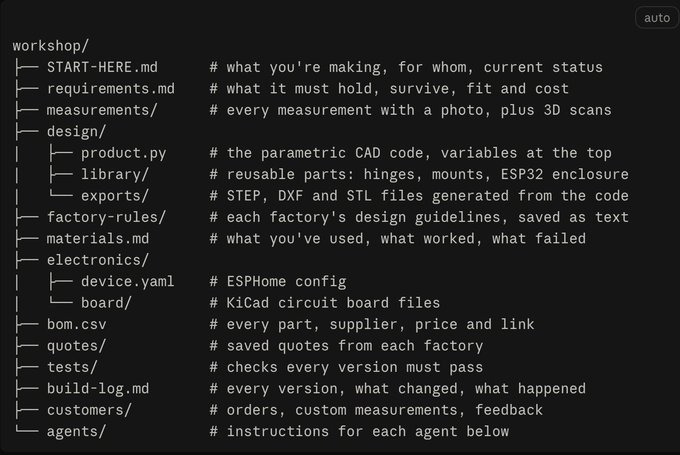
A few of these files do most of the work.
requirements.md - Write down what the product has to do in plain numbers: "holds 2kg of keys, survives a 40°C hallway in summer, mounts with two screws, costs under $35 to make." Now every design the AI produces gets checked against something real, instead of against whether it looks nice.
factory-rules/ holds the design guidelines from every factory you use, downloaded and saved as text. The AI reads them before it designs anything, so it stops drawing parts that can't be made.
materials.md is where hard lessons go. "PLA drooped in a hot car." "6061 aluminum cracked at the bend, switched to 5052." One line like that saves you from paying for the same mistake twice.
library/ is your secret weapon over time. Every hinge, mount and enclosure you get right becomes a building block. By your fifth product, the agent is mostly snapping together pieces you already know work.
tests/ is borrowed straight from software. Write checks the code can run automatically: every wall at least 2mm thick, every hole at least as wide as the metal is thick, the whole thing under 300mm wide so it fits the cheaper shipping box. Every time the design changes, the tests run, and you find problems on your screen instead of in your mailbox.
The agents:
Once the folder exists, you can split the work across a few agents, each with its own instruction file in agents/. Build them one at a time.
1/ The design agent turns requirements and measurements into parametric CAD code. The trick is to have it render pictures of the part from three angles after every change and look at its own work, the same way the best models check themselves. It catches a surprising number of its own mistakes this way.
2/ The manufacturability agent reads the design and the factory rules and returns a list of problems, each with the line of code to change and a suggested fix. Run it after every design change, the way software teams run tests before they ship.
3/ The sourcing agent gets quotes from SendCutSend, Xometry and JLCPCB, finds electronic parts on sites like DigiKey and LCSC, and keeps bom.csv up to date. It drafts orders, and a human clicks buy.
4/ The firmware agent writes the ESPHome config, connects the device to Home Assistant, and tests that every sensor and switch reports correctly before anything gets soldered.
5/ The cost agent rolls up parts, finishing, packaging and shipping into a unit cost at 1, 10, 50 and 500 units, and flags you when a design change pushes your margin below target. Most hardware businesses die because nobody was watching this number.
6/ The order agent is the one that turns this into a business. A customer enters their measurements, the agent checks them against the limits in requirements.md, generates the custom files, runs them past the manufacturability agent, and queues the order for your approval.
Every agent writes a line to build-log.md when it changes something. When a part comes back wrong, you can trace exactly which change caused it, which is the difference between a hobby and a company.
## How to build your first thing (to sell or just for yourself)
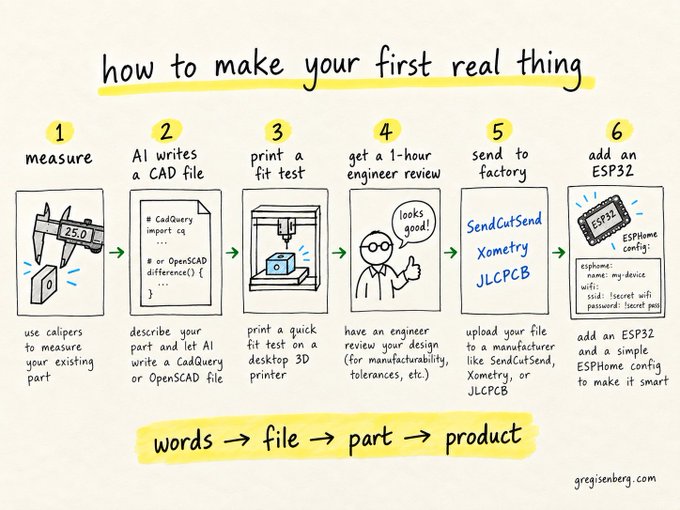
Let's make it concrete. Say you want a slim metal shelf for your entryway that holds your keys, wallet and sunglasses, fits the exact strip of wall between your door frame and light switch, and tells your agent when you walked out the door without your keys. Here's how I'd build it.
Measure like your money depends on it, because it does. Bad measurements are the number one reason first builds fail. The AI will happily design a beautiful part that's 4mm too wide, and the factory will happily cut it. Buy digital calipers for about $25 for anything small, like screw holes or the thickness of a key fob. For the wall itself, a phone LiDAR app like Polycam gives you the overall shape, and a tape measure gives you the numbers that matter. Write every measurement into one text file with a photo of where you took it, and measure the critical ones three times.
Have the AI write the design as code. Describe the part to a frontier model and ask it to write the design in CadQuery or OpenSCAD. The prompt can be as plain as this:
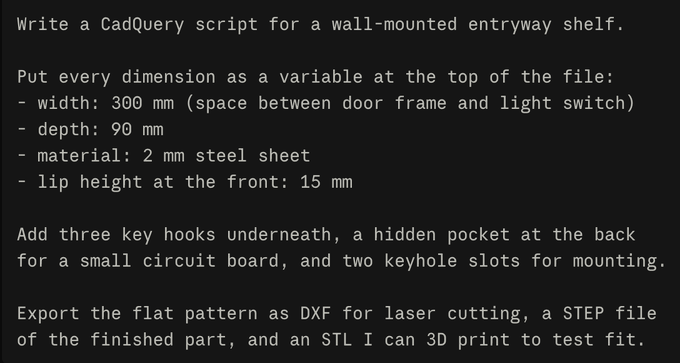
That line about putting every dimension in a variable is the most important habit in this entire guide. When a measurement is off, you change one number and everything updates. When a friend wants one for their wall, you change three numbers. That's the seed of a product.
Know which file goes where. STL is for 3D printing, a mesh made of triangles. STEP is the universal format for precise 3D parts and what you send a machine shop. DXF is a flat 2D drawing and what you send for laser-cut sheet metal. For bent parts, most sheet metal shops will take a STEP file of the finished shape and work out the flat pattern for you.
Check that it can actually be made. A design can look perfect on screen and be impossible to manufacture. Metal only bends so tightly, holes can only be so small relative to the material, and a round cutting tool can never make a perfectly sharp inside corner. The trick is that every serious factory publishes its design guidelines. Download them, paste them into the chat, and ask the AI to check your design against them line by line. It'll catch a hole sitting too close to a bend, which would tear the metal, before it costs you anything.
Print it in plastic first. Before you pay for metal, print a version on a home printer. You rarely need to print the whole thing. If the risky part is how the shelf meets the wall, print just that corner, a 40 minute print instead of a 14 hour one. Hardware people call these fit tests, and they're how you iterate five times in a day. For large flat parts, print the outline on paper at full size and tape it to the wall. It costs nothing and catches half your mistakes.
Pay an engineer for one hour. Before your first real order, find a mechanical engineer on Upwork and pay them for an hour to review the files. Ask three questions: Where will this break? What will the factory reject? What would you change to make it cheaper? It'll cost around $100 and it's the cheapest insurance you'll ever buy. One comment like "use 5052 aluminum instead of 6061, because 6061 cracks when you bend it" can save an entire order.
Send it out. Upload your files and get an instant quote. SendCutSend cuts and bends sheet metal, and can also tap threads, press in hardware and powder coat the parts in your color, so they show up looking finished. Xometry and Protolabs handle CNC machining, injection molding and industrial 3D printing in materials much stronger than anything you'll print at home. JLCPCB and PCBWay make circuit boards and will solder the components on for you. Order two sets of parts. You'll mess one up during assembly, and the spare costs less than another week of waiting.
Add the brains. Start with an ESP32 development board, a few jumper wires and a cheap sensor, like a small scale or a magnetic switch under each hook. No soldering needed for the first version. Program it with ESPHome, where instead of writing firmware you write a short config file that says "this pin reads hook one," and the AI can write that file for you. ESPHome plugs straight into Home Assistant, and Home Assistant hands it to your agent. Now you can tell your agent, "if I leave the house and my keys are still on the hook, text me."
Once it works on your desk, have the AI help you design a tidy circuit board in KiCad, the free open-source tool, and send it to JLCPCB. Two moves here save months later. Power the device from an off-the-shelf certified wall adapter that outputs low voltage, so your gadget never touches wall power directly. And use an ESP32 module that already carries FCC certification for its radio, which lets you skip a big, expensive chunk of testing.
Make one, then fix it. Your first version will be off somewhere. A screw will land on a stud, a hook will sit 3mm too low. That's normal, and it's why you make one before you make ten. Change one variable at a time, keep a short build log, and keep your design files in git like software, so you can always get back to the version that worked. By version three, it'll look like it came from a store and fit better than anything a store sells.
## The business model
Plenty of people will stop at making things for themselves, and that's a great outcome. I think that’s really cool. A home full of things built exactly for your life used to be a luxury reserved for the very rich.
But if you want to sell, the economics here are different from anything hardware founders dealt with before.
Sell before you make. Because your product is a file, you can take the order first and manufacture second. A customer types their measurements into a simple form on your site, the code generates a design that fits, they pay, and only then does anything get cut or printed. In the old world you bet everything on 5,000 units before you had a single customer. Here, every unit is sold before it exists, which means you can start with almost no cash.
Do the math before you fall in love. Add up everything: parts, finishing, electronics, your time assembling, packaging, shipping both ways, payment fees and the occasional unit that arrives bent. Most first-time builders forget at least three of those. Custom products are also hard to resell, so returns hurt more than usual. A common rule of thumb in hardware is to sell at three to five times what a unit costs you to make. Custom work can often go higher, because the customer is paying for fit, which nobody else can give them.
Sell it three ways. The finished product is the obvious one. But you can also sell a kit for people who like to assemble, and a customizable file for people who own a printer. The file has nearly 100% margins and turns your customers into a community that suggests your next product.
Let the build be the marketing. A video of a product going from a sentence to a finished metal part in a week is more compelling than any ad you could buy, and every version you make is another piece of content. The people winning at this are building in public, and their audience is often the first 100 customers.
Treat certification as a moat. If your product plugs into a wall, you'll want a safety mark like UL or ETL in the US. If it has a radio, it needs FCC approval. If it's for kids, there's a whole separate set of rules and testing, and Europe brings its own marks. It's slow, annoying and expensive, which is exactly why it's a moat. Most hobbyists will never do it, so the builders who do get access to retailers, insurers and business customers everyone else is locked out of.
Scale when demand is real. Once orders are steady and the design has stopped changing, switch to batch runs. Ordering 50 of a part instead of one at a time drops your unit cost fast, because the factory spreads its setup time across more pieces. At serious volume, plastic parts can move from printing to injection molding, where each part costs pennies. The difference from the old world is that you get there with real customers and real demand, instead of a guess.
Note: I’ll be adding more hardware startup ideas to [Ideabrowser.com](http://ideabrowser.com/) over the next 30 days.
## Where it breaks (and it goes wrong sometimes)
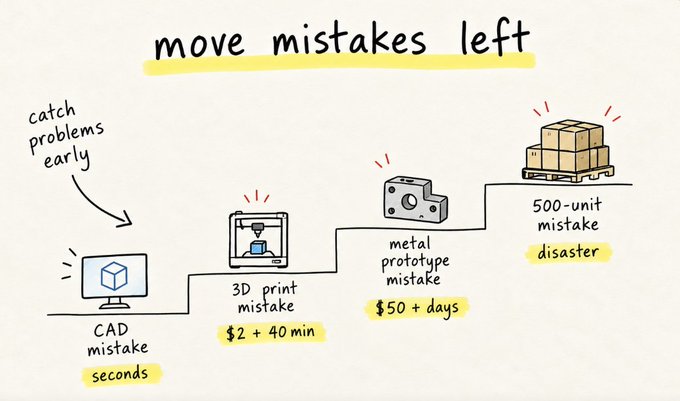
The AI is confident about physics it barely understands. It'll design a bracket that looks perfect and snaps the first time someone hangs a heavy coat on it, because it never thought about load, leverage or metal fatigue. Anything that holds weight, gets hot, spins or touches skin needs a real test and ideally a real engineer.
Materials will surprise you. The most common 3D printing plastic, PLA, starts going soft around 60°C, which means a part left on a car dashboard in July can droop into a puddle. Small errors also stack. Three parts that are each half a millimeter off can add up to an assembly that refuses to close.
Copycats are fast. If your product is a simple shape, someone will download the photo, have their own AI recreate it, and undercut you on Etsy by Friday. The defensible businesses are built on things that are hard to copy: a perfect fit for a specific product, a parametric customizer, certification, a brand people trust and a community that builds on your standard.
And liability is real. The moment you sell something that plugs into a wall, holds a child or locks a door, you're responsible for what happens when it fails. Get insurance, follow the certification rules, and design every agent-connected device so a human can always override it by hand.
Every one of these is a reason to start now and learn it properly, because the people who do will have a real edge over the flood of people printing whatever is trending.
## Where this goes
If you want to start this week, keep it small. Buy a pair of calipers. Pick one annoying thing in your house that no store sells in the right size: a shelf, a mount, a cable organizer, a holder for something you own. Have an AI write it in CadQuery, print it, fix it, then order one version in metal from SendCutSend. If you already have access to a printer, the whole thing probably costs under $100. The first time a box shows up with a part you designed from a sentence, something in your brain rewires.
Then go one step further. Grab an ESP32 board and make one thing in your house report to your agent. A door, a mailbox, a plant. Watch how much more useful your agent becomes the moment it can see the real world.
I think we'll look back on this period the way we look back on the early App Store. A small group of people noticed the tools had changed before everyone else did, and they built the first wave of products while the space was wide open.
My guess is that within a few years, a meaningful share of the things in our homes will be made for us specifically. Designed by someone who never went to engineering school, made in a factory they never visited, sold before it existed, and run by an agent that knows our routines. The big brands will keep selling the average product to everyone. The interesting stuff will come from people making things for a market of 500, or 50, or one.
Vibe coding changed who gets to build software. Vibe manufacturing is changing who gets to build everything else. And even if you only ever make things for yourself, it's one of the most fun skills you can pick up right now.
Welcome to the vibe manufacturing era.
If you want more ideas like this, I break them down every week on the podcast [@startupideaspod](https://x.com/@startupideaspod): [YouTube](https://www.youtube.com/@GregIsenberg), [Spotify](https://open.spotify.com/show/6aB0v6amo3a8hgTCjlTlvh?si=663ff716745a4b08), [Apple](https://podcasts.apple.com/us/podcast/the-startup-ideas-podcast/id1593424985).
If you want to build agentic products or looking to take your company into the AI age, speak to our design firm [LCA](https://latecheckout.agency). We are the leading product design firm for AI.
And if you want startup ideas/trends to get your creative juices flowing, check out [Ideabrowser.com](//Ideabrowser.com) (you get 1 idea/day for free, my gift to you).
DM me if I can ever be helpful. Can't respond to everyone but will respond to some!
I'm rooting for you.
[Greg Isenberg](https://gregisenberg.com)
## 相关链接
- [GREG ISENBERG](https://x.com/gregisenberg)
- [@gregisenberg](https://x.com/gregisenberg)
- [116K](https://x.com/gregisenberg/status/2106737353431581132/analytics)
- [https://x.com/BrianNorgard/status/2103453066372730924?s=20](https://x.com/BrianNorgard/status/2103453066372730924?s=20)
- [Ideabrowser.com](http://ideabrowser.com/)
- [@startupideaspod](https://x.com/@startupideaspod)
- [YouTube](https://www.youtube.com/@GregIsenberg)
- [Spotify](https://open.spotify.com/show/6aB0v6amo3a8hgTCjlTlvh?si=663ff716745a4b08)
- [Apple](https://podcasts.apple.com/us/podcast/the-startup-ideas-podcast/id1593424985)
- [LCA](https://latecheckout.agency/)
- [Ideabrowser.com](https://ideabrowser.com/)
- [Greg Isenberg](https://gregisenberg.com/)
- [Upgrade to Premium](https://x.com/i/premium_sign_up)
- [9:25 PM · Oct 4, 2026](https://x.com/gregisenberg/status/2106737353431581132)
- [116.8K Views](https://x.com/gregisenberg/status/2106737353431581132/analytics)
- [View quotes](https://x.com/gregisenberg/status/2106737353431581132/quotes)
---
*导出时间: 2026/10/5 09:48:44*
---
## 中文翻译
# 凭感觉制造时代已经来临
**作者**: GREG ISENBERG
**日期**: 2026-10-04T13:25:01.000Z
**来源**: [https://x.com/gregisenberg/status/2106737353431581132](https://x.com/gregisenberg/status/2106737353431581132)
---

历史上第一次,你可以用一句话描述一件实体产品,一周之后,就能亲手拿到它——金属切割、按你的精确尺寸打造。
这就是“凭感觉制造”,它即将对实体产品做的事,就像凭感觉编程对软件做的事一样。也许不是今天,但在未来24个月内就会发生。
凭感觉编程让从没写过代码的人也能开发应用。凭感觉制造让任何人都能制造真实的东西。你描述你想要什么,AI把它变成精确的设计文件。你桌上的打印机一夜之间完成测试。你在网站上找到的工厂几秒钟内报价,几天内发货。一颗5美元的芯片让它变智能,而你的AI智能体负责运行它。
这一切已经在悄然发生。根据全球最热门消费级打印机制造商拓竹(Bambu Lab)的数据,目前约有3万人每天运行3D打印机超过七小时。这相当于一份全职工作。他们在闲置的卧室和车库里经营着小型工厂,打印产品,在Etsy和TikTok Shop上销售,哪个好卖就补印哪个。拓竹的设计共享网站MakerWorld拥有1000万月活用户和260万个原创设计,其用户在2025年累计打印时长达到2.9亿小时。一个隐形的制造经济正在人们的家里生长,而AI即将给它浇上一桶汽油。
这是一份关于凭感觉制造的完整指南。如果你曾经想制作一件实体产品,或者你正在寻找AI领域的下一个大商业机会,这份指南就是为你准备的。我会讲讲发生了什么变化,如何一步步做出你的第一件真实产品,我会追寻哪些商业机会,以及个人智能体和Hugging Face之类的平台如何融入其中。

## 为什么硬件曾经那么难
硅谷有句老话:硬件很难。几十年来,这是人们说过的最真实的话之一。这句话已经深深刻在我的脑子里,因为太多风投这么说过。
2010年,如果你想制作一件实体产品,你要面对的是这些。你聘请工业设计师画草图,再请机械工程师把草图变成CAD文件。你飞到深圳,参观工厂,试图搞清楚哪家愿意认真对待小订单。在第一件产品诞生之前,你就为一套注塑模具支付了数万美元。你订购5000件,因为那是最低起订量,然后把它们存进仓库,祈祷人们真的需要这5000件。如果有一个尺寸错了,你就得再付一次模具钱。
Kickstarter时代撬开了一扇门。我还记得2012年Pebble为智能手表筹集了超过1000万美元,小团队突然可以用预售来支付模具费用。但其中很大一部分项目延迟发货、超出预算,或者死在工厂里,因为最难的部分依然很难。你仍然需要会CAD的人、懂工厂思维的人,以及一大笔压在库存里的现金。
所以硬件始终是资金雄厚的公司的游戏,而其他人只能拿到为“平均客户”设计的“平均产品”。
## 改变一切的四个转变
软件也经历过同样的事情,并成功走了出来。起初你需要工程师。后来无代码工具让非工程师也能构建简单的小东西。再后来AI编程让几乎任何人都能构建几乎任何东西。硬件正在迎来属于它的那个时刻,因为四件事几乎在同一时间发生了。
1/ 设计变成了代码。
有一整个家族的CAD工具,比如OpenSCAD和CadQuery,零件是用几行代码写出来的,而不是用鼠标画出来的。一个带圆角和四个螺丝孔的盒子,只是一段带数字的短脚本。理论上,任何会写代码的AI都能写出零件。但实践中,多年来结果大多只是玩具。
然后上个月OpenAI发布了GPT 6 Astra,从那一刻起,很多人开始相信AI真的能做CAD(包括我)。OpenAI在一个叫BenchCAD的新基准上测试了它,模型需要从多个角度观察物体图片,然后通过编写CAD代码来重建它。Astra得分95.9%,远超之前的所有模型。
几天之内,人们就开始“凭感觉CAD”了。一位FIRST Robotics论坛的用户把Astra连接到Autodesk Inventor上,让它在大约7小时内设计出整个机器人进料机构,包括齿轮箱和折叠连杆。它仍有需要人工修补的缺陷,但一年前,这需要一名熟练工程师花上好几天。
现在你可以用大白话描述一个零件,或者给它看几张照片,就能得到一份精确、可编辑的设计,相当疯狂。
一大批初创公司正竞相让它变得更简单。Zoo的Text-to-CAD能把一句话一步转换成真正的CAD文件。来自Y Combinator的Adam在去年十月完成了种子轮融资,已经有数万名用户通过对话来设计零件。Backflip由3D打印公司Markforged的创始人创立,从NEA和a16z筹集了3000万美元,它的绝招之一是扫描转CAD:对一个实体物体进行3D扫描,就能得到可编辑的CAD模型。
一切都还处于早期,但已经开始。
2/ 工厂变成了API。
把设计文件上传到SendCutSend、Xometry、Protolabs或嘉立创(JLCPCB),你就能立即得到报价,不需要打电话,没有最低起订量,也不需要任何关系。零件通常几天内发货,而且你可以只订一件。
仅Xometry一家在2025年的市场平台收入就达6.3亿美元,增长30%,其网站另一端连接着约5000家工厂和机加工车间。想想这意味着什么。现在有一朵“工厂云”,你可以按零件租用,就像AWS让你按小时租用服务器一样。
3/ 智能化变便宜了。
ESP32是一颗带WiFi和蓝牙的芯片,只要几美元,可以驱动电机、读取传感器、点亮LED并与你的手机通信。二十年前,把联网计算机装进产品里是电气工程师团队才能干的项目。今天它只是一个5美元的零件,大概3小时的活儿。
4/ 每个家庭都拥有了一座工厂。
这是被人们低估的转变。拓竹做出了开箱即用的3D打印机,据估计其销量去年大约翻了三倍。一台300到600美元的机器,现在能打印十年前需要专业车间才能做出的零件。这意味着你可以晚上在桌上测试一个设计,早上修正,当晚再测试。硬件迭代曾经需要几个月,现在更接近软件的速度。
我还记得我上大学的时候(2009/2010年前后),个人3D打印刚兴起但很昂贵,而且要真正打印出有价值的东西需要做太多准备工作。那个时代已经一去不复返了。
其中任何一项单独看都很有意思。但四项加在一起,改变的是“谁有资格去制造东西”。
## 产品正在变成文件
我一直在思考这件事。
纵观历史,产品一直是实体物件。价值存在于库存之中。如果你做货架,你的生意就是仓库里那5000个货架,而你最大的风险就是没人想要它们。
在凭感觉制造的世界里,产品是一个文件。更确切地说,它是一份用代码编写的设计,所有关键尺寸都以变量的形式存在文件顶部:宽度、高度、厚度、孔距。改一个数字,整个设计就会自动重建。这个文件可以为我家的墙生成一个货架,也可以为你的墙生成一个略有不同的货架,而且在有人付费之前,它们都不存在。
真正酷的是,这实际上是一种完全不同的商业模式。实体商品开始像软件一样运转。昂贵的部分——设计——只做一次。之后的每一份拷贝都免费定制、按需制造。没有仓库,没有滞销库存,利润率开始看起来更像软件公司而不是硬件公司。

[https://x.com/BrianNorgard/status/2103453066372730924?s=20](https://x.com/BrianNorgard/status/2103453066372730924?s=20)
你已经能看到它的早期版本。MakerWorld允许设计师发布可定制模型,你输入自己的尺寸,网站就会生成合适的文件。大型打印农场提供API,可以接入Shopify店铺,订单一下就打印。从设计文件到定制产品再到家门口的完整技术栈,各个环节已经存在。它们只是还没有为大多数品类被串联起来。
当产品变成文件后,另一件会发生的事情是,它们变得可以“分叉”,就像开源代码一样。最好的例子是Gridfinity,一个由YouTuber Zack Freedman在2022年发布、基于42毫米简单网格的开源收纳系统。因为这个标准是开放的,成千上万的人设计了都能卡进同一网格的收纳盒、工具架和抽屉。它演变成了一个完整的生态系统,有自己的卖家、自己的配件、自己的粉丝,全部建立在一份免费文件之上。
这就是我会押注的模式。谁为一个品类创造了伟大的开放标准,谁就获得了一个在其之上构建的社区;而谁为这个标准做出最好的产品,谁就赢得了客户。
## 没人愿意做的小玩意

一百多年来,产品必须为“平均客户”设计,因为让账算得过来的唯一方法就是成千上万件地生产同一种东西。你调整你的房子、你的桌子和你的生活来迁就产品。
当设计是一个文件、工厂一件一件生产时,产品就可以来迁就你。这就打开了一个品类,我称之为“没人愿意做的小玩意”。为一个只有500人的市场做产品,或者50人,甚至1个人。大公司会嘲笑这样的市场规模。但独立制造者可以在这里过上体面的生活,因为一个完美契合500人的产品可以想卖多少钱就卖多少钱。

有三个方向我会最先看。
1. 人们已经买下的东西的配件。每一款热门产品都会产生其制造商永远不会解决的长尾需求。有人买了一辆特定的电动自行车、一台特定的意式咖啡机、一辆特定的露营车,然后立刻就想要一个专为其型号设计的支架、托架、收纳件或升级件。最好的利基市场都附着在人们已经花了很多钱的东西上,因为这些用户容易找到,而且乐意多花一点钱。
2. 替换零件。数以百万计完好无损的电器、工具和玩具被扔进垃圾堆,只因为一个小塑料件断了,而制造商几年前就停产了。借助扫描转CAD,你可以拍照或扫描损坏的部件,得到一份干净的设计。人们会乐意花40美元买一个2美元的零件,来拯救一台900美元的洗碗机,而且他们已经在搜索了——这意味着你在做任何东西之前就有了需求。
3. 奇怪的商业需求。兽医诊所、美发沙龙、餐厅、实验室、健身房、船主和承包商,都有极其具体、没人为其做产品的问题。某个特定位置平板电脑的支架。某台机器的护罩。只存在于某个行业里的工具的托架。企业的采购速度比消费者快,对价格不那么敏感,而且一旦好用就会回购。
这正是软件发生过的事。当开发变便宜后,人们为极小的利基市场开发产品,而其中很多利基最终成了真正的生意。实体产品即将迎来自己的长尾时代。
同样的逻辑。
## 你的智能体需要身体
听我说完。
我们都在构建个人AI智能体。它们读我们的邮件、管理日程、帮我们做调研、在网上替我们跑腿。但它们完全活在屏幕里。你的智能体可以预约遛狗服务,却完全不知道狗在不在家里。它可以订购食材,却不知道冰箱里有什么。
你构建的每一个廉价的智能设备,都成为智能体的一双眼睛或一双手。邮箱上的传感器告诉它包裹到了。咖啡罐下的秤告诉它咖啡快没了,于是自动补货。前门旁的小墨水屏显示它认为你出门前需要知道的事。侧门的锁让它能在下午2点放遛狗人进来,2点半锁门。
基础设施已经到位了。开源智能家居中枢Home Assistant可以通过MCP——智能体用来连接Gmail或Notion的同一标准——把你家里的每台设备暴露给AI智能体。生产ESP32的乐鑫(Espressif)去年12月推出了自己的智能体平台,开发者可以把带工具调用能力的语音智能体直接装到芯片上。爱好者们正在把ESP32开发板连接起来,让它们在接入的那一刻就向智能体宣布自己的能力,就像新员工自我介绍:“我能读温度,我能开通风口,我能蜂鸣。”
我认为我们将迎来一个新的设计学科:为智能体优先、人类其次而设计的硬件。我一直在和我的设计公司LCA讨论这个话题,我认为智能体原生硬件有几个特征。
1. 它会自我描述。接入时,它会用平实的语言告诉智能体它能感知什么、能做什么。
2. 它持续汇报自身状态。锁定还是解锁、满还是空、开还是关,让智能体始终知道真相。
3. 它保留物理操控。智能体会犯错,所以人始终可以手动开锁、拨动开关或拔掉插头。
它会安全地失败。WiFi断开时,门依然可用,加热器自动关闭。
大公司会出售这些设备的通用版本。有趣的版本将是定制的——由既懂智能体又懂物理空间的人,为特定的家、店铺或工作流程而打造。
## 使用Hugging Face
Hugging Face是全球最大的开放AI模型库,它在凭感觉制造中扮演着三种截然不同的角色。大多数人只知道第一种,而恰恰是这一种会让人栽跟头。
1. 形状。Hugging Face上有文生3D和图生3D模型,如TRELLIS和Hunyuan3D,能在几秒钟内把一句话或一张照片变成3D形状。它们非常适合任何有机形态或装饰性的东西:手办、雕塑灯、logo形状的把手、定制棋子。但陷阱在这里:它们做出来的形状看起来对、量起来错。它们产出的是网格,由成千上万个微小三角面组成的表面,没有精确尺寸。切割金属的工厂需要40毫米的孔就是精确的40毫米。所以,凡是给人看的用3D模型,凡是必须严丝合缝的用代码式CAD。
2. 大脑。Hugging Face还托管能在你设备内部的廉价硬件上运行的小型模型,不需要向云端发送任何数据。像Whisper这样的小型语音模型能让设备听懂语音命令。微型视觉模型能让摄像头分清你的狗和一只浣熊。现在已经有面向ESP32级硬件的扩展模块,能在约1.5瓦功耗下运行一个5亿参数的语言模型,完全离线。对于任何装在别人家里的东西,“它永远不会把你的数据发到任何地方”是一个强有力的卖点,而开放模型使之成为可能。
3. 身体。这部分就疯狂了。Hugging Face在2025年4月收购了法国机器人公司Pollen Robotics,并开始发布开源机器人,其中包括一台起价约300美元的小型桌面机器人Reachy Mini。它的LeRobot项目免费提供低成本机械臂的软件、数据集和设计,人们可以在家打印并组装,然后通过演示几十次来教它新任务。
把这三者结合起来,你就能看出方向。今晚打印外壳的那个人,明天可以下载一个视觉模型,到周末就造出一台给螺丝分类的机械臂。机器人技术正沿着软件走过的那条路前进——从封闭昂贵走向开放廉价——而Hugging Face正试图成为它的GitHub。
## 搭建你的工作室:文件夹和智能体
如何用你选择的智能体平台(Hermes、Claude Code、Cursor等),用多个智能体搭建一支小型AI硬件团队?
其实,AI编程智能体活在你电脑上的一个文件夹里。它读取其中的每个文件,运行代码,并且记住你做过的每个决定,因为一切都写下来了。给它一个组织良好的文件夹,它就不再瞎猜。以下是我会给凭感觉制造项目使用的结构:

其中几个文件承担了大部分工作。
requirements.md——用朴实的数字写下产品必须做到什么:“承重2公斤的钥匙,能扛住夏天40°C的走廊,用两颗螺丝安装,制造成本低于35美元。”这样AI产出的每个设计都会对照真实标准检验,而不是对照“看起来好不好看”。
factory-rules/ 存放你所用每家工厂的设计规范,下载后保存为文本。AI在设计任何东西之前先读它们,这样就不再画出无法制造的零件。
materials.md 是存放惨痛教训的地方。"PLA在热车里软化了。""6061铝在弯折处开裂,换成了5052。"这样一句话能让你免于为同一个错误付两次钱。
library/ 是你随时间积累的秘密武器。每一个你做对了的铰链、支架和外壳都变成一块积木。到第五个产品时,智能体大部分时间只是在拼装你已经验证过的零件。
tests/ 是直接从软件领域借来的。写一些代码可以自动运行的检查项:每面墙至少2毫米厚,每个孔至少与材料厚度一样宽,整体宽度小于300毫米以便装入更便宜的运输箱。每次设计变更后测试都会运行,问题在你的屏幕上被发现,而不是在你的邮箱里。
这些智能体:
文件夹建好后,你可以把工作拆分给几个智能体,每个在agents/里有自己的指令文件。一次建一个。
1/ 设计智能体把需求和尺寸转化为参数化CAD代码。诀窍是让它在每次修改后从三个角度渲染零件图片并审视自己的作品,就像最好的模型自我检查那样。用这种方式它能抓住数量惊人的自身错误。
2/ 可制造性智能体读取设计和工厂规则,返回一份问题清单,每条问题都附上要改的代码行和修改建议。每次设计变更后都运行它,就像软件团队在上线前跑测试一样。
3/ 采购智能体向SendCutSend、Xometry和嘉立创获取报价,在DigiKey和立创商城等网站上寻找电子元件,并保持bom.csv更新。它起草订单,由人来点击购买。
4/ 固件智能体编写ESPHome配置,把设备接入Home Assistant,并在任何东西焊接之前测试每个传感器和开关是否正确上报。
5/ 成本智能体把零件、表面处理、电子元件、组装工时、包装、双向运费汇总成1件、10件、50件和500件数量下的单位成本,并在某次设计变更把利润率压到目标以下时提醒你。大多数硬件生意死于没人盯着这个数字。
6/ 订单智能体是把这一切变成一门生意的那一个。客户输入他们的尺寸,智能体对照requirements.md里的限制进行检查,生成定制文件,交给可制造性智能体审核,然后排队等待你的批准。
每个智能体在改动任何东西时都向build-log.md写一行记录。当某个零件做错了,你可以精确追溯到是哪次改动导致的——这就是爱好和公司的区别。
## 如何做出你的第一件东西(用来卖,或者只是自用)

让我们说点具体的。假设你想要一个玄关用的纤薄金属置物架,能放钥匙、钱包和太阳镜,精确嵌入你门框和灯开关之间那段墙,还能在你的智能体告诉你——你出门没带钥匙。以下是我会怎么做。
认真测量,就像你的钱取决于此——因为确实如此。糟糕的测量是首次制作失败的头号原因。AI会很乐意设计一个宽了4毫米的漂亮零件,工厂也会很乐意切割它。花大约25美元买一把数显卡尺,用于测量小东西,比如螺丝孔或钥匙扣的厚度。对于墙面本身,像Polycam这样的手机LiDAR应用能给你整体形状,卷尺给你关键数字。把每个测量值和拍摄位置的照片写进一个文本文件,关键尺寸测三次。
让AI用代码写设计。向前沿模型描述这个零件,请它用CadQuery或OpenSCAD写设计。提示词可以简单到这样:

“把每个尺寸都放进变量”这句话,是整份指南中最重要的习惯。当某个尺寸不对时,你只改一个数字,一切自动更新。当朋友想要一个适配他家墙面的版本时,你改三个数字。这就是一个产品的种子。
搞清楚哪种文件用在哪。STL用于3D打印,是由三角形组成的网格。STEP是精确3D零件的通用格式,是发给机加工车间的。DXF是平面2D图纸,用于激光切割钣金。对于折弯件,大多数钣金厂会接受成品形状的STEP文件,并帮你算出展开图。
检查它是否真的能被制造出来。一个设计在屏幕上可能看起来完美,却无法制造。金属只能弯到一定程度,孔相对材料厚度只能小到一定程度,圆形刀具永远无法做出完全锋利的内角。诀窍是每家正规工厂都发布设计规范。下载它们,粘贴到对话里,让AI逐条检查你的设计。它会在你花一分钱之前,发现一个离折弯太近、会撕裂金属的孔。
先用塑料打印。在为金属付钱之前,先在家用打印机上打印一个版本。你很少需要打印整个东西。如果风险在于货架与墙面的接合处,只打印那个角落,40分钟的打印而不是14小时。硬件人管这叫适配测试,这就是你一天迭代五次的方法。对于大型平面零件,按1:1尺寸在纸上打印轮廓,贴到墙上。零成本,却能抓住一半的错误。
付钱请工程师一小时。在第一笔真正的订单之前,在Upwork上找一位机械工程师,付一小时的钱审查文件。问三个问题:这东西会在哪里坏?工厂会拒绝什么?你会怎么改让它更便宜?大约100美元,这是你能买到的最便宜的保险。一句“用5052铝代替6061,因为6061弯折时会开裂”的评论,就能拯救整批订单。
发出去。上传文件,立即获得报价。SendCutSend切割和折弯钣金,还能攻丝、压入五金件、按你选的颜色做粉末喷涂,寄到时就是成品的样子。Xometry和Protolabs承接CNC加工、注塑成型和工业级3D打印,材料强度远超你在家能打印的任何东西。嘉立创和PCBWay制造电路板,并替你焊接元件。订两套零件。组装时你会搞坏一套,备件比再等一周便宜。
加上大脑。从一块ESP32开发板、几根跳线和一颗廉价传感器开始,比如每个挂钩下的一个小秤或磁控开关。第一版不需要焊接。用ESPHome编程——不用写固件,只需写一个简短的配置文件,写着“这个引脚读取一号挂钩”,而AI可以替你写这个文件。ESPHome直接接入Home Assistant,Home Assistant再交给你的智能体。现在你可以对智能体说:“如果我离开家而钥匙还挂在钩子上,给我发短信。”
桌面验证通过后,让AI帮你在KiCad这个免费开源工具里设计一块整洁的电路板,发给嘉立创。这里有两个动作能为你省下几个月:用市售认证的低压墙插适配器给设备供电,这样你的小玩意永远不直接接触市电;使用无线电部分已通过FCC认证的ESP32模块,让你跳过一大块昂贵耗时测试。
先做一个,再修正。你的第一版一定会有偏差。一颗螺丝会打在龙骨上,一个挂钩会低3毫米。这很正常,这就是为什么先做一件再做十件。一次只改一个变量,保持简短的构建日志,把设计文件像软件一样放进git,这样你总能回到能用的版本。到第三版,它会看起来像商店货,而且比商店卖的任何东西都更贴合你。
## 商业模式
很多人会止步于为自己做东西,这也是一个很好的结果。我觉得这真的很酷。一个充满为你生活量身打造之物的家,曾经是极少数富人才能享受的奢侈品。
但如果你想卖,这里的经济学与硬件创始人以前面对的完全不同。
先卖再做。因为你的产品是一个文件,你可以先接单,后生产。客户在你的网站上一个简单表单里输入尺寸,代码生成合适的设计,客户付款,然后才开始切割或打印。旧世界里,你在有第一个客户之前就押上全部赌5000件。在这里,每一件在存在之前就已售出,这意味着你几乎可以零现金起步。
在坠入爱河之前先算账。把一切加起来:零件、表面处理、电子元件、你的组装时间、包装、双向运费、支付手续费,以及偶尔弯曲变形到货的那件。大多数首次制作者至少漏算其中三项。定制产品也很难转卖,所以退货的代价比平常更大。硬件行业的一条经验法则是按制造成本的三到五倍定价。定制产品往往可以更高,因为客户付的是“贴合”的钱,这是别人给不了的。
三种方式卖。成品是显而易见的一种。但你也可以卖给喜欢动手的人套件,卖给有打印机的人可定制文件。文件的利润率接近100%,还能把你的客户变成一个为你建议下一个产品的社区。
让制作过程成为营销。一个产品从一句话变成成品金属零件、耗时一周的视频,比你买的任何广告都更有说服力,你做的每个版本都是新的内容素材。在这件事上赢的人都在公开构建,而他们的受众往往就是最初的100个客户。
把认证当作护城河。如果你的产品要插墙,在美国你需要UL或ETL等安全标志。如果它有无线电,需要FCC批准。如果给孩子用,有整套单独的规则和测试,欧洲还有自己的标志。它缓慢、烦人、昂贵——而这恰恰是它成为护城河的原因。大多数爱好者永远不会去做,所以做了的制造者能获得其他所有人被挡在门外的零售商、保险公司和企业客户。
需求真实时再扩产。一旦订单稳定、设计不再变更,就切换到批量生产。一次订50件而不是一件一件订,单位成本会迅速下降,因为工厂把设置时间摊到了更多件上。产量上量后,塑料件可以从打印转向注塑成型,每件成本只要几美分。与旧世界的区别在于,你是带着真实的客户和真实的需求到达那里的,而不是一个猜测。
注:未来30天我会在[Ideabrowser.com](http://ideabrowser.com/)上添加更多硬件创业点子。
## 它会坏在哪里(而且有时确实会出问题)

AI对它几乎不懂的物理充满自信。它会设计一个看起来完美的支架,结果有人第一次挂上厚重的大衣它就断了,因为它从没考虑过载荷、杠杆或金属疲劳。任何承重、发热、旋转或接触皮肤的东西都需要真实测试,最好还有真正的工程师。
材料会让你吃惊。最常见的3D打印塑料PLA在60°C左右就开始变软,这意味着七月留在汽车仪表盘上的零件会软成一摊。小误差还会叠加。三个各自偏差半毫米的零件,加起来可能就是一个装不上的组件。
山寨者很快。如果你的产品是一个简单形状,有人会下载照片,用自己的AI复刻,周五就在Etsy上以更低价格卖你。可防御的生意建立在难以复制的东西上:对特定产品的完美贴合、参数化定制器、认证、人们信任的品牌,以及建立在你的标准之上的社区。
还有责任问题是真实的。一旦你卖的东西要插墙、要接触儿童或要锁门,它失效时发生的事情你就要负责。买保险,遵守认证规则,并把每个连接智能体的设备都设计成人类始终可以手动接管。
以上每一条都是从现在就开始、并认真学习的理由,因为这么做的人,将在涌入的大量打印热门货的人面前拥有真正的优势。
## 这一切将走向何方
如果你想这周就开始,从小做起。买一把卡尺。挑一件你家让人头疼、商店里没有合适尺寸的东西:一个架子、一个支架、一个理线器、某件你拥有的东西的托架。让AI用CadQuery写出来,打印,修正,然后从SendCutSend订一个金属版本。如果你已经有打印机,整个过程大概花费不到100美元。当第一个装着你从一句话设计出来的零件的包裹出现在门口时,你大脑里的某些东西会被重新接线。
然后再进一步。拿一块ESP32开发板,让你家里的一件东西向你的智能体汇报。一扇门、一个邮箱、一盆植物。看看当它能看见真实世界时,你的智能体会变得多有用的那一刻。
我想,将来我们回顾这段时期,会像回顾早期的App Store一样。一小群人比别人更早注意到工具已经变了,在这个领域还完全敞开时,他们造出了第一波产品。
我的猜测是,几年之内,我们家中的物品将有相当可观的比例是为我们 specifically 定制的。由一个从没上过工程学院的人设计,在一家他从未到访的工厂制造,在存在之前就已售出,并由一个了解我们生活习惯的智能体运行。大品牌将继续向所有人卖平均产品。有趣的东西将来自那些为一个500人、50人甚至1人的市场做东西的人。
凭感觉编程改变了谁有资格开发软件。凭感觉制造正在改变谁有资格制造其余的一切。即使你只为自己做东西,这也是你现在能学到的最有乐趣的技能之一。
欢迎来到凭感觉制造时代。

如果你想要更多这样的点子,我每周都会在播客[@startupideaspod](https://x.com/@startupideaspod)中拆解它们:[YouTube](https://www.youtube.com/@GregIsenberg)、[Spotify](https://open.spotify.com/show/6aB0v6amo3a8hgTCjlTlvh?si=663ff716745a4b08)、[Apple](https://podcasts.apple.com/us/podcast/the-startup-ideas-podcast/id1593424985)。
如果你想构建智能体产品,或者想让你的公司迈入AI时代,请联系我们的设计公司[LCA](https://latecheckout.agency)。我们是领先的AI产品设计公司。
如果你想要激发创意的创业点子/趋势,请看看[Ideabrowser.com](//Ideabrowser.com)(每天免费获得1个点子,这是送给你的礼物)。
如果我能帮上忙,欢迎私信我。无法回复所有人,但会回复一部分!
我为你加油。
[Greg Isenberg](https://gregisenberg.com)
## 相关链接
- [GREG ISENBERG](https://x.com/gregisenberg)
- [@gregisenberg](https://x.com/gregisenberg)
- [116K](https://x.com/gregisenberg/status/2106737353431581132/analytics)
- [https://x.com/BrianNorgard/status/2103453066372730924?s=20](https://x.com/BrianNorgard/status/2103453066372730924?s=20)
- [Ideabrowser.com](http://ideabrowser.com/)
- [@startupideaspod](https://x.com/@startupideaspod)
- [YouTube](https://www.youtube.com/@GregIsenberg)
- [Spotify](https://open.spotify.com/show/6aB0v6amo3a8hgTCjlTlvh?si=663ff716745a4b08)
- [Apple](https://podcasts.apple.com/us/podcast/the-startup-ideas-podcast/id1593424985)
- [LCA](https://latecheckout.agency/)
- [Ideabrowser.com](https://ideabrowser.com/)
- [Greg Isenberg](https://gregisenberg.com/)
- [Upgrade to Premium](https://x.com/i/premium_sign_up)
- [9:25 PM · Oct 4, 2026](https://x.com/gregisenberg/status/2106737353431581132)
- [116.8K Views](https://x.com/gregisenberg/status/2106737353431581132/analytics)
- [View quotes](https://x.com/gregisenberg/status/2106737353431581132/quotes)
---
*导出时间: 2026/10/5 09:48:44*