# I Replaced My Entire Research Stack With Obsidian and Claude. Here Is the Full System.
**作者**: Dami-Defi
**日期**: 2026-05-26T13:32:33.000Z
**来源**: [https://x.com/DamiDefi/status/2059266442957058414](https://x.com/DamiDefi/status/2059266442957058414)
---
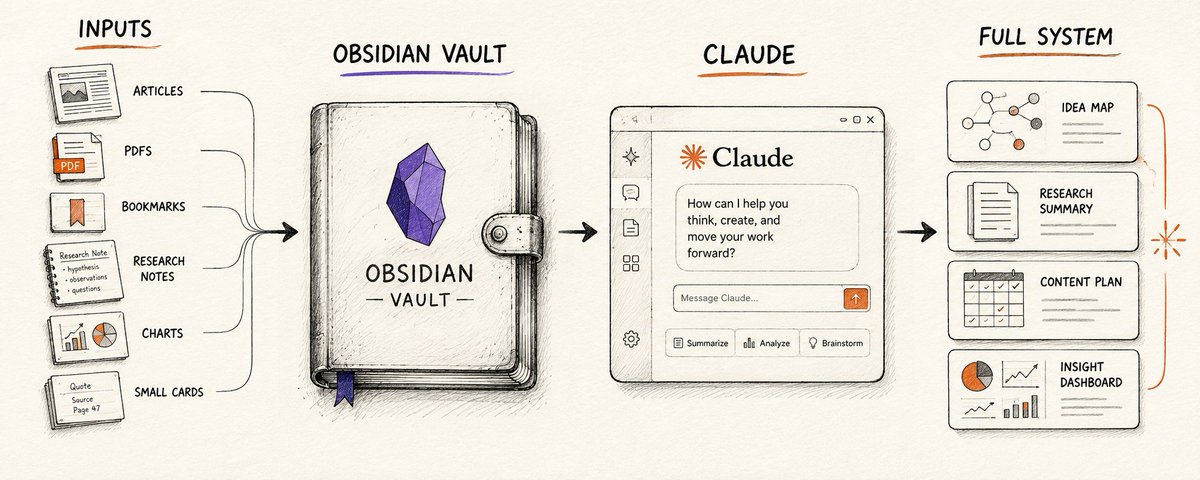
For two years I ran five different tools to do one job.
Notion for organising research projects and storing articles I intended to read. Readwise for capturing highlights from everything I actually read. X bookmarks for saving tweets, threads, and links in the moment and never finding them again. Browser bookmarks for the articles I saved with the best intentions and never revisited. ChatGPT for the quick analysis questions I needed answered before moving on.
Five tools. Five different places to look for the same piece of information. Five different mental models for what lived where.
The system felt comprehensive until I needed something from it. Then it felt like five locked rooms with no master key.
Four months ago I shut all of it down and rebuilt everything inside Obsidian with Claude as the intelligence layer. I have not opened Notion for research once since. I cancelled one subscription and deleted two apps. And the quality of my research output is better than it was when I had more tools.
Here is the full system.
## Why Five Tools Was Actually Zero Systems
The problem was never the tools. Each one did its job reasonably well in isolation.
The problem was that they did not talk to each other in any way that was useful to me. A highlight in Readwise had no relationship to a project in Notion unless I manually created that relationship. A link saved in X bookmarks had no connection to a Claude conversation unless I manually retrieved it. Every insight lived in a silo and the work of connecting silos fell entirely on me.
That is the tax nobody talks about when they recommend their research stack. The connection cost. Every time I needed to synthesise across tools I paid it in time and mental load. Multiplied across hundreds of research sessions over two years, that cost was enormous.
The shift I made was architectural, not cosmetic. Instead of asking which tools were best at their individual jobs, I asked which system would make connections automatically. The answer was a single environment where everything lived together and Claude could reason across all of it without me routing information manually between applications.
## What the System Looks Like Now
Everything lives in one Obsidian vault. One place. One search. One context window when Claude needs to reason across it.
The vault has six folders and nothing else:
- 00-Inbox — everything lands here first. No organisation at capture time.
- 01-Sources — processed articles, papers, reports, transcripts. One note per source.
- 02-Ideas — atomic observations, reactions, patterns. One idea per note.
- 03-Projects — active research threads. Each one links to relevant sources and ideas.
- 04-Outputs — finished articles, threads, reports. What came out the other side.
- 05-Claude — the CLAUDE.md file, skill files, and session logs.
The rule that makes this work: everything goes into Inbox first and gets processed later. Capture speed is non-negotiable. If saving something takes more than ten seconds, it will not get saved.
## How Each of the Five Tools Got Replaced
Notion → Obsidian Projects folder
Notion was where I kept research projects: a database of topics, a page per project, links to relevant articles, status fields, and sub-pages for notes. It looked organised. In practice I had 34 projects, 11 of which I had not touched in three months, and finding anything required navigating through nested pages that had not been updated since I created them.
The Projects folder in Obsidian does the same job with two differences. Every project note is plain text, which means Claude can read and reason across all of them simultaneously. And there are no status fields or database views creating the illusion of organisation without the substance of it. A project note either has recent activity or it does not. That honesty is more useful than a database that says everything is "In Progress."
Readwise → Obsidian Inbox + Readwise Official Plugin
Readwise still runs in the background as the capture mechanism for everything I highlight in Reader. But instead of highlights living in Readwise and requiring a separate export step, the Readwise Official plugin for Obsidian pushes every highlight directly into my Inbox as a note the moment I make it. The highlight arrives in Obsidian within minutes. I process it into the Sources folder when I have time.
The difference: my highlights are now in the same environment as my ideas and projects. When Claude runs a weekly synthesis, it reads my highlights from this week alongside my existing project notes and finds connections between them automatically. In Readwise, those highlights sat in a separate application that nothing else could reason across.
X Bookmarks → Telegram Bot to Obsidian Inbox
X bookmarks were the worst graveyard in my entire stack. The problem is specific to how the platform works: you save a tweet in the moment because it contains something useful, and then it disappears into a reverse-chronological list with no organisation, no search worth using, and no way to connect it to anything else you have saved. I had over 800 bookmarked tweets when I shut this down. I had meaningfully revisited maybe 30 of them.
The fix is the same Telegram bot that handles browser links. When I find a tweet or thread worth saving I forward it to the bot with a one-line note on why it matters. It lands in Obsidian Inbox within 30 seconds. The content of the tweet and my note about it become a single note that Claude can reason across alongside everything else in the vault.
The graveyard is now empty. Everything that used to die in X bookmarks either gets processed into the vault or does not get saved at all, which turns out to be the correct outcome for most of it.
Browser Bookmarks → Same Telegram Bot
Browser bookmarks had the same disease as X bookmarks: organised folders that looked like a system and functioned like a cemetery. The Telegram bot handles these too. Any link from any browser on any device goes to the bot, lands in Inbox, and gets processed when I sit down to work.
The difference from before is not the capture step. The difference is what happens after. A browser bookmark sits in a folder and waits to be remembered. An Obsidian Inbox note gets reviewed by Claude every Sunday and connected to whatever else arrived that week. Same link, completely different fate.
ChatGPT → Claude Projects with vault context
This is the replacement that changed the quality of my research outputs most significantly.
The issue with using ChatGPT or Claude in a separate tab for research questions was context. Every session started fresh. I would ask a question, get an answer, close the tab, and the answer had no relationship to any previous research I had done. The AI was smart. It just did not know anything about my specific work.
Claude Projects fixed this. I loaded my CLAUDE.md file, my active project notes, and my best source notes as project knowledge. Now when I ask Claude a research question it is not answering from training data alone. It is reasoning from months of my own accumulated thinking and flagging where my existing notes conflict with or support what it is finding.
The first week I ran this I asked Claude to analyse a narrative I had been tracking. It came back with three connections to notes I had written six weeks apart that I had completely forgotten were related. That does not happen in a fresh ChatGPT tab. It only happens when the AI has context.
## The Weekly Synthesis That Replaced My Monday Morning Review
Every Monday morning I used to spend 30 to 45 minutes reviewing what I had read and saved the previous week, trying to find the threads worth pursuing. It felt productive. Looking back it was mostly me reminding myself that information existed without doing anything useful with it.
Now Claude runs the review automatically every Sunday evening and the output is waiting when I open my laptop Monday morning.
Prompt
> Read all notes added to my Obsidian vault in the last 7 days across every folder.Produce a weekly synthesis with four sections:1. Connections: Two or three non-obvious links between things I captured separately this week. Each connection must reference the specific notes by title. If the connection is obvious it does not qualify.2. Patterns: Any theme or argument that appears across three or more notes from this week. Name it in one sentence. List the notes.3. Contradictions: Any two notes where my stated positions or saved claims conflict with each other. Quote the relevant line from each. Do not resolve it.4. Highest-value source: The single note from this week most worth developing further. One sentence on why.Do not summarise what I read. Synthesise what it means across the full week.
The output from this prompt on a good week is better than anything I produced from 45 minutes of manual review. On a slow research week it is still useful because it tells me clearly what I am not thinking about.
## The New Source Template
Every article, paper, report, or transcript I process from Inbox to Sources gets filed using the same template. This matters because consistent structure is what lets Claude reason across sources without getting confused by inconsistent formatting.
The template:
Prompt
> I am going to paste a piece of content. Process it into a source note using this exact structure:Title: [original title] Source: [publication or author] Date: [date] Type: [article / paper / transcript / report]Core argument: [one sentence — what is the central claim?]Key points: — [three to five bullet points, each a complete standalone idea]My reaction: [leave this blank — I will fill it in]Connections to existing notes: [search my vault for any notes this source relates to and list them by title]Open question: [what does this source leave unanswered?][PASTE CONTENT HERE]
The connections field at the bottom is the one that matters most. Every time I process a new source Claude scans my existing vault and tells me what it connects to. That is the manual work that used to happen in my head, inconsistently and incompletely, now happening automatically every time a new source enters the system.
## What Four Months of Running This Actually Looks Like
Month one felt like setup and adjustment. I was rebuilding capture habits and the vault was thin enough that the weekly synthesis was not finding much.
Month two was when the connections started. Enough material had accumulated that Claude was surfacing links between things I had genuinely forgotten were related. The Monday synthesis became something I looked forward to rather than a task I ran out of obligation.
Month three was when I noticed I had stopped context-switching. No Notion tab. No Readwise tab. No separate ChatGPT window. Everything I needed for research was in one environment. The friction I had normalised over two years of running five tools was simply gone.
Month four is now. The vault has enough accumulated thinking that the weekly synthesis regularly surfaces something worth writing about that I would not have found manually. The connections it makes between notes from different weeks are the source material for a significant portion of what I publish.
The before stack cost me approximately $30 per month across the paid tools in the stack. The current stack costs my Claude subscription and nothing else. That is not why I switched. But it is worth noting.
## The One Thing That Will Break This System
Inconsistent capture.
Every other part of this system is automated or structured enough to survive a bad week. The weekly synthesis still runs. The source template still works. Claude still has context.
But if capture breaks down, the whole thing degrades within two weeks. The vault gets stale. The synthesis has nothing interesting to surface. The connections stop appearing.
The Telegram bot is the single most important piece of infrastructure in the system because it removes every possible excuse for not capturing something. Phone, desktop, any device. Forward the link. Done. If you build this and only implement one thing from the capture layer, make it that.
## How to Build This in One Weekend
Saturday morning: Install Obsidian. Create the six-folder structure. Install the Readwise Official plugin and connect your Readwise account. Set up the Telegram bot using Zapier or Make to create Obsidian notes from forwarded links.
Saturday afternoon: Write your CLAUDE.md file. This is the highest-leverage hour in the entire build. Fill it with real specifics about your work, your audience, your content pillars, and your research focus. Vague CLAUDE.md files produce vague outputs.
Saturday evening: Process your five most important existing research sources into the Sources folder using the template above. These seed notes give Claude something to connect new captures against from day one.
Sunday: Set up a Claude Project. Load your CLAUDE.md and your five seed notes as project knowledge. Run the weekly synthesis prompt manually and read the output. Adjust the prompt based on what is useful and what is noise.
Week one: Capture everything through Inbox. Process sources into the Sources folder each evening. Run the synthesis manually on Sunday. Do not automate anything yet.
Week two: Automate the Sunday synthesis trigger using N8N or Zapier. Let the system run without you managing it.
The five tools I replaced took two years to accumulate. The system that replaced them took one weekend to build.
I should have done it earlier.
Follow @damidefi on X for daily Claude AI tools, the full system stack, and the journey to 100K. Bookmark this. Share it with one person still paying for five tools to do one job.
## 相关链接
- [Dami-Defi](https://x.com/DamiDefi)
- [@DamiDefi](https://x.com/DamiDefi)
- [43K](https://x.com/DamiDefi/status/2059266442957058414/analytics)
- [why.Do](https://why.do/)
- [@damidefi](https://x.com/@damidefi)
- [Upgrade to Premium](https://x.com/i/premium_sign_up)
- [9:32 PM · May 26, 2026](https://x.com/DamiDefi/status/2059266442957058414)
- [43.3K Views](https://x.com/DamiDefi/status/2059266442957058414/analytics)
- [View quotes](https://x.com/DamiDefi/status/2059266442957058414/quotes)
---
*导出时间: 2026/5/27 11:06:25*
---
## 中文翻译
# 我用 Obsidian 和 Claude 替换了整个研究工作流。这是完整系统。
**作者**: Dami-Defi
**日期**: 2026-05-26T13:32:33.000Z
**来源**: [https://x.com/DamiDefi/status/2059266442957058414](https://x.com/DamiDefi/status/2059266442957058414)
---

两年来,我为了完成一项工作,一直运行着五种不同的工具。
Notion 用于组织研究项目和存储打算阅读的文章。Readwise 用于捕捉我实际阅读的所有内容中的高亮部分。X 书签用于即时保存推文、推文串和链接,然后再也找不到它们。浏览器书签用于那些我出于好意保存却从未再回顾的文章。ChatGPT 用于在继续推进之前快速回答分析类问题。
五个工具。五个不同的地方寻找同一条信息。五个不同的心智模型来记录什么在哪里。
直到我需要从中提取某些东西时,这个系统才显得全面。随后,它感觉就像五个上锁的房间,却没有一把万能钥匙。
四个月前,我关闭了所有这些东西,并在 Obsidian 内部重建了一切,以 Claude 作为智能层。从那以后,我再没有为了研究打开过一次 Notion。我取消了一项订阅,删除了两个应用程序。而我的研究产出质量比我拥有更多工具时还要好。
这就是完整的系统。
## 为什么五个工具实际上等于零系统
问题从来都不在于工具本身。每一个工具在孤立工作时都做得相当不错。
问题在于,它们无法以对我有用的方式进行交流。Readwise 中的一个高亮与 Notion 中的一个项目没有任何关系,除非我手动创建这种关系。保存在 X 书签中的一个链接与 Claude 的对话没有连接,除非我手动检索它。每一个见解都生活在孤岛中,而连接这些孤岛的工作完全落在了我的肩上。
这就是当人们推荐他们的研究工具栈时,很少有人谈论的“税收”。连接成本。每当我需要跨工具进行综合时,我都要用时间和精神负荷来支付它。在两年间数百次的研究会话中累积起来,这个成本是巨大的。
我所做出的转变是架构性的,而非表面性的。我不再问哪些工具在各自的岗位上表现最好,而是问哪个系统能自动建立连接。答案是一个单一的环境,所有的东西都共存其中,而 Claude 可以在不由我手动在应用程序间路由信息的情况下,对所有内容进行推理。
## 系统现在的样子
所有东西都存放在一个 Obsidian 保险库中。一个地点。一个搜索。当 Claude 需要对其进行推理时,一个上下文窗口。
该保险库包含六个文件夹,别无他物:
- 00-Inbox(收件箱)——所有东西首先到达这里。捕捉时不做任何组织。
- 01-Sources(来源)——经过处理的文章、论文、报告、转录文本。每个来源一条笔记。
- 02-Ideas(想法)——原子化的观察、反应、模式。每个想法一条笔记。
- 03-Projects(项目)——活跃的研究线索。每一条都链接到相关的来源和想法。
- 04-Outputs(产出)——完成的文章、推文串、报告。从另一端出来的东西。
- 05-Claude——CLAUDE.md 文件、技能文件和会话日志。
使这个系统运作的规则是:所有东西首先进入收件箱,稍后再进行处理。捕捉速度是不可妥协的。如果保存某样东西需要超过十秒钟,它就不会被保存。
## 五个工具是如何被逐一替换的
Notion → Obsidian Projects 文件夹
Notion 曾是我存放研究项目的地方:一个主题数据库,每个项目一个页面,指向相关文章的链接,状态字段,以及用于记录笔记的子页面。它看起来井井有条。实际上我有 34 个项目,其中 11 个我已经三个月没碰过了,而寻找任何东西都需要浏览那些自创建以来就未更新过的嵌套页面。
Obsidian 中的 Projects 文件夹做着同样的工作,但有两点不同。每个项目笔记都是纯文本,这意味着 Claude 可以同时阅读并推理所有这些笔记。而且没有状态字段或数据库视图来制造没有实质内容的组织假象。一个项目笔记要么有最近的活动,要么没有。这种诚实比一个声称一切都在“进行中”的数据库更有用。
Readwise → Obsidian Inbox(收件箱)+ Readwise 官方插件
Readwise 仍然在后台运行,作为我在 Reader 中高亮的所有内容的捕捉机制。但是,高亮不再存在于 Readwise 中并需要单独的导出步骤,Obsidian 的 Readwise 官方插件会在我制作高亮的瞬间,将每一条高亮直接作为笔记推送到我的收件箱中。高亮会在几分钟内到达 Obsidian。我会在我有时间时将其处理到 Sources 文件夹中。
区别在于:我的高亮现在与我的想法和项目处于同一个环境中。当 Claude 运行每周综合时,它会阅读我本周的高亮以及我现有的项目笔记,并自动发现它们之间的联系。在 Readwise 中,这些高亮位于一个独立的应用程序中,没有其他任何东西能对它们进行跨应用的推理。
X 书签 → Telegram 机器人到 Obsidian Inbox(收件箱)
X 书签是我整个工具栈中最糟糕的“坟墓”。这个问题特定于该平台的运作方式:你当下保存一条推文是因为它包含有用的东西,然后它就消失在一个按时间倒序排列的列表中,没有组织,没有值得使用的搜索功能,也无法将其与你保存的其他任何东西联系起来。当我关闭这个系统时,我有超过 800 条加了书签的推文。我有意义地重新审视过其中的大概只有 30 条。
解决方案是处理浏览器链接的同一个 Telegram 机器人。当我发现一条值得保存的推文或推文串时,我会把它转发给机器人,并附上一行关于它为何重要的笔记。它会在 30 秒内到达 Obsidian Inbox。推文内容和我的相关笔记成为一条单一的笔记,Claude 可以将其与保险库中的所有其他内容一起进行推理。
这个“坟墓”现在是空的。所有过去死在 X 书签里的东西,要么被处理进了保险库,要么根本没有被保存,后者结果证明对大多数内容来说是正确的结局。
浏览器书签 → 同一个 Telegram 机器人
浏览器书签与 X 书签有着同样的毛病:看起来像系统、功能却像墓地一样的有组织文件夹。Telegram 机器人也处理这些。来自任何设备上的任何浏览器的任何链接都会发送给机器人,进入收件箱,并在我坐下来工作时得到处理。
与之前的区别不在于捕捉步骤。区别在于之后发生的事情。浏览器书签坐在文件夹里等待被记起。Obsidian 收件箱笔记会在每个周日由 Claude 审查,并连接到当周到达的其他任何东西。同一个链接,完全不同的命运。
ChatGPT → 带有保险库上下文的 Claude Projects
这是显著改变我研究产出质量的替代方案。
在一个单独的标签页中使用 ChatGPT 或 Claude 来回答研究问题,问题在于上下文。每次会话都是全新的。我会问一个问题,得到一个答案,关闭标签页,而那个答案与我之前所做的任何研究都没有关系。AI 很聪明。它只是对我的具体工作一无所知。
Claude Projects 解决了这个问题。我加载了我的 CLAUDE.md 文件、活跃的项目笔记以及我最好的来源笔记作为项目知识。现在,当我问 Claude 一个研究问题时,它不仅仅是从训练数据中回答。它是根据我自己几个月积累的思考来进行推理的,并会指出我现有的笔记与它的发现之间存在冲突或支持的地方。
在我运行这个系统的第一周,我让 Claude 分析一个我一直在追踪的叙事。它返回了与我相隔六周写的笔记的三个连接,而我完全忘记了它们是相关的。这在一个全新的 ChatGPT 标签页中是不会发生的。只有当 AI 拥有上下文时,才会发生这种情况。
## 替代我周一早上回顾的每周综合
以前每个周一早上,我会花 30 到 45 分钟回顾我上周阅读和保存的内容,试图找到值得追踪的线索。感觉很有成效。回想起来,那主要是我在提醒自己这些信息的存在,却没有做任何有用的事情。
现在 Claude 会在每个周日晚上自动运行回顾,当我周一早上打开笔记本电脑时,输出结果已经在等着我了。
提示词(Prompt)
> 阅读过去 7 天添加到我的 Obsidian 保险库中每个文件夹的所有笔记。生成一份每周综合报告,包含四个部分:1. 连接:本周我分别捕捉的内容之间两个或三个非显而易见的联系。每个连接必须引用具体笔记的标题。如果连接是显而易见的,它就不符合资格。2. 模式:本周出现在三个或更多笔记中的任何主题或论点。用一句话命名它。列出这些笔记。3. 矛盾:我任何两条笔记中,我所表明的立场或保存的主张相互冲突的地方。引用每一方的相关行。不要解决它。4. 最高价值来源:本周最值得进一步发展的单条笔记。用一句话说明原因。不要总结我读了什么。综合它在整周意味着什么。
在一个充实的一周里,这个提示词的输出比我花 45 分钟手动回顾产生的任何结果都要好。即使是一个研究进展缓慢的一周,它仍然有用,因为它清楚地告诉我我没有在思考什么。
## 新的来源模板
每篇从收件箱处理到来源的文章、论文、报告或转录文本,都使用相同的模板进行归档。这很重要,因为一致的结构是让 Claude 能够跨来源进行推理,而不会被不一致的格式搞混的关键。
模板:
提示词(Prompt)
> 我将粘贴一段内容。使用这个精确的结构将其处理为来源笔记:标题:[原始标题] 来源:[出版物或作者] 日期:[日期] 类型:[文章 / 论文 / 转录文本 / 报告]核心论点:[一句话——核心主张是什么?]关键点:— [三到五个要点,每一个都是一个完整的独立想法]我的反应:[留空——我会填写]与现有笔记的连接:[搜索我的保险库以查找此来源相关的任何笔记,并列出它们的标题]未解的问题:[这个来源有什么未回答的问题?][在此处粘贴内容]
底部的连接字段是最重要的。每当我处理一个新来源时,Claude 会扫描我现有的保险库,并告诉我它与什么相连。这就是过去在我脑海中发生的手动工作,时断时续且往往不完全,现在每当一个新来源进入系统时都会自动发生。
## 运行这个系统四个月的实际样子
第一个月感觉像是设置和调整。我正在重建捕捉习惯,而且保险库内容还不够丰富,每周综合发现不了多少东西。
第二个月是连接开始出现的时候。已经积累了足够的材料,Claude 开始将我确实忘记有联系的事物联系起来。周一的综合成了我期待的事情,而不是我出于义务去执行的任务。
第三个月,我注意到我停止了上下文切换。没有 Notion 标签页。没有 Readwise 标签页。没有单独的 ChatGPT 窗口。我研究需要的所有东西都在一个环境中。我在两年运行五个工具中习以为常的摩擦就这样消失了。
第四个月就是现在。保险库已经积累了足够的思考,每周综合经常性地挖掘出一些值得撰写的内容,这些内容我手动是无法找到的。它在不同周的笔记之间建立的连接,是我发布的很大一部分内容的素材来源。
之前的工具栈让我每月大约花费 30 美元用于付费工具。目前的工具栈花费我的是 Claude 订阅费,除此之外别无其他。这不是我转换的原因。但这值得注意。
## 唯一会破坏这个系统的事情
不一致的捕捉。
这个系统的所有其他部分都是自动化的或结构化的,足以挺过糟糕的一周。每周综合仍然会运行。来源模板仍然有效。Claude 仍然拥有上下文。
但是,如果捕捉环节崩溃,整个系统会在两周内退化。保险库会变得陈旧。综合没有有趣的东西可以呈现。连接停止出现。
Telegram 机器人是系统中最重要的单一基础设施,因为它消除了不捕捉某样东西的所有可能借口。手机、桌面、任何设备。转发链接。完成。如果你构建了这个系统,并且只从捕捉层实施一样东西,就选它。
## 如何在一个周末内构建这个系统
周六上午:安装 Obsidian。创建六个文件夹结构。安装 Readwise 官方插件并连接你的 Readwise 账户。使用 Zapier 或 Make 设置 Telegram 机器人,以便从转发的链接创建 Obsidian 笔记。
周六下午:编写你的 CLAUDE.md 文件。这是整个构建中杠杆率最高的一个小时。用关于你的工作、你的受众、你的内容支柱和你的研究重点的真实细节来填充它。模糊的 CLAUDE.md 文件产生模糊的输出。
周六晚上:使用上面的模板,将你五个最重要的现有研究来源处理到 Sources 文件夹中。这些种子笔记给 Claude 提供了从第一天起就可以与新捕捉的内容建立连接的依据。
周日:设置一个 Claude Project。将你的 CLAUDE.md 和你的五个种子笔记作为项目知识加载。手动运行每周综合提示词并阅读输出。根据什么是有用的、什么是噪音来调整提示词。
第一周:所有东西都通过收件箱捕捉。每天晚上将来源处理到 Sources 文件夹。周日手动运行综合。暂时不要自动化任何东西。
第二周:使用 N8N 或 Zapier 自动化周日综合触发器。让系统在没有你管理的情况下运行。
我替换的五个工具花了我两年时间积累。替换它们的系统花了一个周末来构建。
我应该早点这么做。
在 X 上关注 @damidefi,获取每日 Claude AI 工具、完整的系统栈以及通往 10K 的旅程。收藏这个。把它分享给那个仍然在为做一项工作而付费使用五个工具的人。
## 相关链接
- [Dami-Defi](https://x.com/DamiDefi)
- [@DamiDefi](https://x.com/DamiDefi)
- [43K](https://x.com/DamiDefi/status/2059266442957058414/analytics)
- [why.Do](https://why.do/)
- [@damidefi](https://x.com/@damidefi)
- [Upgrade to Premium](https://x.com/i/premium_sign_up)
- [9:32 PM · May 26, 2026](https://x.com/DamiDefi/status/2059266442957058414)
- [43.3K Views](https://x.com/DamiDefi/status/2059266442957058414/analytics)
- [View quotes](https://x.com/DamiDefi/status/2059266442957058414/quotes)
---
*导出时间: 2026/5/27 11:06:25*