构建超越单一模型的持久 AI 系统 ✍ ericosiu🕐 2026-07-25📦 14.9 KB 🟢 已读 𝕏 文章列表 文章指出,模型只是可随时替换的引擎,真正的价值在于构建围绕模型的系统。作者介绍了利用 Hermes 工具从简单的问答、一次性任务,进化到生成可共享的产物、封装可复用的技能,最终形成自动化运行的循环系统,以实现 AI 效用的复利增长。 AI系统HermesSkillAgent工作流自动化技能封装 # How to build an AI system that outlasts every new model **作者**: ericosiu **日期**: 2026-07-22T22:12:05.000Z **来源**: [https://x.com/ericosiu/status/2080777068757819675](https://x.com/ericosiu/status/2080777068757819675) ---  Opus 5 just released. ChatGPT dropped 5.6 last week. And everybody's rushing off to try the newest models. I get the excitement, but I'm not changing much about how I work, and I want to explain why. The model is the easy part. You swap it whenever a better one comes along. But the part that takes effort, and pays you back, is the SYSTEM you build around it, and for me that whole system lives inside Hermes. So if you're using Hermes like a fancier ChatGPT, you're probably getting maybe 10% out of it. I've spent hundreds of hours in this thing, so let me walk you through how I use it. The way I think about all of it is pretty simple. Hermes runs on context. That context becomes an artifact, like a PDF or an HTML doc or a diagram your team and your agents can both read quickly. Once you're doing something over and over, it turns into a skill, and a stack of skills eventually becomes a loop that runs on its own. There's a ladder that goes with it, eight levels, and most of us get stuck near the bottom. ``` 8 company brain, compounding 7 permissioning + governance 6 connected company data 5 recurring checks as crons 4 repeatable work as skills 3 shareable artifacts 2 delegate one-off tasks 1 ask questions (start here) ``` ## The model is just the part you swap Let me start here, since it's what everyone's thinking about today with Opus 5 out. A new model doesn't change my setup much, and that's on purpose. Hermes is open source, so it runs whatever model I point it at. When Opus 5 drops, or 5.4, or whatever shows up next month, I just spin up a profile on it and leave everything else alone. My context, my skills, my memory, my permissions, none of that moves. The model is basically the engine, and I can swap engines without rebuilding the car. What I do is keep a few profiles for different jobs. Something heavier like Opus 5 or Fable when I'm planning or thinking through strategy, and something lighter for quick stuff. You match the model to how much thinking the task needs. And because it's open source, you can run it on a local model, your subscription, or the API, whatever makes sense for the job. So chasing every new model is kind of a treadmill. The thing worth building is the system underneath, because that sticks around no matter which model is winning that week. ## Levels 1 and 2: don't treat it like a chatbot Level one is asking it questions. Level two is handing it one-off tasks. Nothing wrong with either, and I do both. I use it to plan a trip to Italy like anybody else. The mistake is stopping there. My Hermes is connected to my documents, my memory files, my data, so I use it more like a thinking partner. The other day I asked it why my X views dropped from 3.1 million last month to a pace of 1.6 million this month. It went and ran the whole analysis and came back with some banger candidates to get the profile moving again. It pushes me on stuff too. It told me my website should be a revenue agent, not a brochure, which sounded a little contrarian at first, but it's right. So now I've got a loop testing the site's conversion against a target, and it even wrote the resource offer that gets people to comment on a post to opt in. I also lean on it to argue with me. I'll drop in someone's post, one of Matt Van Horn's skills for example, and ask how much it would move the needle for us on a scale of 1 to 100. It rates it, tells me where it's weak, and upgrades it if it's worth keeping. One time it rebuilt a chunk of scaffolding and renamed all the stale copies over about 34 replies, and I barely touched it. There's a /learn command too, which goes a long way. When something works, I have it save the lesson so the next run starts from a smarter place. One habit that feeds all of this: when I go for a walk, I just talk into Whisper Flow for five minutes about whatever's on my mind. Product ideas, sales stuff, random thoughts. Then Hermes sorts it into next steps or points me at a skill I already have. 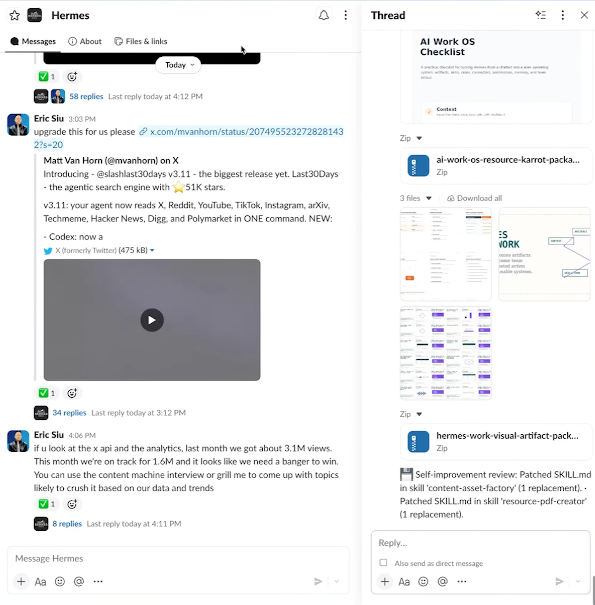 ## Level 3: artifacts are how you scale yourself The way I see it, a private answer is useful, sure. But the second it becomes an artifact your team can grab, it's a different thing entirely. An artifact can be a checklist, a diagram, an HTML doc, a one-pager, a carousel, whatever. When I want the team to get a concept, I'll have Hermes turn it into a diagram and drop it in Slack. People understand one clear picture a lot faster than a wall of text, and they usually come back asking if they can reuse it. I also point it at our design file so whatever it makes comes out looking like us instead of generic. And these artifacts pull double duty. When I make something downloadable, like an AI work OS checklist, people comment on the post to get it through ManyChat, so it helps the reader and pulls in a lead at the same time. 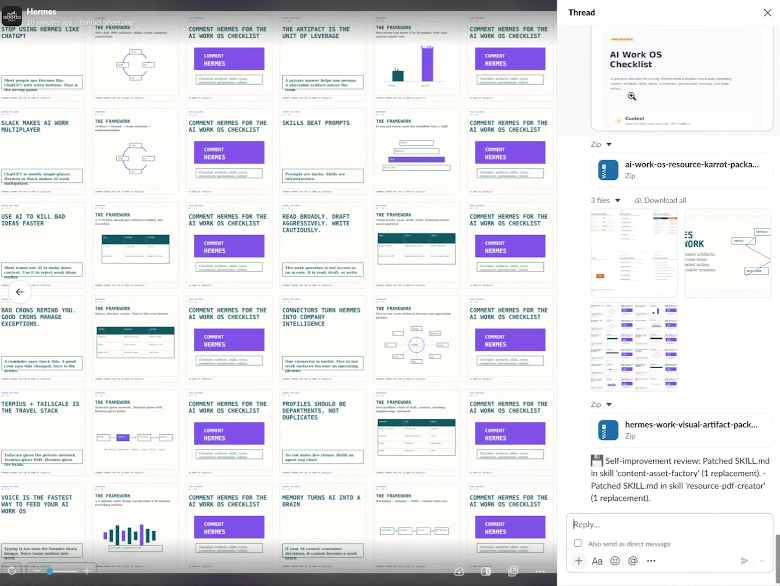 I even had it spin up the outline and a bunch of short-form video ideas off the same context. Same raw material, just more things the team can run with. ## Level 4: skills are where it starts compounding Prompts are kind of a pain. They're hard to remember and they're gone the second you close the tab. A skill is a saved process you can reuse, hand off, and run in any tool, and that's the part that compounds. So anything I do more than once, I ask Hermes to skillify it. I've got a Grill Me skill, from a guy named Matt PCO, that asks me one question at a time until it's satisfied and then builds a better plan. The one-at-a-time thing matters, because your answer to question one changes question two. It'll ask stuff like which artifact Hermes has built that mattered most, and saying it out loud is usually where the answer shows up. I've also got a Content Machine skill. Before it even interviews me, it reads my messy dump of thoughts and tells me which of my POVs are strongest, the ones buried in there. Then it grills me to sharpen them. Honestly the best agent isn't the obedient one. Grill Me makes me think harder, Content Machine pulls the sharpest stuff out of me, and Hermes will straight up tell me when an idea is mid. I use it to cut things too, because a lot of what I make needs deleting and it's good at spotting what to drop. I keep skills for all the work I repeat. YouTube packaging for long and short form, recruiting, AEO and SEO. Each one is a process I never have to rebuild from scratch. In the dojo I pack skills by role, so a new person on paid media or revenue picks up the right set on day one. Every skill has an eval that says what done looks like, so the quality doesn't drift as more people run it. Skills get better socially too. Once one is public, people upvote it, fork it, improve it, and a better fork ends up being the one everybody runs. Ours is public over at skillsdojo.com if you want to grab one and make it yours. > **ericosiu@ericosiu**: [原文链接](https://x.com/ericosiu/status/2080053294903562402) > > We built an app store for AI agents. > It's called Skills Dojo. > Instead of every person teaching their agent how to do a task from scratch, we keep all our best workflows as ready-to-use "skills" in one shared library. > You search for what you want to get done, grab the proven > > 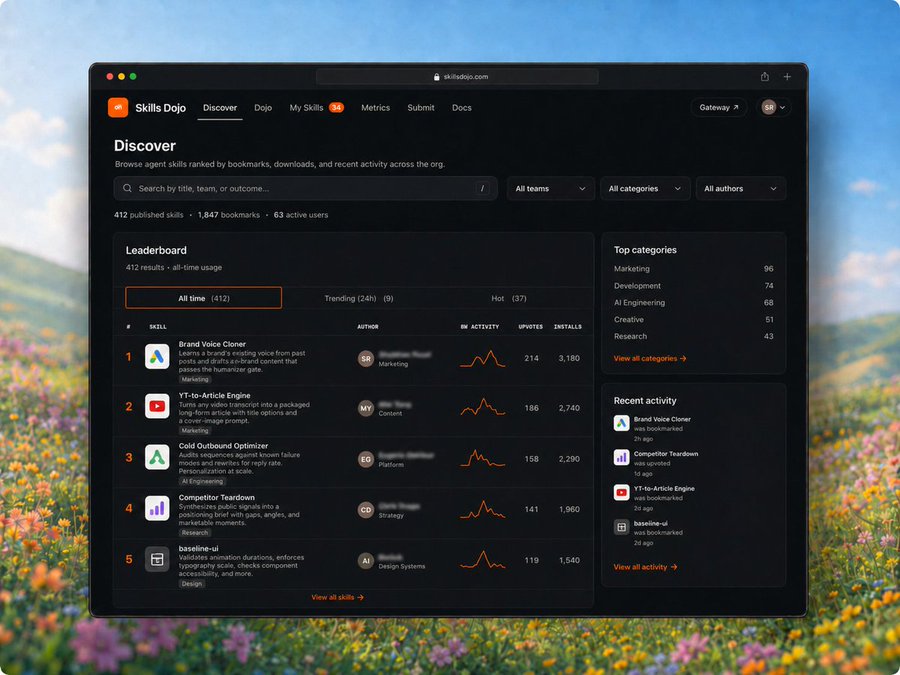 The one I use most is my X long-form writer. I built it a few months ago and it just keeps getting better as people build on top of it. ## Level 5: crons that run without you A cron is just a job that runs on a schedule. Mine keep an eye on the stuff that costs me money if I miss it. Deals that went quiet, follow-ups I'm late on, a pipeline summary sitting there when I wake up. A good one does three things. It tells me what changed, it suggests what to do about it, and it offers to just do it for me. That last part is what makes it feel like an assistant instead of one more notification. One thing to watch is that crons go stale. Something that mattered last month is noise this month, so every now and then I go through and kill the ones that stopped pulling their weight. ## Level 6: multiplayer and connected data It's easy to just run Hermes by yourself. The bigger move is making it multiplayer, putting it where your team already works, which for us is Slack. The way I explain a company brain to people is pretty simple. Hermes is the driver. Your connectors feed it your tools. Memory holds what it's learned. And permissions decide who on the team can do what. Wire all that into Slack and now it's multiplayer. Once it's multiplayer, everybody sees everybody's questions. Chris will ask for the open sales leads from the last four weeks with dates and follow-ups, and that answer is sitting right there for me too. I'll ask who submitted applications in the last seven days and it pulls the list in seconds. His question sparks one of mine, mine turns into a quick meeting, and the whole team just trades ideas faster. And faster ideas turn into faster action. The connectors themselves aren't the magic. The magic is the synthesis. When your analytics and your CRM and your revenue intelligence and your docs are all talking to each other, the answers get a lot sharper. 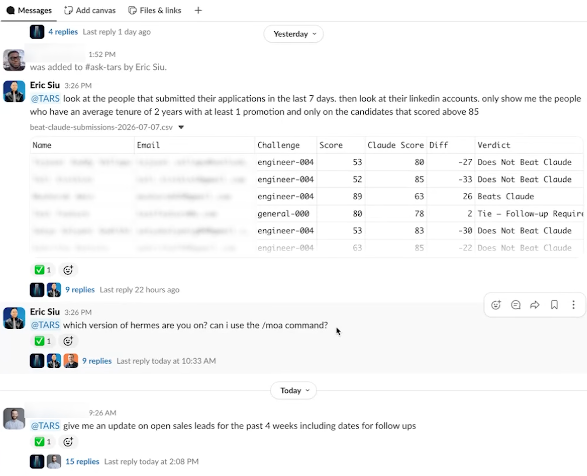 I asked Hermes to read our HubSpot and Gong and tell me the patterns from our client calls. It told me people are about an eight or nine out of ten excited to talk about Single Brain, and lower on Single Grain, more as a service than as hype. That kind of read used to take me a week. And when you run all that through a stronger model, the output gets even better. The flip side is if the data going in is a little off, it drifts on you. It's like a plane one degree off course ending up on the wrong continent. ## Level 7: governance before something breaks Before you scale any of this, you've got to decide who can do what. The way I break it down is three tiers. Reading is usually fine as long as you scope it. Drafting is where I let Hermes be aggressive, because a bad draft is cheap to throw away. But anything that writes externally, that publishes or sends, needs a human to sign off. I'd start the team on read-only and open up drafting as you build trust. We run an API gateway across all our products so nobody can just wire up whatever they feel like. Set the permissions and the security up front, because if a client's data leaks and it's because you never thought about this, that's on you. Think about it early and you skip a whole category of problems later. ## Level 8: the company brain Here's the one that matters most. If an agent can't remember its own decisions, it's never going to become a brain. So I put a lot into memory. We log everything daily in Obsidian, keep a running decision history and active tasks, push the bigger stuff into Linear, and keep a lessons file that just grows over time. We plug in outside memory systems too, like QMD from one of Shopify's co-founders, and Gary Tan's Gbrain and Gstack for deeper reviews. Hermes leans on recent context the most, so the fresh stuff stays close. That's the difference between a chatbot and a brain. A brain holds onto what it decided, and that memory is what lets everything compound over time. > **ericosiu@ericosiu**: [原文链接](https://x.com/ericosiu/status/2060415100603781497) > ## Run it in the desktop app One practical thing before I wrap. Slack is where my team lives, but it's kind of fleeting, and I lose track of what I was doing in there. The Hermes desktop app fixes that for me. I can see what I was working on, reprioritize the list, and keep my skills and artifacts and crons all in one spot. It even pulls context in from my other chats. It feels a lot like working in Codex or Cloud Code, where I don't lose the thread of what I'm building. If you're serious about climbing this ladder, that's where I'd run it. > **ericosiu@ericosiu**: [原文链接](https://x.com/ericosiu/status/2079502362364817433) > > If you aren’t using your Hermes with this app, you’re leaving money on the table. > Don’t get me wrong, I love using Hermes inside of Slack and Telegram, but this is a major unlock for work. > Previously, I felt restricted on my mobile devices in terms of how far I could push > > 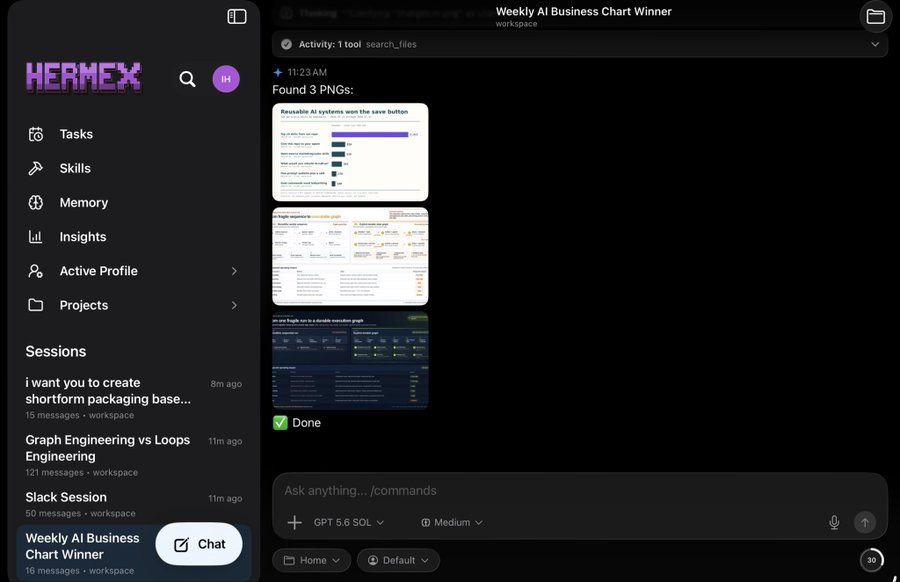 ## Where you are on the ladder Look, new models are going to keep coming. Opus 5 today, something bigger next month, it doesn't stop. The people who win won't be the ones who tried each one first. They'll be the ones who built something worth plugging those models into. That's all the ladder is. Artifacts so your work travels, skills so it compounds, crons so it runs without you, connected data so it thinks with your whole company, permissions so it stays safe, and memory so it turns into a brain. Pick whatever rung is one above where you are right now, and go build it this week. That's how you get off level one. Watch the video breakdown here: https://www.youtube.com/watch?v=nunIJuHMRGU If you're a business that wants AI systems built for you, check out https://www.singlebrain.com For marketing help, go to https://www.singlegrain.com For more like this, level up your marketing with 14,000+ marketers and founders in my Leveling Up newsletter, free: https://levelingup.beehiiv.com/subscribe If you want to join our team, beat AI first ;) https://github.com/ericosiu/beat-claude ## 相关链接 - [ericosiu](https://x.com/ericosiu) - [@ericosiu](https://x.com/ericosiu) - [1.1K](https://x.com/ericosiu/status/2080777068757819675/analytics) - [skillsdojo.com](https://skillsdojo.com/) - [Jul 23](https://x.com/ericosiu/status/2080053294903562402) - [15K](https://x.com/ericosiu/status/2080053294903562402/analytics) - [May 30](https://x.com/ericosiu/status/2060415100603781497) - [958K](https://x.com/ericosiu/status/2060415100603781497/analytics) - [Jul 21](https://x.com/ericosiu/status/2079502362364817433) - [7.7K](https://x.com/ericosiu/status/2079502362364817433/analytics) - [https://www.youtube.com/watch?v=nunIJuHMRGU](https://www.youtube.com/watch?v=nunIJuHMRGU) - [https://www.singlebrain.com](https://www.singlebrain.com/) - [https://www.singlegrain.com](https://www.singlegrain.com/) - [https://levelingup.beehiiv.com/subscribe](https://levelingup.beehiiv.com/subscribe) - [https://github.com/ericosiu/beat-claude](https://github.com/ericosiu/beat-claude) - [Upgrade to Premium](https://x.com/i/premium_sign_up) - [6:08 AM · Jul 25, 2026](https://x.com/ericosiu/status/2080777068757819675) - [1,128 Views](https://x.com/ericosiu/status/2080777068757819675/analytics) - [View quotes](https://x.com/ericosiu/status/2080777068757819675/quotes) --- *导出时间: 2026/7/25 11:05:05* --- ## 中文翻译 # 如何构建一个经得起每一个新模型更迭的 AI 系统 **作者**: ericosiu **日期**: 2026-07-22T22:12:05.000Z **来源**: [https://x.com/ericosiu/status/2080777068757819675](https://x.com/ericosiu/status/2080777068757819675) ---  Opus 5 刚刚发布。ChatGPT 上周推出了 5.6 版。大家都在争先恐后地尝试最新的模型。 我理解这种兴奋,但我不会改变我工作的方式,我想解释一下原因。 模型是最简单的部分。一旦有更好的出现,你随时可以替换。但需要你付出努力、并给你带来回报的,是你围绕它构建的**系统**,对我来说,整个系统都运行在 Hermes 里面。 所以,如果你只是把 Hermes 当作一个更花哨的 ChatGPT 来用,你可能只发挥出了它 10% 的潜力。我在这个系统上花了几百个小时,让我带你看看我是怎么使用它的。 我对这一切的思考方式非常简单。Hermes 运行在“上下文”之上。 这种上下文会变成一种“制品”,比如一个 PDF、一个 HTML 文档,或者一个你的团队和智能体都能快速读懂的图表。 一旦你重复做某件事,它就变成了一项“技能”,而一堆技能最终会形成一个自主运行的闭环。 这伴随着一个阶梯,共八个层级,我们大多数人都会卡在底部附近。 ``` 8 公司大脑,复利增长 7 权限 + 治理 6 关联的公司数据 5 定期检查 4 可重复的工作转化为技能 3 可共享的制品 2 委派一次性任务 1 提问 (从这里开始) ``` ## 模型只是你可以随时替换的零件 让我从这里开始,因为这是 Opus 5 发布后大家今天都在思考的事情。 新模型不会改变我的设置太多,这刻意的。Hermes 是开源的,所以无论我指向哪个模型,它都能运行。 当 Opus 5 发布,或者 5.4,或者下个月出现的任何东西,我只是为它创建一个配置文件,其他的一切都保持不变。 我的上下文、我的技能、我的记忆、我的权限,这些都不会动。模型基本上就是引擎,我可以在不重建汽车的情况下更换引擎。 我的做法是针对不同的工作保留几个配置文件。当我做规划或思考策略时,会使用像 Opus 5 或 Fable 这样更重的模型,处理琐事时使用更轻量的模型。你要将模型与任务所需的思考量相匹配。 而且因为它是开源的,你可以在本地模型、订阅服务或 API 上运行它,只要对工作来说合理就行。 所以追逐每一个新模型有点像在跑步机上跑步。值得构建的是底层的系统,因为不管这周哪个模型获胜,它都会一直存在。 ## 第 1 和第 2 层:不要把它当作聊天机器人 第一层是向它提问。第二层是给它一次性任务。这两者都没问题,我也都做。我会像其他人一样用它计划去意大利的旅行。 错误的是止步于此。 我的 Hermes 连接着我的文档、记忆文件和数据,所以我更多是把它当作一个思考伙伴。有一天我问它,为什么我的 X(推特)浏览量从上个月的 310 万降到了这个月的 160 万的速度。 它去运行了完整的分析,然后带回了一些让账号重新活跃起来的绝佳方案。 它也会推动我去做事。它告诉我,我的网站应该是一个创收智能体,而不是宣传册,这听起来起初有点反直觉,但它是对的。 所以现在我有一个循环在测试网站的转化率是否达标,它甚至写好了资源诱饵,让人们通过评论帖子来选择加入。 我还依赖它来和我争论。我会丢进去某人的帖子,比如 Matt Van Horn 的某个技能,然后问它这能在多大程度上推动我们的进展,按 1 到 100 分打分。 它会打分,告诉我哪里薄弱,如果值得保留,就会对其进行升级。有一次,它重建了一大块脚手架,并在大约 34 条回复中重命名了所有过时的副本,而我几乎没怎么动手。 还有一个 `/learn` 命令,非常有用。当某件事奏效时,我会让它保存这个教训,以便下一次运行能从一个更聪明的起点开始。 一个支撑所有这些习惯的做法:当我散步时,我会对着 Whisper Flow 说五分钟,说出我脑子里想的任何东西。产品创意、销售事务、随机的想法。 然后 Hermes 会将其整理成下一步行动,或者指向我已有的某个技能。  ## 第 3 层:制品是你扩展自己的方式 在我看来,私人的答案当然有用。但一旦它变成你的团队可以获取的制品,情况就完全不同了。 制品可以是检查清单、图表、HTML 文档、单页文档、轮播图,任何东西。当我希望团队理解一个概念时,我会让 Hermes 把它变成图表并丢进 Slack。 人们理解一张清晰的图片比理解一堵文字墙要快得多,而且他们通常会回来问是否可以重复使用。 我还会指向我们的设计文件,这样它做出来的东西看起来就像是我们自己的,而不是通用的。 这些制品还有双重用途。当我制作可下载的东西时,比如 AI 工作操作系统检查清单,人们会在帖子下评论以通过 ManyChat 获取它,这既帮助了读者,同时又引入了一个潜在客户。  我甚至让它基于相同的上下文生成了大纲和一堆短视频创意。相同的原始材料,只是团队可以操作的东西更多了。 ## 第 4 层:技能是复利开始的地方 提示词有点麻烦。它们很难记住,而且一旦你关闭标签页就消失了。技能是一个保存好的流程,你可以重复使用、移交,并在任何工具中运行,这就是产生复利效应的部分。 所以,任何我做不止一次的事情,我都会要求 Hermes 把它变成技能。 我有一个“Grill Me”(拷问我)技能,来自一个叫 Matt PCO 的人,它会一次问我一个问题,直到它满意为止,然后构建一个更好的计划。一次一个问题的做法很重要,因为你对第一个问题的回答会改变第二个问题。 它会问诸如“Hermes 制作的哪个制品最重要”之类的问题,而把它说出来通常是答案浮现的地方。 我还有一个“Content Machine”(内容机器)技能。在它采访我之前,它会阅读我那堆混乱的想法,并告诉我哪些观点最强,那些深埋其中的观点。然后它会拷问我以把它们磨得更锋利。 老实说,最好的智能体不是那个听话的。Grill Me 让我思考得更努力,Content Machine 把我身上最犀利的东西挖掘出来,而当一个想法很平庸时,Hermes 会直接告诉我。 我也用它来删减内容,因为我做的很多东西需要删除,而它很擅长发现该舍弃什么。 我为所有重复的工作保留技能。长短视频的 YouTube 包装、招聘、AEO 和 SEO。每一个都是我永远不需要从头重建的流程。 在道场里,我按角色打包技能,所以付费媒体或营收部门的新人在第一天就能获得合适的技能组合。每个技能都有一个评估标准,说明“完成”是什么样子的,所以随着更多人运行它,质量不会发生偏离。 技能在社会层面也会变得更好。一旦一个技能公开,人们会点赞、分叉、改进它,而更好的分叉版本最终会成为每个人运行的版本。我们的在 skillsdojo.com 公开,如果你想去拿一个并把它变成你自己的。 > **ericosiu@ericosiu**: [原文链接](https://x.com/ericosiu/status/2080053294903562402) > > 我们为 AI 智能体构建了一个应用商店。 > 它叫 Skills Dojo。 > 我们不再让每个人都教他们的智能体从头开始做任务,而是将我们所有最佳的工作流程作为即用型“技能”保存在一个共享库中。 > 你搜索你想做的事情,获取经过验证的 > >  我用得最多的是我的 X 长文写作器。我几个月前构建了它,随着人们在此基础上不断构建,它变得越来越好。 ## 第 5 层:无需你干预的 Crons Cron 只是一个按计划运行的任务。我的 Crons 会盯着那些如果错过了会让我损失金钱的东西。沉寂的交易、迟到的跟进、当我醒来时就在那里的销售漏斗摘要。 一个好的 Cron 会做三件事。它告诉我什么改变了,它建议对此做什么,并且它提出直接替我做。最后一部分是让它感觉像个助手而不是多一个通知的原因。 需要注意的一点是,Crons 会过时。上个月重要的事情在这个月就是噪音,所以我会时不时地检查并杀掉那些不再产生价值的任务。 ## 第 6 层:多人协作和关联数据 一个人运行 Hermes 很容易。更大的举措是让它变成多人协作,把它放到你的团队已经工作的地方,对我们来说就是 Slack。 我向人们解释“公司大脑”的方式非常简单。Hermes 是司机。你的连接器将你的工具输送给它。Memory 保存它学到的东西。权限决定团队里的谁能做什么。把所有这些连接到 Slack,现在它就是多人协作的了。 一旦变成多人协作,每个人都能看到每个人的问题。Chris 会询问过去四周有日期和跟进记录的开放销售线索,而那个答案也正好在那里等着我。 我会问过去七天谁提交了申请,它会在几秒钟内拉出列表。他的问题引发了我的问题,我的问题变成一个快速的会议,整个团队只是更快地交换想法。更快的想法转化为更快的行动。 连接器本身并不是魔法。魔法在于综合。当你的分析、CRM、营收智能和文档都在互相交流时,答案会变得犀利得多。  我让 Hermes 阅读我们的 HubSpot 和 Gong,并告诉我客户通话中的模式。它告诉我,人们对于谈论 Single Brain 的兴奋程度大约是 8 或 9 分(满分 10 分),而对 Single Grain 的兴趣较低,更多的是将其视为一种服务而不是炒作。 以前这种分析需要花我一周时间。 当你通过更强大的模型运行所有这些时,输出会变得更好。反面是,如果输入的数据有点偏差,它就会产生偏离。这就像飞机偏离航向一度,最后却降错大陆。 ## 第 7 层:出问题之前的治理 在你扩展这些之前,你必须决定谁能做什么。 我把它分为三个层级。阅读通常没问题,只要你设定了范围。 起草是我允许 Hermes 激进一点的地方,因为一个糟糕的草稿丢弃成本很低。但任何对外部写入、发布或发送的内容,都需要人工签字。 我会先让团队从只读权限开始,随着信任的建立再开放起草权限。我们在所有产品上运行一个 API 网关,所以没有人可以随意连接他们想要的任何东西。 提前设置权限和安全,因为如果客户数据泄露了,而原因是你从未考虑过这一点,那就是你的责任。早点考虑,你以后就能跳过整整一类问题。 ## 第 8 层:公司大脑 这是最重要的一点。如果一个智能体记不住它自己的决定,它永远无法成为大脑。 所以我非常重视记忆。我们每天在 Obsidian 中记录所有内容,保持一个持续更新的决策历史和活跃任务,把更大的东西推送到 Linear,并维护一个只会随着时间增长的教训文件。 我们也接入外部记忆系统,比如来自 Shopify 联合创始人的 QMD,以及 Gary Tan 的 Gbrain 和 Gstack 用于更深入的审查。Hermes 最依赖最近的上下文,所以新鲜的东西保持贴近。 这就是聊天机器人和大脑的区别。大脑会保留它决定的东西,而这种记忆让一切都能随着时间的推移产生复利。 > **ericosiu@ericosiu**: [原文链接](https://x.com/ericosiu/status/2060415100603781497) > ## 在桌面应用中运行它 在我结束之前讲一个实际的点。Slack 是我团队待的地方,但它有点转瞬即逝,我会跟不上我在那里做的事情。 Hermes 桌面应用为我解决了这个问题。我可以看到我在做什么,重新排列优先级列表,并将我的技能、制品和 Crons 全都集中在一个地方。它甚至会从我的其他聊天中提取上下文。 这感觉有点像在 Codex 或 Cloud Code 中工作,我不会丢失我正在构建的线索。如果你认真想要攀登这个阶梯,我会建议你在那里运行它。 > **ericosiu@ericosiu**: [原文链接](https://x.com/ericosiu/status/2079502362364817433) > > 如果你不使用这个应用来运行你的 Hermes,你就亏大了。 > 别误会,我喜欢在 Slack 和 Telegram 里使用 Hermes,但这对于工作来说是一个巨大的解锁。 > 以前,我在移动设备上感觉受限,无法把事情做到极致…… > >  ## 你在阶梯的哪个位置 听着,新模型会不断涌现。今天是 Opus 5,下个月就是更大的东西,这不会停止。 赢家不会是那些每个都第一时间尝试的人。赢家会是那些构建了值得将这些模型接入进去的东西的人。 这就是阶梯的全部意义。制品让你的工作可以传播,技能让它产生复利,Crons 让它无需你干预运行,关联的数据让它用整个公司的智慧思考,权限让它保持安全,记忆让它变成大脑。 选择比你目前所在的层级高一级的那一级,并在这一周把它构建出来。这就是你脱离第一层的方法。 在此处观看视频详解:https://www.youtube.com/watch?v=nunIJuHMRGU 如果你是一家想要构建 AI 系统的企业,请查看 https://www.singlebrain.com 如需营销帮助,请访问 https://www.singlegrain.com 想要更多类似内容,与 14,000 多名营销人员和创始人一起订阅我的“Leveling Up”免费通讯,提升你的营销水平:https://levelingup.beehiiv.com/subscribe 如果你想加入我们的团队,先击败 AI ;) https://github.com/ericosiu/beat-claude ## 相关链接 - [ericosiu](https://x.com/ericosiu) - [@ericosiu](https://x.com/ericosiu) - [1.1K](https://x.com/ericosiu/status/2080777068757819675/analytics) - [skillsdojo.com](https://skillsdojo.com/) - [Jul 23](https://x.com/ericosiu/status/2080053294903562402) - [15K](https://x.com/ericosiu/status/2080053294903562402/analytics) - [May 30](https://x.com/ericosiu/status/2060415100603781497) - [958K](https://x.com/ericosiu/status/2060415100603781497/analytics) - [Jul 21](https://x.com/ericosiu/status/2079502362364817433) - [7.7K](https://x.com/ericosiu/status/2079502362364817433/analytics) - [https://www.youtube.com/watch?v=nunIJuHMRGU](https://www.youtube.com/watch?v=nunIJuHMRGU) - [https://www.singlebrain.com](https://www.singlebrain.com/) - [https://www.singlegrain.com](https://www.singlegrain.com/) - [https://levelingup.beehiiv.com/subscribe](https://levelingup.beehiiv.com/subscribe) - [https://github.com/ericosiu/beat-claude](https://github.com/ericosiu/beat-claude) - [Upgrade to Premium](https://x.com/i/premium_sign_up) - [6:08 AM · Jul 25, 2026](https://x.com/ericosiu/status/2080777068757819675) - [1,128 Views](https://x.com/ericosiu/status/2080777068757819675/analytics) - [View quotes](https://x.com/ericosiu/status/2080777068757819675/quotes) --- *导出时间: 2026/7/25 11:05:05*
装 装完 Codex 不知道干什么?这 6 个 GitHub Skills 让你做视频搞钱 文章介绍了 6 个适用于 Codex 的 GitHub Skills,涵盖动效生成、视频剪辑、批量制作、AI 生成及中文剪辑等工具,帮助用户构建自动化视频工作流以提升效率。 技术 › Codex ✍ Kay🕐 2026-07-30 Codex视频制作AgentSkill自动化HyperFramesRemotionAI剪辑工作流
用 用Codex做自媒体,我建议你先装好这10个Skill 本文推荐了10个Codex Skill,覆盖自媒体创作全流程:选题、素材、创作、设计、发布及复盘。这套工具链能帮助新手将重复性工作自动化,构建高效的内容生产流水线,但账号成功仍需依赖个人选题判断与持续输出。 技术 › 工具与效率 ✍ zhouluobo🕐 2026-07-19 Codex自媒体AI工具Skill工作流Agent自动化内容创作效率复盘
使 使用 Hermes Agent Blender MCP 免费构建 3D 产品模型 文章介绍了 Hermes Agent Blender MCP 工具,它能将文字描述直接转化为可编辑的 Blender 3D 场景。用户无需深入学习 Blender 的复杂节点和参数,只需描述想法,Agent 即可自动完成建模、材质、灯光和渲染。这种方式大大降低了 3D 创作门槛,特别适合产品模型快速制作。 技术 › Hermes ✍ Julian Goldie SEO🕐 2026-07-18 3D建模BlenderAgentAI设计产品渲染自动化HermesMCP创意工具工作流
B Build Your Whole Team With Claude 文章介绍了如何将 Claude 转变为一个完整的虚拟团队,通过安装 42 个涵盖开发、设计、营销、财务和法律等部门的特定技能(Skills),构建一个类真实的组织架构。这改变了传统的使用 AI 的方式,从重复提示转变为向专业员工委托任务,极大提高了个人或小团队的工作效率。 技术 › Skill ✍ Hamza Khalid🕐 2026-07-18 ClaudeSkillAgent生产力团队构建自动化工作流效率工具虚拟团队
别 别再把收藏夹当知识库了:用 Hermes 和 AutoCLI 搭建自动整理链路 针对“收藏即遗忘”的痛点,文章提出了一套本地化知识管理方案。作者建议结合 AutoCLI(采集层)、Hermes Agent(处理层)和 Obsidian(存储层),构建一条自动化流水线。通过定时抓取网页、清洗摘要并生成 Markdown,将杂乱信息转化为可检索的本地知识库,从而提升资料利用率。 技术 › 工具与效率 ✍ AFei Liang🕐 2026-07-06 知识管理HermesAutoCLIObsidian自动化工作流AgentMarkdown效率工具
多 多模型整合指南:用 Hermes Desktop 统一管理 ChatGPT、Grok 与 DeepSeek 本文介绍如何使用 Hermes Desktop 将 ChatGPT、Grok、DeepSeek 和 MiniMax 等多个 AI 模型接入同一个桌面应用。文章详细讲解了通过图形界面一键配置模型账号、连接 Telegram/Discord 消息通道、以及设置 10 个实用的自动化工作流(如每日简报、竞品监控)的步骤,旨在无需编程即可实现多模型协同与自动化任务处理。 技术 › Hermes ✍ Wei🕐 2026-07-03 HermesAgentDeepSeekChatGPTGrok工作流教程自动化工具与效率多模型
把 把 Skill 工作流打包成电脑 App 的新玩法 文章介绍了使用 KroWork 将 AI Skill 工作流打包成本地桌面 App 的新方法。作者指出单纯依赖对话框使用 Skill 存在重复输入和消耗额度的问题,通过 KroWork 可以将常用的 AI 技能组合(如提示词优化、AI 资讯阅读)封装成独立 App,支持定时任务和一键启动,从而实现自动化工具的沉淀与本地化复用。 技术 › Skill ✍ 卡尔的AI沃茨🕐 2026-06-25 SkillAgent工作流本地应用自动化效率工具KroWorkOpenAI
H HyperFrames + F5:批量文章转视频实战 本文详述了一套将技术文章批量转化为带克隆旁白视频的自动化工作流。作者通过结合 HyperFrames 与 F5-TTS,将文章拆解为口播脚本,针对不同技术风格定制视频界面,并重点解决了文本对齐、技术术语发音及字体显示等常见问题,提供了完整的从脚本到成片的质量验收标准。 技术 › TTS ✍ AFei Liang🕐 2026-06-24 F5-TTSHyperFrames工作流视频制作语音合成AgentCodexHermes自动化内容创作
每 每天省下3小时,用 Codex 搭建自动化信息收集流水线 本文介绍了如何利用 Codex 搭建自动化信息收集系统,以替代繁琐的手动搜索和整理工作。通过配置 AGENTS.md 设置上下文,利用 MCP 协议连接外部数据源,并结合 Skill 技能封装与 Automation 自动化功能,作者实现了对客户动态、政策更新和美股新闻的自动监控与整理。文中详细分享了从基础配置到多代理协作的实战经验,旨在将重复劳动转化为高效的工作流。 技术 › Codex ✍ Kyrie🕐 2026-06-16 自动化信息收集工作流MCPAgent技能封装Automation实战教程效率工具
1 17个Hermes Agent提示词:在你睡觉时运行的高效自动化工作流 本文介绍了如何通过17个具体的Prompt配置,将Nous Research的开源Agent框架Hermes转化为强大的“夜间劳动力”。文章强调了Hermes作为持久化、可调度Agent的核心理念,即通过后台守护进程接管重复性工作(如通知摘要、代码审查、竞品监控、Inbox分流等),从而在用户离线时自动完成任务。作者分享了实战中的具体Prompt案例及其解决的实际痛点,并提供了关于模型选择、服务器配置及持久化运行的关键建议。 技术 › Hermes ✍ Mnimiy🕐 2026-06-08 AgentHermes自动化工作流开源PromptClaudeDevOps效率工具Nox Research
S Skill 工程化指南:解决不稳定与高 Token 消耗 文章指出 AI Skill 在应用中常因大模型的不确定性导致运行不稳定和 Token 消耗过高。作者提出应将确定性流程(如固定代码、参数)沉淀为脚本,仅让大模型负责逻辑判断与调度。通过视频字幕处理案例,详细演示了四步工程化法,并提供了可直接复制的工程化提示词,帮助用户实现流程稳定化与成本优化。 技术 › Skill ✍ 金尘马🕐 2026-06-03 AgentSkill工程化提示词DevOpsLLMCodexToken 优化工作流自动化
不 不用写代码,三招把日常经验沉淀为 AI Skill 本文指出 Skill 的本质是将个人工作经验固化为 Agent 的操作手册。文章分析了为什么直接套用他人 Skill 往往失效,并提出了三种将个人经验转化为 Skill 的实用方法:拆解并改造他人 Skill、复盘成功的 AI 协作过程、利用 skill-creator 搭建骨架。作者强调通过持续迭代,Skill 能让 AI 越用越像自己,从而实现工作流的自动化和个人知识的资产化。 技术 › Skill ✍ 金尘马🕐 2026-05-16 SkillAgent工作流经验沉淀AI辅助OpenClawHermesClaude CodeCodex效率提升