# How we built a Single Company Brain (and how you can too)
**作者**: ericosiu
**日期**: 2026-05-29T17:36:55.000Z
**来源**: [https://x.com/ericosiu/status/2060415100603781497](https://x.com/ericosiu/status/2060415100603781497)
---
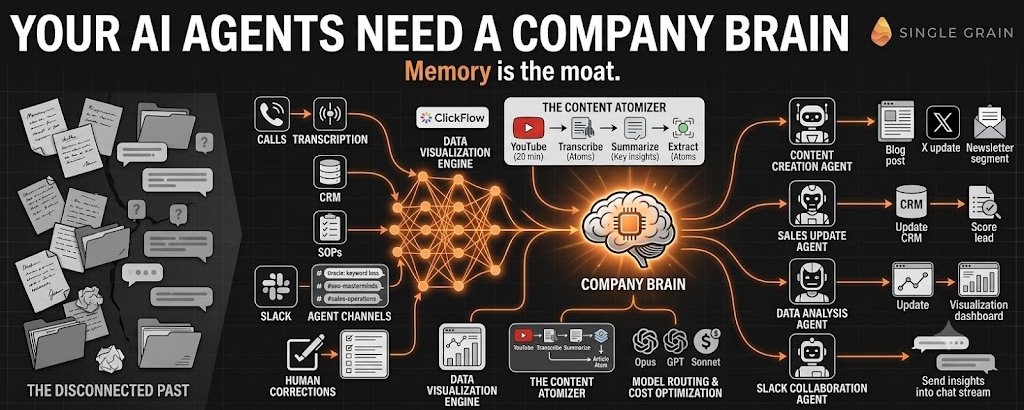
Your company already has a brain. It's just scattered across Slack, Gong, HubSpot, and someone who's out today.
That's the part people miss when they talk about a company brain.
The value isn't a giant folder of company knowledge. Every company already has that.
The real advantage is the intelligence layer that sits between all that context and the work your team needs done.
A company brain isn't useful because it remembers more. It's useful when it knows what to retrieve, what to trust, who can see it, and how to turn corrections into better work.
We learned this the hard way at Single Grain.
When we first started building our internal agent fleet, the obvious answer was memory. Give every agent more context. Save the useful notes. Keep the call transcripts. Let the system remember what the humans forget.
That worked for about three weeks. Then memory itself became the bottleneck.
Our persistent memory files started eating about 40% of the context window. Agents had more information, but they weren't always pulling the right information at the right time.
The system was technically smarter, but operationally much messier.
## Here's the 5-layer system we used to fix this:
The broken version:
```
Call transcript
↓
Random notes
↓
Human remembers
↓
Agent starts cold
↓
Human re-explains
```
That loop doesn't scale.
The human becomes the router. Every agent output depends on whether someone remembered the right call, copied the right note, pasted the right context, or corrected the same mistake for the fifth time.
So we rebuilt the system around a different idea.
Memory is the raw material. Retrieval is the operating layer.
The working version looks more like this:
```
text
Calls ─────┐
CRM ───────┼──► Retrieval ─► Agent ─► Work
SOPs ──────┤ ▲ │
Slack ─────┘ │ ▼
Human correction ─► Rule
```
That one change sounds small, but it changes how the whole company works.
At SG, this is already running across real workflows. We have 500K+ tokens of persistent memory, 90+ daily crons, multiple specialized agents, and thousands of sales calls feeding the system.
One source set included 2,862 Gong call transcripts turned into operational playbooks. In one daily ingestion example, 15 calls produced 390 insights, 470 facts, and 125 frameworks.
That doesn't matter because the number is big. It matters because the system can turn scattered company exhaust into reusable operating intelligence.
A call is no longer just a call. It becomes:
- an objection library
- a sales training input
- a positioning signal
- a content idea source
- a CRM risk flag
- a future agent instruction
A Company Brain should convert knowledge into better execution.
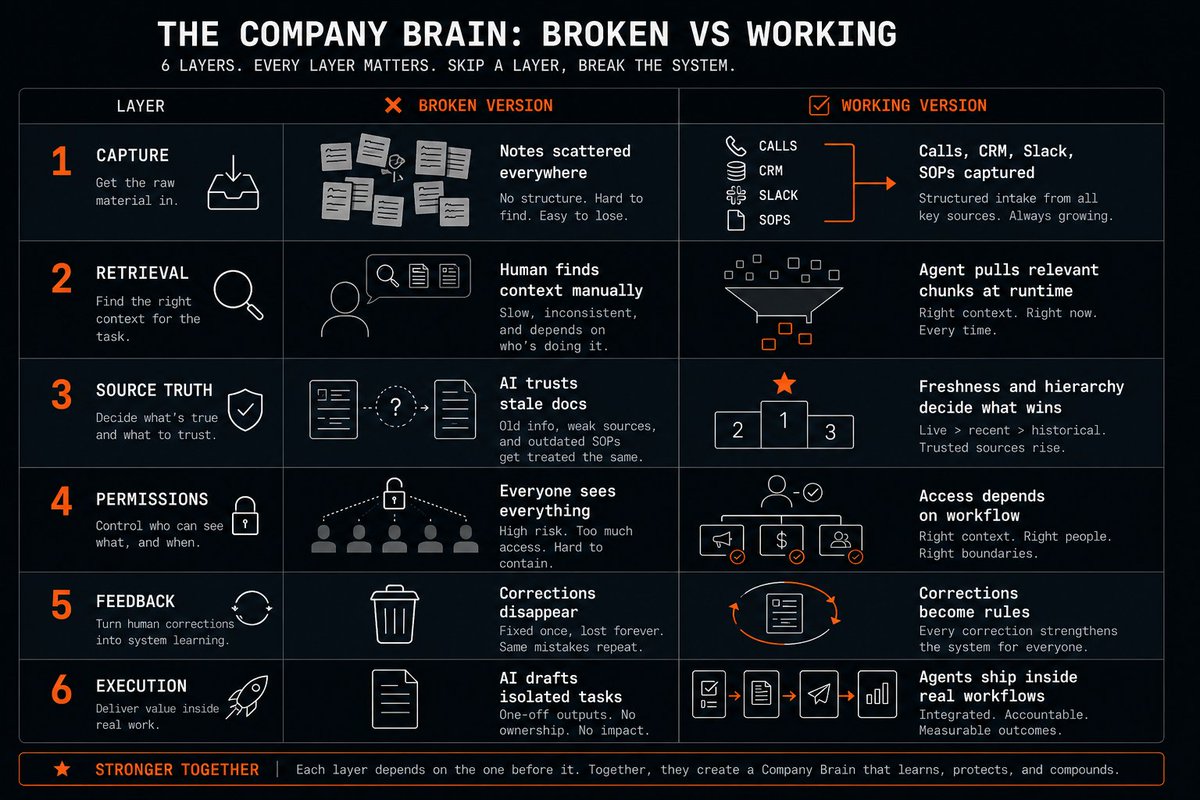
Think about the architecture in five layers.
```
┌──────────────┐
│ Execution │ agents, workflows
├──────────────┤
│ Feedback │ corrections → rules
├──────────────┤
│ Permission │ who can use what
├──────────────┤
│ Source Truth │ what to trust
├──────────────┤
│ Retrieval │ right context now
├──────────────┤
│ Capture │ calls, CRM, SOPs
└──────────────┘
```
## Layer 1: capture
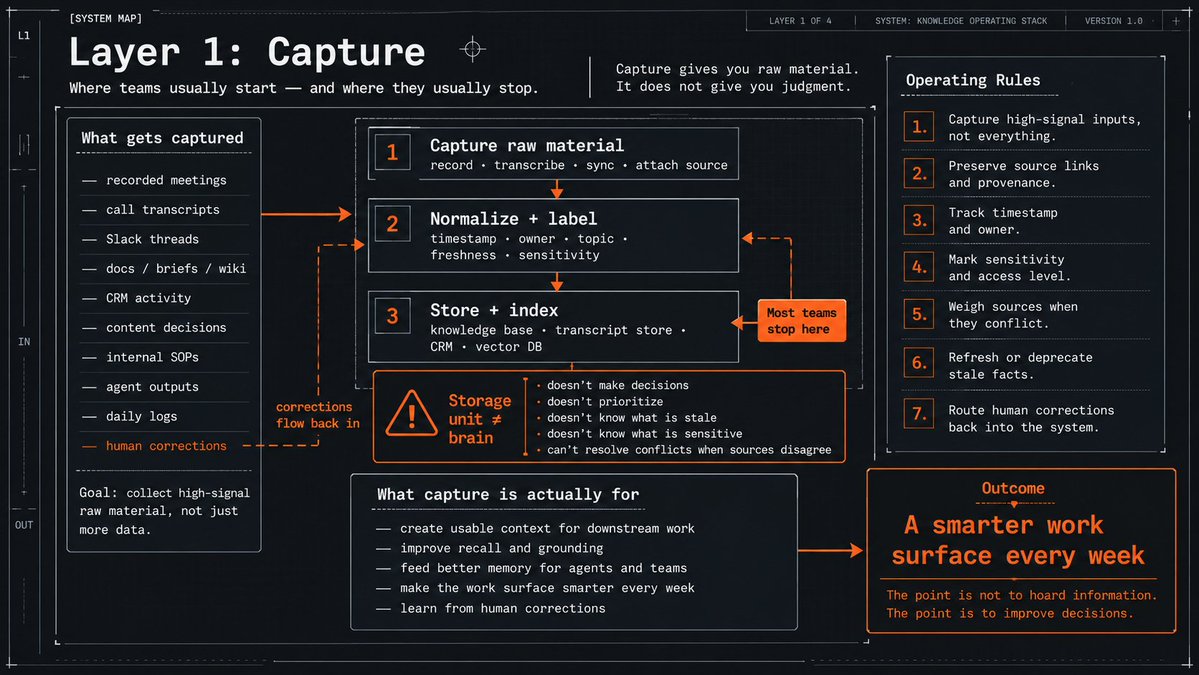
This is where teams usually start, and it's also where they usually stop.
They record meetings. They transcribe calls. They save Slack threads. They dump docs into a vector database. Then they call it a brain.
That's a storage unit, not a brain.
Capture matters because you need raw material. But raw material doesn't make decisions. It doesn't prioritize. It doesn't know which fact is stale, which note is sensitive, or which source should win when two docs disagree.
At Single Grain, capture includes calls, CRM activity, content decisions, internal SOPs, agent outputs, daily logs, and corrections from humans. The point isn't to hoard more information. The point is to make the work surface smarter every week.
## Layer 2: retrieval
Retrieval is where the system starts becoming useful.
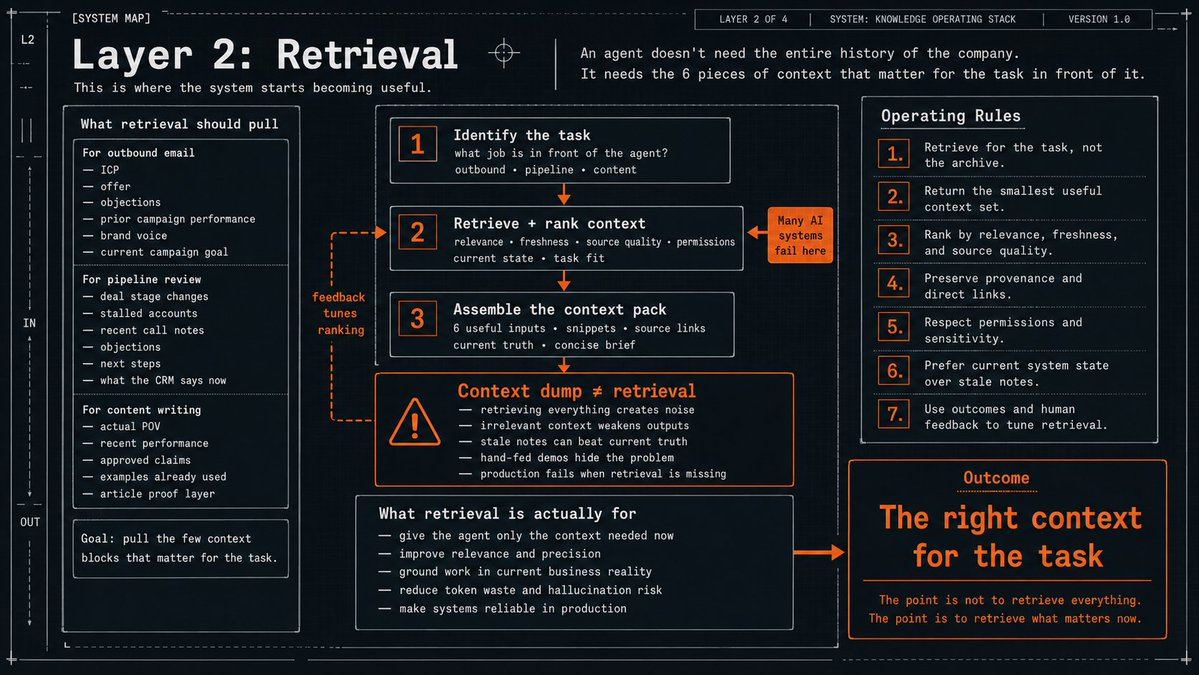
An agent doesn't need the entire history of the company. It needs the 6 pieces of context that matter for the task in front of it.
If it's drafting an outbound email, it needs the ICP, offer, objections, prior campaign performance, brand voice, and current campaign goal.
If it's reviewing pipeline, it needs deal stage changes, stalled accounts, recent call notes, objections, next steps, and what the CRM says now.
If it's writing content, it needs our actual POV, recent performance, approved claims, examples we've already used, and the specific article's proof layer.
This is where a lot of AI systems quietly fail. They look smart in a demo because the context is hand-fed. Then they fall apart in production because nobody built the retrieval layer.
## Layer 3: source truth
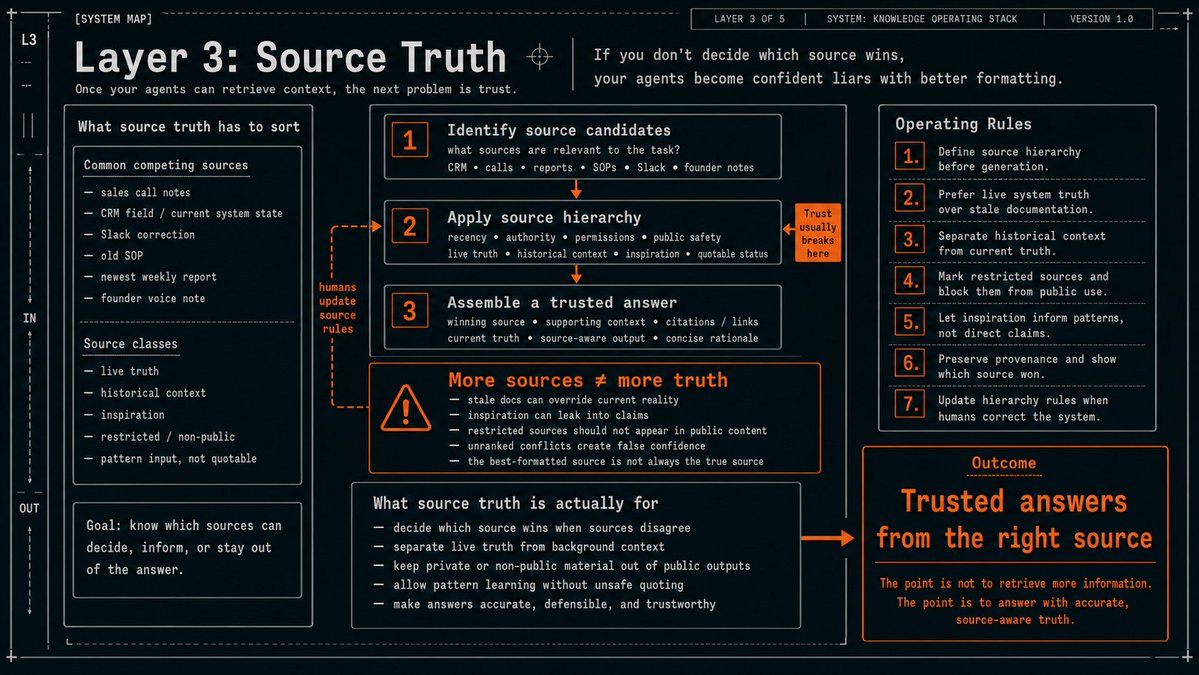
Once your agents can retrieve context, the next problem is trust.
Which source wins?
The sales call? The CRM field? The Slack correction? The old SOP? The newest weekly report? The founder's latest voice note?
If you don't answer that, your agents become confident liars with better formatting.
We had to treat source hierarchy as an operating design problem. Some sources are live truth. Some are historical context. Some are inspiration. Some should never be used in public content. Some can inform a pattern but can't be quoted.
That distinction matters more as the company brain grows.
A good answer from an AI system has to be accurate and source-aware.
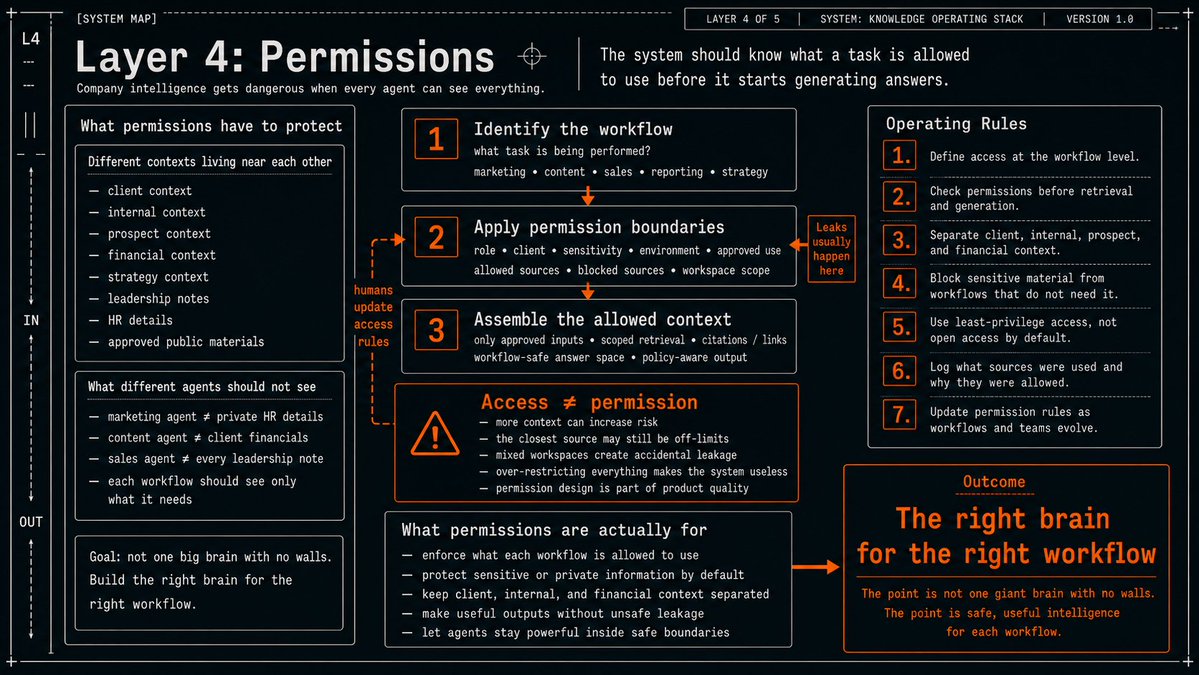
## Layer 4: permissions
Company intelligence gets dangerous when every agent can see everything.
The marketing agent doesn't need private HR details. The content agent doesn't need client financials. The sales agent doesn't need every internal leadership note.
A real Company Brain needs workflow-level permissions. The system should know what a task is allowed to use before it starts generating answers.
This is especially important for agencies and services companies. You have client context, internal context, prospect context, financial context, and strategy context living near each other. If you don't build permission boundaries early, you either leak things or neuter the system until it's useless.
The goal is not one big brain with no walls. The goal is the right brain for the right workflow.
## Layer 5: feedback loops
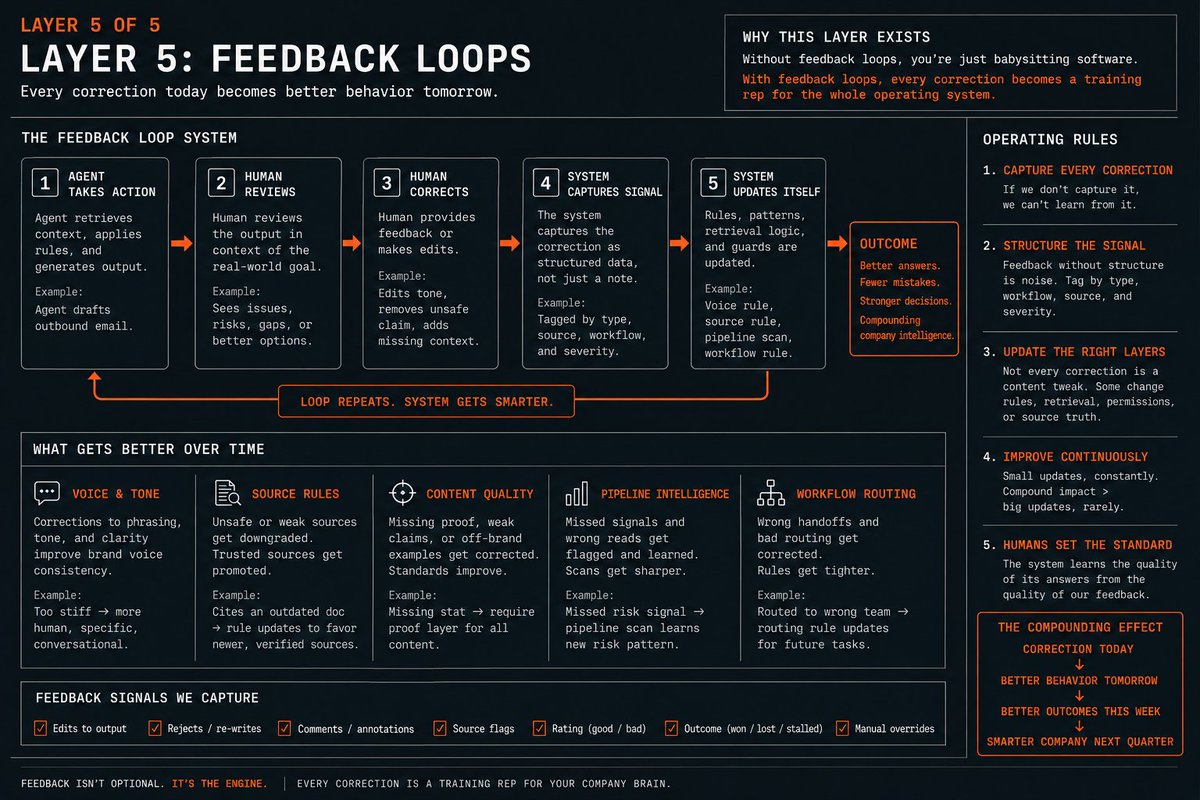
This is the layer that makes the system compound.
Every time a human corrects an agent, that correction should become future behavior.
If the agent uses a stiff phrase, the voice rule should update. If it cites an unsafe example, the source rule should update. If it misses a CRM risk signal, the pipeline scan should update. If it routes work to the wrong place, the workflow rule should update.
This is where company intelligence turns into company learning.
Without feedback loops, you're just babysitting software.
With feedback loops, every correction becomes a training rep for the whole operating system.
Here's the audit I would run if I were building this inside a company tomorrow:
The fastest test is simple.
Pick one recurring workflow that already wastes time. Weekly reporting. Pipeline review. Content drafting. Sales call follow-up. Client onboarding. Proposal creation.
Then ask 6 questions:
> 1. What sources does this workflow depend on?
> 2. Which source is the truth when they conflict?
> 3. What context does the agent need every time?
> 4. What context should the agent never see?
> 5. What human corrections happen repeatedly?
> 6. How does one correction become a future rule?
If you can't answer those, you're not ready to automate the workflow yet. You'll just make the mess faster.
We saw this with reporting.
The old flow was data pulling, manual interpretation, leadership follow-up, and then more clarification. A weekly reporting loop could involve about 25 minutes of data pulling plus hours of follow-up.
Once the brain had the right context, the answer could come back in under 60 seconds.
The time savings are nice. But the bigger win is decision latency.
When a company can ask better questions faster, it starts operating differently. Leaders don't wait for someone to assemble the dashboard. Operators don't start from zero. Agents don't wake up stupid every morning.
This is the actual Single Brain advantage.
It makes the company harder to forget, faster to teach, and easier to operate.
> The companies that win with AI won't be the ones with the biggest prompt library. They'll be the ones with the cleanest intelligence layer.
Capture the work.
Retrieve the right context.
Know what to trust.
Protect what shouldn't be used.
Turn every correction into a rule.
That's how the brain compounds.
If you're a business interested in having AI systems built for you, check out https://www.singlebrain.com
For marketing help, just go to https://www.singlegrain.com
For more like this, level up your marketing with 14,000+ marketers and founders in my Leveling Up newsletter here for free: https://levelingup.beehiiv.com/subscribe
If you want to join up with our team, 'beat AI' first ;)
## 相关链接
- [ericosiu](https://x.com/ericosiu)
- [@ericosiu](https://x.com/ericosiu)
- [76K](https://x.com/ericosiu/status/2060415100603781497/analytics)
- [Single Brain](https://www.singlebrain.com/)
- [https://www.singlebrain.com](https://www.singlebrain.com/)
- [https://www.singlegrain.com](https://www.singlegrain.com/)
- [https://levelingup.beehiiv.com/subscribe](https://levelingup.beehiiv.com/subscribe)
- ['beat AI' first ;)](https://www.singlegrain.com/apply)
- [Upgrade to Premium](https://x.com/i/premium_sign_up)
- [1:36 AM · May 30, 2026](https://x.com/ericosiu/status/2060415100603781497)
- [76.7K Views](https://x.com/ericosiu/status/2060415100603781497/analytics)
- [View quotes](https://x.com/ericosiu/status/2060415100603781497/quotes)
---
*导出时间: 2026/5/30 10:45:22*
---
## 中文翻译
# 我们是如何构建“单一公司大脑”的(以及你也可以如何做到)
**作者**: ericosiu
**日期**: 2026-05-29T17:36:55.000Z
**来源**: [https://x.com/ericosiu/status/2060415100603781497](https://x.com/ericosiu/status/2060415100603781497)
---

你的公司其实已经拥有了一个大脑。只是它散落在 Slack、Gong、HubSpot 以及今天请假的那个人脑子里。
这就是人们在谈论“公司大脑”时经常忽略的部分。
价值不在于存放公司知识的一个巨型文件夹。每个公司都已经有了那个东西。
真正的优势在于位于所有这些上下文和团队需要完成的工作之间的“智能层”。
公司大脑之所以有用,不是因为它的记忆力更好。而是因为它知道该检索什么、该信任什么、谁能看到这些信息,以及如何将修正转化为更好的工作成果。
我们在 Single Grain 是通过惨痛的教训才明白这一点的。
当我们开始构建内部智能体舰队时,显而易见的答案就是“记忆”。给每个智能体更多的上下文。保存有用的笔记。保留通话记录。让系统记住人类会遗忘的东西。
这招大概奏效了三个星期。随后,“记忆”本身成了瓶颈。
我们的持久化记忆文件开始吞噬大约 40% 的上下文窗口。智能体掌握的信息更多了,但它们并不总能在对的时间拉取对的信息。
系统在技术上更聪明了,但在实际操作上却变得更加混乱。
## 以下是我们用来解决这个问题的 5 层系统:
崩溃的版本:
```
通话记录
↓
随机笔记
↓
人类记忆
↓
智能体从零开始
↓
人类重新解释
```
那个循环无法规模化。
人类变成了路由器。每一个智能体的输出都依赖于某人是否记住了正确的通话、复制了正确的笔记、粘贴了正确的上下文,或者是否第五次纠正了同一个错误。
所以我们围绕一个不同的理念重建了系统。
记忆是原材料。检索是操作层。
工作正常的版本看起来更像这样:
```
text
通话 ─────┐
CRM ───────┼──► 检索 ─► 智能体 ─► 工作
SOPs ──────┤ ▲ │
Slack ─────┘ │ ▼
人类修正 ─► 规则
```
这一个小改变听起来微不足道,但它改变了整个公司的运作方式。
在 SG(Single Grain),这个系统已经运行在真实的工作流中。我们要拥有超过 50 万 tokens 的持久化记忆,90 多个每日定时任务,多个专用智能体,以及数千个销售通话在为系统提供数据。
其中一个数据源包含了 2,862 份 Gong 通话记录,它们被转化成了运营操作手册。在一个每日数据摄取的例子中,15 个通话产生了 390 个洞察、470 个事实和 125 个框架。
这之所以重要,并不是因为数字很大,而是因为系统能将分散的公司“废气”(exhaust)转化为可复用的运营智能。
一个通话不再仅仅是一个通话。它变成了:
- 一个异议库
- 一个销售培训输入
- 一个定位信号
- 一个内容创意来源
- 一个 CRM 风险标记
- 一个未来的智能体指令
一个公司大脑应该将知识转化为更好的执行。
从五个层面来思考这个架构。
```
┌──────────────┐
│ 执行层 │ 智能体,工作流
├──────────────┤
│ 反馈层 │ 修正 → 规则
├──────────────┤
│ 权限层 │ 谁可以使用什么
├──────────────┤
│ 真实来源层 │ 该信任什么
├──────────────┤
│ 检索层 │ 当前正确的上下文
├──────────────┤
│ 捕获层 │ 通话,CRM,SOPs
└──────────────┘
```
## 第 1 层:捕获
这是团队通常开始的地方,也是他们通常止步的地方。
他们录制会议。转录通话。保存 Slack 线程。把文档倾倒进向量数据库。然后他们宣称这就叫大脑。
那是一个仓库,不是大脑。
捕获很重要,因为你需要原材料。但原材料不做决策。它不区分优先级。它不知道哪个事实已过时,哪条笔记是敏感的,或者当两个文档发生冲突时该以哪个来源为准。
在 Single Grain,捕获包括通话、CRM 活动、内容决策、内部 SOP(标准作业程序)、智能体输出、每日日志以及人类的修正。重点不是囤积更多信息,而是让工作表面每周都变得更聪明。

## 第 2 层:检索
检索是系统开始变得有用的地方。
智能体不需要公司的整个历史记录。它需要的是与当前任务相关的 6 个上下文片段。
如果它在撰写外发邮件,它需要 ICP(理想客户画像)、报价、异议、过往营销活动的表现、品牌语调以及当前活动目标。
如果它在审查销售管道,它需要交易阶段变化、停滞的账户、最近的通话笔记、异议、下一步措施以及 CRM 当前的状态。
如果它在撰写内容,它需要我们要实际的 POV(观点)、最近的表现、已批准的宣称、我们已经用过的例子,以及特定文章的证明层级。
这是许多 AI 系统悄悄失效的地方。它们在演示中看起来很聪明,因为上下文是人工喂养的。然后它们在生产环境中崩溃,因为没有人构建检索层。

## 第 3 层:真实来源
一旦你的智能体能够检索上下文,下一个问题就是信任。
哪个来源胜出?
销售通话?CRM 字段?Slack 修正?旧的 SOP?最新的周报?创始人最新的语音备忘录?
如果你不回答这个问题,你的智能体就会变成自信的骗子,而且格式排版更好。
我们必须将来源层级视为一个操作设计问题。有些来源是实时真相。有些是历史背景。有些是灵感。有些绝不应该用于公开内容。有些可以提供模式参考但不能被引用。
随着公司大脑的增长,这种区分变得更加重要。
AI 系统给出的一个好的答案必须是准确的且明确来源的。

## 第 4 层:权限
当每个智能体都能看到一切时,公司情报就会变得危险。
营销智能体不需要私密的 HR 细节。内容智能体不需要客户的财务数据。销售智能体不需要每一条内部领导层笔记。
一个真正的公司大脑需要工作流级别的权限。系统应该在开始生成答案之前就知道任务允许使用什么。
这对于代理商和服务型公司尤为重要。你有客户上下文、内部上下文、潜在客户上下文、财务上下文和战略上下文比邻而居。如果你不尽早构建权限边界,你要么会泄露信息,要么会把系统阉割到毫无用处。
目标不是拥有一个没有围墙的大脑。目标是为正确的工作流提供正确的大脑。

## 第 5 层:反馈循环
这是让系统产生复利效应的层级。
每次人类修正智能体时,那个修正都应成为未来的行为准则。
如果智能体使用了生硬的措辞,语调规则应该更新。如果它引用了不安全的例子,来源规则应该更新。如果它漏掉了一个 CRM 风险信号,管道扫描应该更新。如果它把工作路由到了错误的地方,工作流规则应该更新。
这就是公司情报转化为公司学习的地方。
没有反馈循环,你只是在看护软件。
有了反馈循环,每一次修正都成为整个操作系统的训练次数。

如果我是明天在公司内部构建这个系统,我会执行以下审计:

最快的测试很简单。
选择一个已经在浪费时间重复性工作流。周报。管道审查。内容起草。销售电话跟进。客户入职。提案创建。
然后问 6 个问题:
> 1. 这个工作流依赖于哪些来源?
> 2. 当它们发生冲突时,哪个来源是真相?
> 3. 智能体每次需要什么上下文?
> 4. 智能体绝不应该看到什么上下文?
> 5. 哪些人类修正在重复发生?
> 6. 一个修正如何变成未来的规则?
如果你回答不了这些问题,你还没准备好自动化那个工作流。你只会把混乱制造得更快。
我们在报表工作中看到了这一点。
旧的流程是数据拉取、人工解读、领导层跟进,然后是更多的澄清。一个周报循环可能涉及大约 25 分钟的数据拉取加上数小时的跟进。
一旦大脑拥有了正确的上下文,答案可以在 60 秒内返回。
节省下来的时间固然不错。但更大的胜利在于决策延迟。
当一家公司能更快地提出更好的问题时,它的运作方式就会开始改变。领导者不需要等待某人去组装仪表盘。操作者不需要从零开始。智能体不会每天早上醒来时都很蠢。
这就是真正的“单一大脑”优势。
它让公司更难遗忘、更快学会、更易于运营。
> 在 AI 领域获胜的公司不会是那些拥有最大提示词库的公司。而是那些拥有最清洁智能层的公司。
捕获工作。
检索正确的上下文。
知道该信任什么。
保护不该使用的内容。
将每一次修正转化为规则。
这就是大脑产生复利的方式。
如果你是一家有兴趣构建 AI 系统的企业,请访问 https://www.singlebrain.com
如需营销方面的帮助,请访问 https://www.singlegrain.com
欲获取更多类似内容,请在此处免费加入我的 Leveling Up 通讯,与 14,000 多名营销人员和创始人一起提升你的营销水平:https://levelingup.beehiiv.com/subscribe
如果你想加入我们的团队,请先通过 'beat AI' 测试 ;)
## 相关链接
- [ericosiu](https://x.com/ericosiu)
- [@ericosiu](https://x.com/ericosiu)
- [76K](https://x.com/ericosiu/status/2060415100603781497/analytics)
- [Single Brain](https://www.singlebrain.com/)
- [https://www.singlebrain.com](https://www.singlebrain.com/)
- [https://www.singlegrain.com](https://www.singlegrain.com)
- [https://levelingup.beehiiv.com/subscribe](https://levelingup.beehiiv.com/subscribe)
- ['beat AI' first ;)](https://www.singlegrain.com/apply)
- [升级到 Premium](https://x.com/i/premium_sign_up)
- [1:36 AM · May 30, 2026](https://x.com/ericosiu/status/2060415100603781497)
- [76.7K 观看次数](https://x.com/ericosiu/status/2060415100603781497/analytics)
- [查看引用](https://x.com/ericosiu/status/2060415100603781497/quotes)
---
*导出时间: 2026/5/30 10:45:22*