# What It Takes to Get Paid
**作者**: Tarek Alaruri
**日期**: 2026-08-12T14:02:26.000Z
**来源**: [https://x.com/realtarek/status/2087540216298885512](https://x.com/realtarek/status/2087540216298885512)
---
The contract was signed, the price was agreed, the product was delivered, the work was done, the customer is happy. The only question left is when the money actually arrives, and the honest answer is that nobody quite knows. Next week, maybe. October, maybe.
Identical invoices to similar customers can pay in days or drift for months, and past a certain point someone on your side has to start asking about it, carefully, because the person on the other end is also your customer.
That is the odd bargain at the center of B2B: the sale is settled, the timing is not. On paper, the terms are tidy: net 30, meaning payment due 30 days after the invoice. There is a whole profession built around the gap between those terms and reality. This piece is about what getting paid actually takes.
This edition of our weekly chartpost series goes inside the most awkward recurring conversation in business: asking to be paid for what you already delivered. That is where our data comes from. Stuut builds the AI agent that runs collections for B2B companies. Its vantage point covers billions of dollars worth of receivables at any given moment. This is data from the ledger and the inbox, where money moves or refuses to, and the work that gets done to move it.
Let’s start with the size of the problem:
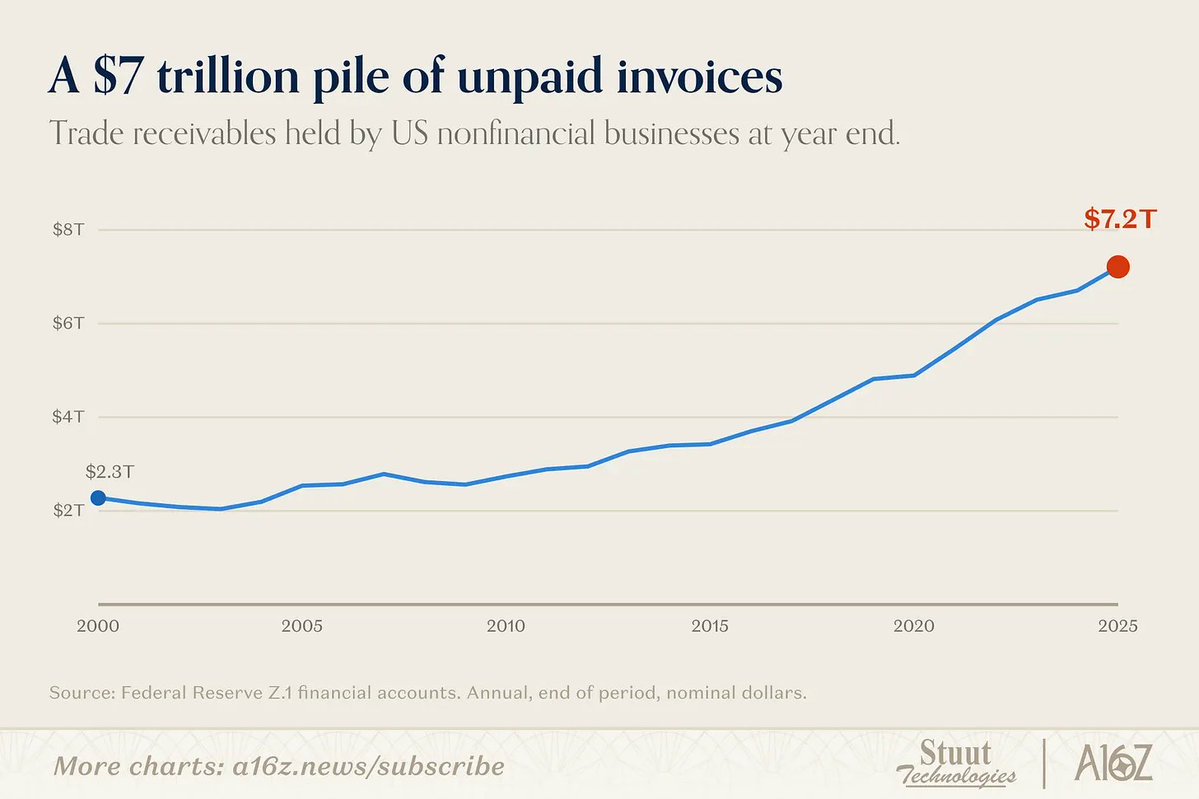
US nonfinancial businesses were sitting on $7.2 trillion of trade receivables at the end of 2025, money owed for goods and services already delivered. At trillions with a T scale, small delays are expensive: at the collection speeds typical in this data, one extra day of average delay is $150 billion or so. And with the Fed funds rate holding at 3.5 to 3.75%, none of the waiting is free. And the pile keeps growing.
Unpaid Invoices Are Unevenly Distributed
There is no single answer to how long the money sits in this pile. The time from when an invoice is issued to the moment the cash lands is a “results may vary” process:
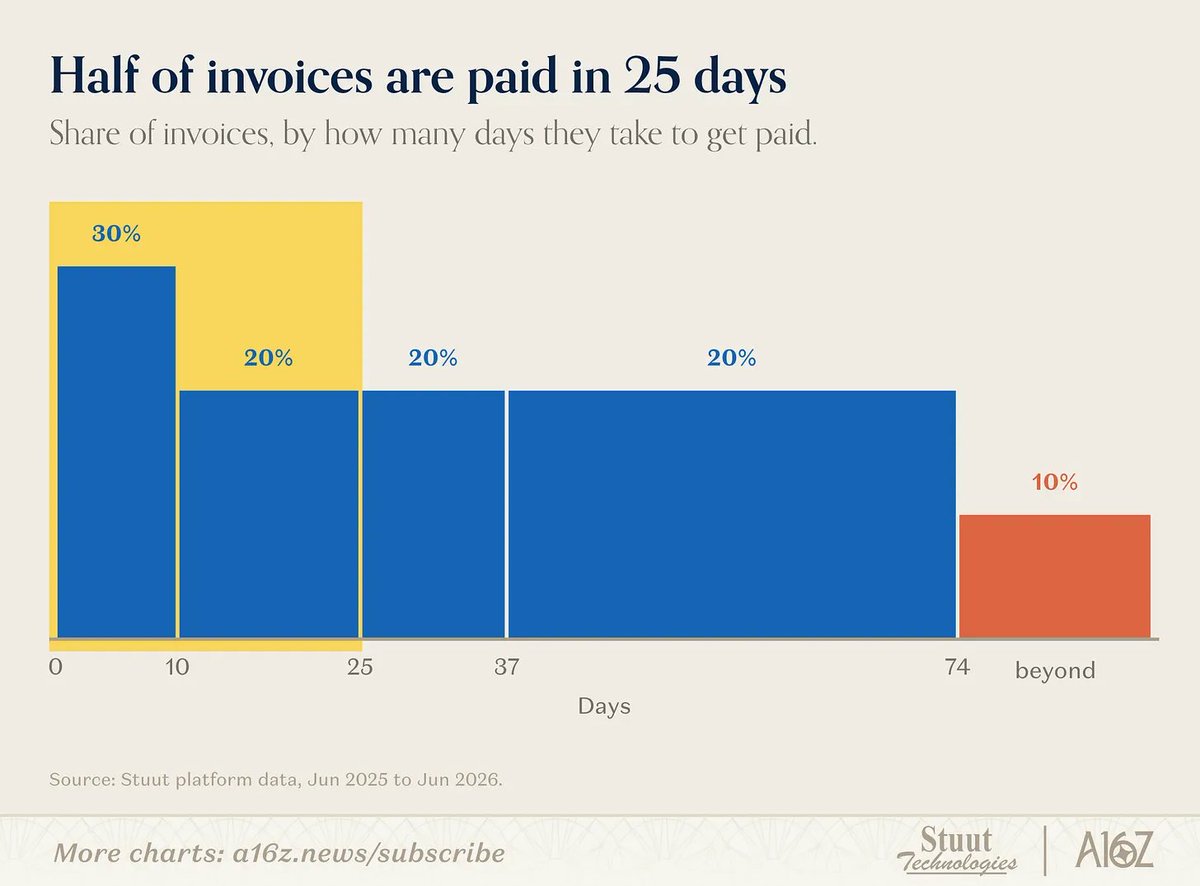
The typical invoice is fine. A tenth of invoices are paid within a day (nice), and half of all invoices turn to cash within 25 days, with little drama or chasing. Then the axis stretches: moving from 70% paid to 90% paid takes you from day 37 all the way to day 74, and the last tenth drifts far beyond that. If the median invoice shows up on its own inside a month, collections as a profession exists for the other half.
The finance world grades this entire struggle with one number: DSO, days sales outstanding, which is essentially the average age of the money you are owed. Boards track it. CFOs get compensated on it. But that turns out to be an oversimplification, and a good DSO does NOT mean collections is healthy. Turns out that reporting the average over a very skewed distribution can hide almost anything.
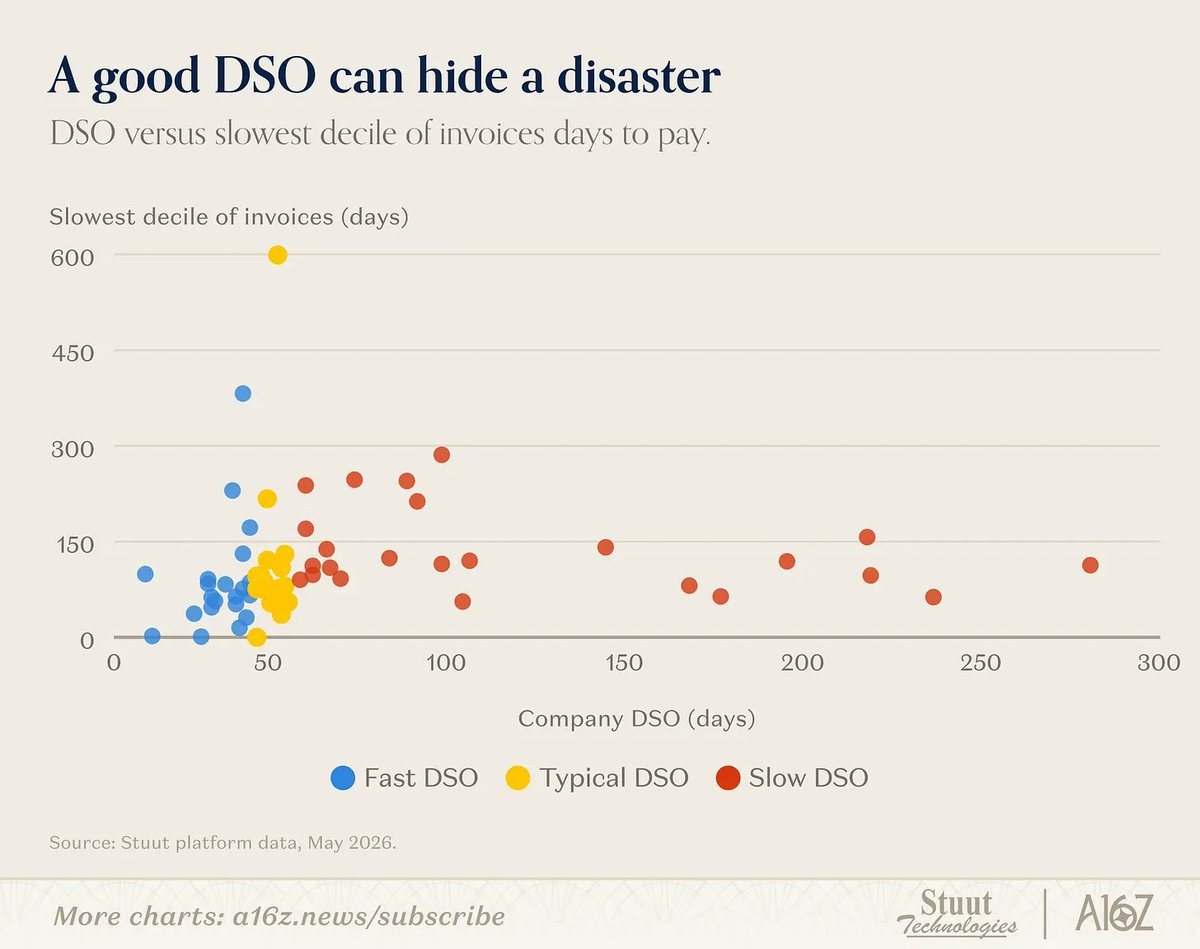
Take the companies scoring in the 40s, a respectable DSO by most standards. Inside that band, one company’s slowest tenth of invoices pays same-day, and another’s takes 599 days. Same headline number, opposite problems. The first book is healthy: its stragglers come loose with a phone call. The second only looks healthy: fast payers up front hide money that may never arrive. That is a write-off waiting to be admitted, and likely a big one (we’ll get to that). Across the companies in the data, the same May snapshot spans DSO 8.8 to 280. For a number of reasons, the scoreboard cannot tell sick from healthy.
So, if the DSO as an average will not tell you where the money is, what will?
Bigger Invoices, Bigger Problems
Start with where the late money actually sits. Collections folklore treats it as a volume game: thousands of small invoices, an army of reminders, grind down the long tail. The data shows the opposite.
For the typical company, the biggest tenth of past-due invoices holds 65.7% of the overdue dollars, and the middle half lands between 55.5% and 74.1%. Count the leftovers: the smallest 80% of past-due invoices are fighting over the last fifth of the money. Collections is less of a grinding problem and more of a search problem: find the few invoices that move the number, and put your best effort there.
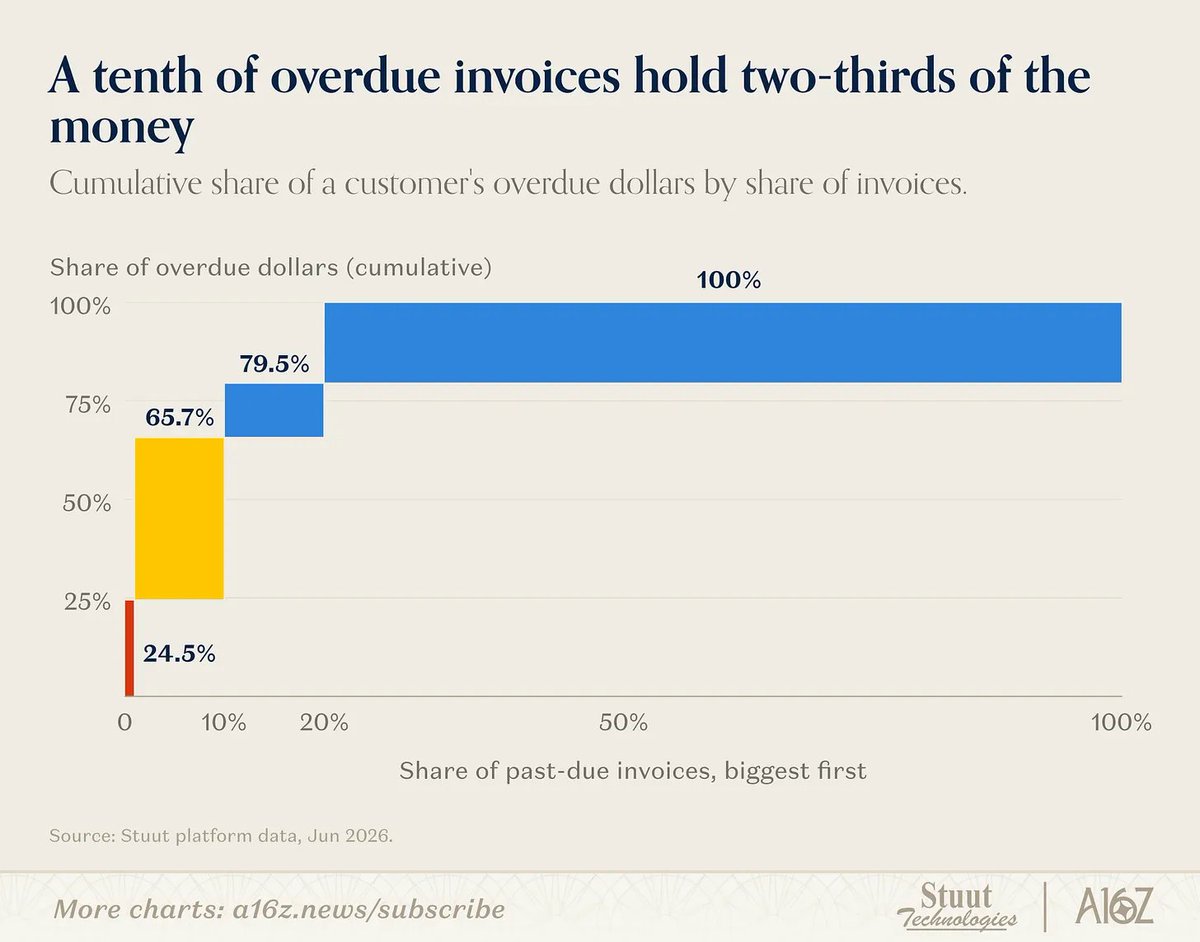
The largest receivables books are the most top-heavy of all. The bigger the book, the more its money crowds into a few invoices, so the operators sitting on the most overdue dollars are the ones for whom the search problem is most extreme.
The concentration is not an accident of bad luck. It is inherited from where B2B revenue comes from in the first place:
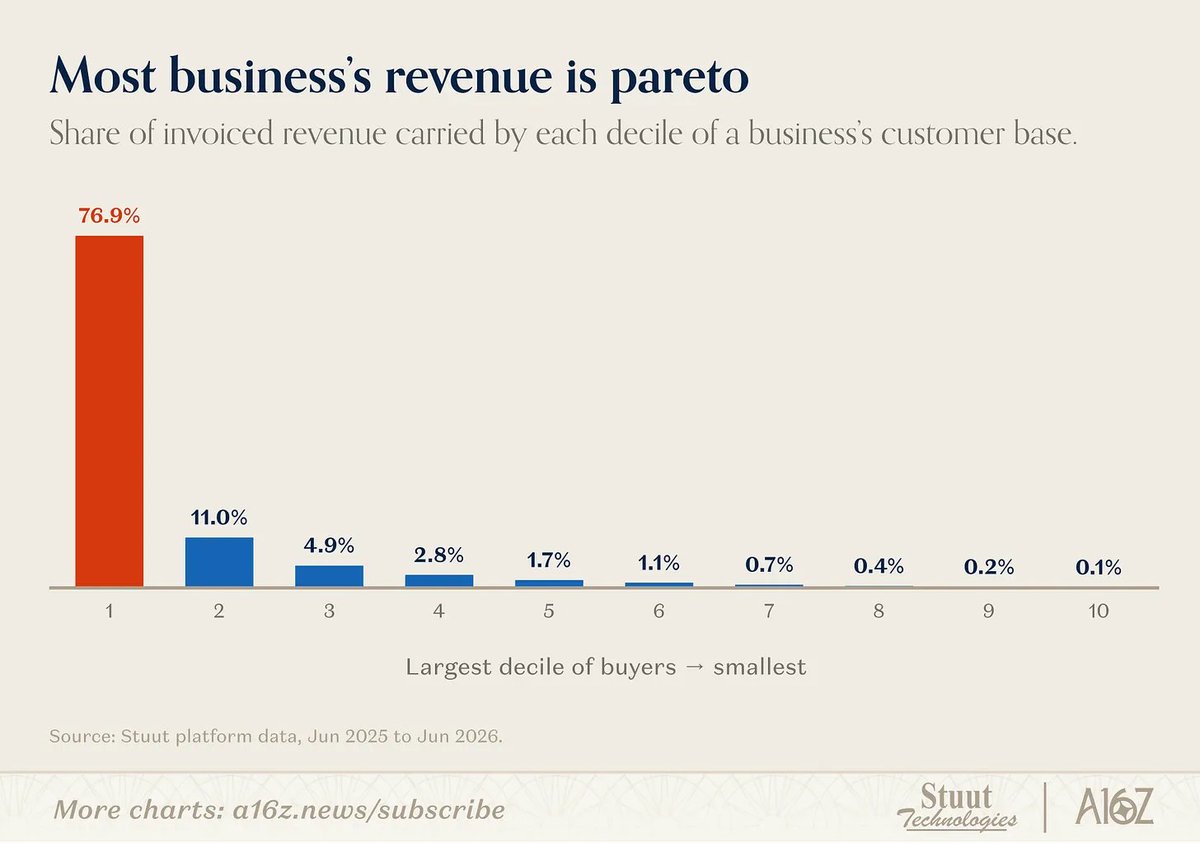
Welcome to today’s episode of “everything is an 80/20 rule”. The pattern varies little from company to company. For most B2B companies, a tenth of your buyers are the meat of your business, so when money goes missing, it goes missing in size.
Conventional accounting wisdom says big invoices pay slow. The $250,000 invoice crawls through procurement and approvals while the $2,000 one sails through. This is correct but not the meat of the issue.
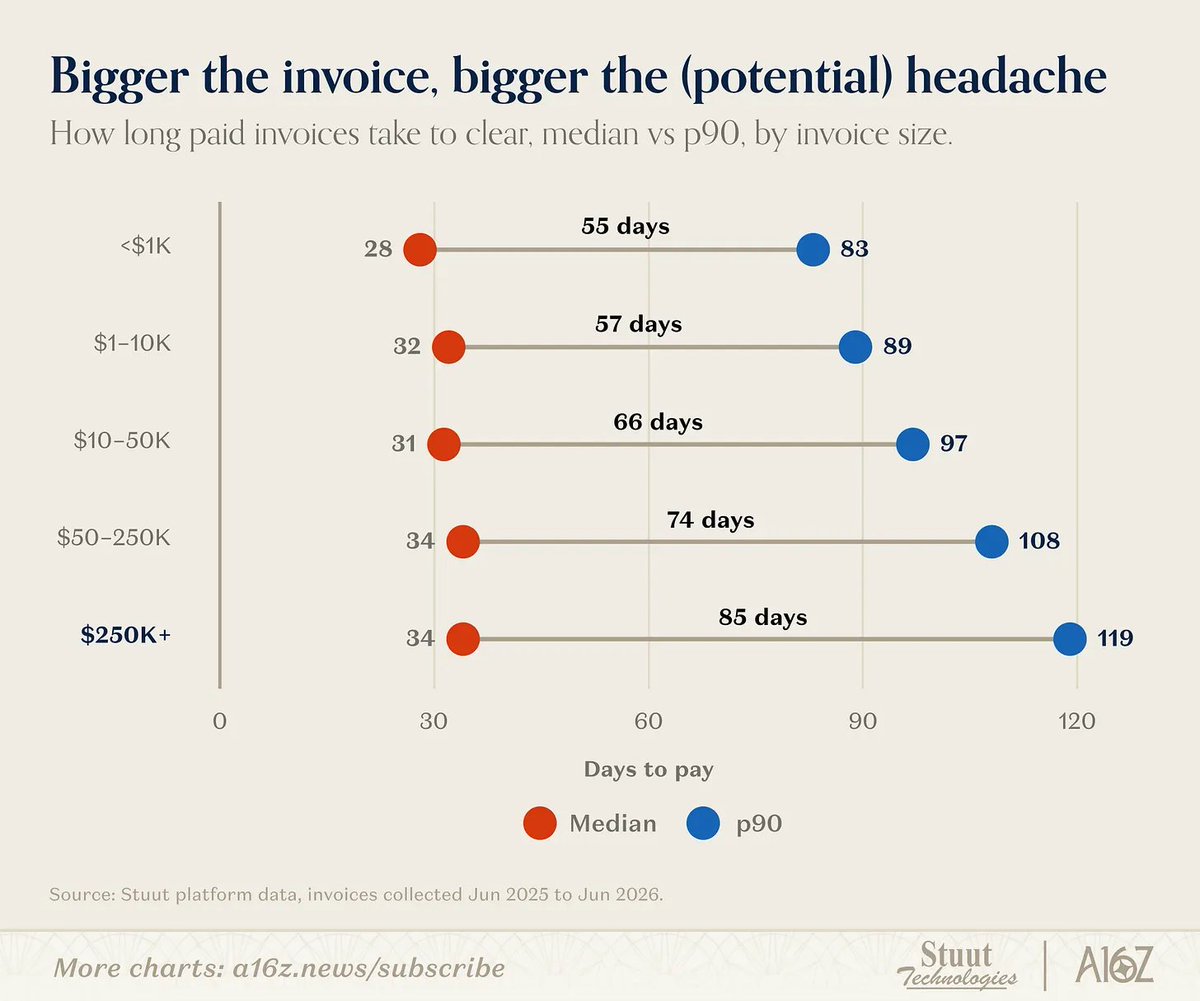
The typical invoice pays in 28 to 34 days in every size band, from under $1,000 to over $250,000. Yeah, it is a little slower for bigger invoices, but a quarter-million-dollar invoice is not meaningfully slower than a small one, most of the time. What grows with size is the pain for the slowest tenth, which stretches 36 days, from 83 days on the smallest invoices to 119 on the largest. Size predicts how badly an invoice can stall.
So what do all these unpaid invoices cost? At a 4% cost of money, a million dollars arriving two months late quietly burns about $6,600. That is a friendly scenario, since in this data, about a quarter of the concentrated overdue money has already sat untouched past 90 days, which is where write-offs are born. Late money is a financing cost; stuck money is a haircut.
Getting Paid Requires Asking
So how do you get paid? It’s as simple as asking.
Some definitions, because the industry has its own vocabulary for this. Any outbound nudge about an unpaid invoice, an email, a call, a text, is what we will call an ask. The trade calls them touches, and arranges them into dunning ladders: preset escalation sequences, seven to ten steps deep, each step a little sterner than the last.
First, the ritual every collector knows. You reach out about the overdue invoice, and the buyer says the magic words: “We’ll pay Friday.” In this data, only about half of the payment promises that came due were kept. But broken promises tell you very little about a buyer. Buyers who broke at least one promise and buyers who kept every single one pay at an identical 41-day median afterward. The data tells us a promise, broken or kept, is worth very little.
But how many times should you expect to have to ask for your money?
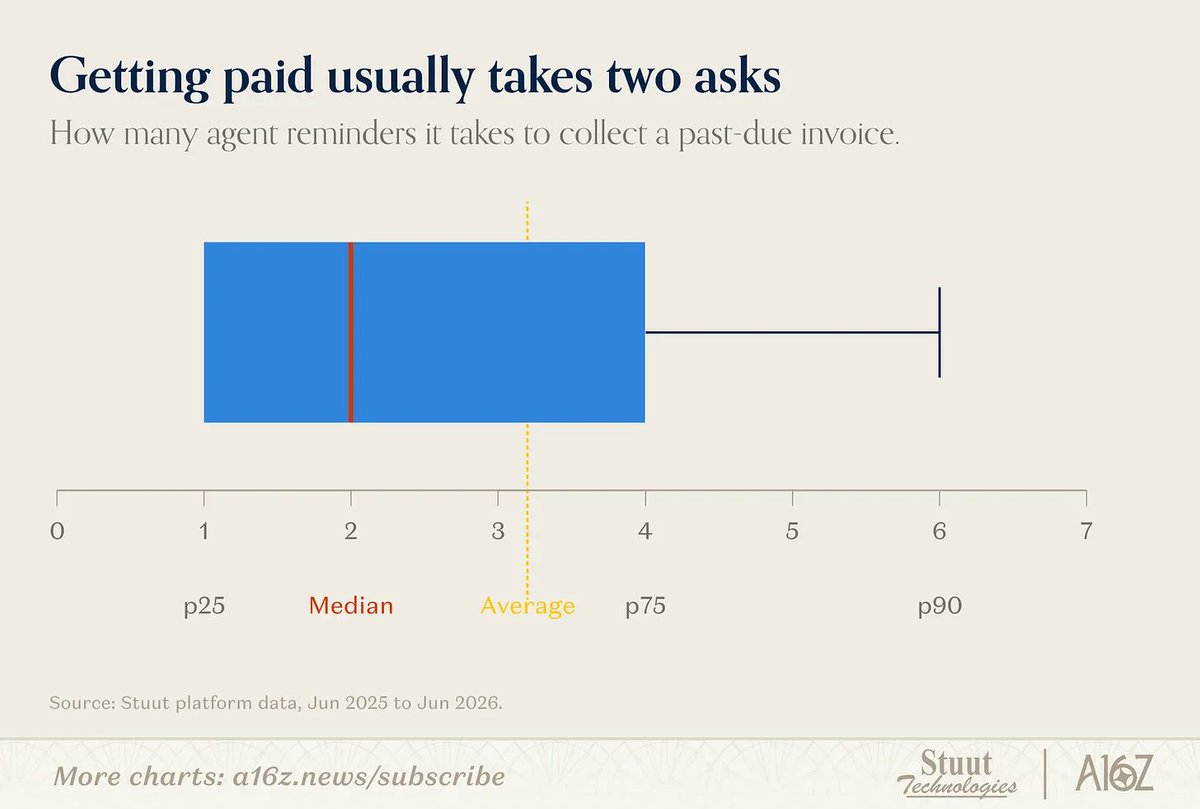
Half of collected past-due invoices close within two asks, and nine in ten close within six. The average sits at 3.2 because a few stubborn invoices soak up attention. Remember the ladder: seven to ten steps, each politely angrier. Barely one in ten invoices that get paid ever climbs past the sixth rung.
None of which makes the early asks pointless: a reminder is part of the choreography of selling to another business. But it means that the choreography is shorter than legacy playbooks assume (a stat that we can likely thank better technology for).
Which brings us to the tricky dance of collections. Every ask lands on someone who is also your customer, so the question is never just how often to ask. It is how hard you can afford to press, and the answer changes with the size of the invoice:
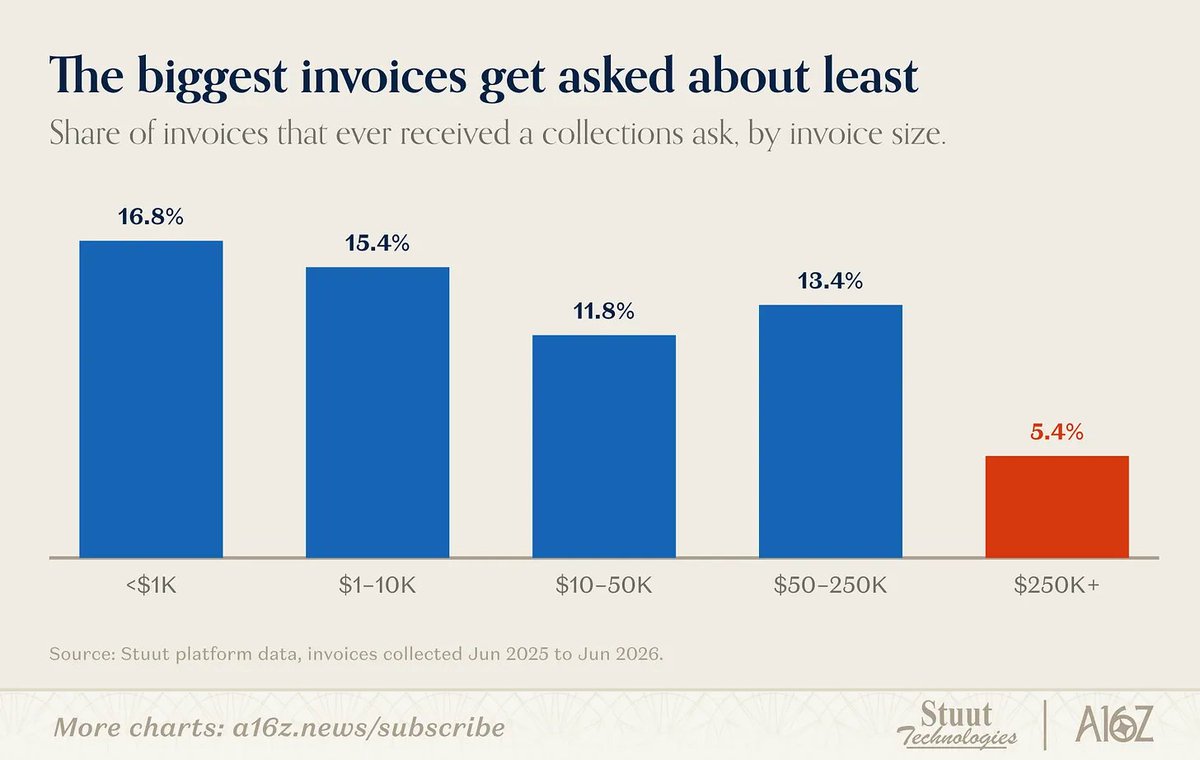
Only 5.4% of $250,000+ invoices ever receive a collections nudge, versus 16.8% of the smallest. Please enjoy the image of the $250,000 invoice that nobody emails. It is not neglect. In fact, it is quite the opposite; invoices that size are relationship-managed, handled in phone calls between humans who know each other, not fed into reminder sequences. This is the art of white-glove service, balancing today’s cash-flow needs and the future value of a relationship.
Now Something Does the Asking for You
Add up what the data has said so far. The money that matters is concentrated in a few invoices. Most of it is still movable. The loudest warning signal carries no information, and when an invoice does get collected, it takes a median of two well-aimed asks. That is a precise job description: read everything, find the few invoices that matter, ask early and often enough, and hand the genuinely stuck cases, and the relationships that matter, to a person with judgment. It is also a job description that is misshaped for a human team, because the reading spans millions of invoices and the asking never ends.
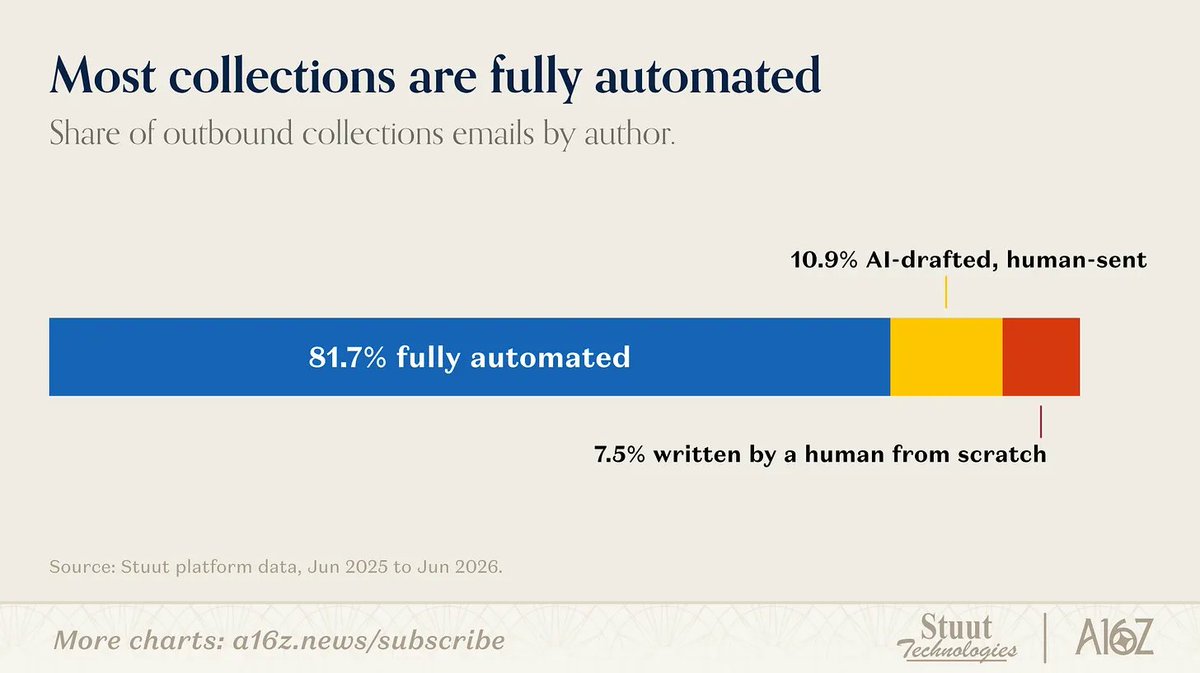
81.7% of outbound collection emails go out with no human involved at all, a tenth are drafted by the agent and reviewed by a person before sending, and just 7.5% are written by a human from scratch. The division of labor is sharper than those email numbers suggest. Judgment work: escalations, disputes, manual calls, and broken-promise follow-ups are still 100% human-resolved, as they should be. The machine does the asking. People handle the fights, and only the fights.
So the asking is concentrated, brief, and mostly automated, and the cost of an ask has collapsed. That changes what the whole function watches. Forget the average age of your money for a moment. Here is the number an agent-run collections team manages: 1.35 outbound asks per $1,000 collected, one ask for every $739 that comes in, with three in five completed collection tasks resolving fully automatically.
The invoice from March is still out there somewhere, waiting in a queue behind nine hundred others. The difference is that something is now asking after it: at dawn, again Thursday if needed, politely every time, for a fraction of a cent per dollar. For as long as businesses have sold to each other, the space between sold and paid has been a void you shouted into.
Now something shouts back, and it never gets tired of asking.
## 相关链接
- [Tarek Alaruri](https://x.com/realtarek)
- [@realtarek](https://x.com/realtarek)
- [7.6K](https://x.com/realtarek/status/2087540216298885512/analytics)
- [Upgrade to Premium](https://x.com/i/premium_sign_up)
- [10:02 PM · Aug 12, 2026](https://x.com/realtarek/status/2087540216298885512)
- [7,648 Views](https://x.com/realtarek/status/2087540216298885512/analytics)
---
*导出时间: 2026/8/12 23:31:54*
---
## 中文翻译
# 收款之道
**作者**: Tarek Alaruri
**日期**: 2026-08-12T14:02:26.000Z
**来源**: [https://x.com/realtarek/status/2087540216298885512](https://x.com/realtarek/status/2087540216298885512)
---

合同签了,价格谈妥了,产品交付了,工作完成了,客户也满意了。唯一剩下的问题是钱什么时候真正到账,而诚实的答案是:没人确切知道。也许下周,也许十月。
给相似客户开出的相同发票,有的几天内就能付款,有的则要拖上数月。超过某个时间点后,你这边就得有人开始过问这件事,而且得小心翼翼,因为对面那个人同时也是你的客户。
这就是B2B核心处那个奇特的交易:销售已经敲定,但时间安排却没有。纸面上,条款是清晰的:net 30,即发票开具后30天内付款。围绕这些条款与现实之间的差距,整个职业应运而生。这篇文章讲的是,真正拿到钱需要什么。
本期每周图表系列将深入探讨商业中最尴尬的重复对话:要求对方为你已经交付的东西付款。我们的数据正来源于此。Stuut构建了为B2B公司运营催收业务的AI代理。它的视角覆盖了任何时刻数十亿美元的应收账款。这些数据来自账本和收件箱,来自资金流动或拒绝流动的地方,以及为促使资金流动所做的工作。
让我们从问题的规模开始:

截至2025年底,美国非金融企业坐拥7.2万亿美元的商业应收账款,即已交付商品和服务所欠的款项。在万亿级别的规模下,小小的延迟都代价高昂:按照该数据中典型的收款速度,平均延迟每增加一天,就相当于约1500亿美元。而联邦基金利率维持在3.5%至3.75%的水平,等待绝非免费。而且这笔堆积还在不断增长。
未付发票分布不均
关于资金在这堆积中停留多久,没有单一答案。从发票开具到现金到账的时间,是一个“结果因人而异”的过程:

典型的发票没问题。十分之一的发票在一天内付清(不错),一半的发票在25天内转化为现金,没什么波折或催收。然后坐标轴开始拉伸:从70%付清到90%付清,时间从第37天一直延伸到第74天,最后那十分之一则漂移得更远。如果中位数发票在一个月内自行出现,那么催收这个职业的存在就是为了另外那一半。
金融界用一数字来评判这整场挣扎:DSO,即应收账款周转天数,本质上就是你被拖欠资金的平均账龄。董事会追踪它,CFO的薪酬与它挂钩。但事实证明这是一种过度简化,一个好的DSO并不意味着催收是健康的。事实证明,在一个极度偏斜的分布上报告平均值,几乎可以掩盖任何事情。

以那些得分在40多分的公司为例,按大多数标准这是一个体面的DSO。在这个区间内,一家公司最慢的十分之一发票当天付款,而另一家的则要599天。相同的头条数字,截然相反的问题。第一本账是健康的:它的掉队者一个电话就能松动。第二本只是看起来健康:前面的快速付款者掩盖了可能永远不会到的钱。那是一个等待被承认的坏账,而且很可能是一笔大数目(我们稍后会谈到)。在数据中的各公司之间,同一个五月快照跨越了DSO 8.8到280的范围。出于多种原因,记分牌无法区分病态与健康。
那么,如果作为平均值的DSO不能告诉你钱在哪里,什么能?
更大的发票,更大的问题
从逾期资金实际所在之处开始。催收界的传统观念将其视为数量游戏:成千上万张小额发票,一支提醒大军,磨平长尾。数据显示的恰恰相反。
对于典型公司来说,最大的十分之一逾期发票占据了65.7%的逾期金额,中间一半落在55.5%到74.1%之间。算算剩下的:最小的80%逾期发票在争夺最后五分之一的资金。催收与其说是一个磨人的问题,不如说是一个搜索问题:找到那些能撬动数字的少数发票,把最好的精力放在那里。

最大的应收账款账簿是最头重脚轻的。账簿越大,资金越集中在少数几张发票上,因此坐拥最多逾期金额的运营者,正是搜索问题最为极端的人。
这种集中并非运气不好的偶然。它源于B2B收入最初的来源:

欢迎收看今天的“一切都是80/20法则”节目。这种模式在不同公司之间几乎没什么变化。对大多数B2B公司来说,十分之一的买家是你业务的命脉,所以当钱丢失时,丢失的也是大数目。
传统会计智慧认为大额发票付款慢。25万美元的发票在采购和审批流程中爬行,而2000美元的发票则畅通无阻。这是正确的,但不是问题的核心。

从不到1000美元到超过25万美元,每个规模区间的典型发票都在28到34天内付款。是的,大额发票稍微慢一点,但一张25万美元的发票在大多数时候并不比小额发票慢多少。随着规模增长的是最慢十分之一的痛苦,它拉伸了36天,从最小发票的83天到最大发票的119天。规模预测了一张发票可能停滞到多糟糕的程度。
那么所有这些未付发票的成本是多少?按4%的资金成本计算,一百万美元晚到两个月悄无声息地烧掉约6600美元。那还是友好的情况,因为在该数据中,约四分之一的集中逾期资金已经闲置超过90天,而这正是坏账诞生的地方。迟到的钱是融资成本;卡住的钱是割肉。
要拿到钱,就得开口要
那么你如何拿到钱?简单到就像开口要。
先定义一些术语,因为这个行业有自己的词汇。任何关于未付发票的外发催促——邮件、电话、短信——我们称之为一次“询问”。业内称之为“触达”,并将它们编排成催收阶梯:预设的升级序列,七到十步深,每一步都比上一步稍微严厉一些。
首先,每个催收员都知道的仪式。你就逾期发票联系对方,买家说出那句神奇的话:“我们周五付款。”在该数据中,只有约一半到期应兑现的付款承诺得到了兑现。但破碎的承诺几乎不能告诉你关于买家的什么信息。至少打破过一次承诺的买家和每次都信守承诺的买家,之后的中位付款时间都是相同的41天。数据告诉我们,一个承诺,无论兑现与否,价值都很小。
但你应该预期要开口要多少次钱?

一半已收回的逾期发票在两次询问内结清,十分之九在六次内结清。平均值在3.2次,因为少数顽固的发票吸收了注意力。记住那个阶梯:七到十步,每一步都礼貌地更加愤怒。在已付款的发票中,勉强有十分之一会爬到第六级以上。
这些都不意味着早期的询问毫无意义:提醒是与另一家企业做生意时编排舞蹈的一部分。但这意味着这种编排比传统剧本假设的要短(这个统计数据很可能要归功于更好的技术)。
这把我们带到了催收的微妙舞蹈。每一次询问都落在某个同时也是你客户的人身上,所以问题从来不只是多久问一次。而是你能承受多大的施压力度,答案随发票规模而变化:

只有5.4%的25万美元以上发票收到过催收提醒,而最小面额发票的这一比例为16.8%。请欣赏那张没人发邮件的25万美元发票的画面。这不是疏忽。事实上恰恰相反;那种规模的发票是关系管理的,通过彼此认识的人之间的电话来处理,而不是投入提醒序列。这是白手套服务的艺术,在今天的现金流需求和关系的未来价值之间取得平衡。
现在有东西替你开口
把数据到目前为止所说的加起来。重要的钱集中在少数几张发票上。其中大部分仍然可以移动。最响亮的警告信号不携带任何信息,而当一张发票确实被收回时,中位数需要两次精准的询问。这是一份精确的工作描述:阅读一切,找到少数重要的发票,尽早且足够频繁地询问,然后把真正卡住的案例,以及重要的关系,交给有判断力的人。这也是一份不适合人类团队的工作描述,因为阅读范围涵盖数百万张发票,而询问永无止境。

81.7%的外发催收邮件在完全没有人工参与的情况下发出,十分之一由代理起草并由人工在发送前审核,只有7.5%是由人工从头撰写的。分工比这些邮件数字所显示的更为分明。判断性工作:升级、争议、人工电话和破碎承诺的跟进,仍然100%由人工解决,理应如此。机器负责询问。人处理战斗,而且只处理战斗。
所以询问是集中的、简短的、大部分自动化的,而一次询问的成本已经崩塌。这改变了整个职能所关注的东西。暂时忘掉你的资金平均账龄。以下是代理运营的催收团队管理的一个数字:每收回1000美元对应1.35次外发询问,每收回739美元对应一次询问,五分之三完成的催收任务完全自动解决。
三月的那张发票还在某个地方,排在九百张其他发票后面等着。不同之处在于,现在有东西在追问它:黎明时分,如果需要的话周四再来一次,每次都彬彬有礼,每美元只需不到一分钱。自从企业之间开始互相销售以来,已售与已付之间的空间一直是一个你对着呼喊的虚空。
现在有东西回应了,而且它从不厌倦询问。
## 相关链接
- [Tarek Alaruri](https://x.com/realtarek)
- [@realtarek](https://x.com/realtarek)
- [7.6K](https://x.com/realtarek/status/2087540216298885512/analytics)
- [Upgrade to Premium](https://x.com/i/premium_sign_up)
- [10:02 PM · Aug 12, 2026](https://x.com/realtarek/status/2087540216298885512)
- [7,648 Views](https://x.com/realtarek/status/2087540216298885512/analytics)
---
*导出时间: 2026/8/12 23:31:54*