# How To Sell Anything To Anyone (Using The “3 Sales Within Every Sale”)
**作者**: Dickie Bush
**日期**: 2026-09-10T11:39:33.000Z
**来源**: [https://x.com/dickiebush/status/2098013505387458573](https://x.com/dickiebush/status/2098013505387458573)
---

Over the last 6 years, I’ve made over 150,000 individual sales to over 34,000 customers.
But when I first started out, I had no clue how to sell anything.
- I thought copywriting was a legal term
- I thought salespeople only worked at used car dealerships
- And I was so terrified to charge money for things that I gave away my first course, my first service, and my first cohort completely for free
Determined to solve my knowledge bottleneck, I did deeply studied every marketing & sales methodology I could find.
After thousands of hours learning, applying, reflecting, and iterating, I’ve distilled my entire sales philosophy down into a single framework. And you can apply it to quite literally every purchase that is made by anyone at any time.
So today, I want to walk you through that framework & help you apply it to your business, no matter what type of business you run.
We’re going to cover:
- The 3 sales within every sale (and why you must make them in order)
- How those 3 sales map to a set of “necessary beliefs”
- A full example walkthrough of the necessary beliefs we instill for every vertical in our business
And at the end I’ve included a full guided interview prompt to help you build the necessary beliefs required to sell your specific product or service. It's linked at the bottom of this piece.
Now let’s dive in.
Before we dive in, I want to give credit to Cole Gordon, Alex Hormozi, Todd Brown, and Mark Ford who have heavily influenced my understanding of marketing & sales. I highly recommend checking out their full philosophies as well to immerse yourself in a range of perspectives.
# The 3 Sales Within Every Sale
To introduce this framework, we must answer two questions:
1. What do people buy?
2. Why do people buy?
Let’s start with inversion: what do people not buy?
They do not buy:
- You
- Your story
- Your offer
- Your product
- Your company
- Your testimonials
- Your guarantee
People buy vehicles for change.
Put simply, every purchase is a vehicle that takes someone from where they are to where they want to be.
It looks like this:
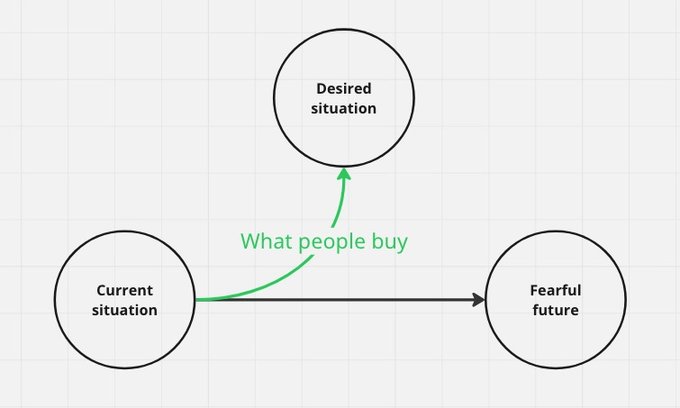
They want something - this is their desired situation. The path they are currently on is not leading them there. Instead, it is leading them to a fearful future situation. To avoid that, they buy the new path.
Simple.
For example, let’s look at someone with joint pain.
- (Current situation) They are currently in pain. No fun.
- (Fearful future) They are not doing anything to fix their pain, so they will be in more pain in the future. Also no fun.
- (Desired situation) They want to be out of pain, but their current path is not leading there.
- (Vehicle for change) They buy some Advil. It removes their pain, so they end up in their desired situation.
Now - on the surface this looks like a relatively simple sale. However, there are actually 3 elements within this sale that a prospect must go through to make a purchasing decision.
Those 3 sales are:
1. The sale on making a change
2. The sale on a certain method being the solution
3. The sale on the specific brand to deliver that method
Applying this framework to someone in pain:
1. The sale on making a change. Before they purchase anything, they need to want to get out of pain. This sounds obvious, but it must happen before anything else. They must understand they are in pain, which they might be unaware of or ignoring. They must understand that it’s possible to build a better life with no pain (creating a desired situation). They must understand that if they don’t make a change, they will end up in more pain over time, which sucks (creating a fearful future situation). Once they understand 1) they are in pain and 2) there is a world where they can get out of pain, they will start to explore solutions.
2. The sale on a certain method being the solution. Once they’re exploring solutions, they will find many options. They could start cold plunging. They could get a massage. They could get surgery. They could take Ibuprofen. They could take Acetaminophen. They could do dry needling. There are TONS of potential solutions out there that they could explore. So the second sale is on this particular solution being the one that is best for them. Best for them will be relative to their situation & preferences, so the job of a sales process is to help elevate this solution over the others. We will talk below about how to do that.
3. The sale on a specific brand to deliver that solution. Once they’re bought in on Ibuprofen (the generic anti-inflammatory drug) being the best solution to get out of pain, they will research the different brands. So the final sale is on Advil (the brand) being the best option to deliver the solution. And again, we will talk through different ways to make this third sale down below.
Or applying it to someone making a much bigger purchase: hiring a personal trainer:
1. The sale on making a change. They must believe they need to get in better shape.
2. The sale on a certain method being the solution. They must believe that lifting weights with a personal trainer is the best way to get there, rather than trying it on their own or doing some other health fad.
3. The sale on the specific brand to deliver that method. They must believe this specific personal trainer is the one they should work with.
Importantly, these sales MUST HAPPEN IN ORDER. If you try to sell the specific solution to someone who doesn’t even know they’re in pain, it’s not going to work. If you try to sell your brand before someone is bought in on that solution, it’s not going to work.
Now, this does not mean that you have to be the one to make each of these sale. Some people will enter your world very ready to make a change and fully bought in on your method. Your job is to meet each potential customer where they’re at and give them the right amount of information they need to progress through the next sale. Sometimes that means starting at the very beginning. Other times it means jumping to the very end.
So when selling 1:1, you need to diagnose where someone is currently at, then sell them on the next belief.
When you’re selling 1 to many, you will need to understand where the majority of your audience is entering your world and structure your marketing accordingly.
If you are marketing to a cold audience who has never considered making this change, you will need to spend significant time on Sale #1 before moving forward.
If you are marketing to a problem-aware audience already searching for solutions, you can spend less time on Sale #1 and more time making Sale #2.
And if you are marketing to people who already believe in your method, then most of your work will happen in Sale #3.
The colder and less aware the audience, the earlier in the sequence you need to start.
The warmer and more sophisticated the audience, the further into the sequence you can begin.
If in doubt, it’s typically more effective to err on the side of emphasizing an earlier sale, because it never hurts to remind someone of the importance of making a change.
So summarizing each of these 3 sales:
- Sale #1: The sale on making a change - Question: “Do I need to do something about this?” - Belief: My current path is not good enough, and making a change is worth it.
- Sale #2: The sale on a certain method being the solution - Question: “What is the best way to make that change?” - Belief: This particular method is the best vehicle for getting where I want to go.
- Sale #3: The sale on the specific brand to deliver that method - Question: “Who should I trust to help me implement that method?” - Belief: This specific product, service, or company is the best option for delivering that method
Everything we’re about to cover simply breaks these 3 sales down into the smaller necessary beliefs someone must hold before they confidently move to the next one.
So now let’s talk about how to engineer each of these.
## Sale #1: The sale on making a change
To get someone to want to make a change, we must get extremely clear & specific on 3 “situations.”
1. Their current situation
2. Their desired situation
3. Their future situation, if nothing changes
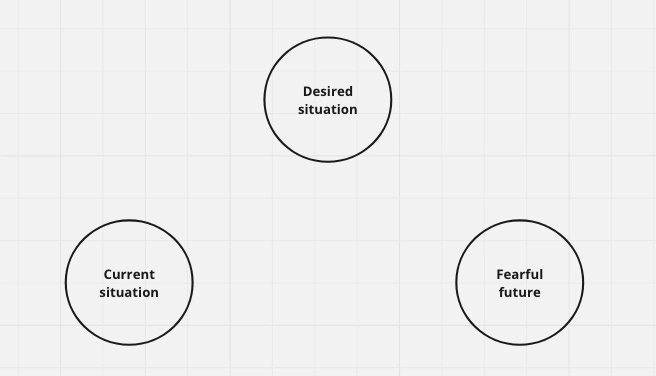
For each of these situations, we want to clearly define:
1. Their surface level state (what is happening)
2. Their emotional state (how they feel)
Then, to engineer a change, we want to:
1. Paint a vivid & clear picture of the pain in their current situation (Pain)
2. Paint a vivid & clear picture of their desired situation (Desire)
3. Paint a vivid and clear picture of where they will be in a certain amount of time if they don’t change (Cost)
When painting this picture, we want to get a SPECIFIC and TANGIBLE as possible.
Pain & Desire happens in moments. Specific moments. Visceral moments.
Depending on the type of funnel you are running, you will either need to describe this for them (like if you’re writing emails or driving traffic to a landing page) or have them describe it (if you are selling via the phone).
For an example of what this looks like when you get someone to describe their current situation:
- V1: “My job sucks.”
- V2: “I feel like I’m wasting my potential. I’m not growing, I’m not paid what I’m worth, and I dread logging in every day.”
- V3: “Every week I pour in effort and get nothing back. No recognition, no progress, just more busywork. I’m constantly overlooked while people who care less than me keep moving up.”
- V4: “Last month I hit my targets, took on extra projects, and stayed late almost every night, only to watch my manager hand the promotion to someone who does half the work and plays politics. That was the moment I realized no matter how much I give here, I’ll never get what I deserve.”
This is the same person describing their situation. V1 is very surface level and does not elicit any emotions of change. V4 is so visceral and tangible you can feel the exhaustion and desperation for change from every word.
And this is what it looks like to get specific on a desired situation:
- V1: “I want to make a bit more money and work remotely while traveling.”
- V2: “I want enough income to not stress about bills, while having the flexibility to work from anywhere instead of being chained to an office.”
- V3: “I want to be in control of my schedule—earning multiple five figures a month, choosing projects I actually enjoy, and being able to spend weeks abroad without asking for permission.”
- V4: “I want to hit $10K+ a month consistently, running my ghostwriting business entirely from my laptop. I want to wake up in Barcelona, spend the morning writing for two clients I actually respect, then close the laptop by 2 PM and explore the city with my partner. I want the freedom to pick projects that excite me, skip the ones that drain me, and know my income is predictable, enough to cover rent, travel, savings, and still have margin. I want the confidence that I never need to ask a boss for vacation days again, and that I can design my weeks around what matters most to me.”
Can you see how someone having clarity over V4 is significantly more likely to make the necessary change to get there, compared to V1?
That clarity is what your sales process needs to engineer.
## 12 Ways To Get More Specific With Your Sales Messaging
Depending on what you are selling, the elements you want to paint vividly will differ.
1. Income → specific number per month
2. Location Freedom → specific places they would go
3. Time Freedom → specific things they would do on a random Tuesday
4. Dislike for job → specific moments they dislike the most
5. Stress → specific moments they experience stress
6. Pain → specific moments they experience pain
7. Experience Freedom → specific things they want to be able to book on a whim
8. Care for Others → specific things they want to do for their friends & family
9. Impact → specific causes they care about and how they can influence them
10. Feelings → what specifically would that success feel like? Or that failure feel like?
11. Relationships → specific people they want to spend more time with or stop being around
12. Health → specific physical feelings they want to wake up with every morning
Importantly, each of these is a “spectrum.”
It’s not whether or not they are in pain, it’s how much pain are they in.
It’s not whether or not they have a goal, it’s how badly do they want that goal.
It’s not whether or not they see the cost of inaction, it’s how badly do they want to avoid that fearful future situation.
Each of these work together to get someone above a “change threshold” — and your job as is to help someone get above that threshold by making each state more specific.
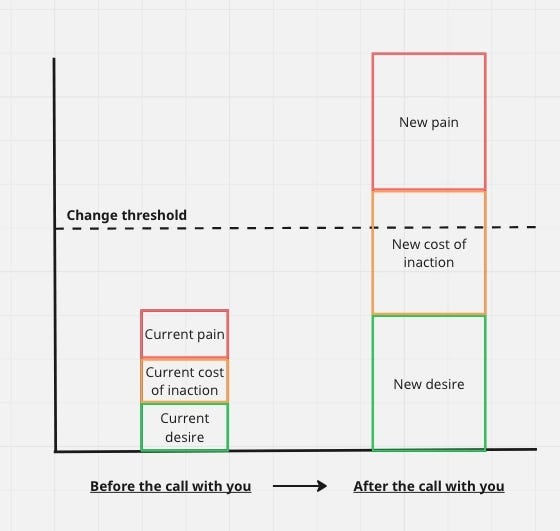
If you genuinely believe in your product or service, it is your moral responsibility to help people rise above this change threshold. The reason most people stay the same for their entire life is because THEY NEVER DO THIS.
- They never take a tough look at their current situation and realize it’s not what it should be.
- They never take the time to clearly define their desired situation and explore paths to get there.
- They never look at the long-term implications of their actions and see that they don’t want to end up there
And this is the beautiful opportunity you have in your sales process.
You are helping people, for potentially the first time in their life, actually reflect on what they want, what they don’t want, and what it looks like to get to where they want to go.
Once someone has clarity over where they are, where they want to go, and where they are headed if nothing changes, they will experience an internal tension to find a solution.
And that perfectly leads us to the second sale.
## Sale #2: The sale on this particular solution
When someone is sold on making a change, they will start to search for solutions.
In evaluating solutions, people will compare along the following lines:
1. Effort & Sacrifice. What are all the things they’re going to have to start doing that they aren’t currently doing and what are all the things they’re going to have to stop doing that they are currently doing.
2. Likelihood of achievement FOR THEM. How likely is it that if they put forth effort & make the sacrifices, that they will end up achieving their goal. Importantly, it must be likely to work for their individual circumstances. Everyone thinks they are special, so we must assure them that their specialness is not something that will derail their success.
3. Investment. How much money does it take to get started on this path and to continue on this path in the future?
So in pitching your solution, you want to make it:
- As easy as possible, without having to stop doing things they like doing
- Inexpensive relative to its likelihood of success
- With an exceptionally high likelihood of success
And at the same time, you want to make all other solutions look:
- As hard as possible + having to stop doing a ton of things they like
- As expensive as possible relative to its likelihood of success
- With little likelihood of it actually working out
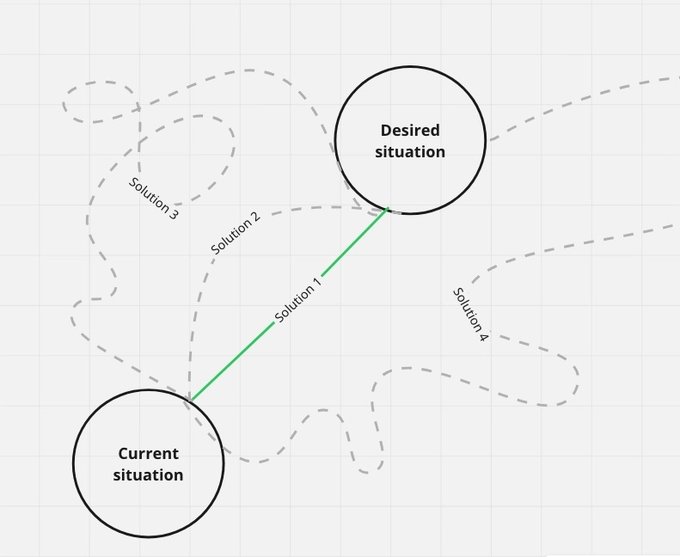
Building on our Advil example, we would position Ibuprofen as:
- Easy. Just one super small pill, easy to swallow, sold in a big bottle of 500 so you rarely have to go to the store. And you get to keep doing all the things you like to do. No side effects to work through.
- Extremely likely to work. Results happen in under an hour. You’ll feel like your joints are brand new again.
- Inexpensive. Just a couple bucks per bottle of pills.
And in comparing it to say, cold plunge therapy, you would position that as:
- Difficult & sacrifice heavy. Extremely painful, not a fun experience. Also out of the way, you have to drive all the way to the cold plunge place and hope there’s a spot available And after your cold plunge you shouldn’t exercise for a few hours. Plus you might need someone to drive you home.
- Unlikely to work. The benefits of cold plunging are mostly mental, without any long-term proof that your joints will stop hurting. And it might take many months of consistent cold plunging to feel the effects. And there’s a chance you go through all of that and still ache every day.
- Expensive. Roughly ~$50 per session, so about ~$500 per month if you go 2x per week.
Then you would repeat the process for all of the other things someone is considering instead of Ibuprofen. Once you’ve thrown daggers into all of them and they’re fully bought in on this solution, THEN you present the final sale which is on this specific brand.
Importantly, this is why many of the best marketers in the world market the CATEGORY, then let customers do their own research on the best brand within that category.
- Tesla doesn’t market Tesla, they market Electric Cars
- Starbucks doesn’t market Starbucks, they market Coffee
At a certain point, a brand cannot grow unless more people overall get interested in this particular type of solution. They have already converted all of the people bought in on this solution who were already comparing brands. Once that happens, they must shift their marketing and messaging “upstream” to get more people interested overall.
## Sale #3: The sale on the brand to deliver that solution
Once someone is bought in on 1) making a change and 2) the specific solution to deliver that change, they now will compare options within that solution.
To clarify the difference between Sale #2 (method) and Sale #3 (brand):
- The method is the category, mechanism, or approach that creates the change.
- The brand is the specific product, service, or company that delivers that method.
For example:
- Get out of joint pain Method: Ibuprofen Brand: Advil
- Lose weight Method: Calorie tracking Brand: MyFitnessPal
- Build strength Method: Barbell training Brand: Starting Strength
- Get around a city Method: Ridesharing Brand: Uber
- Learn a new language Method: App-based language learning Brand: Duolingo
A simple test:
Could someone fully believe in this method and still choose a competitor instead of us?
If yes, you’re still talking about the method.
If no, you’re probably talking about the brand.
Now, once a prospect is at this stage, they will actually use the same criteria when they were evaluating the different solutions. But now they will be comparing options within the same solution, so there will be more minor changes/differences.
Your goal during this stage is to help them understand that our solution is unique relative to the other options out there, rather than saying we’re better/faster/cheaper.
This is extremely important. You do not try to differentiate with a relative comparison. You do not not acknowledge competition.
You instead want to explain our solution as the simultaneous explanation for why 1) what we do is different and 2) why everything else they’ve tried in the past hasn’t worked.
Finishing out the example for Advil, we now position our version of Ibuprofen as the only option by emphasizing:
- Credibility of our track record. Advil has been the leading ibuprofen drug for the last 20 years with over 10 million people currently taking it daily.
- Highest likelihood of achievement. Studies have shown that Ibuprofen’s unique slow release methodology leads to the longest lasting pain relief per dose. We are the only provider on the market who is able to use this patented technology.
Importantly, this is where intangible “brand affinity” comes into play. Some people buy from brands that are more expensive, or more niche, or more “like them” even if there could potentially be a better deal elsewhere.
And this is also where a new competitor will pop up: “doing it myself.”
If you sell an educational product or service, you must first sell them on making a change and using your particular method for implementing that change. However, at that point their main decision will come down to either working with you, working with someone else, or doing it themselves. Which means part of Sale #3 is building doubt by explaining all the things someone would have to do if they tried to implement their method on their own.
Now, once someone is fully bought in on making a change, using our method to implement the change, and working with us to implement that method, closing the sale will come down to one thing: logistics.
## Logistics
Depending on what you sell, logistics will either be a minimal factor or a huge factor.
Generally speaking, the more change required from someone or the larger the investment, the more likely logistics are to play a role in the final decision.
There are three logistics that must also be “handled” before someone will buy:
- Time → They must feel they have enough time in the day in the “season” to get started using your product or service
- Support → They must have the approval of their significant other or business partner to pursue this path
- Money → They must have the minimum amount of money it takes to get started in their possession
An important realization about logistics is they are easy to overcome when someone is fully bought in on all 3 sales. When someone is dead-set on making a change working with you to implement your method:
- They will find the time to make it work
- They will win the support of their significant other
- They will find the money to make it happen
And the reverse is also true. When someone is not dead-set on making a change, or on your method, or on working with you, they will rarely, if ever, say that explicitly. Instead, they will express their uncertainty by blaming a logistic.
- They will say they are too busy
- They will say others are stopping them from doing it
- They will say they are not financially able to make it happen
But the example I always share with people I work with: if someone came to you and offered you a brand new Ferrari for $1,000 - do you think logistics would get in the way of buying that?
Absolutely not. I don’t care how busy you are, how much your wife hates cars, or how few dollars are in your bank account. You would find a way to buy the $300,000 car for $1,000.
And that is why trying to “objection handle” these types of logistics is typically a losing game. They are not bought in on making a change, your method, or your brand. And so it’s better to spend time increasing certainty on the first three sales before spending more time on these.
Now - there are certainly legitimate logistical objections that can prevent someone who is fully bought in from buying. But I use this test to illustrate that more often than not, these objections provide cover for an earlier sale that has been missed. Your job is to recognize which of these you’re dealing with and either strengthen the necessary belief, or accept it might be a legitimate logistical objection.
## Putting all of this together into a set of “Necessary Beliefs”
Again credit to [Cole Gordon for coining the term “Buying Beliefs”](https://www.youtube.com/watch?v=VVxmHLBv5mw) and [Todd Brown for coining the term “Necessary Beliefs.](https://toddbrown.me/the-most-important-question-when-marketing/)” Highly recommend watching both of those videos.
Putting this all together, a great sales process involves building all of the following beliefs in some way:
1. Sale on making a change of some kind Pain → they must want to change their current situation Desire → they must have something drawing them forward Cost of Inaction → they must believe there is a cost of not taking action today
2. Sale on the solution being the best way to deliver that change Superiority → Belief in this solution being better than other potential solutions Fit → Belief they can have success with this solution in their unique situation
3. Sale on us being the best option to deliver that solution Doubt → Doubt they can just do it on their own Method → Trust in your method for delivering the solution Credibility → Trust we will deliver the thing we say we will deliver
4. Logistics that enable them to get started: Time → Enough time in the day & in this season to get started Support → Spouse/partner will approve of going down this path Money → They have the minimum amount of money it takes to get started in their possession or access to get it
With this list in mind, let’s look at some examples of how we do this inside our business. And then we’ll take a look at how you can use this framework to improve your content, emails, landing pages, and sales calls.
# The 3 Sales Applied To Our Portfolio of Businesses
Over the last 6 years, we’ve operated 8 major types of monetization methods ([full breakdown here](https://aioperatornewsletter.substack.com/p/full-guide-digital-monetization-methods)):
- Done-for-you agency service
- 1:1 coaching/consulting
- Evergreen coaching program (1:1 + group)
- Cohort-based experiences
- Digital products
- Paid communities
- Paid newsletters
- Software/SaaS
Each of these uses a different funnel, different content, and a different sales process. But the 3 sales are always the same.
Before you think about how to sell something (what emails to write, what type of content to make, what to put on your landing page, etc.) you need to start with what beliefs you need to build. Once you have that chain set up, then you can figure out how to use each touchpoint to strengthen it.
Most readers of this newsletter will fall into one of the 4 following monetization methods:
- Evergreen coaching program
- Done for you agency service
- Digital product/cohort-based experience
- Paid community
So let’s look at our versions of each of these verticals so you can see how we engineer beliefs across each of them.
## Evergreen Coaching Program (Premium Ghostwriting Academy)
PGA is our 16-week program helping freelance writers & 9-5ers landing premium ghostwriting clients. Sold for $5,000+ spread out over 16 weeks.
Looking at the 3 sales we must engineer:
Sale #1: Making a change of some kind
- Pain. They must recognize they are stuck in a job that caps their income and controls their time
- Desire. They must want a different lifestyle than the one their job is providing
- Cost of inaction. They must recognize that nothing will change if they stay on their current path, with things likely to feel worse over time.
Sale #2: Ghostwriting being the best solution
- Superiority. They must believe for those with basic writing skills & willingness to put in significant effort, this is the best online business model. There is no audience needed, no product to build, and no startup cost. Positioned correctly, clients will pay 3-5k/month retainers for you to run their email & social media.
- Fit. They must believe that they have the skillset required to execute this model.
Sale #3: PGA being the place to learn it
- Doubt. They must believe trying to do this alone, or with just free content, is likely to lead to months, if not years of trial and error.
- Method. They must believe that a 16-week, guided 1:1 coaching system is the best way to make progress.
- Credibility. They must believe that we provide the accountability, educational materials, and mentorship we advertise.
Logistics:
- Time. They have 10-15 hours per week to dedicate to this alongside their full-time job
- Support. Their spouse or significant other will encourage them to take this path.
- Money. They have access to the amount needed to get started on our lowest payment option.
As you can see, this is a relatively complex sale. And generally speaking, the more complex the sale, the better it is to have a 1:1 salesperson involved in it, which is exactly how our sales process works.
Now let’s compare this to a simpler sale, our Ship 30 for 30 cohort-based writing course.
## Cohort-Based Experience (Ship 30 for 30)
Ship 30 for 30 is our 30-day writing experience that helps beginners publish their first 30 pieces of writing online.
Ship 30’s mission is to help 1 million people start writing online. So to do that, we have to start “broader” and get more people interested in writing at all. We cannot only market to people who are already thinking about writing online. We need to make them aware that they should start building an online presence somehow. Then we help them understand writing online is the best way to build that presence. Then, and only then, do we help them understand that Ship 30 is the best way to start writing online.
Sale #1: Making a change to build a presence online
- Pain. They feel they have something worth saying but haven’t been able to do so. They see other people building audiences & online presences and reaping the rewards as a result. They keep getting passed over by other people who are more well-known.
- Desire. They want people to know them for something. They want inbound opportunities from people who stumble across them. They want status and reputation that opens doors for them in the future. And they want to connect with likeminded people who see the world the same was them.
- Cost of Inaction. They must recognize that another year staying invisible means another year of watching less skilled people with more attention get promotions, more opportunities, and more clients.
Sale #2: Writing online is the best way to build that presence
- Superiority. They must believe writing is the fastest & lowest-barrier way to start. Better than videos or podcasting because both require hours of filming, editing, and equipment. They must believe writing is quick to produce, easy to repurpose, and has the secondary benefit of forcing them to think clearly about something. And they must see the creation of a written library as something that compounds in the future.
- Fit. They must believe they don’t need to be a “writer” to start writing. They must understand that if they can explain what they do in conversation, they can write it online.
Sale #3: Ship 30 is the best way to start writing online
- Doubt. They must believe that trying to do it alone will increase their likelihood of failure. And that trying to just get started with free content will prevent them from having “buy in” or structure that improves their odds of success.
- Method. They must believe that a 30-day writing challenge is the best way to learn a news skill. And that having daily prompts, templates, and peer accountability increases their likelihood of success.
- Credibility. They must believe that this is something others have done successfully. And with 10,000+ students across 23 live cohorts, this is one of the easiest sales we make.
Logistics
- Time: They have 30-60 minutes per day to execute on the challenge
- Support: Their friends and loved ones will encourage them on their journey
- Money: They have access to $800 one-time to get started
## Paid Community (AI Writing Skool)
AI Writing Skool is our Skool-based membership at $99/month or $800/year. Courses, live workshops, bootcamps, and a community of writers and operators integrating AI into their business. Sold self-serve via landing page, no sales call.
Sale #1: Making a change to integrate AI into their writing & business
- Pain. They must recognize they are falling behind on AI while others are already using it daily & with more skill.
- Desire. They must want to confidently use AI in their writing & business. And the knock-on is they must also want to build a successful business around their writing.
- Cost of Inaction. They must recognize that the gap between them & people already using AI grows every day that they wait.
Sale #2: A community is the best way to keep up with AI
- Superiority. They must believe AI moves too fast for courses or YouTube to keep up. They must see that a live community, with peers & mentors, increases their pace of learning and increases their likelihood of success.
- Fit. They must believe that they’re able to execute the frameworks we share even if they aren’t already successful writers or deeply skilled with AI.
Sale #3: AIWS is the community to join
- Doubt. They must believe trying to piece things together with free content will not give them the structure or accountability to actually implement.
- Method. They must believe that a system of courses, live workshops, and community sharing is the best way to learn a new skill.
- Credibility. They must believe we use AI to run every part of our own business and teach from what we’re actively doing.
Logistics:
- Time: They must feel that they can actively participate in the community and get their money’s worth each month.
- Support. Their spouse or business partner must support the investment & encourage them to learn new skills
- Money. They must be able to afford $99 per month on a consistent basis
## Done-For-You Agency Service (Velocity)
[Velocity](http://emailvelocity.com/) is our email ghostwriting agency. We write newsletters, launch sequences, and lead magnets for businesses that know email should be their most profitable channel but aren’t doing anything about it. We sell this primarily via outbound DM & sales call. We also occasionally get referrals & inbound clients.
Sale #1: Making a change to take email seriously
- Pain. They must recognize they have an email list they’re not using with revenue sitting idle inside of it.
- Desire. They must want email as a major engine in their business.
- Cost of Inaction. They must recognize that they are racking up money left on the table that is impossible to get back in the future. And the longer they delay, the longer they will have to go without a healthy new channel that could allow them to better reinvest in their business.
Sale #2: Done-for-you email is the best solution
- Superiority. They must believe that hiring in-house is too expensive, doing it themselves has already failed, and buying a course won’t fix a time problem. They must see done-for-you as the only option that actually removes the bottleneck.
- Fit. They must believe this works at any list size. The only requirement is having a list of people to contact & something valuable to send them.
Sale #3: Velocity is the agency to hire
- Doubt. They must believe that hiring a freelancer or trying to do it themselves is the wrong choice, since they don’t build strategy, set up automations, or think holistically about email fits within the rest of the business.
- Method. They must believe in the Velocity approach of email courses, newsletters, and periodic launch squeezes all working together for their business.
- Credibility. They must believe we’ve done this for ourselves and for other clients, so we aren’t just making this framework up from theory.
Logistics:
- Time: They must feel they have the bandwidth to ramp us up on their business and tools, which is often time-intensive
- Support: Their business partner or team must be aligned on investing in email as a channel
- Money: They must be able to commit to a 7.5k/mo (or more) retainer.
## Putting it all together
Hopefully after seeing this framework applied across several different types of businesses, you can see how universal it is.
No matter what you sell, your job is to figure out what beliefs someone needs to have to buy, then help them build those beliefs in the right order.
Once you have all of those beliefs mapped out, the next question becomes: how do you actually engineer a marketing campaign that instills them?
That means deciding which beliefs should be built through your content, ads, emails, landing pages, webinars, sales calls, DMs, etc.
That is an entire guide in itself, so I’m going to stop there rather than turn this into a book.
But if you’d like me to write a full breakdown on how to engineer a marketing campaign around these necessary beliefs, let me know.
And if you want education & community that will help you build a content ecosystem & product suite around your writing, [come join us inside AI Writing Skool.](http://aiwritingskool.com/)
# [FREE INTERVIEW PROMPT] Build Your “Necessary Beliefs” Map
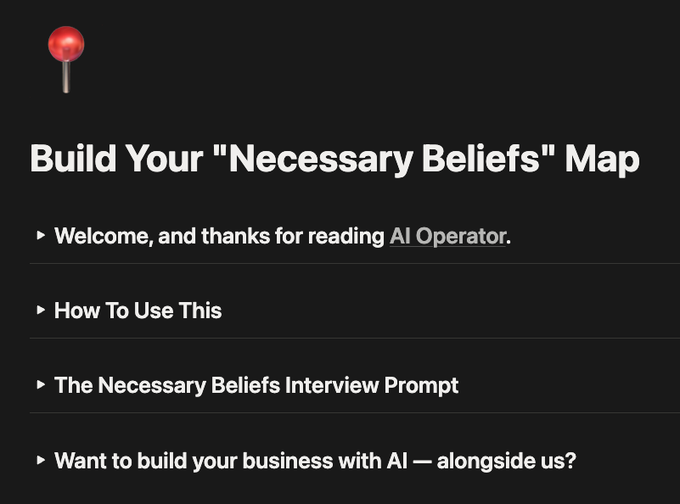
If you made it this far, you might be thinking:
“Ok this all sounds cool. But what are the specific beliefs for MY product?”
Lucky for you, I’ve put together a full interview prompt that will build your necessary beliefs map with you, based on your product or service, who you sell to, how you sell it, and what alternatives your customers are comparing you against.
Based on your answers, it gives you your set of necessary beliefs in this format:
Sale #1: Making a change
- Pain. [What they must recognize about their current situation]
- Desire. [What they must want badly enough to act]
- Cost of Inaction. [What happens if they stay on their current path]
Sale #2: Your method being the best solution
- Superiority. [Why this type of solution beats the alternatives]
- Fit. [Why it works for their specific situation]
Sale #3: You being the one to deliver it
- Doubt. [Why doing it alone won’t work]
- Method. [What makes your approach unique]
- Credibility. [Why they should trust you to deliver]
Logistics:
- Time. [Do they have enough time in this season to get started]
- Support. [Will their spouse or partner support this decision]
- Money. [Do they have access to the minimum investment required]
# [Here's the link to the "Build Your Necessary Beliefs" Map](https://vine-perch-730.notion.site/Build-Your-Necessary-Beliefs-Map-3d301b956bb6810b9b76e6ab7cfe9220?source=copy_link)
And if you have any other questions about anything we covered today, please leave a comment to let me know. I read and reply to every single one of them.
I hope you found this piece valuable.
Talk soon,
Dickie
PS: If you want a full guide to writing long-form articles like this on the internet, [here's a free 13,000-word Ultimate Guide to help you get started](http://x.startwritingonline.com).
## 相关链接
- [Dickie Bush](https://x.com/dickiebush)
- [@dickiebush](https://x.com/dickiebush)
- [1.4K](https://x.com/dickiebush/status/2098013505387458573/analytics)
- [Cole Gordon for coining the term “Buying Beliefs”](https://www.youtube.com/watch?v=VVxmHLBv5mw)
- [Todd Brown for coining the term “Necessary Beliefs.](https://toddbrown.me/the-most-important-question-when-marketing/)
- [full breakdown here](https://aioperatornewsletter.substack.com/p/full-guide-digital-monetization-methods)
- [Velocity](http://emailvelocity.com/)
- [come join us inside AI Writing Skool.](http://aiwritingskool.com/)
- [Here's the link to the "Build Your Necessary Beliefs" Map](https://vine-perch-730.notion.site/Build-Your-Necessary-Beliefs-Map-3d301b956bb6810b9b76e6ab7cfe9220?source=copy_link)
- [here's a free 13,000-word Ultimate Guide to help you get started](http://x.startwritingonline.com/)
- [Upgrade to Premium](https://x.com/i/premium_sign_up)
- [7:39 PM · Sep 10, 2026](https://x.com/dickiebush/status/2098013505387458573)
- [1,481 Views](https://x.com/dickiebush/status/2098013505387458573/analytics)
---
*导出时间: 2026/9/10 20:03:22*
---
## 中文翻译
# 如何把任何东西卖给任何人(利用“每笔销售中的3次销售”)
**作者**: Dickie Bush
**日期**: 2026-09-10T11:39:33.000Z
**来源**: [https://x.com/dickiebush/status/2098013505387458573](https://x.com/dickiebush/status/2098013505387458573)
---

在过去的6年里,我完成了超过15万次个人销售,服务了超过34,000名客户。
但当我刚起步时,我完全不知道怎么卖东西。
- 我以为“文案写作”是一个法律术语
- 我以为销售员只在二手车行工作
- 我害怕到不敢收钱,以至于我的第一门课程、第一项服务和第一期训练营全部免费送出
为了解决我的知识瓶颈,我深入研究了我能找到的每一种营销与销售方法论。
经过数千小时的学习、实践、反思和迭代,我把自己的整个销售哲学提炼成了一个框架。而且你可以把它应用到任何人任何时候的每一次购买行为中。
所以今天,我想带你了解这个框架,并帮助你把它应用到你的业务中,无论你经营什么类型的业务。
我们将涵盖:
- 每笔销售中的3次销售(以及为什么必须按顺序完成)
- 这3次销售如何对应一组“必要信念”
- 完整的实例演练:我们为业务中每个垂直领域灌输的必要信念
在最后,我提供了一个完整的引导式访谈提示词,帮助你构建销售你的特定产品或服务所需的必要信念。链接在本文末尾。
现在让我们开始吧。
在开始之前,我要感谢Cole Gordon、Alex Hormozi、Todd Brown和Mark Ford,他们对我的营销与销售认知产生了深远影响。我强烈建议你也去研究他们的完整哲学,让自己沉浸在多种视角中。
# 每笔销售中的3次销售
要介绍这个框架,我们必须回答两个问题:
1. 人们买什么?
2. 人们为什么买?
让我们从反向思考开始:人们不买什么?
他们不买:
- 你
- 你的故事
- 你的报价
- 你的产品
- 你的公司
- 你的客户见证
- 你的保证
人们买的是“改变的载体”。
简单来说,每一次购买都是一个载体,把一个人从此刻所在之处带到他想去的地方。
它是这样的:

他们想要某样东西——这是他们的理想情境。他们目前所处的路径无法把他们带到那里,反而会把他们引向一个可怕的 future 情境。为了避免那种结果,他们购买新的路径。
很简单。
举个例子,我们来看一个有关节疼痛的人。
- (当前情境)他们现在很疼。很不舒服。
- (可怕的未来)他们没有采取任何措施来止痛,所以将来会更疼。同样很不舒服。
- (理想情境)他们想摆脱疼痛,但当前的路径无法把他们带到那里。
- (改变的载体)他们买了布洛芬(Advil)。疼痛消除了,他们达到了理想情境。
现在——表面上看,这似乎是一笔相当简单的交易。然而,潜在客户在做出购买决定的过程中,实际上要经历这3个环节。
这3次销售是:
1. 关于“要不要做出改变”的销售
2. 关于“某个方法是解决方案”的销售
3. 关于“哪个具体品牌来提供该方法”的销售
把这个框架应用到一个疼痛患者身上:
1. 关于做出改变的销售。在购买任何东西之前,他们需要先想摆脱疼痛。这听起来显而易见,但它必须发生在其他一切之前。他们必须意识到自己在疼痛之中,而他们可能没有意识到或正在忽视这一点。他们必须明白,过上没有疼痛的更好的生活是可能的(创造理想情境)。他们必须明白,如果不做出改变,随着时间推移疼痛会加剧,那很糟糕(创造可怕的未来情境)。一旦他们理解了1)自己在疼痛中,2)存在一个能摆脱疼痛的世界,他们就会开始探索解决方案。
2. 关于某个方法是解决方案的销售。一旦他们开始探索解决方案,就会发现很多选项。他们可以尝试冷水浴。可以做按摩。可以做手术。可以吃布洛芬。可以吃对乙酰氨基酚。可以做干针疗法。有大量的潜在解决方案可供选择。所以第二次销售是关于这个特定解决方案最适合他们。“最适合”是相对于他们的情况和偏好而言的,所以销售流程的任务就是帮助凸显这个解决方案相对于其他方案的优越性。我们下面会讨论如何做到这一点。
3. 关于具体品牌来提供该解决方案的销售。一旦他们认可布洛芬(这种通用的消炎药)是摆脱疼痛的最佳解决方案,他们就会研究不同的品牌。所以最后一次销售是关于Advil(这个品牌)是提供该解决方案的最佳选择。同样,我们下面会讨论完成这第三次销售的不同方法。
或者把它应用到一个大得多的购买行为上:聘请私人教练:
1. 关于做出改变的销售。他们必须相信自己需要把身材练得更好。
2. 关于某个方法是解决方案的销售。他们必须相信在私人教练指导下进行力量训练是实现这一目标的最佳方式,而不是自己练或追随某种健康潮流。
3. 关于具体品牌来提供该方法的销售。他们必须相信这位特定的私人教练就是他们应该合作的人。
重要的是,这些销售必须按顺序发生。如果你试图向一个甚至不知道自己疼痛的人推销具体解决方案,那是行不通的。如果你在某人尚未认可某个解决方案之前就推销你的品牌,那也是行不通的。
当然,这并不意味着每一次销售都必须由你来完成。有些人进入你的世界时已经准备好做出改变,并且完全认可你的方法。你的工作是洞察每位潜在客户所处的阶段,并提供恰到好处的信息量,帮助他们完成下一次销售。有时这意味着要从头开始,有时则意味着直接跳到最后。
所以在一对一销售时,你需要诊断客户目前所处的位置,然后向他们销售下一个信念。
当你进行一对多销售时,你需要了解你的受众大多是处于什么阶段进入你的世界的,并据此设计你的营销。
如果你面向的是从未考虑过做出这种改变的冷受众,你需要在进入下一步之前,在第1次销售上花大量时间。
如果你面向的是已经意识到问题并在寻找解决方案的受众,你可以在第1次销售上少花些时间,把更多时间用于第2次销售。
而如果你面向的是已经认可你方法的人,那么你的大部分工作将发生在第3次销售上。
受众越冷、认知越少,你就需要越早开始这个序列。
受众越热、越成熟,你就可以越靠后开始这个序列。
如果拿不准,宁可偏向强调更早的销售,因为提醒人们做出改变的重要性永远不会有害。
总结这3次销售:
- 第1次销售:关于做出改变的销售——问题:“我需要为此做点什么吗?”——信念:我当前的路径不够好,做出改变是值得的。
- 第2次销售:关于某个方法是解决方案的销售——问题:“做出这种改变的最佳方式是什么?”——信念:这个特定的方法是实现目标的最佳载体。
- 第3次销售:关于具体品牌来提供该方法的销售——问题:“我应该信任谁来帮我执行这个方法?”——信念:这个特定的产品、服务或公司是提供该方法的最佳选择
我们接下来要讲的一切,都是把3次销售拆解成更小的必要信念——人们必须先持有这些信念,才能自信地迈向下一个阶段。
现在让我们讨论如何设计每一个环节。
## 第1次销售:关于做出改变的销售
要让一个人想要做出改变,我们必须把3种“情境”讲得极其清晰和具体。
1. 他们的当前情境
2. 他们的理想情境
3. 如果一切不变,他们的未来情境

对于每一种情境,我们要清晰地定义:
1. 他们的表层状态(正在发生什么)
2. 他们的情绪状态(他们感受如何)
然后,为了促成改变,我们要:
1. 生动清晰地描绘他们当前情境中的痛苦(痛苦)
2. 生动清晰地描绘他们的理想情境(渴望)
3. 生动清晰地描绘如果他们不改变,在一段时间后会身处何地(代价)
在描绘这些画面时,我们要尽可能具体、有形。
痛苦与渴望发生在瞬间。具体的瞬间。刻骨铭心的瞬间。
根据你运营的漏斗类型,你要么需要替他们描述这些(比如你写邮件或给落地页导流时),要么让他们自己描述(如果你通过电话销售)。
举个例子,让客户描述他们的当前情境会是什么样子:
- V1:“我的工作很烂。”
- V2:“我觉得自己在浪费潜力。我没有成长,薪水配不上我的价值,每天登录工作系统都让我恐惧。”
- V3:“每周我全力以赴却毫无回报。没有认可,没有进步,只有更多琐碎的事务。我不断被忽视,而那些远不如我用心的人却在步步高升。”
- V4:“上个月我完成了所有指标,承担了额外项目,几乎每晚都加班到很晚,结果眼睁睁看着经理把晋升机会给了一个干活只有我一半多、却很会玩办公室政治的人。那一刻我意识到,无论我在这里付出多少,我永远得不到我应得的东西。”
这是同一个人描述自己的处境。V1非常表层,不会引发任何想要改变的情绪。而V4如此真实、如此有形,你能从每一个字里感受到疲惫和对改变的渴望。
下面是在理想情境上做到具体是什么样子:
- V1:“我想多赚点钱,远程工作边旅行。”
- V2:“我想有足够的收入,不为账单发愁,同时能灵活地在任何地方工作,而不是被拴在办公室里。”
- V3:“我想掌控自己的日程——每月赚取数万美元,选择自己真正喜欢的项目,能在国外待上几周而无需向任何人请示。”
- V4:“我想稳定地做到月入1万美元以上,仅用笔记本电脑运营我的代写业务。我想在巴塞罗那醒来,上午为两位我真正尊敬的客户写作,下午2点前合上电脑,和伴侣一起探索这座城市。我想要选择令我兴奋的项目、放弃消耗我的项目的自由,并且知道我的收入是可预测的,足以覆盖房租、旅行、储蓄还有结余。我想要那种自信——再也不用向老板请假,我可以围绕对自己最重要的事情来设计每一周。”
你能看出,对V4有清晰认知的人,比起V1,做出必要改变去实现目标的概率要大得多吗?
这种清晰度,正是你的销售流程需要打造的。
## 让销售信息更具体的12种方法
根据你销售的东西不同,你需要生动描绘的元素也会不同。
1. 收入 → 具体的月收入数字
2. 地点自由 → 他们会去的具体地方
3. 时间自由 → 他们在某个普通周二会做的具体事情
4. 对工作的厌恶 → 他们最厌恶的具体时刻
5. 压力 → 他们经历压力的具体时刻
6. 疼痛 → 他们经历疼痛的具体时刻
7. 体验自由 → 他们想随心所欲预订的具体事物
8. 关爱他人 → 他们想为朋友和家人做的具体事情
9. 影响力 → 他们关心的具体事业以及如何影响它们
10. 感受 → 成功具体会是什么感觉?失败又是什么感觉?
11. 人际关系 → 他们想多陪伴或想远离的具体人
12. 健康 → 他们每天早晨醒来想拥有的具体身体感受
重要的是,以上每一项都是一个“光谱”。
问题不是他们是否疼痛,而是他们有多疼。
问题不是他们是否有目标,而是他们有多渴望那个目标。
问题不是他们是否看到不行动的代价,而是他们有多想避免那个可怕的未来情境。
这些要素共同作用,把一个人推过“改变阈值”——你的工作就是通过把每种状态变得更具体,帮助人们越过这个阈值。

如果你真心相信自己的产品或服务,那么帮助人们越过这个改变阈值就是你的道德责任。大多数人一辈子原地踏步的原因,就是他们从来没有做过这件事。
- 他们从未认真审视自己的当前情境,意识到它本不该如此。
- 他们从未花时间清晰定义自己的理想情境,并探索通往那里的路径。
- 他们从未审视自己行为的长期后果,看到自己并不想最终落到那个地步。
而这正是你在销售流程中拥有的美好机会。
你在帮助人们——也许是他们人生中第一次——真正反思自己想要什么、不想要什么,以及到达目的地是什么样子。
一旦一个人清楚地知道自己身处何地、想去哪里、以及如果一切不变会走向何方,他们就会产生一种寻找解决方案的内在张力。
而这恰好把我们引向了第二次销售。
## 第2次销售:关于这个特定解决方案的销售
当一个人认可要做出改变后,他们就会开始寻找解决方案。
在评估解决方案时,人们会沿以下维度进行比较:
1. 付出与牺牲。他们将不得不开始做哪些现在没在做的事情,以及不得不停止做哪些现在在做的事情。
2. 对他们而言的达成可能性。如果他们付出努力并做出牺牲,最终实现目标的可能性有多大。重要的是,它必须可能在他们个人的情况下奏效。每个人都认为自己是特殊的,所以我们必须向他们保证,他们的“特殊性”不会阻碍他们的成功。
3. 投入。走这条路并持续走下去,需要花多少钱?
所以在推介你的解决方案时,你要让它显得:
- 尽可能轻松,无需放弃他们喜欢做的事情
- 相对于成功可能性而言价格低廉
- 拥有极高的成功可能性
与此同时,你要让所有其他解决方案看起来:
- 尽可能艰难 + 不得不放弃很多他们喜欢的事情
- 相对于成功可能性而言尽可能昂贵
- 实际见效的可能性很小

延续我们的Advil例子,我们会把布洛芬定位为:
- 简单。只需一颗超小的药丸,易于吞咽,一大瓶500粒装,很少需要去药店。而且你可以继续做所有你喜欢的事。没有需要担心的副作用。
- 极有可能见效。不到一小时就有效果。你会感觉关节焕然一新。
- 便宜。一瓶药只要几美元。
而对比冷水浴疗法时,你会把它定位为:
- 困难且需要大量牺牲。极其痛苦,体验并不愉快。而且地点不便,你得开车老远去冷水浴馆,还得祈祷有空位。冷水浴之后几个小时内不能运动。另外你可能还需要有人开车送你回家。
- 不太可能见效。冷水浴的好处主要是心理层面的,没有任何长期证据表明你的关节会不再疼痛。而且可能需要连续坚持好几个月才能感受到效果。还有可能你经历了这一切,仍然每天疼痛。
- 昂贵。每次约50美元,如果每周去2次,每月约500美元。
然后你要对潜在客户考虑用来替代布洛芬的所有其他选项重复这个过程。当你把所有这些选项都一一“戳穿”、而他们完全认可这个解决方案之后,这时你才呈现最后一次销售——关于这个具体品牌的销售。
重要的是,这就是为什么世界上许多最顶尖的营销者营销的是“品类”,然后让客户自己去研究该品类中最好的品牌。
- 特斯拉营销的不是特斯拉,而是电动汽车
- 星巴克营销的不是星巴克,而是咖啡
到了某个节点,一个品牌想要继续增长,就必须让更多人对这类解决方案整体产生兴趣。他们已经转化了所有认可这个解决方案、并正在比较品牌的人。一旦发生这种情况,他们就必须把营销和信息“向上游”转移,让更多人对整体产生兴趣。
## 第3次销售:关于提供该解决方案的品牌的销售
一旦某人认可了1)做出改变,以及2)实现该改变的特定解决方案,他们接下来就会比较该解决方案内部的不同选项。
为了澄清第2次销售(方法)和第3次销售(品牌)的区别:
- 方法是创造改变的品类、机制或路径。
- 品牌是提供该方法的具体产品、服务或公司。
例如:
- 摆脱关节疼痛 方法:布洛芬 品牌:Advil
- 减肥 方法:卡路里追踪 品牌:MyFitnessPal
- 增强力量 方法:杠铃训练 品牌:Starting Strength
- 城市出行 方法:网约车 品牌:Uber
- 学习新语言 方法:App语言学习 品牌:多邻国
一个简单的测试:
一个人是否可能完全相信这个方法,却仍然选择竞争对手而不是我们?
如果是,那你谈论的还是方法。
如果不是,那你谈论的可能是品牌。
现在,当潜在客户到达这个阶段时,他们会用与之前评估不同解决方案时相同的标准。只不过现在他们比较的是同一解决方案内的选项,所以差异会更细微。
你在这个阶段的目标,是帮助他们理解我们的解决方案相对于其他选项是独特的,而不是说我们更好/更快/更便宜。
这一点极其重要。你不要试图通过相对比较来实现差异化。你不要回避承认竞争的存在。
相反,你要把我们的解决方案解释为对以下两点的统一回答:1)我们做的事有何不同,以及2)为什么他们过去尝试过的其他方法都没有奏效。
继续用Advil的例子,我们现在通过强调以下几点,把我们这款布洛芬定位为唯一的选择:
- 我们的业绩信誉。Advil过去20年一直是领先的布洛芬药品,目前有超过1000万人每天服用。
- 最高的达成可能性。研究表明,布洛芬独特的缓释技术使每剂药的止痛持续时间最长。我们是市场上唯一能够使用这项专利技术的供应商。
重要的是,这正是无形的“品牌好感度”发挥作用的地方。有些人会购买更贵、更小众、或更“像他们自己”的品牌,即使别处可能有更划算的选择。
这里也会出现一个新的竞争对手:“自己动手做”。
如果你销售教育类产品或服务,你必须先让他们认可做出改变、并使用你的特定方法来实现这个改变。然而到了这一步,他们的主要决策就变成:与你合作、与他人合作,还是自己动手。这意味着第3次销售的一部分,是通过解释如果他们想自己执行这个方法将不得不做的所有事情,来建立疑虑。
现在,一旦某人完全认可了做出改变、使用我们的方法来实现改变、以及与我们合作来执行该方法,成交就只剩下一件事:现实条件。
## 现实条件
根据你销售的东西,现实条件要么是微不足道的因素,要么是巨大的因素。
一般来说,对方需要做出的改变越大或投入越大,现实条件就越可能在最终决策中发挥作用。
在人们购买之前,还有三个现实条件必须被“解决”:
- 时间 → 他们必须觉得自己在这个人生阶段每天有足够的时间开始使用你的产品或服务
- 支持 → 他们必须获得配偶或商业伙伴的同意来走这条路
- 金钱 → 他们必须手头拥有开始所需的最低金额
关于现实条件的一个重要认知是:当一个人完全认可这3次销售时,这些条件很容易克服。当一个人铁了心要做出改变、并与你合作执行你的方法时:
- 他们会挤出时间来让它实现
- 他们会赢得配偶的支持
- 他们会找到钱来让它实现
反过来也一样。当一个人并没有铁了心做出改变,或对你的方法,或与你合作时,他们很少会直接说出来。相反,他们会把犹豫归咎于某个现实条件。
- 他们会说自己太忙了
- 他们会说是别人阻止他们
- 他们会说自己财务上负担不起
但我总是和合作者分享这样一个例子:如果有人来找你,愿意以1000美元的价格卖给你一辆崭新的法拉利——你觉得现实条件会阻碍你购买吗?
绝对不会。我不在乎你有多忙、你妻子多讨厌车、或者你银行账户里有多少钱。你都会想方设法用1000美元买下这辆价值30万美元的车。
这就是为什么试图“处理异议”来应对这类现实条件通常是徒劳的。他们并没有认可做出改变、你的方法或你的品牌。所以与其花更多时间处理这些问题,不如先花时间增强前三次销售中的确定性。
当然,确实存在合理的现实条件异议,会阻止一个完全认可的人购买。但我用这个例子是为了说明:大多数时候,这些异议只是为某次被遗漏的销售提供掩护。你的工作是分辨你面对的是哪一种,然后要么强化必要的信念,要么接受它可能是一个合理的现实条件异议。
## 把这一切整合成一组“必要信念”
再次感谢[Cole Gordon提出“购买信念”这一术语](https://www.youtube.com/watch?v=VVxmHLBv5mw),以及[Todd Brown提出“必要信念”这一术语](https://toddbrown.me/the-most-important-question-when-marketing/)。强烈推荐观看这两个视频。
把这一切整合起来,一个优秀的销售流程需要以某种方式建立起以下所有信念:
1. 关于做出某种改变的销售 痛苦 → 他们必须想要改变自己的当前情境 渴望 → 他们必须有某种东西强烈吸引着他们前行 不行动的代价 → 他们必须相信今天不采取行动是有代价的
2. 关于解决方案是实现改变最佳方式的销售 优越性 → 相信这个解决方案优于其他潜在方案 适配性 → 相信在自己独特的情况下能用这个解决方案取得成功
3. 关于我们是提供该解决方案最佳选择的销售 疑虑 → 怀疑他们能否仅靠自己完成 方法 → 信任你提供解决方案的方法 可信度 → 相信我们会兑现我们承诺交付的东西
4. 使他们能够开始的现实条件: 时间 → 在这个阶段每天有足够的时间开始 支持 → 配偶/伴侣会支持走这条路 金钱 → 他们手头拥有或能获得开始所需的最低金额
带着这个清单,让我们来看一些我们在自己业务中如何实践这些原则的例子。然后我们再看看你如何利用这个框架来改进你的内容、邮件、落地页和销售电话。
# 3次销售在我们业务组合中的应用
在过去的6年里,我们运营过8种主要的变现方式([完整拆解见这里](https://aioperatornewsletter.substack.com/p/full-guide-digital-monetization-methods)):
- 全托管代理服务
- 1对1教练/咨询
- 常青教练项目(1对1 + 小组)
- 训练营式体验
- 数字产品
- 付费社群
- 付费Newsletter
- 软件/SaaS
每一种都使用不同的漏斗、不同的内容和不同的销售流程。但这3次销售始终不变。
在思考如何卖一样东西之前(写什么邮件、做什么内容、落地页放什么等),你需要先明确需要建立哪些信念。一旦你把这整条信念链搭建好,你才能确定如何利用每个触点去强化它。
本Newsletter的大多数读者会落入以下4种变现方式之一:
- 常青教练项目
- 全托管代理服务
- 数字产品/训练营式体验
- 付费社群
那么让我们看看我们在这几个垂直领域的版本,这样你就能看到我们是如何在每一个领域中设计信念的。
## 常青教练项目(Premium Ghostwriting Academy)
PGA是我们的16周项目,帮助自由撰稿人和上班族获得高端代写客户。售价5,000美元以上,分16周支付。
看看我们必须设计的3次销售:
第1次销售:做出某种改变
- 痛苦。他们必须意识到自己被困在一份收入封顶、时间受控的工作里
- 渴望。他们必须渴望一种不同于工作所提供的生活方式
- 不行动的代价。他们必须意识到,如果继续留在当前路径上,什么都不会改变,而且情况可能会越来越糟。
第2次销售:代写是最佳解决方案
- 优越性。他们必须相信,对于具备基本写作能力并愿意付出大量努力的人来说,这是最好的线上商业模式。不需要粉丝,不需要开发产品,没有启动成本。定位得当的话,客户会支付每月3-5k的 retainer 请你管理他们的邮件和社交媒体。
- 适配性。他们必须相信自己具备执行这个模式所需的技能。
第3次销售:PGA是学习它的地方
- 疑虑。他们必须相信,单打独斗或仅靠免费内容,很可能导致数月甚至数年的反复试错。
- 方法。他们必须相信,16周的1对1导师制辅导系统是取得进步的最佳方式。
- 可信度。他们必须相信我们能提供我们宣传的督促、教材和导师指导。
现实条件:
- 时间。他们在全职工作之余每周有10-15小时可以投入到这件事上
- 支持。他们的配偶或伴侣会鼓励他们走这条路。
- 金钱。他们能获得以我们最低付款方案开始所需的金额。
如你所见,这是一笔相对复杂的销售。一般来说,销售越复杂,让1对1销售员参与其中就越有利,这正是我们销售流程的运作方式。
现在让我们对比一个更简单的销售,我们的Ship 30 for 30训练营式写作课程。
## 训练营式体验(Ship 30 for 30)
Ship 30 for 30是我们的30天写作体验,帮助初学者在网上发布他们的前30篇作品。
Ship 30的使命是帮助100万人开始在线写作。为此,我们必须从更“宏观”的层面入手,让更多人对写作本身产生兴趣。我们不能只向已经在考虑在线写作的人做营销。我们需要让他们意识到应该开始以某种方式建立线上影响力。然后,我们帮助他们理解在线写作是建立影响力的最佳方式。然后,也只有到那时,我们才帮助他们理解Ship 30是开始在线写作的最佳方式。
第1次销售:做出改变以建立线上影响力
- 痛苦。他们觉得自己有值得表达的东西,却一直无法表达出来。他们看到别人积累受众、建立线上影响力并因此收获回报。他们不断被那些更有名气的人超越。
- 渴望。他们想让人因为某件事而认识自己。他们想获得那些偶然发现他们的人带来的机会。他们想要地位和声誉,为未来打开大门。他们还想与志同道合、看待世界方式相同的人建立联系。
- 不行动的代价。他们必须意识到,再隐身一年,就意味着再多一年眼睁睁看着技能不如自己但更有关注度的人获得晋升、更多机会和更多客户。
第2次销售:在线写作是建立影响力的最佳方式
- 优越性。他们必须相信写作是最快、门槛最低的起步方式。比视频或播客更好,因为后两者都需要数小时的拍摄、剪辑和设备。他们必须相信写作产出快、易于复用,还有附带好处——迫使他们清晰地思考。他们还必须把文字库的建立视为一种能在未来复利增长的东西。
- 适配性。他们必须相信自己不需要是“作家”才能开始写作。他们必须明白,如果他们能在对话中解释自己做的事情,他们就能在网上写出来。
第3次销售:Ship 30是开始在线写作的最佳方式
- 疑虑。他们必须相信,单打独斗会增加失败的概率。而仅靠免费内容起步,会让他们缺乏提升成功概率的“投入感”或结构。
- 方法。他们必须相信,30天写作挑战是学习新技能的最佳方式。而每日提示、模板和同伴督促会提高他们成功的概率。
- 可信度。他们必须相信这件事别人已经成功做到过。而我们已拥有横跨23期训练营的10,000多名学员,这是我们最容易完成的一次销售。
现实条件
- 时间:他们每天有30-60分钟来执行挑战
- 支持:他们的朋友和亲人会鼓励他们的旅程
- 金钱:他们能获得800美元的一次性付款来开始
## 付费社群(AI Writing Skool)
AI Writing Skool是我们基于Skool的会员社群,99美元/月或800美元/年。包含课程、直播工作坊、训练营,以及一个正在将AI融入业务的写作者和运营者社群。通过落地页自助销售,无需销售电话。
第1次销售:做出改变,将AI融入他们的写作与业务
- 痛苦。他们必须意识到自己在AI上正在落后,而别人已经在每天、更熟练地使用它。
- 渴望。他们必须渴望在写作和业务中自信地使用AI。连带地,他们还必须渴望围绕自己的写作建立成功的事业。
- 不行动的代价。他们必须意识到,自己与已经在使用AI的人之间的差距,每等待一天就会扩大一天。
第2次销售:社群是跟上AI发展的最佳方式
- 优越性。他们必须相信AI发展太快,课程或YouTube都跟不上。他们必须看到,一个有同伴和导师的实时社群,能加快学习速度并提高成功的可能性。
- 适配性。他们必须相信,即使自己还不是成功的写作者、也不精通AI,也能执行我们分享的框架。
第3次销售:AIWS是值得加入的社群
- 疑虑。他们必须相信,试图用免费内容拼凑知识,无法提供真正落地执行所需的结构和督促。
- 方法。他们必须相信,课程 + 直播工作坊 + 社群分享的系统是学习新技能的最佳方式。
- 可信度。他们必须相信,我们自己的业务每个环节都在使用AI,并且我们是在自己正在实践的基础上进行教学。
现实条件:
- 时间:他们必须觉得自己能积极参与社群,让每月的会费物有所值。
- 支持。他们的配偶或商业伙伴必须支持这笔投资,并鼓励他们学习新技能
- 金钱。他们必须能持续负担每月99美元
## 全托管代理服务(Velocity)
[Velocity](http://emailvelocity.com/) 是我们的邮件代写代理机构。我们为那些明知邮件应该是自己最赚钱的渠道、却迟迟没有行动的企业撰写newsletter、发布序列和引流磁铁。我们主要通过主动私信和销售电话来销售这项服务。偶尔也会有转介绍和主动找上门的客户。
第1次销售:做出改变,认真对待邮件
- 痛苦。他们必须意识到自己有一个尚未利用的邮件列表,里面闲置着收入。
- 渴望。他们必须渴望让邮件成为业务的主要引擎。
- 不行动的代价。他们必须意识到,自己正在积累那些未来无法挽回的损失。拖延越久,他们就越久无法拥有一个健康的、能让他们更好地再投资业务的新渠道。
第2次销售:全托管邮件服务是最佳解决方案
- 优越性。他们必须相信,内部招聘太贵,自己做已经失败过,买课程解决不了时间问题。他们必须看到全托管服务是唯一能真正消除瓶颈的选项。
- 适配性。他们必须相信这对任何列表规模都有效。唯一的要求就是有一份可以联系的名单,以及有有价值的内容可以发送给他们。
第3次销售:Velocity是值得聘请的代理机构
- 疑虑。他们必须相信,聘请自由职业者或自己动手是错误的选择,因为后者既不构建策略,也不搭建自动化流程,更不会整体思考邮件如何融入业务的其他部分。
- 方法。他们必须相信Velocity的方法论——邮件课程、newsletter和定期的发布序列协同服务于他们的业务。
- 可信度。他们必须相信我们为自己和其他客户都做到过这一点,所以这套框架不是凭空编造的理论。
现实条件:
- 时间:他们必须觉得自己有带宽让我们熟悉他们的业务和工具,这往往非常耗时
- 支持:他们的商业伙伴或团队必须在投资邮件渠道这件事上达成一致
- 金钱:他们必须能够承诺每月7.5k(或更多)的 retainer。
## 整合全部内容
希望看到这个框架应用于几种不同类型的业务之后,你能体会到它的普适性。
无论你卖什么,你的工作就是弄清楚一个人需要拥有哪些信念才会购买,然后按正确的顺序帮助他们建立这些信念。
一旦你把所有这些信念都梳理出来,下一个问题就是:你该如何设计一套真正能灌输这些信念的营销活动?
这意味着要决定哪些信念应该通过你的内容、广告、邮件、落地页、网络研讨会、销售电话、私信等来建立。
这本身就需要一整篇指南来讲,所以我打算就此打住,而不是把它写成一本书。
但如果你想让我写一篇关于如何围绕这些必要信念设计营销活动的完整拆解,请告诉我。
如果你想获得能帮助你围绕自己的写作构建内容生态系统和产品体系的教育与社群,[欢迎加入AI Writing Skool。](http://aiwritingskool.com/)
# [免费访谈提示词] 构建你的“必要信念”地图

如果你读到了这里,你可能在想:
“好吧,这些听起来都不错。但对我的产品来说,具体的信念是什么呢?”
幸运的是,我整理了一个完整的访谈提示词,它会根据你的产品或服务、你的目标客户、你的销售方式,以及客户正在将你与哪些替代方案做比较,来和你一起构建你的必要信念地图。
根据你的回答,它会以如下格式输出你的必要信念:
第1次销售:做出改变
- 痛苦。[他们必须对当前情境认识到什么]
- 渴望。[他们必须渴望到什么程度才足以采取行动]
- 不行动的代价。[如果他们继续留在当前路径上会发生什么]
第2次销售:你的方法是最佳解决方案
- 优越性。[为什么这类解决方案胜过其他替代方案]
- 适配性。[为什么它在他们的具体情况下有效]
第3次销售:你是提供它的那个人
- 疑虑。[为什么自己单干行不通]
- 方法。[你的方法独特之处是什么]
- 可信度。[为什么他们应该信任你来交付]
现实条件:
- 时间。[他们在这个阶段是否有足够的时间开始]
- 支持。[他们的配偶或伴侣是否会支持这个决定]
- 金钱。[他们是否能获得所需的最低投资]
# [以下是“构建你的必要信念”地图的链接](https://vine-perch-730.notion.site/Build-Your-Necessary-Beliefs-Map-3d301b956bb6810b9b76e6ab7cfe9220?source=copy_link)
如果你对今天涵盖的任何内容还有其他问题,请留言告诉我。每一条留言我都会阅读并回复。
希望你觉得这篇文章有价值。
回头聊,
Dickie
PS:如果你想要一份关于在互联网上撰写此类长文的完整指南,[这里有一份免费的13,000字终极指南帮你入门](http://x.startwritingonline.com)。
## 相关链接
- [Dickie Bush](https://x.com/dickiebush)
- [@dickiebush](https://x.com/dickiebush)
- [1.4K](https://x.com/dickiebush/status/2098013505387458573/analytics)
- [Cole Gordon提出“购买信念”术语](https://www.youtube.com/watch?v=VVxmHLBv5mw)
- [Todd Brown提出“必要信念”术语](https://toddbrown.me/the-most-important-question-when-marketing/)
- [完整拆解见这里](https://aioperatornewsletter.substack.com/p/full-guide-digital-monetization-methods)
- [Velocity](http://emailvelocity.com/)
- [欢迎加入AI Writing Skool。](http://aiwritingskool.com/)
- [以下是“构建你的必要信念”地图的链接](https://vine-perch-730.notion.site/Build-Your-Necessary-Beliefs-Map-3d301b956bb6810b9b76e6ab7cfe9220?source=copy_link)
- [这里有一份免费的13,000字终极指南帮你入门](http://x.startwritingonline.com/)
- [升级到Premium](https://x.com/i/premium_sign_up)
- [2026年9月10日 19:39](https://x.com/dickiebush/status/2098013505387458573)
- [1,481次浏览](https://x.com/dickiebush/status/2098013505387458573/analytics)
---
*导出时间: 2026/9/10 20:03:22*