# Claude + your own voice should be illegal.
**作者**: Guri Singh
**日期**: 2026-04-15T15:08:53.000Z
**来源**: [https://x.com/heygurisingh/status/2044432782747951581](https://x.com/heygurisingh/status/2044432782747951581)
---
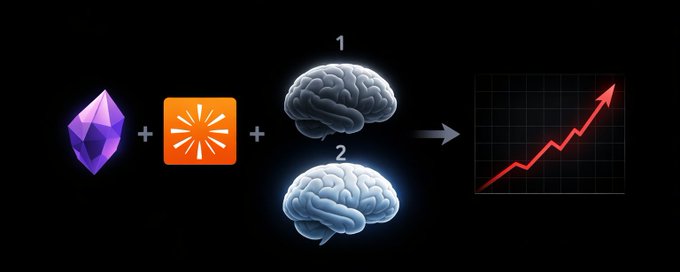
I'm going to show you what my setup does before I tell you how to build it.
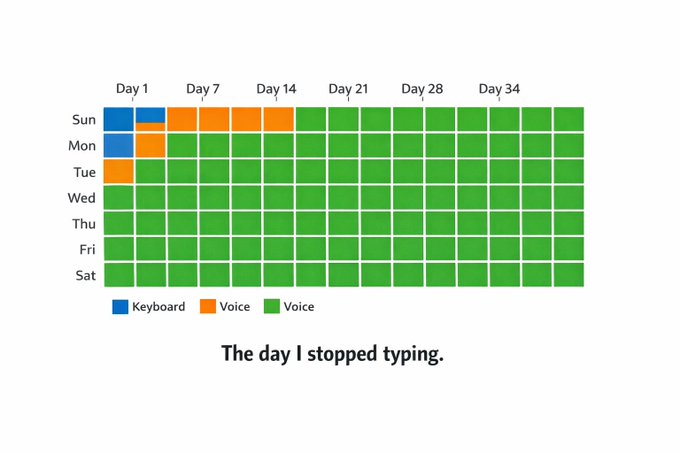
I haven't typed a first draft in 34 days.
Not a tweet. Not an email. Not a Slack message. Not a single sentence of the last three articles I published on this account, including the one that got 2.1M views last week.
I talk. Claude writes. In my voice. Not a chatbot voice. My voice the rhythm, the tics, the way I always start paragraphs with "Look," and end them with a one-liner. The way I over-use em-dashes. The way I hate the word "leverage" and refuse to say "utilize."
After 34 days, it's closer to me than my own typed drafts. Because my typed drafts are filtered. My voice isn't.
This is a second self. Not a productivity tool. A working copy of how you think, trained on nothing but your own mouth, that handles every piece of written output in your life while you go for a walk.
Here's exactly how it works, and how you can build it in one afternoon this week. It will take you 3 hours to save you, conservatively, 1,000 hours a year.
## The one thing nobody tells you about voice → LLM
Everyone writing about voice dictation is missing the point.
They think it's about speed. "Type 3x faster." "150 words per minute vs. 40." Technically true, practically irrelevant. If faster typing was the edge, court reporters would rule the earth.
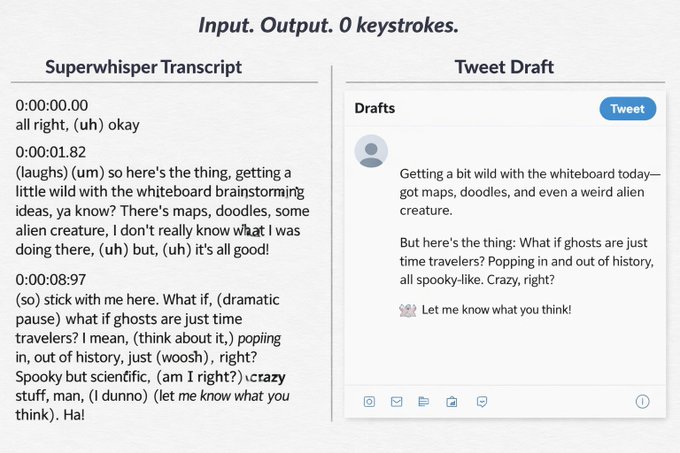
The real edge is this: when you talk, you don't self-edit.
When you type, there's a filter between your brain and the page. You soften takes. You drop half-formed ideas because they look dumb in a text field. You rewrite the same sentence four times before you even finish it. By the time something hits the page, it's been pre-optimized into mush.
When you talk — into a phone while driving, into a mic while walking, into your laptop while pacing — that filter is gone. You say the weird thing. You say the actual reason. You say the contrarian version. You follow the tangent that turns out to be the whole point.
Andrej Karpathy has been saying this for a year. In his "How I Use LLMs" talk, he said that roughly 80% of his interactions with LLMs are now voice-based. Pieter Levels uses Superwhisper all day. Guillermo Rauch (Vercel CEO) uses it as his primary input. Karpathy literally coined the term "vibe coding" in February 2025 while talking to Cursor through Superwhisper, because the voice → LLM loop was so much better than typing that it felt like a different activity.
None of them are doing it to type faster. They're doing it because the unfiltered version of their thinking is more valuable than the filtered version, and voice is the only way to capture it at full fidelity.
Now take that insight and run it forward one step. If your raw voice is more valuable than your typed version, and Claude can read your raw voice and produce polished writing from it…
Why are you still typing?
## What a second self actually is
Let me define this precisely, because every productivity-bro blog is going to muddy it within a month.
A second self is not an AI that sounds like you. ChatGPT can do that after 300 words of fine-tuning. Boring.
A second self is three things stacked:
1. A perfect capture layer. Every voice memo, every walk-and-talk, every shower-thought rant, every off-the-cuff Loom ends up as searchable text in one folder. Not "most of them." All of them. Automatically. With zero friction — if there's friction, you stop doing it, and the whole thing collapses.
2. A style model of you. Not a prompt that says "write in a casual tone." An actual document that Claude reads before every generation, containing: 40 examples of sentences you've written, 20 sentences you'd never write, your rhythm rules, your vocabulary bans, the structural moves you always make. Think of it as a CLAUDE.md, but for your personality.
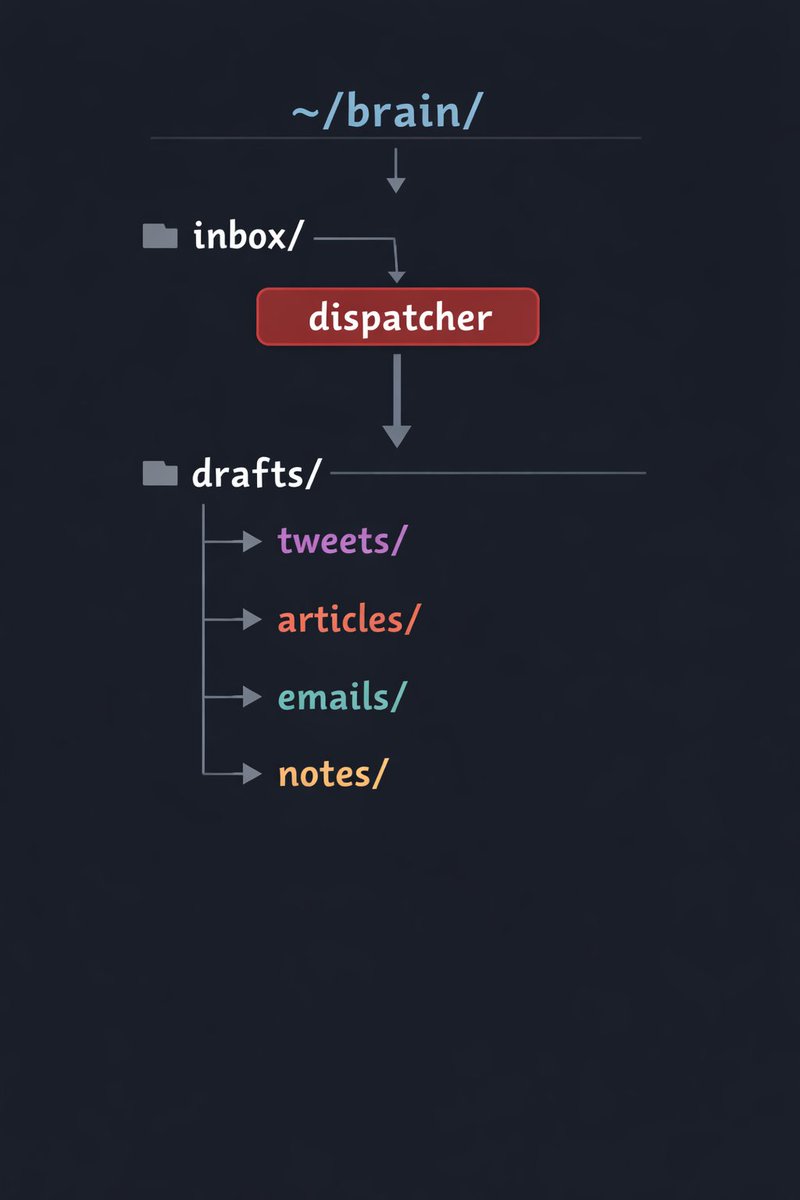
3. A routing system. Claude decides what each piece of voice-captured thinking actually is — a tweet, an article draft, an email reply, a decision to file, a task for future-you, a note for a specific project — and sends it to the right place. Not a single output. A dispatcher.
Stack all three and you get something that feels genuinely unnerving the first week you use it.
You walk around the block talking about an idea. By the time you get back to your desk, there's a draft tweet in your drafts folder, two bullet points added to an article you're working on, a reminder filed under a client's name, and one decision logged to your weekly review — all in your voice, all without you touching a keyboard.
The first time it happened I stared at my screen for a full minute. I didn't move. It was the same feeling as the first time ChatGPT answered a real question. That "oh, something just changed" feeling.
## How to build it in 3 hours
Three pieces. None of them hard.
Piece 1: The capture layer (15 minutes)
Download Superwhisper (Mac) or Wispr Flow (Mac/Windows). Either one. I use Superwhisper because Karpathy does and I am not above copying people smarter than me.
https://superwhisper.com
Set a global hotkey. I use Right Option. Hold it, talk, release. Whatever app you're in, the text drops into the cursor position. Works in Claude Code, works in a blank .txt file, works in the address bar of your browser if you want to chaos-pilot your life.
Critical setting: turn on Super Mode, and set the LLM to Claude Sonnet or Haiku. This strips filler words, fixes grammar, and light-touches the output before it hits the page. You don't want raw transcription — you want cleaned-up you.
But don't over-clean it. In Superwhisper's custom mode prompt, paste this:
That last paragraph matters more than anything else in this article. The default behavior of every voice tool is to make you sound like a LinkedIn post. That's the enemy. You're trying to capture you, not a polished version of you.
Piece 2: The style model (1 hour — the only hard part)
This is where people bounce. Don't bounce.
Create a folder: ~/brain/. Inside it, create a file: voice.md.
Now go find the 10 pieces of writing you're proudest of. Tweets, emails, article intros, whatever. Paste them into the file. Then write a short section underneath that looks like this:
Now — and this is the move most people miss — open Claude and paste your 10 best pieces and say: "Read these and write 30 more voice rules I didn't think to write down. Be specific. Point to sentences."
Claude will give you 30 rules about your own writing that you've never articulated. Paste them in. This is your actual style model. It's better than anything you'd write about yourself because you have blind spots about your own voice that only an outside reader can see.
Your voice.md should be 400-800 words. Not longer. Longer is worse.
Piece 3: The dispatcher (1 hour)
Install Claude Code. Point it at your ~/brain/ folder. This is your second self's home base.
Create three sub-folders:
Now the dispatcher. Save this as ~/brain/.claude/commands/dispatch.md:
Run it with:
Or schedule it to fire every 15 minutes using Claude Code's /schedule command (shipped in v2.1.72 — if you don't have it, update). Now your voice notes get processed in near-real-time, without you ever opening a terminal.
That's the whole system. Three pieces. One afternoon. The compounding starts immediately.
## What this actually feels like after 30 days
Week 1 is clunky. Claude gets your voice 70% right. You hand-edit everything. You add rules to voice.md based on what it got wrong. It feels like training a puppy that's almost as smart as you.
Week 2, something shifts. You realize you've stopped hand-editing the tweets. You skim, hit post. The voice is right.
Week 3, you notice you're talking to yourself more. On walks. In the car. Waiting in line. Because every idea you say out loud turns into something — a draft, a file, a decision — and every idea you don't say out loud disappears. The reward loop rewires you. You become an idea-speaker instead of an idea-forgetter.
Week 4, the weird part. You open one of Claude's drafts and you can't remember if you wrote it or it wrote it. Because it's both. It's you — but the version of you that didn't self-edit, didn't hedge, didn't water it down. The version of you that exists in your head for 3 seconds before the filter kicks in.
That version of you is a much better writer than the typed version. This is the part that messed me up.
I had always assumed the typed version was the real me, and voice was the sloppy first pass. It's the opposite. The typed version is a compromise between what I actually think and what I'm willing to commit to in writing. Voice is what I actually think. When Claude writes from voice, I'm not getting a worse draft — I'm getting a less-compromised draft. The hedges and softenings were never improvements. They were defenses.
Which leads to the thing I need to say out loud, because no one in the productivity space is saying it:
This is not about writing faster. It's about writing more honestly.
Typing is a filter that was installed when we invented the keyboard. We didn't know it was a filter because we had nothing to compare it to. Now we do. Voice + a style model + a dispatcher is what thinking-on-paper would have always looked like if our hands could keep up with our mouths.
## What to watch for, what to do tonight
The window on this is maybe 6 months.
Anthropic is going to ship native voice capture directly into Claude. Every AI lab is. When that happens, the edge shrinks — not because the tech gets better, but because everyone has it. Right now the edge exists because (a) you need to wire three tools together and (b) you need to build voice.md, and almost nobody is going to spend an hour documenting their own voice. That's your moat for the next two quarters.
Here's what to do before you close this tab:
Tonight: Download Superwhisper. Set the hotkey. Talk into a blank text file for 5 minutes about anything. Feel what it's like to have your brain hit the page without the keyboard filter.
This weekend: Build voice.md. One hour. Don't skip the step where Claude reads your best writing and tells you 30 rules about yourself. That step is the whole thing.
Next week: Wire up the dispatcher. Run it once a day manually. Don't automate it until it's producing drafts you're willing to post without edits.
Month two: Start tracking how many of your published posts never touched your keyboard. Mine is now above 90%. Yours will be too.
And then, send this article to one person — the one friend you have who is drowning in ideas they never write down. They are the person who needs this most, and they will not find it on their own.
The people who build a second self in 2026 are not going to look 3x more productive. They're going to look like they have a completely different kind of brain.
Because they will.
That's why it should be illegal.
## 相关链接
- [Guri Singh](https://x.com/heygurisingh)
- [@heygurisingh](https://x.com/heygurisingh)
- [74K](https://x.com/heygurisingh/status/2044432782747951581/analytics)
- [https://superwhisper.com](https://superwhisper.com/)
- [Upgrade to Premium](https://x.com/i/premium_sign_up)
- [11:08 PM · Apr 15, 2026](https://x.com/heygurisingh/status/2044432782747951581)
- [74.6K Views](https://x.com/heygurisingh/status/2044432782747951581/analytics)
- [View quotes](https://x.com/heygurisingh/status/2044432782747951581/quotes)
---
*导出时间: 2026/4/16 14:52:02*