# Claude: Dynamic Workflows ULTIMATE GUIDE
**作者**: AI Edge
**日期**: 2026-06-03T13:22:50.000Z
**来源**: [https://x.com/aiedge_/status/2062163097280979223](https://x.com/aiedge_/status/2062163097280979223)
---
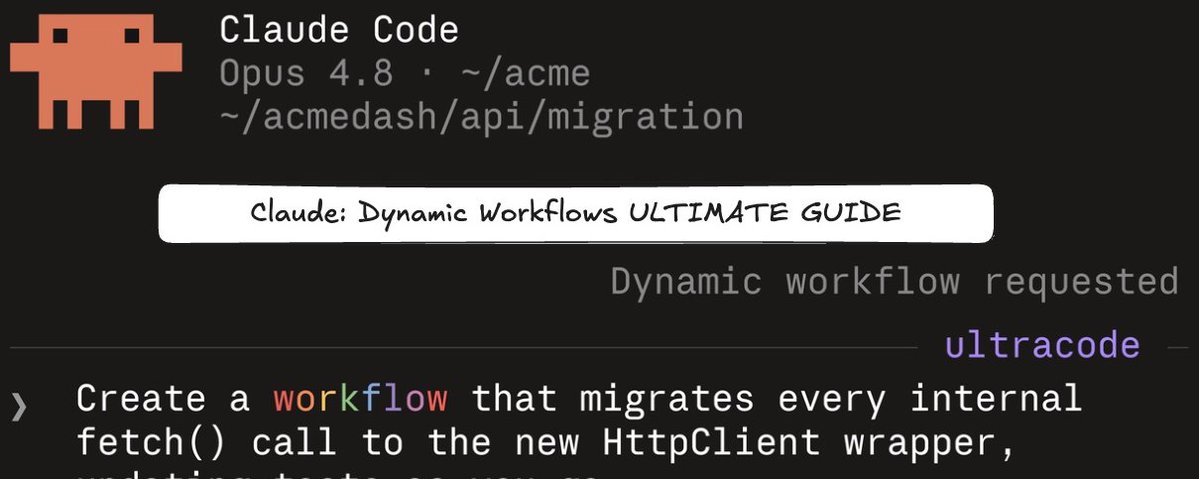
Anthropic just shipped the most powerful Claude feature, and 99% of people scrolled straight past it because Opus 4.8 was louder.
The feature is Dynamic Workflows, and they're like Claude Skills on steroids.
If you use Claude Code for anything complex, this changes everything.
In this article, I'm covering everything you need to know about the Dynamic Workflows.
I guarantee your Claude workflow productivity will skyrocket after this read.
Table of Contents
I: What Are Dynamic Workflows?
II: How to Use Them
III: Real World Examples
IV: Pro Tips
## Section I: What Are Dynamic Workflows?
Anthropic's definition: "A dynamic workflow is a JavaScript script that orchestrates subagents at scale. Claude writes the script for the task you describe, and a runtime executes it in the background while your session stays responsive."
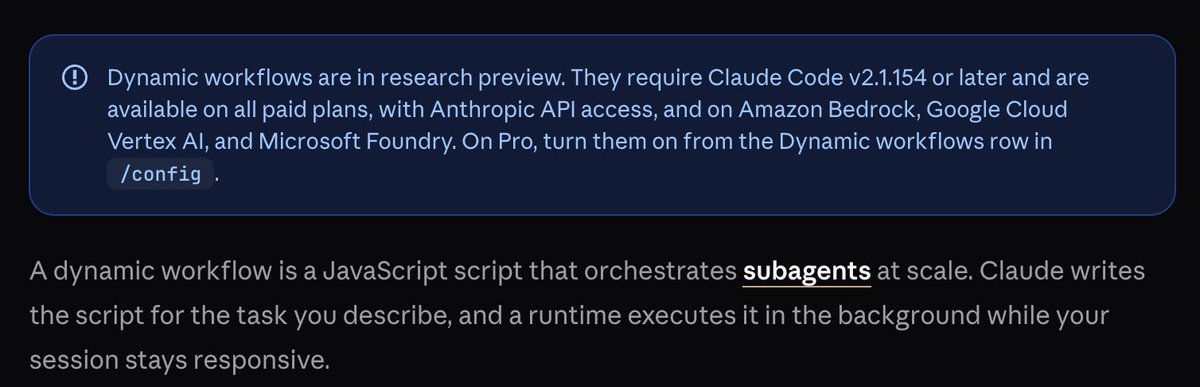
Anthropics definition
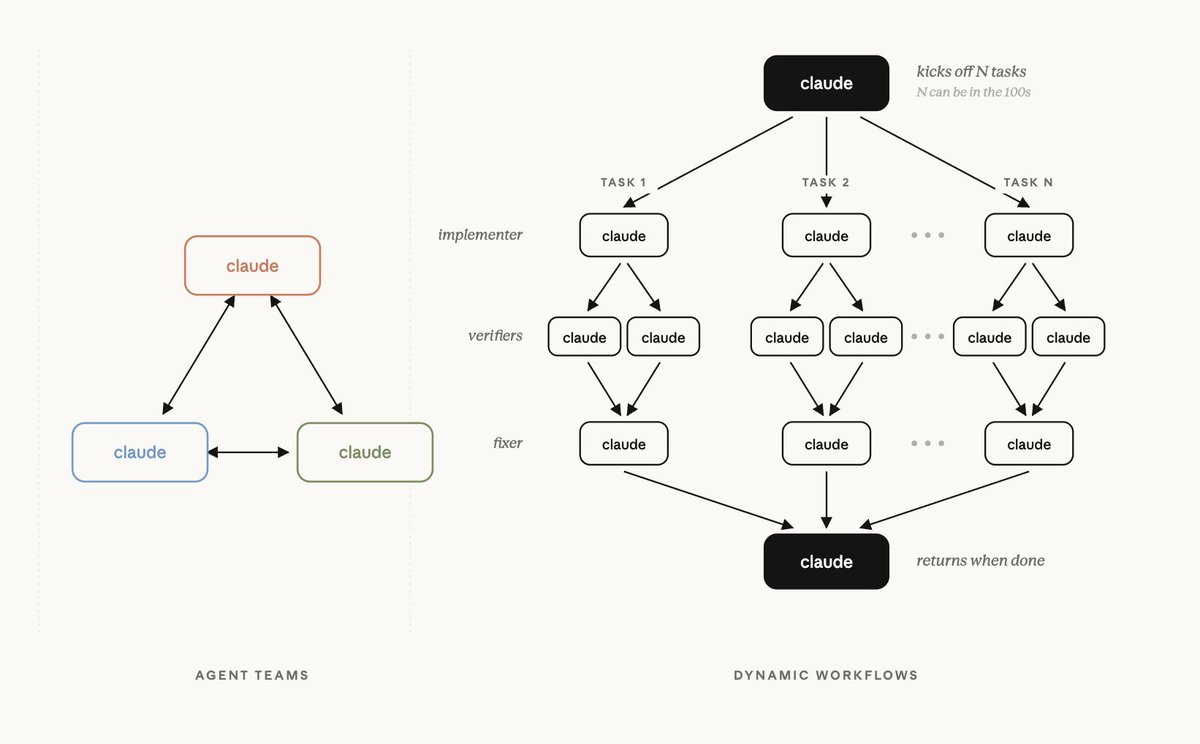
In plain English, this now means that Claude works through a problem step by step inside a single conversation. It writes a plan as a script, spins up tens to hundreds of parallel agents to execute different parts of that plan simultaneously, and has those agents check each other's work.
What Dynamic Workflows Do (in practice)
Dynamic Workflows do three things that nothing else in Claude Code can do at the same scale.
1. They Fan Out Across Parallel Agents
Instead of working through a task sequentially, a Dynamic Workflow splits it into subtasks and runs them simultaneously.
2. Agents Verify Their Own Work
A workflow can have independent agents adversarially review each other's findings before, or draft a plan from several angles and weigh them against each other.
3. They Are Resumable
Dynamic Workflows are resumable (good for long tasks).
4. The Orchestration Is Saved and Reusable
Once a workflow does what you wanted, you save it. It becomes a slash command in your project or personal library. Every future run uses the same orchestration logic, so you don't have to describe it again.
You might be thinking: "What's the difference between Skills, Plugins, etc. ?"
The simplest way to think about the difference:
- Skills tell Claude how to do something it already knows
- Plugins give Claude access to tools it didn't have
- Dynamic Workflows give Claude the ability to coordinate an entire workforce to tackle something too big for one conversation
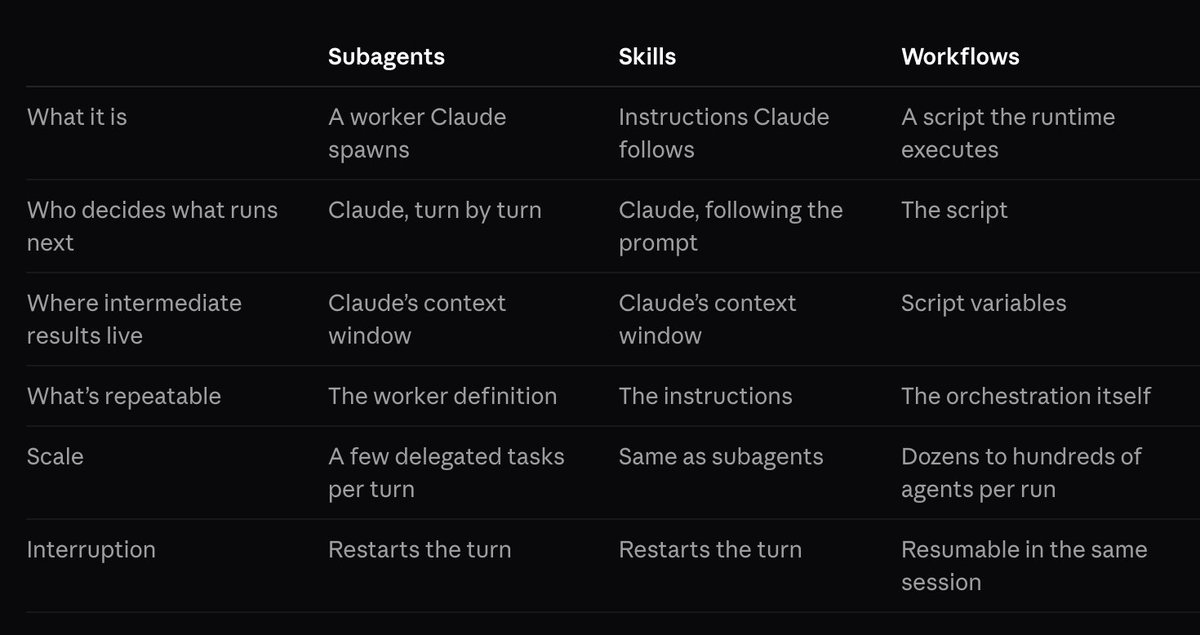
Difference between other Claude tools
For example, a skill can write a research brief, while a plugin can pull live data into that brief, and a Dynamic Workflow can fan out across hundreds of sources simultaneously, have agents cross-check each other's findings, filter out anything that doesn't hold up, and hand you a verified report.
## Section II: How to Use Dynamic Workflows
Luckily, creating and using dynamic workflows is actually extremely easy.
There are three main methods for getting started with dynamic workflows:
1. Creating your own workflows
To create your own workflow, just type "workflow" directly inside your Claude prompts.
Examples:
```
Run a workflow to audit every API endpoint in src/routes/ for missing authentication checks.
Create a workflow to research the top ten DeFi protocols by TVL, cross-check their recent security audits, and produce a risk-ranked summary.
Build a workflow to review every file in this repository for outdated dependencies and produce a prioritised upgrade list.
```
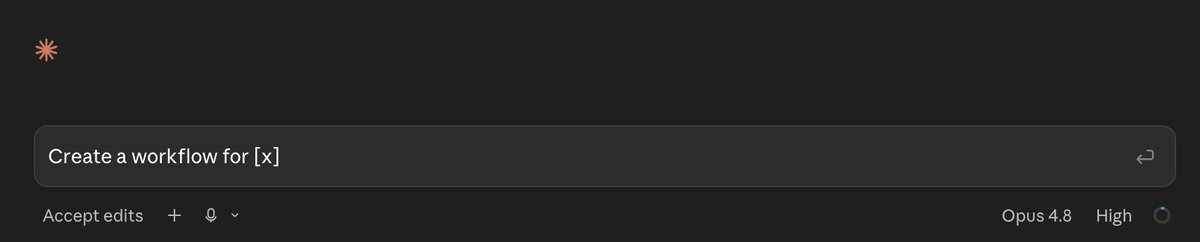
Creating custom workflows
The moment Claude sees the word "workflow" in your prompt, it switches to orchestration mode. It writes the script, shows you the planned phases, asks for approval, and then fans out across parallel agents to execute it.
Pro tip: If Claude Code highlights the word when you didn't mean to trigger one, press Alt + W to ignore it for that prompt. To stop the word from triggering at all, turn off the Workflow keyword trigger in /config.
2. Bundled Workflows
The quickest way to see a workflow in action is to run /deep-research, the built-in workflow Claude Code includes for investigating a question across many sources.
Example:
```
/deep-research What changed in the Node.js permission model between v20 and v22?
```
3. UltraCode
Ok, now this is powerful.
Ultracode is a Claude Code setting that combines xhigh reasoning effort with automatic workflow orchestration. With it on, Claude plans a workflow for each substantive task instead of waiting for you to ask.
As expected, this does burn through tokens, though.
To enable it, run "/effort ultracode" in Claude Code CLI.
Dynamic Workflows
Watching a Run in Progress
Once a workflow starts, you can monitor it in real time.
"/workflows"
This opens a progress view showing each phase with its agent counts, token totals, and elapsed time.
The key controls inside the progress view:
- p - pause or resume the run
- x - stop a selected agent or stop the entire workflow
- r - restart a selected running agent
- s - save the run's script as a reusable command
- Enter - drill into a phase or agent to see its prompt, tool calls, and result
Saving a Workflow for Reuse
Run /workflows, select the run you want to keep, and press s. In the save dialog, Tab toggles between two save locations.
## Section III: Real Examples
Ok, now that you have a good understanding of dynamic workflows, let's run through some real examples.
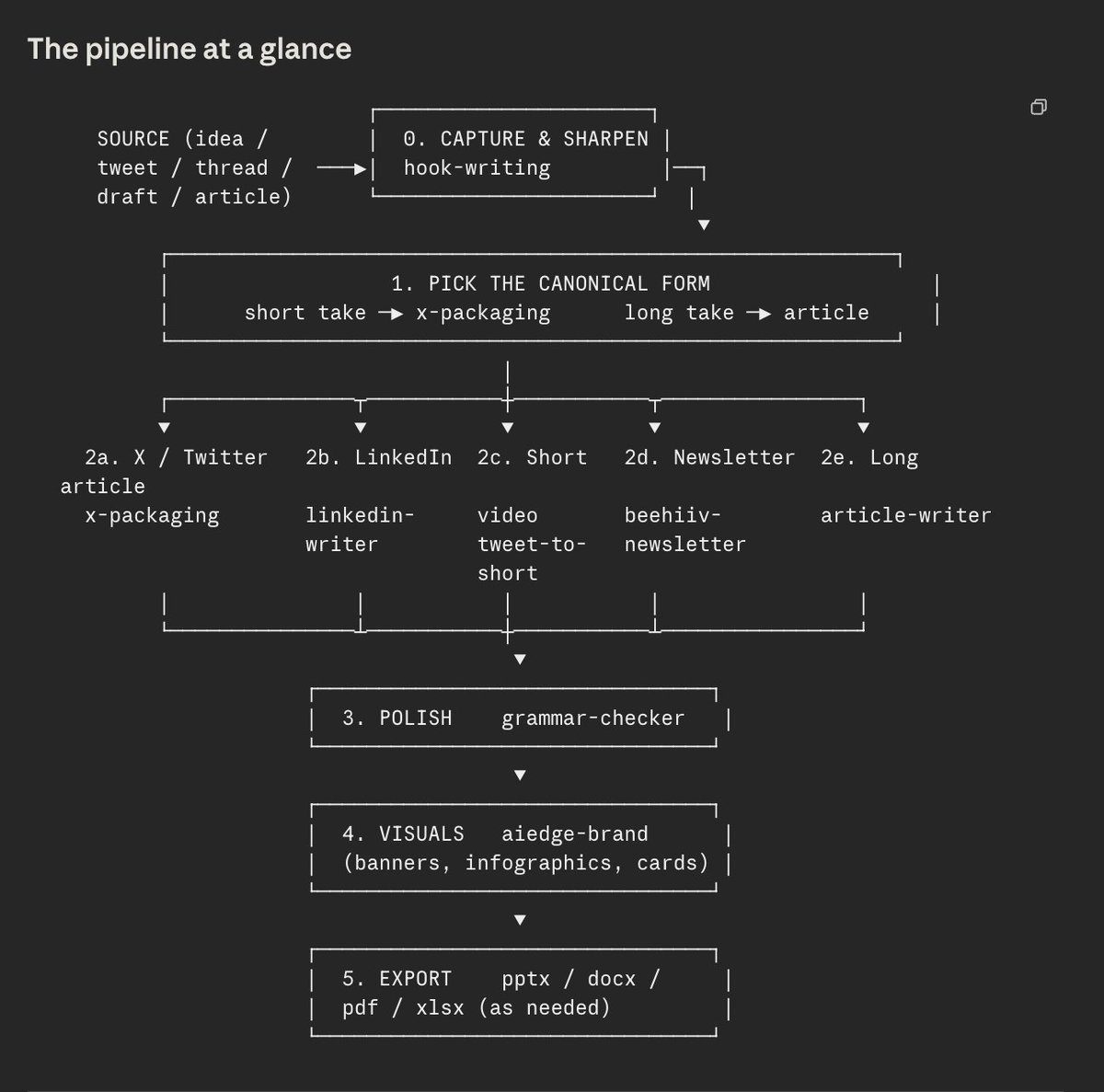
One workflow I recently created with Claude is an AI Edge content pipeline workflow.
It draws on all my AI Edge skills and maps the entire content ecosystem for this brand.
Step one: Content angle
Step two: Channel distribution
Step three: Polish
Step four: Visuals
Step five: Export
AI Edge Content Pipeline Dynamic Workflow
With this dynamic workflow, I can tell Claude to turn a tweet into a newsletter post, or simply give it a rough idea and have it run the entire workflow to complete the pipeline.
Deep Research Workflow
As mentioned above, /deep-research is a built-in workflow you can use now.
```
/deep-research What are the key narratives
driving the crypto market in June 2026
and which sectors are showing the strongest
on-chain activity?
```
What happens: Claude fans out across dozens of web sources simultaneously, cross-checks claims across sources, filters out anything that doesn't hold up, and delivers a cited research report in minutes. The same research done manually would take hours.
Save this workflow and run it daily for a personalized market intelligence briefing that updates automatically.
Content Research & Production Pipeline
```
Run a workflow to identify the ten
most discussed AI developments
from the last seven days. For each one:
summarise what happened, why it matters,
find three credible sources, and assess
its relevance to a crypto and AI audience.
Produce a ranked briefing with the three
highest potential article topics highlighted at the top.
```
What happens: agents scan news sources, social platforms, and research publications simultaneously, cross-reference coverage across sources, filter noise, and deliver a ranked editorial briefing.
The kind of research that takes a content team hours gets compressed into a single workflow run.
Hopefully, these sample prompts/workflows give you an idea of what's possible with this new feature.
Essentially, you can automate any repetitive task end-to-end with several agents.
## Section IV: Pro Tips
A rapid-fire section of pro tips for maximizing your dynamic workflows.
- Always check /model before starting a large run
Every agent in the workflow uses whatever model is active in your session (running 100 agents on Opus 4.8 costs significantly more than running them on Sonnet).
- Connect your MCPs before triggering research workflows
For example, a /deep-research run with CoinGecko, DeFiLlama, and Nansen produces dramatically richer crypto research than one that pulls from web search alone.
- Combine with existing Claude Skills
As shown above, use your skills to build workflows. For example, if you have multiple content skills (hook writer, article writer, etc.), package them into a single workflow.
- Workflows work in both CLI AND desktop app!
- Prompt for Claude
If you're ever unsure how to take advantage of workflows, just ask Claude:
"Based on everything you know about me, what workflows should we build?"
## Closing
I hope you found this ultimate guide helpful.
I've been testing Dynamic Workflows for the past week, and they've genuinely changed how I use Claude - give them a go and let me know how you like them!
For more AI articles like this, be sure to follow me @aiedge_ - I post articles like this 2-3x/week only on the hottest topics in AI.
If you enjoy written AI content, feel free to subscribe to my free newsletter.
https://www.aiedgehq.co/
100% free, no spam ever & unsub anytime!
## 相关链接
- [AI Edge](https://x.com/aiedge_)
- [@aiedge_](https://x.com/aiedge_)
- [107K](https://x.com/aiedge_/status/2062163097280979223/analytics)
- [@aiedge_](https://x.com/@aiedge_)
- [https://www.aiedgehq.co/](https://www.aiedgehq.co/)
- [https://www.aiedgehq.co/](https://www.aiedgehq.co/)
- [Upgrade to Premium](https://x.com/i/premium_sign_up)
- [9:22 PM · Jun 3, 2026](https://x.com/aiedge_/status/2062163097280979223)
- [107.2K Views](https://x.com/aiedge_/status/2062163097280979223/analytics)
- [View quotes](https://x.com/aiedge_/status/2062163097280979223/quotes)
---
*导出时间: 2026/6/4 15:37:35*
---
## 中文翻译
# Claude:动态工作流终极指南
**作者**:AI Edge
**日期**:2026-06-03T13:22:50.000Z
**来源**:[https://x.com/aiedge_/status/2062163097280979223](https://x.com/aiedge_/status/2062163097280979223)
---

Anthropic 刚刚发布了最强大的 Claude 功能,但 99% 的人直接划过去了,因为 Opus 4.8 的风头太盛。
这个功能就是动态工作流,它们就像是超级加强版的 Claude Skills。
如果你用 Claude Code 处理任何复杂的任务,这将改变一切。
在这篇文章中,我将涵盖关于动态工作流你需要知道的一切。
我保证,阅读本文后,你的 Claude 工作效率将飞速提升。
目录
I:什么是动态工作流?
II:如何使用它们
III:真实案例
IV:专业提示
## 第一部分:什么是动态工作流?
Anthropic 的定义:“动态工作流是一种大规模编排子代理的 JavaScript 脚本。Claude 会根据你描述的任务编写脚本,而运行时会在后台执行它,同时你的会话保持响应状态。”

Anthropic 的定义
用大白话来说,这意味着 Claude 现在可以在单个对话中一步步解决问题。它将计划编写为脚本,启动数十到数百个并行代理同时执行该计划的不同部分,并让这些代理互相检查工作。
动态工作流的作用(在实践中)
动态工作流可以做到三件 Claude Code 中其他功能无法在同一规模下做到的事情。
1. 在并行代理间分派任务
动态工作流不是按顺序处理任务,而是将其拆分为子任务并同时运行。
2. 代理验证自己的工作
工作流可以让独立的代理在之前对抗性地审查彼此的发现,或者从几个角度起草计划并相互权衡。
3. 它们是可恢复的
动态工作流是可恢复的(适合长任务)。
4. 编排逻辑可保存和重用
一旦工作流完成了你想要的工作,你就可以保存它。它就变成了你项目或个人库中的一个斜杠命令。未来的每次运行都使用相同的编排逻辑,所以你无需再次描述它。
你可能会想:“Skills、Plugins 等等之间有什么区别?”
思考这种区别最简单的方法是:
- Skills 告诉 Claude 如何做它已经知道的事情
- Plugins 给予 Claude 访问它原本没有的工具的能力
- Dynamic Workflows 赋予 Claude 协调整个“劳动力”来解决对于一个对话来说太大的问题的能力

其他 Claude 工具之间的区别
例如,Skill 可以写一份研究简报,Plugin 可以将实时数据拉入该简报,而 Dynamic Workflow 可以同时分派到数百个来源,让代理交叉检查彼此的发现,过滤掉任何站不住脚的内容,并交给你一份经过验证的报告。
## 第二部分:如何使用动态工作流
幸运的是,创建和使用动态工作流实际上非常简单。
有三种主要方法可以开始使用动态工作流:
1. 创建你自己的工作流
要创建你自己的工作流,只需在你的 Claude 提示词中直接输入 "workflow"。
示例:
```
Run a workflow to audit every API endpoint in src/routes/ for missing authentication checks.
运行一个工作流,审计 src/routes/ 中每个 API 端点,查找缺失的身份验证检查。
Create a workflow to research the top ten DeFi protocols by TVL, cross-check their recent security audits, and produce a risk-ranked summary.
创建一个工作流,研究按 TVL 排名的前十大 DeFi 协议,交叉检查它们最近的安全审计,并生成风险排名摘要。
Build a workflow to review every file in this repository for outdated dependencies and produce a prioritised upgrade list.
构建一个工作流,审查此仓库中的每个文件是否存在过时的依赖项,并生成优先升级列表。
```

创建自定义工作流
当 Claude 在你的提示词中看到 "workflow" 这个词的那一刻,它就会切换到编排模式。它会编写脚本,向你展示计划阶段,请求批准,然后分派到并行代理去执行它。
专业提示:如果在你无意触发的情况下 Claude Code 高亮了该词,请按 Alt + W 在该提示词中忽略它。若要完全阻止该词触发,请在 /config 中关闭 Workflow 关键词触发器。
2. 捆绑的工作流
查看工作流实际运行的最快方法是运行 /deep-research,这是 Claude Code 内置的用于跨多个源研究问题的工作流。
示例:
```
/deep-research What changed in the Node.js permission model between v20 and v22?
/deep-research Node.js 权限模型在 v20 和 v22 之间发生了什么变化?
```
3. UltraCode
好了,现在这个功能很强大。
Ultracode 是一个 Claude Code 设置,它结合了极高的推理努力和自动工作流编排。开启后,Claude 会为每个实质性任务规划一个工作流,而不是等你提出要求。
不出所料,这确实会消耗更多的 Token。
要启用它,请在 Claude Code CLI 中运行 "/effort ultracode"。

动态工作流
实时监控运行过程
一旦工作流开始,你就可以实时监控它。
"/workflows"
这将打开一个进度视图,显示每个阶段的代理计数、Token 总数和已用时间。
进度视图内的关键控制键:
- p - 暂停或恢复运行
- x - 停止选定的代理或停止整个工作流
- r - 重启选定的运行中代理
- s - 将运行的脚本保存为可重用命令
- Enter - 深入查看某个阶段或代理,查看其提示词、工具调用和结果
保存工作流以供重用
运行 /workflows,选择你想要保留的运行,然后按 s。在保存对话框中,Tab 键可在两个保存位置之间切换。
## 第三部分:真实示例
好了,既然你对动态工作流有了很好的理解,让我们来看一些真实的例子。
我最近用 Claude 创建的一个工作流是 AI Edge 内容流水线工作流。
它利用我所有的 AI Edge 技能,并绘制出这个品牌的整个内容生态系统。
第一步:内容角度
第二步:渠道分发
第三步:润色
第四步:视觉
第五步:导出

AI Edge 内容流水线动态工作流
有了这个动态工作流,我可以告诉 Claude 将推文转换成时事通讯文章,或者只是给它一个粗略的想法,让它运行整个工作流来完成流水线。
深度研究工作流
如上所述,/deep-research 是你现在就可以使用的内置工作流。
```
/deep-research What are the key narratives
driving the crypto market in June 2026
and which sectors are showing the strongest
on-chain activity?
/deep-research 2026 年 6 月推动加密市场的关键叙事是什么?
哪些领域的链上活动最强劲?
```
发生了什么:Claude 同时分派到数十个网络来源,交叉检查不同来源的声明,过滤掉任何站不住脚的内容,并在几分钟内交付一份引用研究报告。同样的研究如果手动进行需要数小时。
保存此工作流并每天运行,以获得一份自动更新的个性化市场情报简报。
内容研究与生产流水线
```
Run a workflow to identify the ten
most discussed AI developments
from the last seven days. For each one:
summarise what happened, why it matters,
find three credible sources, and assess
its relevance to a crypto and AI audience.
Produce a ranked briefing with the three
highest potential article topics highlighted at the top.
运行一个工作流,识别过去七天最受讨论的十个 AI 发展。
针对每一个:总结发生了什么,为什么重要,找到三个可信来源,
并评估其对加密货币和 AI 受众的相关性。
生成一份排名简报,并在顶部突出显示三个最具潜力的文章主题。
```
发生了什么:代理同时扫描新闻来源、社交平台和研究出版物,交叉引用不同来源的报道,过滤噪音,并交付排名的编辑简报。
原本需要内容团队花费数小时的研究被压缩到一次工作流运行中。
希望这些示例提示词/工作流能让你对这个新功能的可能性有所了解。
本质上,你可以利用多个代理端到端地自动化任何重复性任务。
## 第四部分:专业提示
这是用于最大化利用动态工作流的一系列快速专业提示。
- 在开始大规模运行之前务必检查 /model
工作流中的每个代理都使用你会话中当前激活的模型(在 Opus 4.8 上运行 100 个代理比在 Sonnet 上运行成本高得多)。
- 在触发研究工作流之前连接你的 MCP
例如,结合了 CoinGecko、DeFiLlama 和 Nansen 的 /deep-research 运行生成的加密研究,比仅从网络搜索提取的研究要丰富得多。
- 与现有的 Claude Skills 结合
如上所示,使用你的技能来构建工作流。例如,如果你有多个内容技能,可以将它们打包到一个工作流中。
- 工作流在 CLI 和桌面应用中均可使用!
- 向 Claude 提问
如果你不确定如何利用工作流,只需问 Claude:
“基于你对我的所有了解,我们应该构建哪些工作流?”
## 结语
我希望这份终极指南对你有所帮助。
在过去的一周里,我一直在测试动态工作流,它们真的改变了我使用 Claude 的方式——试试看,并告诉我你的感受!
想看更多这样的 AI 文章,请务必关注我 @aiedge_ ——我每周发布 2-3 篇此类文章,仅关注 AI 领域最热门的话题。
如果你喜欢文字形式的 AI 内容,欢迎免费订阅我的新闻通讯。
https://www.aiedgehq.co/

100% 免费,绝无垃圾邮件 & 随时可退订!
## 相关链接
- [AI Edge](https://x.com/aiedge_)
- [@aiedge_](https://x.com/aiedge_)
- [107K](https://x.com/aiedge_/status/2062163097280979223/analytics)
- [@aiedge_](https://x.com/@aiedge_)
- [https://www.aiedgehq.co/](https://www.aiedgehq.co/)
- [https://www.aiedgehq.co/](https://www.aiedgehq.co/)
- [升级到 Premium](https://x.com/i/premium_sign_up)
- [下午 9:22 · 2026年6月3日](https://x.com/aiedge_/status/2062163097280979223)
- [10.7万次观看](https://x.com/aiedge_/status/2062163097280979223/analytics)
- [查看引用](https://x.com/aiedge_/status/2062163097280979223/quotes)
---
*导出时间: 2026/6/4 15:37:35*