# The GitHub Trick That Makes AI Actually Know Your Business
**作者**: Nick Spisak
**日期**: 2026-09-12T13:21:01.000Z
**来源**: [https://x.com/NickSpisak_/status/2098763814976073854](https://x.com/NickSpisak_/status/2098763814976073854)
---
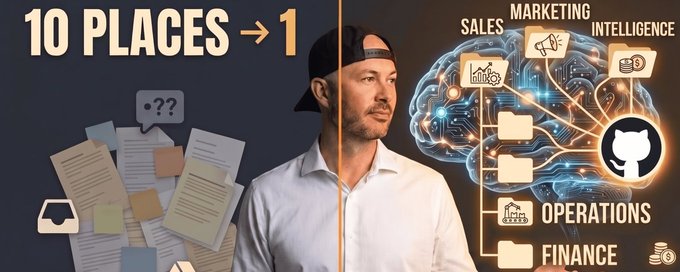
Every AI tool, agent, and new hire in your business starts from zero. Your SOPs and core knowledge live in ten places, nobody owns the current copy, and you explain the business again in every chat.
In the second lesson of The AI Owner-Operator, I set up a free, business-owned GitHub organization for Capstone Brands, my Amazon brand business, and show an AI tool answering a question from a file in that repository.
## What GitHub is, for an owner
GitHub stores files and folders and keeps their history. You can go back to any snapshot and see who made a change, when they made it, and what changed. A knowledge base in its most primitive form is files and folders, which is why AI tools can read one directly.
My own portfolio runs from a GitHub-hosted second brain. The repository is the gold copy every tool reads from.
## What goes in, what stays out
- Standard operating procedures. The way you actually do the work.
- Decisions. Who was in the room and what the circumstances were, so a quarterly review or annual planning session does not relitigate a settled question. When circumstances change, the log shows what the old decision rested on, and you can make a different one.
- Reference data. Price lists, vendor sheets, quotes. The proprietary information your decisions get made from.
Three things stay out: passwords, customer personal information, and bank statements. Anything you would not want a new hire to have on day one.
## The business owns it
Set the knowledge base up at the organization level in GitHub, under the actual name of your business, with everything underneath that organization. You get role-based access control over who can reach it. The company's organization holds the data, with you as an owner, rather than a consultant's account or an office manager's Google Drive. When people change, the knowledge stays.
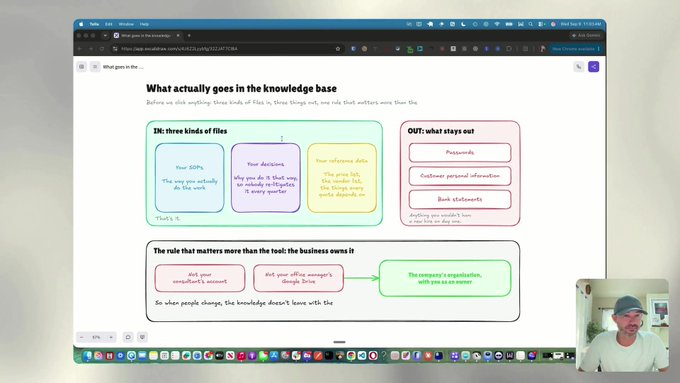
From Episode 2 at 3:05: three kinds of files in, three things out, and the business owns it.
## Create the organization
1. Go to [github.com](//github.com). Sign up with Google, Apple, or an email address if you are new, or sign in if you already have an account.
2. Pick a plan for the organization. The free plan covers most of what a business needs to start.
3. Choose "create a free organization." Name it after the business, give it a contact email, mark it as a business or institution, and accept the terms.
4. Add team members, or skip this step and add them later.
The private repository for the knowledge base sits inside that organization. GitHub Desktop gives you a local copy on your machine without a terminal: paste the repository URL and click clone.
## Give every procedure a home
The Capstone Brands repository has a top-level folder for each domain of the business, including sales, marketing, operations, intelligence, integrations, and finance. A new procedure goes into operations, under SOPs.
Each SOP follows the same format: an ID, a title, and its place in the structure, then the procedure itself. Say brand A makes widgets and you restock that product every 45 days. Interview yourself, or the person with the expertise, about how that restock decision gets made. Run the transcript back through the repository and the AI files the SOP where it belongs. You end up with a framework for any procedure or decision the business depends on.
## Ask it one question
I opened the repository folder in the ChatGPT desktop app, working through Codex, and set the reasoning level low, because reading a file back does not need the most expensive setting. Use the right level of intelligence for the job.
The first instruction was git pull origin main. It means go to GitHub, grab the latest version of the gold copy, and bring it down to this machine.
Then I asked the real question: who is Capstone Brands' ideal customer profile?
About 30 seconds later it answered from the file. Brands generating at least $100,000 a month across all channels, with a focus on brands where we have a specialized advantage on Amazon. It cited the exact file it read, icp.md.
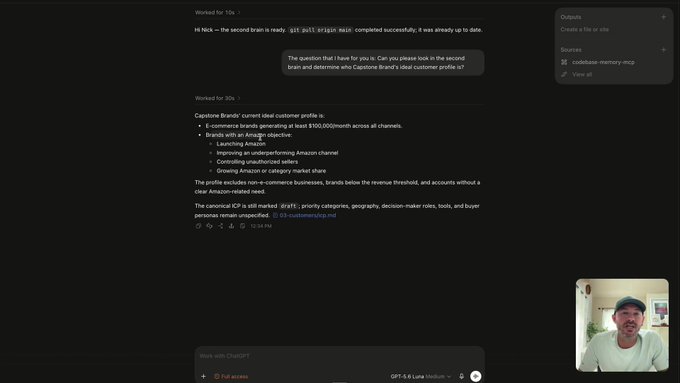
From Episode 2 at 10:05: the answer, and the file it came from.
## Your first step this week
Create a GitHub organization for your business with a repository inside it. Put something real in it. An SOP, a decision log, or a price list is enough. Then point the AI tool you already pay for at it and ask one question, not ten. Make that one question work before you build on it.
A future episode covers connectors, distilling your business knowledge into clean data, and getting the rest of it into the second brain without turning it into a mess.
## Episode 2: What stays out, and who owns it
Excerpt · 2:34–3:14. Passwords, customer personal information, and bank statements stay out. The business's organization owns the knowledge base.
<video controls preload="metadata" poster="/doc/6478/image/img_dc1fe1be30ac.jpg" src="/videos/0606.mp4"></video>
## Episode 2: Ask it one question
Excerpt · 9:40–10:21. One question to the second brain, answered from the cited file.
<video controls preload="metadata" poster="/doc/6478/image/img_dcbc1aa46315.jpg" src="/videos/0606.mp4"></video>
## Watch the full episode
[Watch Episode 2 on YouTube: The GitHub Trick That Makes AI Actually Know Your Business](https://youtu.be/DjnpYc4fmL4)
The free setup guide is linked in the video description. If something was unclear, tell me in the comments.
## 相关链接
- [Nick Spisak](https://x.com/NickSpisak_)
- [@NickSpisak_](https://x.com/NickSpisak_)
- [2.3K](https://x.com/NickSpisak_/status/2098763814976073854/analytics)
- [github.com](https://github.com/)
- [Watch Episode 2 on YouTube: The GitHub Trick That Makes AI Actually Know Your Business](https://youtu.be/DjnpYc4fmL4)
- [Upgrade to Premium](https://x.com/i/premium_sign_up)
- [9:21 PM · Sep 12, 2026](https://x.com/NickSpisak_/status/2098763814976073854)
- [2,394 Views](https://x.com/NickSpisak_/status/2098763814976073854/analytics)
---
*导出时间: 2026/9/13 09:28:13*
---
## 中文翻译
# 让 AI 真正了解你生意的 GitHub 技巧
**作者**: Nick Spisak
**日期**: 2026-09-12T13:21:01.000Z
**来源**: [https://x.com/NickSpisak_/status/2098763814976073854](https://x.com/NickSpisak_/status/2098763814976073854)
---

企业里的每一个 AI 工具、智能体和新员工都是从零开始的。你的 SOP 和核心知识散落在十个地方,没有人负责最新版本,而且每次对话你都得重新解释一遍业务。
在《The AI Owner-Operator》的第二课中,我为 Capstone Brands——我的亚马逊品牌业务——搭建了一个免费的、归企业所有的 GitHub 组织,并展示了一个 AI 工具如何回答来自该仓库中文件的问题。
## 对于企业主来说,GitHub 是什么
GitHub 存储文件和文件夹,并保留它们的历史记录。你可以回到任何快照,查看谁做了更改、何时做的以及改了什么。知识库最原始的形式就是文件和文件夹,这正是 AI 工具能够直接读取它的原因。
我自己的业务组合就运行在一个由 GitHub 托管的“第二大脑”上。这个仓库是所有工具读取的黄金版本。
## 什么放进去,什么排除在外
- 标准操作程序。你实际开展工作的方式。
- 决策记录。谁参与了决策,当时的背景是什么,这样季度复盘或年度规划会议就不会重新争论已经解决的问题。当情况发生变化时,日志会显示旧决策的依据,你可以据此做出不同的决定。
- 参考数据。价格表、供应商资料、报价单。你做决策所依据的专有信息。
有三样东西要排除在外:密码、客户个人信息和银行对账单。任何你不想让新员工第一天就拿到的东西。
## 归企业所有
在 GitHub 的组织级别搭建知识库,以你企业的真实名称命名,所有内容都放在该组织之下。你可以获得基于角色的访问控制,管理谁能访问它。数据由公司的组织持有,你是所有者,而不是放在咨询顾问的账户或办公室经理的 Google Drive 里。人员变动时,知识得以保留。

第二集 3:05 处:三类文件放入,三样东西排除,归企业所有。
## 创建组织
1. 访问 [github.com](//github.com)。如果你是新用户,用 Google、Apple 或电子邮箱注册;如果已有账户,直接登录。
2. 为组织选择一个计划。免费计划已经涵盖了企业起步所需的大部分功能。
3. 选择“创建免费组织”。以企业名称命名,填写联系邮箱,标记为企业或机构,并接受条款。
4. 添加团队成员,或者跳过这一步,稍后再添加。
知识库的私有仓库就放在这个组织内。GitHub Desktop 让你在不使用终端的情况下在本地获得副本:粘贴仓库 URL 并点击克隆。
## 给每个流程一个家
Capstone Brands 仓库为业务的每个领域设有一个顶层文件夹,包括销售、营销、运营、情报、集成和财务。新流程放入运营文件夹下的 SOPs 中。
每份 SOP 都遵循相同的格式:一个 ID、一个标题及其在结构中的位置,然后是流程本身。假设品牌 A 生产小商品,你每 45 天为该产品补货一次。访谈你自己或掌握专业知识的人,了解补货决策是如何做出的。把访谈记录放回仓库,AI 会把 SOP 归档到它该在的位置。最终你会得到一套框架,适用于业务所依赖的任何流程或决策。
## 向它提一个问题
我在 ChatGPT 桌面应用中打开了仓库文件夹,通过 Codex 运行,并将推理级别设为低,因为读取文件不需要最昂贵的设置。为工作匹配合适的智能级别。
第一条指令是 git pull origin main。意思是去 GitHub,获取黄金版本的最新内容,下载到这台机器上。
然后我提出了真正的问题:Capstone Brands 的理想客户画像是怎样的?
大约 30 秒后,它从文件中给出了答案:在全渠道月收入至少 10 万美元的品牌,重点是我们能在亚马逊上拥有专业化优势的品牌。它引用了它所读取的确切文件:icp.md。

第二集 10:05 处:答案及其来源文件。
## 本周你的第一步
为你的企业创建一个 GitHub 组织,并在其中建一个仓库。放入一些真实的内容。一份 SOP、一份决策日志或一张价格表就足够了。然后把已经在付费使用的 AI 工具指向它,问一个问题,而不是十个。先让这一个问题发挥作用,再在此基础上扩展。
未来的一集将介绍连接器、将业务知识提炼为干净的数据,以及如何把其余知识导入第二大脑而不使其变成一团糟。
## 第二集:什么排除在外,归谁所有
节选 · 2:34–3:14。密码、客户个人信息和银行对账单排除在外。知识库归企业的组织所有。
<video controls preload="metadata" poster="/doc/6478/image/img_dc1fe1be30ac.jpg" src="/videos/0606.mp4"></video>
## 第二集:向它提一个问题
节选 · 9:40–10:21。向第二大脑提一个问题,根据引用的文件作答。
<video controls preload="metadata" poster="/doc/6478/image/img_dcbc1aa46315.jpg" src="/videos/0606.mp4"></video>
## 观看完整剧集
[在 YouTube 上观看第二集:让 AI 真正了解你生意的 GitHub 技巧](https://youtu.be/DjnpYc4fmL4)
免费设置指南的链接在视频描述中。如果有不清楚的地方,请在评论区告诉我。
## 相关链接
- [Nick Spisak](https://x.com/NickSpisak_)
- [@NickSpisak_](https://x.com/NickSpisak_)
- [2.3K](https://x.com/NickSpisak_/status/2098763814976073854/analytics)
- [github.com](https://github.com/)
- [在 YouTube 上观看第二集:让 AI 真正了解你生意的 GitHub 技巧](https://youtu.be/DjnpYc4fmL4)
- [升级到 Premium](https://x.com/i/premium_sign_up)
- [2026年9月12日 晚上9:21](https://x.com/NickSpisak_/status/2098763814976073854)
- [2,394 次浏览](https://x.com/NickSpisak_/status/2098763814976073854/analytics)
---
*导出时间: 2026/9/13 09:28:13*