# 20 Things Smart People Are Learning With AI Right Now While Everyone Else Waits.
**作者**: NeilXbt
**日期**: 2026-04-18T08:18:35.000Z
**来源**: [https://x.com/neil_xbt/status/2045416688808554571](https://x.com/neil_xbt/status/2045416688808554571)
---
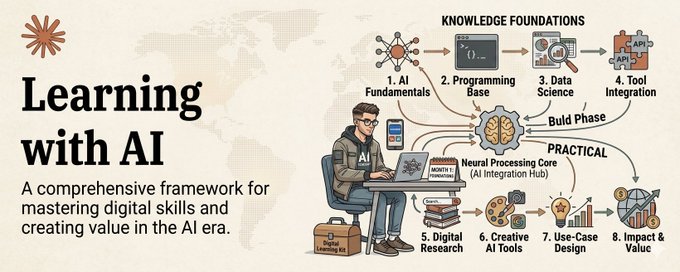
There is a group of people who are not waiting.
They are not waiting for AI to mature. They are not waiting for better tools. They are not waiting for the right course to arrive or the right moment to feel ready.
They are using what exists right now, today, to learn things that used to take years, and they are getting a compounding head start that will be very difficult to close later.
The people still waiting have a list of reasons. They are watching to see how things develop. They are not sure which skill to focus on. They are busy with what is in front of them. They intend to start next month.
Next month, the gap will be larger.
This is not a list of the most exotic AI applications or the most technically impressive things being built in research labs. This is a list of practical things that real people are learning with AI right now that produce real returns, skills that pay, perspectives that change decisions, capabilities that used to require expensive courses or years of experience to develop.
Here are 20 of them.
1. How to Write in a Way That Actually Persuades People
Most people write to express what they think. Persuasive writing is different. It requires you to understand what the reader already believes, what their objections are before they voice them, and how to sequence information so that each sentence makes the next one easier to accept.
Smart people are using AI to study this in real time. They paste their writing in, ask Claude to identify where the logic drops, where a reader would push back, where the argument assumes too much. They ask for the three weakest sentences. They ask for a rewrite of the opening that would keep a skeptic reading.
This is an editorial feedback loop that used to cost money or require a skilled friend who was also a writer. It is now available in every draft.
2. How to Understand Financial Statements
The ability to read a balance sheet, understand what the income statement is actually telling you, and interpret a cash flow statement without getting lost is one of the most practically useful skills in business. Most people never develop it because the resources for learning it either assume you already know or bury you in jargon.
AI can explain a P&L line by line, in plain language, as many times as you need, at exactly your level of understanding. You can paste in a real company's annual report and ask Claude to walk you through what the numbers mean, which ones matter most, and what would concern a sophisticated investor.
This skill used to take a business degree or a very patient CFO mentor to develop. It now takes a few focused sessions with AI and a willingness to ask questions that would feel embarrassing in a room full of people.
3. How to Learn a New Language Faster Than Any App Teaches It
Duolingo teaches you to say "the cat drinks milk" in German. What it does not teach you is how to sound like a person rather than a textbook, how to understand fast native speech, or how to have a real conversation about something that matters to you.
Smart people are using AI as a conversation partner in their target language, asking it to correct their grammar, explain why a phrase sounds unnatural, teach them the idioms that native speakers actually use, and simulate real-world conversations around their specific interests and profession.
The feedback loop is immediate. The patience is infinite. And the ability to practice at two in the morning when you have twenty minutes and no language partner available makes the consistency that language learning requires actually achievable.
4. How to Think Through Complex Decisions Without Bias
Every major decision you make is shaped by biases you are not aware of. Confirmation bias. Availability bias. Sunk cost fallacy. The tendency to overweight recent events. The tendency to underweight base rates in favor of specific details.
AI gives you a thinking partner that can name the bias operating in your reasoning, steelman the position you are dismissing, and force you to engage with your assumptions rather than act on them unchecked. You describe the decision, explain your current thinking, and ask Claude to tell you what you are probably getting wrong.
This is not about outsourcing judgment. It is about having a mirror that reflects back the structure of your thinking so you can see it clearly rather than just feeling your way through it.
5. How to Build Something Online Without a Technical Background
A working landing page. A functional tool. A prototype that demonstrates an idea. A simple automation that saves ten hours per week. These things used to require a developer, which meant either money or a co-founder or months of learning to code.
Smart people are using AI to build real things without waiting. They describe what they want in plain language. They work through the problems that come up. They ship something that works, get feedback from real users, and iterate.
The gap between "I have an idea" and "I have a working version" has never been smaller. The people closing that gap are not waiting for perfect technical skills. They are learning the skill of working with AI to build, which is its own capability and one that compounds quickly.
6. How to Research Any Topic at a Professional Level
Shallow research produces shallow conclusions. Most people read the first three articles that appear in a search, form an opinion, and move on. Professional-quality research means understanding the primary sources, knowing what the actual debate is among experts, identifying where the evidence is strong versus where it is contested, and being able to articulate the steelman version of positions you disagree with.
AI compresses the time it takes to develop that depth without compressing the depth itself. You can go from "I have heard of this topic" to "I understand the main arguments, their strongest evidence, and the key objections" in a single focused session, which changes the quality of every decision, conversation, and piece of work that touches that topic.
7. How to Negotiate
Most people negotiate by stating a position, hearing a counteroffer, and compromising somewhere in the middle. Skilled negotiators know this is the most expensive way to negotiate.
Real negotiation skill involves understanding what the other party actually values, identifying the interests underneath stated positions, knowing which concessions cost you little but matter to them, and recognizing when to hold and when to move. These are learnable, specific skills and AI can teach them through case studies, role-plays, and real-time feedback on your reasoning.
You can describe a real negotiation you are preparing for, explain both parties' positions, and ask Claude to identify the leverage you are not using, the assumptions you are making that might be wrong, and the three most likely ways it goes badly. This kind of preparation used to require a coach.
8. How to Speak in Public Without Fear
Public speaking anxiety is almost never about speaking. It is about the combination of uncertainty, perceived judgment, and the gap between how you sound in your head and how you fear you sound out loud.
Smart people are using AI to prepare for specific speeches and presentations in a way that reduces uncertainty, which is the root of the anxiety. They practice their opening ten sentences until they know them cold. They work through every question they might receive. They ask Claude to identify the moment in their outline where a skeptical audience would check out.
Removing uncertainty through preparation is the most reliable path to composure under pressure. AI makes that preparation faster and more comprehensive than any other tool available.
9. How to Build Systems That Run Without Constant Attention
A system is any set of processes where doing the setup work once produces results repeatedly without proportional ongoing effort. Email sequences. Content pipelines. Client onboarding flows. Recurring reports. Standard operating procedures that survive the absence of the person who built them.
The ability to think in systems, to see where repeated effort exists and replace it with a process, is one of the highest-value skills in any professional context. AI makes it faster to design these systems, document them clearly, and build the automation layer that makes them run.
People who develop this skill are not just more productive. They are building leverage that compounds, because every system they create returns time that can be invested in the next one.
10. How to Give and Receive Feedback Without Damaging Relationships
Most people avoid giving honest feedback because they are afraid of how it will land. Most people receive feedback defensively because it arrives without enough context to understand the intent. Both problems make organizations, teams, and relationships worse over time.
AI can help you learn to frame difficult feedback in a way that is specific, actionable, and delivered with genuine care for the other person's growth. It can also help you understand how to receive feedback without the emotional shutdown that makes people stop giving it.
These are communication skills that used to get learned through trial and error, usually with real relationship damage along the way. They are learnable much faster through deliberate practice with AI, which has no ego in the outcome.
11. How to Understand the Technology Reshaping Your Industry
Every industry is being changed by AI and most people in those industries understand this at a headline level without understanding it at a practical level. They know "AI is affecting healthcare" or "AI is changing legal work." They do not know which specific tasks are being automated first, which roles are becoming more valuable, and what the person who thrives in their industry in ten years knows that they do not know yet.
AI can give you that specificity. You can ask Claude to explain exactly how AI is being deployed in your field, which jobs it is replacing versus augmenting, what skills the people thriving in your industry in five years will have, and what you should be learning now to be in that group rather than watching it from outside.
12. How to Write Code Well Enough to Use It
Not enough to be a professional developer. Enough to automate repetitive tasks in your own workflow, build simple tools that solve your own problems, and understand what engineers are telling you when they explain technical constraints.
This level of coding fluency is more achievable now than it has ever been, because AI explains every line you do not understand and helps you debug in real time. You do not need to learn syntax before you can build something that works. You learn syntax by building things that work and asking why they work.
The people developing this skill are not trying to become developers. They are trying to stop being limited by what they cannot build themselves.
13. How to Manage Your Own Psychology
The research on what actually drives performance, wellbeing, and sustained motivation is substantial and almost entirely ignored in the way most people approach their own lives. They manage their time but not their energy. They set goals but not the conditions that make achieving them likely. They address symptoms without understanding the systems producing them.
AI gives you access to the practical implications of that research in a way that is personalized to your actual situation. You describe what is happening, how you are responding to it, and what you want to be different, and you can explore the cognitive patterns, behavioral interventions, and environmental changes that are most relevant to your specific case. This is not therapy. It is evidence-based self-knowledge, applied.
14. How to Run Meetings That Produce Decisions
Most meetings produce no decisions. They produce conversation, alignment-building, status updates, and vague agreement to think about the topic more and discuss it again next week. The people who know how to run meetings that end with clear decisions, clear owners, and clear timelines are rare and valued everywhere they work.
This is a learnable skill and AI can accelerate the learning substantially. You can study meeting design, prepare agendas that force decisions rather than enable deferral, and get real-time feedback on why specific meetings in your experience went nowhere.
15. How to Build an Audience Around What You Know
Every person who has developed real expertise in something has knowledge that other people would pay attention to. Most of them never share it because they do not know how, do not have the confidence, or do not understand that the bar for valuable content is much lower than the bar they are setting for themselves.
Smart people are using AI to bridge that gap. Not to replace their voice but to help them find it. To turn their half-formed thoughts into coherent pieces. To understand which of their ideas will resonate with the people they want to reach. To build a consistent output without the creative overhead that stops most people before they start.
16. How to Understand Data Well Enough to Question It
Statistics can be used to support almost any conclusion. The people who know how to examine a study, identify the assumptions baked into a dataset, and recognize when a percentage is being used to mislead are functionally operating in a different reality than the people who accept numbers at face value.
AI can teach this skill through specific examples. You paste in a statistic, a study summary, or a chart, and ask Claude to identify what questions a statistically sophisticated reader would ask about it. After enough of these sessions, you start asking those questions automatically.
17. How to Solve Problems Systematically
Most people approach problems the way they always have, by doing the first thing that comes to mind, adjusting when it does not work, and continuing until something sticks. This produces solutions but rarely the best ones, because the first solution that comes to mind is almost never the one that would survive careful analysis.
Systematic problem-solving is a set of specific tools: defining the actual problem before jumping to solutions, separating symptoms from causes, generating options before evaluating them, and stress-testing proposed solutions against the conditions most likely to break them. AI can walk you through this framework on real problems you are facing, which is how you actually learn it rather than just knowing it exists.
18. How to Build Genuine Confidence
Not performed confidence. Not the kind that collapses under pressure or requires constant validation. The kind that comes from accumulated evidence of your own competence, from understanding your actual strengths and weaknesses clearly rather than through the distorted lens of other people's opinions or your own anxiety.
This is not something AI builds for you. But AI can accelerate the process by helping you reflect honestly on your experience, identify patterns in what you do well, and build the skills that produce the competence that confidence is actually built on.
19. How to Write Proposals That Win
A proposal is a sale in document form. Most proposals lose not because the work being proposed is not good but because the document focuses on the deliverables instead of the transformation. It describes what will be done rather than what will be different as a result.
Smart people are using AI to understand the structure of proposals that win, practice writing them against specific scenarios, and get feedback on where their current proposals are selling the process rather than the outcome. This skill pays directly and immediately in anyone who ever needs to convince another person or organization to say yes to something.
20. How to Learn Anything New in Half the Time
This one is the meta-skill underneath all the others.
Most people learn by reading linearly and hoping comprehension accumulates. The most effective learners engage differently. They start with the big picture structure of the subject before filling in details. They actively test their understanding rather than passively reviewing material. They teach back what they have learned to expose the gaps. They seek the specific type of example that makes an abstract concept concrete.
AI can be configured to teach in exactly this way, building learning experiences around your existing knowledge, testing comprehension in real time, generating the specific examples that connect new ideas to things you already understand, and making explicit the structure of a new subject that would otherwise take months of immersion to perceive.
The people who develop this meta-skill are not just learning faster. They are building a capability that accelerates every area of learning they turn it toward for the rest of their lives.
## The Reason to Start Now
There is a window in which learning these skills with AI produces disproportionate returns. That window exists because the people who learn now build advantages while most people are still deciding whether to start.
It will not stay open indefinitely. The tools will become more mainstream. The skills will become table stakes rather than differentiators. The first-mover advantage will compress.
None of that means starting later is fine. It means starting now is better than starting later, and starting later is better than not starting at all.
Pick two from this list. The two that produce the most return in your specific life, in the work you do, in the goals you are building toward.
Use AI to develop them deliberately, not casually, over the next 90 days.
The people who are learning these things right now are not exceptionally talented.
They are not technically sophisticated.
They are not waiting for the right moment.
They just decided to start while everyone else was still watching.
## 相关链接
- [NeilXbt](https://x.com/neil_xbt)
- [@neil_xbt](https://x.com/neil_xbt)
- [5.9K](https://x.com/neil_xbt/status/2045416688808554571/analytics)
- [Upgrade to Premium](https://x.com/i/premium_sign_up)
- [4:18 PM · Apr 18, 2026](https://x.com/neil_xbt/status/2045416688808554571)
- [5,964 Views](https://x.com/neil_xbt/status/2045416688808554571/analytics)
- [View quotes](https://x.com/neil_xbt/status/2045416688808554571/quotes)
---
*导出时间: 2026/4/19 11:09:56*