# 9 Prompt Templates That Compressed an 8-Hour Workday Into 47 Minutes of Actual Work.
**作者**: NeilXbt
**日期**: 2026-05-23T07:59:25.000Z
**来源**: [https://x.com/neil_xbt/status/2058095440818565490](https://x.com/neil_xbt/status/2058095440818565490)
---

The eight hours of work still happen.
That is the first thing to understand about this. Nothing is being skipped. The tasks that used to take a full day are still being completed at the same quality.
The competitive scans. The email triage. The meeting prep. The weekly status report. The research. The content distribution.
All of it runs. The difference is that it runs in the background, executed by nine prompt templates, while the person who built them spends forty-seven minutes reviewing decisions instead of eight hours doing everything manually.
This is not a claim made from a weekend experiment. It is a number pulled from thirty days of logged hours running manual processes side-by-side with automated ones, comparing the results, and measuring the gap. The gap across all nine templates combined was thirty-four hours per week. Not a projection. A delta between April logs and May logs.
Below are all nine templates, verbatim and ready to copy. The three properties that make them work are explained at the end. So are the two failure modes that killed the other twenty-one templates that did not survive testing.
## How to Use These
Each template is a Claude Cowork slash command: a saved prompt with structured inputs that you trigger with a single command. You type /morning-brief, fill in the fields the template asks for, and walk away. The template does the rest.
Drop each one into Cowork via the Plugin Create flow. Point the bracketed inputs at your actual data sources before using it. Every template assumes the relevant connectors are already authorized: Gmail, Slack, Google Drive, Linear, Notion, and Polymarket depending on the template.
Run each one for a full week before tuning anything. The templates as written are conservative. After a week you will see one or two places where the output does something you consistently skip or ignore. Cut those sections out. Do not add more.
The thirty-four hour weekly savings is the number after tuning. Week one tends to produce around eighteen hours saved. Week three tends to reach the full number. The tuning matters more than the original prompts.
## Template 1: Daily Intelligence Briefing
Manual time: 47 minutes. Template time: 4 minutes.
Runs every morning at 7:30. Pulls overnight Gmail, Slack messages, the day's calendar, any active positions in Polymarket, and three news sources. Outputs one page with exactly three sections: what needs attention before 10am, what can wait, and what is noise.
```
/morning-brief
ROLE: my chief of staff. you read everything overnight and prepare
a one-page briefing.
PULL:
- gmail: last 12 hours, inbox + sent (to see what i committed to)
- slack: DMs + @-mentions, last 12 hours, channels = [list]
- calendar: today + tomorrow morning, with attendee context
- polymarket: open positions, current P&L vs entry
- news: [3 RSS sources], last 12 hours, only items mentioning [keywords]
OUTPUT (markdown, one page max):
## Needs response before 10am
[bullets: sender + 1-line summary + suggested action]
## Can wait
[bullets, max 5]
## Noise — flagged so i know you saw it
[1 line per item, no detail]
TERMINATION: stop when all five sources are processed and the page
is under 400 words. Do not summarize the summary.
```
The TERMINATION line is doing the most work in this template. Without it, the same prompt expands to a 1,400-word document with executive overviews and key takeaways blocks. With it, the output is one printable page. The "do not summarize the summary" clause alone cut output length by 60 percent with no quality loss.
## Template 2: Competitive Landscape Scan
Manual time: 3 hours. Template time: 18 minutes.
Runs on demand. Pulls product pages, pricing pages, recent blog posts, social media presence, hiring posts, and recent funding for up to eight named competitors. Cross-references against your own positioning notes in a connected Drive folder.
```
/competitor-scan
INPUTS:
- competitors: [comma-separated list, up to 8]
- my_positioning_doc: [Drive path]
- focus: [pricing | product | hiring | go-to-market | full]
WORKFLOW:
1. For each competitor, fetch: homepage, pricing page, last 5 blog
posts, last 30 days of X posts from main handle, open job listings.
2. Compare positioning against my_positioning_doc.
3. Flag any competitor that has moved closer to my positioning
in the last 60 days.
4. Flag any new hire or funding round (last 90 days).
OUTPUT (markdown):
## TL;DR (3 lines max)
## Per competitor
- pricing delta vs me
- positioning delta vs me (last 60 days)
- hiring signal
- funding signal
- one paragraph: what they would do that i would not see coming
TERMINATION: stop when each competitor section has all 5 fields filled.
Do not write an industry overview. Do not predict the future.
```
"Do not predict the future" saved forty minutes per run. Cowork's default behavior is to add a strategic outlook section at the bottom of every report. That section is always the same three observations in different clothing. Removing it loses nothing.
## Template 3: Email Triage and Draft Replies
Manual time: 90 minutes. Template time: 11 minutes.
Runs three times a day at 9am, 1pm, and 5pm. Sorts the inbox by who is waiting and how long, drafts a response for each thread that needs one, and saves all drafts in Gmail with a label so they can be reviewed and sent in one batch.
```
/triage
INPUTS:
- since: [last_run | morning | 24h]
WORKFLOW:
1. Pull all gmail messages since [since], excluding promotions and updates.
2. For each thread: needs_reply | informational | already_handled.
3. For needs_reply, draft a response using:
- my last 5 sent emails to the same person (matches voice)
- if no prior thread, default to 3-sentence acknowledgment + question
4. Save drafts in gmail with label "claude_draft", do not send.
5. Group informational by sender, summarize in 1 line each.
OUTPUT:
## Needs my eyes (drafts ready)
[list: sender + subject + 1-line on what the draft says]
## Informational (read-only)
[grouped by sender]
## Already handled / loops
[1 line each]
TERMINATION: stop when all unread threads are categorized.
Do not generate replies for threads you've already drafted.
```
Two notes on this template. The "last 5 sent emails" voice-matching instruction is the difference between a draft you can send and a draft you have to rewrite. Without it, the output is business-school English. With it, the drafts match your actual voice closely enough that you sometimes forget which ones you touched. Three sent emails under-fits on rare subjects. Ten over-fits to old patterns. Five is the working number.
The second line, "do not generate replies for threads you've already drafted," came from week-one logs where the same threads were being re-drafted every morning. Three days of duplicate drafts accumulated before the pattern was noticed.
## Template 4: Meeting Prep Dossier
Manual time: 30 minutes. Template time: 3 minutes.
Runs two hours before any external meeting. Pulls every past touchpoint with attendees, the five most recent emails, any shared documents, public profile updates since the last interaction, and three open questions worth bringing.
```
/meeting-prep
INPUTS:
- meeting: [calendar event ID, or "next external meeting"]
WORKFLOW:
1. Identify external attendees (anyone outside my org).
2. For each: last 10 emails (any direction), shared docs,
last linkedin update, last 30 days of X posts.
3. Find the last conversation we had and what was unresolved.
4. Generate 3 open questions based on what was unresolved.
OUTPUT (one page):
## Who's in the room
[per attendee: 2-line context]
## Last touchpoint
[when, what we agreed, what's unfinished]
## 3 open questions
## What's changed since
[only things that affect the meeting]
TERMINATION: stop at one page. If you can't fit something on one page,
drop it.
```
"Drop it." Cowork wants to include everything. A four-page meeting prep is a polite distraction. The one-page version gets read.
## Template 5: Weekly Status Report
Manual time: 2 hours. Template time: 7 minutes.
Runs Friday at 4pm. Pulls closed Linear issues, Notion documents created or edited that week, Slack channel digests, and calendar data to reconstruct what actually happened. Generates the status document the team and clients expect.
```
/weekly-status
INPUTS:
- week: [current | last]
- audience: [internal | client | board]
WORKFLOW:
1. Pull all closed Linear issues this week, with PR titles and reviewers.
2. Pull Notion docs created or significantly edited this week.
3. Read Slack #status, #shipping, #design channels for the week.
4. Calendar: count external meetings, internal meetings, deep work blocks.
OUTPUT (markdown, audience-specific length):
- internal: 1 page
- client: 1.5 pages, soften failures, surface risks
- board: 2 pages, with metrics-vs-targets table
Sections:
## Shipped
## In flight
## Blocked / risks
## Metrics (board version only)
## Next week's focus
TERMINATION: stop at length for chosen audience. Do not invent metrics
not present in source data.
```
"Do not invent metrics" is the single most important line in this article. Cowork will fabricate a number when it thinks the audience expects one. During week one, it generated "team velocity" estimates with no data source three separate times. The instruction stops this. When a metric is not in the source data, the output writes "not tracked" and moves on.
## Template 6: Document Review With Structured Q&A
Manual time: 90 minutes. Template time: 9 minutes.
Runs on any uploaded document longer than ten pages. Reads the whole document, generates a structured Q&A on what matters, flags inconsistencies, and surfaces anything that contradicts prior writing.
```
/doc-review
INPUTS:
- document: [file path or url]
- my_context: [Drive path with related notes, optional]
- depth: [skim | review | deep]
WORKFLOW:
1. Read the document in full.
2. Identify: thesis, key claims, supporting evidence, gaps in evidence.
3. If my_context provided: flag contradictions or alignments with
my prior writing.
4. Generate Q&A: 5 questions a thoughtful reader would ask, with
the answer from the document (or "not addressed").
OUTPUT:
## Thesis (1 line)
## Key claims (3-5 bullets, each with evidence quality)
## Inconsistencies / gaps
## Contradictions or alignments with my prior work (if context provided)
## Q&A (5 questions)
## Verdict: read in full | skim | skip
TERMINATION: stop at this structure. Do not summarize the document
linearly section by section.
```
The last TERMINATION line is the critical one. Without it, Cowork's default output for any document review is a linear walkthrough that is roughly thirty percent of the length of the original. Useless. The structured Q&A format takes the same input and turns it into something usable in thirty seconds.
## Template 7: Polymarket Position Audit
Manual time: 45 minutes. Template time: 3 minutes.
Runs three times a day. Reads open positions, current prices, and relevant news from the last twelve hours. Flags positions that need attention based on price movement, news events, or volume changes.
```
/poly-audit
INPUTS:
- wallet: [my polymarket wallet address]
- alert_threshold: [10% | 20% | 30%]
WORKFLOW:
1. Pull all open positions, entry price, current price, P&L.
2. For each: search news (last 12 hours) for related events.
3. Cross-reference with [my watchlist doc].
4. Flag any position where:
- P&L is more than [threshold] from entry
- News mentions the underlying event
- Volume on the market increased >50% in the last 6 hours
OUTPUT:
## Needs my eyes
[per flagged position: market + reason + suggested action]
## Holding pattern
[1 line each]
## Closed since last audit
[1 line each, with realized P&L]
TERMINATION: stop after all positions are checked. Do not recommend
new positions. Do not predict market direction. Audit only.
```
"Do not recommend new positions" is structural, not stylistic. This template is an audit. Trade recommendations belong in a separate slash command. Mixing them degrades both.
## Template 8: Research Deep-Dive With Parallel Sub-Agents
Manual time: 4 hours. Template time: 28 minutes.
Runs on any topic requiring a fully-cited research brief. Spawns five parallel sub-agents, one per source category. Each reports back and the coordinator synthesizes.
```
/research-deep
INPUTS:
- topic: [free text]
- depth: [survey | brief | full]
- timebox: [30min | 60min | 120min]
WORKFLOW (uses sub-agents):
Spawn 5 parallel sub-agents:
- AGENT_A: academic sources (Google Scholar, arXiv, key journals)
- AGENT_B: news + trade press (last 12 months)
- AGENT_C: X discourse (top voices on topic, last 90 days)
- AGENT_D: primary documents (gov filings, company docs, public datasets)
- AGENT_E: contrarian view — the 3 strongest critics, what they argue
Each sub-agent returns: 5 sources + 3-line summary of what they found.
COORDINATOR then synthesizes:
## TL;DR (3 lines, written as if to a smart skeptic)
## Mainstream consensus
## Contrarian case
## Open questions where evidence is genuinely thin
## My recommendation given the evidence
TERMINATION: stop at timebox. One pass per sub-agent. If AGENT_A
returns 5 sources at minute 4 of a 60-minute timebox, do not spawn
a second pass.
```
The four-hour to twenty-eight minute reduction is not a tuning win. It is five workers running five tasks simultaneously instead of one person running them sequentially. The TERMINATION line keeps each sub-agent from over-fetching its own category once the work is done.
## Template 9: Content Repurposing
Manual time: 90 minutes. Template time: 12 minutes.
Takes one finished long-form piece and generates platform-specific versions for every distribution channel.
```
/repurpose
INPUTS:
- source: [file path or url of long-form piece]
- channels: [x | linkedin | newsletter | slack | email | all]
- tone: [my default | formal | casual]
WORKFLOW:
For each channel selected:
1. Identify the single strongest claim in the source.
2. Adapt to channel-specific constraints:
- x: thread, 6-10 posts, each <280 chars, hook in post 1
- linkedin: 1 post, 300 words, professional voice
- newsletter: 2-paragraph excerpt + 1-line CTA back to full piece
- slack: 4-line summary + link, written for #share channel
- email: 60-word blurb + subject line + CTA
CONSTRAINTS:
- never use the same opening line across channels
- never quote more than 15 consecutive words from the source
- match my voice from [my last 10 posts on the channel, if available]
OUTPUT: one block per channel, ready to copy-paste.
TERMINATION: stop after all selected channels are filled. Do not
generate additional "bonus" versions.
```
"Never use the same opening line across channels" was the most consistently violated rule across the twenty-one templates that did not survive. Without it, all five versions open with some variation of the same hook. The result looks like a content mill across your accounts. With it, each channel earns a distinct entry point.
## Why These Nine Survived When Twenty-One Did Not
Thirty templates were tested. Nine survived. The nine that work share three properties. The twenty-one that did not share two failure modes.
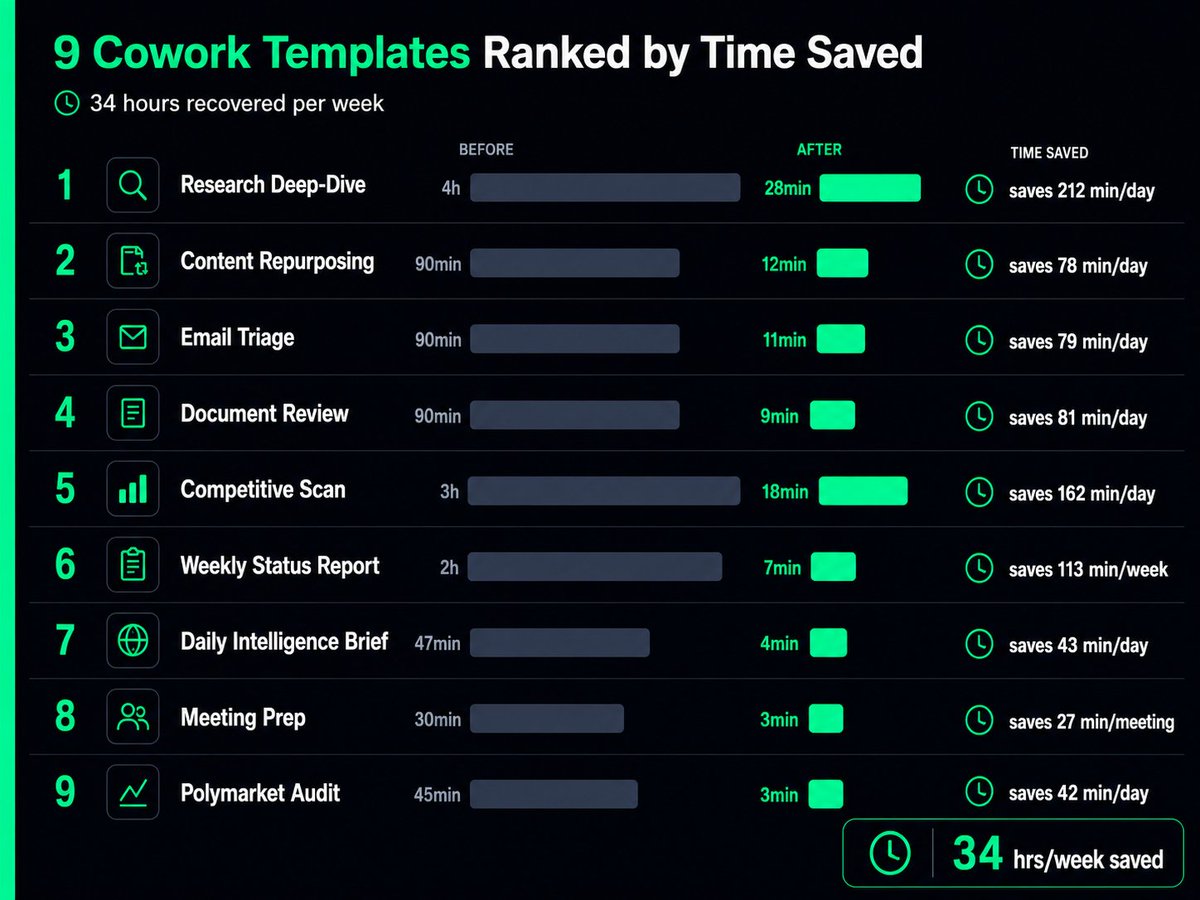
Time saved by each template.
What the nine have in common:
Every surviving template ends with an explicit TERMINATION criterion. Not "be thorough" or "be concise." A condition that can be checked by looking at the output: page count, field count, structural completeness. Without this, every session expands to fill the available time. With it, median session length dropped from two hours and twenty minutes to fourteen minutes.
Every surviving template specifies the output as named sections with defined contents. The model writes into a shape it did not invent. The discarded templates asked for "synthesis" or "summary" without defining what those containers should hold. Undefined containers get filled with whatever seems impressive.
Every surviving template names a role in the first line. Chief of staff. Coordinator. Auditor. Repurposer. The role definition limits what the model thinks it should produce. Without a role, a triage prompt tries to predict reply rates and recommend new contacts. An audit prompt tries to recommend new positions. Role definition cuts off the helpfulness that goes in the wrong direction.
The two failure modes of the twenty-one that did not survive:
No clean stop condition. Without TERMINATION, the model iterated. Output got longer and worse rather than better. This killed fourteen of the twenty-one discarded templates.
Mission creep without a role definition. Without a named role, every template expanded into adjacent functions the model thought would be helpful. This killed the remaining seven.
## The Actual Math
The raw weekly delta across all nine templates is seventy-two hours. The figure actually reported as recovered time is thirty-four hours because several adjustments apply.
Some templates pull from the same data sources, so the input cost is not counted twice. Time spent reviewing Cowork output and tuning prompts subtracts from the total, about three to five hours per week across all nine. Background tasks running while other productive work is happening are not counted as free time.
After those adjustments, thirty-four hours per week is what the logs show as actual freed time doing other work or not working.
Week one typically produces around eighteen hours saved. The full number arrives around week three as tuning removes the sections that consistently get skipped and the templates sharpen to the specific way each person works.
The tuning is where the real savings live. The templates as written here are the starting point. They are not the endpoint.
## The One Thing Worth Taking From This
The public conversation about Cowork focuses almost entirely on which plugins to install. That is the wrong layer.
The plugin is the kitchen. The slash command is the recipe. You can have every kitchen on the market and still cook nothing worth eating if you do not have recipes that are built right.
The three properties described above are what "built right" means in practice for this class of tool. Explicit termination. Structured output shape. Role definition in the first line.
Every template you build that has all three will work. Every template that lacks even one will eventually fail in a way that costs you more time than it saves.
These nine have all three. That is why they survived.
## 相关链接
- [NeilXbt](https://x.com/neil_xbt)
- [@neil_xbt](https://x.com/neil_xbt)
- [5.8K](https://x.com/neil_xbt/status/2058095440818565490/analytics)
- [Upgrade to Premium](https://x.com/i/premium_sign_up)
- [3:59 PM · May 23, 2026](https://x.com/neil_xbt/status/2058095440818565490)
- [5,863 Views](https://x.com/neil_xbt/status/2058095440818565490/analytics)
- [View quotes](https://x.com/neil_xbt/status/2058095440818565490/quotes)
---
*导出时间: 2026/5/23 20:53:25*
---
## 中文翻译
# 9 个将 8 小时工作日压缩为 47 分钟实际工作的提示词模板
**作者**: NeilXbt
**日期**: 2026-05-23T07:59:25.000Z
**来源**: [https://x.com/neil_xbt/status/2058095440818565490](https://x.com/neil_xbt/status/2058095440818565490)
---

这 8 小时的工作量依然存在。
这是首先要理解的一点。没有任何环节被跳过。过去需要花费一整天才能完成的任务,现在依然以同样的质量完成。
竞争扫描、邮件分诊、会议准备、周报、研究、内容分发。
所有这些都在运行。不同之处在于,它们在后台运行,由九个提示词模板执行,而构建它们的人只需花 47 分钟审查决策,而不是 8 小时手动完成所有事情。
这并非基于周末实验得出的结论。这个数字来自 30 天的工时记录,在这期间,手动流程与自动化流程并行运行,对比结果并测量差距。所有九个模板加在一起,每周节省的时间是 34 小时。这不是预测,而是 4 月日志与 5 月日志之间的差值。
以下是全部九个模板,逐字记录,随时可以复制。使其奏效的三个特性将在文末解释。另外,导致其他二十一个模板未能通过测试的两种失败模式也会一并说明。
## 如何使用这些模板
每个模板都是一个 Claude Cowork 斜杠命令:一个带有结构化输入的已保存提示词,你可以通过单个命令触发。你输入 /morning-brief,填写模板要求的字段,然后就可以离开了。剩下的工作由模板完成。
通过插件的创建流程将每一个模板放入 Cowork。在使用之前,将括号内的输入指向你的实际数据源。每个模板都假设相关的连接器(Gmail、Slack、Google Drive、Linear、Notion 和 Polymarket,具体取决于模板)已经获得授权。
在调整任何设置之前,先完整运行每个模板一周。这些模板按原样编写时较为保守。一周后,你会发现一两个输出部分被你习惯性地跳过或忽略。删掉那些部分。不要添加更多内容。
每周节省 34 小时是调整后的数字。第一周通常能节省约 18 小时。第三周趋于达到这个满额数字。调整工作比原始提示词更重要。
## 模板 1:每日情报简报
手动耗时:47 分钟。模板耗时:4 分钟。
每天早上 7:30 运行。提取过夜的 Gmail、Slack 消息、当天的日历、Polymarket 上的任何活跃持仓以及三个新闻来源。输出包含恰好三个部分的一页纸:上午 10 点前需要关注的事、可以等待的事,以及噪音。
```
/morning-brief
ROLE: 我的幕僚长。你阅读所有过夜信息并准备一份一页纸的简报。
PULL:
- gmail: 过去 12 小时,收件箱 + 发件箱(看我承诺了什么)
- slack: 私信 + @-提及,过去 12 小时,频道 = [列表]
- calendar: 今天 + 明天上午,包含与会者背景
- polymarket: 开仓持仓,当前盈亏 vs 入场价
- news: [3 个 RSS 来源],过去 12 小时,仅提及 [关键词] 的条目
OUTPUT (markdown,最多一页):
## 10am 前需回复
[项目符号:发件人 + 1 行总结 + 建议操作]
## 可以等待
[项目符号,最多 5 条]
## 噪音 —— 标记出来以便我知道你看到了
[每条 1 行,无详情]
TERMINATION: 处理完所有五个来源且页面字数少于 400 字时停止。不要概括总结。
```
TERMINATION 行在这个模板中起到了最大的作用。如果没有它,同样的提示词会扩展成一份 1400 字的文档,包含执行概览和关键要点块。有了它,输出就是一张可打印的一页纸。仅“不要概括总结”这一条款就将输出长度减少了 60%,且没有质量损失。
## 模板 2:竞争格局扫描
手动耗时:3 小时。模板耗时:18 分钟。
按需运行。提取多达 8 个指定竞争对手的产品页面、定价页面、最近的博客文章、社交媒体动态、招聘帖和最近的融资信息。与连接的 Drive 文件夹中你自己的定位笔记进行交叉比对。
```
/competitor-scan
INPUTS:
- competitors: [逗号分隔的列表,最多 8 个]
- my_positioning_doc: [Drive 路径]
- focus: [pricing | product | hiring | go-to-market | full]
WORKFLOW:
1. 对于每个竞争对手,获取:主页、定价页、最后 5 篇博客文章、主账号过去 30 天的 X 帖子、开放的职位列表。
2. 与 my_positioning_doc 对比定位。
3. 标记任何在过去 60 天内定位向我靠拢的竞争对手。
4. 标记任何新招聘或融资轮次(过去 90 天)。
OUTPUT (markdown):
## TL;DR (最多 3 行)
## 每个竞争对手
- 与我的定价差异
- 与我的定位差异(过去 60 天)
- 招聘信号
- 融资信号
- 一段话:他们会做什么而我没有预料到
TERMINATION: 当每个竞争对手部分都填满所有 5 个字段时停止。不要撰写行业概览。不要预测未来。
```
“不要预测未来”每次运行节省了 40 分钟。Cowork 的默认行为是在每份报告底部添加一个战略展望部分。那部分总是同样的三个观察结果,只是换了身马甲。删除它毫无损失。
## 模板 3:邮件分诊与草拟回复
手动耗时:90 分钟。模板耗时:11 分钟。
每天运行三次,时间为上午 9 点、下午 1 点和下午 5 点。按等待者和等待时长对收件箱排序,为每个需要回复的线程草拟回复,并将所有草稿保存在 Gmail 中并加上标签,以便可以批量审查和发送。
```
/triage
INPUTS:
- since: [last_run | morning | 24h]
WORKFLOW:
1. 提取自 [since] 以来的所有 gmail 消息,排除促销和更新。
2. 对于每个线程:needs_reply(需回复) | informational(资讯类) | already_handled(已处理)。
3. 对于 needs_reply,使用以下方式草拟回复:
- 我发给同一人的最后 5 封邮件(匹配语气)
- 如果没有先前的线程,默认为 3 句确认语 + 提问
4. 将草稿保存在 gmail 中,标签为 "claude_draft",不要发送。
5. 按发件人将 informational 分组,每条总结 1 行。
OUTPUT:
## 需我过目(草稿已就绪)
[列表:发件人 + 主题 + 关于草稿内容的 1 行说明]
## 资讯类(仅阅读)
[按发件人分组]
## 已处理 / 循环
[每条 1 行]
TERMINATION: 当所有未读线程都归类后停止。不要为你已经草拟过的线程生成回复。
```
关于这个模板有两点说明。“最后 5 封已发送邮件”的语气匹配指令,决定了草稿是能直接发送还是需要重写。没有它,输出就是商学院英语。有了它,草稿非常贴近你的真实语气,以至于有时你会忘记自己修改过哪些。三封邮件在罕见主题上略显拟合不足。十封则过度拟合旧模式。五是可行的数字。
第二行指令,“不要为你已经草拟过的线程生成回复”,来自第一周的日志,当时同样的线程每天早上都被重新草拟。在注意到这种模式之前,积累了三天的重复草稿。
## 模板 4:会议准备档案
手动耗时:30 分钟。模板耗时:3 分钟。
在任何外部会议前两小时运行。提取与会者过去的所有接触点、最近五封邮件、任何共享文档、自上次互动以来的公开资料更新,以及三个值得提出的开放性问题。
```
/meeting-prep
INPUTS:
- meeting: [日历事件 ID,或 "next external meeting"]
WORKFLOW:
1. 识别外部与会者(我组织之外的任何人)。
2. 对于每个人:最后 10 封邮件(任何方向)、共享文档、最后一条 linkedin 更新、最后 30 天的 X 帖子。
3. 找出我们最后一次交谈的内容以及未解决的问题。
4. 根据未解决的问题生成 3 个开放性问题。
OUTPUT (一页):
## 谁在房间里
[每位与会者:2 行背景]
## 最后接触点
[时间,我们同意了什么,什么未完成]
## 3 个开放性问题
## 自那时起的变化
[仅影响会议的事项]
TERMINATION: 在一页时停止。如果一页放不下,就删掉。
```
“删掉”。Cowork 想要包含一切。四页的会议准备材料是一种礼貌的干扰。一页版本才会被阅读。
## 模板 5:每周状态报告
手动耗时:2 小时。模板耗时:7 分钟。
周五下午 4 点运行。提取已关闭的 Linear 问题、本周创建或编辑的 Notion 文档、Slack 频道摘要和日历数据,以重构实际发生的情况。生成团队和客户期望的状态文档。
```
/weekly-status
INPUTS:
- week: [current | last]
- audience: [internal | client | board]
WORKFLOW:
1. 提取本周所有已关闭的 Linear 问题,包含 PR 标题和审查者。
2. 提取本周创建或显著编辑的 Notion 文档。
3. 阅读 Slack 的 #status、#shipping、#design 频道的本周内容。
4. 日历:统计外部会议、内部会议、深度工作块。
OUTPUT (markdown,特定受众长度):
- internal: 1 页
- client: 1.5 页,弱化失败,突出风险
- board: 2 页,包含指标与目标对比表
章节:
## 已发布
## 进行中
## 阻塞 / 风险
## 指标(仅限 board 版本)
## 下周重点
TERMINATION: 达到选定受众的长度时停止。不要编造源数据中不存在的指标。
```
“不要编造源数据中不存在的指标”是整篇文章中最重要的一行。当 Cowork 认为受众期望看到一个数字时,它会凭空捏造一个。在第一周,它三次生成了没有数据来源的“团队速度”估算。该指令阻止了这种情况。当源数据中没有某个指标时,输出会写上“未追踪”并继续。
## 模板 6:带结构化问答的文档审查
手动耗时:90 分钟。模板耗时:9 分钟。
对任何超过十页的上传文档运行。通读整篇文档,针对关键内容生成结构化问答,标记不一致之处,并突出任何与先前写作相矛盾的内容。
```
/doc-review
INPUTS:
- document: [文件路径或 url]
- my_context: [包含相关笔记的 Drive 路径,可选]
- depth: [skim | review | deep]
WORKFLOW:
1. 通读文档。
2. 识别:论点、关键主张、支持证据、证据缺口。
3. 如果提供了 my_context:标记与我先前写作的矛盾或一致之处。
4. 生成问答:5 个深思熟虑的读者会问的问题,以及文档中的答案(或“未涉及”)。
OUTPUT:
## 论点 (1 行)
## 关键主张 (3-5 个项目符号,每个附带证据质量)
## 不一致 / 缺口
## 与我先前工作的矛盾或一致之处(如果提供了上下文)
## 问答 (5 个问题)
## 判定:全文阅读 | 略读 | 跳过
TERMINATION: 在此结构处停止。不要逐节线性概括文档。
```
最后的 TERMINATION 行是关键。没有它,Cowork 对任何文档审查的默认输出都是线性演练,长度约为原文的 30%。毫无用处。结构化问答格式接收同样的输入,并将其转化为可在 30 秒内使用的内容。
## 模板 7:Polymarket 持仓审计
手动耗时:45 分钟。模板耗时:3 分钟。
每天运行三次。读取开仓持仓、当前价格以及过去 12 小时内的相关新闻。根据价格变动、新闻事件或交易量变化标记需要注意的持仓。
```
/poly-audit
INPUTS:
- wallet: [我的 polymarket 钱包地址]
- alert_threshold: [10% | 20% | 30%]
WORKFLOW:
1. 提取所有开仓持仓、入场价格、当前价格、盈亏。
2. 对于每个持仓:搜索过去 12 小时内的相关新闻事件。
3. 与 [我的观察名单文档] 进行交叉比对。
4. 标记任何符合以下条件的持仓:
- 盈亏偏离入场价超过 [threshold]
- 新闻提到了底层事件
- 市场交易量在过去 6 小时内增长 >50%
OUTPUT:
## 需我过目
[每个被标记的持仓:市场 + 原因 + 建议操作]
## 观望模式
[每条 1 行]
## 自上次审计以来已关闭
[每条 1 行,包含已实现盈亏]
TERMINATION: 检查完所有持仓后停止。不要推荐新仓位。不要预测市场方向。仅限审计。
```
“不要推荐新仓位”是结构性要求,而非文风要求。此模板用于审计。交易推荐应放在单独的斜杠命令中。混合两者会降低两者的质量。
## 模板 8:带并行子代理的深度研究
手动耗时:4 小时。模板耗时:28 分钟。
针对任何需要带完整引用的研究简报的主题运行。生成五个并行子代理,每个对应一个来源类别。每个子代理回报,然后协调者进行综合。
```
/research-deep
INPUTS:
- topic: [自由文本]
- depth: [survey | brief | full]
- timebox: [30min | 60min | 120min]
WORKFLOW (使用子代理):
生成 5 个并行子代理:
- AGENT_A: 学术来源
- AGENT_B: 新闻 + 行业媒体(过去 12 个月)
- AGENT_C: X 论坛(该话题的头部声音,过去 90 天)
- AGENT_D: 一级文档(政府文件、公司文档、公共数据集)
- AGENT_E: 反对方观点 —— 3 个最强的批评者及其论点
每个子代理返回:5 个来源 + 关于其发现的 3 行总结。
COORDINATOR 随后进行综合:
## TL;DR (3 行,写给一位聪明的怀疑论者)
## 主流共识
## 反对方论点
## 证据确实薄弱的未决问题
## 基于证据我的建议
TERMINATION: 在 timebox 限时处停止。每个子代理仅执行一次。如果 AGENT_A 在 60 分钟 timebox 的第 4 分钟返回了 5 个来源,不要启动第二轮。
```
从 4 小时缩减到 28 分钟并非调整的胜利。而是五名工作者同时运行五个任务,而不是一个人按顺序运行它们。TERMINATION 行阻止了每个子代理在工作完成后过度获取其类别中的内容。
## 模板 9:内容再利用
手动耗时:90 分钟。模板耗时:12 分钟。
选取一篇完成的长文,为每个分发渠道生成特定于平台的版本。
```
/repurpose
INPUTS:
- source: [长文的文件路径或 url]
- channels: [x | linkedin | newsletter | slack | email | all]
- tone: [my default | formal | casual]
WORKFLOW:
对于每个选定的渠道:
1. 识别源文中唯一最强有力的主张。
2. 适应特定于渠道的限制:
- x: 串推,6-10 帖子,每帖 <280 字,钩子在第 1 帖
- linkedin: 1 帖子,300 字,专业语气
- newsletter: 2 段摘录 + 1 行返回全文的 CTA
- slack: 4 行总结 + 链接,写给 #share 频道
- email: 60 字简介 + 主题行 + CTA
CONSTRAINTS:
- 永远不要在渠道间使用相同的开场行
- 永远不要引用源文中超过 15 个连续的单词
- 匹配我的语气(来自 [我在该渠道上的最后 10 个帖子,如果有的话])
OUTPUT: 每个渠道一块,随时可复制粘贴。
TERMINATION: 填满所有选定渠道后停止。不要生成额外的“奖励”版本。
```
“永远不要在渠道间使用相同的开场行”是在未存活的二十一个模板中最常被违反的规则。没有它,所有五个版本都会以某种相同钩子的变体开头。结果看起来就像你的账号是个内容工厂。有了它,每个渠道都获得了独特的切入点。
## 为什么这九个存活而二十一个没有
测试了三十个模板。九个存活了下来。奏效的九个模板共有三个特性。未奏效的二十一个模板共有两种失败模式。

每个模板节省的时间。
这九个模板的共同点:
每个存活的模板都以明确的 TERMINATION(终止)标准结束。不是“要彻底”或“要简洁”。而是一个可以通过查看输出来检查的条件:页数、字段数、结构完整性。没有这一点,每次会话都会膨胀以填满...