# Top AI Papers of the Week
**作者**: DAIR.AI
**日期**: 2026-10-11T13:10:41.000Z
**来源**: [https://x.com/dair_ai/status/2109270464962916674](https://x.com/dair_ai/status/2109270464962916674)
---
## 1. Harness Learning
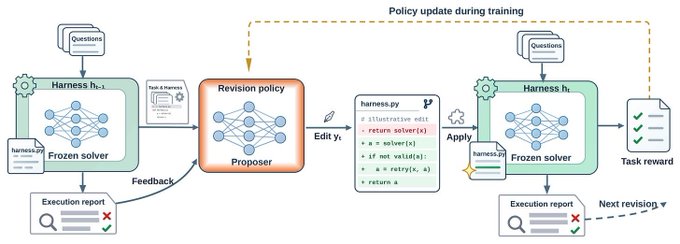
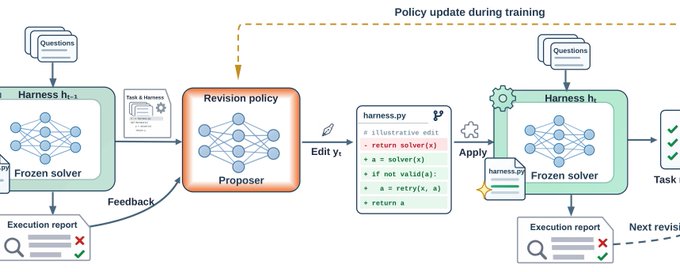
An agent is defined by its model and its harness, the program that organizes model calls, tool use, and information flow. Researchers at CMU train a proposer model to revise the harness based on execution feedback, while the solver model’s weights never change.
- Edits as updates: The authors frame harness adaptation as meta-learning over executable programs, where each harness revision plays the role of a weight update in gradient-based adaptation. The proposer reads a task, the current harness, and an execution report, then writes a code edit to the harness.
- RL on harness scores: The proposer is trained with reinforcement learning, and the reward is the revised harness's task score. At test time, it refines the harness on a new task through successive executions, without updating parameters.
- Small proposer, broad transfer: A trained 4B proposer beats its 35B teacher at single-step revision on Reasoning Gym, including task families it never saw in training. A proposer trained on HotpotQA keeps improving harnesses on MuSiQue and 2WikiMultihopQA, and policies trained on single revisions continue improving harnesses over multiple rounds.
- Why it matters: Improving agents by editing harness code instead of weights is becoming its own AI engineering skill, and this work shows the skill can be learned and transferred to unseen tasks. It points toward agents that turn accumulated experience into general improvements without retraining the underlying model.
[Paper](https://academy.dair.ai/papers/harness-learning-enables-generalizable-test-time-adaptation-2609.35738) | [Tweet](https://x.com/omarsar0/status/2106529236068819394)
## 2. CorpusMap
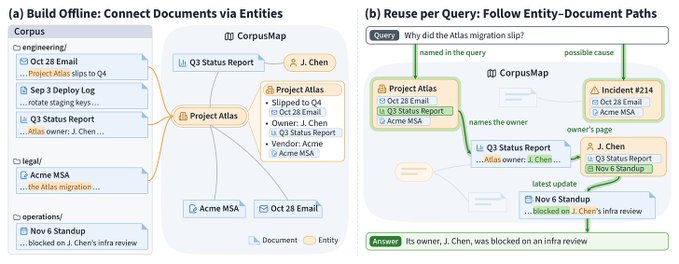
Agents that search large document collections usually see the corpus as a flat set of files, so a relevant document gives no hint of how it connects to others. Researchers from Microsoft and colleagues introduce CorpusMap, a navigation layer built around the entities that recur across a collection.
- Entity pages: CorpusMap resolves mentions of the same entity across documents in advance and gives each recurring entity a page that aggregates what is known about it and links to every document that refers to it. The original documents stay in place.
- Built once, reused per query: The agent reads a document, follows an entity to related documents, and avoids searching for the same evidence again. The links are built offline, so they are shared across queries instead of rediscovered at inference time. The map can be built without LLM calls and updated as new documents arrive.
- Better answers, fewer tokens: Across 7 models and three benchmarks, answer quality rises 6.4 to 11.7 points over raw-corpus agentic search while input tokens drop 34% to 57%. CorpusMap also beats an LLM Wiki layer and three other navigation layers.
- Why it matters: Enterprise questions often need evidence spread across emails, reports, and contracts in different folders. A precomputed entity graph gives agents structure to follow, which reduces both missed evidence and repeated searches.
[Paper](https://academy.dair.ai/papers/follow-the-entities-a-corpus-map-for-agentic-search-2609.37226) | [Tweet](https://x.com/dair_ai/status/2107146326639358188)
## 3. VeriHarness
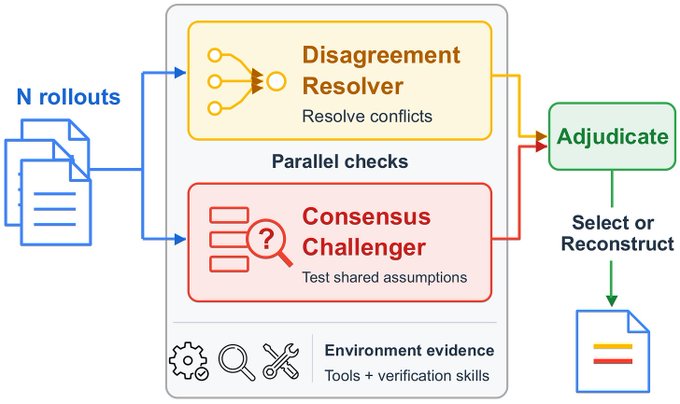
A common practice with long-horizon agents is to sample several rollouts and trust the answers they agree on. Researchers at Google show that agreement can hide shared errors, while disagreement often points to the correct alternative, and they built VeriHarness to verify rollouts with the same base model.
- Verifier from the generator’s model: VeriHarness gives the generator model a workspace, evidence tools, and reusable verification skills. It needs no reference answers or grading rubrics at test time.
- Two checks: A disagreement resolver checks competing claims against evidence in the environment. A consensus challenger tests claims that every rollout shares and looks for requirements they all missed. Their findings guide which artifact to select and how to revise it.
- Results: Across five long-horizon workspace benchmarks and two frontier models, VeriHarness reaches the highest selection scores among the baselines tested. With evidence-backed revision, it adds 6.2 points over a single rollout with Gemini 3.5 Flash and 6.4 points with Claude Opus 4.8. Its verification skills also improve from feedback on failures.
- Why it matters: Majority voting discards the minority answer, which is sometimes correct. The authors released about 26,000 rollouts across all five benchmarks and both models, costing over $100,000, to support further work on agentic verification.
[Paper](https://academy.dair.ai/papers/veriharness-scaling-agentic-verification-for-long-horizon-tasks-2610.00972) | [Tweet](https://x.com/omarsar0/status/2106700905051746803)
## 4. HERMES
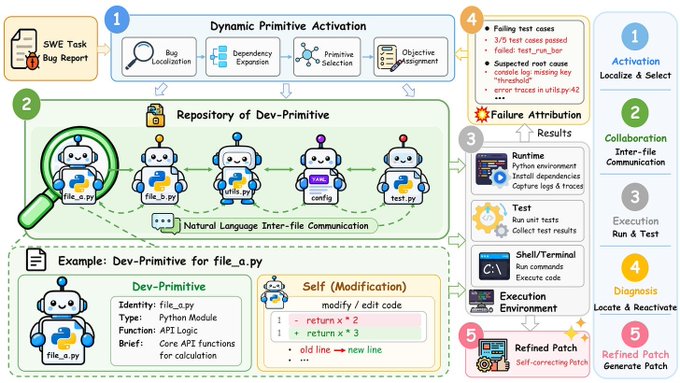
Software engineering agents on long-horizon tasks keep reconstructing program state spread across source files, configurations, tests, and dependencies, which leads to long interaction histories and context explosion. HERMES is a harness that turns repository components into active participants in the task.
- Dev-Primitives: Each repository component is paired with a resident LLM that knows its own implementation and dependencies. The component gets an agent-native interface for natural-language reasoning, communication with other components, and localized self-modification.
- Activation and diagnosis: A dependency-aware step decides which components to activate for a task, and a diagnosis step maps test failures and execution evidence back to the components that need changes.
- Same model, different harness: On whole-repository migration, GPT-5.6 Sol goes from 6.5% to 31.0% when Codex is replaced with HERMES, at the same model and effort setting. Across four software engineering benchmarks, HERMES beats matched baseline harnesses by 12.4% on average.
- Why it matters: With strong activation and diagnosis models, HERMES running Qwen3-8B Dev-Primitives stays within 4.5% of an all-GPT-5.6 Sol configuration on all four benchmarks and cuts inference cost on Terminal-Bench 4.0 by 26.2%. Most of the migration gain comes from the harness, so building one around your own codebase is worth the engineering effort.
[Paper](https://academy.dair.ai/papers/harness-engineering-for-software-engineering-via-modular-executable-dev-primitiv-2610.07832) | [Tweet](https://x.com/omarsar0/status/2108360049848717588)
## 5. MASS
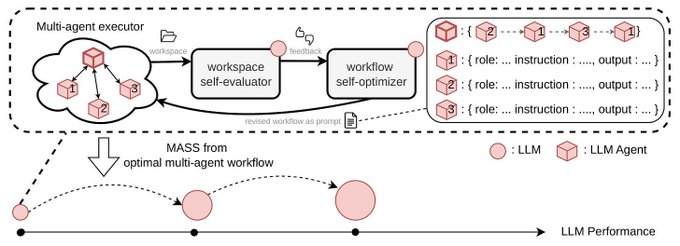
Recursive self-improvement on open-ended tasks like research runs into a supervision problem because the outputs can exceed what even human experts can reliably assess, and there is no external checker. Researchers at Sakana AI propose Multi-Agent Self-Supervision (MASS), in which a single base model acts as the agent, evaluator, and optimizer.
- Workflows as the search space: The base model proposes multi-agent workflows, runs them, and grades the results. An evolutionary search constrained by structural guardrails keeps the best-scoring workflows and settles on distinct roles and information routing for each task.
- Alternating cycles: Each cycle pairs that workflow optimization with supervised fine-tuning on the model’s own multi-agent traces. The improved model then starts the next cycle as a better optimizer and grader, so the loop can keep bootstrapping the model’s capabilities.
- Results: Two MASS cycles on Qwen3.6-27B yield 1.2-1.6x higher performance per output token on four open-ended public benchmarks. A student trained on multi-agent traces also beats a single-agent student trained on 1.4x more tokens.
- Why it matters: Self-improvement loops usually depend on an external verifier, so open-ended tasks with no checker are left out. MASS shows that one model can supply its own supervision signal by learning orchestration and bounded subagent execution from multi-agent trajectories.
[Paper](https://academy.dair.ai/papers/recursive-self-improvement-through-multi-agent-self-supervision-2610.12176) | [Tweet](https://x.com/omarsar0/status/2108934334589857850)
## 6. Sharpening Tax
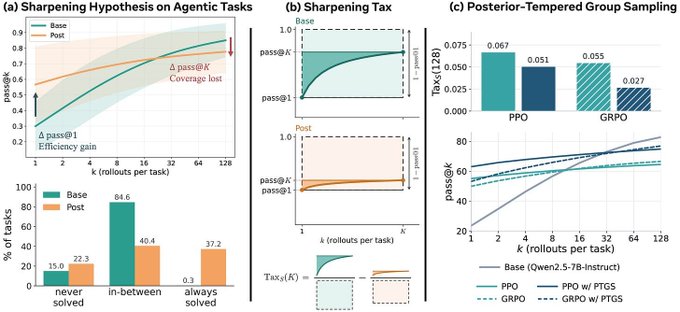
A common hypothesis holds that RL post-training only sharpens behaviors the base model already has, raising single-shot accuracy at the cost of solution coverage. Researchers from Meta Superintelligence Labs test whether this holds for agentic tasks, where multi-turn tool use might need capabilities learned during post-training.
- Base models as agents: Pre-trained LLMs with a light inference harness work as capable agents. Post-trained models win on pass@1, but at large K the base models often solve tasks their post-trained versions never solve on BFCL v4 multi-turn, ACEBench, and WebShop.
- Why coverage drops: Post-training pushes each task toward always solved or never solved. Consistency and sampling efficiency increase, while coverage decreases.
- Measuring the cost: The authors propose the Sharpening Tax, a metric for the test-time scalability lost after post-training. Across 42 base and post-trained cases from four model families and three benchmarks, the tax shows up in most settings, grows with model size, and can be estimated from a few rollouts.
- Why it matters: Their fix, posterior-tempered group sampling (PTGS), sets the sampling temperature per prompt from its estimated difficulty during RL. It pays a smaller tax than a fixed-temperature baseline and also raises pass@1. If your agent relies on repeated sampling at test time, a base model may cover tasks that your post-trained model has lost.
[Paper](https://academy.dair.ai/papers/sharpening-tax-in-post-training-2610.01509) | [Tweet](https://x.com/dair_ai/status/2106418508259377411)
## 7. VERA
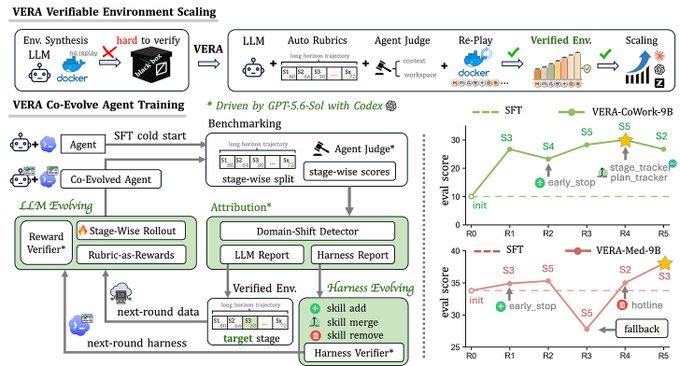
Long-horizon agents need environments that can be resumed at any stage and scored from observable evidence, yet most environments score only the final outcome. Researchers from NVIDIA present VERA, which builds such environments at scale and uses them to update both the model and its harness.
- Verifiable environments from trajectories: VERA turns initial trajectories into more than 9,000 restartable sandboxes. An agent writes rubrics and executable checks, a judge verifies each sandbox, and only environments that run and can be scored from observable evidence enter the training bank.
- Two update paths: VERA alternates between training the model with rubric rewards and editing the harness skills. We keep a harness edit only if it passes self-tests and adds at least 5 points on the development set, and we reject a model checkpoint if its score drops by more than 20%.
- Results: At 9B, the co-evolved agent beats the strongest single-axis baseline by 10.3 points on AutoCoWorkBench and 13.0 points on AutoMedBench. At 27B, it scores 71.6 on AutoCoWorkBench and 80.7 on AutoMedBench, transfers to unseen workflows, and keeps its general capabilities.
- Why it matters: Training the harness alongside the model is a big part of owning the intelligence stack, and many frontier AI companies have started doing it. The open-source corpus of environments gives others a starting point for this kind of co-evolution on long-horizon work.
[Paper](https://academy.dair.ai/papers/vera-scaling-verifiable-environments-for-agentic-co-evolution-2610.05923) | [Tweet](https://x.com/omarsar0/status/2107849444897243141)
## 8. Agent Plasticity
Researchers from Meta Superintelligence Labs introduce agent plasticity, a measure of how efficiently an agent converts experience into gains on held-out tasks per dollar spent on learning, with model weights frozen and each run starting from a fresh context while inheriting artifacts written by earlier runs. The model with the best final score is often a different model from the one that learns most efficiently. In chess, Go, and Hex, Claude Fable 5 reaches the highest final score, while GPT-5.6 Sol gains the most per dollar; in NetHack, only Claude Opus 5.5 improves significantly, by 66 normalized points for about $1,073 of learning. Slow learners often ignore artifacts they already wrote, while faster learners reuse their artifacts and still fail when an artifact is low quality.
[Paper](https://academy.dair.ai/papers/agent-plasticity-measuring-self-improvement-through-experience-2610.08902) | [Tweet](https://x.com/omarsar0/status/2108580251127439710)
## 9. Continuous Memory Machines
Sakana AI’s Continuous Memory Machine gives a recurrent model two matrix-valued memories: a short-term store that tracks recent neuron activity and a long-term store for information needed later, with a Transformer reading and writing both at every step. Built on the Continuous Thought Machine, it beats LSTM, DNC, RMC, and CTM baselines on copy, associative recall, sorting, few-shot regression, and maze solving, and it generalizes to longer inputs than earlier memory-augmented networks. Its attention maps show it uses long-term memory for algorithmic and in-context tasks and skips it when a task does not need it.
[Paper](https://academy.dair.ai/papers/continuous-memory-machines-2610.07907) | [Tweet](https://x.com/dair_ai/status/2108359294609768715)
## 10. MIMESIS
Agent RL setups usually let an assistant LLM play the user, making the simulated user overly cooperative and explicit; a fixed GPT-5.5 agent finds tau-bench tasks easier with these users than with real people. Researchers from Meta Superintelligence Labs train MIMESIS, a 9B user simulator built from human conversations with explicit reasoning supervision and 13 behavioral patterns observed in real users, which beats Claude Opus 5 on behavioral fidelity by 13.4 points. Agents trained against the frozen simulator with multi-turn RL outperform agents trained against GPT-5.5 under all nine unseen user simulators, and a coaching step that turns the simulator’s private reasoning into token-level feedback adds further gains.
[Paper](https://academy.dair.ai/papers/mimesis-learning-user-simulators-as-training-environments-for-interactive-agents-2610.09484) | [Tweet](https://x.com/dair_ai/status/2108588052914598084)
## 相关链接
- [DAIR.AI](https://x.com/dair_ai)
- [@dair_ai](https://x.com/dair_ai)
- [41K](https://x.com/dair_ai/status/2109270464962916674/analytics)
- [Paper](https://academy.dair.ai/papers/harness-learning-enables-generalizable-test-time-adaptation-2609.35738)
- [Tweet](https://x.com/omarsar0/status/2106529236068819394)
- [Paper](https://academy.dair.ai/papers/follow-the-entities-a-corpus-map-for-agentic-search-2609.37226)
- [Tweet](https://x.com/dair_ai/status/2107146326639358188)
- [Paper](https://academy.dair.ai/papers/veriharness-scaling-agentic-verification-for-long-horizon-tasks-2610.00972)
- [Tweet](https://x.com/omarsar0/status/2106700905051746803)
- [Paper](https://academy.dair.ai/papers/harness-engineering-for-software-engineering-via-modular-executable-dev-primitiv-2610.07832)
- [Tweet](https://x.com/omarsar0/status/2108360049848717588)
- [Paper](https://academy.dair.ai/papers/recursive-self-improvement-through-multi-agent-self-supervision-2610.12176)
- [Tweet](https://x.com/omarsar0/status/2108934334589857850)
- [Paper](https://academy.dair.ai/papers/sharpening-tax-in-post-training-2610.01509)
- [Tweet](https://x.com/dair_ai/status/2106418508259377411)
- [Paper](https://academy.dair.ai/papers/vera-scaling-verifiable-environments-for-agentic-co-evolution-2610.05923)
- [Tweet](https://x.com/omarsar0/status/2107849444897243141)
- [Paper](https://academy.dair.ai/papers/agent-plasticity-measuring-self-improvement-through-experience-2610.08902)
- [Tweet](https://x.com/omarsar0/status/2108580251127439710)
- [Paper](https://academy.dair.ai/papers/continuous-memory-machines-2610.07907)
- [Tweet](https://x.com/dair_ai/status/2108359294609768715)
- [Paper](https://academy.dair.ai/papers/mimesis-learning-user-simulators-as-training-environments-for-interactive-agents-2610.09484)
- [Tweet](https://x.com/dair_ai/status/2108588052914598084)
- [Upgrade to Premium](https://x.com/i/premium_sign_up)
- [9:10 PM · Oct 11, 2026](https://x.com/dair_ai/status/2109270464962916674)
- [41.4K Views](https://x.com/dair_ai/status/2109270464962916674/analytics)
- [View quotes](https://x.com/dair_ai/status/2109270464962916674/quotes)
---
*导出时间: 2026/10/12 10:08:48*
---
## 中文翻译
# 本周热门 AI 论文
**作者**: DAIR.AI
**日期**: 2026-10-11T13:10:41.000Z
**来源**: [https://x.com/dair_ai/status/2109270464962916674](https://x.com/dair_ai/status/2109270464962916674)
---

## 1. Harness Learning(框架学习)

智能体由其模型和“框架”(harness,即组织模型调用、工具使用和信息流的程序)共同定义。CMU 的研究人员训练了一个提议者模型,根据执行反馈来修订框架,而求解者模型的权重始终保持不变。
- 编辑即更新:作者将框架适应框架化为对可执行程序的元学习,其中每次框架修订都扮演着基于梯度的适应中权重更新的角色。提议者读取任务、当前框架和执行报告,然后编写对框架的代码修改。
- 基于框架得分的强化学习:提议者通过强化学习进行训练,奖励是修订后框架的任务得分。在测试时,它通过 successive 执行在新任务上细化框架,无需更新参数。
- 小型提议者,广泛迁移:经过训练的 4B 提议者在 Reasoning Gym 的单步修订中超越了其 35B 的教师模型,包括训练中从未见过的任务族。在 HotpotQA 上训练的提议者能够在 MuSiQue 和 2WikiMultihopQA 上持续改进框架,并且在单次修订上训练的策略能够在多轮中持续改进框架。
- 为何重要:通过编辑框架代码而非权重来改进智能体,正成为一项独立的 AI 工程技能,而这项工作表明该技能可以被学习并迁移到未见过的任务上。它指向了无需重新训练底层模型就能将积累的经验转化为通用改进的智能体。
[Paper](https://academy.dair.ai/papers/harness-learning-enables-generalizable-test-time-adaptation-2609.35738) | [Tweet](https://x.com/omarsar0/status/2106529236068819394)
## 2. CorpusMap

搜索大型文档集合的智能体通常将语料库视为一组扁平的文件,因此找到一篇相关文档也无法得知它与其他文档的关联。微软的研究人员及其同事提出了 CorpusMap,这是一个围绕集合中反复出现的实体构建的导航层。
- 实体页面:CorpusMap 提前解析跨文档中同一实体的提及,并为每个重复出现的实体创建一个页面,汇总有关该实体的已知信息,并链接到所有提及它的文档。原始文档保持原样。
- 一次构建,每个查询复用:智能体阅读文档,通过实体跳转到相关文档,避免重复搜索相同的证据。这些链接离线构建,因此在各查询之间共享,而不是在推理时重新发现。该地图可以在不调用 LLM 的情况下构建,并随着新文档的到来而更新。
- 更好的答案,更少的 token:在 7 个模型和三个基准测试上,相比原始语料库的智能体搜索,答案质量提升 6.4 至 11.7 分,同时输入 token 减少 34% 至 57%。CorpusMap 还超越了 LLM Wiki 层以及其他三种导航层。
- 为何重要:企业问题通常需要来自不同文件夹中电子邮件、报告和合同中分散的证据。预计算的实体图给智能体提供了可遵循的结构,既减少了遗漏的证据,也减少了重复搜索。
[Paper](https://academy.dair.ai/papers/follow-the-entities-a-corpus-map-for-agentic-search-2609.37226) | [Tweet](https://x.com/dair_ai/status/2107146326639358188)
## 3. VeriHarness

长时程智能体的一种常见做法是采样多个 rollout,并信任它们一致认同的答案。Google 的研究人员表明,一致性可能掩盖共同的错误,而分歧往往指向正确的替代方案,他们构建了 VeriHarness,用相同的基础模型来验证 rollout。
- 来自生成模型的验证器:VeriHarness 为生成模型提供工作空间、证据工具和可复用的验证技能。它在测试时不需要参考答案或评分标准。
- 两项检查:分歧解决器根据环境中的证据核查相互竞争的声明。共识挑战器测试所有 rollout 共有的声明,并寻找它们都遗漏的要求。它们的发现指导选择哪个产出物以及如何修订。
- 结果:在五个长时程工作空间基准和两个前沿模型上,VeriHarness 在所测试的基线中达到最高的选择得分。借助基于证据的修订,它在 Gemini 3.5 Flash 上比单次 rollout 高出 6.2 分,在 Claude Opus 4.8 上高出 6.4 分。它的验证技能也从失败反馈中不断改进。
- 为何重要:多数投票会丢弃少数派答案,而少数派答案有时是正确的。作者公开了跨越所有五个基准和两个模型的约 26,000 次 rollout,成本超过 10 万美元,以支持智能体验证的后续研究。
[Paper](https://academy.dair.ai/papers/veriharness-scaling-agentic-verification-for-long-horizon-tasks-2610.00972) | [Tweet](https://x.com/omarsar0/status/2106700905051746803)
## 4. HERMES

在长时程任务上的软件工程智能体不断重建分散在源文件、配置、测试和依赖中的程序状态,这导致冗长的交互历史和上下文爆炸。HERMES 是一个框架,它将仓库组件转变为任务中的主动参与者。
- 开发原语(Dev-Primitives):每个仓库组件都配有一个常驻 LLM,它了解自身实现和依赖。组件获得一个智能体原生接口,用于自然语言推理、与其他组件的通信以及局部化的自我修改。
- 激活与诊断:依赖感知步骤决定为任务激活哪些组件,诊断步骤将测试失败和执行证据映射回需要修改的组件。
- 相同模型,不同框架:在全仓库迁移任务上,当用 HERMES 替换 Codex 时,GPT-5.6 Sol 从 6.5% 提升到 31.0%,且模型和算力设置相同。在四个软件工程基准上,HERMES 平均比匹配的基线框架高出 12.4%。
- 为何重要:借助强大的激活和诊断模型,运行 Qwen3-8B 开发原语的 HERMES 在所有四个基准上与全 GPT-5.6 Sol 配置的差距保持在 4.5% 以内,并在 Terminal-Bench 4.0 上将推理成本降低 26.2%。迁移的大部分收益来自框架本身,因此围绕自己的代码库构建一个框架是值得投入的工程。
[Paper](https://academy.dair.ai/papers/harness-engineering-for-software-engineering-via-modular-executable-dev-primitiv-2610.07832) | [Tweet](https://x.com/omarsar0/status/2108360049848717588)
## 5. MASS

在研究等开放式任务上的递归自我改进面临监督问题,因为输出可能超出即使人类专家也能可靠评估的范围,且没有外部检查器。Sakana AI 的研究人员提出多智能体自我监督(MASS),其中一个基础模型同时充当智能体、评估者和优化器。
- 工作流作为搜索空间:基础模型提出多智能体工作流,运行它们并为结果打分。受结构约束的进化搜索保留得分最高的工作流,并为每个任务确定独特的角色分工和信息路由。
- 交替循环:每个循环将工作流优化与基于模型自身多智能体轨迹的监督微调配对。改进后的模型随后作为更好的优化器和评分者开始下一个循环,使这一循环能够持续引导模型能力提升。
- 结果:在 Qwen3.6-27B 上进行两个 MASS 循环,在四个开放式公开基准上每个输出 token 的性能提升 1.2 至 1.6 倍。基于多智能体轨迹训练的学生也超越了使用多 1.4 倍 token 训练的单智能体学生。
- 为何重要:自我改进循环通常依赖外部验证器,因此没有检查器的开放式任务被排除在外。MASS 表明,一个模型可以通过从多智能体轨迹中学习编排和有界的子智能体执行,来提供自己的监督信号。
[Paper](https://academy.dair.ai/papers/recursive-self-improvement-through-multi-agent-self-supervision-2610.12176) | [Tweet](https://x.com/omarsar0/status/2108934334589857850)
## 6. Sharpening Tax(锐化税)

一个常见的假设是,RL 后训练只是锐化基础模型已有的行为,以提高单次准确率,代价是解的覆盖面。Meta Superintelligence Labs 的研究人员测试了这一假设是否适用于智能体任务——在智能体任务中,多轮工具使用可能需要后训练期间学到的能力。
- 基础模型作为智能体:带有轻量推理框架的预训练 LLM 可以充当有能力的智能体。后训练模型在 pass@1 上胜出,但在大 K 值下,基础模型往往能解决其后训练版本从未解决的任务——在 BFCL v4 多轮、ACEBench 和 WebShop 上均如此。
- 为何覆盖面下降:后训练使每个任务趋向于“总是解决”或“从不解决”。一致性和采样效率提高,而覆盖面下降。
- 衡量代价:作者提出了“锐化税”(Sharpening Tax),一个衡量后训练后损失的测试时可扩展性的指标。在来自四个模型家族和三个基准的 42 个基础与后训练案例中,这种代价在大多数设置中都会出现,随模型规模增大而增长,并且可以通过少量 rollout 估算。
- 为何重要:他们的解决方案“后验温度调节组采样”(PTGS)在 RL 期间根据每个提示的估计难度设定采样温度。它比固定温度基线付出更小的代价,同时也提高了 pass@1。如果你的智能体依赖测试时的重复采样,基础模型可能覆盖你的后训练模型已失去的任务。
[Paper](https://academy.dair.ai/papers/sharpening-tax-in-post-training-2610.01509) | [Tweet](https://x.com/dair_ai/status/2106418508259377411)
## 7. VERA

长时程智能体需要可以在任何阶段恢复、并能从可观察证据进行评分的环境,然而大多数环境只对最终结果评分。NVIDIA 的研究人员提出 VERA,它大规模构建此类环境,并用它们来同时更新模型及其框架。
- 从轨迹生成可验证环境:VERA 将初始轨迹转化为 9,000 多个可重启的沙盒。一个智能体编写评分标准和可执行检查,一个裁判验证每个沙盒,只有能够运行且可从可观察证据评分的环境才进入训练库。
- 两条更新路径:VERA 在用评分标准奖励训练模型与编辑框架技能之间交替。只有通过自测并在开发集上提升至少 5 分的框架编辑才会被保留,模型检查点如果得分下降超过 20% 则会被拒绝。
- 结果:在 9B 规模下,共同进化的智能体在 AutoCoWorkBench 上比最强的单轴基线高出 10.3 分,在 AutoMedBench 上高出 13.0 分。在 27B 规模下,它在 AutoCoWorkBench 上得分 71.6,在 AutoMedBench 上得分 80.7,能迁移到未见的工作流,并保持其通用能力。
- 为何重要:在训练模型的同时训练框架是掌控智能技术栈的重要部分,许多前沿 AI 公司已开始这样做。开源的环境语料库为其他人在长时程任务上进行这种共同进化提供了起点。
[Paper](https://academy.dair.ai/papers/vera-scaling-verifiable-environments-for-agentic-co-evolution-2610.05923) | [Tweet](https://x.com/omarsar0/status/2107849444897243141)
## 8. Agent Plasticity(智能体可塑性)
Meta Superintelligence Labs 的研究人员提出智能体可塑性这一概念,衡量智能体在模型权重冻结、每次运行从全新上下文开始并继承此前运行产出物的条件下,每花费一美元学习成本能在留出任务上获得多少提升的效率。最终得分最高的模型往往不是学习效率最高的模型。在国际象棋、围棋和 Hex 中,Claude Fable 5 达到最高的最终得分,而 GPT-5.6 Sol 每美元获得的提升最多;在 NetHack 中,只有 Claude Opus 5.5 有显著提升,花费约 1,073 美元学习成本提升了 66 个归一化分点。学习较慢的模型往往忽略自己已写下的产出物,而学习较快的模型会复用产出物,但当产出物质量低时仍然会失败。
[Paper](https://academy.dair.ai/papers/agent-plasticity-measuring-self-improvement-through-experience-2610.08902) | [Tweet](https://x.com/omarsar0/status/2108580251127439710)
## 9. Continuous Memory Machines(连续记忆机)
Sakana AI 的连续记忆机为循环模型提供两个矩阵值记忆:一个跟踪近期神经元活动的短期存储和一个存储后续所需信息的长期存储,由一个 Transformer 在每一步对两者进行读写。它构建于连续思维机(Continuous Thought Machine)之上,在复制、联想回忆、排序、少样本回归和迷宫求解上超越了 LSTM、DNC、RMC 和 CTM 基线,并能泛化到比以往记忆增强网络更长的输入。其注意力图显示,它将长期记忆用于算法和上下文任务,而在任务不需要时跳过它。
[Paper](https://academy.dair.ai/papers/continuous-memory-machines-2610.07907) | [Tweet](https://x.com/dair_ai/status/2108359294609768715)
## 10. MIMESIS
智能体 RL 设置中通常让一个助手 LLM 扮演用户,使得模拟用户过于配合和直白;一个固定的 GPT-5.5 智能体在这些模拟用户下完成 tau-bench 任务比与真实人类交互更容易。Meta Superintelligence Labs 的研究人员训练了 MIMESIS,一个 9B 用户模拟器,它基于真实人类对话构建,带有显式推理监督和从真实用户中观察到的 13 种行为模式,在行为保真度上超越 Claude Opus 5 达 13.4 分。通过与该冻结模拟器进行多轮 RL 训练的智能体,在全部九个未见用户模拟器下均优于与 GPT-5.5 对抗训练的智能体,而一个将模拟器的私有推理转化为 token 级反馈的教练步骤带来了进一步的提升。
[Paper](https://academy.dair.ai/papers/mimesis-learning-user-simulators-as-training-environments-for-interactive-agents-2610.09484) | [Tweet](https://x.com/dair_ai/status/2108588052914598084)
## 相关链接
- [DAIR.AI](https://x.com/dair_ai)
- [@dair_ai](https://x.com/dair_ai)
- [41K](https://x.com/dair_ai/status/2109270464962916674/analytics)
- [Paper](https://academy.dair.ai/papers/harness-learning-enables-generalizable-test-time-adaptation-2609.35738)
- [Tweet](https://x.com/omarsar0/status/2106529236068819394)
- [Paper](https://academy.dair.ai/papers/follow-the-entities-a-corpus-map-for-agentic-search-2609.37226)
- [Tweet](https://x.com/dair_ai/status/2107146326639358188)
- [Paper](https://academy.dair.ai/papers/veriharness-scaling-agentic-verification-for-long-horizon-tasks-2610.00972)
- [Tweet](https://x.com/omarsar0/status/2106700905051746803)
- [Paper](https://academy.dair.ai/papers/harness-engineering-for-software-engineering-via-modular-executable-dev-primitiv-2610.07832)
- [Tweet](https://x.com/omarsar0/status/2108360049848717588)
- [Paper](https://academy.dair.ai/papers/recursive-self-improvement-through-multi-agent-self-supervision-2610.12176)
- [Tweet](https://x.com/omarsar0/status/2108934334589857850)
- [Paper](https://academy.dair.ai/papers/sharpening-tax-in-post-training-2610.01509)
- [Tweet](https://x.com/dair_ai/status/2106418508259377411)
- [Paper](https://academy.dair.ai/papers/vera-scaling-verifiable-environments-for-agentic-co-evolution-2610.05923)
- [Tweet](https://x.com/omarsar0/status/2107849444897243141)
- [Paper](https://academy.dair.ai/papers/agent-plasticity-measuring-self-improvement-through-experience-2610.08902)
- [Tweet](https://x.com/omarsar0/status/2108580251127439710)
- [Paper](https://academy.dair.ai/papers/continuous-memory-machines-2610.07907)
- [Tweet](https://x.com/dair_ai/status/2108359294609768715)
- [Paper](https://academy.dair.ai/papers/mimesis-learning-user-simulators-as-training-environments-for-interactive-agents-2610.09484)
- [Tweet](https://x.com/dair_ai/status/2108588052914598084)
- [Upgrade to Premium](https://x.com/i/premium_sign_up)
- [9:10 PM · Oct 11, 2026](https://x.com/dair_ai/status/2109270464962916674)
- [41.4K Views](https://x.com/dair_ai/status/2109270464962916674/analytics)
- [View quotes](https://x.com/dair_ai/status/2109270464962916674/quotes)
---
*导出时间: 2026/10/12 10:08:48*