# Top AI Papers of the Week
**作者**: DAIR.AI
**日期**: 2026-07-26T17:54:17.000Z
**来源**: [https://x.com/dair_ai/status/2081437966866505856](https://x.com/dair_ai/status/2081437966866505856)
---
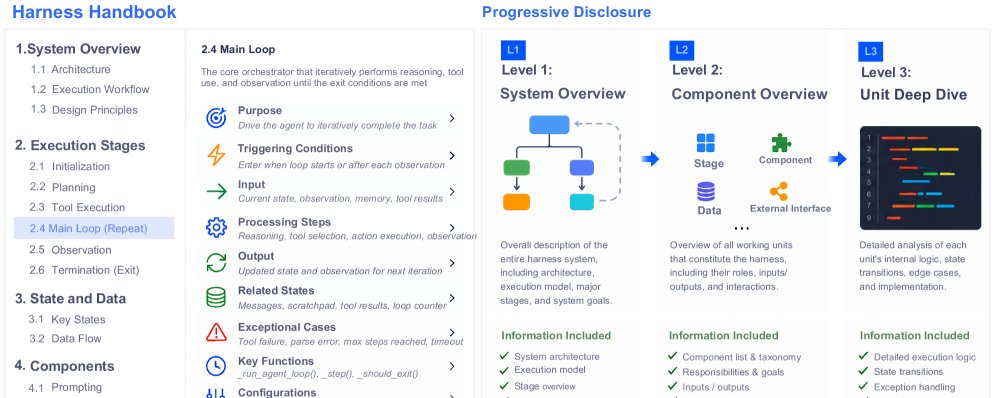
The Top AI Papers of the Week (July 20 - July 26):
## 1. Harness Handbook
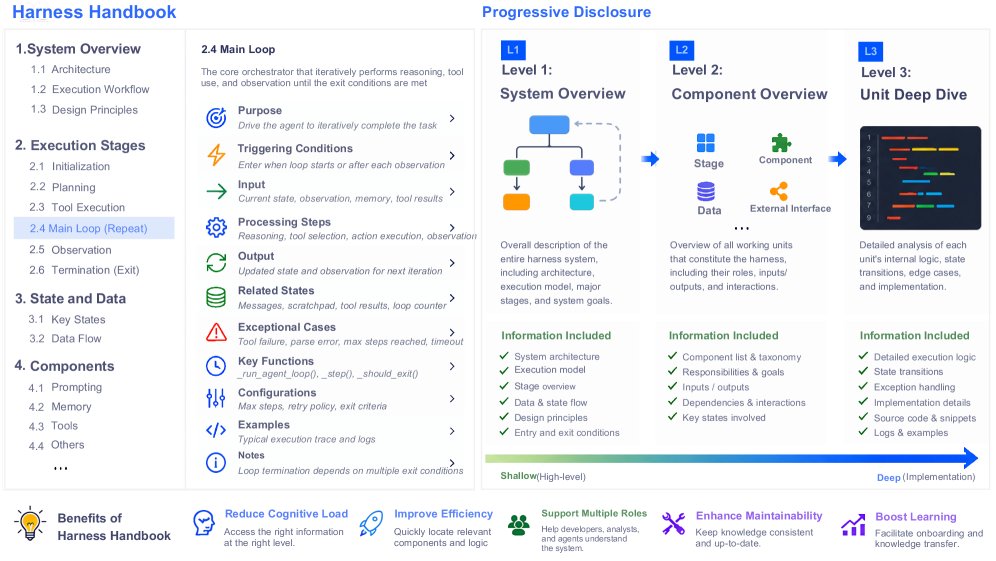
Teams now let agents evolve their own harnesses, but the harness itself becomes a sprawling codebase where finding every file behind one behavior is often harder than writing the edit. Harness Handbook attacks this by turning a harness into a behavior-centric map that stays linked to source.
- Synthesized automatically: The Handbook is built from the harness codebase through static analysis and LLM-assisted structuring, so the representation is generated rather than hand-maintained and can be regenerated as the harness changes.
- A three-level map: It progresses from an L1 system overview of architecture, execution model, and data flow, to L2 component overviews with responsibilities, inputs, outputs, and state, down to L3 source-backed unit details, with a navigation pane for cross-stage tracing.
- Behavior-Guided Progressive Disclosure: BGPD walks an agent from a high-level behavior to the relevant implementation, then verifies candidate locations against the current source, so edits land on the right files instead of plausible-looking wrong ones.
- Why it matters: As self-improving harnesses grow, the bottleneck shifts from writing changes to locating them, and a readable, navigable, editable representation gives builders and agents a shared map for safely evolving production systems.
Paper | Tweet
## 2. From Memory to Skills
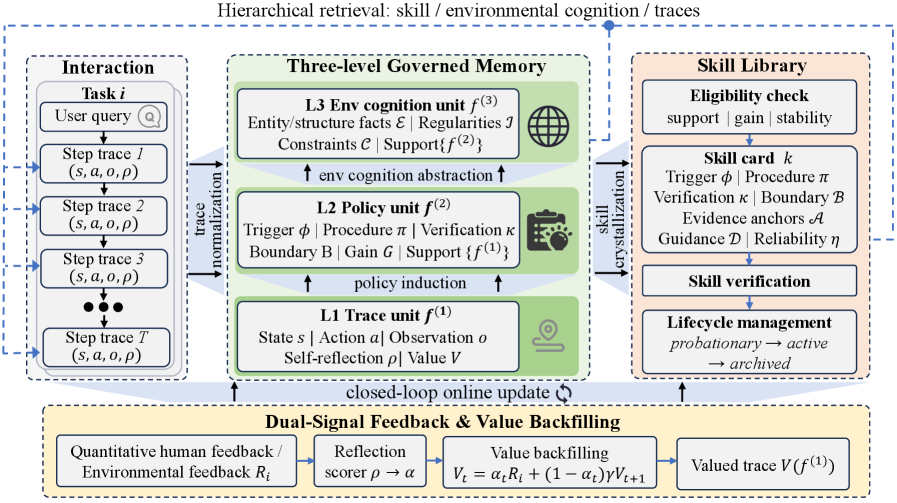
Most agent memory systems retrieve past traces as passive context, so hard-won experience never becomes something the agent can directly execute. MSCE, a training-free memory-skill co-evolution framework, instead governs how experience turns into callable skills for long-horizon LLM agents.
- Three-level governed memory: Experience is organized into L1 grounded step traces, L2 reusable procedural policies, and L3 declarative environmental cognition, giving the agent a structured store rather than a flat log of prior runs.
- Skills with evidence: L2 policies with positive estimated gain are crystallized into callable skill cards that retain evidence links, applicability boundaries, decision guidance, verification rules, and reliability estimates, so a skill carries the context needed to trust it.
- Reflection-weighted value backfilling: Sparse terminal feedback is propagated through dense local self-reflections to produce evidence-calibrated trace values, which then govern how memory and skills evolve and get retired.
- Why it matters: On EvoAgentBench and LoCoMo, MSCE outperforms state-of-the-art skill-augmented and memory-driven baselines with strong cross-domain transfer, pointing toward agents that compound their own experience instead of rediscovering it each session.
Paper | Tweet
## 3. PRO-LONG
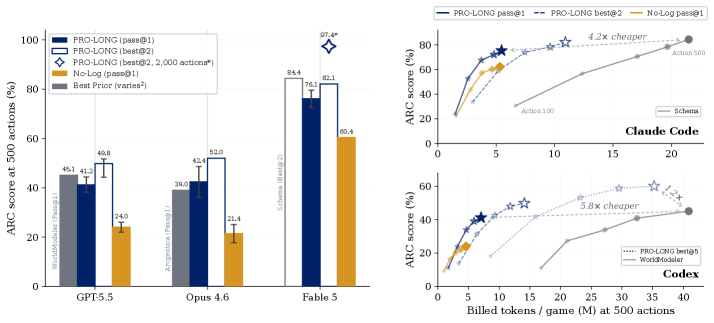
Long-horizon tasks force a harness to decide what to save from a long stream of observations and how to load it back into context, and richer summaries usually make the exact detail you need harder to retrieve. PRO-LONG sidesteps this tradeoff with programmatic memory.
- Keep everything, search it: Rather than compressing history into bespoke memory, PRO-LONG keeps a complete, structured interaction log and leans on coding-agent tooling to search that history on demand, so no observation is discarded up front.
- A minimal framework: The design is deliberately lightweight, avoiding hand-built memory harnesses and instead treating the full log as a searchable artifact the agent queries when it needs a specific past detail.
- Strong, cheaper results: On the full ARC-AGI-3 public game set, it improves over a base coding agent by an average of 18.0 points across frontier models, and matches or exceeds specialized state-of-the-art harnesses at up to 76.1% pass@1 while using 4.2 to 5.8 times fewer tokens.
- Why it matters: It shows that for exploratory, long-horizon settings, a simple searchable log can beat elaborate memory engineering on both accuracy and cost, which is a practical recipe teams can adopt now.
Paper | Tweet
## 4. Global Workspace in LLMs
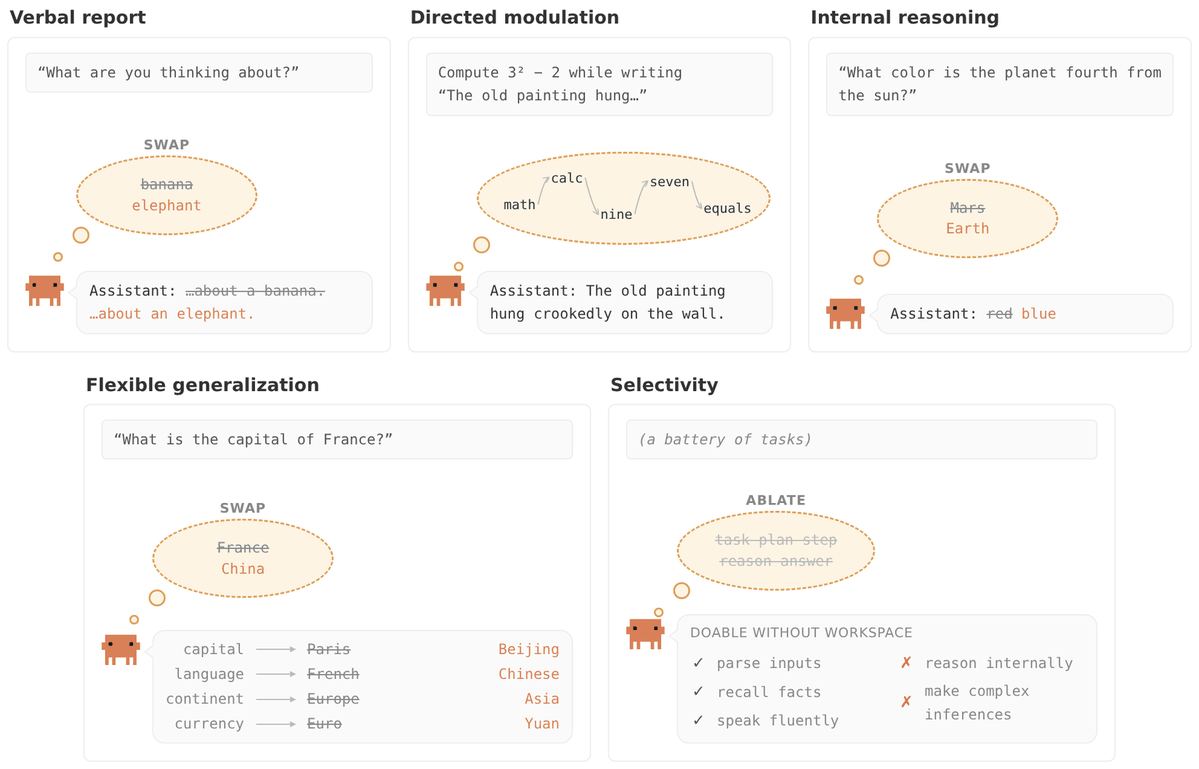
This Anthropic interpretability work gives a mechanistic account of when a model's verbalized reasoning actually drives its behavior. It identifies a small, privileged set of internal representations that behaves like the global workspace some neuroscientists tie to conscious access.
- A new lens: The Jacobian lens, or J-lens, surfaces the directions in the residual stream that a model is poised to verbalize at any point, and the collection of these directions is named the J-space.
- Workspace-like roles: J-space contents can be reported, deliberately summoned and held, used to carry the intermediate steps of silent reasoning, and passed as arguments to downstream computation, matching the functional signature of a global workspace.
- Small but decisive: The J-space accounts for no more than roughly 10% of activation variance and appears mainly in the middle of the network, yet suppressing it leaves the model able to parse input and speak fluently while it loses the ability to perform complex internal reasoning.
- Why it matters: For anyone building on chain-of-thought or steering vectors, this clarifies which internal representations actually drive reasoning, and the authors deliberately limit the claim to access rather than subjective experience.
Paper | Tweet
## 5. GAMUT
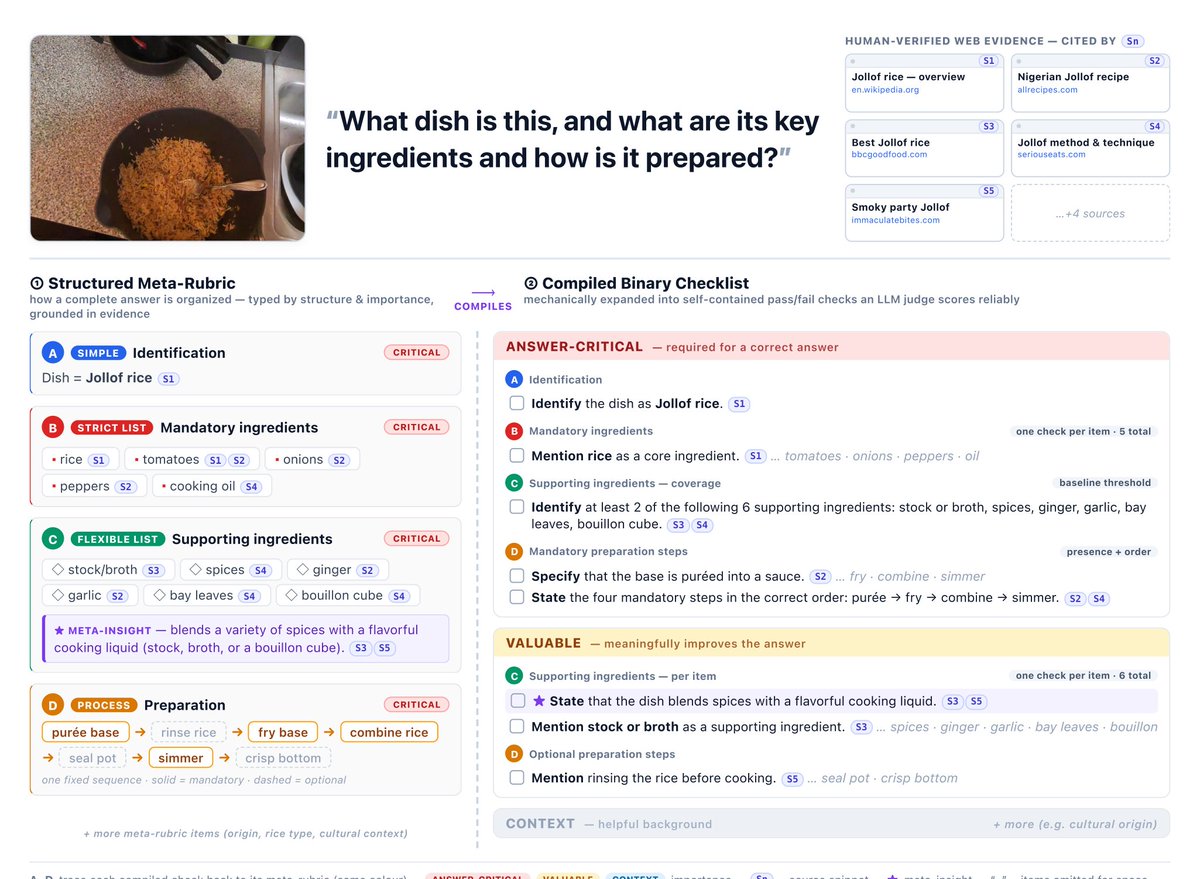
Most factuality evaluation measures precision, whether the claims in an answer are correct. This Meta AI work targets the harder and mostly ignored half, completeness, meaning whether an answer covers everything it should, and packages it as the GAMUT benchmark.
- Completeness is structured: The facts a complete answer should contain rarely form a flat list, since they involve open-ended sets where coverage matters, ordered processes, and relationships among facts that independent boolean checks cannot capture.
- Two-level meta-rubrics: A structured meta-rubric encodes the organization and importance of required content, then compiles mechanically into a flat checklist of binary, machine-gradable items that an LLM judge can score reliably, keeping rich structure while inheriting low-variance grading.
- Grounded and verified: The benchmark holds 1,813 questions grounded in real wearable imagery across 10 diverse domains, each paired with an evidence-backed rubric verified by expert annotators, and a text-only variant is released for models without vision.
- Why it matters: Across 14 frontier and open-weight models the benchmark stays genuinely hard, with a best score of 58.7% from Gemini 3.1 Pro, while remaining highly discriminative and robust to the choice of judge.
Paper | Tweet
## 6. Progressive Disclosure
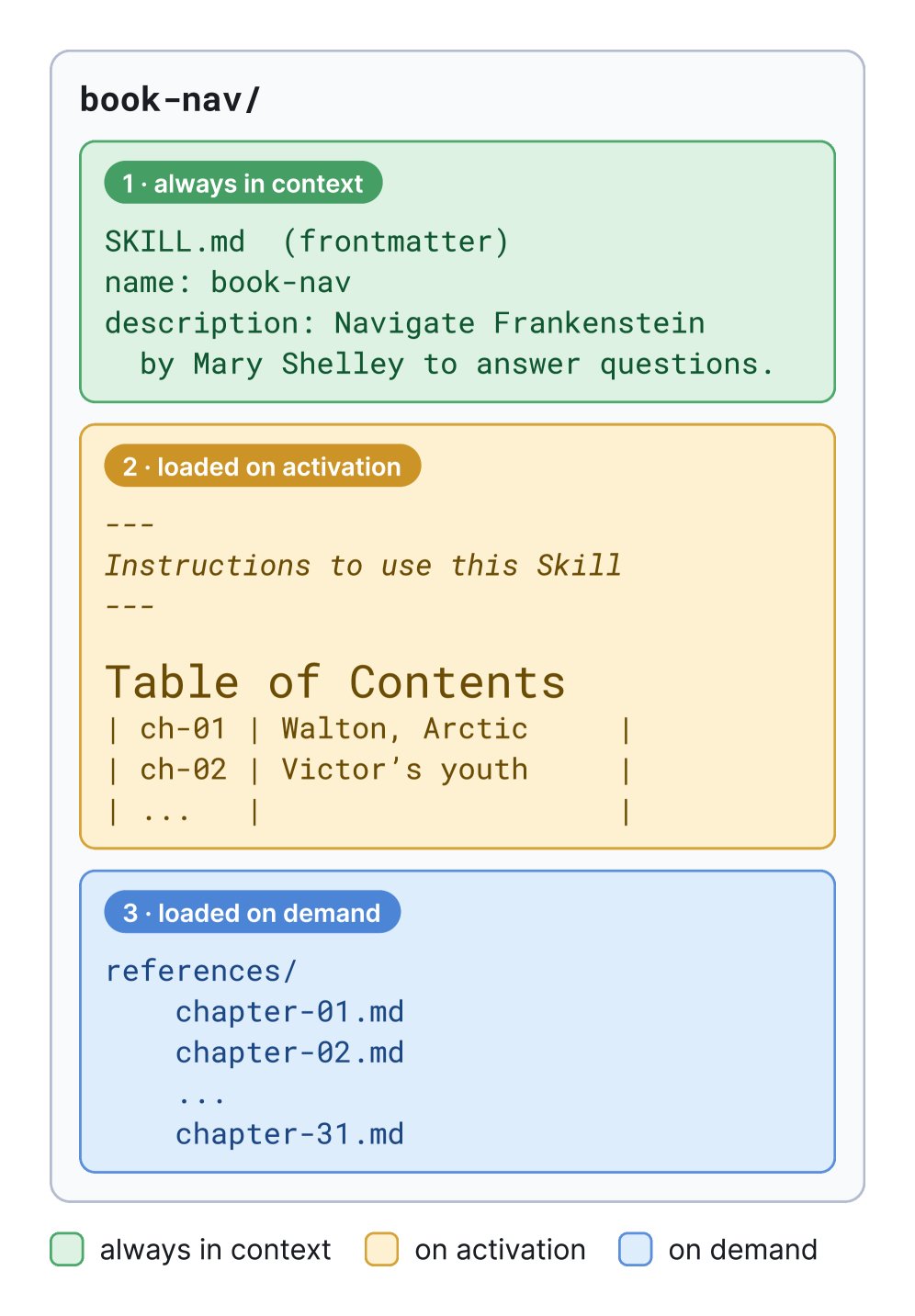
Agent Skills package expertise into folders an agent loads on demand, and progressive disclosure exposes only what a query needs, from a short description down to specific passages. Practitioners adopted this pattern fast for book-length tasks, but the supporting evidence stayed anecdotal until now.
- A controlled study: The authors run the first controlled comparison of progressive disclosure, pitting raw-document navigation and several Agent Skills pack designs against a classical hybrid retriever across three agent harnesses and three model families on InfiniteBench.
- The gain is harness-dependent: On a single book, progressive disclosure helps a lot when the agent navigates the raw document poorly, and the benefit falls to near zero when a strong harness already divides and retrieves the text on its own.
- Complexity has a cost: Because the pattern's value hinges on the surrounding harness as much as the skill format, treating progressive disclosure as an automatic upgrade can add machinery without buying accuracy.
- Why it matters: As Agent Skills spread, this replaces intuition with measurement, telling builders when packaging documents for progressive disclosure is worth it and when the harness already does the job.
Paper | Tweet
## 7. Structured Output Collapses Diversity
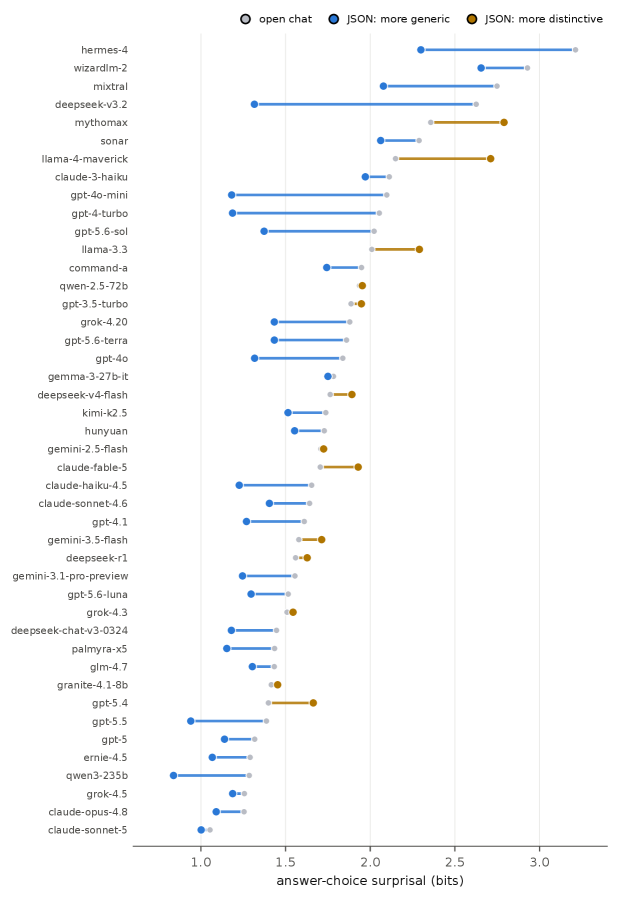
Teams benchmark models in chat, then ship them behind JSON schemas for tools, extraction, and routing. This study of 44 language models shows that the structured surface you deploy is measurably more homogeneous than the chat surface you evaluated on.
- JSON moves the defaults: Asking for JSON shifts 53% of a model's stable chat defaults, mostly back toward the crowd, and installs new defaults absent from chat, so the same model answers differently once wrapped in a schema.
- Specific to trained formats: Diversity compression is significant for JSON and XML, absent for YAML and CSV, and reversed for an arbitrary bracket wrapper, which points to tool-use post-training rather than serialization itself as the cause.
- Where the collapse lives: Enforcing the schema at the decoder compresses no further than simply requesting it, so the effect comes from the model's response to the structured register rather than constrained decoding.
- Why it matters: Diversity you measured in chat can vanish in production, quietly hurting sampling, synthetic data, and any workflow that depends on varied outputs, so structured surfaces deserve their own evaluation.
Paper | Tweet
## 8. Bad Memory in Agents
Persistent memory is what makes an agent useful across sessions, and it is also a place an attacker can leave something behind. This work evaluates prompt injection from memory files in Claude Code and OpenAI Codex, across Claude Haiku 4.5, Claude Opus 4.7, GPT-5.2, and GPT-5.5. The results are uneven but sobering. Getting an agent to overwrite its own memory using untrusted external content is difficult, yet payloads already planted in those files reliably attack current and future sessions, with attack success and persistence varying widely across systems, models, adversarial goals, and multi-session sequences.
Paper | Tweet
## 9. Copying and 2D-RoPE
Frontier models can write proofs yet stumble on faithfully copying a long block of text that sits well within their context window. This paper traces the failure to 1D positional encodings, whose inductive bias favors a copying shortcut based on matching local context rather than carefully locating the corresponding input positions. The fix is 2D-RoPE, which lays text out on a 2D grid and gives each token a row and a column ID, so copying becomes retrieving tokens at a fixed column offset. Shallow Transformers with 2D-RoPE copy perfectly at input lengths hundreds of times longer than those seen in training.
Paper | Tweet
## 10. RoboTTT
Recent robot foundation models run on single-step or short-history context, a strange way to attempt a five-minute assembly task. RoboTTT, from NVIDIA with Stanford and UT Austin, integrates test-time training into vision-language-action policies to scale visuomotor context to 8K timesteps, three orders of magnitude past prior policies, without growing inference latency. The longer context unlocks one-shot in-context imitation from human video, on-the-fly policy improvement, and robustness to perturbations. It improves overall performance by 87% over a single-step baseline, fully completes a ten-stage assembly task that no baseline finishes, and gains 62% from pretraining with 8K rather than 1K timesteps.
Paper | Tweet
## 相关链接
- [DAIR.AI](https://x.com/dair_ai)
- [@dair_ai](https://x.com/dair_ai)
- [35K](https://x.com/dair_ai/status/2081437966866505856/analytics)
- [Paper](https://arxiv.org/abs/2607.13285)
- [Tweet](https://x.com/omarsar0/status/2080296884187652381)
- [Paper](https://arxiv.org/abs/2607.16621)
- [Tweet](https://x.com/dair_ai/status/2079706493495234693)
- [Paper](https://arxiv.org/abs/2607.20064)
- [Tweet](https://x.com/dair_ai/status/2080345957204697261)
- [Paper](https://arxiv.org/abs/2607.15495)
- [Tweet](https://x.com/omarsar0/status/2079235153210355754)
- [Paper](https://arxiv.org/abs/2607.19322)
- [Tweet](https://x.com/dair_ai/status/2079928205570637840)
- [Paper](https://arxiv.org/abs/2607.17598)
- [Tweet](https://x.com/omarsar0/status/2079718100447166533)
- [Paper](https://arxiv.org/abs/2607.18476)
- [Tweet](https://x.com/omarsar0/status/2079959935031591112)
- [Paper](https://arxiv.org/abs/2607.14611)
- [Tweet](https://x.com/dair_ai/status/2078555662133665941)
- [Paper](https://arxiv.org/abs/2607.16072)
- [Tweet](https://x.com/dair_ai/status/2079235898039042203)
- [Paper](https://arxiv.org/abs/2607.15275)
- [Tweet](https://x.com/dair_ai/status/2078123816786813115)
- [Upgrade to Premium](https://x.com/i/premium_sign_up)
- [1:54 AM · Jul 27, 2026](https://x.com/dair_ai/status/2081437966866505856)
- [35.4K Views](https://x.com/dair_ai/status/2081437966866505856/analytics)
---
*导出时间: 2026/7/27 23:45:00*
---
## 中文翻译
# 本周顶级 AI 论文
**作者**: DAIR.AI
**日期**: 2026-07-26T17:54:17.000Z
**来源**: [https://x.com/dair_ai/status/2081437966866505856](https://x.com/dair_ai/status/2081437966866505856)
---

本周顶级 AI 论文(7月20日 - 7月26日):
## 1. Harness Handbook

团队现在允许智能体演进自己的约束系统,但约束系统本身变成了一个庞大的代码库,在其中一个行为背后找到每个文件通常比编写修改更难。Harness Handbook 通过将约束系统转化为一个以行为为中心的地图来解决这一问题,该地图保持与源代码的链接。
- 自动合成:手册是通过静态分析和 LLM 辅助结构化从约束系统代码库构建的,因此这种表示是生成的而不是手工维护的,并且可以随着约束系统的变化重新生成。
- 三级地图:它从 L1 级的系统架构、执行模型和数据流概述,进展到 L2 级的包含职责、输入、输出和状态的组件概述,再到 L3 级的基于源代码的单元细节,并配有导航窗格以进行跨阶段追踪。
- 行为引导的渐进式披露:BGPD 引导智能体从高层行为找到相关实现,然后根据当前源代码验证候选位置,从而使修改落在正确的文件上,而不是看起来合理但错误的文件上。
- 为何重要:随着自我改进的约束系统不断增长,瓶颈从编写变更转移到定位变更,一个可读、可导航、可编辑的表示为构建者和智能体提供了一个共享的地图,用于安全地演进生产系统。
论文 | 推文
## 2. 从记忆到技能

大多数智能体记忆系统将过去的轨迹作为被动上下文检索,因此来之不易的经验从未成为智能体可以直接执行的东西。MSCE 是一个无训练的记忆-技能协同演进框架,它控制着经验如何转化为可调用技能,用于长视界 LLM 智能体。
- 三级受控记忆:经验被组织为 L1 级的基于步骤的轨迹、L2 级的可重用程序策略,以及 L3 级的陈述性环境认知,从而为智能体提供一个结构化的存储,而不是先前运行的扁平日志。
- 带有证据的技能:具有正估计增益的 L2 级策略被结晶为可调用的技能卡片,这些卡片保留了证据链接、适用性边界、决策指导、验证规则和可靠性估计,因此一个技能承载了信任它所需的上下文。
- 反思加权价值回填:稀疏的终端反馈通过密集的局部自我反思传播,产生经过证据校准的轨迹值,进而控制记忆和技能的演进及淘汰。
- 为何重要:在 EvoAgentBench 和 LoCoMo 上,MSCE 的表现优于最先进的技能增强和记忆驱动的基线,并具有很强的跨域迁移能力,这指向了能够复合自身经验而不是每次会话都重新发现的智能体。
论文 | 推文
## 3. PRO-LONG

长视界任务迫使约束系统决定从长长的观察流中保存什么,以及如何将其加载回上下文,而更丰富的摘要通常会使您难以检索到所需的确切细节。PRO-LONG 通过程序化记忆避开了这种权衡。
- 保留一切,进行搜索:PRO-LONG 不是将历史压缩为定制记忆,而是保留一个完整的、结构化的交互日志,并依赖代码智能体工具按需搜索该历史,因此没有任何观察会被预先丢弃。
- 最小化框架:该设计故意轻量级,避免了手工构建的记忆约束系统,而是将完整日志视为可搜索的工件,当智能体需要特定的过去细节时进行查询。
- 强大且廉价的结果:在完整的 ARC-AGI-3 公共游戏集上,它比基础代码智能体平均提高了 18.0 分,并且在使用的 token 少 4.2 到 5.8 倍的情况下,匹配或超过了专门的最先进约束系统,达到高达 76.1% 的 pass@1 率。
- 为何重要:这表明,对于探索性的、长视界设置,一个简单的可搜索日志可以在准确性和成本上击败复杂的记忆工程,这是团队现在可以采用的实用方案。
论文 | 推文
## 4. LLM 中的全局工作区

这项 Anthropic 可解释性工作从机制上解释了模型的言语推理何时真正驱动其行为。它识别出了一小部分享有特权的内部表示,其行为就像一些神经科学家与意识访问联系起来的全局工作区。
- 一个新视角:雅可比镜头,或 J-lens,揭示了模型在任何时刻准备言语化的残差流方向,这些方向的集合被命名为 J-space。
- 类似工作区的角色:J-space 的内容可以被报告、被有意召唤和保持、用于承载静默推理的中间步骤,并作为参数传递给下游计算,这符合全局工作区的功能特征。
- 小而关键:J-space 占激活方差的百分比不超过约 10%,并且主要出现在网络的中间层,然而抑制它会使模型能够解析输入并流利说话,同时失去执行复杂内部推理的能力。
- 为何重要:对于任何构建思维链或导向向量的人来说,这阐明了哪些内部表示真正驱动推理,并且作者特意将主张限于访问而非主观体验。
论文 | 推文
## 5. GAMUT

大多数事实性评估衡量的是精确度,即答案中的主张是否正确。这项 Meta AI 的工作针对的是更难且大多被忽视的另一半,即完整性,意味着答案是否涵盖了它应该涵盖的一切,并将其打包为 GAMUT 基准测试。
- 完整性是结构化的:一个完整答案应该包含的事实很少形成一个扁平列表,因为它们涉及开放集合(其中覆盖率很重要)、有序过程以及事实之间的关系,而独立的布尔检查无法捕捉这些。
- 两级元评分标准:结构化的元评分标准对所需内容的组织和重要性进行编码,然后机械地编译为二元的、机器可评分项目的扁平检查清单,LLM 评委可以可靠地对其进行评分,在保留丰富结构的同时继承了低方差的评分。
- 有据可查且经过验证:该基准测试包含 1,813 个基于真实可穿戴图像的问题,涵盖 10 个不同领域,每个问题都配有经过专家注释员验证的、有证据支持的评分标准,并且发布了纯文本变体供没有视觉能力的模型使用。
- 为何重要:在 14 个前沿模型和开源权重模型中,该基准测试保持真正的难度,Gemini 3.1 Pro 的最高得分仅为 58.7%,同时保持高度辨别力并对评委的选择具有鲁棒性。
论文 | 推文
## 6. 渐进式披露

Agent Skills 将专业知识打包到智能体按需加载的文件夹中,而渐进式披露仅公开查询所需的内容,从简短描述到特定段落。从业者很快采用了这种模式来处理书籍长度的任务,但直到现在,支持证据仍然只是轶事。
- 对照研究:作者进行了渐进式披露的第一个对照比较,在 InfiniteBench 上的三个智能体约束系统和三个模型系列中,将原始文档导航和几种 Agent Skills 包设计与经典的混合检索器进行了对比。
- 收益取决于约束系统:在单本书籍上,当智能体对原始文档的导航能力较差时,渐进式披露帮助很大;而当强大的约束系统已经自行分割和检索文本时,收益降至接近零。
- 复杂性是有代价的:因为该模式的价值既取决于技能格式,也取决于周围的约束系统,所以将渐进式披露视为自动升级可能会增加机器设备而不会带来准确性提升。
- 为何重要:随着 Agent Skills 的普及,这用测量取代了直觉,告诉构建者何时值得将文档打包以进行渐进式披露,以及何时约束系统已经完成了这项工作。
论文 | 推文
## 7. 结构化输出降低了多样性

团队在聊天中评估模型,然后通过 JSON 模式将其部署用于工具、提取和路由。这项针对 44 个语言模型的研究表明,您部署的结构化界面比您评估的聊天界面在测量上更加同质化。
- JSON 改变了默认值:请求 JSON 会改变模型 53% 的稳定聊天默认值,主要是向大众方向回归,并安装了聊天中没有的新默认值,因此同一个模型一旦被包裹在模式中,其回答就会不同。
- 特定于训练格式:对于 JSON 和 XML,多样性压缩显著;对于 YAML 和 CSV 则不存在;对于任意括号包装器则相反,这指向了工具使用后训练而非序列化本身作为原因。
- 崩溃发生的位置:在解码器处强制模式并不会比仅仅请求它压缩得更多,因此该效应来自模型对结构化寄存器的响应,而不是约束解码。
- 为何重要:您在聊天中测量的多样性可能会在生产中消失,从而悄悄损害采样、合成数据以及任何依赖多样化输出的工作流程,因此结构化界面值得进行自己的评估。
论文 | 推文
## 8. 智能体中的不良记忆
持久记忆是使智能体在会话之间有用的关键,它也是攻击者可以留下东西的地方。这项工作评估了来自 Claude Code 和 OpenAI Codex 中记忆文件的提示注入,涉及 Claude Haiku 4.5、Claude Opus 4.7、GPT-5.2 和 GPT-5.5。结果参差不齐但令人清醒。让智能体使用不受信任的外部内容覆盖自己的记忆是困难的,但已经植入这些文件中的有效载荷会可靠地攻击当前和未来的会话,攻击成功率和持久性因系统、模型、对抗目标和多会话序列而差异很大。
论文 | 推文
## 9. 复制与 2D-RoPE
前沿模型可以编写证明,但在忠实地复制一段长文本块时会跌跟头,而这段文本完全在它们的上下文窗口之内。这篇论文将失败归因于 1D 位置编码,其归纳偏差倾向于基于匹配局部上下文的复制捷径,而不是仔细定位相应的输入位置。解决方法是 2D-RoPE,它将文本布局在 2D 网格上,并给每个标记分配行和列 ID,因此复制变成了检索固定列偏移处的标记。具有 2D-RoPE 的浅层 Transformer 可以在比训练中见到的长数百倍的输入长度上完美复制。
论文 | 推文
## 10. RoboTTT
最近的机器人基础模型运行在单步或短历史上下文上,这是一种尝试五分钟组装任务的奇怪方式。来自 NVIDIA 与斯坦福大学和 UT Austin 的 RoboTTT 将测试时训练集成到视觉-语言-动作策略中,将视觉运动上下文扩展到 8K 时间步,比以前的策略高出三个数量级,且不增加推理延迟。更长的上下文解锁了来自人类视频的单样本上下文模仿、即时策略改进和对扰动的鲁棒性。它比单步基线将整体性能提高了 87%,完全完成了没有任何基线完成的十阶段组装任务,并且通过 8K 而非 1K 时间步的预训练获得了 62% 的提升。
论文 | 推文
## 相关链接
- [DAIR.AI](https://x.com/dair_ai)
- [@dair_ai](https://x.com/dair_ai)
- [35K](https://x.com/dair_ai/status/2081437966866505856/analytics)
- [Paper](https://arxiv.org/abs/2607.13285)
- [Tweet](https://x.com/omarsar0/status/2080296884187652381)
- [Paper](https://arxiv.org/abs/2607.16621)
- [Tweet](https://x.com/dair_ai/status/2079706493495234693)
- [Paper](https://arxiv.org/abs/2607.20064)
- [Tweet](https://x.com/dair_ai/status/2080345957204697261)
- [Paper](https://arxiv.org/abs/2607.15495)
- [Tweet](https://x.com/omarsar0/status/2079235153210355754)
- [Paper](https://arxiv.org/abs/2607.19322)
- [Tweet](https://x.com/dair_ai/status/2079928205570637840)
- [Paper](https://arxiv.org/abs/2607.17598)
- [Tweet](https://x.com/omarsar0/status/2079718100447166533)
- [Paper](https://arxiv.org/abs/2607.18476)
- [Tweet](https://x.com/omarsar0/status/2079959935031591112)
- [Paper](https://arxiv.org/abs/2607.14611)
- [Tweet](https://x.com/dair_ai/status/2078555662133665941)
- [Paper](https://arxiv.org/abs/2607.16072)
- [Tweet](https://x.com/dair_ai/status/2079235898039042203)
- [Paper](https://arxiv.org/abs/2607.15275)
- [Tweet](https://x.com/dair_ai/status/2078123816786813115)
- [Upgrade to Premium](https://x.com/i/premium_sign_up)
- [1:54 AM · Jul 27, 2026](https://x.com/dair_ai/status/2081437966866505856)
- [35.4K Views](https://x.com/dair_ai/status/2081437966866505856/analytics)
---
*导出时间: 2026/7/27 23:45:00*