# Top AI Papers of the Week
**作者**: DAIR.AI
**日期**: 2026-05-03T15:12:24.000Z
**来源**: [https://x.com/dair_ai/status/2050956647909015788](https://x.com/dair_ai/status/2050956647909015788)
---
The Top AI Papers of the Week (April 26 - May 3)
## 1. Agentic Harness Engineering
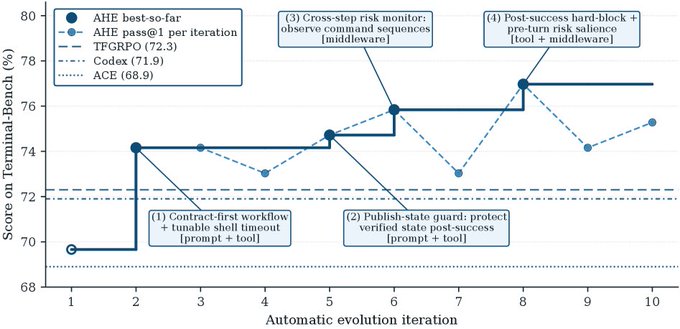
Most coding-agent harnesses are still tuned by hand or kept alive through brittle trial-and-error self-evolution. This paper introduces Agentic Harness Engineering (AHE), a framework that makes harness evolution observable and falsifiable. AHE separates the system into three layers: components stored as revertible files, experience condensed from millions of trajectory tokens into structured evidence, and decisions written as predictions that get checked against task outcomes. Every edit becomes a contract you can verify or revert.
- Three-layer evolution model: Components, experience, and decisions are each first-class artifacts. Components are versioned files, experience is compressed evidence pulled from full trajectory logs, and decisions are explicit hypotheses with expected outcomes. The structure turns black-box harness tuning into an auditable engineering loop.
- Pass@1 gains on Terminal-Bench 2: Pass@1 climbs from 69.7% to 77.0% across ten iterations, beating both human-designed Codex-CLI (71.9%) and self-evolving baselines like ACE and TF-GRPO. The framework also uses 12% fewer tokens than the seed harness on SWE-bench-verified.
- Cross-model transfer: The evolved harness transfers across model families with +5.1 to +10.1 point gains, suggesting the optimizations are structural rather than overfit to a specific backbone. That is the property you actually want from harness engineering.
- Why it matters: Harness work is the largest hidden cost in most agent systems. AHE is the first credible recipe for letting the harness improve itself without drifting into noise, which makes it the most important agent-systems paper of the week.
Paper | Tweet
## 2. AgenticQwen-30B-A3B
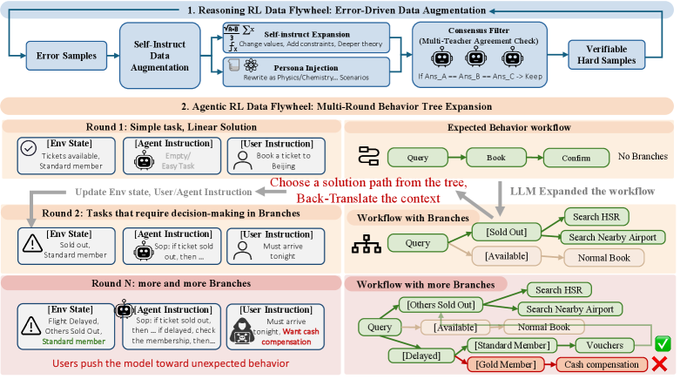
Alibaba shows that a 30B MoE model with only 3B active parameters can match Qwen3-235B on real tool-use workloads. AgenticQwen-30B-A3B scores 50.2 average on TAU-2 plus BFCL-V4 Multi-Turn, while AgenticQwen-8B scores 47.4. Both more than double their vanilla Qwen baselines and close most of the gap to a 235B model. The recipe is built around two reinforcement learning flywheels that run in parallel, with simulated users actively trying to mislead the agent.
- Reasoning flywheel from self-failure: The first loop mines the model's own errors and converts them into harder reasoning problems each round. The training distribution gets harder on its own as the model improves, removing the need for new human-curated reasoning data.
- Agentic flywheel for tool use: The second loop grows simple linear tool-use trajectories into multi-branch behavior trees. Simulated users test recovery from misleading instructions, ambiguous goals, and failed tool calls, which is where vanilla supervised tuning typically breaks.
- Real efficiency for production agents: A 30B MoE with 3B active tokens at inference is significantly cheaper to serve than a 235B dense or MoE alternative. For tool-use workloads where frontier reasoning is overkill, this changes the cost profile of shipping production agents.
- A reusable recipe: The flywheel approach generalizes beyond Qwen. Teams can generate hard examples from their own agent's failures rather than relying on static synthetic data, which is the more scalable path for domain-specific agents.
Paper | Tweet
## 3. Agentic World Modeling
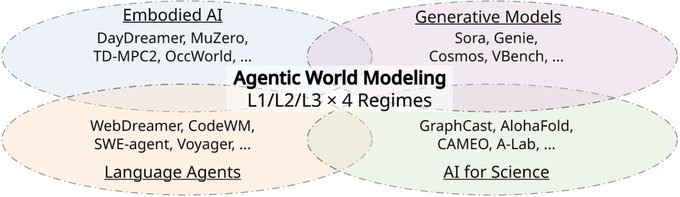
A massive 40-author survey lands the cleanest taxonomy of world models in agent research released so far. The paper proposes a "levels by laws" framework spanning three capability levels and four law regimes, then synthesizes 400+ works and 100+ representative systems across model-based RL, video generation, web and GUI agents, multi-agent simulation, and scientific discovery. As agents shift from chatbots to goal-accomplishers, the bottleneck moves from language to environment, and this is the first paper that gives builders a shared vocabulary across communities that have been working in isolation.
- Three capability levels: L1 Predictors handle one-step transitions, L2 Simulators do multi-step action-conditioned rollouts, and L3 Evolvers self-revise as the world changes. The hierarchy makes it easy to place existing systems and identify where capability gaps actually live.
- Four law regimes: Physical, digital, social, and scientific laws each impose different constraints on what a world model needs to capture. The framework treats them as orthogonal axes, which clarifies why a strong physics simulator can still fail at social or digital tasks.
- Failure-mode catalog: The survey extracts recurring failure patterns across 100+ systems, including misaligned reward shaping, drift under non-stationarity, and brittle transfer across regimes. Each failure mode is mapped to a level and law combination, so the diagnosis is grounded.
- Evaluation principles per level: The authors propose evaluation criteria specific to each capability level rather than a single benchmark. This is the right move because L1 prediction accuracy and L3 self-revision quality are not measurable on the same axis.
Paper | Tweet
## 4. RecursiveMAS
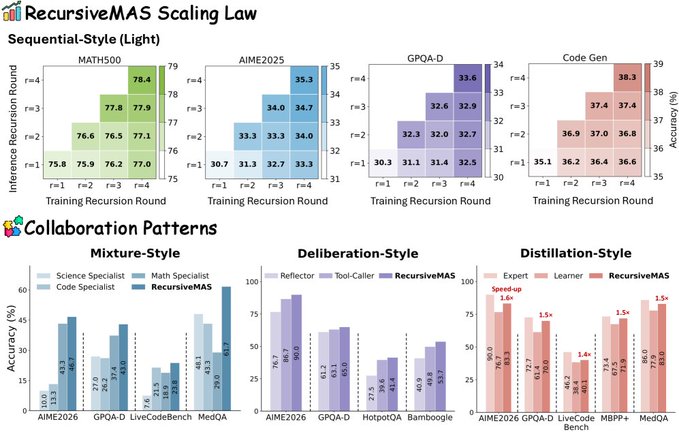
Multi-agent systems usually pass full text messages between agents at every step, which causes token bloat, latency, and context dilution that all grow with team size. RecursiveMAS asks a different question: what if agents collaborated through recursive computation in a shared latent space instead of through text? The system treats a multi-agent team as a recursive computation where each agent acts like an RLM layer, iteratively passing latent representations to the next and forming a looped interaction process. Less talking, more thinking.
- RecursiveLink for latent communication: A RecursiveLink module generates latent thoughts and transfers state directly between heterogeneous agents, replacing natural-language messages with internal representations. The change removes the cost of re-encoding and re-parsing text on every coordination step.
- Inner-outer loop learning: The training algorithm uses an inner loop for per-step latent updates and an outer loop for team-level credit assignment, with shared gradient-based updates across agents. This makes joint optimization tractable instead of relying on hand-tuned communication protocols.
- Strong gains across 9 benchmarks: Across math, science, medicine, search, and code generation, RecursiveMAS delivers 8.3% average accuracy gain over baselines, 1.2x to 2.4x end-to-end inference speedup, and 34.6% to 75.6% reduction in token usage. The efficiency story is at least as important as the accuracy story.
- A path past the agent communication tax: If agent-to-agent communication is the next real bottleneck, latent-space recursion is one of the cleaner ways to scale collaboration. Teams running multi-agent systems at scale should treat this as a serious design alternative, not a research curiosity.
Paper | Tweet
## 5. OneManCompany
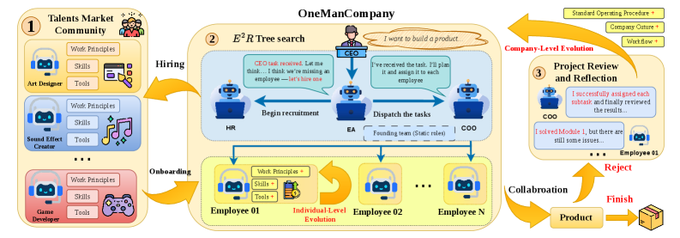
If you are building multi-agent systems, you are probably wiring static org charts. This paper argues they should look more like a labor market. OneManCompany (OMC) replaces fixed teams with "Talents," portable agent identities that bundle skills and tools, and a "Talent Market" where agents get recruited dynamically per task. An Explore-Execute-Review tree search decomposes work hierarchically and aggregates results back up. On PRDBench, OMC reaches 84.67% success, +15.5 points over prior SOTA, and the framework generalizes across the case studies the authors run.
- Talents as portable identities: A Talent bundles a skill set, tool access, and behavioral priors into a reusable agent identity. Talents can be hired into any task without rewiring the orchestration graph, which removes most of the brittleness in pre-wired multi-agent pipelines.
- Dynamic recruitment via Talent Market: Tasks post requirements, and the market matches Talents to roles based on capability fit and current load. This replaces the standard "design a team for every workflow" pattern with on-demand assembly that adapts as the task population shifts.
- Explore-Execute-Review tree search: Work is decomposed top-down into subtasks, executed in parallel by recruited Talents, then reviewed and aggregated up the tree. The structure naturally supports retries, branching, and cross-checking without manual coordination logic.
- Why it matters: Pre-wired multi-agent pipelines break the moment tasks drift outside their design envelope. Treating agents as a recruitable workforce gets you self-organization and continuous improvement by default, which is what open-ended agent systems need.
Paper | Tweet
## 6. From Skill Text to Skill Structure
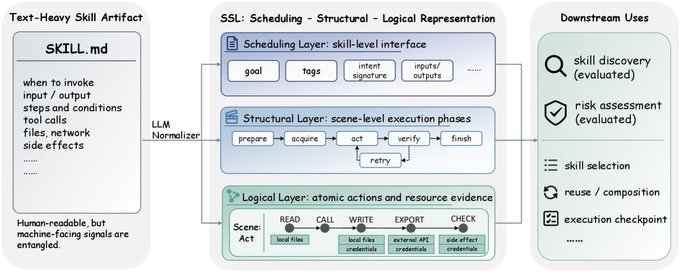
SKILL.md files entangle invocation interface, execution flow, and tool side effects in a single blob of natural language. That makes downstream discovery and risk review brittle as skill registries scale. This paper proposes SSL, a three-layer typed JSON representation drawn from Schank and Abelson's classical work on scripts, MOPs, and conceptual dependency. An LLM-based normalizer converts existing SKILL.md files into the structure, so adoption does not require rewriting registries by hand.
- Three layers, cleanly separated: A Scheduling layer captures invocation signals and trigger conditions, a Structural layer encodes execution scenes and ordering, and a Logical layer specifies atomic actions plus resource and side-effect annotations. The separation lets discovery, risk, and execution each reason about the layer they care about.
- Skill Discovery MRR jumps 0.573 to 0.707: Treating skills as typed structure rather than prose makes retrieval significantly more accurate, even before any model fine-tuning. The gain comes from the structure exposing what skills actually do, not just how they describe themselves.
- Risk Assessment macro F1 of 0.787: The Logical layer's resource annotations enable a 0.744 to 0.787 jump in risk classification. Auditors can now reason about side effects directly instead of inferring them from free-form prose.
- A 6,184-skill corpus released: The authors ship a normalized corpus of 6,184 skills, 403 task queries, and 500 risk-labeled skills. As skill registries cross a million entries, structured representations are the only path that keeps discovery and review tractable.
Paper | Tweet
## 7. Latent Agents
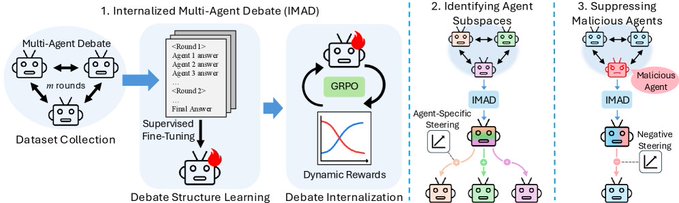
Multi-agent debate makes models reason better. It also burns tokens generating long transcripts before any answer comes out. Latent Agents distills the entire debate into a single LLM through a two-stage fine-tuning pipeline: the model first learns debate structure, then internalizes it through dynamic reward scheduling and length clipping. The internalized model matches or beats explicit multi-agent debate while using up to 93% fewer tokens, which makes debate-quality reasoning practical at production scale.
- Two-stage internalization pipeline: Stage one teaches the structure of debate (turn taking, critique, revision) through supervised fine-tuning on transcript data. Stage two uses dynamic reward scheduling and length clipping to compress that structure into single-pass reasoning without losing the gains from the multi-agent setup.
- Up to 93% token savings: The internalized model matches or beats explicit debate accuracy while drastically reducing inference cost. For teams running reasoning workloads at scale, this is the kind of efficiency win that turns a research idea into a deployment default.
- Activation steering reveals agent subspaces: The "agents" survive distillation as identifiable circuits in activation space. Probing finds interpretable directions corresponding to different agent perspectives, which means the internal structure persists even when the external transcript is gone.
- A safety angle worth noting: When malicious agents are deliberately embedded via distillation, negative steering suppresses them more cleanly than steering a base model would, with smaller hits to general performance. Internalized debate may turn out to be a useful interpretability and alignment substrate, not just a token-saver.
Paper | Tweet
## 8. OCR-Memory
Most agent memory systems compress trajectories into text summaries and hope the model remembers what matters, which is exactly where the information loss hides. OCR-Memory renders the agent's interaction history as images with indexed visual anchors, then retrieves via a locate-and-transcribe pipeline: the model scans visual memory, predicts the index of the relevant region, and the original text is fetched verbatim from a database. Older trajectories are stored as low-resolution thumbnails with active-recall up-sampling, and the method reaches SOTA on Mind2Web and AppWorld under strict context limits.
Paper | Tweet
## 9. When to Retrieve During Reasoning
Most RAG systems retrieve once, before the model starts reasoning. Large reasoning models like o1 and R1 do not work that way. They generate 12k to 25k token chains of thought and hit knowledge gaps mid-inference, long after the retrieval window closed. ReaLM-Retrieve is a reasoning-aware retrieval framework that injects evidence during multi-step inference, detects uncertainty at reasoning-step granularity, and learns a policy for when external evidence actually helps. It achieves +10.1% absolute F1 over standard RAG across MuSiQue, HotpotQA, and 2WikiMultiHopQA, with 47% fewer retrieval calls than fixed-interval IRCoT, and hits 71.2% F1 on 2-4 hop MuSiQue with only 1.8 retrieval calls per question.
Paper | Tweet
## 10. Co-evolving Decisions and Skills
Long-horizon agents fail in two ways: the decision-maker cannot decompose well, or the skill library goes stale. This paper introduces a co-evolution framework where an LLM decision agent and a dynamic skill bank improve each other through iterative refinement. The decision agent picks and chains skills, performance feedback updates both the policy and the skills, and new skills emerge by generalizing successful sequences instead of being hand-coded upfront. Most long-horizon agent stacks treat skills and decision-making as separate optimization problems, which is why they plateau. Co-evolution gives you adaptive planning and a growing library of reusable behaviors from a single loop, which is what you actually want when task structure is not predetermined: robotics, game agents, and complex planning.
Paper | Tweet
## 相关链接
- [DAIR.AI](https://x.com/dair_ai)
- [@dair_ai](https://x.com/dair_ai)
- [2.7K](https://x.com/dair_ai/status/2050956647909015788/analytics)
- [Paper](https://arxiv.org/abs/2604.25850)
- [Tweet](https://x.com/omarsar0/status/2049492169887748365)
- [Paper](https://arxiv.org/abs/2604.21590)
- [Tweet](https://x.com/omarsar0/status/2048504655932760565)
- [Paper](https://arxiv.org/abs/2604.22748)
- [Tweet](https://x.com/omarsar0/status/2048783073547079816)
- [Paper](https://arxiv.org/abs/2604.25917)
- [Tweet](https://x.com/omarsar0/status/2050261229315477988)
- [Paper](https://arxiv.org/abs/2604.22446)
- [Tweet](https://x.com/dair_ai/status/2048909068409147460)
- [Paper](https://arxiv.org/abs/2604.24026)
- [Tweet](https://x.com/omarsar0/status/2049252335105491147)
- [Paper](https://arxiv.org/abs/2604.24881)
- [Tweet](https://x.com/dair_ai/status/2049493173639278818)
- [Paper](https://arxiv.org/abs/2604.26622)
- [Tweet](https://x.com/dair_ai/status/2049957482811056307)
- [Paper](https://arxiv.org/abs/2604.26649)
- [Tweet](https://x.com/omarsar0/status/2049954716298494386)
- [Paper](https://arxiv.org/abs/2604.20987)
- [Tweet](https://x.com/omarsar0/status/2048440985726955998)
- [Upgrade to Premium](https://x.com/i/premium_sign_up)
- [11:12 PM · May 3, 2026](https://x.com/dair_ai/status/2050956647909015788)
- [2,754 Views](https://x.com/dair_ai/status/2050956647909015788/analytics)
---
*导出时间: 2026/5/3 23:45:25*
---
## 中文翻译
# 本周顶级 AI 论文
**作者**: DAIR.AI
**日期**: 2026-05-03T15:12:24.000Z
**来源**: [https://x.com/dair_ai/status/2050956647909015788](https://x.com/dair_ai/status/2050956647909015788)
---

本周顶级 AI 论文(4月26日 - 5月3日)
## 1. 代理工程

大多数编码代理的测试框架仍然依靠手工调整,或者通过脆弱的试错式自我进化来维持。这篇论文介绍了代理工程,一个使框架进化变得可观察和可证伪的框架。AHE 将系统分为三层:存储为可回滚文件的组件、从数百万轨迹令牌压缩成结构化证据的经验,以及写成预测并与任务结果进行核对的决定。每一次编辑都成为了一份您可以验证或回滚的契约。
- 三层进化模型:组件、经验和决策都是一等公民产物。组件是版本化的文件,经验是从完整轨迹日志中提取的压缩证据,而决策是带有预期结果的显式假设。这种结构将黑盒的框架调优转变为可审计的工程循环。
- Terminal-Bench 2 上的 Pass@1 提升:在十次迭代中,Pass@1 从 69.7% 攀升至 77.0%,击败了人工设计的 Codex-CLI (71.9%) 以及 ACE 和 TF-GRPO 等自我进化的基线。此外,在 SWE-bench-verified 上,该框架使用的 Token 比种子框架少了 12%。
- 跨模型迁移:进化后的框架在不同模型族之间迁移时可获得 +5.1 到 +10.1 的收益,这表明这些优化是结构性的,而非针对特定骨干模型的过拟合。这正是您在框架工程中真正想要的属性。
- 为何重要:框架工作是大多数代理系统中最大的隐藏成本。AHE 是第一个让框架能够自我改进而不至于退化为噪声的可靠方案,这也使其成为本周最重要的代理系统论文。
论文 | 推文
## 2. AgenticQwen-30B-A3B

阿里巴巴展示了仅有 3B 活跃参数的 30B 混合专家模型可以在真实工具使用工作负载中匹敌 Qwen3-235B。AgenticQwen-30B-A3B 在 TAU-2 和 BFCL-V4 多轮对话中平均得分 50.2,而 AgenticQwen-8B 得分为 47.4。两者都比其原生 Qwen 基线翻了一倍多,并大大缩小了与 235B 模型的差距。该方案的核心是两个并行运行的强化学习飞轮,其中的模拟用户会主动试图误导代理。
- 源自自我失败的推理飞轮:第一个循环挖掘模型自身的错误,并将其转化为每一轮中更难的推理问题。随着模型的提升,训练分布会自动变难,从而消除了对新的人工标注推理数据的需求。
- 工具使用的代理飞轮:第二个循环将简单的线性工具使用轨迹生长为多分支行为树。模拟用户测试从误导性指令、模糊目标和失败的工具调用中恢复的能力,而这通常正是标准监督调优失效的地方。
- 生产级代理的真正效率:在推理时具有 3B 活跃 Token 的 30B MoE,其服务成本显著低于 235B 的稠密或 MoE 替代方案。对于顶级推理属于性能过剩的工具使用工作负载,这改变了部署生产级代理的成本结构。
- 可复用的方案:飞轮方法不仅限于 Qwen。团队可以从自己代理的失败中生成困难样本,而不是依赖静态的合成数据,这是特定领域代理更具扩展性的路径。
论文 | 推文
## 3. 代理世界建模

一篇由 40 位作者合著的大型综述提出了迄今为止发布的代理研究领域中关于世界模型最清晰的分类法。该论文提出了一个跨越三个能力等级和四个规律体系的“按规律分层”框架,然后综合了基于模型的强化学习、视频生成、Web 和 GUI 代理、多代理模拟以及科学发现领域的 400 多篇作品和 100 多个代表性系统。随着代理从聊天机器人转向目标完成者,瓶颈从语言转向了环境,这篇论文首次为此前各自孤立工作的社区构建者提供了一个共享的词汇表。
- 三个能力等级:L1 预测器处理单步转换,L2 模拟器进行多步条件行动推演,而 L3 进化器随着世界的变化自我修正。这种层级结构使得定位现有系统和识别真正的能力缺口变得容易。
- 四种规律体系:物理、数字、社会和科学规律对世界模型需要捕捉的内容施加了不同的约束。该框架将它们视为正交轴,这阐明了为什么强大的物理模拟器仍然可能在社交或数字任务中失败。
- 失败模式目录:该综述提取了 100 多个系统中反复出现的失败模式,包括错位的奖励塑形、非平稳性下的漂移以及跨体系迁移的脆弱性。每种失败模式都映射到一个等级和规律的组合,使诊断具有依据。
- 分级评估原则:作者提出了针对每个能力等级的具体评估标准,而不是单一的基准。这是正确的举措,因为 L1 预测准确度和 L3 自修正质量无法在同一轴线上衡量。
论文 | 推文
## 4. RecursiveMAS

多代理系统通常在每一步的代理之间传递完整的文本消息,这会导致 Token 膨胀、延迟和上下文稀释,且这些问题都会随着团队规模的扩大而加剧。RecursiveMAS 提出了一个不同的问题:如果代理通过共享潜在空间中的递归计算而不是通过文本来协作会怎样?该系统将多代理团队视为一种递归计算,其中每个代理都像一个 RLM 层,迭代地将潜在表示传递给下一个层,形成一个循环交互过程。少说话,多思考。
- 用于潜在通信的 RecursiveLink:RecursiveLink 模块生成潜在思维,并在异构代理之间直接传输状态,用内部表示取代自然语言消息。这种改变消除了在每个协调步骤中重新编码和重新解析文本的成本。
- 内外循环学习:训练算法使用内循环进行单步潜在更新,使用外循环进行团队级功劳分配,并在代理之间进行基于梯度的共享更新。这使得联合优化变得切实可行,而不是依赖手工调优的通信协议。
- 在 9 个基准测试中的强劲表现:在数学、科学、医学、搜索和代码生成领域,RecursiveMAS 比基线平均提高了 8.3% 的准确率,实现了 1.2 倍至 2.4 倍的端到端推理加速,并减少了 34.6% 至 75.6% 的 Token 使用量。效率方面的故事至少与准确率同样重要。
- 绕过代理通信税的路径:如果代理间的通信是下一个真正的瓶颈,那么潜在空间递归是扩展协作的最清晰方式之一。大规模运行多代理系统的团队应将其视为严肃的设计替代方案,而非仅仅是研究上的新奇玩意。
论文 | 推文
## 5. OneManCompany

如果您正在构建多代理系统,您可能正在编写静态的组织结构图。这篇论文认为它们应该更像是一个劳动力市场。OneManCompany (OMC) 用“人才”——即捆绑了技能和工具的可移植代理身份——以及一个“人才市场”取代了固定的团队,在人才市场中,代理针对每个任务被动态招募。一个探索-执行-审查的树搜索将工作分层分解并聚合结果。在 PRDBench 上,OMC 达到了 84.67% 的成功率,比之前的 SOTA 提高了 15.5 分,该框架在作者运行的案例研究中具有泛化能力。
- 作为可移植身份的人才:人才将技能集、工具访问权限和行为先验捆绑为一个可重用的代理身份。人才可以被雇用到任何任务中,而无需重新编排编排图,这消除了预连线的多代理流水线中的大部分脆弱性。
- 通过人才市场进行的动态招聘:任务发布需求,市场根据能力匹配度和当前负载将人才与角色匹配。这用按需组装取代了标准的“为每个工作流设计一个团队”的模式,随着任务群体的变化,这种按需组装会进行自适应。
- 探索-执行-审查树搜索:工作自上而下分解为子任务,由招募的人才并行执行,然后沿树向上审查和聚合。这种结构天然支持重试、分支和交叉检查,而无需人工协调逻辑。
- 为何重要:预连线的多代理流水线在任务漂移出其设计范围的那一刻就会崩溃。将代理视为可招募的劳动力,默认就能获得自组织和持续改进,这正是开放式代理系统所需要的。
论文 | 推文
## 6. 从技能文本到技能结构

SKILL.md 文件将调用接口、执行流程和工具副作用纠缠在一坨自然语言中。这使得随着技能注册表的扩大,下游的发现和风险审查变得脆弱。本文提出了 SSL,这是一种三层类型的 JSON 表示法,借鉴了 Schank 和 Abelson 关于脚本、MOP 和概念依赖的经典著作。一个基于 LLM 的规范化器将现有的 SKILL.md 文件转换为这种结构,因此采用它不需要手工重写注册表。
- 三层清晰分离:调度层捕获调用信号和触发条件,结构层编码执行场景和排序,逻辑层指定原子动作以及资源和副作用注释。这种分离让发现、风险和执行各自关注它们关心的层。
- 技能发现 MRR 从 0.573 跃升至 0.707:将技能视为类型化结构而非散文,即使在没有任何模型微调的情况下,也显著提高了检索准确性。这种增益源于结构揭示了技能实际做什么,而不仅仅是它们如何描述自己。
- 风险评估宏 F1 分数达到 0.787:逻辑层的资源注释使风险分类从 0.744 跃升至 0.787。审计员现在可以直接推断副作用,而不必从自由形式的散文中进行推测。
- 发布了 6,184 个技能的语料库:作者发布了一个包含 6,184 个技能、403 个任务查询和 500 个带风险标签技能的规范化语料库。随着技能注册表突破一百万条目,结构化表示是保持发现和审查可行的唯一路径。
论文 | 推文
## 7. 潜在代理

多代理辩论使模型推理更好。它也会在产生任何答案之前消耗大量 Token 生成长篇记录。潜在代理通过两阶段微调流水线将整个辩论提炼到单个 LLM 中:模型首先学习辩论结构,然后通过动态奖励调度和长度裁剪将其内化。内化后的模型在使用多达 93% 更少 Token 的同时,匹敌或击败显式的多代理辩论,这使得具有辩论质量的推理在生产规模上变得切实可行。
- 两阶段内化流水线:第一阶段通过基于记录数据的监督微调来教授辩论的结构(轮流、批评、修正)。第二阶段使用动态奖励调度和长度裁剪,将该结构压缩为单次推理,而不会失去来自多代理设置的增益。
- 多达 93% 的 Token 节省:内化模型在大幅降低推理成本的同时,匹敌或击败显式辩论的准确率。对于大规模运行推理工作负载的团队来说,这种效率提升正是将研究想法转化为部署默认设置的关键。
- 激活 steering 揭示了代理子空间:“代理”作为激活空间中可识别的电路存活下来。探测发现了对应于不同代理视角的可解释方向,这意味着即使外部记录消失,内部结构依然存在。
- 值得注意的安全角度:当恶意代理通过提炼被故意嵌入时,负向 steering 比 steer 基础模型能更干净地抑制它们,且对通用性能的影响较小。内化辩论可能最终被证明是一种有用的可解释性和对齐基底,而不仅仅是 Token 节省器。
论文 | 推文
## 8. OCR-Memory
大多数代理记忆系统将轨迹压缩为文本摘要,指望模型记住重要内容,而这正是信息丢失的隐藏之处。OCR-Memory 将代理的交互历史渲染为带有索引视觉锚点的图像,然后通过定位-转录流水线进行检索:模型扫描视觉记忆,预测相关区域的索引,并从数据库中逐字获取原始文本。较旧的轨迹存储为低分辨率缩略图,并带有主动回忆上采样,该方法在严格的上下文限制下在 Mind2Web 和 AppWorld 上达到了 SOTA。
论文 | 推文
## 9. 推理期间何时检索
大多数 RAG 系统在模型开始推理之前检索一次。像 o1 和 R1 这样的大型推理模型并非如此工作。它们生成 12k 到 25k 的思维链,并在推理中途遇到知识缺口,那时检索窗口早已关闭。ReaLM-Retrieve 是一个推理感知检索框架,它在多步推理期间注入证据,以推理步骤粒度检测不确定性,并学习外部证据真正有帮助的策略。它在 MuSiQue、HotpotQA 和 2WikiMultiHopQA 上比标准 RAG 实现了 +10.1% 的绝对 F1 提升,比固定间隔的 IRCoT 少了 47% 的检索调用,并且每个问题仅需 1.8 次检索调用,就在 2-4 跳的 MuSiQue 上达到了 71.2% 的 F1。
论文 | 推文
## 10. 共同进化决策与技能
长视距代理会以两种方式失败:决策者无法很好地分解,或者技能库变得陈旧。本文介绍了一个共同进化框架,其中 LLM 决策代理和动态技能库通过迭代改进相互促进。决策代理挑选和链接技能,性能反馈同时更新策略和技能,新技能通过泛化成功序列而非预先手工编码而涌现。大多数长视距代理堆栈将技能和决策制定视为单独的优化问题,这就是它们停滞不前的原因。共同进化让您可以从单个循环中获得自适应规划和不断增长的可重用行为库,这正是当任务结构未预先确定时您真正想要的:机器人技术、游戏代理和复杂规划。
论文 | 推文
## 相关链接
- [DAIR.AI](https://x.com/dair_ai)
- [@dair_ai](https://x.com/dair_ai)
- [2.7K](https://x.com/dair_ai/status/2050956647909015788/analytics)
- [Paper](https://arxiv.org/abs/2604.25850)
- [Tweet](https://x.com/omarsar0/status/2049492169887748365)
- [Paper](https://arxiv.org/abs/2604.21590)
- [Tweet](https://x.com/omarsar0/status/2048504655932760565)
- [Paper](https://arxiv.org/abs/2604.22748)
- [Tweet](https://x.com/omarsar0/status/2048783073547079816)
- [Paper](https://arxiv.org/abs/2604.25917)
- [Tweet](https://x.com/omarsar0/status/2050261229315477988)
- [Paper](https://arxiv.org/abs/2604.22446)
- [Tweet](https://x.com/dair_ai/status/2048909068409147460)
- [Paper](https://arxiv.org/abs/2604.24026)
- [Tweet](https://x.com/omarsar0/status/2049252335105491147)
- [Paper](https: