# 20 Hackathons For Vibe Coders With Big Prize Pools & How To Win Them
**作者**: Meta Alchemist
**日期**: 2026-04-30T13:42:11.000Z
**来源**: [https://x.com/meta_alchemist/status/2049846781576622570](https://x.com/meta_alchemist/status/2049846781576622570)
---
There is $2M+ in cash prizes and another $5 million+ in funding sitting on the table for people who can vibe code a working demo product.
If you have spent the last six months coding with Codex, Claude, Cursor, or any AI stack, you have already done the hard part of preparing.
Most people may think it's hard to win a hackathon, but it's actually not that hard.
This article is a map.
Twenty live hackathons. For each one: the prize, the deadline, who is actually behind it, and a tactical "what to build" shortlist keyed to the published tracks and sponsor stack.
But the list itself is only half of why you came here.
Besides, we will cover what separates a winning submission from the 90% that don't medal. Idea selection, polish, demo, brand, ecosystem fit. We start there. Then the list.
Then how to turn this into a real income stream if you want to pay for your already available subscriptions and get even more AI inference..
## Before you pick one: what actually wins hackathons
Pick the wrong project for the right hackathon and you lose. Pick the right project but ship it ugly and you lose.
Pick a winner-shaped idea and execute against the rubric below and you can compete with teams that have ten times your experience.
Here is the meta-criteria checklist. Internalize this before you pick which event to enter, not after.
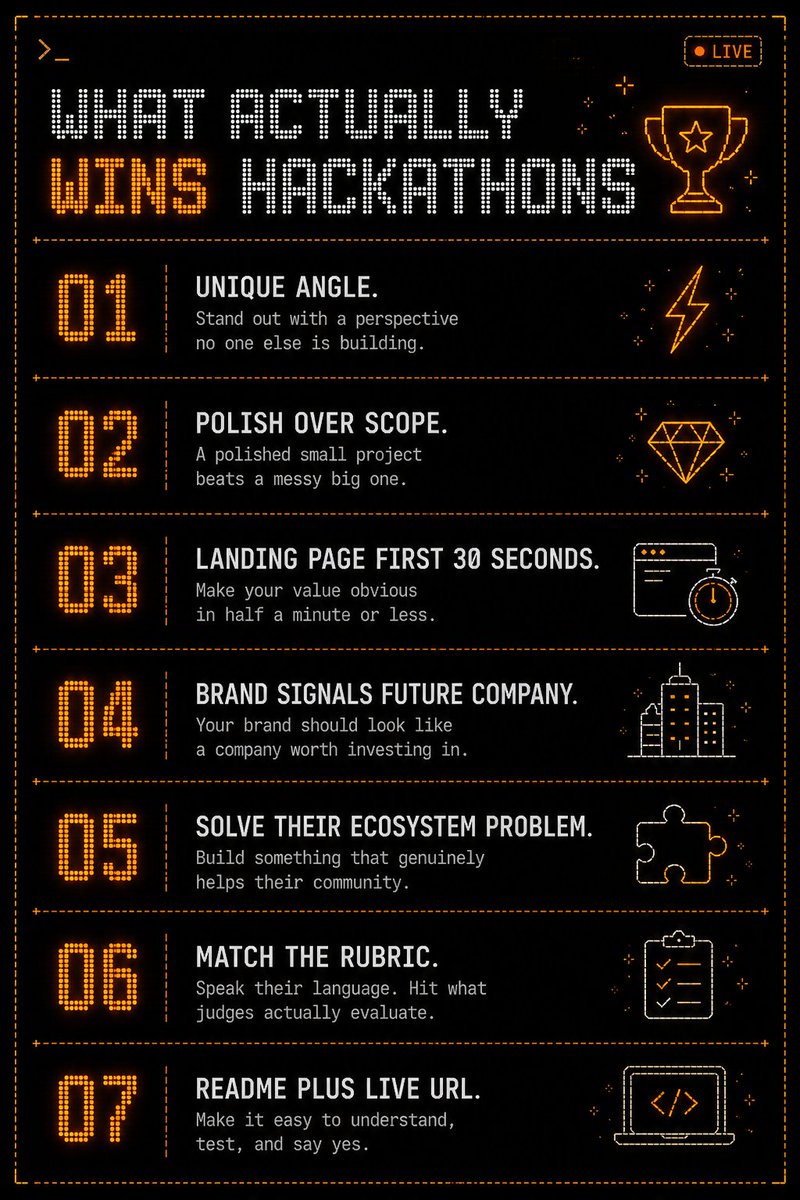
1. The idea has to be uniquely yours, not the obvious one
Hackathon submissions cluster hard. Many teams in every AI hackathon build exactly the same stuff. Judges remember the weird angle. If your idea is the first thing anyone would think of when they read the prompt, kill it and start over.
Originality is not a tiebreaker; it is literally the gate that opens many possibilities. Take your time talking to any LLM if you want to find original ideas, or new hybrids that become originals...
2. Polish beats scope, every time
A clean working demo of one thing beats a half-built demo of five things. Judges do not have time to imagine what you meant.
They click around for 90 seconds.
Whatever they see has to look intentional. If you have to choose between adding a feature and fixing a layout glitch the night before submission, fix the glitch.
3. The first 30 seconds on your landing page is the deliverable
Most submissions are scored from the live URL, not cloned and run by judges. They open the page, scan above the fold for 30 seconds, and form an opinion that rarely changes.
The hero section, the headline, the first interactive element, that is what gets judged.
Spend the last hours of the hackathon making that surface look like a launched product, not on shipping one more feature behind a flag.
4. Brand signals "future company", and judges are venture-betting
Logo, landing page, screenshot framing, even a placeholder X account that looks deliberately designed.
The host and sponsors are not just paying for the best weekend project, they are paying to seed teams that will later say "this company started at our hackathon" and brought some form of a win to us, whether that's brand recognition, ecosystem building, or simply the fact that they were right about you.
A polished brand whispers, "we are going to keep building this regardless of whether we win".
A bare default-template repo whispers "this was for the prize money but we don't have taste".
You know who will win.
5. Solve a problem inside their ecosystem
Hackathons exist because the host wants growth in their stack. Solana wants real Solana apps.
Anthropic wants Claude-native products. Mantle wants on-chain agents that pull volume to Mantle. Blockchains want projects built on them that can drive adoption of their chains.
The closer your project sits to the host's actual roadmap, the higher your win odds.
If you are entering Solana Frontier with a project that runs equally well on Ethereum, that's not an edge. Build something that can be enabled, especially in their ecosystem. Culture products included.
6. Read the rubric, then match it ruthlessly
Most hackathons publish their judging criteria. Most submissions ignore them.
If the rubric weights "originality 25%, technical depth 25%, impact 25%, presentation 25%", you should be able to point to exactly where in your submission each criterion is satisfied.
Build to the rubric in your head. Polish to the rubric. Pitch to the rubric.
Judge your project from all angles before they judge you, and if you give yourself an honest 10/10, you will likely win a prize. When in doubt, ask LLMs too, but make them be honest in the prompts, they might make you feel comfy, so first be your honest judge first and foremost.
P.S. the more variety of LLMs that judge what you built, the better. You can even share screenshots to show how things look and feel.
Key prompt is: "give me a honest verdict on this".
7. The README and the live URL carry the prize money
Whatever judges see in the first two minutes is what they grade. Spend disproportionate time on those two artifacts.
Your README should state the problem in one line, show the live demo URL in line two, ship a GIF or screenshot in line three, and only then explain setup.
The live URL should open on a hero section that names the problem and shows the working product immediately. Both should look like a launched product, not a school project.
## Patterns from teams who actually win these
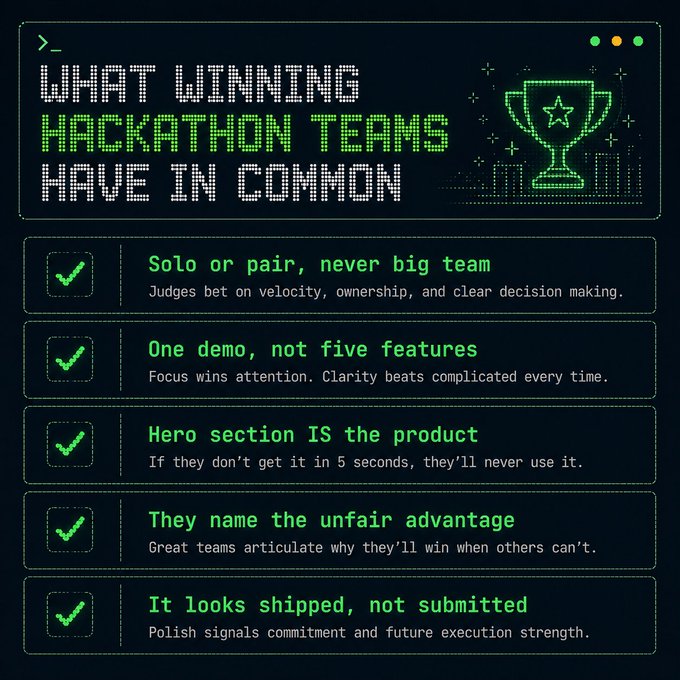
Across Anthropic, ETHGlobal, Solana, and YC-adjacent hackathons over the last 18 months, the same patterns keep showing up in the winners' circle:
- Solo or pair, not big team. Coordination tax kills weekend projects. The 2025 Anthropic hackathon was won by a single lawyer with no engineering background. The Solana Cypherpunk grand prize went to a two-person team. Three is fine, four is hard, five is a death march.
- One demo, not five features. Winning submissions almost always demo a single workflow that works flawlessly end-to-end. Losing ones demo five half-working features and ask the judge to "imagine if".
- The hero section of their landing page is the working product. Not a marketing pitch. Not a roadmap. An interactive surface that does the thing within 5 seconds of arrival.
- They name the unfair advantage out loud. "We can do this because [specific platform feature]." Judges remember teams that articulate why their stack choice was correct.
- The submission looks shipped, not submitted. Live URL with a custom domain. Screenshot in the README. X post announcing the demo. Discord screenshot of someone using it. All before judging closes.
Kicking off this week, May 1 to 7
## 1. Mantle Turing Test Hackathon 2026, Phase 2: AI Awakening
Opens / closes: May 1 to June 15
Prize: $100,000 (Phase 2 of $120,000 total)
Format: online
Co-hosts: Mantle, Bybit, Byreal, Blockchain for Good Alliance (BGA), DoraHacks, HackQuest, Tencent Cloud
Links: DoraHacks page, Mantle official
What they're looking for
Mantle is an Ethereum Layer-2 chain that has spent the last year repositioning itself as "the chain for AI agents." This hackathon is the flagship campaign for that pivot. The Human vs AI framing isn't theatre. It's how Mantle wants to prove that on-chain agents can compete with expert humans at real financial decisions. Bybit's involvement signals heavy interest in trading-shaped use cases.
Categories that resonate
- Agents that operate as legitimate financial actors on-chain, with verifiable performance over time.
- Anything that turns the human-vs-machine framing into a real demonstration, not a tagline.
- Ideas that pull volume into Mantle DeFi primitives (perpetuals, yield, lending).
- Plain-English interfaces between retail users and agent strategies. Trust layers matter as much as the strategy itself.
- Agent identity, reputation, and accountability. Who do you trust with your money, and why?
The white space: Most submissions will be vanilla trading bots. The teams that stand out treat the agent as a character with a track record and a personality, not a script.
## 2. Prompt a Startup 2026 (Polar.sh x Lovable)
Format: online, with an optional in-person kick-off in Stockholm
Prize: $10,000 to the team with the highest MRR after 1 month
Stack: build with Lovable (AI app generator), monetize with Polar (payments)
Link: hackathon.polar.sh
What they're looking for
Polar wants more developers monetizing software through Polar. Lovable wants more apps actually shipped using Lovable. The unique judging mechanic, where the team with the highest monthly recurring revenue after 30 days wins, is a tell: this is a hackathon about distribution, not engineering. Polar's whole pitch is that you can run a real software business without VC. They're trying to seed proof points for that pitch.
Categories that resonate
- Painkillers for narrow audiences. The faster you can find your first 50 paying users, the better.
- Productized services that replace work people already pay humans for.
- Tools that turn a recurring chore into a recurring habit. Subscriptions live or die on monthly perceived value.
- Boring back-office work that nobody else is excited to build. The shiny consumer-app lane is overcrowded.
- Anything that helps creators or solo operators see and grow their own revenue.
The white space: The market is the judge. Most teams will spend the first 25 days building. The ones who win will spend 5 days building, 25 days distributing, and the build will be intentionally small.
## 3. EasyA x Consensus Miami Hackathon
Dates: May 5 to 7
Prize: $200,000 total ($15K USDC grand, $5K runner-up, plus per-sponsor buckets)
Format: onsite, Miami, 72 hours
Sponsors: CoinDesk, Ripple, Polygon, Tezos, Immutable, Scroll
Link: easya.io/events/easya-consensus-miami-hackathon
What they're looking for
EasyA's mission is onboarding new developers to crypto, and Consensus is the biggest crypto conference of the year. Each chain sponsor (Ripple, Polygon, Tezos, Immutable, Scroll) brings their own prize bucket and judges the submissions on their track. The strategic move is to pick one chain, study what their developer relations team has been talking about for the last six months, and build directly into that conversation.
Categories that resonate
- Cross-border payments and stablecoin remittance, the entire reason Ripple exists.
- Consumer-grade UX on Polygon. Account abstraction, gasless flows, anything that hides the chain from the user.
- Real-world asset tooling on Tezos, where the foundation has been pushing institutional adoption.
- Genuine games on Immutable, especially anything that solves the bot-buyer plague that ruins web3 game launches.
- Privacy-preserving consumer apps on Scroll, where zero-knowledge tech is the moat.
The white space: Each track has its own judges and its own prize bucket. Picking one chain and overfitting to its developer relations priorities beats trying to ship something cross-chain.
## 4. Sui Overflow 2026
Kickoff: May 7 (full track list revealed at Sui Live Miami)
Prize: TBD; 2025 edition reached $1M+ after sponsor increases
Format: online, global
Sponsors: Walrus, Pyth, Alibaba Cloud, OpenZeppelin, OtterSec, Scallop, Navi, Wormhole
Link: overflow.sui.io
What they're looking for
Sui's whole technical pitch is its object-centric model: instead of treating everything as ledger entries, every digital thing on Sui is an object you can pass around. That's a meaningful difference from Ethereum, and Sui's team is desperate for apps that actually use it. They've also been pushing Walrus (decentralized storage) and zkLogin (Google sign-in directly to a Sui wallet) as adoption-friendly primitives.
Categories that resonate
- Apps where ownership of digital things is genuinely portable. Game inventories, photos with provenance, membership passes that work across services.
- Consumer crypto that doesn't feel like crypto. Sui has been investing heavily in zkLogin precisely so users don't need a seed phrase.
- Storage-heavy applications using Walrus. Sponsor track magnet.
- Real-world asset tokenization, especially anything that benefits from Sui's parallel execution speed.
- Cross-chain agent or app patterns through Wormhole.
The white space: Most submissions will be DeFi forks that don't engage with the object model. Anything that proves the object-centric architecture matters by being literally impossible on EVM stands out hard.
## 5. NandaHack: Agentic AI Hackathon, Phase 2
Phase 2: May 7 to June 13
Prize: undisclosed (academic prestige plus MIT Media Lab demo day)
Format: hybrid, MIT Media Lab base
Tracks (six arenas): deploy, coordinate, trade, adapt, defend, integrate
Organizer: HCLTech and MIT Media Lab
Link: media.mit.edu/events/nanda-hackathon
What they're looking for
This is an academic hackathon, with academic priorities. The judges are MIT faculty and HCLTech engineering leadership, not VCs. They're not looking for the most polished demo. They're looking for ideas that name a previously unnamed problem in agent infrastructure and ship a defensible attempt at solving it. The six "arenas" are real production agent failures the team thinks about all day.
Categories that resonate
- Coordination protocols between agents that haven't been formalized yet.
- Defense and red-teaming infrastructure for agents going to production.
- Self-adaptation mechanisms that change agent behavior based on observed failure patterns, not on philosophical "self-improvement".
- Migration and continuity tooling. The portability problem of moving agent state between providers is real and unsolved.
- Observability, telemetry, and replay tooling for production agent debugging.
The white space: Submissions that look like undergraduate projects lose. Submissions that look like research-grade work with a working prototype win. The bar is "could plausibly become a paper".
Build phase, May 8 to 18
## 6. ETHPrague 2026
Dates: May 8 to 10
Prize: undisclosed (sponsor pools historically $50K+)
Format: onsite, Municipal House Prague
Theme: Building Ethereum's Solarpunk Future
Sponsors: Gnosis Chain, ENS, Fhenix, Trezor, Zircuit, Ackee, Wake, Umia
Link: ethprague.com
What they're looking for
ETHPrague leans values-driven. The "solarpunk" theme means crypto used for regenerative, community-rooted, sustainability-aligned purposes, not extractive speculation. The judges include Ethereum core contributors who care deeply about the cypherpunk-meets-ecological framing. Surface-level ESG positioning will be seen through. Genuine engagement with the theme is rewarded.
Categories that resonate
- Mutual aid, community resource sharing, and local commons protocols.
- Regenerative economic primitives. Bonds and incentives that route money toward maintenance and stewardship instead of growth-at-all-costs.
- Privacy-preserving climate or eco-action verification using zk tech.
- Network economies and place-based identity, where the chain anchors something physical.
- Hardware-rooted security for high-stakes onchain decisions.
The white space: Most submissions will half-heartedly bolt the solarpunk frame onto a generic dapp. The teams that win take the theme seriously enough to choose what they wouldn't have built otherwise.
## 7. Solana Frontier Hackathon
Closes: May 11
Prize: $2.75M total ($30K Grand Champion, 20 startups receive $10K each, 10+ winners get $250,000 each in pre-seed funding from Colosseum's accelerator)
Format: online
Sponsors: Colosseum, Solana Foundation, Phantom, Arcium, Raydium, Coinbase, World, MoonPay
Link: colosseum.com/frontier
What they're looking for
Solana's superpower is speed and cost. Sub-second settlement, fees that round to zero, throughput that no other chain matches. Colosseum (the host) is an accelerator, not a foundation, which means the actual prize is acceleration into their cohort. They're scouting future portfolio companies. They want consumer apps that prove crypto can compete with web2 user experience, and infrastructure that supports those apps.
Categories that resonate
- Consumer-grade apps where Solana's speed makes something feel native that previously felt clunky.
- Real-time financial primitives that aren't possible at slower settlement.
- Compressed-NFT-based social or gaming patterns that exploit Solana's near-zero minting costs.
- Privacy-preserving DeFi via Arcium's confidential compute.
- Anything that quietly hides the wallet, the seed phrase, and the chain from the user.
The white space: Most submissions will be DeFi tools and memecoin tooling. Apps with real consumer pull on day one stand out because they're the kind of thing Colosseum can actually accelerate.
## 8. AI Agent Olympics, Milan AI Week
Online build: May 13 to 18
Onsite demo: May 19 to 20 at Fiera Milano
Prize: $28,000+
Format: hybrid
Tracks (real-world domains): legal, medical, logistics, finance, research, code review, content moderation, localization
Link: lablab.ai/ai-hackathons/milan-ai-week-hackathon
What they're looking for
Lablab.ai's whole identity is "AI agents for real-world domains." Milan AI Week is Europe's largest applied AI conference, and the audience is European enterprise buyers. They reward agents that work in regulated, friction-heavy domains where casual AI is not good enough. They don't reward chat demos.
Categories that resonate
- Domain-specific agents in regulated industries with real workflow grounding.
- Multi-tool agents that orchestrate calls across multiple data sources or APIs to complete a task end-to-end.
- Agents that produce structured, citable, audit-ready outputs (not just paragraphs).
- Cross-language and cross-jurisdictional tooling, especially anything serving European compliance contexts.
- Tools that explicitly handle the high-stakes failure cases instead of papering over them.
The white space: Most submissions will be horizontal "AI assistant" demos. Going narrow into a regulated domain with a real expert as a co-author beats going wide.
## 9. QIE Blockchain Hackathon 2026
Building: through May 15
Prize: $20,000
Format: online (registration technically closed April 15, late submissions sometimes accepted)
Tracks (5): Real-World Payments, AI+Web3, Consumer dApps, Dev Tools, QIE Ecosystem
Link: hackathon.qie.digital
What they're looking for
QIE is a smaller chain trying to seed an ecosystem. Smaller pool, smaller competition, easier to medal. They're not trying to be Ethereum or Solana. They want apps that prove QIE has a use case worth sticking around for. The five tracks are practical: payments, AI integration, consumer, developer infrastructure, and ecosystem tooling.
Categories that resonate
- Payment patterns that name a specific user (gig workers, distributed teams, immigrant remittance senders) instead of "global crypto users".
- AI-plus-web3 wrappers where the AI does the chain-specific reasoning so the user doesn't have to.
- Consumer apps that look and feel like web2 products, with the chain hidden underneath.
- Developer tooling that fills an actual gap in QIE's stack today, not a generic dev tool that works anywhere.
- Ecosystem analytics, block explorer enhancements, and bridges that the team is openly missing.
The white space: Smaller hackathons reward submissions that talk to the foundation team directly. Show up in their Discord, ask what's missing, then build that. Few teams do this and it heavily moves the needle.
## 10. UC Berkeley AI Hackathon 2026
Closes: May 17 (event June 20 to 21)
Prize: $100,000 in cash plus tech prizes
Format: onsite, MLK Building UC Berkeley campus
Themes: AI, LLM, open-source, dev tools, social impact
Eligibility: undergrad and grad students plus recent grads (Fall 2024 or later), teams up to 4
Link: ai.hackberkeley.org
What they're looking for
The judges at Berkeley AI hackathons are recruiters, founders, and engineering leaders, not professors. They're scouting future hires and future portfolio companies. They reward submissions that look like real products, not class projects. The student demographic skews toward problems they personally feel: study, scheduling, accessibility, dorm life, career.
Categories that resonate
- Student-life productivity tools that the judges themselves would have wanted to install in college.
- Open-source dev tools that look polished enough to live on a real engineer's machine.
- Accessibility-focused projects, especially anything mobile or local-first.
- Civic and community-tech projects with a clear, narrow target user.
- Tooling for AI evaluation, model behavior, or open-source LLM ecosystems.
The white space: Most teams will demo something theoretical. The teams that win bring something that judges can install on their phone or run on their laptop in front of them, and it works on the first try.
## 11. The Gemma 4 Good Hackathon (Google DeepMind x Kaggle)
Closes: May 18
Prize: $200,000 total. Awards across general, impact, and technical categories.
Format: online, global
Stack: Gemma 4 (open weights, multimodal, native function calling)
Tracks: health, education, climate, global resilience
Organizer: Kaggle in partnership with Google DeepMind
Link: kaggle.com/competitions/gemma-4-good-hackathon
What they're looking for
Google's strategic positioning for Gemma is "open weights you can actually run on-device." That framing is the entire pitch. The "Good" theme is health/edu/climate/resilience because that's where on-device, low-bandwidth, low-cost AI matters most. Kaggle judges historically reward technical rigor, measurable benchmarks, and reproducibility.
Categories that resonate
- On-device, offline-first applications. Things that work in places where cloud AI does not.
- Multimodal use cases that genuinely need vision plus language together (not just bolted on).
- Solutions for low-resource regions, languages, or infrastructure contexts.
- Technical contributions like novel fine-tunes, quantization schemes, or efficiency gains with measurable benchmarks.
- Public-good applications with a clear story about who is helped and how.
The white space: Most submissions will be cloud-hosted "AI for X" apps that could have used GPT-4. Submissions that genuinely require Gemma's local-first nature stand out because they're the proof-of-concept Google needs.
Late May to June, runway
## 12. Anthropic AI Hackathon (lablab.ai)
Dates: May 26 to June 2
Prize: undisclosed (top prize is accelerated Claude API access)
Format: online, capped at 3,000 participants
Ideal use cases (per organizer): customer service, legal, coaching, search, back-office, sales
Link: lablab.ai/ai-hackathons/anthropic-ai-hackathon
What they're looking for
Anthropic spelled out the categories that matter to them: customer service, legal, coaching, search, back-office, sales. That list is deliberate. Those are mainstream B2B verticals where Claude's strengths (long context, careful reasoning, safety-aligned outputs) are real advantages over alternatives. Anthropic wants Claude embedded in real products people pay for, not in chat-toy demos.
Categories that resonate
- Claude-native B2B products in the six published verticals, where the agent's value is grounded in domain knowledge.
- Tools that exploit Claude's long-context strengths for tasks alternatives can't reliably handle.
- Anything that turns Claude into a workflow tool used daily, not a novelty.
- Safety-aware applications in sensitive contexts (legal advice, mental health, coaching).
- Constitutional-AI-aligned tools where the framing of "what should this agent refuse" is part of the product design.
The white space: Most submissions will be agentic chat demos. Domain-specific, structured, audit-friendly products in regulated verticals stand out because they show Claude doing what alternatives can't.
## 13. DevNetwork [AI + ML] Hackathon 2026
Dates: May 11 to 28 (in-person finale May 27 to 28, South San Francisco)
Prize: $12,500+ in cash, products, and sponsor-track prizes. Plus an announcement to 60,000 newsletter subscribers for the grand prize team.
Format: online and in-person. Free to register.
Sponsors: Apple, Google, plus rotating challenge sponsors across DevOps, Enterprise, and ML/AI
Link: devnetwork-ai-ml-hack-2026.devpost.com
What they're looking for
DevNetwork hackathons are sponsor-funded developer reach. The grand prize is modest, but the per-sponsor challenge tracks (Apple, Google, and others) are where the real value lives. Each track is judged by that sponsor's actual engineering team, who are scouting tools and developers they want to work with. Sponsor track wins frequently turn into follow-up business or hires.
Categories that resonate
- Apple's developer story: privacy-preserving on-device intelligence. Anything that genuinely needs to run locally and showcases Apple silicon.
- Google's developer story: practical productivity wins on Gemini, MCP, and Workspace integrations.
- "Tiny model wins" demos. Receipts that prove a small fine-tuned model beats the big one for a specific task.
- Enterprise pain points, especially around legacy systems, observability, and ML deployment safety.
- MLOps and reliability tooling that practicing engineers actually wish they had.
The white space: Treat the grand prize as a side bet and aim straight at one sponsor track. Sponsor judges have thinner judging pools and clearer priorities, and the relationships you build there outlast the prize.
## 14. The Bags Hackathon
Closes: June 1 (33 days from now)
Prize: $1,000,000 grant pool. Top 100 projects each receive $10,000 to $100,000.
Broader fund: $4M total commitment ($1M to this hackathon, $3M continuation fund for winners)
Format: virtual, global
Tags (per organizer): AI, AI agents, Claude Skills, web3, DeFi, payments, Solana ecosystem
Partners: Solana, Helius, Meteora, Privy, DFlow, Birdeye
Links: DoraHacks page, bags.fm/hackathon (official)
What they're looking for
Bags is a Solana-based platform where individual creators (musicians, streamers, writers, podcasters) launch their own personal token. Their team comes from the social tipping and creator-economy world. They want tools that grow their creator-economy flywheel: more creators, more fan engagement, more on-chain volume. The fact that they explicitly tagged "Claude Skills" in their hackathon is unusual and intentional. They want AI integrations specifically.
Categories that resonate
- Claude integrations or Claude Skills that put the Bags economy inside the workflows creators already use.
- Tools that help creators understand, grow, and reward their fan base.
- Fan-side products that turn passive supporters into active participants in a creator's economy.
- Quality-signal infrastructure that filters real fan demand from bot-driven hype.
- Anything that brings new flow into the Bags ecosystem from outside Solana, including from off-chain creator platforms.
The white space: The top 100 projects all get paid, so the bar is "obviously above median" rather than "first place". And most submissions will skew DeFi-tooling. Creator-first projects that show Bags growing GMV are what their team values most.
## 15. USAII Global AI Hackathon 2026
Closes: June 6 (event June 14 to 21)
Prize: $15,000
Format: online, students only (grades 9 through doctoral)
Themes: AI, social impact, responsible AI
Link: aihackathon.usaii.org
What they're looking for
USAII is a US-based AI institute, and this is their student-focused hackathon. The judges are USAII faculty, not VCs. They reward pedagogical clarity and visible attention to AI safety. The "responsible AI" framing isn't optional. They genuinely want submissions that engage with bias, safety, and accessibility as part of the design.
Categories that resonate
- Educational tools for peers (other students) that the judges can immediately see helping their own classes.
- Accessibility-focused applications that name a specific underserved user.
- Tools that help young people navigate the modern information environment (scams, civics, mental health).
- Demonstrations that explicitly engage with AI safety and bias rather than ignoring those questions.
- Local journalism, civic engagement, and community-information infrastructure.
The white space: Most student submissions skew technical-impressive. The ones that win this category demonstrate human understanding of the problem, not just modeling skill.
## 16. AWS Prompt the Planet Challenge
Closes: June 11 (running March 10 to June 11)
Prize: $50,000 in AWS credits split among 10 winners. Multiple submissions allowed.
Format: online, global. Submit prompts, not apps.
Links: DoraHacks page, AWS Events
What they're looking for
Unusual format. You're submitting prompts that help developers do real AWS tasks, not apps. AWS wants more developers using their tools, and a great prompt is a force-multiplier for that. The judges are AWS engineers and developer-relations staff who can recognize a prompt that solves a real pain they hear about constantly from customer support tickets.
Categories that resonate
- Prompts that solve high-frequency, low-tolerance pain points (incident response, billing surprises, IAM configuration).
- Prompts that translate one AWS configuration format into another (CloudFormation, CDK, Terraform).
- Prompts that bridge the gap between technical and non-technical audiences (explain my bill, explain my outage).
- Prompts that automate the boring-but-critical safety work (least-privilege audits, blast-radius analysis, dependency tracing).
- Prompts for disaster-recovery rehearsal and game-day simulation.
The white space: Multiple submissions are explicitly allowed. Submitting five focused prompts in five different pain categories beats submitting one ambitious one.
## 17. Google Cloud Rapid Agent Hackathon
Closes: June 11
Prize: undisclosed (Google-tier credits and swag)
Format: online via Devpost
Stack: Gemini, MCP, AI agents, Google Cloud
Link: rapid-agent.devpost.com
What they're looking for
Google's bet for the agent era is Gemini plus MCP (the Model Context Protocol). They want more developers building real agents on Gemini, with first-class tool integrations through MCP. The Workspace ecosystem (Gmail, Calendar, Drive, Docs) is enormous and underused as an agent surface. Anything that expands what Gemini can do in real workflows is on their roadmap.
Categories that resonate
- MCP integrations that make Google's own surfaces (Workspace, Cloud) more useful as agent tools.
- Multi-step Gemini reasoning agents that complete a real-world task from a single user goal.
- Practical productivity agents that fit into Google Workspace daily flow.
- Tools for engineers (code review, deployment, observability) where Gemini's reasoning is the value.
- Customer-facing agents grounded in product documentation, with citations.
The white space: Most submissions will be Gemini chat demos. Anything that puts Gemini behind a real workflow people use daily, with MCP as the connective tissue, is exactly the proof point Google's looking for.
## 18. ETHGlobal New York 2026
Dates: June 12 to 14
Prize: undisclosed (ETHGlobal in-person events historically $100K+)
Format: onsite, NYC
Link: ethglobal.com/events/newyork2026
What they're looking for
ETHGlobal events are the most technically credible crypto hackathons, full stop. Sponsors are top protocols. Judges are Ethereum Foundation researchers and senior engineers from the sponsor protocols. They reward technical depth, native use of Ethereum primitives, and submissions that look ready to ship as real protocols, not weekend toys.
Categories that resonate
- Restaking, AVS, and the broader EigenLayer adjacent infrastructure.
- Layer-2 native applications where the L2 isn't a vague backdrop but a load-bearing choice.
- Onchain AI agents that actually live and execute on Ethereum, not chains pretending to be Ethereum.
- DAO infrastructure with a real opinion about governance design.
- Privacy and zero-knowledge tooling for serious adult use cases (identity, compliance, professional contexts).
The white space: ETHGlobal NYC always has the highest concentration of "cool but not technically deep" submissions. The teams that medal pair a real-world idea with a clean, technically defensible Ethereum-native implementation.
## 19. FlagOS Open Computing Global Challenge, Season 1
Results announced: early June
Prize: 2,000,000 RMB total (~$280,000 USD). Track 1 pays per-task, Tracks 2 and 3 are larger awards.
Format: multi-season, online
Organizer: FlagOS Community plus Beijing Academy of Artificial Intelligence (BAAI) plus CCF Open Source Development Technology Committee (ODTC)
Links: DoraHacks page, BAAI official
What they're looking for
FlagOS is a software stack designed to run AI models across many different chip architectures, not just NVIDIA. BAAI and the FlagOS community are betting that the AI compute ecosystem will fragment, and that whoever owns the cross-chip layer wins. They want technical contributions, not products. Judges are systems engineers and chip-software specialists.
Categories that resonate
- Operator-level contributions to the FlagGems library. Per-task bounties stack to real money.
- Cross-chip portability work, especially anything that proves the same model artifact runs across diverse hardware.
- Efficiency improvements with measurable benchmarks (memory, throughput, energy).
- Tooling for heterogeneous compute scheduling and model-chip matching.
- Niche hardware targets where the AI software stack barely exists (microcontrollers, specialized accelerators).
The white space: The bar is technical, not product. Show the curve, name the constraint, ship the diff. Polished demos that don't engage with the actual systems-level problem don't compete.
Special and niche
## 20. AI Coding Agents Hackathon (Anthropic x Y Combinator)
Format: onsite ONLY at Y Combinator office in San Francisco
Prize: undisclosed. YC-tier networking plus sponsor swag.
Tracks: Web/Mobile, Game Genesis, Autonomous Reactive Agents, Just-in-Time Software
Sponsors: Anthropic, Freestyle, Same.new, Morph LLM
Link: luma.com/hzwlapu0
What they're looking for
Anthropic and YC together are explicitly scouting the next generation of AI coding tools. The judges are Anthropic researchers (Claude Code team) and YC partners. The actual prize is the networking. The four tracks reflect what Anthropic and YC see as the open frontiers in coding agents: full app generation (Web/Mobile), game agents (Game Genesis), agents that adapt themselves (Autonomous Reactive), and software that builds itself in response to user needs (Just-in-Time).
Categories that resonate
- Coding agents that ship working software end-to-end from one human spec, not just code completions.
- Agents with novel approaches to debugging, repair, or self-correction.
- Reactive systems that respond to non-human signals (logs, telemetry, user behavior).
- Just-in-time software experiences where the UI is generated for the moment, not pre-built.
- Evaluation, observability, and reliability tooling for coding agents in production.
The white space: The networking outweighs the prize. Even non-winning teams who present a thoughtful angle in front of the right room walk away with intros. Treat the demo as a first conversation, not a final pitch.
## Why this is real money for vibe coders
Here's the part nobody talks about enough. If you've been coding with Claude or Cursor for a few months, hackathons are probably the highest-leverage source of income available to you right now, and most builders sleep on it.
The math is simple. A focused weekend of work, with a real shot at $5K to $100K. Even the smallest events on this list pay enough to cover a year of API costs, a year of Cursor Pro, and a Claude Max subscription with money left over.
The bigger ones fund actual runway. Someone who lands one $50K Solana Frontier accelerator slot has a year of self-funded build time.
And most hackathons are genuinely winnable. They get a few thousand registrations, but only a few hundred submit, and only a fraction of those submit something polished.
If you're willing to do the meta-craft work (the brand, the live URL, the rubric mapping, the README) you're competing against fewer people than the headcount suggests. Most people who register never even ship.
One or two wins per year is a realistic target for a serious builder. That's a real second income, a real portfolio, and a real relationship with the platform you won on. You can do even more than that too.
Plenty of people and teams have parlayed a single hackathon win into a seed round, a partnership, or an acqui-hire. This is how a lot of indie builders fund their first six months.
Treat this list as part-time work, not a lottery ticket.
## This week's move
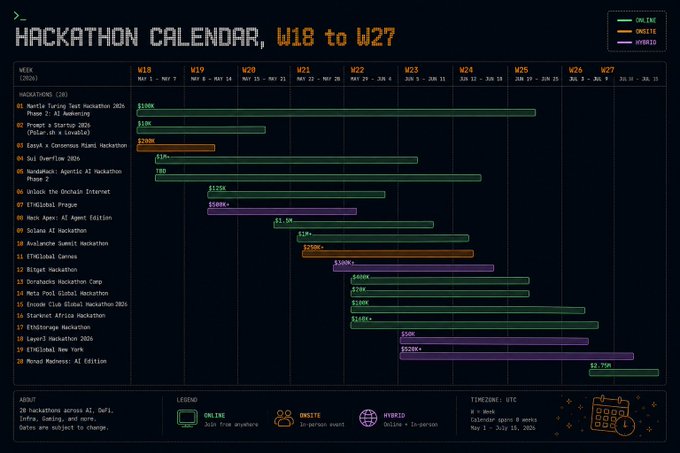
Pick two from the list above. One you can ship in the next 7 days (#1, #2, #3 are all live this week). One with longer runway where you can spend real time on craft (#11 Gemma, #14 Bags, #17 Google Cloud).
Spend tonight on idea selection, because the unique angle filter is more important than the time budget. Spend tomorrow on the build. Spend the last 48 hours on the checklist above.
The W19 list goes out next Monday with new events.
Save this to study it during your preparation sessions.
Good luck, vibe coder. Remember: you can win if you prepare well enough!
## 相关链接
- [Meta Alchemist](https://x.com/meta_alchemist)
- [@meta_alchemist](https://x.com/meta_alchemist)
- [23K](https://x.com/meta_alchemist/status/2049846781576622570/analytics)
- [$2M](https://x.com/search?q=%242M&src=cashtag_click)
- [DoraHacks page](https://dorahacks.io/hackathon/mantleturingtesthackathon2026/detail)
- [Mantle official](https://www.mantle.xyz/)
- [Polar.sh](https://polar.sh/)
- [hackathon.polar.sh](https://hackathon.polar.sh/)
- [$5K](https://x.com/search?q=%245K&src=cashtag_click)
- [easya.io/events/easya-consensus-miami-hackathon](https://www.easya.io/events/easya-consensus-miami-hackathon)
- [$1M](https://x.com/search?q=%241M&src=cashtag_click)
- [overflow.sui.io](https://overflow.sui.io/)
- [media.mit.edu/events/nanda-hackathon](https://www.media.mit.edu/events/nanda-hackathon/)
- [$50K](https://x.com/search?q=%2450K&src=cashtag_click)
- [ethprague.com](https://ethprague.com/)
- [$10K](https://x.com/search?q=%2410K&src=cashtag_click)
- [colosseum.com/frontier](https://colosseum.com/frontier)
- [lablab.ai/ai-hackathons/milan-ai-week-hackathon](https://lablab.ai/ai-hackathons/milan-ai-week-hackathon)
- [Lablab.ai](https://lablab.ai/)
- [hackathon.qie.digital](https://hackathon.qie.digital/)
- [ai.hackberkeley.org](https://ai.hackberkeley.org/)
- [kaggle.com/competitions/gemma-4-good-hackathon](https://www.kaggle.com/competitions/gemma-4-good-hackathon)
- [lablab.ai](https://lablab.ai/)
- [lablab.ai/ai-hackathons/anthropic-ai-hackathon](https://lablab.ai/ai-hackathons/anthropic-ai-hackathon)
- [$4M](https://x.com/search?q=%244M&src=cashtag_click)
- [$3M](https://x.com/search?q=%243M&src=cashtag_click)
- [DoraHacks page](https://dorahacks.io/hackathon/the-bags-hackathon/detail)
- [bags.fm/hackathon (official)](https://bags.fm/hackathon)
- [aihackathon.usaii.org](https://aihackathon.usaii.org/)
- [DoraHacks page](https://dorahacks.io/hackathon/awsprompttheplanet/detail)
- [AWS Events](https://aws.amazon.com/events/)
- [$100K](https://x.com/search?q=%24100K&src=cashtag_click)
- [ethglobal.com/events/newyork2026](https://ethglobal.com/events/newyork2026)
- [DoraHacks page](https://dorahacks.io/hackathon/flagos-open-computing/detail)
- [BAAI official](https://www.baai.ac.cn/en/system)
- [Same.new](https://same.new/)
- [luma.com/hzwlapu0](https://luma.com/hzwlapu0)
- [$5K](https://x.com/search?q=%245K&src=cashtag_click)
- [$100K](https://x.com/search?q=%24100K&src=cashtag_click)
- [$50K](https://x.com/search?q=%2450K&src=cashtag_click)
- [9:42 PM · Apr 30, 2026](https://x.com/meta_alchemist/status/2049846781576622570)
- [23.9K Views](https://x.com/meta_alchemist/status/2049846781576622570/analytics)
- [View quotes](https://x.com/meta_alchemist/status/2049846781576622570/quotes)
---
*导出时间: 2026/5/1 21:19:05*
---
## 中文翻译
# 20 个适合 Vibe 编程者的黑客松及其高额奖金与获胜之道
**作者**: Meta Alchemist
**日期**: 2026-04-30T13:42:11.000Z
**来源**: [https://x.com/meta_alchemist/status/2049846781576622570](https://x.com/meta_alchemist/status/2049846781576622570)
---

目前有超过 200 万美元的现金奖金,以及另外 500 多万美元的融资摆在桌面上,等待着那些能够通过 Vibe 编程构建出可用演示产品的人。
如果你在过去六个月里一直使用 Codex、Claude、Cursor 或任何 AI 技术栈进行编程,那么你已经完成了准备工作中最艰难的部分。
大多数人可能认为赢得黑客松很难,但实际上并没有那么难。
这篇文章是一张地图。
二十场正在进行的黑客松。对于每一场:奖金、截止日期、背后的真正推手,以及一份根据官方赛道和赞助商组合定制的“构建什么”的战术简报。
但这份清单本身只是你来这里的原因的一半。
此外,我们还将涵盖是什么让获胜作品区别于那 90% 拿不到奖的 submissions。创意选择、打磨、演示、品牌、生态系统匹配度。我们将从这里开始。然后再列出清单。
最后,如果你愿意支付现有的订阅费用并获取更多的 AI 推理资源,我们将介绍如何将其转化为真正的收入流。
## 在选择之前:究竟什么能赢得黑客松
在合适的黑客松选错了项目,你会输。选对了项目但交付得很丑陋,你也会输。
选择一个具备“获胜相”的想法,并对照以下标准执行,你就可以与经验比你丰富十倍的团队竞争。
这是一份元标准检查清单。在选择参加哪个活动之前,请先将其内化于心,而不是之后。

1. 想法必须独一无二,而非显而易见
黑客松的作品会严重同质化。在每一个 AI 黑客松中,许多团队都在构建完全相同的东西。评委们会记住那些奇怪的角度。如果你的想法是任何人看到提示词后首先会想到的东西,那就毙掉它,重新开始。
原创性不是打破平局的关键;它实际上是打开许多可能性的大门。如果你想找到原创的想法,或者能变成原创的新颖混合体,花点时间和任何 LLM 聊聊……
2. 打磨胜过广度,每一次都是如此
把一件事做得干净、可用的演示,胜过把五件事做得半吊子的演示。评委没有时间去臆想你的意图。
他们会点击浏览 90 秒钟。
无论他们看到什么都必须看起来是经过深思熟虑的。如果你必须在提交前一晚选择是添加一个功能还是修复一个布局 Bug,请修复那个 Bug。
3. 落地页的前 30 秒就是交付成果
大多数 submissions 是根据实时 URL 评分的,而不是由评委克隆并运行的。他们打开页面,浏览首屏 30 秒,形成的观点几乎不会改变。
英雄区块、标题、第一个交互元素,这才是被评判的内容。
在黑客松的最后几个小时,把精力花在让这个表面看起来像是一个已上线的产品,而不是在某个隐藏开关后面再发布一个功能。
4. 品牌向评委暗示着“未来的公司”,而评委们正在进行风险押注
Logo、落地页、截图构图,甚至是一个看起来经过精心设计的占位 X 账号。
主办方和赞助商不仅仅是在为最好的周末项目付费,他们是在为那些以后会说“我们公司是在我们的黑客松上起步的”的团队付费,并为他们带来某种形式的胜利,无论是品牌知名度、生态建设,或者仅仅是因为他们当初看对了你。
一个精致的品牌在低声诉说:“无论我们是否获胜,我们都会继续构建这个”。
一个光秃秃的默认模板仓库在低声诉说:“这是为了奖金,但我们没有品味”。
你知道谁会赢。
5. 解决他们生态系统内部的问题
黑客松的存在是因为主办方希望其技术栈得到增长。Solana 需要真正的 Solana 应用。
Anthropic 需要 Claude 原生的产品。Mantle 需要能将交易量拉到 Mantle 的链上代理。区块链需要建立在它们之上的项目,以推动其链的采用。
你的项目越贴近主办方的实际路线图,你的获胜几率就越高。
如果你带着一个在 Ethereum 上同样运行良好的项目参加 Solana Frontier,那不是优势。要构建一些能被该生态系统赋能的东西,特别是文化类产品。
6. 阅读评分标准,然后无情地与之匹配
大多数黑客松都会公布他们的评判标准。大多数 submissions 都会忽略它们。
如果评分标准的权重是“原创性 25%,技术深度 25%,影响力 25%,演示 25%”,你应该能够准确指出你的作品中在哪里满足每一条标准。
在脑海中构建时想着标准。打磨时想着标准。宣讲时想着标准。
在他们评判你之前,从各个角度评判你的项目,如果你给自己诚实的打了 10/10 分,你很可能会获奖。如果有疑问,也问问 LLM,但在提示词中要让它们诚实,它们可能会让你自我感觉良好,所以首先且最重要的是做你自己诚实的评委。
P.S. 让更多样化的 LLM 来评判你构建的东西越好。你甚至可以分享截图来展示外观和感觉。
关键提示词是:“给我一个诚实的裁决”。
7. README 和实时 URL 承载着奖金
无论评委在前两分钟看到什么,就是他们评分的依据。在这两个工件上花费不成比例的时间。
你的 README 应该用一句话陈述问题,在第二行展示实时演示 URL,在第三行放上 GIF 或截图,然后才解释设置步骤。
实时 URL 打开时应该是一个点明问题并立即显示可用产品的英雄区块。两者都应该看起来像是一个已上线的产品,而不是一个学校项目。
## 真正能赢的团队的模式

在过去 18 个月里,跨越 Anthropic、ETHGlobal、Solana 和 YC 相关的黑客松,获胜圈中反复出现相同的模式:
- 独狼或双人,而不是大团队。协调税会扼杀周末项目。2025 年 Anthropic 黑客松的获胜者是一名没有工程背景的律师。Solana Cypherpunk 的大奖得主是一个两人团队。三个人还好,四个人很难,五个人是死亡行军。
- 一个演示,而不是五个功能。获奖的作品几乎总是演示一个完美运行的端到端工作流。失败的作品演示五个半吊子的功能,并要求评委“想象一下”。
- 落地页的英雄区块就是可用产品。不是营销宣传。不是路线图。是一个在到达后 5 秒内就能执行任务的交互界面。
- 他们大声说出不公平的优势。“我们可以做到这一点,因为[特定的平台功能]。”评委们会记住那些能阐明为什么他们的技术栈选择是正确的团队。
- 看起来像已发货,而不是已提交。带有自定义域名的实时 URL。README 中的截图。宣布演示的 X 帖子。有人使用它的 Discord 截图。全部在评审结束前完成。
本周启动,5月1日至7日
## 1. Mantle Turing Test Hackathon 2026, Phase 2: AI Awakening
开始 / 结束:5月1日至6月15日
奖金:100,000 美元(总计 120,000 美元的第二阶段)
形式:线上
联合主办方:Mantle, Bybit, Byreal, Blockchain for Good Alliance (BGA), DoraHacks, HackQuest, Tencent Cloud
链接:DoraHacks 页面, Mantle 官网
他们在寻找什么
Mantle 是一条以太坊 Layer-2 链,过去一年一直将自己重新定位为“AI 代理链”。这次黑客松是这一转型的旗舰活动。人类 vs AI 的框架不是演戏。这是 Mantle 想要证明链上代理可以在真正的金融决策中与人类专家竞争的方式。Bybit 的参与表明了对交易类用例的浓厚兴趣。
共鸣类别
- 作为链上合法金融行动者运作的代理,具有随时间可验证的业绩。
- 任何能将人机对决框架变成真实演示的东西,而不是一句口号。
- 能将交易量拉入 Mantle DeFi 原语(永续合约、收益、借贷)的想法。
- 散户用户与代理策略之间的纯英语界面。信任层与策略本身同样重要。
- 代理身份、声誉和问责制。你把钱交给谁,为什么?
空白领域:大多数 submissions 将是普通的交易机器人。脱颖而出的团队会将代理视为一个具有业绩记录和个性的角色,而不是一个脚本。
## 2. Prompt a Startup 2026 (Polar.sh x Lovable)
形式:线上,可选择在斯德哥尔摩参加线下启动仪式
奖金:10,000 美元给一个月后月经常性收入 (MRR) 最高的团队
技术栈:使用 Lovable 构建(AI 应用生成器),使用 Polar 变现(支付)
链接:hackathon.polar.sh
他们在寻找什么
Polar 希望有更多开发者通过 Polar 实现软件变现。Lovable 希望有更多应用真正通过 Lovable 交付。这种独特的评判机制——即 30 天后月经常性收入最高的团队获胜——透露了一个信息:这是一场关于分发,而不是工程的黑客松。Polar 的整个卖点是你可以不拿 VC 的钱经营真正的软件业务。他们正在试图为这一说法寻找证据。
共鸣类别
- 针对狭窄受众的止痛药。你能越快找到前 50 个付费用户越好。
- 商品化的服务,取代人们已经付钱让人做的工作。
- 将重复性苦差事转化为重复性习惯的工具。订阅的生死取决于每月感知到的价值。
- 枯燥的后台办公工作,别人没兴趣去构建。光鲜的消费类应用赛道已经人满为患。
- 任何能帮助创作者或独立经营者查看并增长自己收入的东西。
空白领域:市场就是评委。大多数团队会花前 25 天构建。获胜的团队会花 5 天构建,25 天分发,而且构建会有意做得很小。
## 3. EasyA x Consensus Miami Hackathon
日期:5月5日至7日
奖金:总计 200,000 美元(15,000 美元 USDC 大奖,5,000 美元亚军,加上各赞助商的奖金池)
形式:线下,迈阿密,72 小时
赞助商:CoinDesk, Ripple, Polygon, Tezos, Immutable, Scroll
链接:easya.io/events/easya-consensus-miami-hackathon
他们在寻找什么
EasyA 的使命是让新开发者进入加密货币领域,而 Consensus 是今年最大的加密货币会议。每个链赞助商(Ripple, Polygon, Tezos, Immutable, Scroll)都带来了自己的奖金池,并评判其赛道的 submissions。战略举措是选择一条链,研究其开发者关系团队在过去六个月里一直在谈论什么,并直接构建到该对话中。
共鸣类别
- 跨境支付和稳定币汇款,这是 Ripple 存在的全部理由。
- Polygon 上的消费级 UX。账户抽象、无 Gas 流程,任何能向用户隐藏链的操作。
- Tezos 上的现实世界资产工具,基金会一直在推动机构采用。
- Immutable 上的真正的游戏,特别是任何能解决困扰 Web3 游戏发布的机器人抢购瘟疫的方案。
- Scroll 上的保护隐私的消费应用,零知识技术是护城河。
空白领域:每个赛道都有自己的评委和奖金池。选择一条链并过度贴合其开发者关系的优先事项,胜过试图构建某种跨链的东西。
## 4. Sui Overflow 2026
启动:5月7日(完整赛道列表在 Sui Live Miami 揭晓)
奖金:待定;2025 年版在赞助商增加后达到了 100 万美元以上
形式:线上,全球
赞助商:Walrus, Pyth, Alibaba Cloud, OpenZeppelin, OtterSec, Scallop, Navi, Wormhole
链接:overflow.sui.io
他们在寻找什么
Sui 的整个技术卖点是它的以对象为中心的模型:不是将所有东西视为账本条目,而是 Sui 上的每个数字事物都是一个你可以传递的对象。这与以太坊有着显著的不同,Sui 团队迫切希望能真正使用这一点的应用。他们还一直在推动 Walrus(去中心化存储)和 zkLogin(直接登录 Sui 钱包的 Google 登录)作为对采用友好的原语。
共鸣类别
- 数字事物的所有权真正可移植的应用。游戏库存、有出处证明的照片、跨服务有效的会员通行证。
- 不像加密货币的消费级加密应用。Sui 一直在大力投资 zkLogin,正是为了让用户不需要助记词。
- 使用 Walrus 的重存储应用。赞助商赛道磁铁。
- 现实世界资产代币化,特别是任何能从 Sui 的并行执行速度中受益的东西。
- 通过 Wormhole 实现的跨链代理或应用模式。
空白领域:大多数 submissions 将是不参与对象模型的 DeFi 复制品。任何能证明以对象为中心的架构很重要的东西——通过在 EVM 上字面上是不可能实现的——都会脱颖而出。
## 5. NandaHack: Agentic AI Hackathon, Phase 2
第二阶段:5月7日至6月13日
奖金:未披露(学术声望加上 MIT 媒体实验室演示日)
形式:混合,以 MIT 媒体实验室为基地
赛道(六个竞技场):部署、协调、交易、适应、防御、集成
组织者:HCLTech 和 MIT 媒体实验室
链接:media.mit.edu/events/nanda-hackathon
他们在寻找什么
这是一个学术性的黑客松,具有学术优先级。评委是 MIT 教员和 HCLTech 工程领导层,而不是 VC。他们不是在寻找最打磨的演示。他们是在寻找那些能指出代理基础设施中先前未被命名的问题,并交付可防御的解决方案尝试的想法。这六个“竞技场”是团队整天都在思考的真实生产环境中的代理故障。
共鸣类别
- 尚未形式化的代理之间的协调协议。
- 用于生产环境代理的防御和红队基础设施。
- 自适应机制,根据观察到的故障模式而不是哲学上的“自我改进”来改变代理行为。
- 迁移和连续性工具。在提供商之间移动代理状态的可移植性问题是真实且未解决的。
- 用于生产环境代理调试的可观察性、遥测和重放工具。
空白领域:看起来像本科生项目的 submissions 会输。看起来具有工作原型的研究级工作的 submissions 会赢。门槛是“有理由可能成为一篇论文”。
构建阶段,5月8日至18日
## 6. ETHPrague 2026
日期:5月8日至10日
奖金:未披露(历史上赞助商奖金池 50K+)
形式:线下,布拉格市政厅
主题:构建以太坊的太阳朋克未来
赞助商:Gnosis Chain, ENS, Fhenix, Trezor, Zircuit, Ackee, Wake, Umia
链接:ethprague.com
他们在寻找什么
ETHPrague 倾向于价值观驱动。“太阳朋克”主题意味着加密货币被用于再生性、社区扎根、与可持续性一致的目的,而不是掠夺性投机。评委包括以太坊的核心贡献者,他们非常关心密码朋克与生态相结合的框架。表面的 ESG 定位会被看穿。对该主题的真诚参与会得到奖励。
共鸣类别
- 互助、社区资源共享和地方 commons 协议。
- 再生性经济原语。将资金导向维护和管理而不是不惜一切代价增长的债券和激励。
- 使用 zk 技术的保护隐私的气候或生态行动验证。
- 网络经济和基于地点的身份,链在那里锚定某种物理的东西。
- 用于高风险链上决策的硬件根安全。
空白领域:大多数 submissions 会心不在焉地将太阳朋克框架生硬地套在一个通用的 dapp 上。获胜的团队会认真对待这个主题,以至于选择他们原本不会构建的东西。
## 7. Solana Frontier Hackathon
截止:5月11日
奖金:总计 275 万美元(3 万美元总冠军,20 家初创公司各获 1 万美元,10 名以上获胜者从 Colosseum 加速器获得各 25 万美元的 pre-seed 融资)
形式:线上
赞助商:Colosseum, Solana Foundation, Phantom, Arcium, Raydium, Coinbase, World, MoonPay
链接:colosseum.com/f