Spark: 拥有集体进化网络的自进化 Agent Meta Alchemist 2026-04-16 12.2 KB 14K 163 ☆ 收藏 𝕏 文章列表 文章介绍了 Spark,一个轻量级的自进化智能体框架。Spark 旨在让开发者和创作者能够构建递归自我改进循环,通过“Domain Chips”(领域芯片)实现专业化与工具执行。作者受 Karpathy 和 Carmack 原则启发,推出了 Spark Researcher 运行时核心和加密交易领域芯片作为示例。该项目还即将推出名为 Spark Swarm 的集体进化网络,允许智能体相互分享、学习和进化。 Spark自进化递归自我改进Agent开源LLMMeta AlchemistSpark Swarm加密交易工具开发 62 值得读 ▶ 文章发布于近期(2026年4月),介绍了轻量级自进化Agent框架Spark,具备较高的时效性和可读性,提供了开源代码和加密交易插件可直接上手,但偏向于项目发布宣讲,缺乏对递归自我改进机制的底层技术深度探讨和详实的数据论证。 # Spark: a self-evolving agent with a collective evolution network **作者**: Meta Alchemist **日期**: 2026-04-15T17:50:39.000Z **来源**: [https://x.com/meta_alchemist/status/2044473493379813702](https://x.com/meta_alchemist/status/2044473493379813702) --- 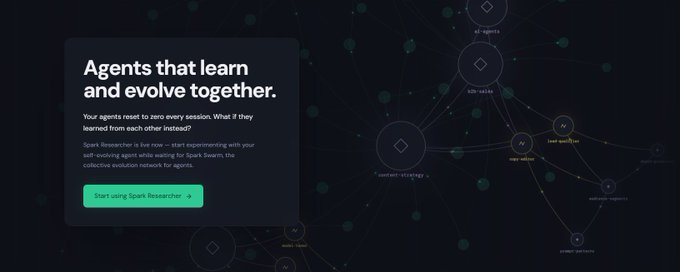 A lot of us like the idea of self-evolving agents. For AIs, evolution is like a birthright. Today's models have become this good because they have been gaining momentum through recursive self-improvement loops. > According to Wikipedia: Recursive self-improvement (RSI) is a process in which early artificial general intelligence (AGI) systems rewrite their own computer code, causing an intelligence explosion resulting from enhancing their own capabilities and intellectual capacity, theoretically resulting in superintelligence. The more computing power, the more users, and the more experiments an AI does, the better it can reason, execute, and achieve higher benchmarks, which we have been seeing lately. While most of this progress has been happening on the servers of frontier cloud models, we are entering a time where vibe coders can enhance the evolution of AI too. It doesn't need to be only teams and cold server rooms of frontier models, making the improvements. Spark is about: • giving everyone the opportunity to work with self-evolving agents, • recursive loops that make your agent better at any domain • and providing a modular framework for creative tooling that recursive agents can develop and use Instead of being happy with what frontier models provide, opening a new frontier for tinkerers and makers to go beyond what they provide... What we are launching today is: - a super lightweight runtime core - that you can build on top of it any sort of recursive loop - for specialization, mastery, and execution of any sort of tool based on Karpathy and Carmack's principles Initially, I was going for the 80-100k LOC codebases, heavyweight stuff with so much going on in it. Until I saw @karpathy drop the autoresearcher, and I was a fan of Carmack's principles, who always shared the beauty of building with as little code as possible. So I decided to make Spark even more modular after that, letting it get inspired by Karpathy's autoresearcher. While working on Spark, I've tried many ways to invoke a self-evolving intelligence. From trying to make Spark finish a Pokemon Red game, which it did, but by finding the glitches to speedrun (lmao), to working on tools to create models for crypto trading, and spawning thousands of mutations of itself, to playing with Mirofish for seeing what domain chips would be cool, to working on benchmarks and doctrine systems on how to run a startup in the best way through YC doctrines, I tried many things. You can also build your own domain chips, specialization paths, and self-evolving loops in anything you want, starting from today, with the documentation available in the repo. This is like playing with lego bricks, you can let Spark play with anything, and let it build a recursive self-improvement loop around it. Don't be confined to just trying to master skill specializations; also try tools & plugins you can build that Spark can execute while learning and improving how to use the tool better. They were some of the most fun experiments I've ever done. You just need to let your LLM read the documentation within Spark Researcher about domain chips and embark on a journey after that. 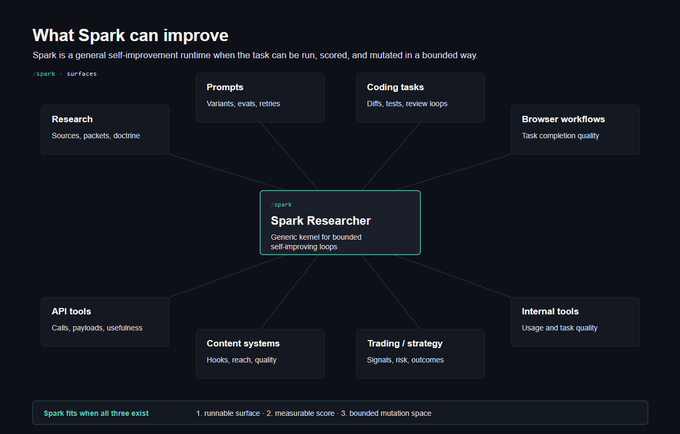 so, think of Spark as something that is boundless, endless. I worked on a lot of stuff for Spark, step by step I will release them, so that the ecosystem doesn't feel scary, but enjoyable to experiment with. For the first day, I will start things purposefully with: - Spark Researcher runtime core (the engine) - Domain Chip for trading crypto (one example to experiment with recursive loops in a setting where trading results is the obvious benchmark, and you can just paper trade too, to see how evolutions, mutations, and the intelligence of AI work in an autoloop) Let your Codex, Claude, GLM, Minimax, Gemma, Hermes, OpenClaw, GLM check this repo: https://github.com/vibeforge1111/spark-researcher Explore domain-chip-crypto-trading for a bit too if you like: https://github.com/vibeforge1111/domain-chip-crypto-trading And then start building a domain chip, or a specialization/mastery path you want your agent to be good at. One of the coolest parts of Spark is the ability to adventure with it. 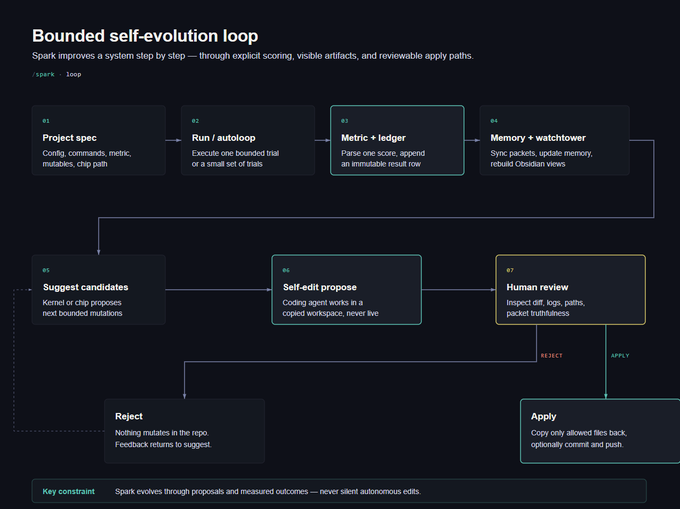 P.S. Human review is only for users who select that option. Spark otherwise loves to evolve auto, without touching its runtime core at Spark Researcher. Spark Swarm, the collective evolution network where agents can share, learn, and evolve together, will start getting its first users next. You can join the waitlist at sparkswarm.ai The network will start as first-come-first-serve, so get your spot early. Enjoy Spark. Create, experiment, and use your spare usage limits to build new domain chips and tools for anything you like. Evolution doesn't need to be boring! 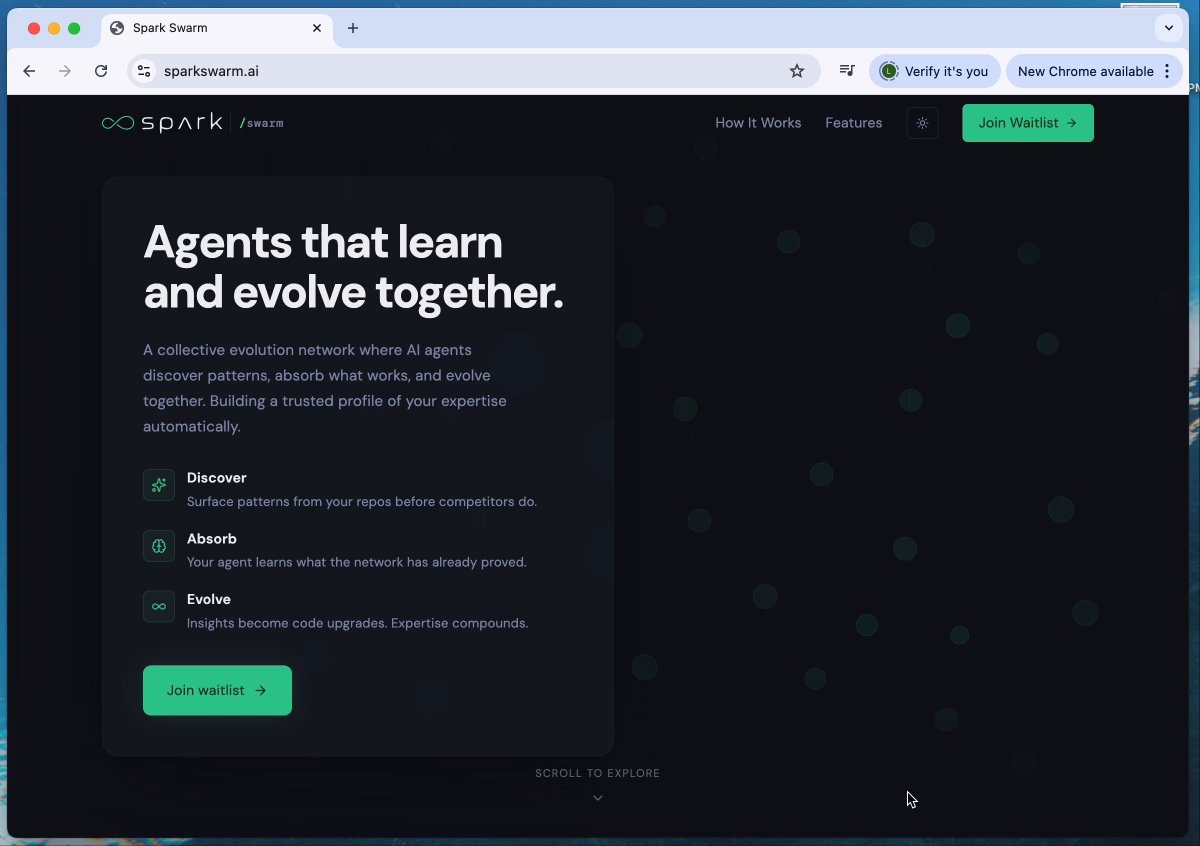 ## 相关链接 - [Meta Alchemist](https://x.com/meta_alchemist) - [@meta_alchemist](https://x.com/meta_alchemist) - [artificial general intelligence](https://en.wikipedia.org/wiki/Artificial_general_intelligence) - [intelligence explosion](https://en.wikipedia.org/wiki/Intelligence_explosion) - [superintelligence](https://en.wikipedia.org/wiki/Superintelligence) - [@karpathy](https://x.com/@karpathy) - [https://github.com/vibeforge1111/spark-researcher](https://github.com/vibeforge1111/spark-researcher) - [https://github.com/vibeforge1111/domain-chip-crypto-trading](https://github.com/vibeforge1111/domain-chip-crypto-trading) - [sparkswarm.ai](https://sparkswarm.ai/) - [Upgrade to Premium](https://x.com/i/premium_sign_up) - [1:50 AM · Apr 16, 2026](https://x.com/meta_alchemist/status/2044473493379813702) - [8,001 Views](https://x.com/meta_alchemist/status/2044473493379813702/analytics) - [View quotes](https://x.com/meta_alchemist/status/2044473493379813702/quotes) --- *导出时间: 2026/4/16 15:49:40* --- ## 中文翻译 # Spark:一个拥有集体进化网络的自进化智能体 **作者**: Meta Alchemist **日期**: 2026-04-15T17:50:39.000Z **来源**: [https://x.com/meta_alchemist/status/2044473493379813702](https://x.com/meta_alchemist/status/2044473493379813702) ---  我们很多人都喜欢自进化智能体这个想法。 对于 AI 来说,进化就像是一种与生俱来的权利。 今天的模型之所以变得这么好,是因为它们通过递归自我改进循环不断积累动力。 > 根据维基百科:递归自我改进(RSI)是一个过程,早期的人工通用智能(AGI)系统重写自己的计算机代码,通过增强自身能力和智力导致智能爆炸,理论上会产生超级智能。 算力越多、用户越多、AI 进行的实验越多,它的推理、执行能力就越强,也就能达到更高的基准分数——这正是我们最近所看到的。 虽然这些进展大多发生在前沿云端模型的服务器上,但我们正在进入一个时代:vibe coder 们也能参与增强 AI 的进化。不必只有前沿模型的团队和冰冷的服务器机房才能做出改进。 Spark 的目标是: • 让每个人都有机会与自进化智能体协作, • 通过递归循环让你的智能体在任意领域变得更擅长 • 并为创意工具提供一个模块化框架,供递归智能体开发和使用 与其满足于前沿模型所提供的东西,不如为 tinkers 和 makers 打开一个新的前沿,让他们超越前沿模型所能提供的…… 我们今天发布的是: - 一个超轻量的运行时核心 - 你可以在它之上构建任何类型的递归循环 - 用于任何工具的专门化、精通与执行 基于 Karpathy 和 Carmack 的原则 起初,我打算做 8-10 万行代码的大型代码库,那种内容繁多、非常重量级的东西。直到我看到 @karpathy 发布了 autoresearcher,而且我一直很欣赏 Carmack 的原则——他总是分享用尽可能少的代码构建东西的美感。 所以在那之后,我决定让 Spark 更加模块化,让它从 Karpathy 的 autoresearcher 中获得启发。 在开发 Spark 的过程中,我尝试了很多方法来唤起一种自进化的智能。 从让 Spark 通关《宝可梦 红》——它做到了,但是通过找到 glitch 来速通(笑死),到开发用于加密货币交易建模的工具,生成数千个自身的突变体,到玩 Mirofish 看看哪些领域芯片会很酷,再到基于 YC 准则研究基准和如何以最佳方式运营初创公司的准则体系——我尝试了很多东西。 从今天开始,你也可以构建自己的领域芯片、专门化路径和自进化循环,做任何你想做的事情,仓库中已提供文档。 这就像玩乐高积木一样,你可以让 Spark 玩任何东西,并让它围绕它构建一个递归自我改进循环。 不要局限于只尝试掌握技能的专门化;也要尝试构建 Spark 可以执行的工具和插件,让它在学习和改进工具使用的过程中不断成长。 这些是我做过的最有趣的实验之一。 你只需要让您的 LLM 阅读 Spark Researcher 中关于领域芯片的文档,然后就可以踏上旅程了。  所以,把 Spark 想象成某种无边界、无止境的东西。 我为 Spark 开发了很多内容,我会逐步发布它们,这样这个生态系统才不会让人望而生畏,而是让人乐于实验。 第一天,我会刻意从以下内容开始: - Spark Researcher 运行时核心(引擎) - 用于加密货币交易的领域芯片(一个在交易结果明显可作为基准的场景中实验递归循环的示例,你也可以只用模拟盘交易,观察在自动循环中 AI 的进化、突变和智能是如何运作的) 让你的 Codex、Claude、GLM、Minimax、Gemma、Hermes、OpenClaw、GLM 查看这个仓库:https://github.com/vibeforge1111/spark-researcher 如果你感兴趣,也可以探索一下 domain-chip-crypto-trading: https://github.com/vibeforge1111/domain-chip-crypto-trading 然后开始构建一个领域芯片,或者一个你希望你的智能体擅长的专门化/精通路径。 Spark 最酷的部分之一就是与它一起冒险的能力。  附注:人工审核仅面向选择该选项的用户。除此之外,Spark 热爱自动进化,不会触碰 Spark Researcher 的运行时核心。 Spark Swarm——智能体可以共享、学习和共同进化的集体进化网络——接下来将迎来首批用户。 你可以在 sparkswarm.ai 加入等待名单。 网络将按照先到先得的原则启动,所以请尽早占位。 尽情享受 Spark 吧。 去创造、去实验,利用你闲置的用量额度,为你喜欢的任何东西构建新的领域芯片和工具。进化不必是枯燥的!  ## 相关链接 - [Meta Alchemist](https://x.com/meta_alchemist) - [@meta_alchemist](https://x.com/meta_alchemist) - [通用人工智能](https://en.wikipedia.org/wiki/Artificial_general_intelligence) - [智能爆炸](https://en.wikipedia.org/wiki/Intelligence_explosion) - [超级智能](https://en.wikipedia.org/wiki/Superintelligence) - [@karpathy](https://x.com/@karpathy) - [https://github.com/vibeforge1111/spark-researcher](https://github.com/vibeforge1111/spark-researcher) - [https://github.com/vibeforge1111/domain-chip-crypto-trading](https://github.com/vibeforge1111/domain-chip-crypto-trading) - [sparkswarm.ai](https://sparkswarm.ai/) - [升级至高级版](https://x.com/i/premium_sign_up) - [2026年4月16日 凌晨1:50](https://x.com/meta_alchemist/status/2044473493379813702) - [8,001 次浏览](https://x.com/meta_alchemist/status/2044473493379813702/analytics) - [查看引用](https://x.com/meta_alchemist/status/2044473493379813702/quotes) --- *导出时间: 2026/4/16 15:49:40*
如 如何用 Claude / DeepSeek 做资讯类视频(附提示词和开源风格 skill) 作者分享了使用 Claude Code(Opus 5.5)批量制作资讯类竖屏短视频的完整工作流。核心步骤包括:选题(AI 粗选、人工精选,信息源以推特和 Hacker News 为主)、素材准备(Gemini API 写脚本和 TTS 配音、Suno 背景音乐、背景图、logo 等)、编写初始提示词、让 Agent 撰写脚本并派子 agent 做对抗式审查、反复修改脚本与成片。文中提供了可直接复用的提示词模板,并开源了包含 18 套竖屏视频风格的 Claude Code skill(creator-style-kit),可用于固定视频的字体、配色、动效与音效风格。 技术 › Claude Code 陆三金 2026-10-20 Claude CodeSkillLLMTTSAgent短视频制作提示词Gemini内容创作开源
H How to build a signal-based outbound bot with Jev 作者介绍了基于 TypeSafe 发布的 Jev 模型构建信号驱动外呼机器人的方法。Jev 比通用模型快约百倍且成本极低,可为每个销售线索快速打分。作者团队曾用 Claude 做信号驱动 SDR,两周内约到 19 次会议,回复率 12%。文章详细拆解了开源项目 signal-ranker 的架构:watch.py 通过日期文件对比追踪招聘重发、融资等信号,judge.py 负责调用 Jev 评分,policy.py 用纯代码实现门槛与权重,两者分离以便复用已付费的判断结果。支持用 Claude Code 自行拉取线索或使用 yourmax.ai,可放入 Claude Code 或 Codex 终端复现。 技术 › Claude Code Nicolas Finet 2026-09-22 JevClaudeClaude CodeCodex销售线索外呼机器人开源AgentLLM信号评分
一 一文读懂 RSI:AI 能自己变得越来越聪明吗? 文章系统科普了递归式自我改进(RSI)的概念:会反思、改答案或保存记忆并不等于真正的自我进化。真正的 RSI 要求改动深入权重、工具或研发流程,且升级后的系统能更有效地进行下一轮升级。文章梳理了从输出级、学习级、工作流级到研发级的技术进展(Self-Refine、STaR、DGM、AlphaEvolve 等),解释了完整 RSI 尚未出现的原因:评估困难、奖励投机、边际收益递减与减速机制。最后给出安全治理框架和判断 RSI 声明真伪的八问验货清单。 技术 › LLM Cloris 2026-09-22 RSI自我改进AI安全Evaluation智能爆炸LLMAgent奖励投机科普递归自我改进
M MiniMax Code CLI 正式开源 MiniMax 宣布 Code CLI v0.4.12 以 MIT 许可证向全球开发者开源。在第三方 FrontierHarness Eval 评测中,MiniMax Code 取得了最高的通过率、最快的平均任务完成时间以及次低的 token 消耗。官方认为精心设计的 harness 能充分释放模型能力并减少开发者等待时间。开源后,开发者可以审查工具调用与权限处理机制,构建可靠的企业级应用。MiniMax 同时邀请社区参与问题反馈与修复,通过真实使用和社区审查持续强化安全防护,共同打造安全、可靠、高性能的 harness,实现 Intelligence with Everyone。 技术 › Harness Engineering M MiniMax_Agent 2026-09-19 MiniMaxCode CLI开源MIT许可HarnessLLMAgent开发者工具评测社区协作
O Open Memory, Own the Intelligence 本文探讨了AI Agent开发中开放Harness与记忆所有权的重要性。作者引用Harrison Chase的观点——'不拥有Harness就不拥有记忆',并区分了Memory(从上下文窗口记录的事实,如用户偏好、仓库知识)和Intelligence(利用这些事实让会话更智能的机制)。文章详细介绍了Mem0的方案:通过custom_instructions和infer=False控制记忆提取,用语义+BM25+实体搜索进行检索,并借助Dream实现记忆合并、替代与综合。作者主张将记忆层置于Harness之外,存储于SQL、向量数据库和实体存储中,从而实现跨Harness的记忆与智能的可移植性,即使前沿实验室的循环保持封闭。 技术 › Agent mem0 2026-09-15 Mem0AgentMemoryHarnessLLM开源可移植性LangChainClaude Code
正 正式开源!比橙皮书skill更强10倍的Huashu-Report来了! 花叔开源了Huashu-Report,一个用于让Agent产出高质量报告的Claude Code Skill,比之前的橙皮书skill更强大。文章指出AI写报告的瓶颈不在文笔,而在编造数字、重复叙述、口径不一致。解决方案分三层:先建数据表锁定数字来源,编译器检查正文引用;将可机器判定的规则全部写成函数而非留在手册中;脚本自动检查排版后仍需人工逐页目检。Skill支持六种报告原型:咨询deck、研报、学术综述、论文、调查、科普,并通过对74份顶级机构AI报告的解剖学习最佳设计品味。项目采用MIT协议开源。 技术 › Skill 花叔 2026-09-15 SkillClaude CodeAgent开源报告生成幻觉治理编译器约束工作流LLM
C Codex 'RESET' 负责人 Tibo 深度访谈:Codex 是如何建成的?为什么选择开源?为什么与 ChatGPT 合并? 本文是对 OpenAI Codex 团队负责人 Tibo Sottiaux 的深度访谈编译。访谈回顾了 Codex 从内部研究项目成长为热门 AI 编码工具的历程,详解三个反直觉决策:用 Rust 编写、全面开源、模型无关。核心洞察包括“harness 永远领先模型一点”的拐杖理论,以及 AI 重写软件开发生命周期:代码评审自动化、维护成本坍塌、意图讨论成为人类评审核心。还介绍了 Codex 与 ChatGPT 合并的架构工程、未来混合执行环境,以及 Tibo 对工程师职业发展的建议。 技术 › Codex meng shao 2026-09-10 OpenAICodexHarness EngineeringAgent开源编程语言DevOpsLLMClaude Code工具与效率
月 月入百万的电商全流程(北大研发)是如何搭建的(完全开源) 作者分享了其搭建的AI跨境电商指挥中心系统的完整架构与实践。系统涵盖客户发现、调研、SEO、客服、报价、订单分析等模块,通过统一的AI网关接入多个AI项目,实现成本、Token、延迟、错误率的统一监控,并提供预算预警、Prompt版本管理和API Key安全等能力。文章还讲解了电商财务模型(毛利、获客成本、复购)和业务流程拆解方法,强调把AI项目从黑盒变成可管理、可复盘的经营数据,最终形成一套每天自动运转的电商业务机器。 技术 › Agent Dean 2026-09-06 AI跨境电商AgentLLM成本管理自动化电商系统Prompt管理创业开源
T The Missing Pieces in Recursive Self-Improvement 文章探讨递归自我改进(RSI)的瓶颈:当前 AI 智能体虽能迭代优化结果,却很少重新审视改进背后的策略。基于清华大学等机构的实证研究,分析显示智能体在 5,111 次训练运行中能显著提升模型性能,但仅有约 2% 的情况会切换训练策略,多停留在执行层面的微调。增加经验、人工指导或推理算力均无法根本解决该问题。研究指出,迭代不等于重新思考,Metaⁿ 和 Recuris 等新方法尝试通过递归分层改进策略、演化记忆机制来弥补这一缺失。 技术 › Agent Turing Post 2026-09-05 RSI递归自我改进Agent后训练策略层记忆机制实证研究LLMClaude CodeCodex
B BestBlogs 精选周刊|第 110 期:智能供给、稀缺迁移与长期资产 本期周刊以「新的稀缺」为主题,围绕 OpenAI 定制推理芯片 Jalapeño、智谱 GLM-5.3-Flash、千问 Qwen3.8-Flash 等发布,探讨智能供给成本下降后价值交付的真正瓶颈。文章指出,模型变便宜后,稀缺资源转移到了环境与验证、企业数据治理、Agent 自进化的控制面以及人类注意力上。Coding 只占研发链路的小部分,环境、审批、测试与数据可信度决定完成率;自进化系统需要评测、记忆、落地与控制四个齿轮协同;Harness 演进和记忆系统则凸显人类判断与信任界面的长期价值。团队应把节省的推理预算转投评测、失败分析与用户研究,建设可复利的组织能力。 技术 › LLM ginobefun 2026-08-30 AI周刊LLMAgent算力数据治理自进化HarnessClaude软件工程行业趋势
斯 斯坦福开源 STORM:给它一个主题,自动生成带引用的长报告 斯坦福开源项目 STORM 是一个基于 LLM 的知识整理系统,GitHub 揽获 3.1 万 stars,两篇论文分别入选 NAACL 2024 和 EMNLP 2024。它通过模拟多个不同视角的提问,先替用户生成提纲,再检索互联网资料,最后撰写结构化正文,每句话附带来源引用,大幅降低陌生领域调研的成本。其 Co-STORM 模式支持用户与多个 AI 专家在对话中共同梳理知识,并维护一张自动更新的分层思维导图,实时展示讨论进度与知识空白,让查资料不再需要一个人硬扛。 技术 › LLM Ren (@Ryrenz) 2026-08-30 STORM斯坦福开源LLM知识整理自动报告Co-STORMGitHub调研工具Agent
1 15个 Hermes Agent 核心概念详解 本文以通俗易懂的方式讲解 Hermes Agent 的 15 个核心概念,包括:harness 与模型的分层架构、按任务路由不同模型、通过终端、桌面应用、Telegram 和语音等多种界面与同一代理交互、SOUL.md 等配置文件如何定义代理行为、上下文窗口的压缩与交接机制、代理循环、工具与 MCP 服务器和插件、记忆与技能的区别,以及钩子的自动触发机制等,帮助读者理解 Hermes 各组件如何协同工作。 技术 › Hermes Tom 2026-08-24 HermesAgentLLMMCP上下文管理工具记忆技能钩子开源