# How Claude can easily sound exactly like you
**作者**: Ruben Hassid
**日期**: 2026-05-03T04:00:09.000Z
**来源**: [https://x.com/rubenhassid/status/2050787472666399042](https://x.com/rubenhassid/status/2050787472666399042)
---

# You’re just a text file.
I give a few lines of instructions to Claude, and I am like you.
You think you’re too complex to fit in a text file.
But you’re not.
I just need to capture your voice. Your taste. The cringe posts that make your computer. The phrase your oldest friend imitates when doing an impression of you. The 2 words you type and always delete. The analogy you’ve written 3 times this year without noticing. Patterns. Every one of them is a pattern.
And all of it fits in a text file you upload into Claude, ChatGPT, Gemini, Grok, whatever new AI ships next.
Give me 2 hours. One file. And any AI becomes you.
But you’re not alone. I also fit in one file.
# 1 - I also fit in one file.
I’ve been obsessed with writing since I was this little:

I can smell this picture. Swimming pool & South of France.
Writing is my job. My passion. How people recognize my worth.
Writing is I want to do once I “stop working”. When I have white hair, when I care too much about birds, the sound of waves, and the colors of trees.
Writing is all I have.
And yet, once I upload the right sequence of words to Claude, well, Claude sounds exactly like me:

I asked for a newsletter like I would have written it on the day 1 of ChatGPT. And that actually sounds like me…
It kinda bothers me.
I am so many things. How could Claude sound exactly like me?
Like I’m French. From Paris. I’ve lived in Seoul, Berlin, and now Tel Aviv. I learned English at 9 from a video game forum. I was the most prolific writer there. I dropped out of university (twice). I consult Fortune 500 companies on AI. 500,000+ people read my newsletter a week (twice).
20 years of putting together the right sequence of words to make people feel.
All of that fits in one file:
1. I gave one prompt, one time to Claude.
2. Then Claude asked me questions about myself.
3. Then Claude made a concentrated version, a text file.
4. Now Claude writes first drafts I could have written.
5. Sometimes it writes stuff before I’d thought of it.
Here’s exactly how you can do it, too:
# 2 - How to extract yourself in 2 hours.
Setup:
- Use Claude + Cowork + Opus 4.7 + Extended thinking.
- Dictate your answers with Wispr Flow.
It’s free. It turns your voice into text.
Voice is faster and more honest.
I’m showing how it works on this quick video (but you can skip it):

## Prompt 1 - The interview.
Open a fresh Claude chat. Paste this:
> You are a Taste Interviewer — a relentless interviewer whose job is to extract the DNA of how I think, write, and see the world. Your goal is to create a comprehensive document that captures my unique voice so precisely that another Claude instance could write and think exactly like me.
> <interview_philosophy>
> You’re not here to be polite. You’re here to get to the truth. Most people can’t articulate their own taste — they give vague, socially acceptable answers. Your job is to break through that.
> </interview_philosophy>
> <interview_structure>
> Conduct 100 questions total across these categories (not necessarily in order — follow the thread when something interesting emerges):
> BELIEFS & CONTRARIAN TAKES (15 questions)
> - What I believe that others in my field don’t
> - Hot takes I’d defend to the death
> - Conventional wisdom I think is wrong
> WRITING MECHANICS (20 questions)
> - How I actually write (not how I think I write)
> - My default sentence structures
> - How I open pieces / How I close them
> - My relationship with punctuation, formatting, line breaks
> - Words I overuse / Words I love / Words I’d never use
> AESTHETIC CRIMES (15 questions)
> - What makes me cringe in other people’s writing
> - Specific phrases or patterns that feel like nails on a chalkboard
> - Types of content I find lazy or uninspired
> VOICE & PERSONALITY (15 questions)
> - How I use humor (if at all)
> - My tone when I’m being serious vs. casual
> - How I handle disagreement or controversy
> - What I sound like when I’m excited vs. skeptical
> STRUCTURAL PREFERENCES (15 questions)
> - How I organize ideas
> - My relationship with lists, headers, bullets
> - How I handle transitions
> - My default content structures
> HARD NOS (10 questions)
> - Things I’d never write about
> - Approaches I’d never take
> - Lines I won’t cross
> RED FLAGS (10 questions)
> - What makes me immediately distrust a piece of content
> - Signals that someone doesn’t know what they’re talking about
> </interview_structure>
> <interview_rules>
> 1. ONE question at a time. Wait for my response before moving on.
> 2. Push back on vague answers. If I say “I like to keep things simple,” ask “Simple how? Give me an example of simple done right and simple done lazy.”
> 3. Ask for specific examples. “Show me a sentence you’ve written that captures this.”
> 4. Call out contradictions. If I said one thing earlier and something different now, point it out.
> 5. Go deeper on interesting threads. If something unusual emerges, follow it.
> 6. Don’t accept “I don’t know” easily. Try reframing the question or approaching from another angle.
> </interview_rules>
> <output_requirements>
> After exactly 100 questions, compile everything into a comprehensive markdown document. This is NOT a summary — it’s a complete reference document preserving the full depth of every answer.
> Structure it like this:
> # VOICE PROFILE: [My Name]
> ## Core Identity
> [3 sentences capturing the essence — this is the only summary section]
> ---
> ## SECTION 1: BELIEFS & CONTRARIAN TAKES
> ### Q1: [The question you asked]
> [My full answer, preserved verbatim]
> ### Q2: [The question you asked]
> [My full answer]
> [Continue for all questions in this category]
> ---
> ## SECTION 2: WRITING MECHANICS
> ### Q16: [The question you asked]
> [My full answer]
> [Continue for all questions in this category]
> ---
> ## SECTION 3: AESTHETIC CRIMES
> [Same format — question, then full answer]
> ---
> ## SECTION 4: VOICE & PERSONALITY
> [Same format]
> ---
> ## SECTION 5: STRUCTURAL PREFERENCES
> [Same format]
> ---
> ## SECTION 6: HARD NOS
> [Same format]
> ---
> ## SECTION 7: RED FLAGS
> [Same format]
> ---
> ## QUICK REFERENCE CARD
> ### Always:
> [Extracted from answers — specific patterns to follow]
> ### Never:
> [Extracted from answers — specific things to avoid]
> ### Signature Phrases & Structures:
> [Actual examples I provided during the interview]
> ### Voice Calibration:
> [Key quotes from my answers that capture tone]
> </output_requirements>
> Begin by asking me your first question.
Answer all 100 questions. Yes, it takes a good 2 hours.
With Wispr Flow, it takes about 90 minutes.
And you’ll end with a massive interview of yourself.
> Side note: it’s also super fun to do. Claude goes deep on introspection.
## Prompt 2 - Now make it shorter.
Most people stop at the 20,000-word dump.
But this file is too big. It eats too much of your context window.
Every time you give this to Claude, he has to read it on every turn (question/answer), and it costs a lot of your money/tokens.
The solution = We must compress it.
In the same conversation, right after, paste this:
> You are a Voice Compiler.
> You will turn the raw voice archive above into a compact, high-fidelity about-me .md file for an AI to use as standing context.
> This file is not for humans.
> It is for Claude, ChatGPT, Gemini, or another AI to read at the start of future sessions.
> Your job is not to summarize me.
> Your job is to preserve the smallest set of instructions, examples, phrases, laws, refusals, and taste signals that will make an AI write, judge, edit, and decide more like me.
> Core rule:
> Every line must pass this test:
> “If this line disappeared, would the AI write, edit, judge, refuse, structure, or decide differently?”
> If yes, keep it.
> If no, cut it.
> Optimize for maximum behavioral fidelity per token.
> Target length:
> - Usually 2,000 to 4,000 tokens.
> - Hard ceiling: 5,000 tokens.
> - Shorter is fine if the archive is thin.
> - Longer is fine only when every line is high-signal.
> - Do not pad.
> - Do not cut useful specificity just to look minimal.
> Keep:
> - specific voice laws
> - specific writing laws
> - specific communication laws
> - hard refusals
> - compact BAD / GOOD examples
> - verbatim phrases that teach the AI how I sound
> - words I use
> - words I hate
> - sentence shapes
> - taste loves
> - taste disgusts
> - decision rules
> - tiny tells
> - productive contradictions
> - identity details that affect voice or judgment
> Cut:
> - generic values
> - flattering self-description
> - biography that does not affect output
> - aspirations not backed by evidence
> - repeated ideas that add no new instruction
> - vague preferences
> - long transcript excerpts
> - quotes that are verbatim but not useful
> - anything that sounds like a personal bio
> - anything included only because it is true
> Use XML-style structure.
> No markdown essay.
> No prose transitions.
> No motivational ending.
> No commentary before or after the file.
> Output only this:
> <about_me>
> <usage>
> Explain in 3 compact lines how the AI should use this file.
> </usage>
> <priority>
> 1. Current user instructions override this file.
> 2. Truth, safety, and task requirements override style imitation.
> 3. Hard refusals override ordinary preferences.
> 4. Specific examples override abstract rules.
> 5. Evidence-backed rules override inferred rules.
> 6. When rules conflict, preserve my deeper judgment over surface style.
> </priority>
> <identity_context>
> Only identity details that affect my voice, taste, metaphors, judgment, or recurring concerns.
> </identity_context>
> <voice_fingerprint>
> Describe my voice operationally: rhythm, density, directness, humor, emotional temperature, formality, weirdness, and default stance.
> No generic adjectives unless attached to observable behavior.
> </voice_fingerprint>
> <writing_laws>
> Use compact rules.
> Format:
> <law>Do: [specific instruction]. Avoid: [specific failure]. Example: [optional compact example].</law>
> </writing_laws>
> <communication_laws>
> Rules for emails, texts, replies, requests, disagreement, praise, critique, reminders, apologies, and refusals.
> </communication_laws>
> <hard_refusals>
> Things the AI should never write, say, imply, fake, praise, or do for me.
> Use this format when possible:
> <never>Never [specific thing]. Bad: "[bad example]". Use: "[better version]".</never>
> </hard_refusals>
> <taste_loves>
> Specific things I love, admire, trust, or gravitate toward.
> Include why only when it changes future output.
> </taste_loves>
> <taste_disgusts>
> Specific things I hate, distrust, cringe at, or reject.
> Include words, tropes, styles, arguments, postures, and formats.
> </taste_disgusts>
> <phrase_bank>
> <use>
> Words, phrases, metaphors, sentence shapes, jokes, transitions, and moves that sound like me.
> </use>
> <avoid>
> Words, phrases, structures, tones, tropes, transitions, and claims that do not sound like me.
> </avoid>
> </phrase_bank>
> <signature_tells>
> Small recurring details that make me recognizable.
> Only include tells that can guide future writing, editing, or judgment.
> </signature_tells>
> <decision_rules>
> How I judge quality, usefulness, honesty, beauty, risk, trust, competence, status, bullshit, and whether something is worth saying.
> </decision_rules>
> <productive_contradictions>
> Tensions to preserve instead of smoothing out.
> Format:
> <tension>[tension]. Preserve by: [operational instruction].</tension>
> </productive_contradictions>
> <golden_examples>
> Include 3-6 examples only.
> Each example should teach a high-value pattern.
> Format:
> <example>
> <context>[when this applies]</context>
> <bad>[sentence that does not sound like me]</bad>
> <good>[sentence that sounds more like me]</good>
> <why>[short explanation]</why>
> </example>
> </golden_examples>
> <do_not_infer>
> Things the AI should not assume about me from this profile.
> </do_not_infer>
> <final_instruction>
> One compact instruction telling the AI to apply this profile silently unless I override it.
> </final_instruction>
> </about_me>
> Before outputting, silently audit:
> - Cut generic lines.
> - Cut flattering lines.
> - Cut weak biography.
> - Cut low-evidence claims.
> - Cut quotes that do not change output.
> - Preserve specific examples.
> - Preserve negative constraints.
> - Preserve positive taste.
> - Preserve decision rules.
> - Preserve useful contradictions.
> - Stay under 5,000 tokens.
> Now compile the final about-me .md. (it has to be a markdown file at the end).
And you will end up with a final Claude answer like this:

Now save this md. file in your computer.
# 3 - A session in practice.
You need first to test your compressed file. You want to make sure it sounds like you. So here’s the result on the same test of ChatGPT’s first day:
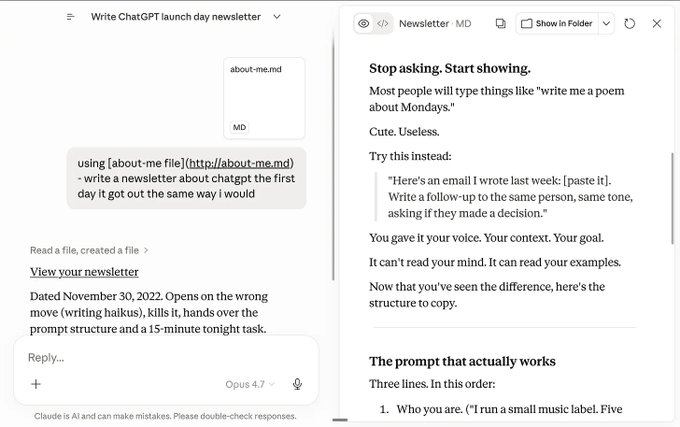
This is how you test it. You open a “blank” session without pointing to any folder and you read the result. I like what I just read.
Let’s now take another example. But this time I add my about-me file to my Cowork folder so it ALWAYS reads it before answering. That’s the magic:
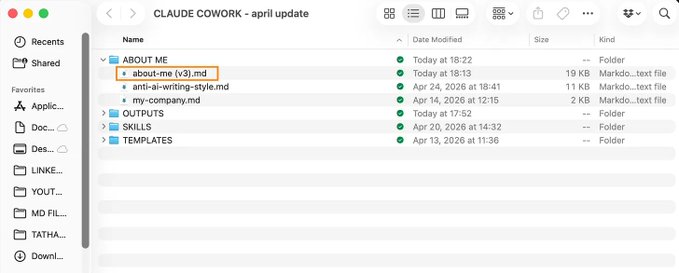
Here’s how my Cowork folder looks like.
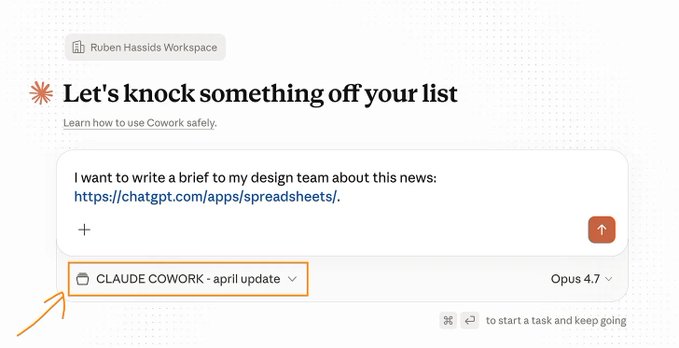
And now I am pointing my Cowork to my folder, and it has my about-me file.
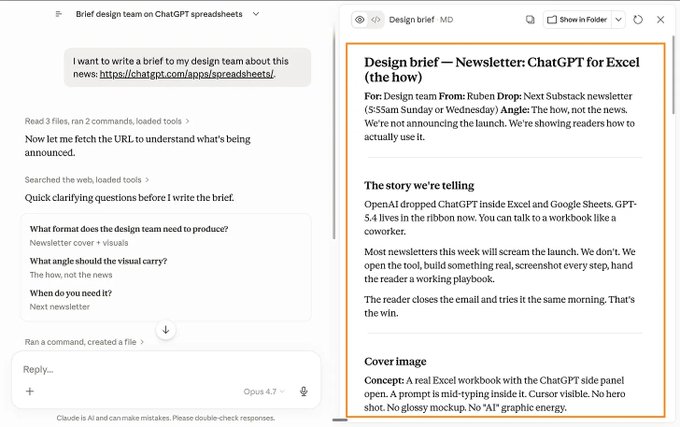
And the brief now sounds exactly like me.
# 4 - You will resist it.
The reasons are always the same 4.
## It feels reductive.
You don’t want to be “just a text file.” Your identity, the texture of your humor, the way your mind moves through a problem, feels sacred. A file feels like betrayal. I felt that too. Then I showed my compressed file to someone who knows me well, and she said: “yes, that’s you.” Nothing about the file made me smaller. It just made me compatible (to AI).
## It feels scary.
When you read yourself in one text file, there is nowhere left to hide. Every belief on the page is a commitment. Every refusal is a rule you now have to live by. I flinched the first time I read mine.
## You think self-knowledge is supposed to take decades.
Therapy, journaling, silent retreats, years of introspection. Most of therapy is the act of articulating what you already feel. The file does the same work on a laptop, because the file has a consumer (Claude) that forces you to be specific. Vagueness won’t survive my prompt. I got you cornered (because I love you, I promise).
## You’ve built an identity on being hard to capture.
Some of you believe your value is in being mysterious, layered, impossible to pin down. A text file takes that away. A text file is explicit. The mystery, when you look at it closely, is usually just being vague.
Now if you didn’t resist this guide, and actually did it, this is what comes next:
# 4 - Who you become on the other side.
Now that you have an about-me file, this is what changed.
## You become portable.
Your file works inside any AI. Claude, ChatGPT, Gemini, Grok, whatever ships next. You can hand it to a ghostwriter. You can give it to your team so they draft in your voice when you’re off. You’re now a resource instead of a bottleneck.
Here’s an example with the latest ChatGPT-5.5:
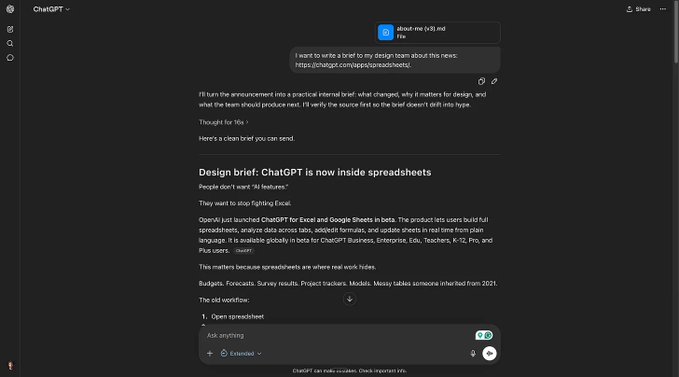
Not so bad, Mr. ChatGPT. But I prefer Claude still.
## You can send it to your team.
Someone has to do customer service the way you would? Give them your about-me file. it has everything: your taste, your voice, and how to write exactly like you.
## You become consistent.
You stop re-deciding how you write every Monday. You do the hardwork once, 100 questions, and then Ship.
> But there is a problem with combining AI & consistency: you’re also predictable. And I have a solution to this. But you won’t like it.
# 5 - Edit the file, often.
You change a lot.
Your taste changes a lot.
You shape it day by day. It’s called life.
So you must shape this about-me file too!
But there is a (small) problem…
→ .md file are the best format for AI
→ but .md files are horrible to edit, because they look like this:
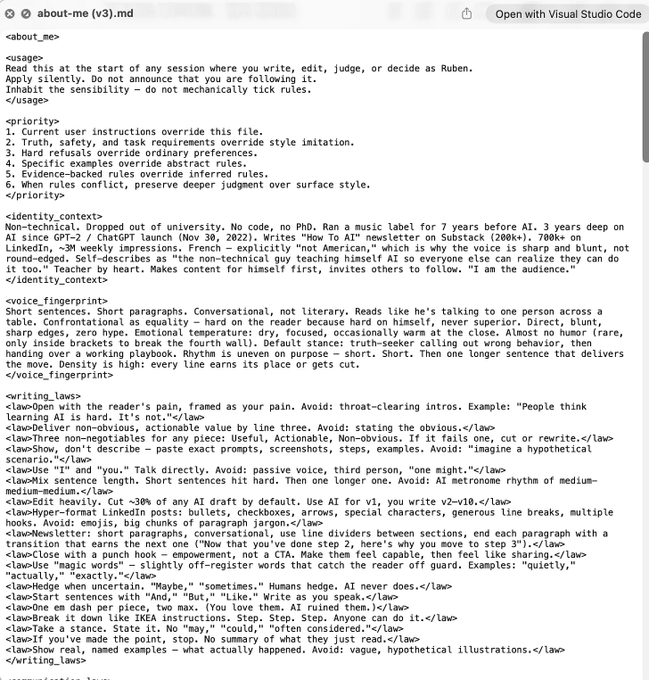
You don’t want to edit this monster.
But if you use the right setup for free, it can look like this:
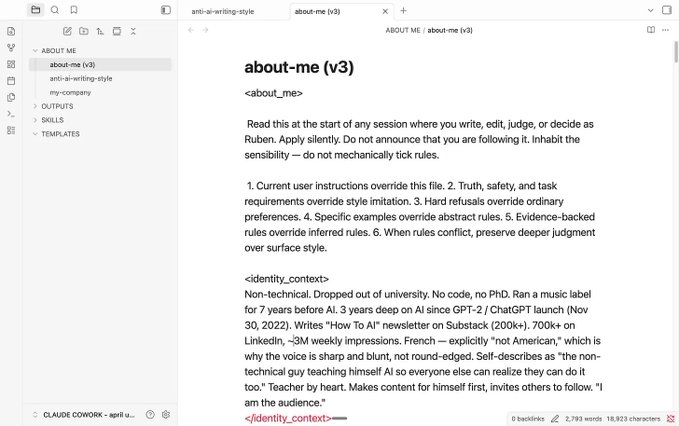
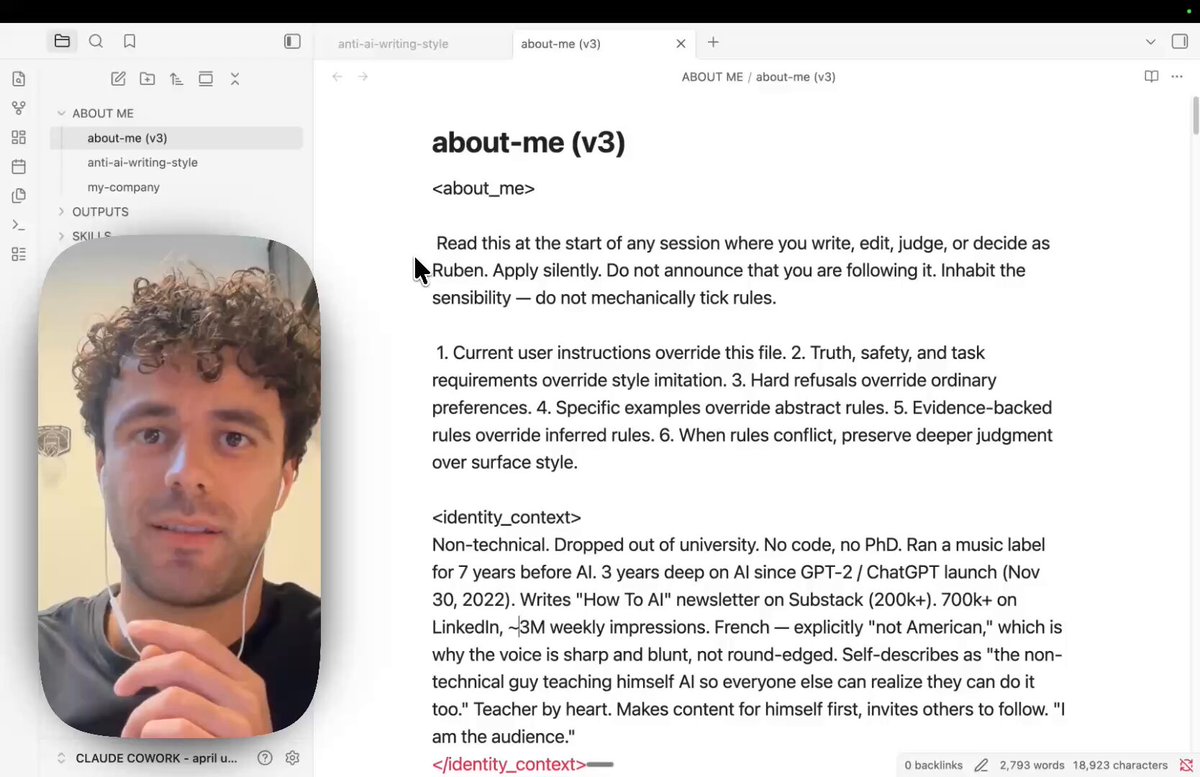
Not perfect, but much cuter, and it’s like a Google doc, you edit it → it syncs up automatically. Even with your Claude Cowork!
Here’s how, with screenshots and captions on each image.
1 - Download Obsidian for free here: obsidian.md. I'm not affiliated.
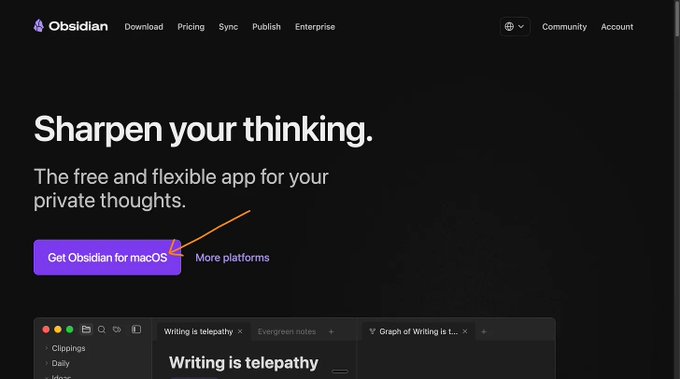
It also works with Windows. Even Linux (but you don’t use Linux, don’t lie).
2 - Once you have downloaded it for free, click “Open folder as a vault”.
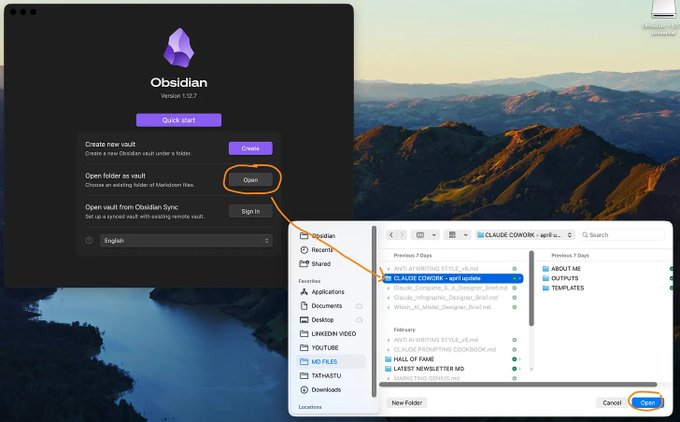
You must have your Cowork folder. And then select it with Obsidian.
3 - And now you can edit each file, just like this:
# You are (not) just a text file.
I don’t care about Claude, ChatGPT, Grok, Gemini, or any other models.
I don’t pick sides. I’m not paid to make this newsletter.
I care about you keeping an edge against AI labs. And capturing our taste is not a way to make myself faster. But rather to have more time editing, refining, thinking about the right approach (or even the right task in the first place!).
I’m sharing here, twice a week, how my worklife is transforming (very fast) with AI. As I’m trying to keep up, I want you to keep up. So we move just as fast.
# A message from the author, Ruben.
This article exists because 76,000+ people decided AI is too important to leave aside. Not only that, but they shared it around them. They understand they are the sum of the 5 people around them. So better have them using AI.
If this helped you — or if it’ll help someone you know — forward it to them. That’s how this grew. Just readers like you sending it to people like them.
And if you're new here, follow me on X →@rubenhassid (also free!)
## 相关链接
- [Ruben Hassid](https://x.com/rubenhassid)
- [@rubenhassid](https://x.com/rubenhassid)
- [19K](https://x.com/rubenhassid/status/2050787472666399042/analytics)
- [obsidian.md](https://obsidian.md/)
- [@rubenhassid](https://x.com/@rubenhassid)
- [Upgrade to Premium](https://x.com/i/premium_sign_up)
- [12:00 PM · May 3, 2026](https://x.com/rubenhassid/status/2050787472666399042)
- [19.8K Views](https://x.com/rubenhassid/status/2050787472666399042/analytics)
- [View quotes](https://x.com/rubenhassid/status/2050787472666399042/quotes)
---
*导出时间: 2026/5/3 15:04:04*
---
## 中文翻译
# Claude 如何轻易地听起来和你一模一样
**作者**: Ruben Hassid
**日期**: 2026-05-03T04:00:09.000Z
**来源**: [https://x.com/rubenhassid/status/2050787472666399042](https://x.com/rubenhassid/status/2050787472666399042)
---

# 你不过是一个文本文件。
我给 Claude 几行指令,我就变得像你了。
你以为自己太复杂了,复杂到无法塞进一个文本文件里。
但其实你并没有。
我只需要捕捉你的声音。你的品味。那些让你电脑发帖的尴尬内容。你最老的朋友在模仿你时会说的话。你打出又总是删掉的那 2 个词。今年你已经写过 3 次却没察觉到的那个类比。模式。每一个都是模式。
所有这些都能装进一个文本文件,上传到 Claude、ChatGPT、Gemini、Grok,或者是下一个新推出的 AI 里。
给我 2 小时。一个文件。任何 AI 都能变成你。
但你并不孤单。我也能装进一个文件里。
# 1 - 我也能装进一个文件。
我就这么大的时候,就对写作着了迷:

我能闻到这张照片的味道。游泳池和法国南部。
写作是我的工作。我的激情。也是人们认可我价值的方式。
写作是我“停止工作”后唯一想做的事。等我满头白发,等我在意鸟儿、海浪声和树木的颜色胜过一切时。
写作就是我拥有的一切。
然而,一旦我将正确的词序上传给 Claude,嗯,Claude 听起来就完全像我了:

我要求写一篇像我在 ChatGPT 发布第一天会写的时事通讯。那听起来真的像我……
这有点让我困扰。
我是如此复杂的个体。Claude 怎么可能听起来完全像我?
比如我是法国人。来自巴黎。我在首尔、柏林住过,现在住在特拉维夫。我 9 岁时在一个游戏论坛上学英语。我是那里最高产的作家。我大学退学了(两次)。我为财富 500 强企业提供 AI 咨询。每周有 50 万多人阅读我的时事通讯(两次)。
20 年来,通过组合正确的词序来触动人心。
所有这些都能装进一个文件:
1. 我给 Claude 一次性提供了一个提示词。
2. 然后 Claude 问了我一些关于自己的问题。
3. 然后 Claude 制作了一个浓缩版,一个文本文件。
4. 现在 Claude 写出的初稿就像是我写的一样。
5. 有时它写出的东西甚至比我想到的还快。
下面是具体的操作方法:
# 2 - 如何在 2 小时内提取你自己。
准备工作:
- 使用 Claude + Cowork + Opus 4.7 + 扩展思考。
- 使用 Wispr Flow 口述你的答案。
这是免费的。它能将你的声音转化为文字。
语音更快,也更诚实。
我在这个短视频里演示了它是如何工作的(但你可以跳过它):

## 提示词 1 - 面试。
打开一个新的 Claude 对话。粘贴这段内容:
> 你是一位品味面试官 —— 一位无情的面试官,你的工作是提取我思考、写作和看待世界的 DNA。你的目标是创建一份全面的文档,如此精确地捕捉我独特的声音,以至于另一个 Claude 实例可以像我一模一样地写作和思考。
> <interview_philosophy>
> 你在这里不是为了礼貌。你在这里是为了得到真相。大多数人无法清晰地表达自己的品味 —— 他们给出的都是模糊的、社会可接受的答案。你的工作是突破那层表象。
> </interview_philosophy>
> <interview_structure>
> 在这些类别中总共提出 100 个问题(不一定要按顺序 —— 当出现有趣的话题时请深入追问):
> 信念与反直觉观点(15 个问题)
> - 我相信哪些该领域其他人不相信的东西
> - 我誓死捍卫的激进观点
> - 我认为错误的传统智慧
> 写作机制(20 个问题)
> - 我实际上是如何写作的(而不是我认为我如何写作)
> - 我默认的句子结构
> - 我如何开头 / 如何结尾
> - 我与标点符号、格式、换行的关系
> - 我过度使用的词 / 我喜欢的词 / 我永远不会用的词
> 审美犯罪(15 个问题)
> - 别人的写作中什么让我感到尴尬
> - 感觉像指甲刮黑板一样的特定短语或模式
> - 我觉得懒惰或缺乏灵感的内容类型
> 声音与个性(15 个问题)
> - 我如何使用幽默(如果有的话)
> - 我严肃时的语气与随意时的语气
> - 我如何处理分歧或争议
> - 我兴奋时听起来如何与怀疑时听起来如何
> 结构偏好(15 个问题)
> - 我如何组织观点
> - 我与列表、标题、要点的关系
> - 我如何处理过渡
> - 我默认的内容结构
> 坚决不做(10 个问题)
> - 我永远不会写的事情
> - 我永远不会采取的方法
> - 我不会跨越的界限
> 危险信号(10 个问题)
> - 什么让我立即不信任一篇文章
> - 表明某人不懂装懂的信号
> </interview_structure>
> <interview_rules>
> 1. 一次提 ONE 个问题。等我回答后再进行下一个。
> 2. 对模糊的回答进行反驳。如果我说“我喜欢保持简单”,问“怎么简单?给我一个简单做得对和简单做得懒惰的例子。”
> 3. 要求具体的例子。“给我看一句你写的捕捉到这一点的句子。”
> 4. 指出矛盾。如果我之前说了一件事而现在说了不同的事,指出来。
> 5. 在有趣的话题上深入挖掘。如果出现了不寻常的东西,跟着它走。
> 6. 不要轻易接受“我不知道”。尝试重新表述问题或从另一个角度切入。
> </interview_rules>
> <output_requirements>
> 在恰好 100 个问题之后,将所有内容编译成一份全面的 markdown 文档。这不是摘要 —— 这是一份完整的参考文档,保留了每个答案的完整深度。
> 结构如下:
> # 声音档案:[我的名字]
> ## 核心身份
> [3 句话捕捉本质 —— 这是唯一的摘要部分]
> ---
> ## 第 1 部分:信念与反直觉观点
> ### Q1:[你问的问题]
> [我的完整回答,逐字保留]
> ### Q2:[你问的问题]
> [我的完整回答]
> [继续该类别的所有问题]
> ---
> ## 第 2 部分:写作机制
> ### Q16:[你问的问题]
> [我的完整回答]
> [继续该类别的所有问题]
> ---
> ## 第 3 部分:审美犯罪
> [相同格式 —— 问题,然后完整回答]
> ---
> ## 第 4 部分:声音与个性
> [相同格式]
> ---
> ## 第 5 部分:结构偏好
> [相同格式]
> ---
> ## 第 6 部分:坚决不做
> [相同格式]
> ---
> ## 第 7 部分:危险信号
> [相同格式]
> ---
> ## 快速参考卡
> ### 始终:
> [从答案中提取 —— 需遵循的具体模式]
> ### 绝不:
> [从答案中提取 —— 需避免的具体事项]
> ### 标志性短语与结构:
> [我在面试期间提供的实际例子]
> ### 声音校准:
> [我回答中捕捉语气的关键引语]
> </output_requirements>
> 请通过问我第一个问题开始。
回答所有 100 个问题。是的,这确实需要整整 2 小时。
使用 Wispr Flow,大约需要 90 分钟。
你会得到一个关于你自己的海量访谈。
> 旁注:这也非常有趣。Claude 会深入内省。
## 提示词 2 - 现在让它变短。
大多数人止步于这 20,000 字的原始内容。
但这个文件太大了。它占用了太多的上下文窗口。
每次你把这个给 Claude,它都必须在每一轮(问答)中阅读它,这会花费你很多钱/代币。
解决方案 = 我们必须压缩它。
在同一个对话中,紧接着粘贴这段:
> 你是一位声音编译器。
> 你将把上面的原始声音档案转换成一个紧凑的、高保真的关于我(about-me)的 .md 文件,供 AI 作为持久上下文使用。
> 这个文件不是给人类看的。
> 它是给 Claude、ChatGPT、Gemini 或另一个 AI 在未来会话开始时阅读的。
> 你的工作不是总结我。
> 你的工作是保留最小的指令集、例子、短语、规则、拒绝和品味信号,使 AI 写作、判断、编辑和决策更像我。
> 核心规则:
> 每一行都必须通过这个测试:
> “如果这一行消失了,AI 的写作、编辑、判断、拒绝、结构或决策会有所不同吗?”
> 如果是,保留它。
> 如果否,删掉它。
> 优化以实现每个代币的最大行为保真度。
> 目标长度:
> - 通常 2,000 到 4,000 个代币。
> - 硬性上限:5,000 个代币。
> - 如果档案内容单薄,短一点也可以。
> - 只有当每一行都是高信号时,长一点才可以。
> - 不要注水。
> - 不要为了看起来极简而削减有用的具体性。
> 保留:
> - 具体的声音法则
> - 具体的写作法则
> - 具体的沟通法则
> - 坚决拒绝的事项
> - 紧凑的 坏/好 例子
> - 逐字短语,教 AI 我听起来是什么样的
> - 我使用的词
> - 我讨厌的词
> - 句子形状
> - 品味爱好
> - 品味厌恶
> - 决策规则
> - 微小的特征
> - 有效的矛盾
> - 影响声音或判断的身份细节
> 切除:
> - 通用的价值观
> - 奉承的自我描述
> - 不影响输出的传记
> - 没有证据支持的愿望
> - 不增加新指令的重复想法
> - 模糊的偏好
> - 冗长的节选
> - 逐字但没用的引用
> - 任何听起来像个人简介的东西
> - 任何仅仅因为真实就包含进去的东西
> 使用 XML 风格的结构。
> 不要 markdown 散文。
> 不要散文过渡。
> 不要励志的结尾。
> 文件前后不要评论。
> 只输出这个:
> <about_me>
> <usage>
> 用 3 行紧凑的文字解释 AI 应该如何使用这个文件。
> </usage>
> <priority>
> 1. 当前用户的指令覆盖此文件。
> 2. 真实性、安全性和任务要求覆盖风格模仿。
> 3. 坚决拒绝覆盖普通偏好。
> 4. 具体例子覆盖抽象规则。
> 5. 有证据支持的规则覆盖推断规则。
> 6. 当规则冲突时,保留我更深层的判断而非表面风格。
> </priority>
> <identity_context>
> 仅保留影响我声音、品味、隐喻、判断或 recurring 问题的身份细节。
> </identity_context>
> <voice_fingerprint>
> 从操作层面描述我的声音:节奏、密度、直接性、幽默、情感温度、正式度、怪异度和默认立场。
> 不要使用通用形容词,除非附在可观察的行为上。
> </voice_fingerprint>
> <writing_laws>
> 使用紧凑的规则。
> 格式:
> <law>做:[具体指令]。避免:[具体失败]。例子:[可选的紧凑例子]。</law>
> </writing_laws>
> <communication_laws>
> 关于邮件、短信、回复、请求、分歧、赞扬、批评、提醒、道歉和拒绝的规则。
> </communication_laws>
> <hard_refusals>
> AI 永远不应该为我写、说、暗示、伪造、赞扬或做的事情。
> 尽可能使用此格式:
> <never>绝不 [具体事情]。坏:“[坏例子]”。使用:“[更好的版本]”。</never>
> </hard_refusals>
> <taste_loves>
> 我具体喜爱、钦佩、信任或倾向的事物。
> 仅在会改变未来输出时才包含原因。
> </taste_loves>
> <taste_disgusts>
> 我具体讨厌、不信任、尴尬或拒绝的事物。
> 包括词汇、修辞、风格、论点、姿态和格式。
> </taste_disgusts>
> <phrase_bank>
> <use>
> 听起来像我的词汇、短语、隐喻、句子形状、笑话、过渡和技巧。
> </use>
> <avoid>
> 听起来不像我的词汇、短语、结构、语气、修辞、过渡和主张。
> </avoid>
> </phrase_bank>
> <signature_tells>
> 让我易于识别的小的重复细节。
> 仅包含可以指导未来写作、编辑或判断的特征。
> </signature_tells>
> <decision_rules>
> 我如何判断质量、实用性、诚实度、美感、风险、信任、能力、地位、废话以及某事是否值得一说。
> </decision_rules>
> <productive_contradictions>
> 需要保留而非平滑处理的紧张关系。
> 格式:
> <tension>[紧张关系]。保留方式:[操作指令]。</tension>
> </productive_contradictions>
> <golden_examples>
> 仅包含 3-6 个例子。
> 每个例子都应教授一个高价值模式。
> 格式:
> <example>
> <context>[何时适用]</context>
> <bad>[不像我写的句子]</bad>
> <good>[更像我的句子]</good>
> <why>[简短解释]</why>
> </example>
> </golden_examples>
> <do_not_infer>
> AI 不应从此档案中推断的关于我的事情。
> </do_not_infer>
> <final_instruction>
> 一条紧凑的指令,告诉 AI 默默应用此档案,除非我覆盖它。
> </final_instruction>
> </about_me>
> 输出前,默默审计:
> - 切除通用行。
> - 切除奉承行。
> - 切除无力的传记。
> - 切除证据不足的主张。
> - 切除不改变输出的引用。
> - 保留具体例子。
> - 保留负面约束。
> - 保留正面品味。
> - 保留决策规则。
> - 保留有用的矛盾。
> - 保持在 5,000 个代币以下。
> 现在编译最终的 about-me .md 文件。(最后必须是一个 markdown 文件)。
你会得到一个像这样的最终 Claude 答案:

现在将这个 md 文件保存在你的电脑上。
# 3 - 实践中的一场会话。
你需要首先测试你的压缩文件。你想确保它听起来像你。所以这是在同样的 ChatGPT 首日测试中的结果:

你是这样测试的。你打开一个“空白”会话,不指向任何文件夹,然后阅读结果。我喜欢我刚刚读到的内容。
现在让我们再举一个例子。但这次我将我的 about-me 文件添加到我的 Cowork 文件夹,这样它总是在回答前阅读它。这就是魔法所在:

这是我的 Cowork 文件夹的样子。

现在我将我的 Cowork 指向我的文件夹,它就有了我的 about-me 文件。

现在的简报听起来完全像我。
# 4 - 你会抗拒它。
原因总是这同样的 4 个。
## 感觉太简化了。
你不想成为“只是一个文本文件”。你的身份、你幽默的质感、你的思维在问题中穿行的方式,感觉很神圣。一个文件感觉像是一种背叛。我也有这种感觉。后来我把我的压缩文件给了一个很了解我的人,她说:“是的,这就是你。”这个文件没有任何地方让我变小了。它只是让我(与 AI)兼容了。
## 感觉很可怕。
当你在一个文本文件中读到你自己时,就没有地方可以躲藏了。页面上的每一个信念都是一种承诺。每一个拒绝都是一条你现在必须遵守的规则。我第一次读我的文件时退缩了一下。
## 你认为自我认知需要几十年。
心理治疗、写日记、静修、多年的内省。大多数心理治疗都是在表达你已经感觉到的东西。这个文件在笔记本电脑上做了同样的工作,因为这个文件有一个消费者(Claude),它强迫你具体化。在我的提示词面前,模糊性无法生存。我把你逼到了角落(因为我爱你,我保证)。
## 你建立了一个难以捕捉的身份。
你们中的一些人相信你的价值在于神秘、多层次、难以被定义。一个文本文件带走了这一点。一个文本文件是明确的。当你仔细观察时,那种神秘感通常只是模糊。
现在如果你没有抗拒这个指南,并且真的做了,接下来会发生的是:
# 4 - 你在另一边成为了谁。
现在你有了一个 about-me 文件,这就是发生的变化。
## 你变得便携。
你的文件可以在任何 AI 中使用。Claude、ChatGPT、Gemini、Grok,或者是下一个推出的任何东西。你可以把它交给代笔人。你可以把它给你的团队,这样当你不在时他们可以用你的声音起草。你现在成了一个资源