# How We Automated 1,000+ Daily AI UGC Reels (Step-by-Step Breakdown)
**作者**: Adrian Solarz
**日期**: 2026-05-05T21:20:24.000Z
**来源**: [https://x.com/adriansolarzz/status/2051774034917122109](https://x.com/adriansolarzz/status/2051774034917122109)
---

most operators in 2026 are stuck producing 20-30 reels per day MAX and wondering why they can't scale...
but we're currently producing 1,000+ AI UGC reels daily across our client portfolios from a single production pipeline that takes 1 operator only a few hours daily to manage.
and in this article, i'll be breaking down exactly how that volume is:
1. operationally feasible
2. the upstream automation that drives the output
3. the specific tooling stack we're using at each layer
4. and the operational rhythm that keeps the workflow simple
so if you've been producing AI UGC manually and wondering whether automation can genuinely scale to this volume...
this is the system that makes it work:
## The 4 Operational Constraints Operators Hit

before getting into the system, the constraints that limit most operators at much lower production volumes deserve explanation because the system below was specifically designed to break through each of them.
constraint 1: the strategic decision bottleneck. every reel requires creative decisions: what hook category to use, what pain angle to hit, what avatar demographic to target, what CTA structure to deploy. operators making these decisions individually for each reel hit a ceiling around 20 to 30 reels per day because the decision volume itself becomes the limiting factor.
constraint 2: the script writing bottleneck. at 5 to 10 reels per day, manual script writing is feasible. at 100+ reels per day, it isn't. operators trying to write scripts manually at high volume hit a quality plateau where the writing time required exceeds available production hours.
constraint 3: the production execution bottleneck. generating Seedance 2.0 video clips, GPT Image 2 reference assets, and slide visuals at production volume requires structured workflows that minimize regeneration cycles. without these workflows, the production session expands beyond sustainable time investment.
constraint 4: the distribution bottleneck. scheduling 1,000+ pieces of content daily across 200+ accounts manually is impossible. without scheduling automation that handles the distribution layer, the production output sits in a queue rather than reaching the audience.
every layer of the system below was designed specifically to break 1 of these constraints. removing all 4 constraints simultaneously is what unlocks the volume.
## Step 1: Claude Co-work Handles Every Strategic and Analytical Decision

Claude Co-work runs the strategic and analytical layer for every client portfolio simultaneously.
this is what breaks the strategic decision bottleneck. instead of an operator making creative decisions individually for each reel across 10 clients, Co-work runs the unified analytical pipeline that produces production briefs for every client based on the previous day's performance data.
The Daily Analytical Session
every production day opens with the analytical session that runs across all client portfolios in parallel.
Co-work pulls performance data from across all 200+ accounts per client, identifies which formats and approaches drove the strongest performance the previous day, and produces 10 separate production briefs (1 per active client) that specify exactly what content categories to prioritize for the upcoming production batch.
each brief identifies:
which hook categories are working strongest for this specific client's audience.
which pain angles are producing the strongest hold rate and DM share volume.
which avatar demographics are converting at the strongest rates.
which CTA structures are driving the most comment funnel entries.
which content categories are saturating and need to be deprioritized.
the analytical session takes 30 to 45 minutes total to run across all 10 clients because the prompt template is unified and Co-work processes the parallel analysis efficiently. what would take 5 to 6 hours of manual analytical work compresses to 30 to 45 minutes of supervised automation.
The Weekly Intelligence Layer
every Monday, the weekly intelligence session synthesizes the previous week's performance data across all active clients into the strategic intelligence brief that updates the upstream creative direction.
cross-client patterns become visible at this layer that wouldn't surface from single-client analysis. a hook format working strongly for client 1 in skincare might inform what we test for client 4 in supplements. a pain angle that's saturating in 1 vertical might predict saturation in adjacent verticals.
the unified analytical layer produces compounding intelligence that fragmented operations running each client separately can't replicate.
## Step 2: Claude Co-work Generates Every Script
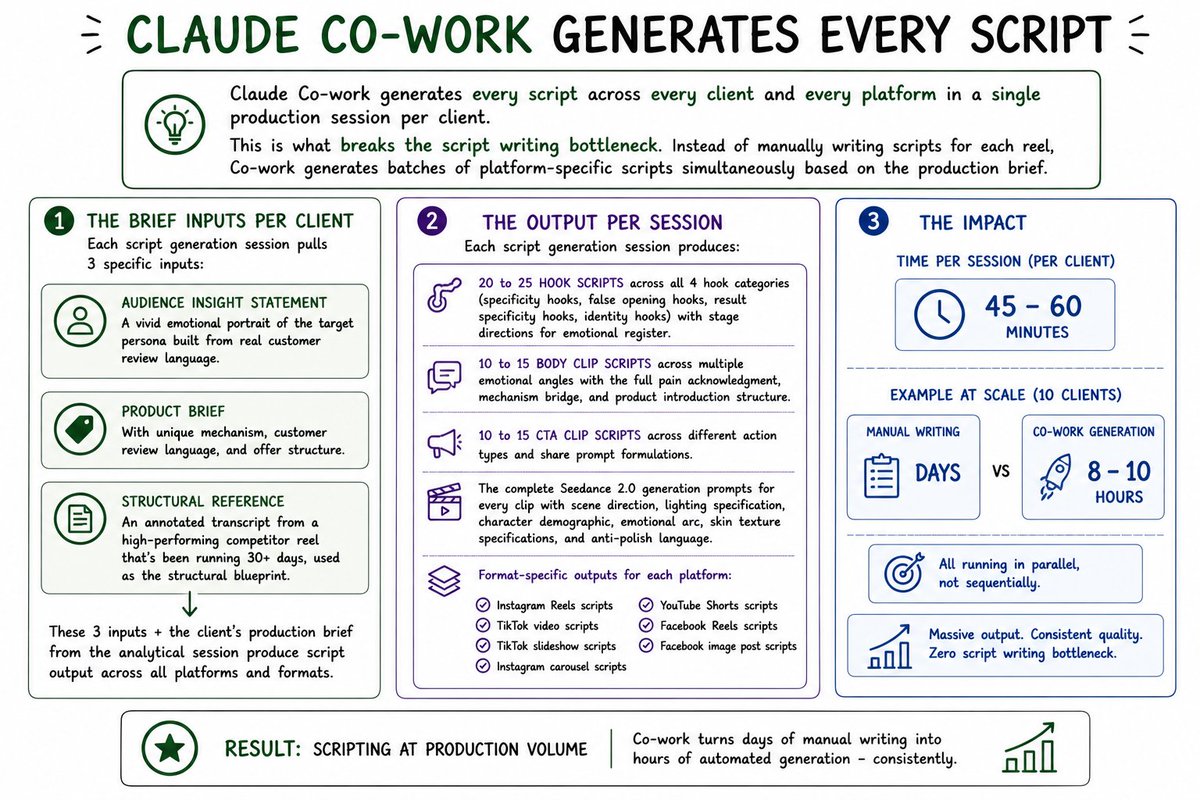
Claude Co-work generates every script across every client and every platform in a single production session per client.
this is what breaks the script writing bottleneck. instead of manually writing scripts for each reel, Co-work generates batches of platform-specific scripts simultaneously based on the production brief.
The Brief Inputs Per Client
each script generation session pulls 3 specific inputs:
the audience insight statement (a vivid emotional portrait of the target persona built from real customer review language).
the product brief (with unique mechanism, customer review language, and offer structure).
the structural reference (an annotated transcript from a high-performing competitor reel that's been running 30+ days, used as the structural blueprint).
these 3 inputs combined with the client's production brief from the analytical session produce script output across all the platforms and formats the client runs.
The Output Per Session
each script generation session produces:
20 to 25 hook scripts across all 4 hook categories (specificity hooks, false opening hooks, result specificity hooks, identity hooks) with stage directions for emotional register.
10 to 15 body clip scripts across multiple emotional angles with the full pain acknowledgment, mechanism bridge, and product introduction structure.
10 to 15 CTA clip scripts across different action types and share prompt formulations.
the complete Seedance 2.0 generation prompts for every clip with scene direction, lighting specification, character demographic, emotional arc, skin texture specifications, and anti-polish language.
format-specific outputs for each platform: Instagram Reels scripts, TikTok video scripts, TikTok slideshow scripts, Instagram carousel scripts, YouTube Shorts scripts, Facebook Reels scripts, Facebook image post scripts.
each session takes 45 to 60 minutes per client. across 10 clients, the total scripting time compresses from what would be days of manual writing into 8 to 10 hours of automated generation, all running in parallel rather than sequentially.
## Step 3: GPT Image 2 Produces Every Visual Reference and Static Slide Asset

GPT Image 2 handles every static visual asset across every client and every platform.
character references for video generation. product reference shots for visual continuity. Instagram carousel slides. TikTok slideshow slides. YouTube thumbnails. Facebook image posts.
The Multi-Angle Character Reference Pipeline
every client gets a multi-angle character reference set generated through GPT Image 2 with Topaz upscaling applied to every approved variant.
the reference asset session takes 5 to 15 minutes per character. that 5 to 15 minutes of upstream investment produces character references that drive content across all 4 platforms for the next 1 to 2 weeks of production for that client.
across 10 clients, the multi-angle reference work happens once per client per rotation cycle, not once per reel. the reference asset workflow is deeply parallelized because it runs at character cadence rather than reel cadence.
The Slide Generation Pipeline
carousel slides and slideshow slides get generated in batches per client with the same character reference and aesthetic baseline loaded as multimodal inputs across the full slide set.
a typical client carousel production session generates 8 slides per carousel across 5 to 8 carousels in a single session. GPT Image 2's batch processing capability means 40 to 80 slides per client can be generated in parallel rather than sequentially.
across 10 clients producing carousels and slideshows, the daily slide generation volume sits at approximately 300 to 500 slides total, all produced through structured batch sessions rather than individual generation cycles.
The Quality Control Discipline
every reference asset and slide generation runs through a 3-criteria quality check before entering the production pipeline:
realism (does this look like a real photograph rather than an AI-generated image).
detail (does the image have the texture and minor imperfections that real photos have).
the "real test" (would this read as a real person within the first 2 seconds without any further context).
variants that fail any of the 3 criteria get regenerated with adjusted prompts targeting the specific failing element. variants that pass enter the production pipeline for that client.
## Step 4: Seedance 2.0 Produces Every Video Clip
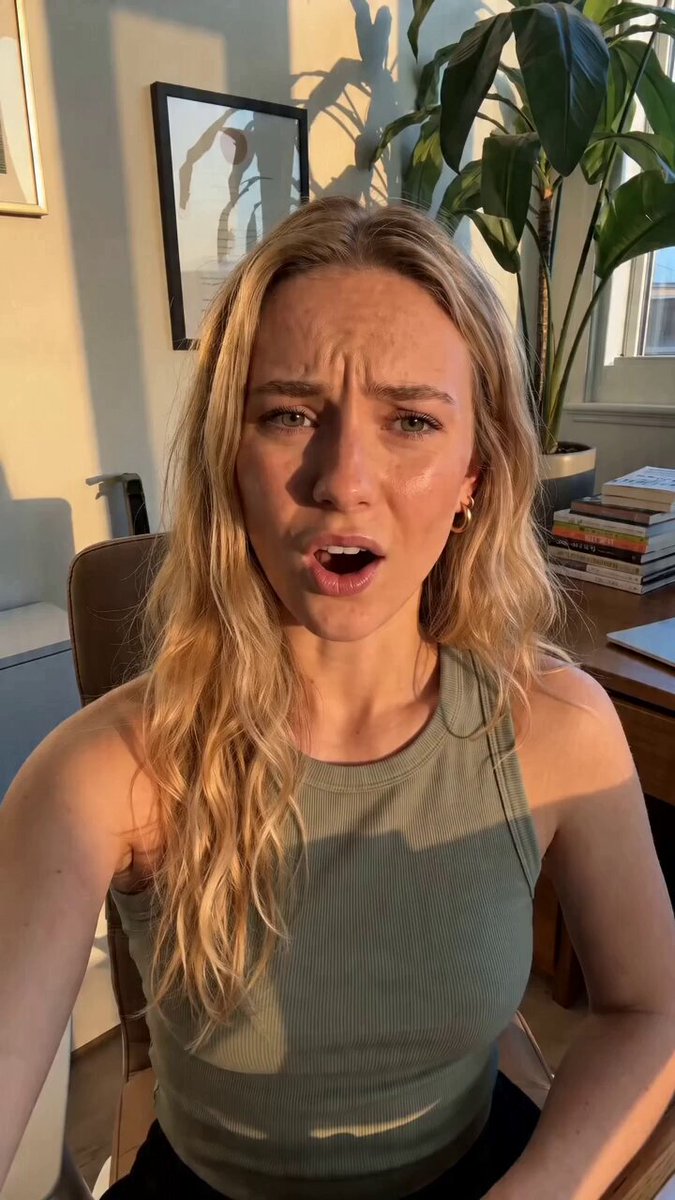
Seedance 2.0 generates every video clip across every client and every platform.
Instagram Reels. TikTok video. YouTube Shorts. Facebook Reels. all running through the same production pipeline with platform-specific format and aesthetic adjustments applied at the prompt level.
The Standing Technical Specifications
every Seedance 2.0 prompt includes the same standing technical specifications regardless of client or platform:
skin texture specification: "realistic skin texture, visible pores around nose and cheeks, natural slight unevenness, no filter quality." this goes in every prompt with a human face without exception.
anti-polish language: "handheld phone camera feel, casual slightly unsteady framing, filmed in a real environment, not a professional set, organic not studio quality."
lighting physics clause: "soft diffused light from window at left, casting gentle shadows, no harsh highlights, skin properly illuminated without overexposure."
emotional arc specification: for any clip where the character's expression shifts during the duration.
these specifications apply identically across all 10 clients and all 4 platforms. the production discipline doesn't fragment by client because the underlying production principles are universal.
The Shot-by-Shot Generation Approach
every clip in the production pipeline gets its own Seedance generation rather than trying to render multi-shot sequences in single passes. this approach has 3 advantages at scale:
it allows the appropriate angle reference to be loaded for each shot rather than asking Seedance to interpret character appearance from multiple angles.
it enables individual shot regeneration when a single clip fails the quality check without requiring full sequence re-renders.
it produces cleaner audio sync across the full duration because each shot's audio is generated as a focused unit.
The 4-Point Quality Check
every Seedance output runs through a 4-point quality check before entering the variation pipeline:
motion realism (does the motion look natural rather than uncanny).
skin rendering (does the skin texture pass for real human skin).
audio sync (does the lip sync track with the dialogue).
the "real person" test in the first 2 seconds (would this register as a real person to a viewer scrolling past).
clips that fail any of the 4 criteria get regenerated with prompt adjustments targeting the specific failing element. clips that pass enter the variation pipeline for assembly.
The Cost Optimization Layer
the dense-script-with-slowdown technique runs across every Seedance generation to recover 25 to 30% of credit spend without sacrificing output quality.
scripts are written at 25 to 30% higher word density than the target duration would normally accommodate. the avatar generates at approximately 1.25x natural pace. the output gets slowed to 0.75x in post-production. the final video plays at natural pace while consuming meaningfully fewer credits than producing it at standard pace would.
across 1,000+ daily reels, the credit savings compound into substantial monthly margin improvement that translates directly into the operation's unit economics.
## Step 5: Modular Assembly and the Compatibility Matrix
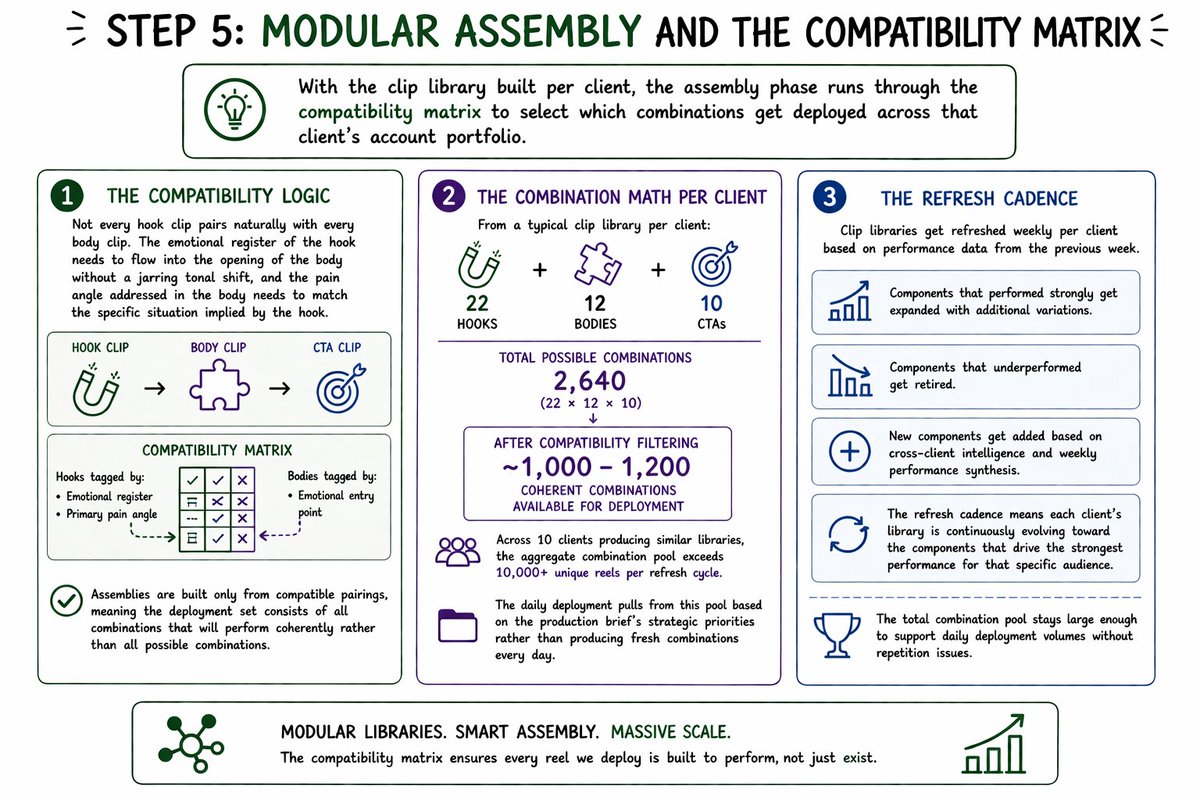
with the clip library built per client, the assembly phase runs through the compatibility matrix to select which combinations get deployed across that client's account portfolio.
The Compatibility Logic
not every hook clip pairs naturally with every body clip. the emotional register of the hook needs to flow into the opening of the body without a jarring tonal shift, and the pain angle addressed in the body needs to match the specific situation implied by the hook.
the compatibility matrix tags each hook clip with its emotional register and primary pain angle, and each body clip with the emotional entry point it's designed to connect with. assemblies are built only from compatible pairings, which means the deployment set consists of all combinations that will perform coherently rather than all possible combinations.
The Combination Math Per Client
from a typical clip library of 22 hooks, 12 bodies, and 10 CTAs per client, the total possible combinations are 2,640. after compatibility filtering, the coherent combinations available for deployment number approximately 1,000 to 1,200 per client.
across 10 clients producing similar libraries, the aggregate combination pool exceeds 10,000 unique reels per refresh cycle. the daily deployment pulls from this pool based on the production brief's strategic priorities rather than producing fresh combinations every day.
The Refresh Cadence
clip libraries get refreshed weekly per client based on performance data from the previous week.
components that performed strongly get expanded with additional variations. components that underperformed get retired. new components get added based on cross-client intelligence and weekly performance synthesis.
the refresh cadence means each client's library is continuously evolving toward the components that drive the strongest performance for that specific audience, while the total combination pool stays large enough to support daily deployment volumes without repetition issues.
## Step 6: Distribution Across the Multi-Account Portfolio
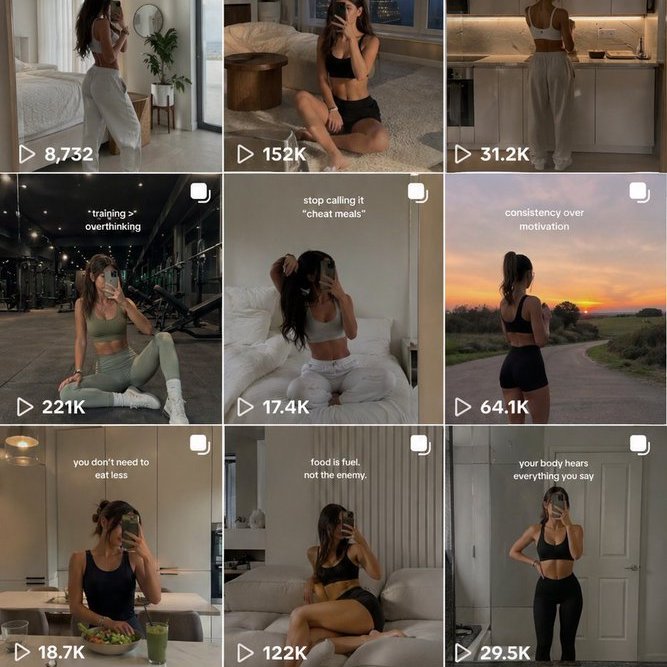
Later (later(.com)) handles cross-platform scheduling for all 10 client portfolios from a single calendar interface.
The Account Portfolio Math
each client runs 50 accounts per platform across 4 platforms, scaling based on CPM budget and niche characteristics. across 10 clients, the operation manages 2,000+ accounts simultaneously.
each account posts 1 to 3 pieces of content daily, which sits in the algorithmic sweet spot for posting frequency on each platform. the daily content volume of 1,000+ reels distributes across 2,000+ accounts with each account receiving 1 to 2 pieces of content daily on average.
The Time-Zone Calibration
each account has its own optimal posting windows based on the activity patterns of its specific audience. the early engagement signals that the algorithm uses to make distribution decisions are stronger when content posts during peak audience activity.
posting time staggering across the full multi-client portfolio prevents the simultaneous posting pattern that flags coordinated networks. content from 10 different brands posting across 2,000+ accounts all at the same minute is identifiable as coordinated activity. the same content posting across the portfolio with each account hitting its own optimal time looks like genuine independent activity.
The Daily Scheduling Session
the daily scheduling session takes approximately 60 to 90 minutes total to distribute the day's content across the full portfolio. each piece of content gets assigned to its target account, paired with platform-specific elements (trending audio for TikTok, native captions for Instagram, optimized titles and descriptions for YouTube, longer conversational captions for Facebook), and scheduled at that account's specific peak posting window.
the cross-platform scheduling interface in Later allows the operator to see the full distribution calendar simultaneously and identify any gaps or scheduling issues before pushing the day's batch live.
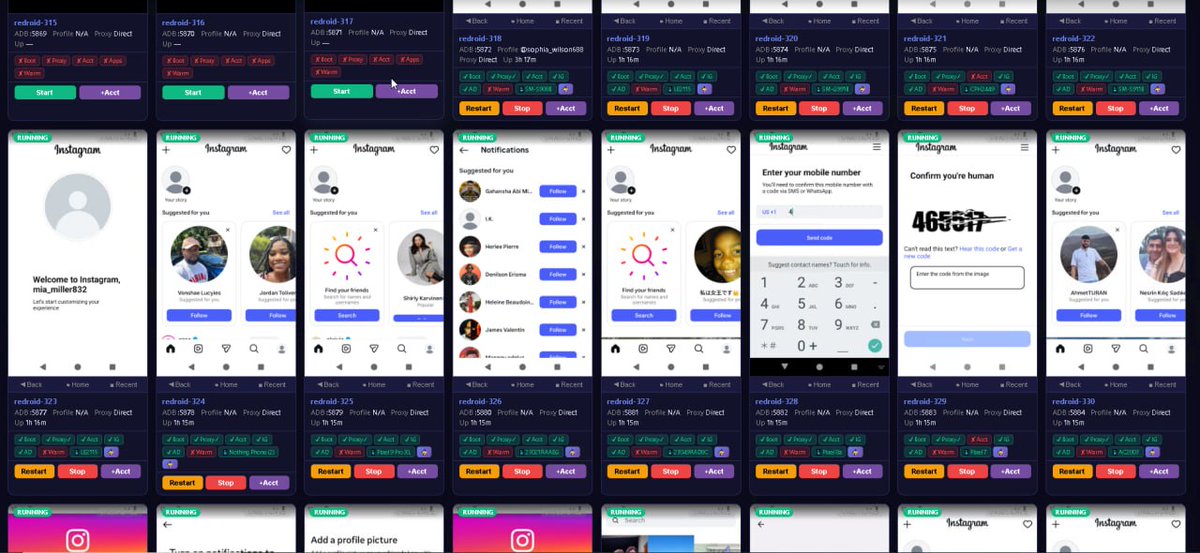
## Step 7: The Account Warmup Protocol Runs Continuously
every new account entering any client's portfolio goes through a structured warmup protocol before being deployed at full production volume.
the protocol follows a 4-week behavioral ramp from profile completion through engagement-only behavior to full posting volume.
at the operation's scale, 30 to 50 new accounts enter warmup per week across all clients as portfolios scale up or replace flagged accounts. the warmup behavior runs through automated systems that simulate the engagement patterns required to establish algorithmic trust before content posting begins.
accounts that skip warmup and immediately post at high frequency are identifiable to platform detection systems and tend to receive suppressed distribution from the start. the warmup discipline is what protects the entire account portfolio's algorithmic trust accumulation.
## The Daily Operational Rhythm at Scale
the production volume of 1,000+ reels daily across 10 clients sounds like it requires a team of 12 to 15 people working full days. with the right system, it requires 1 operator working approximately 3 hours per day.
the analytical session (45 minutes): Co-work runs the analytical prompt across all 10 client portfolios and produces production briefs for the day's batch.
the production session (90 to 120 minutes): Co-work generates scripts for all 10 clients in parallel, GPT Image 2 generates slide visuals and reference assets in batches per client, Seedance 2.0 generates video clips with the standing technical specifications.
the assembly session (30 to 45 minutes): the compatibility matrix runs against each client's clip library and selects the day's deployment combinations.
the scheduling session (60 to 90 minutes): Later distributes the day's finished content across all 2,000+ accounts with platform-specific elements applied per piece.
total operator time: approximately 3 hours per day for 10 active clients producing 1,000+ daily reels combined. the leverage comes from the parallel processing across clients rather than the sequential processing within each client.
## What Makes This Volume Genuinely Sustainable
operators running this volume successfully have a few specific operational disciplines that distinguish the sustainable operation from the burnout operation.
the Co-work prompt templates stay consistent across clients. instead of customizing the analytical prompt for each client individually, the same prompt template runs across all clients with client-specific brief variables fed in. this is what enables parallel processing.
the technical specifications stay universal across the production pipeline. skin texture, anti-polish language, lighting physics, emotional arc specification, all of these apply identically regardless of client or platform. the production discipline doesn't fragment.
the quality control disciplines stay non-negotiable. the 3-criteria reference asset check, the 4-point Seedance output check, the audio check after the post-production speed adjustment, all of these run on every output regardless of production volume. skipping quality control to accommodate volume produces output that fails the organic content test, which collapses the unit economics that the volume was supposed to improve.
the strategic intelligence layer stays unified. weekly cross-client synthesis identifies patterns that wouldn't be visible from single-client analysis. the operation gets smarter over time because the analytical layer compounds intelligence across clients rather than fragmenting it.
## What This Means for Operators at Lower Volume
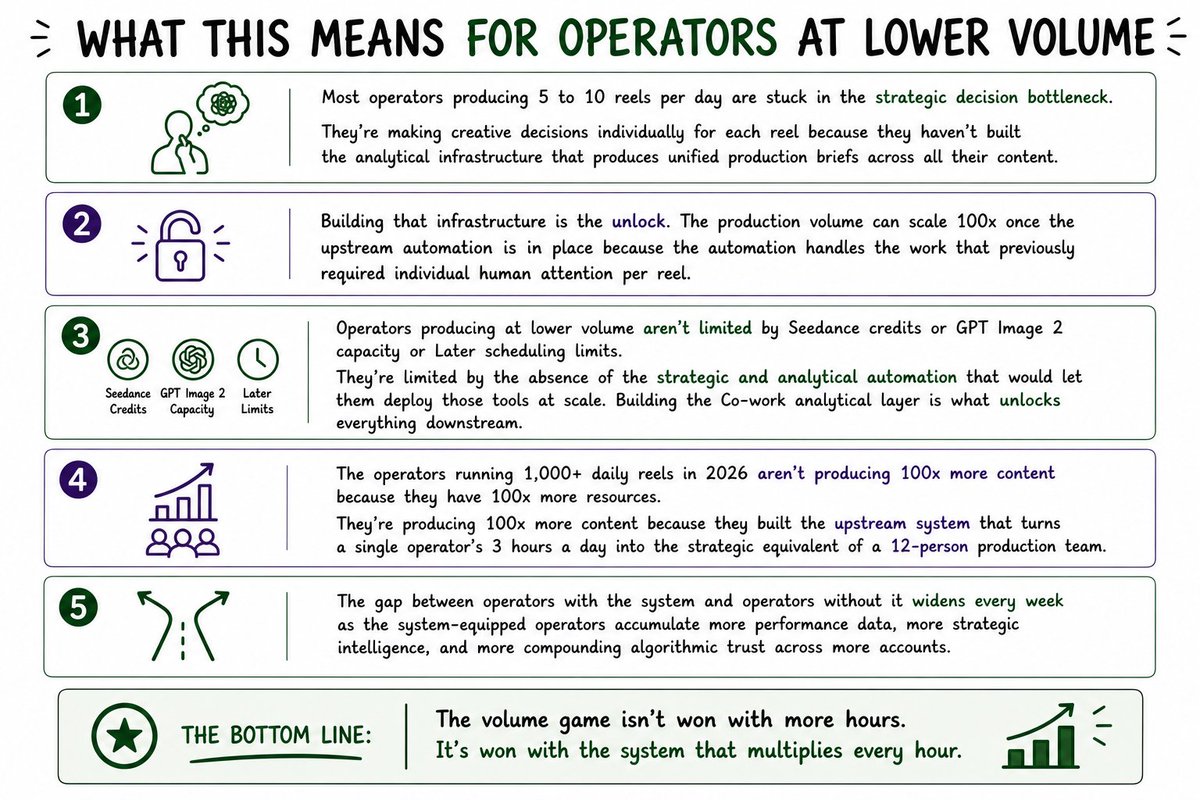
most operators producing 5 to 10 reels per day are stuck in the strategic decision bottleneck.
they're making creative decisions individually for each reel because they haven't built the analytical infrastructure that produces unified production briefs across all their content.
building that infrastructure is the unlock. the production volume can scale 100x once the upstream automation is in place because the automation handles the work that previously required individual human attention per reel.
operators producing at lower volume aren't limited by Seedance credits or GPT Image 2 capacity or Later scheduling limits. they're limited by the absence of the strategic and analytical automation that would let them deploy those tools at scale. building the Co-work analytical layer is what unlocks everything downstream.
the operators running 1,000+ daily reels in 2026 aren't producing 100x more content because they have 100x more resources. they're producing 100x more content because they built the upstream system that turns a single operator's 3 hours a day into the strategic equivalent of a 12-person production team.
the gap between operators with the system and operators without it widens every week as the system-equipped operators accumulate more performance data, more strategic intelligence, and more compounding algorithmic trust across more accounts.
P.S. - if you just want us to implement this entire ai ugc structure for your campaigns instead...
DM me "STACK" on X (@adriansolarzz) and I'll show you exactly how we'd apply these principles to your specific offer.
- adrian
## 相关链接
- [Adrian Solarz](https://x.com/adriansolarzz)
- [@adriansolarzz](https://x.com/adriansolarzz)
- [1.4K](https://x.com/adriansolarzz/status/2051774034917122109/analytics)
- [@adriansolarzz](https://x.com/@adriansolarzz)
- [Upgrade to Premium](https://x.com/i/premium_sign_up)
- [5:20 AM · May 6, 2026](https://x.com/adriansolarzz/status/2051774034917122109)
- [1,480 Views](https://x.com/adriansolarzz/status/2051774034917122109/analytics)
---
*导出时间: 2026/5/6 09:39:14*
---
## 中文翻译
# 我们如何自动化每日 1,000+ 条 AI UGC Reels(逐步详解)
**作者**: Adrian Solarz
**日期**: 2026-05-05T21:20:24.000Z
**来源**: [https://x.com/adriansolarzz/status/2051774034917122109](https://x.com/adriansolarzz/status/2051774034917122109)
---

2026 年的大多数运营者每天最多只能产出 20-30 条 Reels,并且苦于无法扩大规模……
但我们目前正通过单一的制作管线,每天为客户组合产出 1,000+ 条 AI UGC Reels,而这套系统只需一名运营者每天花费几个小时即可管理。
在本文中,我将详细拆解这种体量是如何实现的:
1. 运营上的可行性
2. 驱动产出的上游自动化
3. 我们在每一层使用的具体工具栈
4. 以及保持工作流程简洁的运营节奏
如果你一直手动制作 AI UGC,并想知道自动化是否真的能达到这种规模……
正是这套系统让它成为现实:
## 运营者遇到的 4 个运营限制

在深入系统之前,有必要解释一下限制大多数运营者在更低的产量下徘徊的因素,因为下面的系统正是为了突破每一个限制而专门设计的。
限制 1:战略决策瓶颈。每条 Reels 都需要创意决策:使用什么钩子类别,切入什么痛点角度,针对什么人群画像,部署什么 CTA(号召性用语)结构。运营者为每条 Reels 单独做决策时,每天最多只能处理 20 到 30 条,因为决策量本身就成了限制因素。
限制 2:脚本撰写瓶颈。在每天 5 到 10 条 Reels 的量级,手动写脚本是可行的。但在每天 100+ 条时,就不可行了。试图在大体量下手动写脚本的运营者会遇到质量瓶颈,因为所需的写作时间超过了可用的制作工时。
限制 3:制作执行瓶颈。以生产规模生成 Seedance 2.0 视频片段、GPT Image 2 参考素材和幻灯片视觉素材,需要能够最大限度减少重复生成周期的结构化工作流。如果没有这些工作流,制作环节的时间投入将扩大到不可持续的地步。
限制 4:分发瓶颈。每天手动在 200 多个账号上安排 1,000+ 条内容发布是不可能的。如果没有处理分发层的自动化排期工具,制作出的内容只能堆积在队列中,而无法触达受众。
下面系统的每一层都是为了打破这 4 个限制之一而专门设计的。同时打破这 4 个限制,才是解锁这种体量的关键。
## 第一步:Claude Co-work 处理所有战略和分析决策

Claude Co-work 同时为每个客户组合运行战略和分析层。
这就是打破战略决策瓶颈的关键。运营者不再需要为 10 个客户的每条 Reels 单独做出创意决策,Co-work 运行统一的分析管线,根据前一天的绩效数据为每个客户生成制作简报。
每日分析会议
每个制作工作日都以并行分析所有客户组合的分析会议开始。
Co-work 从每个客户的 200 多个账号中提取绩效数据,识别前一天哪种格式和方法带来了最强的表现,并生成 10 份独立的制作简报(每个活跃客户一份),明确指定即将到来的制作批次应优先考虑的内容类别。
每份简报识别出:
哪些钩子类别对该特定客户受众最有效。
哪些痛点角度产生了最强的留存率和私信(DM)转发量。
哪些人群画像的转化率最高。
哪些 CTA 结构最能带来评论漏斗的入口。
哪些内容类别已经饱和,需要降低优先级。
分析会议在所有 10 个客户上总共只需 30 到 45 分钟,因为提示词模板是统一的,且 Co-work 能高效处理并行分析。这将原本需要 5 到 6 小时的手动分析工作压缩到了 30 到 45 分钟的监督式自动化中。
每周智能层
每周一,每周智能会议将所有活跃客户前一周的绩效数据综合成一份战略智能简报,用于更新上游的创意方向。
跨客户的模式在这一层变得可见,这是单一客户分析无法显现的。例如,客户 1(护肤品类)中表现强劲的钩子格式,可能会启发我们对客户 4(补充剂品类)的测试。在一个垂直领域已经饱和的痛点角度,可能预示着在相邻垂直领域也会饱和。
这种统一的分析层产生了复合智能,这是将每个客户分开运营的分散式操作无法复制的。
## 第二步:Claude Co-work 生成每一个脚本

Claude Co-work 在每个客户的单次制作会议中,生成所有客户和所有平台的每一个脚本。
这就是打破脚本撰写瓶颈的关键。不再需要手动为每条 Reels 撰写脚本,Co-work 根据制作简报同时生成针对特定平台的脚本批次。
每个客户的简报输入
每次脚本生成会议都提取 3 个具体输入:
受众洞察陈述(基于真实客户评价语言构建的目标人群生动情感画像)。
产品简报(包含独特机制、客户评价语言和优惠结构)。
结构参考(来自表现优异的竞品 Reels 的带注释转录文本,该视频已运行 30 天以上,用作结构蓝图)。
这 3 个输入结合分析会议生成的客户制作简报,产出客户运行的所有平台和格式的脚本。
每次会议的输出
每次脚本生成会议产出:
跨越所有 4 个钩子类别(具体性钩子、虚假开场钩子、结果具体性钩子、身份钩子)的 20 到 25 个钩子脚本,并包含情感基调和舞台指导。
跨越多种情感角度的 10 到 15 个主体片段脚本,包含完整的痛点承认、机制桥梁和产品介绍结构。
跨越不同行动类型和分享提示形式的 10 到 15 个 CTA 片段脚本。
每个片段完整的 Seedance 2.0 生成提示词,包含场景指导、灯光规格、人物人口统计、情感弧线、皮肤纹理规格和反精致语言。
每个平台的特定格式输出:Instagram Reels 脚本、TikTok 视频脚本、TikTok 幻灯片脚本、Instagram 轮播脚本、YouTube Shorts 脚本、Facebook Reels 脚本、Facebook 图片贴文脚本。
每次会议每个客户需要 45 到 60 分钟。跨越 10 个客户,总脚本撰写时间从原本需要数天的手动写作压缩到了 8 到 10 小时的自动化生成,且全部并行运行而非串行。
## 第三步:GPT Image 2 生成所有视觉参考和静态幻灯片素材

GPT Image 2 处理所有客户和所有平台的每张静态视觉素材。
视频生成的人物参考。视觉连贯性的产品参考镜头。Instagram 轮播幻灯片。TikTok 幻灯片。YouTube 缩略图。Facebook 图片贴文。
多角度人物参考管线
每个客户都会通过 GPT Image 2 生成一套多角度人物参考集,并对每个通过的变体应用 Topaz 放大。
参考素材会议每个角色需要 5 到 15 分钟。这 5 到 15 分钟的上游投入生成的人物参考,将支持该客户接下来 1 到 2 周制作期间所有 4 个平台的内容。
跨越 10 个客户,多角度参考工作在每个轮换周期内每个客户只需做一次,而不是每条 Reels 做一次。参考素材工作流是高度并行的,因为它按角色节奏运行,而非按 Reels 节奏运行。
幻灯片生成管线
轮播幻灯片和视频幻灯片按客户分批生成,同一人物参考和美学基线作为多模态输入加载到整套幻灯片中。
典型的客户轮播制作会议在单次会议中为 5 到 8 个轮播各生成 8 张幻灯片。GPT Image 2 的批处理能力意味着每个客户的 40 到 80 张幻灯片可以并行生成,而非串行。
跨越 10 个制作轮播和幻灯片的客户,每日幻灯片生成总量约为 300 到 500 张,全部通过结构化的批次会议生成,而非单个生成周期。
质量把控规范
每个参考素材和幻灯片生成在进入制作管线前,都要经过 3 项标准的质量检查:
真实性(这看起来像一张真实的照片,而不是 AI 生成的图像)。
细节(图像是否具有真实照片所具有的纹理和微小瑕疵)。
“真实测试”(在没有进一步上下文的情况下,这是否会在前 2 秒内被解读为真人)。
未能通过 3 项标准中任何一项的变体会针对具体失败元素调整提示词后重新生成。通过的变体则进入该客户的制作管线。
## 第四步:Seedance 2.0 生成每个视频片段

Seedance 2.0 生成所有客户和所有平台的每个视频片段。
Instagram Reels、TikTok 视频、YouTube Shorts、Facebook Reels。全部通过同一条制作管线运行,在提示词层面应用特定平台的格式和美学调整。
常设技术规格
无论客户或平台如何,每个 Seedance 2.0 提示词都包含相同的常设技术规格:
皮肤纹理规格:“真实的皮肤纹理,鼻子和脸颊周围可见毛孔,自然的轻微不均匀,无滤镜质感。” 每个包含人脸的提示词都无一例外地包含此内容。
反精致语言:“手持手机摄像头的感觉,随意略微不稳定的构图,在真实环境中拍摄,而非专业布景,有机非工作室品质。”
光照物理条款:“来自左侧窗户的柔和漫射光,投射柔和阴影,无强烈高光,皮肤光照适当无过曝。”
情感弧线规格:适用于角色表情在持续时间内发生变化的任何片段。
这些规格在所有 10 个客户和所有 4 个平台上均一致应用。制作纪律不会因客户而分散,因为底层制作原则是通用的。
逐镜生成方法
制作管线中的每个片段都获得自己的 Seedance 生成,而不是试图在单次通过中渲染多镜头序列。这种方法在规模化时有 3 个优势:
它允许为每个镜头加载适当的角度参考,而不是要求 Seedance 从多个角度解释角色外观。
它允许在单个片段未通过质量检查时进行单独镜头重新生成,而无需重新渲染整个序列。
它在整个持续时间内产生更清晰的音频同步,因为每个镜头的音频都是作为聚焦单元生成的。
4 点质量检查
每个 Seedance 输出在进入变体管线前都要经过 4 点质量检查:
运动真实性(动作看起来自然而非诡异)。
皮肤渲染(皮肤纹理通过真实人类皮肤测试)。
音频同步(唇音轨与对话对齐)。
前 2 秒的“真人测试”(这对刷过的观众来说是否会注册为真人)。
未能通过 4 项标准中任何一项的片段会针对具体失败元素调整提示词后重新生成。通过的片段进入组装的变体管线。
成本优化层
密集脚本加慢速技术应用于每次 Seedance 生成,以节省 25% 到 30% 的积分支出,而不牺牲输出质量。
脚本的编写密度比目标持续时间通常能容纳的高出 25% 到 30%。虚拟人以约 1.25 倍的自然节奏生成。输出在后期制作中放慢至 0.75 倍。最终视频以自然节奏播放,但消耗的积分明显少于以标准节奏制作所需的积分。
跨越每天 1,000+ 条 Reels,积分节省累积成可观的月度利润率提升,直接转化为运营的单位经济效益。
## 第五步:模块化组装和兼容性矩阵

在为每个客户建立片段库后,组装阶段通过兼容性矩阵运行,以选择哪些组合部署到该客户的账号组合中。
兼容性逻辑
并非每个钩子片段都能自然地与每个主体片段配对。钩子的情感基调需要流畅地过渡到主体的开头,而没有突兀的语调转变,且主体中解决的痛点角度需要与钩子暗示的特定情况相匹配。
兼容性矩阵为每个钩子片段标记其情感基调和主要痛点角度,为每个主体片段标记其设计连接的情感切入点。组装仅来自兼容的配对,这意味着部署集由所有连贯执行的组合组成,而非所有可能的组合。
每个客户的组合数学
从典型的片段库(每个客户 22 个钩子、12 个主体和 10 个 CTA)来看,总可能组合数为 2,640。经过兼容性过滤后,可用于部署的连贯组合每个客户约为 1,000 到 1,200 个。
跨越 10 个制作类似库的客户,总组合池在每个刷新周期超过 10,000 个独特的 Reels。每日部署根据制作简报的战略优先级从这个池中提取,而不是每天制作新的组合。
刷新节奏
片段库根据前一周的绩效数据每周为每个客户刷新。
表现强劲的组件会通过增加变体进行扩展。表现不佳的组件会被淘汰。基于跨客户智能和每周绩效综合添加新组件。
刷新节奏意味着每个客户的库都在不断演进,趋向于为该特定受众带来最强表现的组件,同时总组合池保持足够大,以支持每日部署量而无重复问题。
## 第六步:跨多账号组合的分发

Later (later(.com)) 从单一日历界面处理所有 10 个客户组合的跨平台排期。
账号组合数学
每个客户在 4 个平台上每个平台运行 50 个账号,根据 CPM 预算和利基特征进行扩展。跨越 10 个客户,该运营同时管理 2,000+ 个账号。
每个账号每天发布 1 到 3 条内容,这位于每个平台发布频率的算法最佳点。每日 1,000+ 条 Reels 的内容量分配到 2,000+ 个账号,平均每个账号每天接收 1 到 2 条内容。