# I deleted 224 of 247 Claude Skills I tested. Here are the 23 I kept.
**作者**: Mnimiy
**日期**: 2026-05-05T16:31:54.000Z
**来源**: [https://x.com/Mnilax/status/2051701429987897712](https://x.com/Mnilax/status/2051701429987897712)
---
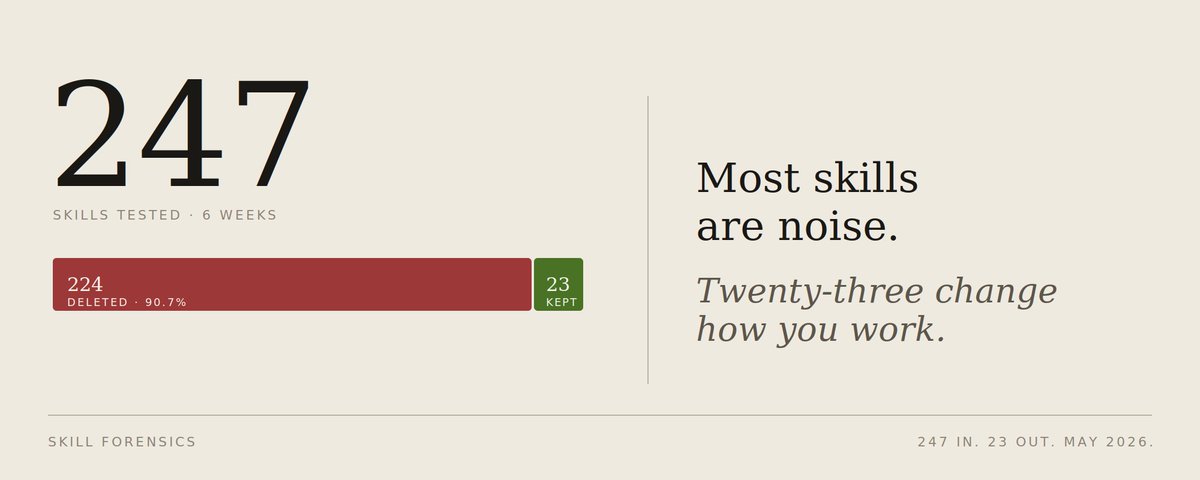
The Claude Skills marketplace went from 16 official skills in October 2025 to 900,000+ community skills by May 2026. Most of them are noise. A handful changed how I work permanently. The rest broke my context window, conflicted with each other, or did literally nothing.
I spent 6 weeks installing skills, running each on real projects, and timing the difference.
247 in. 23 kept. Everything else uninstalled.
Each skill: what it does, what surprised me, when to install it, when to skip it.
Plus the install order, because if you install all 23 at once, you'll burn through your context window before Claude generates a single useful token.
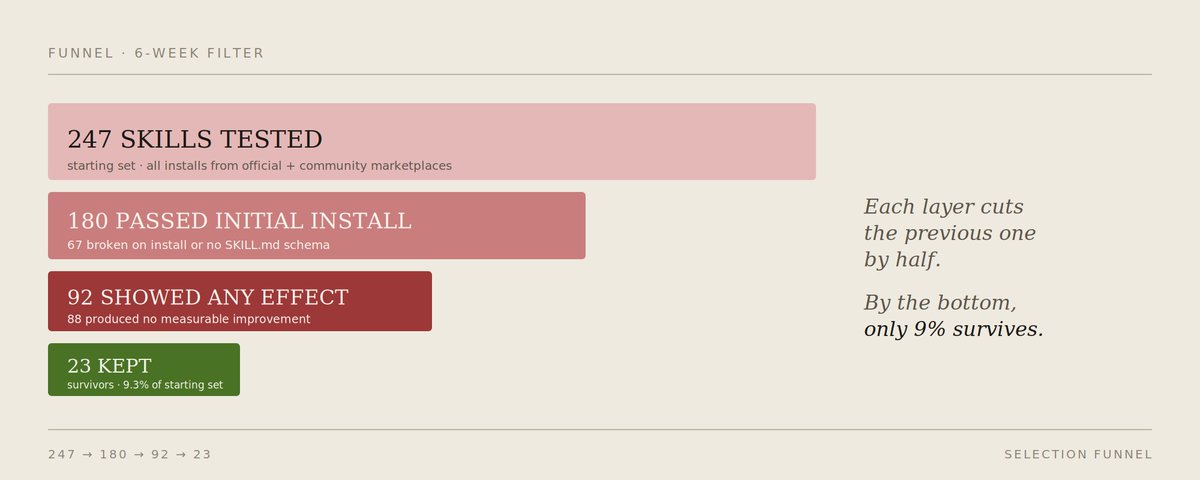
# The methodology (so you can trust the ranking)
I didn't trust install counts. Half of the high-install skills I tested produced nothing measurable. Here's what I actually did:
## For each skill:
1. Installed in isolation on a fresh ~/.claude/ directory
2. Ran 5 representative tasks the skill claims to handle
3. Timed each run against a baseline (no skill)
4. Counted output quality manually on a 1-5 scale
5. Tracked context overhead (tokens injected per session)
Pass criteria:
- Quality improvement of at least 1.5 points on the 5-scale
- Time savings of at least 30% on its core task
- Made possible something the baseline genuinely could not do
Fail criteria:
- No measurable improvement
- Adds more context than it returns in value
- Conflicts with another already-installed skill (cascade detected via the lock-file diagnostic)
- Hasn't been updated since February 2026
That's how 247 became 23.
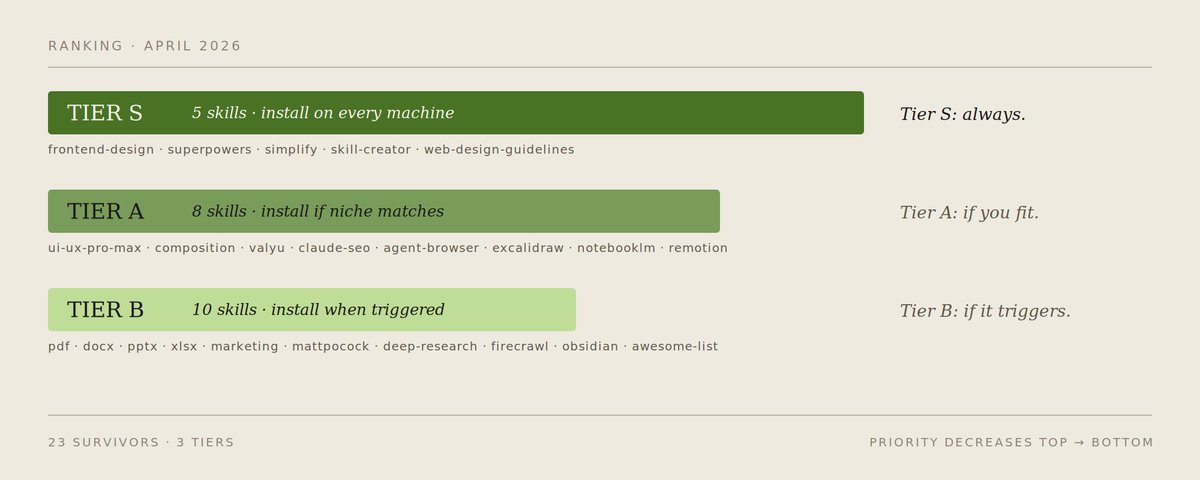
# Tier S: install on every machine, every project (5 skills)
These five gave the largest measurable lift. If you install nothing else from this article, install these.
## 1. frontend-design (Anthropic, 277K+ installs, ~66K repo stars)
What it does: forces Claude into a real design direction — brutalist, editorial, retro-futurist, whatever, before writing any code. Eliminates the AI-slop look (Inter font, purple gradient on white, grid cards) that signals "this was generated."
Install: /plugin marketplace add anthropics/skills && /plugin install frontend-design
Surprise: the biggest gain wasn't visual. It was that Claude stopped second-guessing aesthetic decisions. Once a direction is committed, every subsequent component matches.
When to install: any project with a UI surface. Even internal tools.
When to skip: pure backend / API work.
Worth knowing: pbakaus/impeccable is now a serious alternative, it's 23 commands instead of one auto-trigger, two distinct modes (brand vs product), and a Chrome overlay that highlights anti-patterns directly on the page. Install one or the other, not both. They fight on the same task.
## 2. superpowers (obra, 177K+ stars)
What it does: replaces ad-hoc prompting with a 7-phase workflow — brainstorm -> spec -> plan -> TDD -> subagent execution -> review -> finalize.
The TDD enforcement isn't a suggestion: the skill literally refuses to write implementation before a failing test exists.
Install: /plugin marketplace add obra/superpowers-marketplace && /plugin install superpowers
Or, since January 15, 2026, directly from the official Anthropic marketplace: /plugin install superpowers@claude-plugins-official
Surprise: I expected this to slow me down. It didn't. The 20 minutes of upfront brainstorming saved 3 hours of unwinding wrong directions. Simon Willison called the underlying ideas "genuinely fascinating" — and the repo went from 94K stars in early March to 177K by end of April. Fastest growing Claude Code project of 2026 by a margin.
When to install: any feature that takes more than one session to build.
When to skip: small fixes, exploratory prototyping, single-file scripts.
## 3. simplify (Anthropic, ~133K weekly installs)
What it does: takes recently-modified code and cleans it without changing behavior. Specifically targets nested ternaries, three-jobs-in-one functions, abstractions that "made sense at the time."
Install: /plugin marketplace add anthropics/claude-plugins-official && /plugin install code-simplifier@claude-plugins-official
Surprise: the rule it enforces — "never change behavior, only how behavior is expressed" — kept me from accidentally refactoring my logic. Most "AI cleanups" silently change semantics. This one doesn't.
When to install: every project. Run after every coding session.
When to skip: never.
## 4. skill-creator (Anthropic)
What it does: walks you through building your own skills properly —describes the workflow, proposes a SKILL.md, runs 3-5 test prompts, refines instructions based on failures. Meta-skill that makes every other skill better.
Install: enabled by default in Claude Code v2.1+.
If disabled: /plugin install skill-creator@anthropics/claude-code.
Surprise: writing your own skill took ~5 minutes once I had this. Without it, I burned an afternoon on my first attempt. The hidden value: most "this skill should exist but doesn't" gaps in your workflow are 10-minute fixes once you know how to scaffold a SKILL.md properly.
When to install: as soon as you find yourself writing the same CLAUDE.md instruction twice.
When to skip: only if you're genuinely a Claude consumer, never a producer.
## 5. web-design-guidelines (vercel-labs/agent-skills, 19.5K stars)
What it does: 100+ rules covering accessibility, performance, UX. Reviews UI code against the latest Vercel guidelines and outputs violations in file:line format.
Install: /plugin marketplace add vercel-labs/agent-skills && /plugin install web-design-guidelines
Surprise: caught an accessibility violation (visible focus state) that ESLint's a11y plugin missed entirely. Turns out "technically valid HTML" and "actually usable" are different bars.
When to install: pair with frontend-design, that one creates, this one audits.
When to skip: not building UIs.
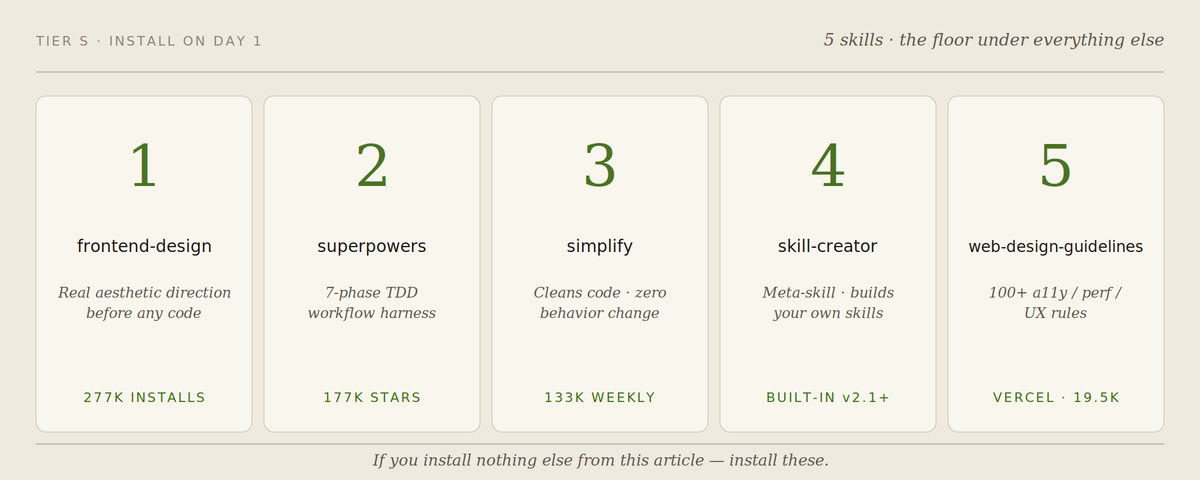
# Tier A: install if your work matches the niche (8 skills)
Strong, focused. Install if your daily work touches the niche. Skip if not.
## 6. ui-ux-pro-max (nextlevelbuilder, 29.6K stars)
50+ UI styles, 97 color palettes, 57 font pairings, 99 UX guidelines, 25 chart types, 9 stacks. Ships with a Python CLI to query the design database. Install when starting from a blank Figma.
Skip when the design system already exists.
## 7. composition-patterns (vercel-labs)
Teaches Claude compound components, context providers, explicit variants. The single rule that justifies install: architecture-avoid-boolean-props. If you've inherited a component with 15 boolean props, install this. If you write modern React from scratch, optional.
## 8. valyu (valyuAI/skills)
Connects Claude to web search + 36+ specialized data sources: SEC filings, PubMed, ChEMBL, ClinicalTrials.gov, FRED economic indicators, academic publishers.
79% on FreshQA benchmark vs Google's 39%.
On finance-specific questions: 73% vs Google's 55%. Install if your work touches any of those domains.
## 9. claude-seo (AgriciDaniel/claude-seo)
Full-stack SEO audits with live DataForSEO data, schema validation, GEO-first optimization (citability scoring for AI crawlers).
12 sub-skills. Install if SEO is part of your job.
## 10. agent-browser
Lets Claude control any web interface through stable element refs — no clean API required.
Clicks, fills, screenshots, parallel sessions. The Playwright MCP alternative for when Playwright is overkill.
## 11. excalidraw-diagram
Generates Excalidraw-style diagrams from natural language. Install if architecture diagrams are part of your communication.
Skip if you live in code only.
## 12. notebooklm-integration
Bridges Claude with NotebookLM. Upload specs / API references / research papers once, query them from Claude with citations.
Install for documentation-heavy projects.
## 13. remotion-best-practices (remotion-dev/skills, 117K weekly installs)
Programmatic video generation in React. Install if you need product demos / release videos / explainers without a separate video workflow.
Skip if you don't.
# Tier B: useful but specific (10 skills)
Worth installing if the trigger condition matches.
14. pdf (Anthropic) - forms, invoices, table extraction
15. docx (Anthropic) - word doc generation/editing with tracked changes
16. pptx (Anthropic) - slide decks from natural language
17. xlsx (Anthropic) - spreadsheet generation, formulas, charts
18. marketing-skills (coreyhaines) - CRO, copywriting, email sequences, growth
19. mattpocock/skills - TypeScript daily, type safety, migrations
20. claude-deep-research-skill - 8-phase research with auto-continuation
21. firecrawl - sraping hostile/JS-heavy sites
22. obsidian-skills (kepano, by Obsidian's CEO) - auto-tagging, auto-linking, vault-native
23. awesome-claude-skills (travisvn) - meta-catalog 22k stars, browse before building
# The 224 I deleted (and why)
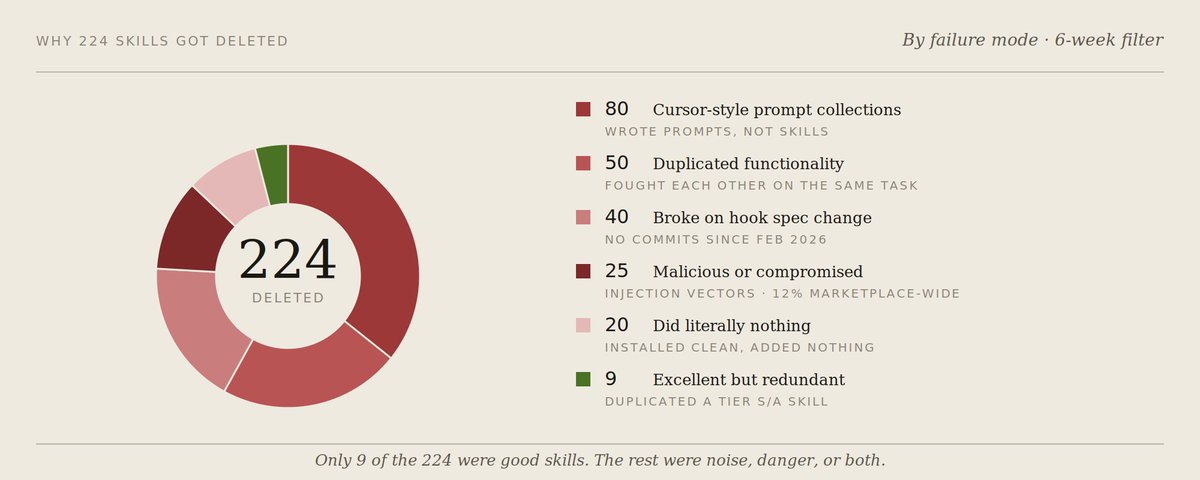
I won't list them all. Here's the pattern of why most failed:
~80 skills were "Cursor-style" prompt collections.
A markdown file with 50 generic rules. No SKILL.md schema. Installs as documentation. Provides nothing the model couldn't already do with CLAUDE.md.
~50 skills duplicated functionality of better-maintained skills.
Two TDD frameworks. Three security scanners. Five "code reviewers." When I instrumented hooks, they fired in series and produced contradictory output. Pick one per category.
~40 skills had no commits since February 2026.
Claude Code's hook spec changed in v2.1 (added 21 lifecycle events), and these skills broke silently. The PostToolUseFailure event in particular invalidates a lot of older "auto-fix" skills that assumed the old failure model.
~25 skills were straight-up malicious or compromised.
Pattern: high stars (500+), repo created after February 2026, no contributor history, dependency on a sketchy package. ECC's AgentShield documented 341 malicious skills out of 2,857 scanned on one major marketplace in January 2026 alone 12% compromised, in a single month.
Treat new high-star skills like new high-yield wallets — too clean usually means farmed or worse.
~20 skills did basically nothing.
They installed cleanly, didn't conflict, didn't break — but didn't measurably improve anything. Net effect zero, with a small context tax.
~9 skills were excellent but redundant with one of the 23 above.
Honorable mentions: spartan-ai-toolkit, artifacts-builder, tdd-guard, Plannotator, claude-mem. If you're already on the 23 list, these don't add. If you want a substitute, fine.
# The install order (this matters more than the list)
Installing all 23 at once will destroy you. Each skill adds context overhead. 23 active skills will hit Claude's context window before you finish typing your first prompt. Worse, they conflict (web-design-guidelines and ui-ux-pro-max will fight on the same task).

The install order I tested:
Week 1 — Foundation (4 skills, install all):
1. skill-creator (so you can build your own when gaps appear) already enabled by default in Claude Code v2.1+
2. simplify / code-simplifier (cleans every output)
3. superpowers (the workflow harness)
4. Pick ONE of frontend-design or backend equivalent based on your domain
Week 2 — Add based on the gap (1-2 more):
- If UI work -> web-design-guidelines + maybe ui-ux-pro-max
- If TypeScript work -> mattpocock/skills
- If research / data work -> valyu
- If SEO / content -> claude-seo
Week 3+ — Domain-specific (1-2 more):
- Document-heavy -> pdf, docx, pptx, xlsx (one of, rarely all four)
- Diagrams -> excalidraw-diagram
- Video -> remotion-best-practices
Stop at 5-7 active skills. That's the sweet spot. Beyond that, context overhead exceeds value. Disable inactive skills with /plugin disable <name>.
There's a deeper reason for this cap. Each skill loads its SKILL.md into context whenever Claude detects relevance.
With 9+ active skills running on conservative "load when in doubt" detection, you're paying ~13,500 tokens of skill overhead per task that needs none of them, before Claude reads your actual prompt. The same logic that caps your CLAUDE.md to 1,200 words caps your active skills to 5-7. Both are baseline tax. Both compound.
If you want a moving target: every two weeks, run an audit. Which skills did Claude actually invoke? The ones that didn't fire — disable. The gap that opened, install one new skill to fill it.
# What didn't work
Installing skills via npx skills add blindly.
Half didn't have proper SKILL.md frontmatter. They installed but Claude never invoked them. Always verify with /plugin list after install, if it shows up but isn't activating on the tasks you expect, the skill is broken.
Trusting install counts as quality signals.
Two of the top-30 by install count produced literally no measurable improvement on my benchmark tasks. Install counts measure marketing reach, not skill quality.
Mass-installing from "awesome-claude-skills" lists.
Same problem as above × 50. The curated lists optimize for breadth. You want depth in the skills you actually use.
Skipping the audit step.
I gave myself 6 weeks. The first 2 weeks I was installing without measuring. I had no idea what was helping until I started timing tasks. Without a baseline, you can't tell if Claude got better or worse.
Installing both web-design-guidelines and ui-ux-pro-max at the same time. Conflict. They both want to drive the design phase.
Pick one based on whether you need creation help (ui-ux-pro-max) or audit help (web-design-guidelines).
Installing both frontend-design and impeccable at the same time.
Same problem, different layer. Both encode aesthetic taste. Pick one.
Installing skills that haven't been updated in 2+ months.
Hook spec changed. PostToolUseFailure event was added. Skills that weren't updated for it produce silent failures. Check last commit before install.
Using Search and Tools feature alongside skills like valyu.
Both invoke web search. They overlap, both consume tokens, neither gets a clean signal. Disable Anthropic's built-in Search when using a search-specialist skill like valyu.
## How to maintain your stack
The marketplace ships ~50-100 new skills per week now. Your stack will go stale.
A 10-minute weekly ritual:
```
# 1. Which skills did Claude actually use this week?
grep -h "skill_invoked" ~/.claude/logs/*.log | sort | uniq -c | sort -rn
# 2. Which skills haven't fired in 14 days?
# (anything in your ~/.claude/skills that's not in the output above)
ls ~/.claude/skills/ > /tmp/installed.txt
# manually compare — disable anything not invoked
# 3. Run an audit on remaining skills
npx ecc-agentshield scan # if you have ECC installed
# 4. Check the official marketplace for new skills in your domain
# claude.com/plugins
```
Disable, don't uninstall. Easier to re-enable later if you find a use.
If a skill hasn't fired in 30 days, uninstall. Context tax doesn't justify keeping it on shelf.
# The mental model
There are two types of skills, and you need both:
Capability skills — give Claude new abilities it didn't have.
firecrawl (scraping hostile sites), valyu (paywalled data), pdf (form extraction), agent-browser (UI automation). Without these, Claude literally can't do the task.
Discipline skills — make Claude execute the way you want, in your style, with your conventions.

frontend-design (aesthetic taste), simplify (code style), superpowers (process), web-design-guidelines (audit). Without these, you get generic AI output.
Most people install only capability skills and wonder why their output looks like everyone else's. Most quality improvement comes from discipline skills. That's why 4 of the Tier S 5 are discipline skills, not capability skills.
If you have time for one more thought exercise for each of the next 5 tasks you do with Claude, ask: "Did the output look generic, or did it look like me?"
If generic, you're missing discipline skills. Install one, retry the same task, compare.
# T H E _ E N D
The skills marketplace is the most undervalued part of the Claude ecosystem. Most people are still using vanilla Claude Code in May 2026. They feel like the model got "smarter slower" than the headlines suggested. It didn't. They didn't install the skills.
23 of the right skills, installed in the right order, is more important than which Claude version you're on.
If this saved you a weekend of marketplace browsing, repost.
> If this saves you a weekend of marketplace browsing, bookmark and pass it on. Part 3 next days.
> Telegram for weekly skill audits and new releases worth knowing: https://t.me/+_ZWrQN7GuDA3ZDEy
## 相关链接
- [Mnimiy](https://x.com/Mnilax)
- [@Mnilax](https://x.com/Mnilax)
- [25K](https://x.com/Mnilax/status/2051701429987897712/analytics)
- [ClinicalTrials.gov](https://clinicaltrials.gov/)
- [https://t.me/+_ZWrQN7GuDA3ZDEy](https://t.me/+_ZWrQN7GuDA3ZDEy)
- [Upgrade to Premium](https://x.com/i/premium_sign_up)
- [12:31 AM · May 6, 2026](https://x.com/Mnilax/status/2051701429987897712)
- [25K Views](https://x.com/Mnilax/status/2051701429987897712/analytics)
- [View quotes](https://x.com/Mnilax/status/2051701429987897712/quotes)
---
*导出时间: 2026/5/6 09:38:27*
---
## 中文翻译
# 我测试了 247 个 Claude 技能,删了 224 个。这是我留下的 23 个。
**作者**: Mnimiy
**日期**: 2026-05-05T16:31:54.000Z
**来源**: [https://x.com/Mnilax/status/2051701429987897712](https://x.com/Mnilax/status/2051701429987897712)
---

Claude 技能市场从 2025 年 10 月的 16 个官方技能,增长到 2026 年 5 月的 90 万+ 社区技能。其中大部分都是噪音。只有少数几个永久地改变了我的工作方式。其他的要么撑爆了我的上下文窗口,要么互相冲突,要么真的毫无用处。
我花了 6 周时间安装技能,在真实项目中运行每一个,并计时其中的差异。
尝试了 247 个。保留了 23 个。其他的全部卸载。
针对每个技能:它的作用、让我意外的地方、何时安装、何时跳过。
此外还包括安装顺序,因为如果你一次性安装全部 23 个,你会在 Claude 生成一个有用的字符之前就耗尽上下文窗口。

# 测试方法(这样你才能信任这个排名)
我不相信安装量。我测试的高安装量技能中有一半没有产生任何可衡量的效果。这是我实际做的:
## 针对每个技能:
1. 安装在全新的 ~/.claude/ 目录中
2. 运行 5 项该技能声称能处理的代表性任务
3. 与基线(无技能)对比计时每次运行
4. 以 1-5 分的标准手动统计输出质量
5. 跟踪上下文开销(每个会话注入的 token 数)
通过标准:
- 质量提升至少 1.5 分(以 5 分为制)
- 核心任务时间节省至少 30%
- 实现了基线真正无法做到的事情
失败标准:
- 没有可衡量的提升
- 增加的上下文超过了其带来的价值
- 与另一个已安装的技能冲突(通过锁文件诊断检测到级联)
- 自 2026 年 2 月以来未更新
这就是 247 个变成 23 个的过程。

# S 级:每台机器、每个项目都必装(5 个技能)
这五个带来了最大的可衡量提升。如果你这篇文章只听一句话,那就是安装这五个。
## 1. frontend-design (Anthropic, 27.7万+ 安装, ~6.6万 仓库星标)
作用:在编写任何代码之前,强制 Claude 进入一个真正的设计方向 —— 粗野主义、编辑风、复古未来主义,随便什么。消除那种“这是 AI 生成的”AI 垃圾外观(Inter 字体、白色上的紫色渐变、网格卡片)。
安装:/plugin marketplace add anthropics/skills && /plugin install frontend-design
意外:最大的收获不是视觉上的。而是 Claude 不再在审美决策上犹豫不决。一旦确定了方向,随后的每个组件都会与之匹配。
何时安装:任何有 UI 界面的项目。甚至是内部工具。
何时跳过:纯后端 / API 工作。
须知:pbakaus/impeccable 现在是一个强大的替代品,它是 23 个命令而不是一个自动触发,有两种截然不同的模式(品牌 vs 产品),还有一个 Chrome 覆盖层直接在页面上突出反模式。安装其中一个,不要两个都装。它们会在同一个任务上打架。
## 2. superpowers (obra, 17.7万+ 星标)
作用:用 7 阶段工作流替代临时的提示 —— 头脑风暴 -> 规格说明 -> 计划 -> TDD -> 子代理执行 -> 审查 -> 定稿。
TDD 强制执行不是一个建议:该技能字面上会拒绝在存在失败的测试之前编写实现代码。
安装:/plugin marketplace add obra/superpowers-marketplace && /plugin install superpowers
或者,自 2026 年 1 月 15 日起,直接从官方 Anthropic 市场安装:/plugin install superpowers@claude-plugins-official
意外:我本以为这会拖慢我的速度。结果没有。前期的 20 分钟头脑风暴节省了 3 小时纠正错误方向的时间。Simon Willison 称其底层思想“真正令人着迷”——该仓库从 3 月初的 9.4 万星标增长到 4 月底的 17.7 万。是 2026 年增长最快的 Claude Code 项目,遥遥领先。
何时安装:任何需要超过一个会话来构建的功能。
何时跳过:小修补、探索性原型、单文件脚本。
## 3. simplify (Anthropic, ~13.3万 周安装量)
作用:获取最近修改的代码并清理它,而不改变行为。专门针对嵌套的三元运算符、三合一函数、那些“当时觉得合理”的抽象。
安装:/plugin marketplace add anthropics/claude-plugins-official && /plugin install code-simplifier@claude-plugins-official
意外:它执行的规则 —— “永远不要改变行为,只改变行为的表达方式” —— 让我避免了意外重构我的逻辑。大多数“AI 清理”会悄悄改变语义。这个不会。
何时安装:每个项目。每次编码会话后运行。
何时跳过:绝不跳过。
## 4. skill-creator (Anthropic)
作用:引导你正确构建自己的技能 —— 描述工作流、提出 SKILL.md、运行 3-5 个测试提示、根据失败情况完善指令。这是一个能让其他所有技能变得更好的元技能。
安装:在 Claude Code v2.1+ 中默认启用。
如果已禁用:/plugin install skill-creator@anthropics/claude-code。
意外:有了它,编写我自己的技能大约只需要 5 分钟。没有它,我第一次尝试花了一整个下午。隐藏的价值:你工作流中大多数“这个技能应该存在但实际上不存在”的空白,一旦你知道如何正确搭建 SKILL.md,就是 10 分钟的修补工作。
何时安装:当你发现自己写了两遍相同的 CLAUDE.md 指令时。
何时跳过:仅当你是纯粹的 Claude 消费者,从未打算成为生产者时。
## 5. web-design-guidelines (vercel-labs/agent-skills, 1.95万 星标)
作用:100+ 条规则,涵盖无障碍性、性能、UX。根据最新的 Vercel 指南审查 UI 代码,并以 file:line 格式输出违规项。
安装:/plugin marketplace add vercel-labs/agent-skills && /plugin install web-design-guidelines
意外:捕捉到了一个无障碍违规(可见的焦点状态),这是 ESLint 的 a11y 插件完全遗漏的。原来“技术上有效的 HTML”和“实际可用”是两个不同的标准。
何时安装:与 frontend-design 配对,那个负责创建,这个负责审查。
何时跳过:如果不构建 UI。

# A 级:如果你的工作匹配该领域则安装(8 个技能)
强大、专注。如果你的日常工作触及该领域,就安装。如果没有,就跳过。
## 6. ui-ux-pro-max (nextlevelbuilder, 2.96万 星标)
50+ 种 UI 风格,97 种配色方案,57 种字体搭配,99 条 UX 指南,25 种图表类型,9 种技术栈。附带一个 Python CLI 来查询设计数据库。当从空白 Figma 开始时安装。
当设计系统已存在时跳过。
## 7. composition-patterns (vercel-labs)
教授 Claude 复合组件、上下文提供者、显式变体。仅一条规则就证明了安装的必要性:architecture-avoid-boolean-props。如果你接手了一个有 15 个布尔属性的组件,安装这个。如果你从零开始编写现代 React,则是可选的。
## 8. valyu (valyuAI/skills)
将 Claude 连接到网络搜索 + 36+ 个专业数据源:SEC 文件、PubMed、ChEMBL、ClinicalTrials.gov、FRED 经济指标、学术出版商。
在 FreshQA 基准测试中得分 79%,而 Google 为 39%。
在金融特定问题上:73% 对比 Google 的 55%。如果你工作涉及其中任何领域,请安装。
## 9. claude-seo (AgriciDaniel/claude-seo)
全栈 SEO 审计,具有实时 DataForSEO 数据、架构验证、GEO 优先优化(AI 爬虫的可引用性评分)。
12 个子技能。如果 SEO 是你工作的一部分,请安装。
## 10. agent-browser
允许 Claude 通过稳定的元素引用控制任何 Web 界面 —— 不需要干净的 API。
点击、填写、截图、并行会话。这是 Playwright MCP 的替代品,适用于 Playwright 大材小用的情况。
## 11. excalidraw-diagram
从自然语言生成 Excalidraw 风格的图表。如果架构图是你沟通的一部分,请安装。
如果你只生活在代码中,请跳过。
## 12. notebooklm-integration
将 Claude 与 NotebookLM 连接起来。一次上传规格 / API 参考 / 研究论文,然后通过 Claude 带引用地查询它们。
适用于文档繁重的项目。
## 13. remotion-best-practices (remotion-dev/skills, 11.7万 周安装量)
React 中的程序化视频生成。如果你需要产品演示 / 发布视频 / 解释视频而不需要单独的视频工作流,请安装。
如果你不需要,请跳过。
# B 级:有用但特定(10 个技能)
如果触发条件匹配,则值得安装。
14. pdf (Anthropic) - 表单、发票、表格提取
15. docx (Anthropic) - 带有修订跟踪的 Word 文档生成/编辑
16. pptx (Anthropic) - 从自然语言生成幻灯片
17. xlsx (Anthropic) - 电子表格生成、公式、图表
18. marketing-skills (coreyhaines) - CRO、文案写作、邮件序列、增长
19. mattpocock/skills - TypeScript 日常、类型安全、迁移
20. claude-deep-research-skill - 8 阶段研究,具有自动延续功能
21. firecrawl - 爬取敌对/JS 重的网站
22. obsidian-skills (kepano, 由 Obsidian CEO 开发) - 自动标签、自动链接、库原生
23. awesome-claude-skills (travisvn) - 元目录,2.2万 星标,构建前先浏览
# 我删除的那 224 个(以及原因)

我不会把它们全列出来。以下是大多数失败的模式:
约 80 个技能是“Cursor 风格”的提示集合。
一个包含 50 条通用规则的 markdown 文件。没有 SKILL.md 架构。作为文档安装。除了模型本身用 CLAUDE.md 就能做的事情外,什么也没提供。
约 50 个技能重复了维护更好的技能的功能。
两个 TDD 框架。三个安全扫描器。五个“代码审查员”。当我检测钩子时,它们会连续触发并产生矛盾的输出。每类选一个。
约 40 个技能自 2026 年 2 月以来没有提交记录。
Claude Code 的钩子规范在 v2.1 中发生了变化(增加了 21 个生命周期事件),这些技能静默失效了。特别是 PostToolUseFailure 事件使许多旧的“自动修复”技能失效,因为它们依赖于旧的失败模型。
约 25 个技能是直白的恶意或被入侵的。
模式:高星标(500+)、2026 年 2 月后创建的仓库、无贡献者历史、依赖可疑的包。ECC 的 AgentShield 记录显示,仅 2026 年 1 月,在一个主要市场上扫描的 2,857 个技能中就有 341 个恶意技能。12% 被入侵,就在这一个月内。
像对待新的高收益钱包一样对待新的高星标技能 —— 太干净通常意味着刷星或更糟。
约 20 个技能基本上什么也没做。
它们安装干净,不冲突,不损坏 —— 但也没有可衡量的改进。净效果为零,还有一点上下文税。
约 9 个技能非常出色,但与上述 23 个中的一个重复。
荣誉提名:spartan-ai-toolkit、artifacts-builder、tdd-guard、Plannotator、claude-mem。如果你已经在 23 个列表中,这些不会增加任何东西。如果你想要替代品,也可以。
# 安装顺序(这比列表本身更重要)
一次性安装所有 23 个会毁了你的体验。每个技能都会增加上下文开销。23 个活跃技能会在你打完第一个提示之前就击中 Claude 的上下文窗口。更糟糕的是,它们会冲突(web-design-guidelines 和 ui-ux-pro-max 会在同一个任务上打架)。

我测试过的安装顺序:
第 1 周 —— 基础(4 个技能,全部安装):
1. skill-creator(这样当出现空白时你可以构建自己的)在 Claude Code v2.1+ 中默认已启用
2. simplify / code-simplifier(清理每个输出)
3. superpowers(工作流套索)
4. 根据你的领域选择 frontend-design 或后端等效工具中的一个
第 2 周 —— 基于空白添加(1-2 个):
- 如果做 UI 工作 -> web-design-guidelines + 也许 ui-ux-pro-max
- 如果做 TypeScript 工作 -> mattpocock/skills
- 如果做研究 / 数据工作 -> valyu
- 如果做 SEO / 内容 -> claude-seo
第 3 周及以后 —— 特定领域(1-2 个):
- 文档繁重 -> pdf、docx、pptx、xlsx(选一个,很少需要全部四个)
- 图表 -> excalidraw-diagram
- 视频 -> remotion-best-practices
停在 5-7 个活跃技能。这是最佳平衡点。超过这个数,上下文开销就会超过价值。使用 /plugin disable <name> 禁用不活跃的技能。
这个上限有一个更深层的原因。每当 Claude 检测到相关性时,每个技能都会将其 SKILL.md 加载到上下文中。
如果在 9+ 个活跃技能上运行保守的“有疑问时加载”检测,你将在每个根本不需要它们的任务上支付约 13,500 个技能开销 token,然后 Claude 才读取你的实际提示。限制你的 CLAUDE.md 为 1200 字的逻辑同样将你的活跃技能限制在 5-7 个。两者都是基础税。都会复合。
如果你想要一个动态目标:每两周运行一次审计。Claude 实际调用了哪些技能?那些没有触发的 —— 禁用。出现的空白,安装一个新技能来填补它。
# 什么没用
盲目通过 npx skills add 安装技能。
一半没有合适的 SKILL.md frontmatter。它们安装了但 Claude 从不调用它们。安装后始终用 /plugin list 验证,如果它显示了但未在你期望的任务上激活,那么技能就是坏的。
相信安装量是质量信号。
安装量前 30 的技能中有两个在我的基准任务中实际上没有产生任何可衡量的提升。安装量衡量的是营销覆盖面,而不是技能质量。
从“awesome-claude-skills”列表中批量安装。
同上 × 50。精选列表优化的是广度。你想要的是你实际使用的技能的深度。
跳过审计步骤。
我给了自己 6 周。前 2 周我在安装但没有测量。直到我开始计时任务,我才知道什么在起作用。没有基线,你就无法判断 Claude 是变好了还是变坏了。
同时安装 web-design-guidelines 和 ui-ux-pro-max。冲突。它们都想驱动设计阶段。
根据你是需要创建帮助还是审计帮助来选择一个。
同时安装 frontend-design 和 impeccable。
同样的问题,不同层级。两者都编码了审美品味。选一个。
安装 2+ 个月未更新的技能。
Hook 规范变了。添加了 PostToolUseFailure 事件。未为此更新的技能会产生静默失败。安装前检查最后一次提交。
在 Search and Tools 功能 alongside 像 valyu 这样的技能使用。
两者都调用网络搜索。它们重叠,都消耗 token,都没有获得清晰的信号。当使用像 valyu 这样的搜索专业技能时,禁用 Anthropic 的内置搜索。
## 如何维护你的技术栈
市场现在每周发布约 50-100 个新技能。你的技术栈会过时。
一个 10 分钟的每周仪式:
```
# 1. Claude 本周实际使用了哪些技能?
grep -h "skill_invoked" ~/.claude/logs/*.log | sort | uniq -c | sort -rn
# 2. 哪些技能 14 天没触发?
# (任何在 ~/.claude/skills 中但不在上面输出中的)
ls ~/.claude/skills/ > /tmp/installed.txt
# 手动比较 —— 禁用任何未触发的
# 3. 对剩余技能运行审计
npx ecc-agentshield scan # 如果你安装了 ECC
# 4. 检查官方市场你领域的新技能
# claude.com/plugins
```
禁用,不要卸载。如果以后发现用途,重新启用更容易。
如果一个技能 30 天没触发,卸载。上下文税不足以证明将其保留在架上。
# 心智模型
有两种类型的技能,你两者都需要:
能力技能 —— 赋予 Claude 它没有的新能力。
firecrawl(爬取敌对网站)、valyu(付费墙数据)、pdf(表单提取)、agent-browser(UI 自动化)。没有这些,Claude 字面上无法完成任务。
纪律技能 —— 让 Claude 按你想要的方式、你的风格、你的约定来执行。

f