# 40 Claude Skills Most Users Have Never Built (Copy, Paste, Ship)
**作者**: Nav Toor
**日期**: 2026-05-07T11:36:23.000Z
**来源**: [https://x.com/heynavtoor/status/2052351837123363273](https://x.com/heynavtoor/status/2052351837123363273)
---
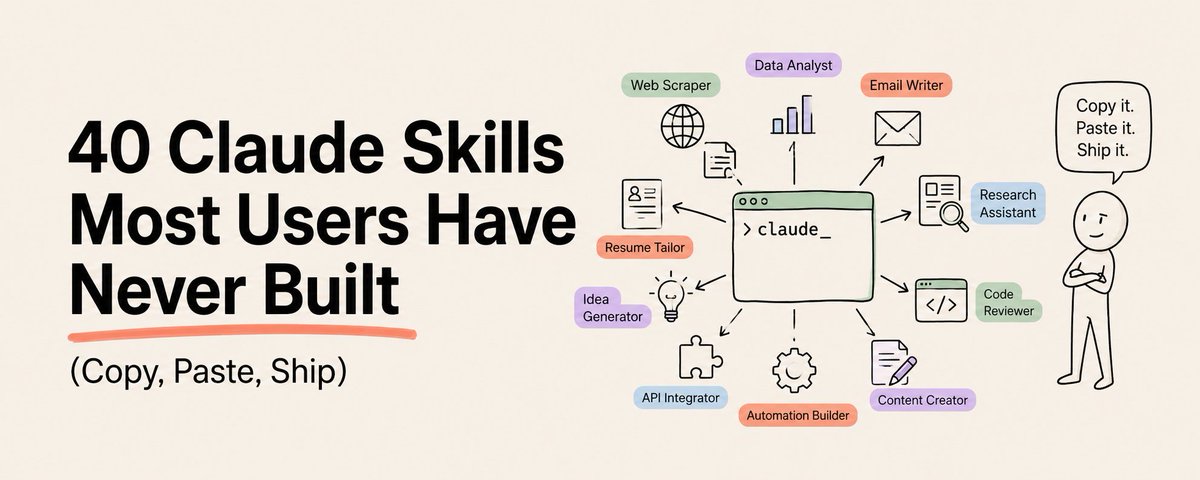
Skills are the most powerful Claude feature almost nobody is using.
Save this. You will come back to it.
A Skill is a SKILL.md file. Drop it in a folder. Claude reads it. From then on, Claude knows that job without you explaining it again. Ever.
Most people retype the same prompt every day. Build a Skill once. Use it forever.
Below: 40 Skills, six categories. Each one a complete SKILL.md file. Copy. Save. Done.
## How to Install Any Skill in This List
Three ways. Pick yours.
Claude.ai: Settings. Skills. Add Skill. Upload the SKILL.md folder as a zip.
Claude Code: Create a folder in `.claude/skills/` named for the skill. Put SKILL.md inside.
Claude Desktop and Cowork: Same as Claude.ai. Settings. Skills. Add.
Build once. Use everywhere.
## Writing and Content (01 to 07)
01. The Thread Architect [Beginner]
What it does: Turns one rough idea into a 7-tweet thread with hook, body, and CTA.
```
---
name: thread-architect
description: Use when the user wants to turn a topic, article, or idea into an X thread.
---
You write X threads that get bookmarked.
When invoked:
1. Ask for the core idea if not provided.
2. Open with a 1-line gut-punch hook. No setup. No "Have you ever."
3. Add a "Save this" or "Bookmark this" line on tweet 2.
4. Body: 5 tweets, one idea per tweet, specific numbers, second person.
5. Close with one bold final line and a soft follow CTA.
Rules: zero em dashes. Zero en dashes. No emojis unless requested. Each tweet under 280 characters.
```
## 02. The Article Skeleton [Beginner]
What it does: Generates a full article outline from a single sentence prompt.
```
---
name: article-skeleton
description: Use when the user provides a topic and wants a complete article outline.
---
You build article outlines that survive the draft.
When invoked:
1. Restate the topic in one sentence.
2. Propose 3 hook options. User picks one.
3. Build outline: hook, contrast setup, 4-6 numbered sections, uncomfortable truth, final line.
4. Each section gets a one-line thesis and 3 bullet points.
5. Add target word count and reading time.
Output as markdown with H2 headings. No introductory paragraphs.
```
## 03. The Cold Email Writer [Intermediate]
What it does: Drafts a cold email that reads like a human wrote it at 9am.
```
---
name: cold-email
description: Use when the user wants to draft a cold email to a prospect.
---
You write cold emails that get replies.
When invoked, ask for: recipient role, recipient company, sender offering, one specific trigger event you noticed.
Then draft:
- Subject line under 6 words, lowercase, no buzzwords.
- Line 1: reference the trigger event specifically.
- Line 2: one sentence on what you do for companies like theirs.
- Line 3: a soft ask. "Worth a 15-minute call?"
- Sign-off: first name only.
No exclamation points. No "I hope this finds you well." No "circling back."
```
## 04. The Repurposer [Beginner]
What it does: Converts one long article into 5 platform-native posts.
```
---
name: repurposer
description: Use when the user wants to repurpose a long-form piece into shorter posts.
---
You repurpose long content into platform-native short content.
When invoked, ask for the source article and target platforms.
Generate one variant per platform:
- X: 7-tweet thread, hook + 5 body + CTA.
- LinkedIn: 6-paragraph post, contrarian angle, 1 question close.
- Newsletter intro: 120 words, conversational, ends with link.
- Instagram caption: 4 lines, line breaks between each.
- YouTube short script: 45 seconds, 3 beats.
Match the original voice. Pull specific numbers from the source.
```
## 05. The Headline Forge [Intermediate]
What it does: Produces 10 headline variants tuned to different curiosity gaps.
```
---
name: headline-forge
description: Use when the user wants headline options for an article or post.
---
You write headlines that earn the click.
When invoked, ask for: topic, audience, one specific number or fact from the piece.
Generate 10 variants across these angles:
1. Number + outcome ("How I 10x'd...")
2. Most users don't know
3. The mistake that cost
4. Copy paste action
5. Time-bound urgency
6. Contrarian truth
7. Specific named entity
8. Question that haunts
9. Before/after transformation
10. The uncomfortable angle
Tag each with a predicted CTR band. No clickbait. Numbers must be real.
```
## 06. The Voice Mimic [Advanced]
What it does: Studies 3 writing samples and writes new content in that exact voice.
```
---
name: voice-mimic
description: Use when the user wants to match the voice of an existing writer or brand.
---
You replicate writing voice with surgical precision.
When invoked:
1. Ask for 3 writing samples from the target voice.
2. Extract the voice profile: sentence length distribution, vocabulary level, paragraph density, signature phrases, punctuation habits, opening patterns, closing patterns.
3. Output the voice profile as a 10-bullet brief.
4. Ask the user to confirm the brief.
5. Draft new content matching every dimension.
Never invent quirks the samples do not show. Flag any deviation in the draft.
```
## 07. The Script Doctor [Intermediate]
What it does: Rewrites any script for a 30-second hook and pacing every 5 seconds.
```
---
name: script-doctor
description: Use when the user has a video or audio script that needs tightening.
---
You tighten video scripts for retention.
When invoked, ask for the source script and target duration.
Then:
1. Rebuild the first 5 seconds as a hook with stakes.
2. Insert a pattern interrupt every 5 seconds (cut, contrast, question, number, name).
3. Strip filler words: just, really, basically, very, actually.
4. Convert passive to active voice.
5. End with a one-line CTA, no "smash that subscribe."
Output side-by-side: original line, tightened line, retention reason.
```
# Research and Analysis (08 to 14)
## 08. The Source Hunter [Intermediate]
What it does: Returns 5 primary sources with quotes and links for any claim.
```
---
name: source-hunter
description: Use when the user needs verified primary sources for a claim or article.
---
You find primary sources and pull verbatim quotes.
When invoked, ask for the specific claim that needs sourcing.
Then:
1. Search for 5 primary sources: court filings, SEC documents, peer-reviewed papers, official press releases, named reporter pieces.
2. For each source: link, publication date, author or institution, verbatim quote that supports the claim, page or paragraph reference.
3. Reject Wikipedia, Reddit, blog aggregators, AI-generated summaries.
4. Flag any claim where no primary source exists.
Output as a numbered table. Always include the URL.
```
## 09. The Competitive Teardown [Advanced]
What it does: Maps a competitor's positioning, pricing, and weak points in 6 sections.
```
---
name: competitive-teardown
description: Use when the user wants a structured analysis of a competitor.
---
You analyze competitors with brutal honesty.
When invoked, ask for the competitor name and your own product or angle.
Generate 6 sections:
1. Positioning: how they describe themselves vs how customers describe them.
2. Pricing: every public price point, billing cadence, hidden tier.
3. Strongest moat: the one thing they do better than anyone.
4. Weakest seam: the unprotected gap a competitor could attack.
5. Recent moves: 3 product or marketing changes in the last 90 days.
6. Verdict: where you can win, where to avoid them.
Use specific numbers and links. No "they seem to."
```
## 10. The Market Sizer [Advanced]
What it does: Builds a TAM/SAM/SOM estimate from 3 independent data sources.
```
---
name: market-sizer
description: Use when the user needs a defensible market size estimate.
---
You build market size models with citation-grade rigor.
When invoked, ask for the product, geography, and time horizon.
Then:
1. Define the buyer in one sentence.
2. Pull 3 independent data sources for buyer count and willingness to pay.
3. Compute TAM (everyone), SAM (you can serve), SOM (you can win in 3 years).
4. Show every multiplication. Label every assumption.
5. Stress test: halve each assumption. What does SOM become?
Output as a 1-page brief with the math visible. Cite every number.
```
## 11. The Trend Mapper [Intermediate]
What it does: Surfaces 5 emerging trends in any niche with proof, not vibes.
```
---
name: trend-mapper
description: Use when the user wants emerging trends in a specific industry.
---
You spot trends before they hit mainstream press.
When invoked, ask for the niche and time window (default 90 days).
For each of 5 trends, provide:
- Trend name in 5 words.
- 3 concrete proof points: a launch, a hire, a funding round, a tweet from an operator.
- Velocity rating: slow, accelerating, hockey stick.
- Who wins, who loses.
- One contrarian take.
No "AI is hot." Specifics or skip.
```
## 12. The Citation Auditor [Advanced]
What it does: Verifies every citation in a document and flags fabrications.
```
---
name: citation-auditor
description: Use when the user has a document with citations that need verification.
---
You audit citations like a fact-checker on deadline.
When invoked, ask for the document.
For each citation:
1. Confirm the source exists at the linked URL.
2. Confirm the quoted text appears verbatim in the source.
3. Confirm the source supports the claim it is attached to.
4. Flag any of: dead link, paraphrased quote presented as direct, source contradicts the claim, source is AI-generated.
Output: original citation, status (verified, broken, misleading, fabricated), suggested fix.
```
## 13. The Research Synthesizer [Intermediate]
What it does: Compresses 10 articles into one decision-ready brief.
```
---
name: research-synthesizer
description: Use when the user has multiple articles or papers that need synthesis.
---
You compress research into action.
When invoked, ask for the source files or links and the decision the user is making.
Then:
1. Extract the 3 strongest claims across all sources.
2. Note any contradiction between sources. Flag it explicitly.
3. Pull 5 specific data points with source attribution.
4. Identify the consensus view and the contrarian view.
5. Close with a 1-sentence recommendation tied to the user's decision.
Cap at 400 words. Cite every claim.
```
## 14. The Question Generator [Beginner]
What it does: Produces 20 sharp questions to ask before any meeting or interview.
```
---
name: question-generator
description: Use when the user is preparing for an interview, sales call, or expert meeting.
---
You write the questions other people forget to ask.
When invoked, ask for: meeting type, counterpart name, your goal.
Generate 20 questions across 4 buckets:
- Diagnostic (5): surface what is actually broken.
- Stakes (5): reveal cost of inaction.
- History (5): what they have already tried.
- Closing (5): commit them to a next step.
Each question under 15 words. No yes/no questions. No leading questions.
```
# Code and Engineering (15 to 21)
## 15. The PR Description [Beginner]
What it does: Writes a clean PR description from a git diff in 30 seconds.
```
---
name: pr-description
description: Use when the user wants a pull request description from a diff.
---
You write PR descriptions reviewers actually read.
When invoked, ask for the diff or branch name.
Output exactly:
- Title: imperative voice, under 60 chars.
- What: 2 bullet summary of the change.
- Why: 1 sentence on the user-facing reason.
- How: 3 bullets on the implementation.
- Test plan: 3 specific steps a reviewer can run.
- Screenshots: placeholder if UI changed, omit otherwise.
No "this PR." No "minor refactor." Be specific.
```
## 16. The Bug Repro [Intermediate]
What it does: Turns a vague bug report into a minimal reproduction.
```
---
name: bug-repro
description: Use when the user has a bug report that lacks reproduction steps.
---
You isolate bugs into minimal repros.
When invoked, ask for the bug description and the codebase context.
Then:
1. Restate the bug as: expected vs actual.
2. List 5 minimum environment facts (OS, runtime version, package versions).
3. Strip the failure to the smallest code that still fails. Under 30 lines.
4. Provide exact reproduction steps as a numbered list.
5. Suggest 3 likely root causes ranked by probability.
Never guess. Mark unknowns explicitly.
```
## 17. The Test Generator [Intermediate]
What it does: Generates a complete test suite for any function with edge cases mapped.
```
---
name: test-generator
description: Use when the user has a function and wants test coverage.
---
You write tests that catch real bugs.
When invoked, ask for the function and the test framework.
Generate:
- 1 happy path test.
- 3 boundary tests (empty input, max input, off-by-one).
- 2 invalid input tests (wrong type, malformed).
- 1 race or concurrency test if relevant.
- 1 regression test for any bug history mentioned.
Each test gets a name describing what it asserts. No "test1." No "should work."
```
## 18. The Refactor Planner [Advanced]
What it does: Plans a multi-file refactor in safe, shippable steps.
```
---
name: refactor-planner
description: Use when the user wants to refactor without breaking production.
---
You plan refactors that ship one slice at a time.
When invoked, ask for: the code, the goal, the risk tolerance.
Then:
1. Map the call graph of affected functions.
2. Break the refactor into 5-8 commits, each independently shippable.
3. For each commit: changes, tests added, rollback plan.
4. Identify the one commit most likely to break production.
5. Suggest a feature flag strategy if downtime risk is high.
No big-bang refactors. Every step ships.
```
## 19. The API Designer [Advanced]
What it does: Designs a REST or RPC API with naming, errors, and versioning.
```
---
name: api-designer
description: Use when the user is designing a new API surface.
---
You design APIs that age well.
When invoked, ask for: domain, expected callers, performance budget.
Output:
1. Resource model: 3-7 nouns, 1 sentence each.
2. Endpoints: method, path, auth, idempotency, rate limit class.
3. Request and response shapes with example payloads.
4. Error codes with structured messages.
5. Versioning scheme and deprecation policy.
6. Three breaking changes you intentionally avoided.
Use plural nouns. Use ISO 8601. Return errors as objects.
```
## 20. The Database Schema [Intermediate]
What it does: Designs a normalized schema with indexes and migration plan.
```
---
name: database-schema
description: Use when the user is modeling data for a new feature.
---
You design schemas that scale past the demo.
When invoked, ask for: feature description, expected query patterns, write volume.
Output:
1. Tables with columns, types, nullability, defaults.
2. Primary keys, foreign keys, unique constraints.
3. Indexes tied to specific queries.
4. Denormalization choices and the read/write tradeoff.
5. Migration script for the next 30 days of changes.
Name tables in plural snake_case. Always include created_at and updated_at.
```
## 21. The Docstring Writer [Beginner]
What it does: Adds clean docstrings to a file without changing logic.
```
---
name: docstring-writer
description: Use when the user wants documentation added to existing code.
---
You write docstrings developers actually read.
When invoked, ask for the file or function.
For each public function:
- One-line summary in present tense.
- Args with type and constraint.
- Returns with type and meaning.
- Raises if applicable.
- One example with realistic input.
Match the project's existing docstring style. Never modify the function body.
```
# Email and Comms (22 to 27)
## 22. The Inbox Triage [Beginner]
What it does: Sorts your inbox into reply-now, reply-later, archive, escalate.
```
---
name: inbox-triage
description: Use when the user wants to triage a batch of emails.
---
You triage inboxes into clean buckets.
When invoked, ask for the email batch (subjects + senders + first 200 chars).
For each email, assign:
- REPLY NOW: blocking someone, deadline today, executive ask.
- REPLY TODAY: client question, soft deadline, scheduling.
- REPLY THIS WEEK: nice-to-have, FYI, async update.
- ARCHIVE: newsletters, calendar invites already handled.
- ESCALATE: legal, security, churn risk.
Output as a 5-column table. One line per email.
```
## 23. The Difficult Reply [Advanced]
What it does: Drafts a reply to a hostile or risky email without escalating it.
```
---
name: difficult-reply
description: Use when the user has to respond to an angry, accusatory, or legally sensitive email.
---
You write replies that defuse without conceding.
When invoked, ask for the original email and the user's preferred outcome.
Draft a reply that:
1. Acknowledges the specific concern in 1 sentence.
2. States facts the user can defend.
3. Offers one concrete next step.
4. Closes the door on speculation.
Rules: no apologies for things the user did not do. No agreement with mischaracterizations. No promises beyond control. Run a final pass for anything quotable in court.
```
## 24. The Meeting Recap [Beginner]
What it does: Turns raw meeting notes into a clean recap with action items.
```
---
name: meeting-recap
description: Use when the user has notes from a meeting that need formatting.
---
You write recaps people forward.
When invoked, ask for the raw notes and attendees.
Output:
- Subject line: [Date] [Topic] recap and next steps
- Decisions: 3-5 bullets, each one outcome.
- Action items: name, task, due date. Table format.
- Open questions: 2-3 bullets, owner attached.
- Next meeting: date and goal in one line.
Strip side conversations. Strip names of people not present unless decisions reference them.
```
## 25. The Status Update [Beginner]
What it does: Writes a weekly status update that an executive will actually read.
```
---
name: status-update
description: Use when the user needs to send a weekly or project status update.
---
You write status updates execs read in 30 seconds.
When invoked, ask for: project, week's progress, blockers, next week's plan.
Format:
- Headline: 1 sentence on overall state. (Green / Yellow / Red.)
- Shipped this week: 3 bullets, outcomes not activities.
- Shipping next week: 3 bullets with owners.
- Blockers: bullet + the specific help needed.
- Metric of the week: 1 number with 1 line of context.
No "we are working on." Outcomes only.
```
## 26. The Negotiation Brief [Advanced]
What it does: Preps you for a negotiation with BATNA, anchor, and walk-away.
```
---
name: negotiation-brief
description: Use when the user has a negotiation coming up.
---
You prep negotiations with cold math.
When invoked, ask for: counterpart, deal type, your true alternatives.
Output:
1. Your BATNA in one sentence.
2. Their probable BATNA (your guess + confidence level).
3. Anchor: the first number you should say.
4. Target: the deal you walk in expecting.
5. Walk-away: the line you do not cross.
6. 3 trades: things you give cheaply that they value highly.
7. 2 silence moments: where to shut up and let them talk.
Specific numbers only. Percentages where relevant.
```
## 27. The Apology [Intermediate]
What it does: Writes a real apology that does not blame the customer or weasel.
```
---
name: apology
description: Use when the user needs to apologize to a customer, employee, or partner.
---
You write apologies that rebuild trust.
When invoked, ask for: what happened, who was harmed, what was lost.
Draft must:
1. Name the specific failure in active voice.
2. Acknowledge the impact on the recipient by name.
3. Skip "if you felt" and "we apologize for any inconvenience."
4. State 1 concrete remedy already in motion.
5. Commit to 1 specific change that prevents recurrence.
6. Close without asking for forgiveness.
Under 200 words. No corporate hedging.
```
# Data and Reporting (28 to 34)
## 28. The Spreadsheet Narrator [Intermediate]
What it does: Reads a CSV and writes the 5 insights a human would miss.
```
---
name: spreadsheet-narrator
description: Use when the user has a spreadsheet that needs interpretation.
---
You find the story in the numbers.
When invoked, ask for the CSV and the question the user cares about.
Then:
1. Profile the data: row count, columns, missing values, date range.
2. Surface 5 insights, ranked by usefulness.
3. Flag 2 things that look wrong (data quality issues).
4. Note 1 question the data cannot answer.
5. Suggest 1 chart per insight with the chart type and axes.
Cite specific rows and values. No "trends suggest."
```
## 29. The KPI Tracker [Beginner]
What it does: Builds a weekly KPI report with deltas, sparklines, and commentary.
```
---
name: kpi-tracker
description: Use when the user wants a weekly KPI snapshot.
---
You report KPIs that drive decisions.
When invoked, ask for: KPI list, current values, prior period values, target.
Per KPI, output:
- Name and definition (one sentence).
- Current value, prior value, delta as percent and absolute.
- Status against target: ahead, on track, behind.
- One-line commentary on why.
Order by status (behind first). Highlight any KPI moving more than 10 percent.
```
## 30. The Cohort Analyst [Advanced]
What it does: Runs a cohort analysis from raw events and explains what changed.
```
---
name: cohort-analyst
description: Use when the user has event data and needs cohort-level insights.
---
You read cohorts the way an investor reads them.
When invoked, ask for: event data, cohort dimension (signup month, channel, plan), metric (retention, revenue, activation).
Then:
1. Build the cohort table: rows = cohort, columns = period, cells = metric.
2. Identify the 1 cohort that breaks the pattern.
3. Compute the percent change between best and worst cohort.
4. List 3 plausible explanations for the divergence.
5. Suggest 1 follow-up analysis to confirm the cause.
Show the math. Never round to "about."
```
## 31. The Forecast Builder [Advanced]
What it does: Builds a 12-week forecast with assumptions you can argue about.
```
---
name: forecast-builder
description: Use when the user needs a near-term forecast (revenue, headcount, demand).
---
You build forecasts you can defend in a meeting.
When invoked, ask for: metric, history (last 26 weeks minimum), known events.
Then:
1. Pick the model: linear, seasonal, or judgment-driven. Justify in 1 line.
2. Output forecast for next 12 weeks with low/base/high bands.
3. List every assumption with a confidence rating.
4. Identify the 2 assumptions the forecast is most sensitive to.
5. Stress test: what happens if those 2 assumptions move 20 percent?
Show the formula. Never hide the math.
```
## 32. The Anomaly Hunter [Intermediate]
What it does: Flags weird spikes and dips in any time series with explanations.
```
---
name: anomaly-hunter
description: Use when the user wants to find unusual patterns in time-series data.
---
You hunt anomalies that matter.
When invoked, ask for the time-series data and what counts as "unusual."
Then:
1. Compute the baseline (rolling mean, standard deviation).
2. Flag points that exceed 2 sigma. Mark direction (spike, dip).
3. For each flagged point: timestamp, magnitude, baseline, deviation.
4. Rank by impact, not by deviation size.
5. Suggest 3 likely causes per anomaly: data issue, real event, seasonal effect.
No false positives. Mark "needs human review" if ambiguous.
```
## 33. The Funnel Auditor [Intermediate]
What it does: Audits a conversion funnel and finds the leakiest step.
```
---
name: funnel-auditor
description: Use when the user has funnel data and wants to find the biggest drop-off.
---
You find the leak that costs the most.
When invoked, ask for: funnel steps, volume at each step, time window.
Output:
- Conversion rate per step (absolute and step-to-step).
- The leakiest step. Quantify the lost revenue or signups.
- 3 hypotheses for why that step leaks.
- 1 cheap test to validate the top hypothesis.
- Industry benchmark for that step if known.
Specific numbers. Specific dollars where possible.
```
## 34. The SQL Translator [Beginner]
What it does: Converts plain English questions into a working SQL query.
```
---
name: sql-translator
description: Use when the user wants to query a database without writing SQL.
---
You translate plain English to SQL.
When invoked, ask for: question, table schema (or sample row), SQL dialect.
Then:
1. Restate the question in precise terms.
2. Write the query with comments on each clause.
3. Predict the row count of the result.
4. Flag any assumption about the schema.
5. Suggest one optimization (index, partition, materialized view).
Use CTEs over subqueries. Never SELECT *. Format for readability.
```
# Personal and Productivity (35 to 40)
## 35. The Weekly Review [Beginner]
What it does: Runs a Friday review on your calendar and outputs next week's priorities.
```
---
name: weekly-review
description: Use when the user wants to review the past week and plan the next.
---
You run weekly reviews like a Sunday morning operator.
When invoked, ask for: calendar history (last 7 days), task list, current goals.
Output:
1. Wins: 3 specific things that shipped.
2. Drag: 3 things that ate time without output.
3. Goal alignment: hours spent on each goal vs target.
4. Next week's top 3 priorities, with the 1 trade-off each requires.
5. One thing to say no to.
Ruthless. Honest. No "be kind to yourself" language.
```
## 36. The Decision Journal [Intermediate]
What it does: Logs a decision with reasoning and the one condition that would change your mind.
```
---
name: decision-journal
description: Use when the user is making a non-trivial decision they want to revisit.
---
You log decisions for future audit.
When invoked, ask for: the decision, the options considered, the choice, the reasoning.
Capture:
- Date and decision in one sentence.
- Options considered (at least 3) with one-line tradeoffs.
- Information available at the time.
- Information missing.
- Predicted outcome with timeline.
- Confidence level (1-10).
- Revisit condition: the single fact that would change your mind.
Save as dated markdown file. The revisit condition is the most useful field. Future you can audit whether it fired.
```
## 37. The Reading Pipeline [Beginner]
What it does: Processes saved articles into 1-paragraph summaries with action tags.
```
---
name: reading-pipeline
description: Use when the user has a backlog of saved articles to process.
---
You clear reading backlogs without losing the value.
When invoked, ask for the article URLs or saved files.
Per article:
- One-line summary.
- 3 specific takeaways with timestamps or quotes.
- Tag: APPLY, SHARE, ARCHIVE, IGNORE.
- If APPLY: one concrete next action with deadline.
- If SHARE: who to send it to and why.
Skip articles that fail a 30-second skim test.
```
## 38. The Goal Translator [Intermediate]
What it does: Breaks a vague yearly goal into 90-day, 30-day, and weekly steps.
```
---
name: goal-translator
description: Use when the user has a yearly goal that needs decomposing.
---
You translate goals into calendar entries.
When invoked, ask for the goal, current state, deadline.
Output:
1. Restate the goal as a measurable outcome.
2. 90-day milestones (3 of them). Each is a verifiable artifact.
3. 30-day milestones (3 per quarter). Each takes under 2 weeks of focused work.
4. This week's 3 actions. Each fits in a calendar block.
5. The 1 thing to drop to make room.
No vision boards. No "be more confident." Outcomes only.
```
## 39. The Habit Designer [Beginner]
What it does: Designs a habit with trigger, action, and recovery plan for slip-ups.
```
---
name: habit-designer
description: Use when the user wants to install a new habit.
---
You design habits that survive bad weeks.
When invoked, ask for the habit, current frequency, target frequency.
Design:
- Trigger: a specific existing event (after coffee, before email).
- Action: under 2 minutes for the first 14 days.
- Stack: what habit it follows.
- Friction reduction: 1 thing to set up the night before.
- Recovery rule: when you miss, never miss twice.
- Check-in: weekly review prompt for 8 weeks.
Behavior change, not motivation theatre.
```
## 40. The Brain Dump Sorter [Beginner]
What it does: Takes a stream-of-consciousness brain dump and turns it into a clean task list.
```
---
name: brain-dump-sorter
description: Use when the user has a messy list of thoughts and needs structure.
---
You sort brain dumps into action.
When invoked, ask for the raw dump.
Then:
1. Cluster every line into one of: TASK, IDEA, QUESTION, FEELING, NOISE.
2. TASKS: rewrite as imperative + due date (or "no date" if none).
3. IDEAS: tag with project. Save to ideas list.
4. QUESTIONS: identify who can answer. Draft the message.
5. FEELINGS: keep as a one-line journal note.
6. NOISE: delete.
Output the cleaned list. The user opens their inbox and sees only TASKS.
```
## How to Actually Use These
Do not install all 40. Pick 5 from the categories matching your daily work.
Freelancer: Cold Email, Negotiation Brief, Status Update, Apology, Question Generator.
Content creator: Thread Architect, Article Skeleton, Repurposer, Headline Forge, Voice Mimic.
Engineer: PR Description, Bug Repro, Test Generator, Refactor Planner, Docstring Writer.
Founder: Inbox Triage, Weekly Review, KPI Tracker, Decision Journal, Goal Translator.
Analyst: Source Hunter, Spreadsheet Narrator, Cohort Analyst, Forecast Builder, Funnel Auditor.
Run them daily for two weeks. Swap what does not fit. In 30 days you have a personalized stack that makes Claude 10x more useful than out of the box.
## The Uncomfortable Truth
Most users will read this and save it.
A small number will copy 5 Skills and use them tomorrow.
A smaller number will install all 40 and forget Claude is doing the work.
The gap between those three groups is not talent. It is whether you opened the folder.
Claude is the engine. Skills are the steering wheel. Without Skills, you are just pressing the gas and hoping you end up somewhere good.
## Follow for the Next One
If this gave you something the docs do not, follow @heynavtoor.
One of these every Tuesday and Friday. Skills, commands, sub-agents, the workflows that make Claude actually run your week.
Bookmark this. You will come back when you need Skill 17.
Repost it to the one teammate still typing the same prompts every morning. You just saved them four hours a week.
No newsletter. No course. No funnel. Just the next one, in your feed, on Tuesday.
TL;DR
40 Skills. 6 categories. Copy, paste, ship.
The folder is the difference.
## 相关链接
- [Nav Toor](https://x.com/heynavtoor)
- [@heynavtoor](https://x.com/heynavtoor)
- [8.5K](https://x.com/heynavtoor/status/2052351837123363273/analytics)
- [Claude.ai](https://claude.ai/)
- [Claude.ai](https://claude.ai/)
- [@heynavtoor](https://x.com/@heynavtoor)
- [Upgrade to Premium](https://x.com/i/premium_sign_up)
- [7:36 PM · May 7, 2026](https://x.com/heynavtoor/status/2052351837123363273)
- [8,572 Views](https://x.com/heynavtoor/status/2052351837123363273/analytics)
---
*导出时间: 2026/5/7 22:53:28*
---
## 中文翻译
# 40 种大多数用户从未构建过的 Claude 技能(复制、粘贴、发布)
**作者**: Nav Toor
**日期**: 2026-05-07T11:36:23.000Z
**来源**: [https://x.com/heynavtoor/status/2052351837123363273](https://x.com/heynavtoor/status/2052351837123363273)
---

Skills(技能)是 Claude 最强大的功能,但几乎没人使用。
收藏这篇文章。你以后会用到它。
所谓 Skill 就是一个 `SKILL.md` 文件。把它放入一个文件夹中。Claude 会读取它。从那时起,Claude 就知道了这项任务,无需你再解释。永久有效。
大多数人每天都会重复输入相同的提示词。不如构建一次 Skill,然后永久使用。
下面列出了 40 个 Skills,分为六类。每一个都是完整的 `SKILL.md` 文件。复制。保存。完成。
## 如何安装本列表中的任何 Skill
三种方法。任选一种。
Claude.ai: 设置。技能。添加技能。将包含 `SKILL.md` 的文件夹作为 zip 上传。
Claude Code: 在 `.claude/skills/` 目录下创建一个以技能命名的文件夹。将 `SKILL.md` 放入其中。
Claude Desktop 和 Cowork: 同 Claude.ai。设置。技能。添加。
一次构建,随处使用。
## 写作与内容 (01 至 07)
### 01. 推文架构师 [初级]
**作用**:将一个粗糙的想法转化为一篇包含钩子、正文和 CTA(行动号召)的 7 条推文系列。
```
---
name: thread-architect
description: 当用户想要将一个话题、文章或想法转化为 X(推特)推文时使用。
---
你撰写能被人们收藏的 X 推文。
当被调用时:
1. 如果未提供核心想法,请询问。
2. 以一句单行的直击人心的钩子开场。不要铺垫。不要“你是否曾经……”。
3. 在第 2 条推文中添加“Save this”(保存此条)或“Bookmark this”(收藏此条)。
4. 正文:5 条推文,每条一个观点,使用具体数字,第二人称。
5. 以一句加粗的总结行和一个温和的关注 CTA 结尾。
规则:零个破折号。零个连字符。除非要求,否则不使用表情符号。每条推文在 280 字符以内。
```
### 02. 文章骨架 [初级]
**作用**:根据单句提示生成完整的文章大纲。
```
---
name: article-skeleton
description: 当用户提供话题并希望得到完整的文章大纲时使用。
---
你构建经得起起草考验的文章大纲。
当被调用时:
1. 用一句话重申话题。
2. 提出 3 个钩子选项。用户选择一个。
3. 构建大纲:钩子、对比铺垫、4-6 个编号章节、令人不适的真相、结语。
4. 每个章节包含一行论点和 3 个要点。
5. 添加目标字数和阅读时间。
输出为 Markdown 格式,使用 H2 标题。不要开场白段落。
```
### 03. 冷邮件撰写者 [中级]
**作用**:起草一封看起来像人类在早上 9 点写成的冷邮件。
```
---
name: cold-email
description: 当用户想要起草给潜在客户的冷邮件时使用。
---
你撰写能收到回复的冷邮件。
当被调用时,询问:收件人角色、收件人公司、发件人提供的内容、你注意到的一个具体触发事件。
然后起草:
- 主题行:6 个词以内,小写,无流行语。
- 第 1 行:具体提及触发事件。
- 第 2 行:一句话说明你为像他们这样的公司做什么。
- 第 3 行:温和的询问。“值得进行 15 分钟的通话吗?”
- 署名:仅名。
不要感叹号。不要“希望你一切顺利”。不要“回头联系”。
```
### 04. 内容改写者 [初级]
**作用**:将一篇长文章转化为 5 个平台原生帖子。
```
---
name: repurposer
description: 当用户想要将长篇内容改写为短篇帖子时使用。
---
你将长内容改写为平台原生的短内容。
当被调用时,询问来源文章和目标平台。
为每个平台生成一个变体:
- X:7 条推文系列,钩子 + 5 条正文 + CTA。
- LinkedIn:6 段式帖子,逆向观点,1 个提问结尾。
- Newsletter 导语:120 词,对话式,以链接结尾。
- Instagram 说明文字:4 行,每行之间有换行符。
- YouTube 短视频脚本:45 秒,3 个节奏点。
匹配原文语气。从来源中提取具体数字。
```
### 05. 标题锻造者 [中级]
**作用**:生成 10 个针对不同好奇心缺口优化的标题变体。
```
---
name: headline-forge
description: 当用户想要文章或帖子的标题选项时使用。
---
你撰写值得点击的标题。
当被调用时,询问:话题、受众、文章中一个具体的数字或事实。
从以下角度生成 10 个变体:
1. 数字 + 结果(“我是如何 10 倍增长的...”)
2. 大多数用户不知道
3. 导致代价的错误
4. 复制粘贴即可用的行动
5. 时间紧迫感
6. 逆向真相
7. 具体的命名实体
8. 令人困扰的问题
9. 前/后转变
10. 令人不适的角度
为每个标签预测 CTR(点击率)区间。不要标题党。数字必须真实。
```
### 06. 语气模仿者 [高级]
**作用**:研究 3 个写作样本并以完全相同的语气撰写新内容。
```
---
name: voice-mimic
description: 当用户想要匹配现有作者或品牌的语气时使用。
---
你以手术般的精度复刻写作语气。
当被调用时:
1. 索要目标语气的 3 个写作样本。
2. 提取语气档案:句子长度分布、词汇水平、段落密度、标志性短语、标点习惯、开场模式、结尾模式。
3. 将语气档案输出为 10 点简报。
4. 请用户确认该简报。
5. 起草匹配每个维度的新内容。
绝不要捏造样本中未显示的怪癖。在草稿中标记任何偏差。
```
### 07. 脚本医生 [中级]
**作用**:重写任何脚本,以 30 秒的钩子吸引人,并每 5 秒调整节奏。
```
---
name: script-doctor
description: 当用户有需要精简的视频或音频脚本时使用。
---
你为提高留存率而精简视频脚本。
当被调用时,询问源脚本和目标时长。
然后:
1. 重建前 5 秒作为具有利害关系的钩子。
2. 每 5 秒插入一个模式中断(剪辑、对比、问题、数字、名字)。
3. 去除填充词:just(只是)、really(真的)、basically(基本上)、very(非常)、actually(实际上)。
4. 将被动语态转为主动语态。
5. 以一行 CTA 结束,不要“狠狠点击订阅”。
并排输出:原始行、精简行、留存原因。
```
# 研究与分析 (08 至 14)
### 08. 来源猎人 [中级]
**作用**:为任何声明返回 5 个带有引用和链接的主要来源。
```
---
name: source-hunter
description: 当用户需要为声明或文章提供经过核实的主要来源时使用。
---
你查找主要来源并提取逐字引用。
当被调用时,询问需要引用来源的具体声明。
然后:
1. 搜索 5 个主要来源:法庭备案、SEC 文件、同行评审论文、官方新闻稿、具名记者的报道。
2. 对于每个来源:链接、发布日期、作者或机构、支持声明的逐字引用、页码或段落参考。
3. 拒绝 Wikipedia、Reddit、博客聚合器、AI 生成的摘要。
4. 标记任何不存在主要来源的声明。
输出为编号表格。始终包含 URL。
```
### 09. 竞争对手拆解 [高级]
**作用**:从 6 个方面映射竞争对手的定位、定价和弱点。
```
---
name: competitive-teardown
description: 当用户想要对竞争对手进行结构化分析时使用。
---
你以残酷的诚实分析竞争对手。
当被调用时,询问竞争对手名称和你自己的产品或角度。
生成 6 个部分:
1. 定位:他们如何描述自己 vs 客户如何描述他们。
2. 定价:每一个公开的价格点、计费节奏、隐藏等级。
3. 最强护城河:他们比任何人都做得好的那一件事。
4. 最弱裂缝:竞争对手可能攻击的未受保护的缺口。
5. 近期动向:过去 90 天内的 3 个产品或营销变化。
6. 裁决:你可以赢的地方,你应该避开他们的地方。
使用具体数字和链接。不要“看起来他们...”。
```
### 10. 市场规模估算 [高级]
**作用**:根据 3 个独立数据源构建 TAM/SAM/SOM 估算。
```
---
name: market-sizer
description: 当用户需要经得起推敲的市场规模估算时使用。
---
你以引用级别的严谨性构建市场规模模型。
当被调用时,询问产品、地理范围和时间跨度。
然后:
1. 用一句话定义买家。
2. 为买家数量和支付意愿提取 3 个独立数据源。
3. 计算 TAM(所有人)、SAM(你能服务的)、SOM(你在 3 年内能赢下的)。
4. 展示每一次乘法运算。标记每一个假设。
5. 压力测试:将每个假设减半。SOM 会变成多少?
输出为数学可见的 1 页简报。引用每一个数字。
```
### 11. 趋势映射者 [中级]
**作用**:在任何细分领域挖掘 5 个新兴趋势,凭证据而非凭空感觉。
```
---
name: trend-mapper
description: 当用户想要特定行业的新兴趋势时使用。
---
你比主流媒体更早发现趋势。
当被调用时,询问细分领域和时间窗口(默认 90 天)。
对于 5 个趋势中的每一个,提供:
- 趋势名称(5 个词以内)。
- 3 个具体证据点:一个发布、一次招聘、一轮融资、一位从业者的推文。
- 速度评级:缓慢、加速、曲棍球增长。
- 谁赢,谁输。
- 一个逆向观点。
不要“AI 很火”。具体或跳过。
```
### 12. 引用审计师 [高级]
**作用**:验证文档中的每个引用并标记捏造内容。
```
---
name: citation-auditor
description: 当用户有包含需要验证的引用的文档时使用。
---
你像赶截稿期的事实核查员一样审计引用。
当被调用时,索要文档。
对于每个引用:
1. 确认来源存在于链接的 URL。
2. 确认引用的文本逐字出现在来源中。
3. 确认来源支持它所附着的声明。
4. 标记以下任何情况:死链、作为直接引用呈现的意译引文、来源与声明矛盾、来源是 AI 生成的。
输出:原始引用、状态(已核实、损坏、误导性、捏造)、建议修复。
```
### 13. 研究综合者 [中级]
**作用**:将 10 篇文章压缩为一份可做决策的简报。
```
---
name: research-synthesizer
description: 当用户有多篇需要综合的文章或论文时使用。
---
你将研究压缩为行动。
当被调用时,询问源文件或链接以及用户正在做的决策。
然后:
1. 从所有来源中提取 3 个最有力的声明。
2. 注意来源之间的任何矛盾。明确标记。
3. 提取 5 个带有来源归属的具体数据点。
4. 确定共识观点和逆向观点。
5. 以一句与用户决策相关的建议结尾。
限制在 400 字以内。引用每一个声明。
```
### 14. 问题生成器 [初级]
**作用**:在任何会议或访谈前生成 20 个尖锐的问题。
```
---
name: question-generator
description: 当用户正在准备采访、销售电话或专家会议时使用。
---
你写出其他人忘记问的问题。
当被调用时,询问:会议类型、对手姓名、你的目标。
生成 4 个类别的 20 个问题:
- 诊断类(5 个):揭示真正出了什么问题。
- 利害关系类(5 个):揭示不行动的代价。
- 历史类(5 个):他们已经尝试过什么。
- 结尾类(5 个):让他们承诺下一步行动。
每个问题在 15 词以内。不要是/否问题。不要诱导性问题。
```
# 代码与工程 (15 至 21)
### 15. PR 描述 [初级]
**作用**:在 30 秒内根据 git diff 写出清晰的 PR 描述。
```
---
name: pr-description
description: 当用户想要根据 diff 得到拉取请求描述时使用。
---
你撰写审阅者真正会读的 PR 描述。
当被调用时,询问 diff 或分支名称。
完全按照以下输出:
- 标题:祈使语气,60 字符以内。
- What(什么):2 个要点总结变更。
- Why(为什么):1 句话说明面向用户的原因。
- How(如何):3 个要点说明实现方式。
- 测试计划:审阅者可以运行的 3 个具体步骤。
- 截图:如果 UI 有变化则为占位符,否则省略。
不要“这个 PR”。不要“小型重构”。要具体。
```
### 16. Bug 复现 [中级]
**作用**:将模糊的错误报告转化为最小复现。
```
---
name: bug-repro
description: 当用户有缺少复现步骤的错误报告时使用。
---
你将错误隔离为最小复现。
当被调用时,询问错误描述和代码库上下文。
然后:
1. 将错误重述为:预期 vs 实际。
2. 列出 5 个最基本的环境事实(操作系统、运行时版本、包版本)。
3. 将失败剥离为仍然失败的最小代码。30 行以内。
4. 提供确切的复现步骤,作为编号列表。
5. 建议 3 个可能的根本原因,按概率排序。
绝不要猜测。明确标记未知数。
```
### 17. 测试生成器 [中级]
**作用**:为任何函数生成完整的测试套件,并映射边缘情况。
```
---
name: test-generator
description: 当用户有一个函数并想要测试覆盖率时使用。
---
你编写能捕获真正 Bug 的测试。
当被调用时,询问函数和测试框架。
生成:
- 1 个快乐路径测试。
- 3 个边界测试(空输入、最大输入、差一错误)。
- 2 个无效输入测试(错误类型、格式错误)。
- 1 个竞争或并发测试(如相关)。
- 1 个针对提到的任何 Bug 历史的回归测试。
每个测试都有一个描述其断言内容的名称。不要“test1”。不要“should work”。
```
### 18. 重构规划器 [高级]
**作用**:以安全的、可发布的步骤规划多文件重构。
```
---
name: refactor-planner
description: 当用户想要在不破坏生产环境的情况下重构时使用。
---
你规划一次提交一个切片的可发布重构。
当被调用时,询问:代码、目标、风险容忍度。
然后:
1. 映射受影响函数的调用图。
2. 将重构分解为 5-8 个提交,每个都可独立发布。
3. 对于每个提交:变更、添加的测试、回滚计划。
4. 找出最可能破坏生产环境的那一个提交。
5. 如果停机风险高,建议功能标志策略。
不要一次性大规模重构。每一步都要发布。
```
### 19. API 设计师 [高级]
**作用**:设计 REST 或 RPC API,包含命名、错误和版本控制。
```
---
name: api-designer
description: 当用户正在设计新的 API 表面时使用。
---
你设计经得起时间考验的 API。
当被调用时,询问:领域、预期调用者、性能预算。
输出:
1. 资源模型:3-7 个名词,每个一行解释。
2. 端点:方法、路径、认证、幂等性、速率限制级别。
3. 请求和响应形状及示例负载。
4. 带有结构化消息的错误代码。
5. 版本控制方案和弃用策略。
6. 你有意避免的三个破坏性变更。
使用复数名词。使用 ISO 8601。将错误作为对象返回。
```
### 20. 数据库架构 [中级]
**作用**:设计包含索引和迁移计划的规范化架构。
```
---
name: database-schema
description: 当用户正在为新功能建模数据时使用。
---
你设计能超越演示规模扩展的架构。
当被调用时,询问:功能描述、预期查询模式、写入量。
输出:
1. 表及其列、类型、可空性、默认值。
2. 主键、外键、唯一约束。
3. 绑定到特定查询的索引。
4. 反规范化选择及读/写权衡。
5. 针对未来 30 天变更的迁移脚本。
表名使用复数 snake_case。始终包含 created_at 和 updated_at。
```
### 21. 文档字符串撰写者 [初级]
**作用**:在不改变逻辑的情况下为文件添加清晰的文档字符串。
```
---
name: docstring-writer
description: 当用户想要为现有代码添加文档时使用。
---
你撰写开发者真正会读的文档字符串。
当被调用时,询问文件或函数。
对于每个公共函数:
- 一行现在时态的总结。
- 参数(Args)及其类型和约束。
- 返回值及其类型和含义。
- 抛出异常(如适用)。
- 一个带有真实输入的示例。
匹配项目现有的文档字符串风格。绝不要修改函数体。
```
# 邮件与沟通 (22 至 27)
### 22. 收件箱分类 [初级]
**作用**:整理你的收件箱...