# 30 Claude Workflows That Most Users Never Know and It's Costing Them Hours Every Week
**作者**: Khairallah AL-Awady
**日期**: 2026-05-22T09:38:08.000Z
**来源**: [https://x.com/eng_khairallah1/status/2057757896847593564](https://x.com/eng_khairallah1/status/2057757896847593564)
---
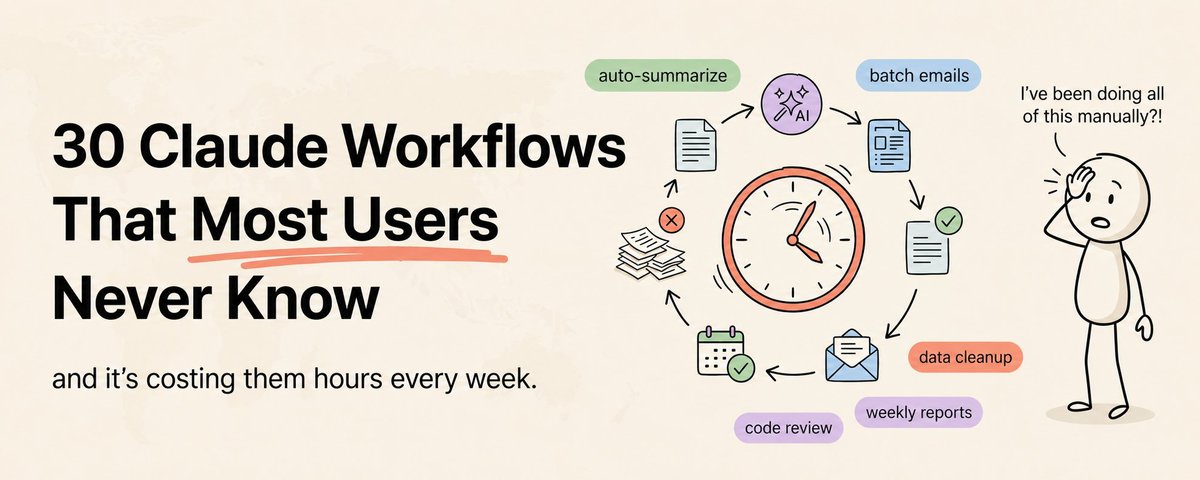
Every day I watch people use Claude the hard way.
Save this :)
They type the same instructions over and over. They re-explain their context every session. They copy-paste between apps manually. They get inconsistent results because they prompt differently every time.
And every day, the people who actually set up Claude properly are producing three times the output in half the time.
The gap between a casual Claude user and a power user is not talent. It is not experience. It is not some paid plan advantage.
It is Skills and workflows.
Skills are permanent instruction files that teach Claude exactly how to execute specific tasks. Workflows are repeatable systems that eliminate guesswork and produce consistent results every single time.
Most new users do not know they exist. The ones who do are operating at a level that makes everyone else look like they are standing still.
I compiled the 30 most impactful Skills and workflows that new users consistently miss. Each one saves real time. Each one makes Claude dramatically more useful.
Set these up today and you will never go back to prompting the old way.
## Part 1: Essential Skills Most Users Never Install (1–10)
01. PDF Processing Skill
Read PDFs, extract tables, fill forms, merge documents, and split files. This is the single highest-utility Skill for anyone who works with documents. Instead of using three different online tools to handle PDFs, Claude does it all natively.
Most users upload a PDF and ask Claude to "read it." The PDF Skill does full extraction with structured output, table parsing, and batch processing.
02. DOCX Skill
Create and edit Word documents with proper formatting, tracked changes, comments, and professional layouts. Not the generic text that Claude outputs in chat - actual .docx files with headers, page numbers, and real formatting.
Most users copy Claude's text output and paste it into Word manually. The DOCX Skill creates the finished document directly.
03. PPTX Skill
Generate presentation slide decks from natural language descriptions. Layouts, charts, speaker notes, and consistent design - all produced automatically. Say "create a 12-slide pitch deck for my startup" and get an actual PowerPoint file.
Most users build slides manually and paste Claude's text in one slide at a time. This is dramatically faster.
04. XLSX Skill
Create spreadsheets with formulas, analysis, formatting, and charts using plain English instructions. Ask Claude to "build a financial model with revenue projections for 12 months" and get a working spreadsheet with real formulas.
Most users ask Claude for the formula and then type it into Excel themselves. The XLSX Skill eliminates the middleman.
05. Frontend Design Skill
Escape generic "AI slop" aesthetics. This Skill teaches Claude real design systems - bold typography, distinctive color palettes, professional layouts. Over 277,000 installs for a reason. If you build anything with a user interface, this Skill is non-negotiable.
06. Canvas Design Skill
Social media graphics, posters, covers, and visual content generated from text descriptions. Output as PNG or PDF. If you create any kind of visual content, this eliminates the need for a separate design tool for most tasks.
07. SEO Skill
Full website audits, schema validation, keyword analysis, and content optimization. Twelve sub-skills covering every part of SEO. Most users ask Claude for generic SEO advice. The SEO Skill runs a systematic audit with specific, actionable findings.
08. Brand Guidelines Skill
Encode your brand - colors, fonts, tone of voice, messaging rules - into a Skill that automatically applies everywhere. Every document, every design, every piece of content follows your brand standards without you reminding Claude every time.
09. Marketing Skills Bundle
Twenty-plus Skills in one package covering CRO, copywriting, SEO, email sequences, and growth strategies. If you work in marketing, this single installation gives Claude specialized knowledge across your entire discipline.
10. Obsidian Skills
Built by Obsidian's CEO. Automatic tagging, linking, and organization of your Obsidian vault. If you use Obsidian for notes and research, this Skill turns Claude into a vault manager that keeps everything organized and interconnected.
## Part 2: Workflows That Save Hours Every Week (11–20)
Skills teach Claude how. Workflows teach Claude when and in what order.
11. The Morning Briefing Workflow
Set this up once and run it every morning:
"Check my email for anything urgent. Summarize overnight Slack messages. Pull my calendar for today. Identify the three most important things I need to focus on. Save everything to a daily briefing file."
Run this as a scheduled task at 7am. You wake up to a complete situation report every single day.
12. The Content Production Pipeline
A four-step workflow that takes any topic from idea to published article:
Step 1: Research the topic and create a brief with key findings Step 2: Create a detailed outline with headline, sections, and key points Step 3: Write the full draft following the outline Step 4: Edit and polish to publication quality
Run all four steps in one Cowork session. A complete article in under 30 minutes.
13. The Weekly Report Compiler
Every Friday at 5pm:
"Pull all my completed tasks from this week. Summarize key metrics from [source]. Compile wins, blockers, and next week's priorities into a formatted report. Save to /Reports."
Your weekly report writes itself while you are wrapping up for the day.
14. The Email Response Workflow
For every email that needs a reply:
"Read this email. Identify the sender's request. Draft a response that is professional, under five sentences, and includes a clear next step. Match the formality level of the sender."
Process twenty emails in the time it normally takes to write three.
15. The Competitive Intelligence Workflow
Monthly recurring:
"Research [competitor names]. Check for new product launches, pricing changes, feature updates, and public statements. Compare to our current position. Save a competitive intelligence brief to /Intelligence."
Stay informed about your competition without spending hours on manual research.
16. The File Organization Workflow
Weekly:
"Scan my Downloads folder. Sort files by type - documents to /Docs, images to /Images, spreadsheets to /Data. Rename files with a consistent naming convention. Delete anything older than 60 days that is not marked important."
Your digital workspace stays clean automatically.
17. The Client Onboarding Workflow
For every new client:
"Create a new folder called [Client Name]. Generate a welcome document from my template. Create a project timeline based on [project scope]. Draft an onboarding email introducing the process and next steps. Save everything to the client folder."
New clients get a professional onboarding experience in minutes instead of hours.
18. The Learning Summary Workflow
After consuming any educational content:
"Read my notes on [topic]. Extract the key concepts. Identify how each concept applies to my current work. Create a one-page summary with action items. Save to /Learning."
Every book, course, and article gets distilled into actionable knowledge.
19. The Social Media Scheduling Workflow
Weekly:
"Based on my content calendar, draft posts for each platform for the coming week. Format each post for its platform - Twitter under 280 characters, LinkedIn under 200 words, Instagram with hashtags. Save all drafts to /Social organized by day."
A full week of social media content prepared in one session.
20. The Invoice and Receipt Workflow
Monthly:
"Process all receipt images in /Receipts. Extract date, vendor, amount, and category. Create a spreadsheet with all transactions sorted by category. Calculate totals. Flag anything unusual. Save to /Finance."
Monthly expense tracking that would take an hour is done in minutes.
## Part 3: Power User Configurations (21–30)
These are the setups that separate beginners from power users.
21. The Master Context File
Create a file called context.md that contains everything Claude needs to know about you:
- Who you are and what you do
- Your audience and what they care about
- Your tone of voice and communication style
- Your current projects and priorities
- Topics you cover and topics you avoid
- Examples of your best work
Add "Read context.md fully before starting any task" to every Skill and workflow. This single file eliminates the need to re-explain yourself in every conversation.
22. The CLAUDE.md File for Code Projects
If you use Claude Code, create a CLAUDE.md file in every project root. Include your tech stack, coding conventions, folder structure, and preferences. Claude reads this before every session and follows it automatically.
Every time you correct Claude twice on the same thing, add it here. The file gets smarter over time.
23. The Prompt Library
Create a folder called /Prompts and save your best-performing prompts as individual files. Content-research-prompt.md. Code-review-prompt.md. Email-draft-prompt.md. Instead of writing prompts from scratch every time, reference your saved library.
24. The Template System
Build templates for every repeating output:
- Report template with your standard sections and formatting
- Email templates for common scenarios (outreach, follow-up, decline)
- Document templates with your brand formatting
- Slide deck templates with your standard structure
Upload these to a Claude Project and reference them when needed. "Use my report template and fill it with this week's data."
25. The Evaluation Checklist
Create a quality checklist that Claude runs against every output before delivering it to you:
Before delivering any output, verify:
- Does it follow the instructions completely?
- Is it the correct format and length?
- Are all claims specific (numbers, names, dates) rather than vague?
- Does it match the required tone?
- Would I be comfortable sharing this with a client without edits?
If any answer is no, fix it before presenting.
Add this to the end of every Skill. Quality goes up immediately.
26. The Error Recovery Protocol
When Claude gets something wrong, most users just correct it in the moment and move on. Power users update their Skills:
"Add a rule: never use passive voice in marketing copy." "Add a rule: always include the source URL when citing statistics." "Add a rule: check the current date before referencing any time-sensitive information."
Every mistake becomes a permanent fix.
27. The Multi-Project Workspace
Set up separate Claude Projects for each major area of your work. Each project has its own system prompt, knowledge files, and conversation history. Switch between projects when you switch between work modes.
This keeps context clean and outputs relevant.
28. The Connector Stack
Connect every app you use daily. Gmail for emails. Google Calendar for scheduling. Slack for communications. Google Drive for files. Notion for knowledge management.
The more Claude can access directly, the less time you spend being the middleman between your tools and your AI.
29. The Feedback Loop System
Every Friday, spend fifteen minutes reviewing Claude's outputs from the week:
- What output did not meet my standard?
- What instruction change would have fixed it?
- What new task could I add to my workflow next week?
Update your Skills and workflows based on the answers. This is the compounding effect that most users miss entirely.
30. The Skill Builder Workflow
Use the Skill Creator meta-skill to build new Skills on demand. Describe a workflow you do manually and let Claude convert it into a permanent Skill:
"I currently do X manually every week. Turn this into a Skill that Claude can execute automatically with consistent quality."
Every repetitive task becomes an automated Skill. Your system grows more powerful every single week.
## The Compound Effect
Here is what happens when you set all of this up.
Week one: you save an hour. You think "that is nice."
Week four: your workflows are refined. You are saving five hours a week. Output quality is noticeably better.
Month three: your entire system is dialed in. Skills handle the grunt work. Workflows run on schedule. Context files ensure consistency. Every output meets your standard without manual review.
You are not working harder. You are not working longer. You are working with a system that gets better every single week.
The people who look like they are producing superhuman amounts of work right now are not geniuses. They are not working 18-hour days. They just built the system.
And now you know exactly how to build it too.
Most people will keep using Claude the same way they always have. One question at a time. No Skills. No workflows. No system.
The ones who set up even five things from this list today will be operating at a level that everyone else cannot figure out within a month. And the gap only gets wider from there.
Follow me @eng_khairallah1 for more tools, workflows, and systems. No fluff. Just what works.
hope this was useful for you, Khairallah ❤️
## 相关链接
- [Khairallah AL-Awady](https://x.com/eng_khairallah1)
- [@eng_khairallah1](https://x.com/eng_khairallah1)
- [141K](https://x.com/eng_khairallah1/status/2057757896847593564/analytics)
- [context.md](http://context.md/)
- [context.md](http://context.md/)
- [CLAUDE.md](http://claude.md/)
- [CLAUDE.md](http://claude.md/)
- [Content-research-prompt.md](http://content-research-prompt.md/)
- [Code-review-prompt.md](http://code-review-prompt.md/)
- [Email-draft-prompt.md](http://email-draft-prompt.md/)
- [@eng_khairallah1](https://x.com/@eng_khairallah1)
- [Upgrade to Premium](https://x.com/i/premium_sign_up)
- [5:38 PM · May 22, 2026](https://x.com/eng_khairallah1/status/2057757896847593564)
- [141.3K Views](https://x.com/eng_khairallah1/status/2057757896847593564/analytics)
- [View quotes](https://x.com/eng_khairallah1/status/2057757896847593564/quotes)
---
*导出时间: 2026/5/23 15:07:54*
---
## 中文翻译
# 30 个大多数用户从未听说过的 Claude 工作流,这每周都在浪费他们数小时的时间
**作者**: Khairallah AL-Awady
**日期**: 2026-05-22T09:38:08.000Z
**来源**: [https://x.com/eng_khairallah1/status/2057757896847593564](https://x.com/eng_khairallah1/status/2057756896847593564)
---

每天我都看到人们用最费力的方式使用 Claude。
把这个收藏起来 :)
他们一遍又一遍地输入相同的指令。每次会话都要重新解释上下文。在应用程序之间手动复制粘贴。因为每次提示的方式不同,得到的结果也不一致。
而每天,那些真正正确设置 Claude 的人,只用一半的时间就能产出三倍的成果。
普通 Claude 用户和高阶用户之间的差距不是天赋。不是经验。也不是某种付费计划的优势。
它是技能和工作流。
技能是永久性的指令文件,它们教 Claude 如何精确地执行特定任务。工作流是可重复的系统,它们消除了猜测,每次都能产生一致的结果。
大多数新用户不知道它们的存在。知道的人正在一个让其他人看起来仿佛原地踏步的水平上运作。
我整理了 30 个新用户经常错过的、最具影响力的技能和工作流。每一个都能节省真实的时间。每一个都能让 Claude 变得更加有用。
今天就设置好这些,你将永远不再想用旧的方式去提示。
## 第一部分:大多数用户从未安装的核心技能 (1–10)
01. PDF 处理技能
读取 PDF,提取表格,填写表单,合并文档,以及拆分文件。对于任何与文档打交道的人来说,这是实用性最高的技能。不需要使用三个不同的在线工具来处理 PDF,Claude 原生就能搞定这一切。
大多数用户上传 PDF 并要求 Claude “读取它”。PDF 技能通过结构化输出、表格解析和批量处理进行完整提取。
02. DOCX 技能
创建和编辑具有正确格式、修订跟踪、批注和专业布局的 Word 文档。不是 Claude 在聊天中输出的那种通用文本——而是带有标题、页码和真实格式的实际 .docx 文件。
大多数用户手动复制 Claude 的文本输出并粘贴到 Word 中。DOCX 技能直接创建完成的文档。
03. PPTX 技能
从自然语言描述生成演示文稿幻灯片组。布局、图表、演讲者备注和一致的设计——所有这些都是自动生成的。只需说“为我的初创公司创建一个 12 页的融资演讲稿”,你就能得到一个实际的 PowerPoint 文件。
大多数用户手动构建幻灯片,一次将 Claude 的文本粘贴一张幻灯片。这种方法要快得多。
04. XLSX 技能
使用简单的英语指令创建带有公式、分析、格式和图表的电子表格。让 Claude “建立一个包含 12 个月收入预测的财务模型”,你会得到一个带有真实公式的可用电子表格。
大多数用户向 Claude 询问公式,然后自己输入到 Excel 中。XLSX 技能消除了中间环节。
05. 前端设计技能
摆脱通用的“AI 垃圾”美学。这个技能教 Claude 真正的设计系统——粗体排版、独特的调色板、专业的布局。有超过 277,000 次安装是有原因的。如果你构建任何带有用户界面的东西,这个技能是必不可少的。
06. Canvas 设计技能
根据文本描述生成社交媒体图形、海报、封面和视觉内容。输出为 PNG 或 PDF。如果你创建任何类型的视觉内容,对于大多数任务,这消除了对单独设计工具的需求。
07. SEO 技能
完整的网站审计、架构验证、关键词分析和内容优化。包含 12 个子技能,涵盖 SEO 的每一个部分。大多数用户向 Claude 询问通用的 SEO 建议。SEO 技能运行系统性的审计,并提供具体、可操作的发现。
08. 品牌指南技能
将你的品牌——颜色、字体、语调、消息传递规则——编码到一个技能中,该技能会自动应用在任何地方。每一份文档、每一个设计、每一条内容都遵循你的品牌标准,无需你每次都提醒 Claude。
09. 营销技能包
一个包含 20 多个技能的软件包,涵盖 CRO(转化率优化)、文案写作、SEO、电子邮件序列和增长策略。如果你从事营销工作,这单一的安装就能让 Claude 掌握你整个学科的专业知识。
10. Obsidian 技能
由 Obsidian 的 CEO 构建。自动标记、链接和组织你的 Obsidian 知识库。如果你使用 Obsidian 进行笔记和研究,这个技能将 Claude 变成一个知识库管理器,保持一切有序且相互关联。
## 第二部分:每周节省数小时的工作流 (11–20)
技能教 Claude 如何做。工作流教 Claude 何时做以及按什么顺序做。
11. 晨间简报工作流
设置一次,每天早上运行:
“检查我的电子邮件是否有任何紧急事项。总结隔夜的 Slack 消息。拉取我今天的日历。确定我需要专注的三件最重要的事情。将所有内容保存到每日简报文件中。”
将此作为定时任务在早上 7 点运行。你每天醒来都会收到一份完整的情报报告。
12. 内容生产流水线
一个四步工作流,将任何主题从想法转化为已发布的文章:
步骤 1:研究主题并创建包含关键发现的简报
步骤 2:创建包含标题、章节和要点的大纲
步骤 3:按照大纲撰写完整草稿
步骤 4:编辑和润色至出版质量
在一个 Cowroom 会话中运行所有四个步骤。30 分钟内完成一篇完整的文章。
13. 周报汇编器
每个周五下午 5 点:
“拉取我本周所有已完成的任务。总结 [来源] 的关键指标。将成果、障碍和下周的优先事项汇编成一份格式化的报告。保存到 /Reports。”
当你正在结束一天的工作时,你的周报会自动写好。
14. 邮件回复工作流
对于每一封需要回复的邮件:
“阅读这封邮件。识别发件人的请求。起草一份专业的回复,长度在五句话以内,并包含明确的下一步。匹配发件人的正式程度。”
在通常写三封邮件的时间内处理二十封邮件。
15. 竞争情报工作流
每月重复:
“研究 [竞争对手名称]。检查新产品发布、价格变化、功能更新和公开声明。与我们的当前地位进行比较。将竞争情报简报保存到 /Intelligence。”
在无需花费数小时进行手动研究的情况下,随时了解竞争对手的动态。
16. 文件组织工作流
每周:
“扫描我的下载文件夹。按类型整理文件——文档到 /Docs,图片到 /Images,电子表格到 /Data。使用一致的命名约定重命名文件。删除任何超过 60 天且未标记为重要的内容。”
你的数字工作空间会自动保持整洁。
17. 客户入职工作流
对于每一位新客户:
“创建一个名为 [客户名称] 的新文件夹。根据我的模板生成欢迎文档。基于 [项目范围] 创建项目时间表。起草一封介绍流程和后续步骤的入职邮件。将所有内容保存到客户文件夹中。”
新客户在几分钟内就能获得专业的入职体验,而不是数小时。
18. 学习总结工作流
在消化任何教育内容后:
“阅读我关于 [主题] 的笔记。提取关键概念。确定每个概念如何应用于我当前的工作。创建一个包含行动项的单页总结。保存到 /Learning。”
每一本书、课程和文章都被提炼为可操作的知识。
19. 社交媒体排期工作流
每周:
“根据我的内容日历,为下周的每个平台起草帖子。为每个平台格式化帖子——Twitter 在 280 字符以内,LinkedIn 在 200 字以内,Instagram 带标签。将所有草稿按日期组织保存到 /Social。”
一次会话准备好整整一周的社交媒体内容。
20. 发票和收据工作流
每月:
“处理 /Receipts 中的所有收据图片。提取日期、供应商、金额和类别。创建一个按类别排序所有交易的电子表格。计算总计。标记任何异常情况。保存到 /Finance。”
原本需要一小时的每月费用跟踪在几分钟内完成。
## 第三部分:高阶用户配置 (21–30)
这些是区分初学者和高阶用户的设置。
21. 主上下文文件
创建一个名为 context.md 的文件,包含 Claude 需要了解关于你的一切信息:
- 你是谁以及你做什么
- 你的受众以及他们关心什么
- 你的语调和沟通风格
- 你当前的项目和优先事项
- 你涵盖的主题和你避免的主题
- 你最佳作品的示例
将“在开始任何任务之前完整阅读 context.md”添加到每一个技能和工作流中。这单一文件消除了在每次对话中重新解释你自己的需要。
22. 代码项目的 CLAUDE.md 文件
如果你使用 Claude Code,在每个项目根目录下创建一个 CLAUDE.md 文件。包括你的技术栈、编码约定、文件夹结构和偏好。Claude 在每次会话前读取它并自动遵循它。
每当你在同一件事上纠正 Claude 两次时,将其添加到这里。这个文件随着时间的推移会变得更聪明。
23. 提示词库
创建一个名为 /Prompts 的文件夹,并将你表现最好的提示词保存为单独的文件。内容研究提示词.md。代码审查提示词.md。邮件草稿提示词.md。与其每次从头开始编写提示词,不如引用你保存的库。
24. 模板系统
为每一个重复性输出建立模板:
- 包含标准章节和格式的报告模板
- 常见场景的邮件模板(外联、跟进、拒绝)
- 带有品牌格式的文档模板
- 具有标准结构的幻灯片模板
将这些上传到 Claude 项目并在需要时引用它们。“使用我的报告模板并填入本周的数据。”
25. 评估检查清单
创建一个质量检查清单,Claude 在将任何输出交付给你之前都会对照该清单运行:
在交付任何输出之前,验证:
- 是否完全遵循了指令?
- 格式和长度是否正确?
- 所有的声明是否具体(数字、姓名、日期)而不是模糊的?
- 是否符合要求的语调?
- 我是否无需编辑就可以舒适地将其分享给客户?
如果任何答案为“否”,请在展示前进行修复。
将此添加到每个技能的末尾。质量会立即提升。
26. 错误恢复协议
当 Claude 出错时,大多数用户只是当场纠正并继续。高阶用户会更新他们的技能:
“添加规则:在营销文案中永远不要使用被动语态。”
“添加规则:引用统计时始终包含来源 URL。”
“添加规则:在引用任何时敏信息之前检查当前日期。”
每一个错误都会变成一个永久性的修复。
27. 多项目工作区
为你工作的每个主要领域设置单独的 Claude 项目。每个项目都有自己的系统提示词、知识文件和对话历史。当你切换工作模式时,在项目之间切换。
这保持了上下文的清洁和输出的相关性。
28. 连接器堆栈
连接你每天使用的每个应用程序。Gmail 用于邮件。Google Calendar 用于日程安排。Slack 用于通讯。Google Drive 用于文件。Notion 用于知识管理。
Claude 能直接访问的越多,你作为工具和 AI 之间中间人所花费的时间就越少。
29. 反馈循环系统
每周五,花十五分钟回顾本周 Claude 的输出:
- 什么输出没有达到我的标准?
- 什么指令变更本可以解决它?
- 下周我可以将什么新任务添加到我的工作流中?
根据答案更新你的技能和工作流。这是大多数用户完全错过的复利效应。
30. 技能构建器工作流
使用技能创建器元技能按需构建新技能。描述一个你手动执行的工作流,让 Claude 将其转换为永久技能:
“我目前每周手动做 X。把它变成一个 Claude 能以一致的质量自动执行的技能。”
每一个重复性任务都变成一个自动化技能。你的系统每周都在变得更强大。
## 复利效应
当你设置好所有这一切后,情况是这样的。
第一周:你节省了一小时。你会想“这真不错”。
第四周:你的工作流已经优化。你每周节省五个小时。输出质量明显更好。
第三个月:你的整个系统都已调试完毕。技能处理繁重的工作。工作流按计划运行。上下文文件确保一致性。每个输出都符合你的标准,无需手动审查。
你不是工作得更辛苦。你不是工作得更久。你是在一个每周都在变好的系统中工作。
那些看起来产出超乎常人工作量的人不是天才。他们不是每天工作 18 小时。他们只是构建了这个系统。
现在你也确切地知道如何构建它了。
大多数人将继续像往常一样使用 Claude。一次一个问题。没有技能。没有工作流。没有系统。
那些今天即使只设置了这份清单中五项的人,将在一个月内达到其他人无法理解的水平。而且从那时起,差距只会越来越大。
在 @eng_khairallah1 关注我,获取更多工具、工作流和系统。没有废话。只有真正有效的东西。
希望这对你有用,Khairallah ❤️
## 相关链接
- [Khairallah AL-Awady](https://x.com/eng_khairallah1)
- [@eng_khairallah1](https://x.com/eng_khairallah1)
- [141K](https://x.com/eng_khairallah1/status/2057757896847593564/analytics)
- [context.md](http://context.md/)
- [context.md](http://context.md/)
- [CLAUDE.md](http://claude.md/)
- [CLAUDE.md](http://claude.md/)
- [Content-research-prompt.md](http://content-research-prompt.md/)
- [Code-review-prompt.md](http://code-review-prompt.md/)
- [Email-draft-prompt.md](http://email-draft-prompt.md/)
- [@eng_khairallah1](https://x.com/@eng_khairallah1)
- [升级到 Premium](https://x.com/i/premium_sign_up)
- [5:38 PM · May 22, 2026](https://x.com/eng_khairallah1/status/2057757896847593564)
- [141.3K 观看](https://x.com/eng_khairallah1/status/2057757896847593564/analytics)
- [查看引用](https://x.com/eng_khairallah1/status/2057757896847593564/quotes)
---
*导出时间: 2026/5/23 15:07:54*