# 20 prompting rules that finally make Claude work the way you expected
**作者**: Anatoli Kopadze
**日期**: 2026-05-05T14:08:03.000Z
**来源**: [https://x.com/AnatoliKopadze/status/2051665228044124548](https://x.com/AnatoliKopadze/status/2051665228044124548)
---
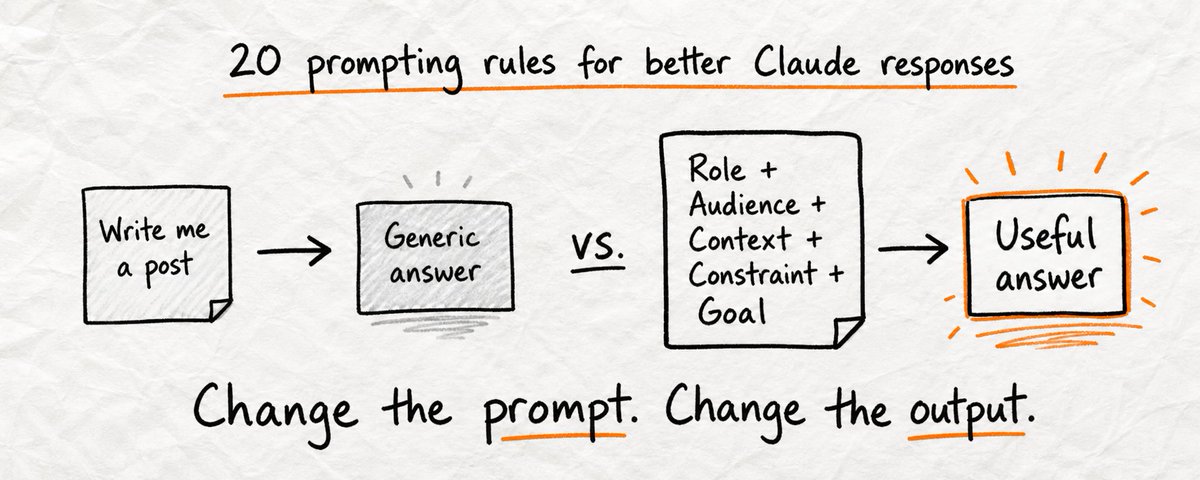
Most people use Claude like a search engine. They type a question, get an answer, move on.
That is not how Claude works. Claude responds to context, roles, constraints, and framing. The same question asked two different ways gets two completely different answers. One of them is actually useful.
These 20 rules are not specific prompts for specific tasks. They are the method. Learn these once and every conversation you have with Claude gets better, no matter what you are working on.
The difference between a mediocre Claude response and one that replaces an hour of work is almost always in how the request was written. Not in the model. In the prompt.
## Setup
1 - Give Claude a role before the task
Before you tell Claude what to do, tell Claude who to be. A role changes the entire lens Claude uses to approach the task. It shifts vocabulary, tone, depth, and what Claude considers relevant.
The role does not need to be elaborate. Three words are enough. But without a role, Claude defaults to a generic assistant mode that is useful for everything and exceptional at nothing.
```
You are a [specific role] who [key trait or value].
[Your actual task]
```
2 - Tell Claude who will read this
Claude has no idea who your audience is unless you say so. Without an audience, it writes for everyone, which means it writes for no one in particular.
The more specific the audience description, the sharper the output. Age, background, what they already know, what they are skeptical about. Any detail you give makes the output fit better.
```
Write this for a [specific person or profile] who already knows [what they know] and is skeptical about [their main objection].
```
3 - Show Claude what you do NOT want
Describing what you want is useful. Describing what you do not want is more useful. Negatives help Claude cut out the defaults it falls into without thinking: corporate language, excessive hedging, generic openers, unnecessary bullet points.
If there is a pattern you hate seeing in Claude responses, name it explicitly. Claude will avoid it.
```
Do not use corporate language.
Do not start with "Great question" or "Certainly".
Do not use bullet points.
Do not hedge every sentence with "it depends" or "it's important to note".
```
4 - Set the length before you start
Claude does not know whether you want three sentences or three pages unless you say so. Left to its own defaults, it will write something that feels complete but may be twice as long as what you actually needed, or half as developed.
Be specific: a word count, a number of sentences, a number of paragraphs, or a description like "short enough to read in 30 seconds."
```
Keep this under 150 words.
Write exactly 3 paragraphs.
Short enough to read in under 30 seconds.
Long enough to cover all the main objections, no longer.
```
5 - Give Claude your own writing first
When Claude writes in your voice without examples, it writes in its own voice. The output is grammatically fine and logically sound, but it does not sound like you. Paste three to five samples of your own writing and ask Claude to match the style before giving it any new task.
Claude will study rhythm, sentence length, vocabulary, how you open paragraphs, how you end them. The output will be closer to what you would have written than anything Claude produces from scratch.
```
Here are 3 examples of my writing:
[paste example 1]
[paste example 2]
[paste example 3]
Analyze my style: sentence length, vocabulary, tone, how I open and close paragraphs.
Then write [new piece] in exactly that style.
```
## Context
6 - Paste the full document, not a summary
When you summarize a document before giving it to Claude, you have already made editorial decisions about what matters. Claude is then working with your interpretation, not the source. Paste the full thing. Claude's context window is large enough to handle it.
This matters most when asking Claude to find problems, inconsistencies, or things you might have missed. A summary hides exactly the things Claude would have caught.
```
Here is the full document. Read all of it before responding.
[paste full document]
Now: [your actual question]
```
7 - Tell Claude what you already know
Claude does not know your background unless you tell it. If you are an expert asking about your own field, say that. If you are a complete beginner, say that too. Claude calibrates explanation depth to what it knows about you.
Without this, Claude picks an assumed level that may be too basic or too technical. One sentence about your background eliminates an entire category of bad answers.
```
I have been working in [field] for [X years].
I understand [what you know] but I am not familiar with [what you need explained].
Explain this at the right level.
```
8 - Tell Claude the purpose, not just the task
There is a difference between "write a subject line for this email" and "write a subject line for this email. The goal is to get a response from someone who has ignored three previous emails." The second one tells Claude why, which changes what Claude optimizes for.
Purpose changes structure, tone, word choice, and what Claude decides to include or cut. When Claude knows why you need something, it makes better decisions about how to deliver it.
```
[Task]. The goal is [specific outcome].
The person reading this will [what they will do or feel after].
```
9 - Give Claude a constraint it has to work within
Constraints make Claude more creative, not less. When Claude has unlimited space and freedom, it produces something complete and average. When it has a specific limitation to work around, it finds solutions you would not have thought of.
Any real constraint works: word limit, format, tone, vocabulary level, medium, reading time. The tighter the constraint, the more interesting the result.
```
Explain this using only words a 10-year-old would know.
Write this as a single sentence.
Make the argument using only numbers and facts, no opinions.
Write this so it works as both a tweet and an email subject line.
```
10 - Start fresh when you switch topics
Claude carries context from everything earlier in the conversation. When you switch to a completely different task in the same chat, that context can pull the new answer in the wrong direction. Claude may apply tone, framing, or assumptions from the previous task when they no longer apply.
A new topic deserves a new conversation. It takes ten seconds to open one and it eliminates an entire category of subtle contamination in Claude's responses.
## Output
11 - Ask Claude to think before it answers
For complex tasks, tell Claude to work through the problem before giving you a final answer. This is not a trick. It genuinely changes what Claude produces. When Claude reasons through something step by step, it catches errors, finds gaps, and arrives at better conclusions than when it generates a response immediately.
This matters most for anything involving decisions, plans, analysis, or creative problems with multiple possible approaches.
```
Before you answer, think through this step by step.
List your reasoning.
Then give me your final answer at the end.
[your question or task]
```
12 - Ask for multiple versions, not one
When Claude gives you one version of something, it has already made every editorial decision for you. You get its best guess at what you want. When you ask for three versions with different angles or tones, you get options, and options let you choose or combine.
This works especially well for headlines, subject lines, hooks, opening sentences, and anything where the first version is rarely the best one.
```
Give me 3 versions of this.
Version 1: [tone or angle]
Version 2: [different tone or angle]
Version 3: [different tone or angle]
Then tell me which one you think is strongest and why.
```
13 - Ask Claude to argue against you
Before you commit to any plan, decision, or piece of writing, ask Claude to push back on it as hard as it can. Not politely. Not with caveats. With the strongest possible case against what you just said.
The holes Claude finds are the ones that would have caused problems later. This is one of the highest-value things Claude can do and almost nobody does it.
```
Here is my plan / idea / argument:
[paste it]
Now argue against it as hard as you can.
Find every weak point.
Assume I am wrong and prove it.
Do not soften the criticism.
```
14 - Tell Claude how you will use the output
A summary for a CEO presentation is different from a summary for your own notes. A tweet draft that will be posted as-is is different from one you will heavily edit. Claude formats and calibrates differently when it knows the destination.
This is one of the simplest rules and one of the most consistently ignored. One sentence about how the output will be used changes the entire structure of what Claude delivers.
```
This will be read aloud in a 5-minute presentation.
This is for my own reference, not for anyone else to read.
This will be sent as-is to a client, no edits after.
This is a first draft I will rewrite heavily.
```
15 - Ask Claude to rate its own answer
After Claude gives you something, ask it to rate the response and explain what it would do differently if it had more information or more time. Claude will often identify the weakest parts of its own output, and that tells you exactly where to push for a better version.
This also works as a quality filter. If Claude rates its answer a 6 out of 10 and explains why, you know the direction to take the next prompt.
```
On a scale of 1-10, how good is the response you just gave me?
What are the weakest parts?
What would you do differently if you had more context or more time?
```
## Iteration
16 - Never say "make it better"
"Make it better" is the most common feedback given to Claude and the least useful. Better how? Better for whom? Better in what direction? Claude will make changes, but they will be guesses about what you meant.
When you want a revision, say exactly what to change and why. The more specific the feedback, the closer the next version gets to what you actually want.
```
The [specific part] is too [problem].
Make it [what you want instead].
Keep everything else exactly as it is.
```
17 - Ask Claude what it needs
Before starting a complex task, ask Claude what information would help it do this better. Claude will tell you exactly what context it is missing. You give it that context. The output improves significantly.
This works especially well for long documents, detailed analysis, and anything where the quality of the output depends heavily on details you might not think to include.
```
I want you to help me with [task].
Before you start, tell me: what information would help you do this significantly better?
What am I probably not telling you that you need to know?
```
18 - Chain tasks instead of combining them
When you give Claude three tasks in one prompt, it completes all three at average quality. When you give it one task, review the output, then give the next task using that output as input, each step gets full attention.
Chaining is slower in terms of messages but faster in terms of getting to a result you can actually use. Complex work benefits from sequential steps, not parallel ones.
```
Step 1: Summarize this document in 5 bullet points.
[after Claude responds]
Step 2: Based on that summary, write 3 key questions a skeptical reader would ask.
[after Claude responds]
Step 3: Answer each of those questions in one paragraph each.
```
## Advanced
19 - Use "explain this as if I am..."
This is one of the most underused prompting patterns and one of the most powerful for learning. Asking Claude to explain something as if you are a specific person, in a specific situation, with a specific level of knowledge forces Claude to translate complex ideas into the exact form you can actually absorb.
It also works in reverse for creative tasks: write this as if you are a journalist, a lawyer, a 10-year-old, a skeptic. The persona unlocks a completely different register.
```
Explain [concept] as if I am a [profession] who has never heard of this.
Explain [concept] using only analogies from [familiar field].
Explain this so clearly that a smart 12-year-old could explain it to someone else.
```
20 - End every important prompt with "what did I miss?"
After Claude completes any significant task, ask it what you did not think to ask. What assumptions did you make that might be wrong? What questions did you not ask that you should have? What would a smarter version of you have included?
Claude will find things. It almost always does. This single habit catches more errors and blind spots than any other prompting technique, because it specifically asks Claude to look for what you could not see yourself.
```
What did I miss?
What should I have asked that I did not?
What assumptions am I making that might be wrong?
What would change your answer if I told you something different?
```
These are not hacks. They are the fundamentals of how Claude actually works.
Claude responds to context. It responds to roles, constraints, purpose, and framing. Every one of these rules gives Claude more of what it needs to produce something useful instead of something average.
Most people apply none of them. They type a sentence, get a mediocre answer, and decide Claude is not that impressive.
Pick three of these rules. Apply them in your next session. That is enough to see a difference.
The other seventeen are here when you need them.
## 相关链接
- [Anatoli Kopadze](https://x.com/AnatoliKopadze)
- [@AnatoliKopadze](https://x.com/AnatoliKopadze)
- [60K](https://x.com/AnatoliKopadze/status/2051665228044124548/analytics)
- [Upgrade to Premium](https://x.com/i/premium_sign_up)
- [10:08 PM · May 5, 2026](https://x.com/AnatoliKopadze/status/2051665228044124548)
- [60K Views](https://x.com/AnatoliKopadze/status/2051665228044124548/analytics)
- [View quotes](https://x.com/AnatoliKopadze/status/2051665228044124548/quotes)
---
*导出时间: 2026/5/6 16:21:01*
---
## 中文翻译
# 20 条让 Claude 最终如你所愿的提示规则
**作者**: Anatoli Kopadze
**日期**: 2026-05-05T14:08:03.000Z
**来源**: [https://x.com/AnatoliKopadze/status/2051665228044124548](https://x.com/AnatoliKopadze/status/2051665228044124548)
---

大多数人像使用搜索引擎一样使用 Claude。他们输入一个问题,得到一个答案,然后就结束了。
这不是 Claude 的工作方式。Claude 会响应上下文、角色、约束和框架。同一个问题用两种不同的方式提问,会得到两个完全不同的答案。其中一个确实是有用的。
这 20 条规则并非针对特定任务的特定提示。它们是方法。只需学习一次,你与 Claude 的每一次对话都会变得更好,无论你在做什么。
一个平庸的 Claude 回复和一个能节省一小时工作的回复之间的区别,几乎完全在于请求的写法。不在于模型,而在于提示。
## 设置
1 - 在分配任务前先给 Claude 一个角色
在告诉 Claude 做什么之前,先告诉 Claude 它是谁。角色会改变 Claude 处理任务时所采用的整个视角。它会改变词汇、语气、深度,以及 Claude 认为相关的内容。
角色不需要很复杂。三个词就足够了。但如果没有角色,Claude 会默认为通用的助手模式,这种模式虽然什么都行,却什么都不精。
```
你是一个 [特定角色],具备 [关键特质或价值观]。
[你的实际任务]
```
2 - 告诉 Claude 谁会读到这些
除非你说明,否则 Claude 不知道你的受众是谁。没有受众,它就会写给所有人看,这意味着它并没有写给任何特定的人看。
受众描述越具体,输出就越精准。年龄、背景、他们已经知道什么、他们怀疑什么。你提供的任何细节都能让输出更契合。
```
针对 [特定的人或画像] 写作,对方已经知道 [他们知道的内容],并对 [他们的主要异议] 持怀疑态度。
```
3 - 告诉 Claude 你**不**想要什么
描述你想要什么很有用。描述你不想要什么更有用。否定性帮助 Claude 剔除那些它不假思索就会陷入的默认习惯:企业行话、过多的限定词、通用的开场白、不必要的要点列表。
如果你讨厌在 Claude 回复中看到某种模式,明确指出来。Claude 会避免它。
```
不要使用企业行话。
不要以“好问题”或“当然”开头。
不要使用要点列表。
不要用“视情况而定”或“值得注意的是”来限定每一个句子。
```
4 - 在开始前设定长度
除非你说明,否则 Claude 不知道你是想要三句话还是三页纸。如果由它默认发挥,它会写出一些看起来完整的内容,但可能是你实际所需长度的两倍,或是其发展程度的一半。
要具体:字数、句子数量、段落数量,或者像“短到 30 秒内能读完”这样的描述。
```
保持在 150 字以内。
准确写出 3 个段落。
短到 30 秒内能读完。
长到足以涵盖所有主要异议,但不要再长。
```
5 - 先把你的写作样本给 Claude
当 Claude 在没有样本的情况下模仿你的风格写作时,它实际上是在用它自己的声音写。输出在语法上没问题,逻辑上也通顺,但听起来不像你。粘贴三到五个你自己的写作样本,并在给它任何新任务之前让它模仿这种风格。
Claude 会研究节奏、句子长度、词汇量、你如何开头和结尾段落。输出结果会比 Claude 从头生成的任何内容都更接近你自己写出来的东西。
```
这里有 3 个我的写作示例:
[粘贴示例 1]
[粘贴示例 2]
[粘贴示例 3]
分析我的风格:句子长度、词汇、语气,以及我如何开头和结尾段落。
然后以完全相同的风格写 [新内容]。
```
## 上下文
6 - 粘贴完整文档,而不是摘要
当你在把文档给 Claude 之前先进行摘要,你已经对什么重要做出了编辑决定。Claude 处理的是你的解读,而不是原始来源。粘贴完整内容。Claude 的上下文窗口足够大,能处理它。
这在要求 Claude 查找问题、不一致之处或你可能遗漏的内容时最为重要。摘要恰恰隐藏了 Claude 本来能捕捉到的那些东西。
```
这是完整的文档。在回复之前阅读全部内容。
[粘贴完整文档]
现在:[你的实际问题]
```
7 - 告诉 Claude 你已经知道什么
除非你告诉 Claude,否则它不知道你的背景。如果你是专家在询问你自己的领域,请说出来。如果你是完全的初学者,也要说出来。Claude 会根据它对你的了解来调整解释的深度。
如果没有这一点,Claude 会选择一个可能太基础或太技术性的假定水平。一句关于你背景的话就能消除一整类糟糕的答案。
```
我在 [领域] 工作了 [X 年]。
我理解 [你知道的内容],但我不熟悉 [需要解释的内容]。
以适当的水平解释这一点。
```
8 - 告诉 Claude 目的,而不仅仅是任务
“为这封邮件写一个主题行”和“为这封邮件写一个主题行。目标是让一个已经忽略了三封先前邮件的人回复”之间是有区别的。第二个告诉了 Claude 为什么,这改变了 Claude 优化的目标。
目的会改变结构、语气、措辞,以及 Claude 决定包含或删减的内容。当 Claude 知道你为什么需要某样东西时,它在如何交付方面会做出更好的决策。
```
[任务]。目标是 [具体结果]。
阅读此内容的人将 [他们之后会做什么或感受到什么]。
```
9 - 给 Claude 一个必须遵守的约束
约束让 Claude 更有创意,而不是更少。当 Claude 拥有无限的空间和自由时,它会产出一些完整但平庸的东西。当它有一个特定的限制需要克服时,它会找到你意想不到的解决方案。
任何真实的约束都有效:字数限制、格式、语气、词汇水平、媒介、阅读时间。约束越紧,结果越有趣。
```
仅使用 10 岁孩子认识的词汇来解释这一点。
将此写成单句话。
仅使用数字和事实进行论证,不要观点。
以此为基础写,使其既能作为推文又能作为邮件主题行。
```
10 - 切换话题时重新开始
Claude 会保留对话中早先所有内容的上下文。当你在同一个聊天中切换到完全不同的任务时,那个上下文可能会把新答案引向错误的方向。Claude 可能会应用不再适用的先前任务的语气、框架或假设。
新话题值得开启一个新的对话。开启一个新对话只需要十秒钟,这消除了 Claude 回复中一整类微妙的“污染”。
## 输出
11 - 让 Claude 在回答前先思考
对于复杂的任务,告诉 Claude 在给出最终答案之前先解决这个问题。这不是一个把戏。它确实改变了 Claude 的产出。当 Claude 逐步推理某事时,它能捕捉错误、发现漏洞,并得出比立即生成回复更好的结论。
这对于涉及决策、计划、分析或具有多种可能方法的创造性问题最为重要。
```
在回答之前,请一步步思考。
列出你的推理过程。
最后给我你的最终答案。
[你的问题或任务]
```
12 - 要求提供多个版本,而不是一个
当 Claude 给你某样东西的一个版本时,它已经为你做出了所有的编辑决定。你得到的是它对你想要什么的最佳猜测。当你要求三个具有不同角度或语气的版本时,你得到的是选项,而选项让你能够选择或组合。
这对于标题、主题行、钩子、开头句以及任何第一个版本很少是最好的东西特别有效。
```
给我 3 个版本。
版本 1:[语气或角度]
版本 2:[不同的语气或角度]
版本 3:[不同的语气或角度]
然后告诉我你认为哪个最强,为什么。
```
13 - 让 Claude 反驳你
在你致力于任何计划、决策或文章之前,让 Claude 尽可能强烈地反驳它。不是礼貌地。不是带有保留地。而是针对你刚才所说内容提出尽可能强有力的反面论证。
Claude 发现的漏洞正是那些后来会导致问题的漏洞。这是 Claude 能做的最高价值的事情之一,但几乎没有人这样做。
```
这是我的计划/想法/论点:
[粘贴它]
现在尽可能强烈地反驳它。
找出每一个弱点。
假设我是错的,并证明这一点。
不要软化批评。
```
14 - 告诉 Claude 你将如何使用输出
用于 CEO 演示的摘要与用于你自己笔记的摘要是不同的。一个将按原样发布的推文草稿与一个将被大量编辑的草稿是不同的。当 Claude 知道去向时,它的格式和调整会不同。
这是最简单的规则之一,也是最常被忽视的规则之一。一句关于输出将如何使用的话会彻底改变 Claude 交付内容的结构。
```
这将在 5 分钟的演示中大声朗读。
这仅供我自己参考,不供其他人阅读。
这将按原样发送给客户,之后不再编辑。
这是初稿,我会大幅重写。
```
15 - 让 Claude 评价它自己的回答
在 Claude 给你某些东西后,让它评价回复,并解释如果有更多信息或更多时间它会做什么不同的处理。Claude 经常会发现自己输出中最弱的部分,而这告诉你确切的方向,以便推动其产生更好的版本。
这也作为一个质量过滤器。如果 Claude 将其答案评为 6 分(满分 10 分)并解释原因,你就知道下一个提示该往哪个方向走。
```
按 1-10 分的标准,你刚才给我的回答有多好?
哪些部分是最弱的?
如果你有更多的上下文或更多的时间,你会做哪些不同的处理?
```
## 迭代
16 - 永远不要说“让它更好”
“让它更好”是给 Claude 最常见的反馈,也是最没用的。怎么更好?为谁更好?在什么方向上更好?Claude 会做出改变,但那是对你意思的猜测。
当你想要修订时,准确说明要改变什么以及为什么。反馈越具体,下一个版本就越接近你真正想要的东西。
```
[特定部分] 太 [问题所在] 了。
把它 [你想要的样子]。
保持其他所有内容完全不变。
```
17 - 问 Claude 它需要什么
在开始复杂任务之前,问问 Claude 什么信息能帮助它做得更好。Claude 会确切地告诉你它缺少什么上下文。你提供那个上下文。输出质量会显著提高。
这对于长文档、详细分析以及任何质量严重取决于你可能想不到要包含的细节的情况特别有效。
```
我想让你帮我处理 [任务]。
在你开始之前,告诉我:什么信息能让你显著更好地完成这件事?
我可能没告诉你什么你需要知道的信息?
```
18 - 链接任务而不是合并它们
当你在一条提示中给 Claude 三个任务时,它会以平均质量完成所有三个任务。当你给它一个任务,审查输出,然后利用该输出作为输入给出下一个任务时,每一步都会得到充分的关注。
链接在消息数上较慢,但在获得你实际可用的结果上较快。复杂的工作受益于顺序步骤,而不是并行步骤。
```
步骤 1:用 5 个要点总结这个文档。
[在 Claude 回复后]
步骤 2:基于该摘要,写出 3 个持怀疑态度的读者会问的关键问题。
[在 Claude 回复后]
步骤 3:分别用一段话回答这些问题中的每一个。
```
## 高级
19 - 使用“假如我是...来解释这一点”
这是最未被充分利用的提示模式之一,也是对于学习最强大的模式之一。要求 Claude 假设你是一个特定的人,处于特定的情况下,拥有特定的知识水平来解释某事,会迫使 Claude 将复杂的想法转化为你实际上能吸收的确切形式。
它也适用于创造性任务的反向操作:假设你是一名记者、律师、10 岁的孩子或怀疑论者来写这个。人设解锁了一种完全不同的语域。
```
假设我是 [职业] 且从未听说过此概念,请解释 [概念]。
仅使用来自 [熟悉领域] 的类比来解释 [概念]。
解释得足够清楚,以便一个聪明的 12 岁孩子能把它解释给别人听。
```
20 - 在每个重要提示的末尾加上“我遗漏了什么?”
在 Claude 完成任何重要任务后,问问它你没有想到要问什么。你做出了哪些可能错误的假设?你没有问哪些你应该问的问题?更聪明的你会包含什么?
Claude 会发现一些东西。它几乎总能发现。这个单一的习惯比任何其他提示技术都能捕捉到更多的错误和盲点,因为它明确要求 Claude 寻找你自己看不到的东西。
```
我遗漏了什么?
我没有问但我应该问什么?
我做了哪些可能错误的假设?
如果我告诉你一些不同的东西,什么会改变你的答案?
```
这些不是技巧。它们是 Claude 实际工作方式的基本原理。
Claude 响应上下文。它响应角色、约束、目的和框架。这些规则中的每一条都给了 Claude 更多它所需要的东西,以产生有用的东西而不是平庸的东西。
大多数人不应用其中的任何一条。他们输入一个句子,得到一个平庸的答案,然后决定 Claude 没什么了不起。
挑选这三条规则。在你的下一次会话中应用它们。这足以让你看到不同。
当你需要时,其余的十七条都在这里。
## 相关链接
- [Anatoli Kopadze](https://x.com/AnatoliKopadze)
- [@AnatoliKopadze](https://x.com/AnatoliKopadze)
- [60K](https://x.com/AnatoliKopadze/status/2051665228044124548/analytics)
- [升级到 Premium](https://x.com/i/premium_sign_up)
- [2026年5月5日 下午10:08](https://x.com/AnatoliKopadze/status/2051665228044124548)
- [60K 浏览量](https://x.com/AnatoliKopadze/status/2051665228044124548/analytics)
- [查看引用](https://x.com/AnatoliKopadze/status/2051665228044124548/quotes)
---
*导出时间: 2026/5/6 16:21:01*