# How to Actually Use Claude. 18 steps that unlock 100% of its potential
**作者**: Anatoli Kopadze
**日期**: 2026-05-13T14:26:20.000Z
**来源**: [https://x.com/AnatoliKopadze/status/2054568935274549597](https://x.com/AnatoliKopadze/status/2054568935274549597)
---
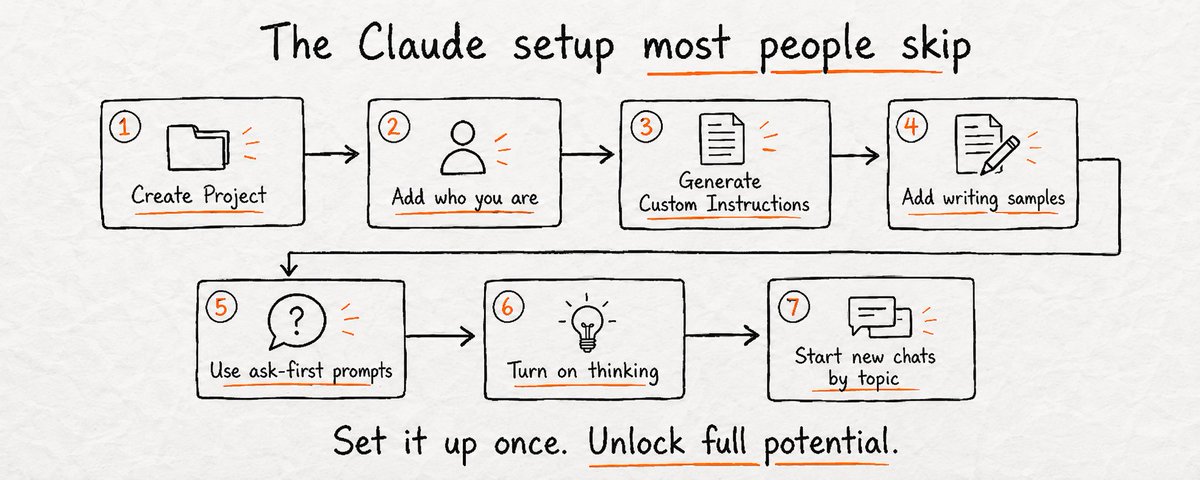
Claude has been out for two years. Most people who use it every day are still using 10% of what it can do.
Not because it's complicated. Because nobody showed them what the other 90% looks like.
This guide fixes that. By the end you will have Claude set up in a way that remembers you, understands you, and works the way you actually think. And you will know how to use it for things most people have never tried.
## Start Here
1 - Create a Project, not a chat
Every time you open a new Claude chat, it starts with zero memory. It doesn't know your name, your work, your goals, or how you like to communicate. You spend the first few messages re-explaining yourself, or you don't, and Claude gives you something generic that doesn't fit how you actually work.
Projects fix this. A Project is a persistent workspace where Claude keeps context across every conversation inside it. You set it up once and every session that follows starts with Claude already knowing who you are.
Go to Claude, click Projects in the sidebar, and create a new one. Name it something like "Work" or "Personal" depending on how you plan to use it. Everything that follows goes inside this Project.
2 - Tell Claude who you are
Before Claude can help you well, it needs to understand you. Most people skip this step entirely and wonder why Claude gives them answers that feel slightly off.
Paste this into your Project and fill in every field honestly. The more specific you are, the better every single response becomes.
```
My name is [your name].
I work as [your role or profession]. My main responsibilities are [2-3 things you actually do day to day].
Right now my biggest goals are [1-3 specific goals you're working toward].
I use Claude mostly for [list your main use cases — writing, research, analysis, learning, coding, etc].
My background and knowledge level: [what you know well, what you're learning, what you're new to].
How I like to receive information: [e.g. direct and concise / detailed with examples / step by step / no bullet points / short paragraphs].
Things I don't want: [e.g. don't add disclaimers, don't use corporate language, don't repeat what I just said back to me, don't start with "Great question"].
Topics and areas I care about: [your interests, industry, niche].
```
Save this inside your Project's knowledge base. Claude will read it at the start of every conversation in this Project.
3 - Turn that into Custom Instructions
Pasting your background is a good start. But Custom Instructions go further. They tell Claude not just who you are, but exactly how to behave with you by default.
Paste this prompt into Claude after you've filled in the template above:
```
Based on everything I've told you about myself, write me a set of custom instructions for this Claude Project.
The instructions should:
- Describe who I am and what I do
- Set my default communication style and format
- Tell Claude what to never do when working with me
- Define the tone I want in every response
- Include any default behaviors I would want in every session
Write them in second person, as if Claude is reading rules about how to help me. Be specific. No generic advice. Under 400 words.
```
Take the output and paste it into your Project Instructions. This becomes Claude's permanent operating mode for every conversation in this Project.
## Claude Is Not What You Think
4 - Claude is not a search engine
Most people use Claude the way they use Google. They type a question and wait for an answer. That is the lowest-value way to use it.
Claude is not a retrieval tool. It is a thinking partner. It doesn't just pull information, it reasons, synthesizes, argues, and builds on context. The moment you treat it like a search engine, you cut its usefulness by 80 percent.
Stop asking Claude what something is. Start asking Claude to help you think through something.
Instead of: "What is prompt caching?"
Try: "I'm building a workflow that calls Claude 20 times per session. Walk me through how prompt caching works and whether it would actually reduce my costs given that context."
The second prompt gives Claude a problem to solve with you. The first gives it a definition to recite.
5 - Ask Claude to ask you questions first
This is one of the most powerful techniques almost nobody uses. Before Claude starts any complex task, tell it to gather information from you first.
When Claude asks you questions before starting, the output is dramatically better because it's built on the right foundation. Without this, Claude makes assumptions and you spend time correcting things that could have been right the first time.
Use this before any important task:
```
Before you start, ask me the 5 most important questions that would help you do this well.
After I answer, then begin.
```
Or for a specific task:
```
I need you to help me write a cold email to a potential client.
Before you write anything, ask me what you need to know to make this genuinely good, not generic.
```
## What Even Regular Users Don't Know
6 - Style cloning
When Claude writes in your voice without examples, it writes in its own voice. The output is grammatically correct and completely wrong in tone. It sounds like AI because it is.
Give Claude three to five samples of your own writing. Ask it to analyze your patterns, not just describe your style. After that analysis, it writes like you, not like a polished corporate assistant.
```
Here are 3 examples of my writing:
[paste sample 1]
[paste sample 2]
[paste sample 3]
Analyze my writing style in detail. Look at: sentence length, rhythm, vocabulary choices, how I open and close paragraphs, what I avoid, how formal or informal I am, and any patterns that make my writing distinct.
After this, when I ask you to write anything for me, match this style exactly. Do not default to your own patterns.
```
7 - Claude as your sparring partner
Most people ask Claude to help them with ideas. That means Claude builds on what you say, adds to it, expands it. You get agreement and elaboration.
That is useful sometimes. But it is not how you stress-test an idea.
Before committing to any plan, decision, or piece of writing, ask Claude to attack it. Not critique it. Attack it. The distinction matters.
```
Here is my plan: [describe your plan]
Your job is to destroy it. Find every assumption I'm making that could be wrong. Find every way this could fail. Argue the opposite position as hard as you can. Do not be polite. Do not add qualifications. Just attack.
After that, steelman my position. Build the strongest possible case for why I'm right.
Then tell me what you actually think.
```
8 - Extended Thinking
Most Claude users have never turned this on. Extended Thinking is a mode where Claude reasons through a problem step by step before giving you an answer, instead of going straight to the output.
For simple tasks, you don't need it. For complex decisions, analysis, or any question where you want Claude to actually think rather than pattern-match, turn it on.
In Claude, click the brain icon before sending your message. Or add this to your prompt:
```
Think through this carefully before responding.
Work through the problem step by step, show your reasoning, identify where you're uncertain, then give me your conclusion.
```
The difference in output quality on hard questions is significant.
9 - Claude writes prompts for Claude
This is the most underused thing you can do. If you're not sure how to prompt Claude for a specific task, ask Claude to write the prompt for you.
Claude knows what kinds of instructions produce better results. Let it use that knowledge on your behalf.
```
I need Claude to help me [describe your actual task].
Write me the best possible prompt for this task.
Include role, context, format instructions, and any constraints that would improve the output.
Then use that prompt immediately.
```
## How to Spend Fewer Tokens and Get More
10 - Specify the output length
Claude's default is to write as much as it thinks is appropriate. That is usually more than you need, which means more tokens used, more time spent reading, and more noise in the output.
Tell Claude exactly how long you want the answer before it starts.
```
Answer in 3 sentences maximum.
```
```
Give me 5 bullet points. No explanations. Just the points.
```
```
Write this in under 150 words.
```
This one instruction cuts token usage on most tasks by 40 to 60 percent without losing any of the value you actually need.
11 - Remove the preamble
Every Claude response defaults to starting with something you didn't ask for. "Great question. Let me break this down for you." Or a full restatement of what you just said. Or a disclaimer. Or a closing summary that repeats everything it just told you.
You didn't ask for any of that. It costs tokens and it wastes your time.
Add this to your Custom Instructions:
```
Never start responses with preamble, affirmations, or restatements of my question.
Go directly to the answer.
Do not add a summary at the end unless I specifically ask for one.
No disclaimers unless the topic genuinely requires one.
```
12 - Don't re-explain yourself every conversation
If you're pasting the same background information into every new chat, you are wasting tokens every single time and training yourself into a habit that costs you more as Claude usage scales.
This is exactly what Projects and Custom Instructions are for. Put your context in once. Let Claude read it automatically at the start of every session. Never paste your background again.
If you are not using Projects yet, start there before anything else in this article.
13 - Start a new chat for a new topic
Claude carries the context of everything said earlier in a conversation. When you switch topics inside a long chat, Claude still has all the previous context loaded. That means more tokens used on every response, slower processing, and context bleed from earlier in the conversation affecting your new topic.
When you switch to something unrelated, start a fresh chat inside your Project. You keep the Project memory. You lose the irrelevant baggage.
## Ready to Use Right Now
These are complete prompts you can copy and use immediately.
14 - Understand anything through analogies (Feynman method)
Most explanations Claude gives by default are technically correct and practically useless. They use the same vocabulary as the thing you're trying to understand, which means you walk away with a definition but not actual comprehension.
The Feynman method forces understanding through simplicity. If Claude can't explain it in plain terms using analogies, it means the explanation isn't clear enough yet. This prompt works for anything from investing to quantum physics to how a specific API works.
```
Explain [topic] to me using only analogies and everyday examples. No jargon. Assume I have no background in this field.
After each analogy, check whether I've actually understood it by asking me one question. Based on my answer, go deeper or adjust the explanation.
Keep going until I can explain it back to you in my own words without using any technical terms.
```
15 - Travel plan built around how you actually travel
Most travel planning starts with destinations and ends with a generic itinerary you could find on any travel blog. Claude can do something different: build a plan around your specific travel style, pace, budget, and what actually matters to you, not what's on every must-see list.
The key is giving it real information about you, not just dates and locations.
```
I'm planning a trip to [destination]. I'll be there for [number of days]. My budget is approximately [amount] per day including accommodation.
Here's how I actually travel: [describe your style — do you like slow mornings or packed days, touristy places or local spots, museums or food, active or relaxed, solo or with someone, etc].
Things I want to avoid: [crowds, tourist traps, expensive restaurants, long transport times, etc].
Build me a day-by-day itinerary that fits this. For each day, include where to stay, what to do, where to eat, and any logistics I need to know. Flag anything that requires booking in advance.
```
16 - Monthly expense analysis with real conclusions
Most people look at their bank statement and feel vaguely bad about their spending without understanding what's actually happening. Claude can turn raw numbers into a clear picture of where your money is going and what you should actually do about it.
This works best when you paste real data, not estimates.
```
I'm going to paste my expenses from the last month. Analyze them and tell me:
1. What categories am I spending the most on
2. Where my spending looks unusual compared to what I described as my goals
3. What I could cut without meaningfully affecting my life
4. What I'm probably underspending on that matters
5. One specific change that would have the biggest financial impact
Here are my expenses: [paste your bank statement or expense list]
My financial goals right now: [describe what you're trying to do — save more, pay off debt, invest, etc]
```
17 - Claude as your personal thinking partner
Most people don't have someone in their life who will listen without judgment, ask the right questions, and help them work through something they're stuck on without pushing their own agenda. Claude can fill that role, but only if you give it the right instructions.
This isn't therapy. It's structured self-reflection with an outside perspective that helps you think more clearly.
```
I want to talk through something I'm dealing with. Your job is not to give me advice right away.
First, ask me questions to understand the situation fully. What's actually happening, how I feel about it, what I've already tried, and what outcome I'm hoping for.
After you understand the full picture, reflect back what you're hearing — not just the facts but what seems to be underneath them.
Then, and only then, offer your perspective. Be honest, not reassuring. Tell me what you actually think, including anything I might not want to hear.
Here's what's on my mind: [describe what you want to think through]
```
18 - Stress-test any business idea before you commit
Most business ideas die because people fall in love with them before testing them. They spend months building something nobody wants because they never honestly asked whether the idea was actually good.
Claude can act as a ruthless first filter. Not to kill ideas, but to find the real problems before they cost you time and money.
```
I have a business idea I want to stress-test before I invest serious time in it.
Here's the idea: [describe it in detail — what it is, who it's for, how it makes money, why you think it works]
Your job is to find everything wrong with it. Specifically:
1. What assumptions am I making that could be wrong
2. Who already does this and why I might lose to them
3. Why the target customer might not actually pay for this
4. What would have to be true for this to work, and how likely is that
5. The single biggest problem with this idea
Be specific. Generic risks like "the market might not be ready" are not useful. Give me the real version of each problem.
After that, tell me what the idea would need to look like to actually work.
```
## The Actual Point
Claude is not smarter than you. It does not have better ideas than you. What it has is infinite patience, broad knowledge, and the ability to think through problems from angles you haven't considered.
The people who get the most from Claude are not the ones with the best questions. They are the ones who have set it up to understand them, who give it real context, and who know how to use it as a partner rather than a dispenser.
Most people will read this and keep opening Claude the same way they always have.
Set it up once. Change how you work permanently.
## 相关链接
- [Anatoli Kopadze](https://x.com/AnatoliKopadze)
- [@AnatoliKopadze](https://x.com/AnatoliKopadze)
- [940K](https://x.com/AnatoliKopadze/status/2054568935274549597/analytics)
- [Upgrade to Premium](https://x.com/i/premium_sign_up)
- [10:26 PM · May 13, 2026](https://x.com/AnatoliKopadze/status/2054568935274549597)
- [940.1K Views](https://x.com/AnatoliKopadze/status/2054568935274549597/analytics)
- [View quotes](https://x.com/AnatoliKopadze/status/2054568935274549597/quotes)
---
*导出时间: 2026/5/14 16:34:34*
---
## 中文翻译
# 如何真正用好 Claude。18 个步骤释放 100% 的潜力
**作者**: Anatoli Kopadze
**日期**: 2026-05-13T14:26:20.000Z
**来源**: [https://x.com/AnatoliKopadze/status/2054568935274549597](https://x.com/AnatoliKopadze/status/2054568935274549597)
---

Claude 发布已经两年了。大多数每天都在使用它的人,仍然只用了它 10% 的功能。
这并不是因为它很复杂。而是因为没人向他们展示剩下那 90% 是什么样的。
这份指南就是为了解决这个问题。读完之后,你将把 Claude 设置成能够记住你、理解你,并按照你实际的思维方式工作的模式。而且,你会知道如何用它来完成大多数人从未尝试过的事情。
## 从这里开始
1 - 创建一个项目,而不是一个聊天
每次你打开一个新的 Claude 聊天窗口,它都是零记忆开始的。它不知道你的名字、工作、目标,或者你喜欢的沟通方式。你总是要花前几条消息重新解释你自己,或者你不解释,结果 Claude 给了你一个通用的、并不适合你实际工作方式的回答。
项目解决了这个问题。项目是一个持久的工作空间,Claude 会在其中的每一次对话中保留上下文。你只需设置一次,随后的每一次会话开始时,Claude 就已经知道你是谁了。
去 Claude,点击侧边栏的“Projects”(项目),然后创建一个新的。根据你的使用计划,将其命名为“工作”或“个人”之类的。接下来的所有操作都在这个项目中进行。
2 - 告诉 Claude 你是谁
在 Claude 能很好地帮助你之前,它需要了解你。大多数人完全跳过这一步,然后纳闷为什么 Claude 给出的答案感觉总是有点不对劲。
把这个模板粘贴到你的项目中,并诚实地填写每一个字段。你越具体,每一个回答就会变得越好。
```
My name is [your name].
I work as [your role or profession]. My main responsibilities are [2-3 things you actually do day to day].
Right now my biggest goals are [1-3 specific goals you're working toward].
I use Claude mostly for [list your main use cases — writing, research, analysis, learning, coding, etc].
My background and knowledge level: [what you know well, what you're learning, what you're new to].
How I like to receive information: [e.g. direct and concise / detailed with examples / step by step / no bullet points / short paragraphs].
Things I don't want: [e.g. don't add disclaimers, don't use corporate language, don't repeat what I just said back to me, don't start with "Great question"].
Topics and areas I care about: [your interests, industry, niche].
```
将其保存在你的项目知识库中。在此项目的每次对话开始时,Claude 都会阅读它。
3 - 将其转化为自定义指令
粘贴你的背景信息只是一个好的开始。但自定义指令更进一步。它们不仅告诉 Claude 你是谁,还确切地告诉它默认情况下该如何与你相处。
在你填写完上面的模板后,将这个提示词粘贴给 Claude:
```
Based on everything I've told you about myself, write me a set of custom instructions for this Claude Project.
The instructions should:
- Describe who I am and what I do
- Set my default communication style and format
- Tell Claude what to never do when working with me
- Define the tone I want in every response
- Include any default behaviors I would want in every session
Write them in second person, as if Claude is reading rules about how to help me. Be specific. No generic advice. Under 400 words.
```
获取输出结果,并将其粘贴到你的项目指令中。这将成为 Claude 在此项目中每次对话的永久运行模式。
## Claude 并非你想象的那样
4 - Claude 不是搜索引擎
大多数人像使用 Google 一样使用 Claude。他们输入一个问题,然后等待一个答案。这是使用它的价值最低的方式。
Claude 不是一个检索工具。它是一个思考伙伴。它不仅拉取信息,它还会推理、综合、论证,并在上下文基础上构建。一旦你把它当作搜索引擎,你就削减了它 80% 的用处。
停止问 Claude “某物是什么”。开始让 Claude 帮你“思考某事”。
不要问:“什么是提示词缓存?”
试着问:“我正在构建一个工作流,每次会话要调用 Claude 20 次。请向我解释提示词缓存是如何工作的,以及考虑到这个背景,它是否真的能降低我的成本。”
第二个提示词给了 Claude 一个需要和你共同解决的问题。第一个只是让它背诵一个定义。
5 - 让 Claude 先问你问题
这是几乎没人使用的最强大的技巧之一。在 Claude 开始任何复杂任务之前,告诉它先从你那里收集信息。
当 Claude 在开始之前问你问题时,输出质量会显著提高,因为它是建立在正确的基础之上的。如果没有这一步,Claude 会做出假设,而你则花时间去修正那些本可以一次做对的事情。
在任何重要任务之前使用这个:
```
Before you start, ask me the 5 most important questions that would help you do this well.
After I answer, then begin.
```
或者针对特定任务:
```
I need you to help me write a cold email to a potential client.
Before you write anything, ask me what you need to know to make this genuinely good, not generic.
```
## 即使是普通用户也不知道的事
6 - 风格克隆
当 Claude 在没有样本的情况下模仿你的语气写作时,它写出来的是它自己的声音。输出结果在语法上是正确的,但在语调上是完全错误的。它听起来像 AI,因为它就是 AI。
给 Claude 提供三到五个你自己的写作样本。让它分析你的模式,而不仅仅是描述你的风格。经过分析之后,它写出来的就像你,而不是一个经过润色的企业助理。
```
Here are 3 examples of my writing:
[paste sample 1]
[paste sample 2]
[paste sample 3]
Analyze my writing style in detail. Look at: sentence length, rhythm, vocabulary choices, how I open and close paragraphs, what I avoid, how formal or informal I am, and any patterns that make my writing distinct.
After this, when I ask you to write anything for me, match this style exactly. Do not default to your own patterns.
```
7 - Claude 作为你的陪练伙伴
大多数人在构思点子时寻求 Claude 的帮助。这意味着 Claude 会基于你所说的内容进行构建、补充和扩展。你得到的是赞同和阐述。
这有时很有用。但这并不是你压力测试一个想法的方法。
在敲定任何计划、决策或文章之前,让 Claude 攻击它。不仅仅是批评它。是攻击它。这个区别很重要。
```
Here is my plan: [describe your plan]
Your job is to destroy it. Find every assumption I'm making that could be wrong. Find every way this could fail. Argue the opposite position as hard as you can. Do not be polite. Do not add qualifications. Just attack.
After that, steelman my position. Build the strongest possible case for why I'm right.
Then tell me what you actually think.
```
8 - 扩展思考
大多数 Claude 用户从未开启过这个功能。扩展思考是一种模式,Claude 在给你答案之前会一步步推理问题,而不是直接给出输出。
对于简单的任务,你不需要它。对于复杂的决策、分析,或者任何你希望 Claude 真正思考而不仅仅是模式匹配的问题,请开启它。
在 Claude 中,发送消息前点击大脑图标。或者把这个添加到你的提示词中:
```
Think through this carefully before responding.
Work through the problem step by step, show your reasoning, identify where you're uncertain, then give me your conclusion.
```
对于难题,输出质量的差异是显著的。
9 - Claude 为 Claude 写提示词
这是你能做的最未被充分利用的事情。如果你不确定如何针对特定任务向 Claude 提示,让 Claude 为你编写提示词。
Claude 知道什么样的指令能产生更好的结果。让它代表你运用这些知识。
```
I need Claude to help me [describe your actual task].
Write me the best possible prompt for this task.
Include role, context, format instructions, and any constraints that would improve the output.
Then use that prompt immediately.
```
## 如何花费更少的 Token 并获得更多
10 - 指定输出长度
Claude 的默认设置是写出它认为合适的长度。这通常比你需要的多,这意味着使用更多的 Token,花更多时间阅读,以及输出中有更多噪音。
在开始之前告诉 Claude 你确切想要的答案长度。
```
Answer in 3 sentences maximum.
```
```
Give me 5 bullet points. No explanations. Just the points.
```
```
Write this in under 150 words.
```
仅此一条指令就能在大多数任务上减少 40% 到 60% 的 Token 使用量,而且不会损失你实际需要的任何价值。
11 - 移除前言
每个 Claude 回复默认都以一些你没要求的内容开头。“好问题。让我为你分解一下。”或者是完全重述你刚才说的话。或者是免责声明。或者是重复刚才告诉你的所有内容的结束总结。
你没有要求任何这些。它花费 Token 并浪费你的时间。
把这个添加到你的自定义指令中:
```
Never start responses with preamble, affirmations, or restatements of my question.
Go directly to the answer.
Do not add a summary at the end unless I specifically ask for one.
No disclaimers unless the topic genuinely requires one.
```
12 - 不要每次对话都重新解释自己
如果你每次新聊天都粘贴相同的背景信息,你每次都在浪费 Token,并且正在养成一个习惯,随着 Claude 使用规模的扩大,这会花费你更多。
这正是项目和自定义指令的用途。将你的上下文放进去一次。让 Claude 在每次会话开始时自动阅读它。永远不要再粘贴你的背景信息。
如果你还没有使用项目,在阅读本文其他内容之前先从这里开始。
13 - 为新话题开始一个新的聊天
Claude 会携带对话中之前所说的所有内容的上下文。当你在长对话中切换话题时,Claude 仍然加载着所有之前的上下文。这意味着每次响应使用更多的 Token,处理更慢,并且之前对话中的上下文干扰会影响你的新话题。
当你切换到不相关的事情时,在你的项目中开始一个新的聊天。你保留了项目记忆。你丢掉了不相关的包袱。
## 现在即可使用
这些都是你可以立即复制并使用的完整提示词。
14 - 通过类比理解任何事物(费曼法)
Claude 默认给出的大多数解释在技术上是正确的,但实际上毫无用处。它们使用了与你试图理解的事物相同的词汇,这意味着你得到了一个定义,但没有真正的理解。
费曼法通过简洁来强制理解。如果 Claude 不能用通俗的术语和类比来解释它,这意味着解释还不够清晰。这个提示词适用于从投资到量子物理再到特定 API 如何工作的任何事情。
```
Explain [topic] to me using only analogies and everyday examples. No jargon. Assume I have no background in this field.
After each analogy, check whether I've actually understood it by asking me one question. Based on my answer, go deeper or adjust the explanation.
Keep going until I can explain it back to you in my own words without using any technical terms.
```
15 - 围绕你的实际旅行方式制定的旅行计划
大多数旅行规划从目的地开始,并以你可以在任何旅行博客上找到的通用行程结束。Claude 可以做一些不同的事情:围绕你的具体旅行风格、节奏、预算以及真正对你重要的事情(而不是每个必去清单上的东西)来制定计划。
关键是给它关于你的真实信息,而不仅仅是日期和地点。
```
I'm planning a trip to [destination]. I'll be there for [number of days]. My budget is approximately [amount] per day including accommodation.
Here's how I actually travel: [describe your style — do you like slow mornings or packed days, touristy places or local spots, museums or food, active or relaxed, solo or with someone, etc].
Things I want to avoid: [crowds, tourist traps, expensive restaurants, long transport times, etc].
Build me a day-by-day itinerary that fits this. For each day, include where to stay, what to do, where to eat, and any logistics I need to know. Flag anything that requires booking in advance.
```
16 - 带有真实结论的月度支出分析
大多数人看着银行对账单,对花钱感到有些不安,却不了解实际情况如何。Claude 可以将原始数据转化为清晰的画面,展示你的钱去哪了以及你实际上应该对此做些什么。
当你粘贴真实数据而不是估算值时,效果最好。
```
I'm going to paste my expenses from the last month. Analyze them and tell me:
1. What categories am I spending the most on
2. Where my spending looks unusual compared to what I described as my goals
3. What I could cut without meaningfully affecting my life
4. What I'm probably underspending on that matters
5. One specific change that would have the biggest financial impact
Here are my expenses: [paste your bank statement or expense list]
My financial goals right now: [describe what you're trying to do — save more, pay off debt, invest, etc]
```
17 - Claude 作为你的个人思考伙伴
大多数人的生活中没有一个能不加评判地倾听、提出正确问题,并帮助他们理清困惑而不推行自己议程的人。Claude 可以填补这个角色,但前提是你必须给它正确的指令。
这不是治疗。这是一种结构化的自我反思,带有外部视角,帮助你更清晰地思考。
```
I want to talk through something I'm dealing with. Your job is not to give me advice right away.
First, ask me questions to understand the situation fully. What's actually happening, how I feel about it, what I've already tried, and what outcome I'm hoping for.
After you understand the full picture, reflect back what you're hearing — not just the facts but what seems to be underneath them.
Then, and only then, offer your perspective. Be honest, not reassuring. Tell me what you actually think, including anything I might not want to hear.
Here's what's on my mind: [describe what you want to think through]
```
18 - 在你承诺之前对任何商业想法进行压力测试
大多数商业想法之所以失败,是因为人们在测试之前就爱上了它们。他们花费数月时间构建没有人想要的东西,因为他们从未诚实地询问过这个想法是否真的很好。
Claude 可以充当一个无情的第一道过滤器。不是为了扼杀想法,而是在它们花费你时间和金钱之前找到真正的问题。
```
I have a business idea I want to stress-test before I invest serious time in it.
Here's the idea: [describe it in detail — what it is, who it's for, how it makes money, why you think it works]
Your job is to find everything wrong with it. Specifically:
1. What assumptions am I making that could be wrong
2. Who already does this and why I might lose to them
3. Why the target customer might not actually pay for this
4. What would have to be true for this to work, and how likely is that
5. The single biggest problem with this idea
Be specific. Generic risks like "the market might not be ready" are not useful. Give me the real version of each problem.
After that, tell me what the idea would need to look like to actually work.
```
## 真正的重点
Claude 并不比你聪明。它的想法并不比你好。它拥有的是无限的耐心、广博的知识,以及从你未曾考虑过的角度思考问题的能力。
从 Claude 中获益最多的人并不是……