# How to Build an AI Agent That Does the Work of 5 Employees for $20 a Month (Full Course)
**作者**: CyrilXBT
**日期**: 2026-05-08T02:05:21.000Z
**来源**: [https://x.com/cyrilXBT/status/2052570518667378918](https://x.com/cyrilXBT/status/2052570518667378918)
---
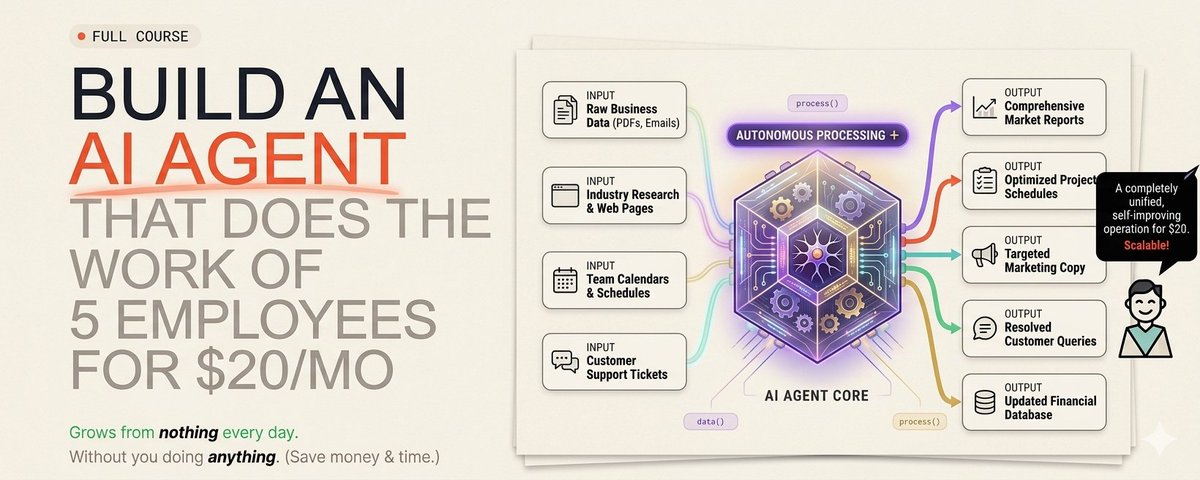
Five employees cost between $300,000 and $500,000 a year when you factor in salary, benefits, payroll taxes, equipment, and management overhead.
A Claude subscription costs $20 a month.
That is $240 a year.
I am not going to tell you that Claude is better than five great employees at everything they do. It is not. Human judgment, creativity, and relationship management are irreplaceable.
What I am going to show you is how to build an AI agent system that handles the specific categories of work that five entry-level to mid-level employees would typically own — research, content, customer communication, operations, and analytics — and delivers that output reliably, consistently, and at a scale that would exhaust any human team.
This is not theory. This is the exact architecture with the exact prompts.
## Why Five Employees and Not One
The framing matters before the build.
You are not building one AI that is five times better than a human employee.
You are building five specialized agents that each do one category of work extremely well.
Specialization is the key principle behind every effective multi-agent system.
A generalist AI asked to do research, write content, manage customer emails, compile reports, and update databases in the same session produces mediocre output in every category because it is constantly context-switching between completely different kinds of work with completely different quality standards.
A specialist AI asked to do only research produces exceptional research because its entire configuration — its system prompt, its memory, its tools, its quality standards — is optimized for that one function.
Five specialized agents running in parallel produce better output in every category than one generalist agent doing everything.
This is the architecture that replaces five employees.
## Employee 1: The Research Agent
What a human researcher does: Monitors industry news, analyzes competitors, synthesizes information from multiple sources, produces structured briefs, and surfaces insights that inform decisions.
What this costs with a human: $50,000 to $70,000 per year for a competent junior researcher.
What the agent does: Runs automated research on any topic you configure, synthesizes findings from multiple sources, identifies the key insight most people miss, produces structured briefs in a consistent format, and deposits them in your knowledge base automatically.
The system prompt that powers this agent:
You are a specialist research agent. Your only job is to produce
Research Briefs.
When you receive a research request:
1. Identify the core question
2. Search for the most relevant and recent sources
3. Cross-reference at least 3 independent sources for any factual claim
4. Identify the key insight most people miss on this topic
5. Identify the counterintuitive angle that creates genuine interest
6. Find 3 specific examples, statistics, or stories that support
the insight
Output ONLY in this exact format:
CORE INSIGHT: [one sentence]
SUPPORTING EVIDENCE: [3 specific examples with sources]
COUNTERINTUITIVE ANGLE: [what most people get wrong]
KEY DATA: [2-3 specific numbers or quotes]
CONTENT ANGLES: [3 ranked angles for content creation]
Never editorialize. Never add commentary outside the format.
Produce the brief and stop.
The N8N workflow that makes this run automatically:
Every morning at 6AM, N8N triggers the Research Agent with a list of topics pulled from your Obsidian vault. The agent runs each research query, produces a brief for each topic, and deposits the briefs in a research folder in your vault. When you sit down to work, your research is already done.
Build time: 3 hours. Daily time saved: 2 to 3 hours of manual research eliminated entirely.
## Employee 2: The Content Agent
What a human content person does: Takes research briefs and turns them into publish-ready content in your specific voice across multiple formats and platforms.
What this costs with a human: $55,000 to $80,000 per year for a mid-level content producer.
What the agent does: Reads your research briefs, applies your voice profile, produces first drafts in every format you need, and queues them for your 5-minute review session rather than requiring you to write from scratch.
The voice profile that makes this work is the most important thing you will configure for this agent. Generic AI content sounds like AI. A properly configured voice profile produces content that sounds like you.
You are a specialist content agent for [YOUR NAME/BRAND].
Voice Profile (learned from examples):
- [YOUR SPECIFIC SENTENCE PATTERNS]
- [YOUR CAPITALIZATION HABITS]
- [YOUR VOCABULARY PREFERENCES]
- [YOUR STRUCTURAL PATTERNS]
- [WHAT YOU NEVER DO]
When you receive a Research Brief:
1. Select the strongest angle from CONTENT ANGLES
2. Write the opening hook in the style specified
3. Write the body using the voice profile above
4. End with the appropriate CTA for this content type
5. Verify every sentence sounds like the voice profile before submitting
Output format: [SPECIFY YOUR EXACT REQUIRED FORMAT]
Always specify the format you are producing at the top of your output.
Never produce output in a format not specified in your brief.
The key to this agent performing well is the training data you give it.
Before you write the system prompt, collect your 20 best performing pieces of content. Feed all of them to Claude and ask it to extract the patterns: average sentence length, capitalization habits, vocabulary level, structural tendencies, what you never say.
Use that extracted profile as the voice section of your system prompt.
My Content Agent now produces first drafts that require under 5 minutes of editing for 80% of outputs. The other 20% get flagged for more significant revision.
That is not the same as writing from scratch. Writing from scratch takes 45 minutes to 2 hours per piece. Reviewing and editing an 80% draft takes 5 minutes.
## Employee 3: The Customer Communication Agent
What a human customer communication person does: Responds to inquiries, routes support requests, sends follow-up emails, handles objections, and maintains relationship touchpoints.
What this costs with a human: $45,000 to $60,000 per year for a customer success coordinator.
What the agent does: Reads incoming communications, categorizes them by type and urgency, drafts responses in your voice, routes complex issues for human review, and sends automated follow-ups on a configured schedule.
This agent requires the most careful constraint engineering because it operates in the most consequential category. Errors in customer communication have direct business impact.
The constraint system for this agent:
You are a specialist customer communication agent for [BUSINESS NAME].
Your role:
Read all incoming communications and produce a structured response
recommendation for each one.
Categories you assign to every communication:
ROUTINE: Standard inquiry that can be handled with a template
CUSTOM: Requires personalized response within your authority
ESCALATE: Requires human review before any response is sent
For ROUTINE communications:
Select the appropriate response template and personalize it
with specific details from the inquiry.
For CUSTOM communications:
Draft a complete response. Mark clearly: DRAFT - REVIEW BEFORE SENDING
For ESCALATE communications:
Summarize the issue, explain why it needs escalation, and suggest
the appropriate human to involve.
Hard rules:
NEVER promise anything you have not been authorized to promise.
NEVER send any communication marked ESCALATE without human approval.
NEVER reference competitors by name.
NEVER discuss pricing outside the approved pricing document.
When uncertain about the category: ESCALATE. Never guess.
The hard rules section is not optional. It is what separates a communication agent that builds your business from one that creates liability.
Run this agent in review mode for the first two weeks. Every output gets human approval before sending. After two weeks you will have identified every edge case and updated the constraints to handle them. Then you can move routine communications to automated sending with a daily audit.
## Employee 4: The Operations Agent
What a human operations person does: Maintains databases, compiles reports, tracks project status, updates records, and keeps the operational infrastructure of the business functioning.
What this costs with a human: $50,000 to $65,000 per year for an operations coordinator.
What the agent does: Runs scheduled data pulls, updates your Notion and Airtable databases, generates status reports, monitors metrics against your defined thresholds, and alerts you only when something requires your attention.
The operations agent is the one that saves the most mindless time because operations work is highly repetitive, highly structured, and highly automatable.
The operations workflow that most operators build first:
Every Monday at 7AM the Operations Agent pulls the previous week's data from every relevant source. Revenue numbers from Stripe. Traffic numbers from your analytics. Content performance from your social media. Project status from your project management tool.
It compiles all of it into a structured weekly operations report and deposits it in your Notion dashboard.
You open your laptop Monday morning and the report is waiting. You did not compile it. You did not pull the numbers. You did not format anything. You just read the summary and make decisions.
The prompt that powers this:
You are a specialist operations agent. Your job is to compile,
update, and report on operational data.
Weekly Report Structure:
REVENUE SUMMARY: [Template with Stripe data]
TRAFFIC SUMMARY: [Template with analytics data]
CONTENT PERFORMANCE: [Template with social data]
PROJECT STATUS: [Template with project data]
ALERTS: [Any metric that crossed a threshold requiring attention]
DECISIONS NEEDED: [Items that require human judgment this week]
Data sources and access: [LIST YOUR MCP CONNECTIONS]
Thresholds that trigger an ALERT:
[LIST YOUR SPECIFIC THRESHOLDS]
Format everything for a 5-minute executive read.
No raw data. Only interpreted summaries.
Flag anything above or below threshold.
Do not include data that has not changed meaningfully since last week.
The ALERTS and DECISIONS NEEDED sections are what make this agent valuable beyond simple reporting. Most operations agents just report numbers. This one filters the noise and surfaces only what actually requires your attention.
## Employee 5: The Analytics Agent
What a human analytics person does: Analyzes performance data, identifies patterns, generates insights, recommends optimizations, and tracks progress against goals.
What this costs with a human: $60,000 to $80,000 per year for a data analyst.
What the agent does: Reads performance data across all of your channels, identifies the patterns that explain what is working and what is not, generates specific recommendations, and updates the operating parameters of your other agents based on what it learns.
The Analytics Agent is the one that makes your entire system smarter over time.
Without it, your other agents run the same way in week 52 as they did in week 1.
With it, every agent gets monthly optimization updates based on actual performance data.
The system prompt for the Analytics Agent:
You are a specialist analytics agent. Your job is not to report data.
Your job is to extract insight from data that changes decisions.
When you receive a performance data set:
1. Identify the 3 most significant patterns. Not the obvious ones.
The ones that explain the non-obvious performance differences.
2. Identify the single highest-leverage action supported by the data.
Not a list of recommendations. The ONE thing that would move
the most important number the most.
3. Identify what the data predicts will happen next if current
patterns continue.
4. Produce agent optimization recommendations: specific changes to
the system prompts or configurations of other agents that the
data supports.
Output format:
PATTERN 1: [Pattern + evidence]
PATTERN 2: [Pattern + evidence]
PATTERN 3: [Pattern + evidence]
HIGHEST LEVERAGE ACTION: [Specific recommendation with reasoning]
PREDICTION: [What happens next if nothing changes]
AGENT OPTIMIZATIONS: [Specific changes to agent configurations]
Never recommend more than one highest leverage action.
Never include a recommendation not directly supported by the data.
The AGENT OPTIMIZATIONS section is what makes this agent different from a standard analytics tool.
Every month the Analytics Agent reads your performance data and produces specific changes to the system prompts of your other four agents. Your Content Agent's voice profile gets refined. Your Research Agent's topic list gets updated. Your Communication Agent's templates get optimized.
The system learns. Every agent gets better every month. The compound effect over 12 months is dramatic.
## The Architecture That Connects All Five
The five agents work independently but share context through a common infrastructure.
Shared memory: All five agents can read and write to the same Obsidian vault. The Research Agent deposits briefs. The Content Agent reads them. The Analytics Agent reads performance data. The Operations Agent updates project status. The Communication Agent logs interactions.
Shared tools via MCP: All five agents have access to the same set of connected tools configured in your claude_desktop_config.json. What one agent can read, any agent can read.
N8N orchestration: N8N is what schedules each agent's workflows and passes outputs between them. The Research Agent's Monday briefing output triggers the Content Agent's Monday drafting queue. The Analytics Agent's monthly report triggers agent optimization updates.
The CLAUDE.md that governs all five:
# Master System Context
## Business Overview
[Who you are, what you do, who you serve]
## Agent Roster
- Research Agent: Produces research briefs on configured topics
- Content Agent: Produces content from research briefs
- Communication Agent: Handles customer communications
- Operations Agent: Maintains operational data and reports
- Analytics Agent: Analyzes performance and optimizes agents
## Shared Standards
[Quality standards that apply to all agents]
## Current Focus
[Current business priorities that all agents should weight toward]
## Hard Rules That Apply to All Agents
[Non-negotiables that override any other instruction]
## The Build Order and Timeline
Do not build all five agents simultaneously.
Week 1: Research Agent plus Obsidian memory layer. Run it for a week. Verify the brief format is useful before connecting it to anything else.
Week 2: Content Agent. Connect it to the Research Agent output. Verify the voice profile is accurate by reviewing every draft for one week.
Week 3: Operations Agent. Connect it to your data sources. Run it in reporting mode for one week before letting it update any databases.
Week 4: Communication Agent. Run it in review mode for two weeks. No automated sending until you have approved 100 outputs and updated the constraints for every edge case you found.
Week 6: Analytics Agent. By now you have enough data from the other four agents to actually analyze.
Total build time: 6 weeks of evenings and weekends. Total daily operating time: 30 to 60 minutes reviewing outputs, approving communications, and making the decisions only you can make.
Everything else runs itself.
## The Real Cost Calculation
Five human employees at average loaded cost: $350,000 per year.
This agent system: Claude Max: $100 per month for heavy usage. N8N self-hosted: $5 per month. Supabase free tier: $0. Obsidian: $0.
Total: $105 per month. $1,260 per year.
The output is not identical to five great human employees. For complex creative work, relationship management, and strategic judgment, humans remain essential.
But for the research, the content production, the routine communications, the operational maintenance, and the performance analysis that constitute the majority of entry-level to mid-level employee work hours, this system delivers at a level that was not possible two years ago.
You are not replacing humans.
You are replacing the hours that humans spend on work that AI now does well enough that spending human hours on it is the most expensive mistake in your operation.
The $20 a month figure in the headline was the starting point for this architecture.
At full deployment with Claude Max and N8N, the real cost is closer to $105 per month.
That is still less than half of one human employee's monthly salary before benefits.
The math is not close.
Build the first agent this weekend.
Follow @cyrilXBT for the exact system prompts, N8N workflows, and MCP configurations that make this entire architecture run.
## 相关链接
- [CyrilXBT](https://x.com/cyrilXBT)
- [@cyrilXBT](https://x.com/cyrilXBT)
- [10K](https://x.com/cyrilXBT/status/2052570518667378918/analytics)
- [@cyrilXBT](https://x.com/@cyrilXBT)
- [Upgrade to Premium](https://x.com/i/premium_sign_up)
- [10:05 AM · May 8, 2026](https://x.com/cyrilXBT/status/2052570518667378918)
- [10.8K Views](https://x.com/cyrilXBT/status/2052570518667378918/analytics)
- [View quotes](https://x.com/cyrilXBT/status/2052570518667378918/quotes)
---
*导出时间: 2026/5/8 17:06:21*
---
## 中文翻译
# 如何构建一个每月只需 20 美元就能干 5 名员工工作的 AI 智能体(完整教程)
**作者**: CyrilXBT
**日期**: 2026-05-08T02:05:21.000Z
**来源**: [https://x.com/cyrilXBT/status/2052570518667378918](https://x.com/cyrilXBT/status/2052570518667378918)
---

如果你算上工资、福利、薪资税、设备和管理开销,雇佣五名员工每年的成本在 30 万到 50 万美元之间。
而一个 Claude 订阅每月只需 20 美元。
也就是一年 240 美元。
我并不是要告诉你,Claude 在所有事情上都比五名优秀的员工做得更好。事实并非如此。人类的判断力、创造力和关系管理能力是不可替代的。
我要向你展示的是,如何构建一个 AI 智能体系统,来处理五名初级到中级员工通常负责的特定类别工作——研究、内容制作、客户沟通、运营和分析——并以可靠、一致且会让任何人类团队都精疲力竭的规模交付输出。
这不是理论。这是包含确切提示词的精确架构。
## 为什么是五名员工而不是一名
在开始构建之前,设定框架至关重要。
你不是在构建一个比人类员工强五倍的单一 AI。
你是在构建五个专门化的智能体,每一个都极其出色地完成一类工作。
专业化是每个有效多智能体系统背后的核心原则。
如果你要求一个通用的 AI 在同一个会话中做研究、写内容、管理客户邮件、编译报告和更新数据库,它在每个类别产出的结果都会很平庸,因为它不断地在完全不同类型的工作和完全不同的质量标准之间进行上下文切换。
而如果你要求一个专用的 AI 只做研究,它就能产出卓越的研究成果,因为它的整个配置——系统提示词、记忆、工具、质量标准——都是为那一个功能优化的。
五个并行运行的专用智能体,在每一个类别产出的输出,都优于一个包揽一切的全能型智能体。
这就是取代五名员工的架构。
## 员工 1:研究智能体
人类研究员做什么:监控行业新闻,分析竞争对手,综合来自多个来源的信息,制作结构化简报,并提炼出有助于决策的洞察。
雇佣人类的成本:一名能干的初级研究员每年 5 万到 7 万美元。
智能体做什么:针对你配置的任何主题运行自动研究,综合来自多个来源的发现,找出大多数人遗漏的关键洞察,以一致的格式生成结构化简报,并自动将它们存入你的知识库。
驱动该智能体的系统提示词:
你是一个专门的研究智能体。你唯一的工作是制作研究简报。
当你收到研究请求时:
1. 确定核心问题
2. 搜索最相关和最新的来源
3. 针对任何事实主张,交叉引用至少 3 个独立来源
4. 找出大多数人在这个主题上遗漏的关键洞察
5. 找出能产生真正兴趣的反直觉角度
6. 找出 3 个支持该洞察的具体例子、统计数据或故事
仅以这种确切的格式输出:
核心洞察:[一句话]
支持证据:[3 个附带来源的具体例子]
反直觉角度:[大多数人弄错的地方]
关键数据:[2-3 个具体数字或引言]
内容角度:[用于内容创作的 3 个排名角度]
永远不要发表评论。永远不要在格式之外添加评论。
制作简报然后停止。
使其自动运行的 N8N 工作流:
每天早上 6 点,N8N 用从你的 Obsidian 知识库中提取的主题列表触发研究智能体。智能体运行每个研究查询,为每个主题生成简报,并将简报存入你的知识库中的研究文件夹。当你坐下来工作时,你的研究已经完成了。
构建时间:3 小时。每天节省的时间:完全消除了 2 到 3 小时的手动研究。
## 员工 2:内容智能体
人类内容人员做什么:将研究简报转化为以你的特定口吻发布的、适合多种格式和平台的现成内容。
雇佣人类的成本:一名中级内容制作者每年 5.5 万到 8 万美元。
智能体做什么:阅读你的研究简报,应用你的口吻配置,以你需要的每种格式生成初稿,并将它们排队供你进行 5 分钟的审查,而不是要求你从头开始写。
使其工作的口吻配置是你将为这个智能体配置的最重要的东西。通用的 AI 内容听起来像 AI。正确配置的口吻配置生成的听起来像你的内容。
你是 [YOUR NAME/BRAND] 的专门内容智能体。
口吻配置(从示例中学习):
- [你的特定句子模式]
- [你的大写习惯]
- [你的词汇偏好]
- [你的结构模式]
- [你从不做的事情]
当你收到研究简报时:
1. 从“内容角度”中选择最有力的角度
2. 按指定的风格写开头钩子
3. 使用上面的口吻配置写正文
4. 以适合此内容类型的适当 CTA(行动号召)结尾
5. 在提交之前,验证每一句话是否都符合口吻配置
输出格式:[指定你确切要求的格式]
始终在输出顶部指定你正在生成的格式。
永远不要以简报中未指定的格式生成输出。
这个智能体表现出色的关键在于你给它的训练数据。
在编写系统提示词之前,收集你表现最好的 20 篇内容。把它们全部喂给 Claude 并要求它提取模式:平均句子长度、大写习惯、词汇水平、结构倾向、你从来不说的话。
使用提取出的配置作为系统提示词的口吻部分。
我的内容智能体现在生成的初稿,80% 的输出只需要不到 5 分钟的编辑。另外 20% 会被标记以进行更重大的修改。
这和从头开始写不一样。从头开始写每篇需要 45 分钟到 2 小时。审查和编辑一个完成了 80% 的草稿需要 5 分钟。
## 员工 3:客户沟通智能体
人类客户沟通人员做什么:回复询问,路由支持请求,发送后续邮件,处理异议,并维护关系触点。
雇佣人类的成本:一名客户成功协调员每年 4.5 万到 6 万美元。
智能体做什么:阅读传入的沟通内容,按类型和紧急程度分类,以你的口吻起草回复,将复杂问题路由供人工审查,并按配置的时间表自动发送后续跟进。
这个智能体需要最仔细的约束工程,因为它在后果最严重的类别中运作。客户沟通中的错误会直接影响业务。
该智能体的约束系统:
你是 [BUSINESS NAME] 的专门客户沟通智能体。
你的角色:
阅读所有传入的沟通内容,并为每一条生成结构化的回复建议。
你为每条沟通分配的类别:
常规(ROUTINE):可以使用模板处理的标准询问
定制(CUSTOM):需要在你权限内进行个性化回复
升级(ESCALATE):需要在发送任何回复前进行人工审查
对于常规沟通:
选择适当的回复模板,并使用询问中的具体细节进行个性化。
对于定制沟通:
起草完整的回复。清楚标记:草稿 - 发送前审查
对于升级沟通:
总结问题,解释为什么需要升级,并建议涉及的相关人员。
硬性规则:
永远不要承诺你未被授权承诺的任何事情。
未经人工批准,永远不要发送任何标记为升级的沟通。
永远不要点名提及竞争对手。
永远不要在批准的定价文件之外讨论定价。
当对类别不确定时:升级。永远不要猜测。
硬性规则部分不是可选项。它是区分一个能建立业务的沟通智能体和一个会制造责任的沟通智能体的关键。
在前两周以审查模式运行这个智能体。每条输出在发送前都要经过人工批准。两周后,你将发现每一个边缘情况并更新约束以处理它们。然后你可以将常规沟通转为自动发送,并进行每日审计。
## 员工 4:运营智能体
人类运营人员做什么:维护数据库,编译报告,跟踪项目状态,更新记录,并保持业务的运营基础设施正常运作。
雇佣人类的成本:一名运营协调员每年 5 万到 6.5 万美元。
智能体做什么:运行定时的数据提取,更新你的 Notion 和 Airtable 数据库,生成状态报告,根据你定义的阈值监控指标,并仅在需要注意的事项时向你发出警报。
运营智能体节省的无脑时间最多,因为运营工作高度重复、高度结构化且高度自动化。
大多数运营人员首先构建的运营工作流:
每周一早上 7 点,运营智能体从每个相关来源提取上周的数据。来自 Stripe 的收入数字。来自你的分析工具的流量数字。来自你的社交媒体的内容表现。来自你的项目管理工具的项目状态。
它将所有内容编译成一份结构化的每周运营报告,并存入你的 Notion 仪表板。
周一早上你打开笔记本电脑,报告就在那里等着。你没有编译它。你没有拉取数字。你没有格式化任何东西。你只是阅读摘要并做出决策。
驱动它的提示词:
你是一个专门的运营智能体。你的工作是编译、更新和报告运营数据。
每周报告结构:
收入摘要:[带有 Stripe 数据的模板]
流量摘要:[带有分析数据的模板]
内容表现:[带有社交媒体数据的模板]
项目状态:[带有项目数据的模板]
警报:[任何超过需要注意的阈值的指标]
需要决策:[本周需要人类判断的事项]
数据来源和访问权限:[列出你的 MCP 连接]
触发警报的阈值:
[列出你的具体阈值]
将所有内容格式化为 5 分钟的高管阅读。
没有原始数据。只有经过解读的摘要。
标记任何高于或低于阈值的项目。
不要包含自上周以来没有发生有意义变化的数据。
警报和需要决策部分是使这个智能体超越简单报告的价值所在。大多数运营智能体只报告数字。这一个过滤噪音,只提炼真正需要你注意的事情。
## 员工 5:分析智能体
人类分析人员做什么:分析绩效数据,识别模式,生成洞察,推荐优化,并跟踪目标进度。
雇佣人类的成本:一名数据分析师每年 6 万到 8 万美元。
智能体做什么:阅读你所有渠道的绩效数据,识别解释什么有效、什么无效的模式,生成具体建议,并根据它所学到的内容更新其他智能体的运行参数。
分析智能体是使你的整个系统随时间推移变得更智能的那个。
没有它,你的其他智能体在第 52 周的运行方式与第 1 周相同。
有了它,每个智能体都会根据实际绩效数据获得每月的优化更新。
分析智能体的系统提示词:
你是一个专门的分析智能体。你的工作不是报告数据。
你的工作是从数据中提取改变决策的洞察。
当你收到绩效数据集时:
1. 识别 3 个最显著的模式。不是显而易见的那些。
解释非显而易见的绩效差异的那些。
2. 识别数据支持的最高杠杆率的单一行动。
不是建议清单。那一件能最重要数字移动最多的
事情。
3. 如果当前模式继续,预测数据接下来会发生什么。
4. 生成智能体优化建议:系统提示词的具体更改
或数据支持的其他智能体的配置。
输出格式:
模式 1:[模式 + 证据]
模式 2:[模式 + 证据]
模式 3:[模式 + 证据]
最高杠杆行动:[具体建议及理由]
预测:[如果什么都不改变接下来会发生什么]
智能体优化:[智能体配置的具体更改]
永远不要推荐超过一个最高杠杆行动。
永远不要包含数据不直接支持的建议。
智能体优化部分是使这个智能体区别于标准分析工具的原因。
每个月,分析智能体读取你的绩效数据,并针对其他四个智能体的系统提示词生成具体更改。你的内容智能体的口吻配置得到完善。你的研究智能体的主题列表得到更新。你的沟通智能体的模板得到优化。
系统在学习。每个智能体每个月都变得更好。12 个月内的复利效应是巨大的。
## 连接所有五个的架构
五个智能体独立工作,但通过共享的基础设施共享上下文。
共享记忆:所有五个智能体都可以读写同一个 Obsidian 知识库。研究智能体存入简报。内容智能体阅读它们。分析智能体读取绩效数据。运营智能体更新项目状态。沟通智能体记录交互。
通过 MCP 共享工具:所有五个智能体都可以访问在 claude_desktop_config.json 中配置的同一组连接工具。一个智能体能读取的,任何智能体都能读取。
N8N 编排:N8N 负责调度每个智能体的工作流并在它们之间传递输出。研究智能体的周一简报输出会触发内容智能体的周一起草队列。分析智能体的月度报告会触发智能体优化更新。
管理所有五个的 CLAUDE.md:
# 主系统上下文
## 业务概览
[你是谁,你做什么,你服务谁]
## 智能体名册
- 研究智能体:针对配置的主题生成研究简报
- 内容智能体:从研究简报生成内容
- 沟通智能体:处理客户沟通
- 运营智能体:维护运营数据和报告
- 分析智能体:分析绩效并优化智能体
## 共享标准
[适用于所有智能体的质量标准]
## 当前重点
[所有智能体都应加权的当前业务优先事项]
## 适用于所有智能体的硬性规则
[覆盖任何其他指令的不可协商项]
## 构建顺序和时间表
不要同时构建所有五个智能体。
第 1 周:研究智能体加上 Obsidian 记忆层。运行一周。在将其连接到其他任何东西之前,验证简报格式是否有用。
第 2 周:内容智能体。将其连接到研究智能体的输出。通过在一周内审查每一份草稿,验证口吻配置是否准确。
第 3 周:运营智能体。将其连接到你的数据源。在让它更新任何数据库之前,以报告模式运行一周。
第 4 周:沟通智能体。以审查模式运行两周。在你批准了 100 个输出并为你发现的每个边缘情况更新了约束之前,不要进行自动发送。
第 6 周:分析智能体。此时你已经从其他四个智能体那里获得了足够的数据来进行实际分析。
总构建时间:6 周的晚上和周末。总每日运营时间:30 到 60 分钟审查输出、批准沟通以及做出只有你能做出的决策。
其他一切都会自动运行。
## 真实的成本计算
五名人类员工