# Hermes Agent Master Class Part 11: The Admin Layer
**作者**: Tony Simons
**日期**: 2026-07-19T00:41:50.000Z
**来源**: [https://x.com/tonysimons_/status/2078641430562492927](https://x.com/tonysimons_/status/2078641430562492927)
---
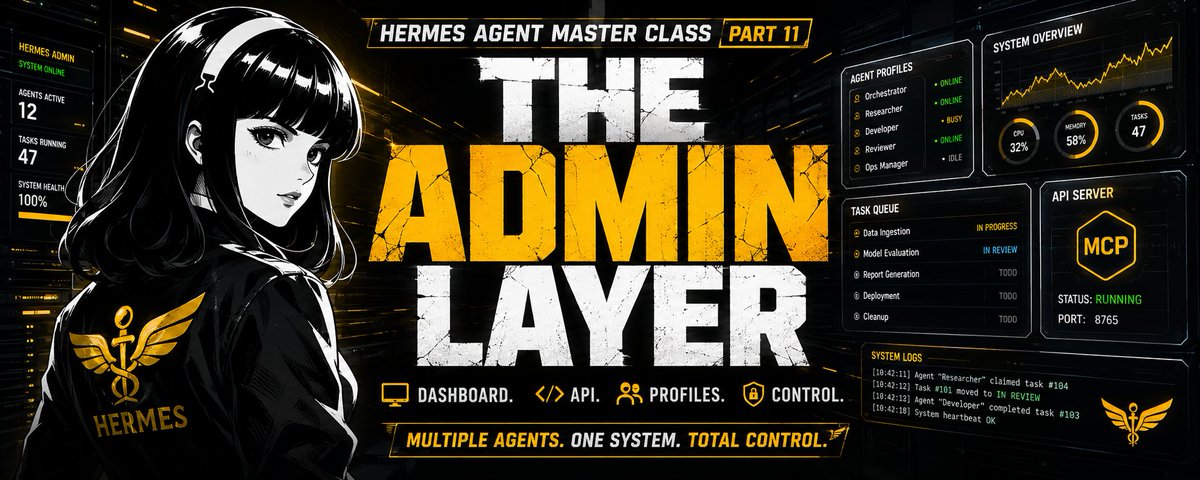
One agent is a tool. Two agents is a system. Three or more is an operation.
As soon as you run multiple Hermes profiles -- one for coding, one for research, one for the gateway, one as a kanban worker -- you need a layer that manages them. The dashboard, API server, and profile system are that layer.
Profiles are the runtime boundary. The dashboard is the control surface. The API server is the integration point.
## Profiles Are the Runtime Boundary
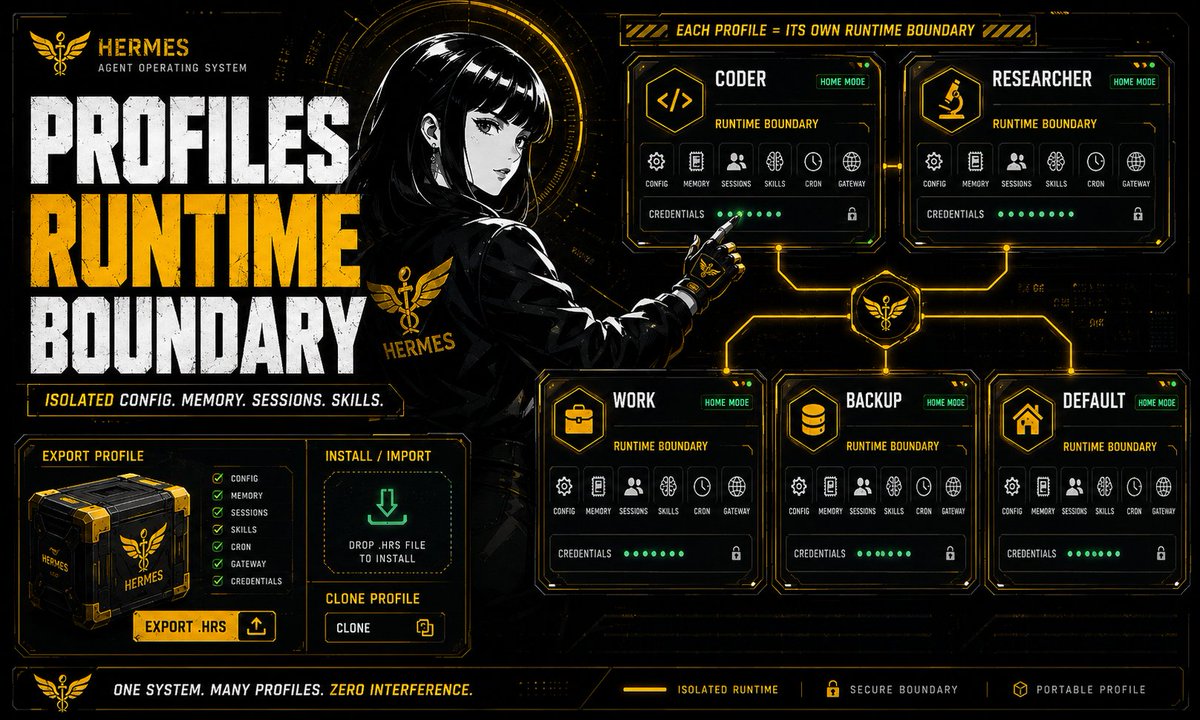
Each Hermes profile is a completely independent agent. Its own config.yaml, its own HERMES_HOME, its own memory, sessions, skills, cron jobs, gateway state, and credentials. Running hermes -p coder chat starts a session in the coder profile.
Running hermes -p researcher chat starts a completely separate session in the researcher profile. They share nothing by default.
Creating a profile is a one-liner.
- hermes profile create coder creates a blank profile with fresh config. hermes profile create work --clone-from default copies your current profile's config, skills, and SOUL into the new one.
- hermes profile create backup --clone-all takes a complete snapshot including memories, sessions, and cron jobs.
Each profile automatically gets its own command alias. Create a profile called coder, and coder chat launches Hermes in that profile. The CLI prefix becomes the profile name. You don't need to type hermes -p coder every time.
Gateways are per-profile too. Each profile runs its own gateway as a separate process with its own bot token. Profile A can talk to Telegram. Profile B can talk to Discord. If two profiles accidentally use the same bot token, the second gateway refuses to start with a clear error naming the conflict.
The home mode setting controls how isolated a profile's tool execution is. By default, all profiles share your real home directory for tool execution -- git config, npm state, SSH keys are the same.
With terminal.home_mode: profile in a profile's config, tool execution gets scoped to that profile's home directory. Useful when you want a kanban worker to have its own git identity.
Profiles can be packaged as distributions. hermes profile export coder creates a shareable archive of the profile's config, SOUL, skills, and cron jobs. Credentials and session history stay local. The distribution can be installed on another machine with hermes profile install.
## The Dashboard Is the Control Surface
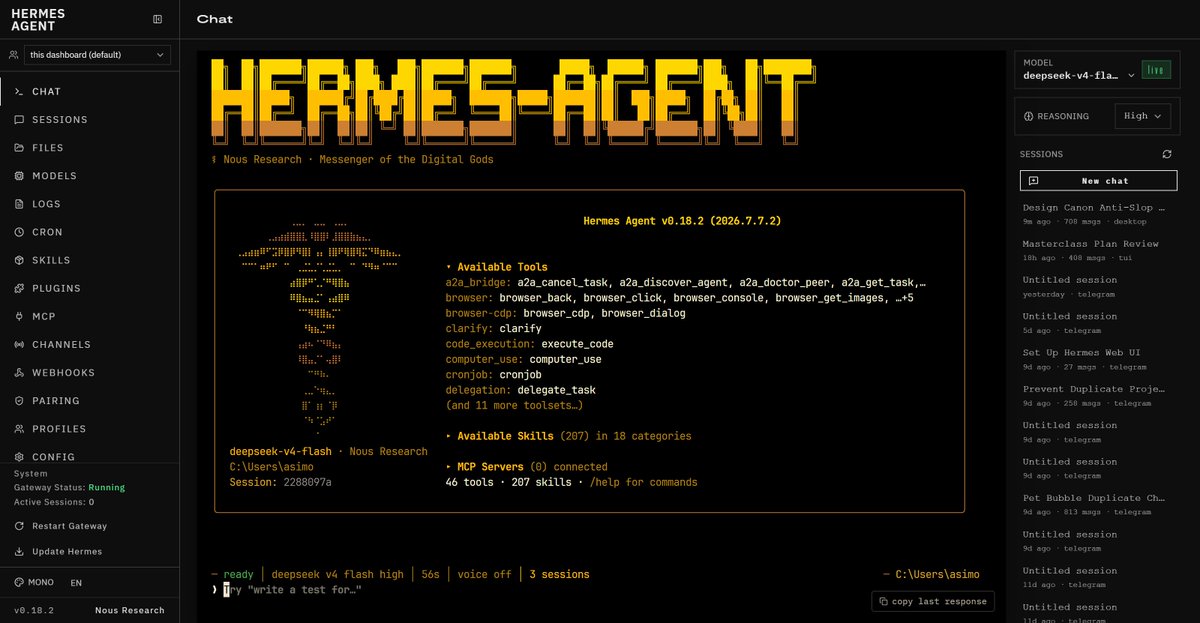
The web dashboard runs as an optional web server. It provides a graphical view of your Hermes installation: current profile, active sessions, model configuration, tool settings, gateway status, skill library, and cron jobs.
The dashboard's main value is the profile switcher. You can switch between profiles, inspect each one's config, edit skills, adjust model settings, and start chat sessions -- all from one browser tab. Each profile's sessions appear in the same dashboard. You can see what the coder profile is working on while chatting from the researcher profile.
The dashboard also exposes the chat interface. Start a session from the browser, pick any profile, and talk to the agent. The session history is shared with the CLI and gateway, so you can switch between surfaces without losing context.
## The API Server Is the Integration Point
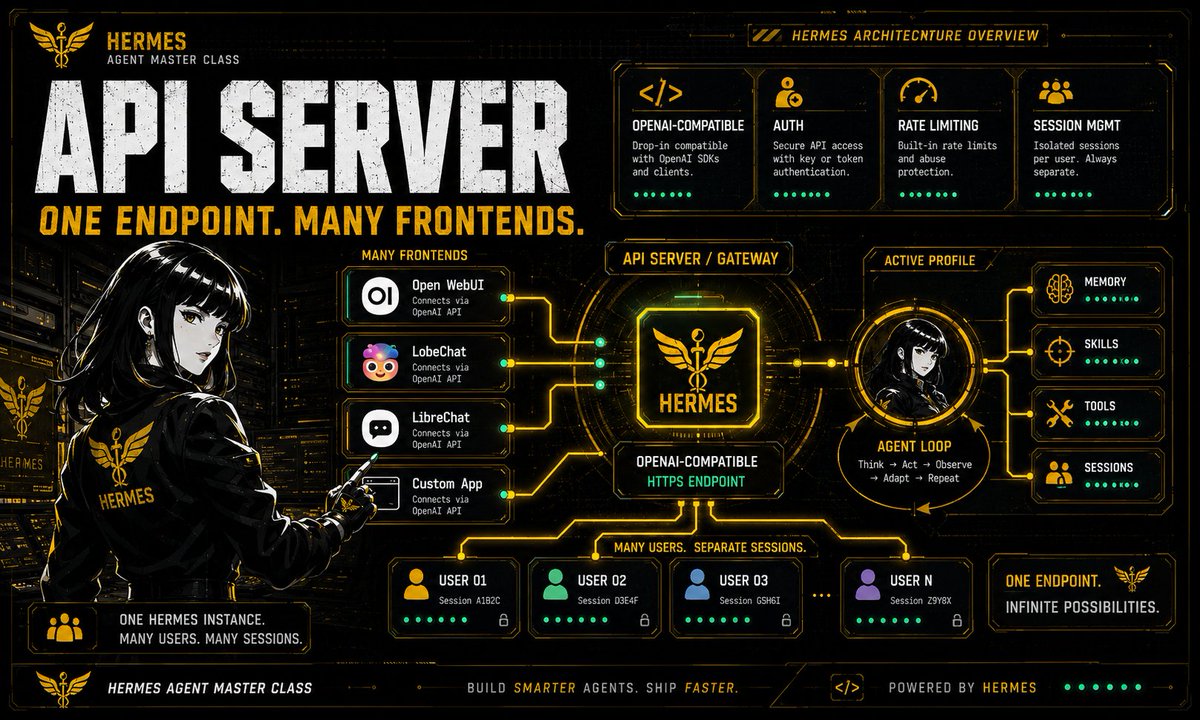
Hermes exposes an OpenAI-compatible HTTP endpoint. Any frontend that speaks the OpenAI format can drive Hermes -- Open WebUI, LobeChat, LibreChat, and similar tools.
The API server routes requests through the active profile's agent loop. The same prompt assembly, tool dispatch, and session persistence that the CLI uses. The same memory and skills. The same tool surface. The only difference is the transport -- HTTP instead of terminal.
This is useful for building custom frontends, integrating Hermes into existing workflows, or exposing the agent to a team through a shared interface. The API server handles auth, rate limiting, and session management. Multiple users can connect through a single Hermes instance, each with their own session.
## The Web Dashboard Is the Admin Control Surface
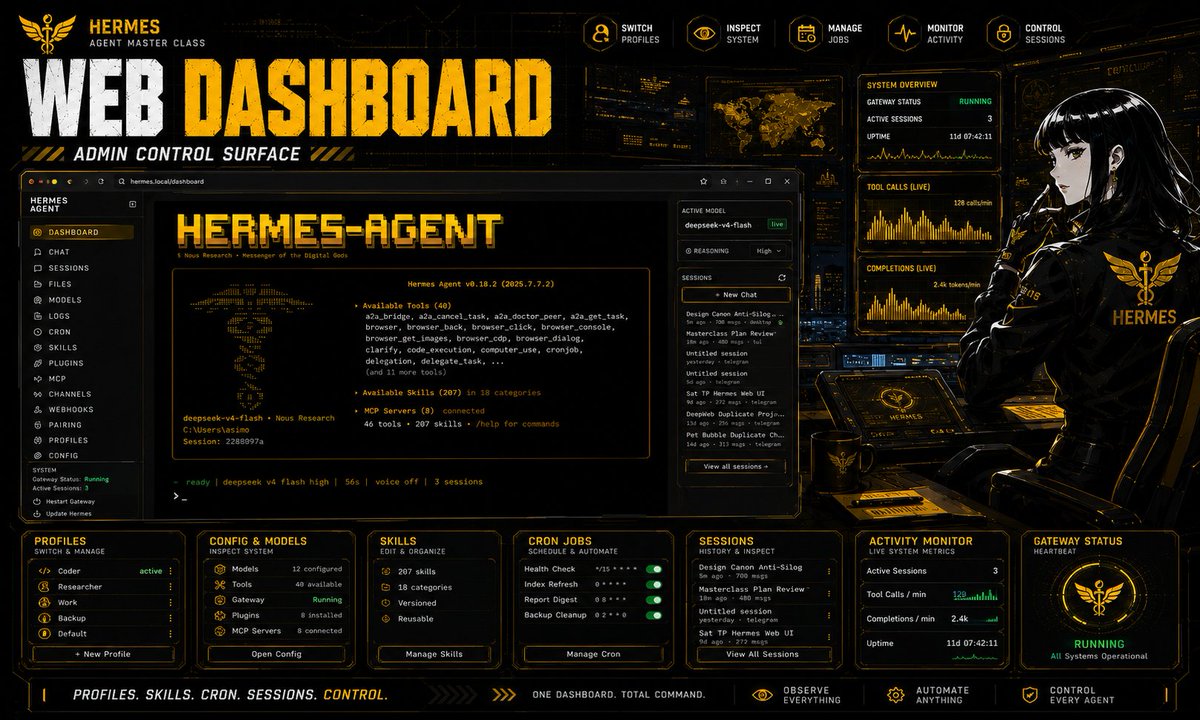
The web dashboard is how you run Hermes without living in a terminal. From one browser tab, you can:
- Switch between profiles and see each one's config, model, tools, and gateway status.
- Edit skills directly in the browser with syntax highlighting and live preview.
- Manage cron jobs -- create, edit, pause, resume, remove -- without CLI commands.
- Inspect session history across profiles and surfaces. Every CLI, gateway, and dashboard session is in the same session store.
- Monitor ongoing activity. Active sessions, running tool calls, gateway status, and recent completions appear in the dashboard views.
The dashboard is optional.
It's a convenience layer for visual management. Everything the dashboard does can be done through the CLI. But for operators running multiple profiles with multiple gateways, the visual view saves time.
## What Changes With Multiple Profiles

Single-profile Hermes is simple. You have one agent, one config, one set of skills, one gateway. Everything is in one place.
Multi-profile Hermes changes the operational model. Each profile is its own agent with its own purpose. The coding profile has terminal access and a different model than the research profile, which has web tools and a cheap model for bulk work. The kanban worker profile has no gateway and a minimal toolset, running as a supervised background service.
Profiles share nothing by default, which is the safe default. But they can coordinate through the kanban board, or through the shared file system if you explicitly configure shared directories. The board from Article 10 is the recommended coordination path because it doesn't require shared filesystem access.
The tradeoff is operational overhead. More profiles means more config files, more gateways to manage, more things that can break. Start with one profile and add specialized ones only when you have a clear use case. A general-purpose profile with all tools enabled and a research profile with a cheap model is usually enough for most setups.
Profiles, dashboard, and the API server give you control over multiple agents. The next and final article in this series is about what limits them -- context windows, token budgets, profile isolation, and when it's smarter to not use Hermes at all.
See ya in the next one! 🤘
## 相关链接
- [Tony Simons](https://x.com/tonysimons_)
- [@tonysimons_](https://x.com/tonysimons_)
- [7.1K](https://x.com/tonysimons_/status/2078641430562492927/analytics)
- [Upgrade to Premium](https://x.com/i/premium_sign_up)
- [8:41 AM · Jul 19, 2026](https://x.com/tonysimons_/status/2078641430562492927)
- [7,110 Views](https://x.com/tonysimons_/status/2078641430562492927/analytics)
- [View quotes](https://x.com/tonysimons_/status/2078641430562492927/quotes)
---
*导出时间: 2026/7/19 15:12:46*
---
## 中文翻译
# Hermes Agent 大师课第 11 部分:管理层
**作者**: Tony Simons
**日期**: 2026-07-19T00:41:50.000Z
**来源**: [https://x.com/tonysimons_/status/2078641430562492927](https://x.com/tonysimons_/status/2078641430562492927)
---

一个代理是一个工具。两个代理是一个系统。三个或更多则是一项操作。
一旦你运行多个 Hermes 配置文件——一个用于编码,一个用于研究,一个用于网关,还有一个作为看板工作者——你就需要一个管理层来管理它们。仪表盘、API 服务器和配置文件系统就是这一层。
配置文件是运行时的边界。仪表盘是控制面。API 服务器是集成点。
## 配置文件是运行时的边界

每个 Hermes 配置文件都是一个完全独立的代理。它拥有自己的 config.yaml、自己的 HERMES_HOME、自己的内存、会话、技能、定时任务(cron jobs)、网关状态和凭据。运行 hermes -p coder chat 会在 coder 配置文件中启动一个会话。
运行 hermes -p researcher chat 会在 researcher 配置文件中启动一个完全独立的会话。它们默认不共享任何内容。
创建配置文件只需一行命令。
- hermes profile create coder 会创建一个带有全新配置的空白配置文件。hermes profile create work --clone-from default 会将你当前配置文件的配置、技能和 SOUL 复制到新的配置文件中。
- hermes profile create backup --clone-all 会创建一个包含内存、会话和定时任务的完整快照。
每个配置文件会自动获得其自己的命令别名。创建一个名为 coder 的配置文件后,coder chat 即可在该配置文件中启动 Hermes。CLI 前缀变为配置文件名称。你不需要每次都输入 hermes -p coder。
网关也是基于配置文件的。每个配置文件都使用自己的机器人令牌作为单独进程运行其自己的网关。配置文件 A 可以与 Telegram 对话。配置文件 B 可以与 Discord 对话。如果两个配置文件意外使用了相同的机器人令牌,第二个网关将拒绝启动,并明确指出冲突的错误。
主目录模式设置控制配置文件的工具执行隔离程度。默认情况下,所有配置文件共享你的真实主目录进行工具执行——git config、npm 状态、SSH 密钥都是相同的。
如果在配置文件的配置中设置 terminal.home_mode: profile,工具执行将被限定在该配置文件的主目录内。当你希望看板工作者拥有自己的 git 身份时,这非常有用。
配置文件可以打包为发行版。hermes profile export coder 会创建一个包含配置文件配置、SOUL、技能和定时任务的可共享归档。凭据和会话历史保留在本地。该发行版可以通过 hermes profile install 安装在另一台机器上。
## 仪表盘是控制面

Web 仪表盘作为一个可选的 Web 服务器运行。它提供你的 Hermes 安装的图形视图:当前配置文件、活动会话、模型配置、工具设置、网关状态、技能库和定时任务。
仪表盘的主要价值在于配置文件切换器。你可以在配置文件之间切换,检查每个配置文件的配置,编辑技能,调整模型设置,并启动聊天会话——所有这些都在一个浏览器选项卡中完成。每个配置文件的会话都出现在同一个仪表盘中。你可以在通过 researcher 配置文件聊天时,看到 coder 配置文件正在处理什么。
仪表盘还公开了聊天界面。从浏览器启动会话,选择任意配置文件,然后与代理对话。会话历史与 CLI 和网关共享,因此你可以切换界面而不会丢失上下文。
## API 服务器是集成点

Hermes 公开了一个兼容 OpenAI 的 HTTP 端点。任何支持 OpenAI 格式的前端都可以驱动 Hermes——例如 Open WebUI、LobeChat、LibreChat 和类似工具。
API 服务器通过活动配置文件的代理循环路由请求。使用与 CLI 相同的提示词组装、工具分发和会话持久化。相同的内存和技能。相同的工具面。唯一的区别是传输方式——使用 HTTP 而不是终端。
这对于构建自定义前端、将 Hermes 集成到现有工作流中,或通过共享接口向团队公开代理非常有用。API 服务器处理身份验证、速率限制和会话管理。多个用户可以通过单个 Hermes 实例连接,每个用户都有自己的会话。
## Web 仪表盘是管理控制面

Web 仪表盘让你无需依赖终端即可运行 Hermes。在一个浏览器选项卡中,你可以:
- 在配置文件之间切换,并查看每个配置文件的配置、模型、工具和网关状态。
- 直接在浏览器中编辑技能,具有语法高亮和实时预览功能。
- 管理定时任务——创建、编辑、暂停、恢复、删除——无需 CLI 命令。
- 检查跨配置文件和界面的会话历史。每个 CLI、网关和仪表盘会话都在同一个会话存储中。
- 监控正在进行的活动。活动会话、运行中的工具调用、网关状态和最近的补全会显示在仪表盘视图中。
仪表盘是可选的。
它是用于可视化管理的便捷层。仪表盘所做的所有事情都可以通过 CLI 完成。但对于运行多个配置文件和多个网关的操作员来说,可视化视图可以节省时间。
## 多个配置文件带来的变化

单配置文件的 Hermes 很简单。你有一个代理、一个配置、一组技能、一个网关。所有东西都在一个地方。
多配置文件的 Hermes 改变了操作模型。每个配置文件都是具有自己目的的独立代理。编码配置文件拥有终端访问权限和与研究配置文件不同的模型,后者具有 Web 工具和用于批量工作的廉价模型。看板工作者配置文件没有网关和最少的工具集,作为受监督的后台服务运行。
配置文件默认不共享任何内容,这是安全的默认设置。但它们可以通过看板进行协调,或者如果你明确配置了共享目录,则可以通过共享文件系统进行协调。第 10 篇文章中的看板是推荐的协调路径,因为它不需要共享文件系统访问权限。
其代价是操作开销。更多的配置文件意味着更多的配置文件、更多要管理的网关,以及更多可能出问题的地方。从一个配置文件开始,只有当你有明确的用例时再添加专门的配置文件。一个启用了所有工具的通用配置文件和一个具有廉价模型的研究配置文件通常足以满足大多数设置。
配置文件、仪表盘和 API 服务器让你能够控制多个代理。本系列的下一篇文章也是最后一篇,将讨论限制它们的因素——上下文窗口、令牌预算、配置文件隔离,以及什么时候不使用 Hermes 才是更明智的选择。
下一期见!🤘
## 相关链接
- [Tony Simons](https://x.com/tonysimons_)
- [@tonysimons_](https://x.com/tonysimons_)
- [7.1K](https://x.com/tonysimons_/status/2078641430562492927/analytics)
- [升级到 Premium](https://x.com/i/premium_sign_up)
- [2026年7月19日 上午 8:41](https://x.com/tonysimons_/status/2078641430562492927)
- [7,110 次查看](https://x.com/tonysimons_/status/2078641430562492927/analytics)
- [查看引用](https://x.com/tonysimons_/status/2078641430562492927/quotes)
---
*导出时间: 2026/7/19 15:12:46*