# What does it mean to "own your intelligence"?
**作者**: Harrison Chase
**日期**: 2026-07-25T13:04:29.000Z
**来源**: [https://x.com/hwchase17/status/2081002647814094888](https://x.com/hwchase17/status/2081002647814094888)
---
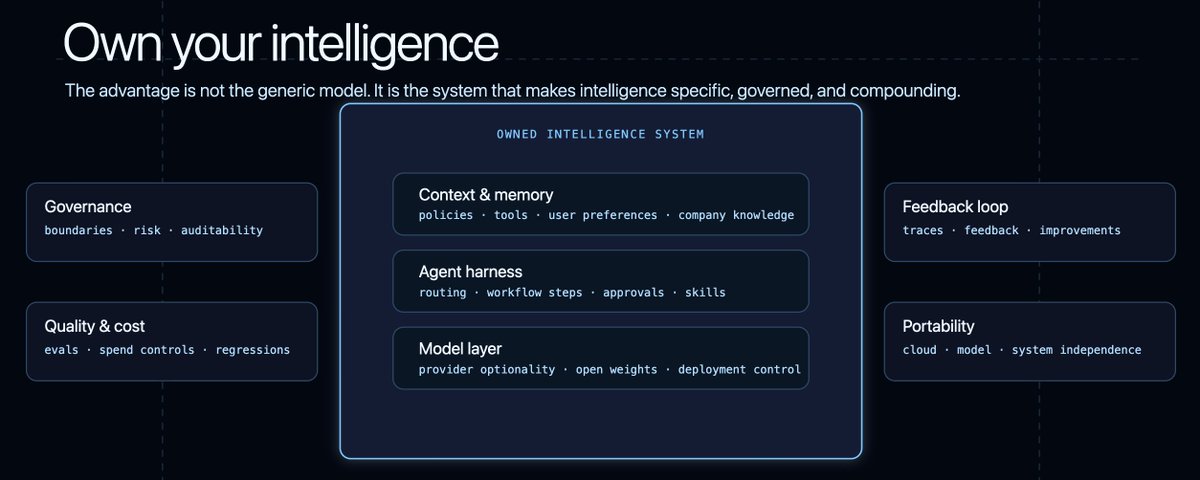
Over the next five years, every company will use AI in one of two ways: to run critical parts of their business, or as part of the product they sell to customers. In both cases, generic intelligence will not be enough.
To have real impact, companies need to own their intelligence. Ownership does not mean building every layer from scratch. It means controlling the parts that determine how intelligence behaves, how it’s managed, and whether it compounds over time.
# Off-the-shelf intelligence does not know your business
Off-the-shelf AI is useful because it is general. It can answer common questions and reason across a broad set of topics. This makes it helpful to get started. But to assume that generic intelligence can run operations inside a company would be a gross simplification.
Companies have MANY specifics in the way they operate. The deeper you embed AI into your company, the more these specifics matter. If you are hoping to use AI as a core part of operating your company, these specifics matter a lot.
As a concrete example, let’s consider a large insurer using AI to help process claims. A generic model can read a policy document, summarize a claim, and explain common coverage concepts. But to actually do the work to handle a claim depends on the insurer’s own policy language, state-by-state regulatory requirements, fraud signals, historical claim patterns, escalation rules, customer tiering, and risk tolerance. These specifics will not be in a generic models weights. A generic model knows the meaning of the word “deductible”. But it does not know how to handle a specific type of claim, for this customer, in this jurisdiction, under this policy, with this evidence.
The same logic applies when AI is the product itself. If you are a vertical AI startup building an AI support agent, legal assistant, or coding agent - the base model is not your product. Everyone else can call the same API. Your product is the system around the model: the workflows it handles, the context it retrieves, the tools it can use, the evals that define quality, the memory it builds, and the feedback loop that improves it with every customer interaction.
In both cases, the advantage is not generic intelligence. It is intelligence adapted to a specific business.
Any company can use AI. But this generic intelligence will not be enough to drive meaningful ROI or build a differentiated product. Companies built around AI will own their intelligence.
# What it means to own your intelligence
Owning your intelligence does not mean building every layer of the AI stack yourself. It means controlling the critical parts - the parts that determine how intelligence behaves, what it learns from, how much it costs, and whether it improves over time.
A useful analogy here: the supply chain. A retailer does not need to manufacture every truck, ship, or warehouse robot it uses. But it does need to own the system that determines what gets sourced, how inventory moves, how demand is forecast, and how the customer experience is delivered.
AI works the same way. You can buy models, compute, and infrastructure. But you need to own the system that turns those inputs into intelligence specific to your business.
There are three parts to this: controlling the agent system; owning the economics, quality and risk; and compounding the intelligence over time.
## Controlling the agent system
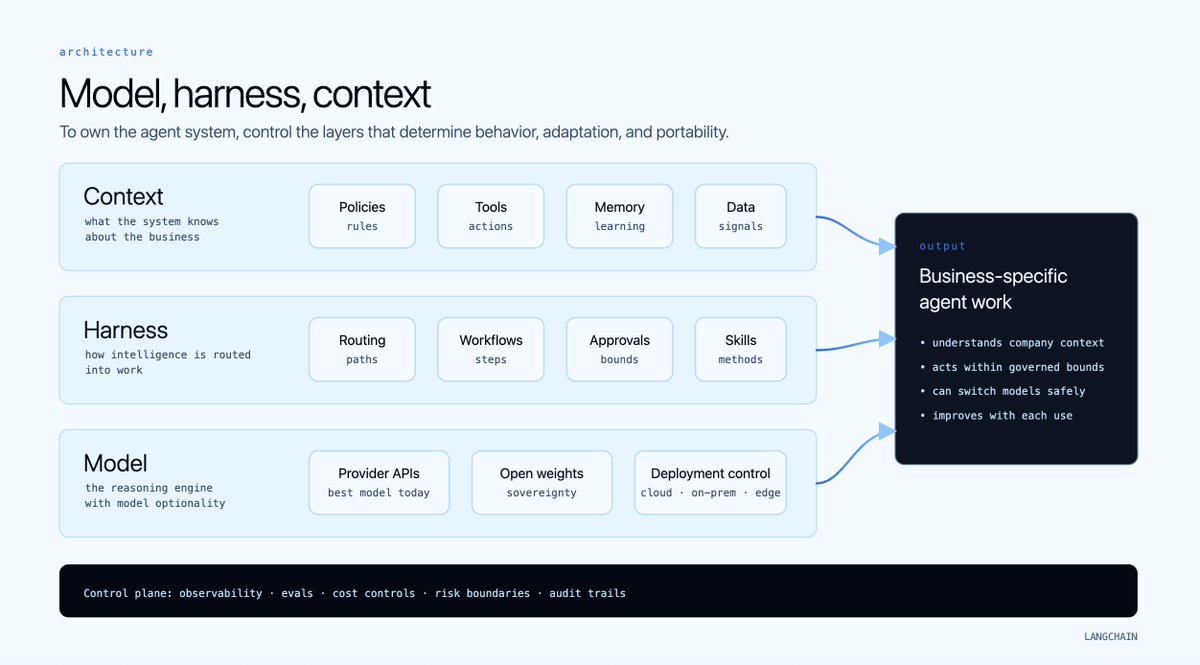
An agent is the bridge between raw intelligence and work. The model provides the intelligence. The harness determines how that intelligence is applied. Context tells the system what matters in a specific situation.
The first layer is the model. Owning the model can mean using open-weight models when sovereignty, portability, or deployment control matters. It can also mean preserving model optionality: the ability to switch across providers as quality, cost, latency, and privacy requirements change. Optionality is defensive because it avoids lock-in. It is offensive because it lets you adopt the best model as soon as it appears.
The second layer is the harness: the orchestration logic that turns model outputs into actions. The harness controls everything around how context is used: routing, tool use, workflow steps, skills, and more. This is where much of the company-specific behavior lives. If the harness is closed, you are accepting someone else’s assumptions about how your agent should work.
The third layer is the context itself. Context is what makes generic intelligence specific: documents, policies, tools, skills, user preferences, organization-level knowledge, and memory. Memory is especially important because it is how the system becomes more useful over time. If you do not own context and memory, you do not own the intelligence your system accumulates.
To own the agent system, you need control over all three: the model, the harness, and the context.
## Own the economics, quality, and risk
Once AI is doing real work, companies need to manage it like any other operating system. That means controlling the cost of the work, measuring its quality, defining where the system can act, and knowing what happened when it does.
Cost matters because intelligence is only valuable if it is cheap relative to the return it generates. As AI adoption has increased rapidly, so have costs - see Uber’s cautionary tale as an example. Being able to lock down costs - on a user, orgs, or agent level - is crucial to being able to scale AI reliably.
Quality needs to be measured, not assumed. If you upgrade a model, change a prompt, add a tool, or adjust a workflow, you need to know whether the system got better or regressed. If you are unable to measure this, you are unable to improve your agent systematically, which means you are unable to truly control and own it.
Boundaries define where AI can act independently and where it needs supervision. Companies need to control what data agents can access, what tools they can use, which actions require approval, and when they should escalate. Owning your intelligence means controlling what it can do.
Observability makes the system accountable. If an agent takes an action, the business needs to see what it saw, what it did, what tools it called, and why. This is important for both being able to improve the system but also being able to audit and trust the system.
## Compound your intelligence
The best AI systems get better with use. The 100th interaction should be more valuable than the 1st because the system has learned more about your users, workflows, policies, failures, and preferences. You need to own both what the system has learned, as well as the learning process itself.
What does it mean for a system to learn?
That learning loop starts with traces. Traces show what the agent actually did: what context it saw, what tools it called, where it got stuck, and what it produced. Feedback gives those traces meaning: whether the behavior was useful, accepted, rejected, inefficient, risky, or wrong. Together, traces and feedback become the raw material for improvement.
Those traces and their associated feedback can be used to improve the system - by changing the prompts, harness, tools. But just as important as those changes are the evals associated with those changes. For every change, you should be adding an eval to capture that change, and make sure that future changes don’t cause regressions.
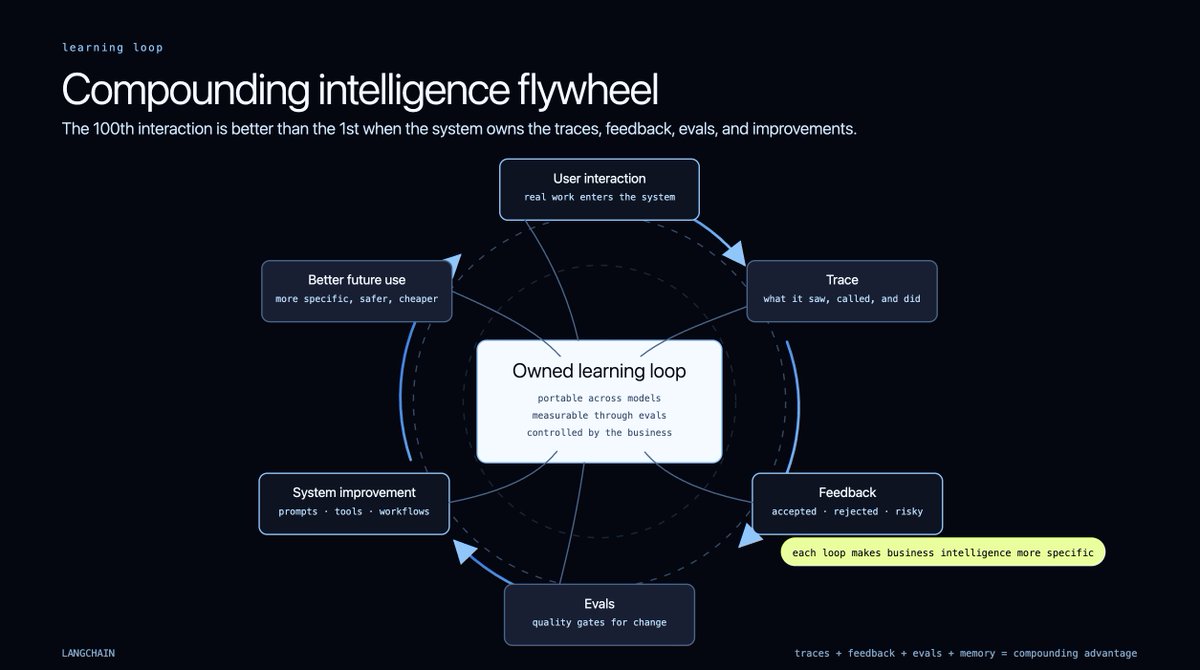
At a bare minimum, these learnings need to be owned by you. They need to be portable from from model to model, from system to system. Even more - you should own this entire loop yourself. Again - it doesn’t really matter how well the agent does the first time someone uses. It matters how much better it is the 100th time they use it. If that’s what matters, then you need to own the loop that drives that.
## A checklist for owning your intelligence
Do you truly own your intelligence? Here’s a set of questions you should be asking yourself to determine that:
- [ ] If a brand new model provider launched a SOTA model tomorrow, could you easily switch to it?
- [ ] If the model provider you are using deprecates a model - could you host it yourself to avoid any disruption?
- [ ] Do you know - and can control - how the orchestration logic works, such that you can know and control exactly what goes into the LLM at every step?
- [ ] Can you run your agent in the exact same way in one cloud vs another vs on device?
- [ ] Can you monitor and control AI spend on per user basis?
- [ ] If someone asks why an agent did something, can you show them a full trace of all the steps they did (and any internal logic for why they did that?)
- [ ] Do you have evals in place to be confident that swapping models won’t introduce regressions?
- [ ] When a user uses your agent for the 100th time, will it know more about them and be a better experience than when they used it for the 1st time?
- [ ] When your agent learns - can you port those learnings to a different system entirely?
- [ ] Can you control how your agent learns?
## The strategic choice
Companies do not need to build every layer of the AI stack. They should buy the parts that are hard, generic, and undifferentiated.
But they need to own the layer where advantage compounds: the agent system, the governance around the work it does, and the feedback loop that makes it better with use.
Any company can adopt AI. The companies that create lasting value with AI will be the ones that own their intelligence.
## 相关链接
- [Harrison Chase](https://x.com/hwchase17)
- [@hwchase17](https://x.com/hwchase17)
- [42K](https://x.com/hwchase17/status/2081002647814094888/analytics)
- [AI support agent](https://www.youtube.com/watch?v=uCKhOmth2ms)
- [coding agent](https://www.youtube.com/watch?v=HbUznYhKFOc)
- [model](https://www.langchain.com/blog/model-neutrality)
- [using open-weight models](https://x.com/JensenHuang/status/2080643682408321103?s=20)
- [switch across providers](https://docs.langchain.com/oss/python/langchain/models)
- [around how context is used](https://www.langchain.com/blog/context-engineering-for-agents)
- [how the system becomes more useful](https://www.langchain.com/blog/how-to-give-your-agent-memory)
- [If you do not own context and memory](https://www.langchain.com/blog/your-harness-your-memory)
- [measuring its quality](https://docs.langchain.com/langsmith/evaluation-concepts)
- [Uber’s cautionary tale](https://www.forbes.com/sites/janakirammsv/2026/05/17/uber-burns-its-2026-ai-budget-in-four-months-on-claude-code/)
- [Being able to lock down costs](https://www.langchain.com/blog/building-governed-agents-a-framework-for-cost-control-and-compliance)
- [makes the system accountable](https://www.langchain.com/blog/on-agent-frameworks-and-agent-observability)
- [Traces show what the agent actually did](https://www.langchain.com/blog/in-software-the-code-documents-the-app-in-ai-the-traces-do)
- [traces and feedback become the raw material for improvement](https://www.langchain.com/blog/improving-agents-is-a-data-mining-problem)
- [Upgrade to Premium](https://x.com/i/premium_sign_up)
- [9:04 PM · Jul 25, 2026](https://x.com/hwchase17/status/2081002647814094888)
- [42.2K Views](https://x.com/hwchase17/status/2081002647814094888/analytics)
- [View quotes](https://x.com/hwchase17/status/2081002647814094888/quotes)
---
*导出时间: 2026/7/26 10:08:21*
---
## 中文翻译
# “拥有你的智能”意味着什么?
**作者**: Harrison Chase
**日期**: 2026-07-25T13:04:29.000Z
**来源**: [https://x.com/hwchase17/status/2081002647814094888](https://x.com/hwchase17/status/2081002647814094888)
---

在未来五年内,每家公司都将通过以下两种方式之一使用 AI:要么用于运营其业务的关键部分,要么作为其向客户销售的产品的一部分。在这两种情况下,通用智能都将是不够的。
要产生真正的影响,公司需要拥有自己的智能。拥有并不意味着从零开始构建每一层。它意味着控制那些决定智能如何表现、如何管理以及是否会随时间增值的部分。
# 现成的智能并不了解你的业务
现成的 AI 之所以有用,是因为它具有通用性。它可以回答常见问题,并在广泛的主题范围内进行推理。这对于入门非常有帮助。但是,假设通用智能可以在公司内部运行运营,这将是一种极大的过度简化。
公司在运营方式上有许多细节。你将 AI 嵌入公司越深,这些细节就越重要。如果你希望将 AI 作为运营公司的核心部分,这些细节就至关重要。
作为一个具体的例子,让我们考虑一家大型保险公司使用 AI 来帮助处理理赔。通用模型可以阅读保单文件,汇总理赔,并解释常见的承保概念。但实际上要完成处理理赔的工作,取决于保险公司自己的保单语言、各州的监管要求、欺诈信号、历史理赔模式、升级规则、客户分层和风险承受度。这些细节不会包含在通用模型的权重中。通用模型知道“免赔额”这个词的含义。但它不知道针对这位客户、在这个司法管辖区、根据这份保单、凭借这些证据,如何处理特定类型的理赔。
当 AI 本身就是产品时,同样的逻辑也适用。如果你是一家垂直 AI 初创公司,正在构建 AI 支持代理、法律助手或编码代理——基础模型并不是你的产品。其他人都可以调用相同的 API。你的产品是模型周围的系统:它处理的工作流程、它检索的上下文、它可以使用的工具、定义质量的评估、它构建的记忆,以及随着每次客户交互而改进它的反馈循环。
在这两种情况下,优势都不是通用智能。而是适应特定业务的智能。
任何公司都可以使用 AI。但这种通用智能不足以推动有意义的投资回报率(ROI)或建立差异化的产品。围绕 AI 构建的公司将拥有自己的智能。
# 拥有你的智能意味着什么
拥有你的智能并不意味着你自己构建 AI 堆栈的每一层。它意味着控制关键部分——那些决定智能如何表现、它从什么中学习、它的成本是多少以及它是否会随时间改进的部分。
这里有一个有用的类比:供应链。零售商不需要制造它使用的每一辆卡车、船舶或仓库机器人。但它确实需要拥有决定采购什么、库存如何移动、如何预测需求以及如何交付客户体验的系统。
AI 也是如此。你可以购买模型、算力和基础设施。但你需要拥有将这些输入转化为针对你业务的特定智能的系统。
这包括三个部分:控制代理系统;拥有经济性、质量和风险;以及让智能随时间增值。
## 控制代理系统
代理是原始智能与工作之间的桥梁。模型提供智能。控制机制决定了该智能如何应用。上下文告诉系统在特定情况下什么最重要。
第一层是模型。拥有模型可能意味着在主权、可移植性或部署控制很重要时使用开源权重模型。它也可能意味着保留模型的可选性:即随着质量、成本、延迟和隐私要求的变化,在不同提供商之间切换的能力。可选性是防御性的,因为它避免了锁定。它也是进攻性的,因为它让你能够在最好的模型出现时立即采用它。
第二层是控制机制:将模型输出转化为动作的编排逻辑。控制机制控制着关于如何使用上下文的一切:路由、工具使用、工作流步骤、技能等等。这是许多特定于公司的行为所在的地方。如果控制机制是封闭的,你就是在接受别人关于你的代理应该如何工作的假设。
第三层是上下文本身。上下文是使通用智能具体化的因素:文档、政策、工具、技能、用户偏好、组织级知识和记忆。记忆尤其重要,因为它是系统随时间变得更有用的方式。如果你不拥有上下文和记忆,你就不拥有你的系统积累的智能。
要拥有代理系统,你需要控制所有这三层:模型、控制机制和上下文。

## 拥有经济性、质量和风险
一旦 AI 开始做真正的工作,公司就需要像管理任何其他操作系统一样管理它。这意味着控制工作的成本,衡量其质量,定义系统可以在哪里行动,以及知道当它行动时发生了什么。
成本很重要,因为只有当智能相对于其产生的回报来说足够便宜时,它才有价值。随着 AI 的采用迅速增加,成本也随之增加——看看 Uber 的警示故事就知道了。能够锁定成本——在用户、组织或代理层面——对于能够可靠地扩展 AI 至关重要。
质量需要被衡量,而不是被假设。如果你升级模型、更改提示、添加工具或调整工作流,你需要知道系统是变好了还是退步了。如果你无法衡量这一点,你就无法系统地改进你的代理,这意味着你无法真正控制和拥有它。
边界定义了 AI 可以在何处独立行动,以及在何处需要监督。公司需要控制代理可以访问哪些数据、它们可以使用哪些工具、哪些操作需要批准以及它们何时应该升级。拥有你的智能意味着控制它能做什么。
可观测性使系统具有可问责性。如果代理采取了一个行动,业务需要看到它看到了什么、它做了什么、它调用了什么工具以及为什么。这对于能够改进系统以及能够审计和信任系统都很重要。
## 让你的智能增值
最好的 AI 系统会随着使用而变得更好。第 100 次交互应该比第 1 次更有价值,因为系统更多地了解了你的用户、工作流、政策、失败和偏好。你需要拥有系统学到了什么,以及学习过程本身。
系统学习意味着什么?
那个学习循环从轨迹开始。轨迹显示了代理实际做了什么:它看到了什么上下文、它调用了什么工具、它在哪里卡住了以及它产生了什么。反馈赋予了这些轨迹意义:该行为是否有用、被接受、被拒绝、低效、有风险或错误。轨迹和反馈共同成为改进的原始材料。
这些轨迹及其相关反馈可以用来改进系统——通过更改提示、控制机制、工具。但与这些更改同样重要的是与这些更改相关的评估。对于每一个更改,你应该添加一个评估来捕获该更改,并确保未来的更改不会导致回归。

至少,这些学习成果需要由你拥有。它们需要可以在模型之间、系统之间移植。更重要的是——你应该自己拥有整个循环。再次强调——代理在某人第一次使用时表现如何并不重要。重要的是它在第 100 次使用时表现好了多少。如果这是重要的,那么你需要拥有驱动这一点的循环。
## 拥有你的智能的检查清单
你真的拥有你的智能吗?你应该问自己以下一组问题来确定这一点:
- [ ] 如果明天有一家全新的模型提供商发布了一个最先进(SOTA)的模型,你能轻松切换到它吗?
- [ ] 如果你正在使用的模型提供商弃用了一个模型——你能自己托管它以避免任何中断吗?
- [ ] 你知道并且可以控制编排逻辑是如何工作的,以便你可以在每一步确切地知道和控制输入给 LLM 的内容吗?
- [ ] 你能否在一个云、另一个云或设备上以完全相同的方式运行你的代理?
- [ ] 你能否监控和控制每个用户的 AI 支出?
- [ ] 如果有人问为什么代理做了某事,你能向他们展示它所做的所有步骤的完整轨迹(以及它这样做的任何内部逻辑)吗?
- [ ] 你是否有适当的评估来确信切换模型不会引入回归?
- [ ] 当用户第 100 次使用你的代理时,它会比第 1 次使用时更多地了解他们,并提供更好的体验吗?
- [ ] 当你的代理学习时——你能将这些学习成果移植到一个完全不同的系统吗?
- [ ] 你能控制你的代理如何学习吗?
## 战略选择
公司不需要构建 AI 堆栈的每一层。它们应该购买那些困难、通用且无差异化的部分。
但它们需要拥有优势会增值的那一层:代理系统、围绕其所做工作的治理,以及使其随使用而改进的反馈循环。
任何公司都可以采用 AI。能够利用 AI 创造持久价值的公司,将是那些拥有自己智能的公司。
## 相关链接
- [Harrison Chase](https://x.com/hwchase17)
- [@hwchase17](https://x.com/hwchase17)
- [42K](https://x.com/hwchase17/status/2081002647814094888/analytics)
- [AI support agent](https://www.youtube.com/watch?v=uCKhOmth2ms)
- [coding agent](https://www.youtube.com/watch?v=HbUznYhKFOc)
- [model](https://www.langchain.com/blog/model-neutrality)
- [using open-weight models](https://x.com/JensenHuang/status/2080643682408321103?s=20)
- [switch across providers](https://docs.langchain.com/oss/python/langchain/models)
- [around how context is used](https://www.langchain.com/blog/context-engineering-for-agents)
- [how the system becomes more useful](https://www.langchain.com/blog/how-to-give-your-agent-memory)
- [If you do not own context and memory](https://www.langchain.com/blog/your-harness-your-memory)
- [measuring its quality](https://docs.langchain.com/langsmith/evaluation-concepts)
- [Uber’s cautionary tale](https://www.forbes.com/sites/janakirammsv/2026/05/17/uber-burns-its-2026-ai-budget-in-four-months-on-claude-code/)
- [Being able to lock down costs](https://www.langchain.com/blog/building-governed-agents-a-framework-for-cost-control-and-compliance)
- [makes the system accountable](https://www.langchain.com/blog/on-agent-frameworks-and-agent-observability)
- [Traces show what the agent actually did](https://www.langchain.com/blog/in-software-the-code-documents-the-app-in-ai-the-traces-do)
- [traces and feedback become the raw material for improvement](https://www.langchain.com/blog/improving-agents-is-a-data-mining-problem)
- [Upgrade to Premium](https://x.com/i/premium_sign_up)
- [9:04 PM · Jul 25, 2026](https://x.com/hwchase17/status/2081002647814094888)
- [42.2K Views](https://x.com/hwchase17/status/2081002647814094888/analytics)
- [View quotes](https://x.com/hwchase17/status/2081002647814094888/quotes)
---
*导出时间: 2026/7/26 10:08:21*