AI 智能体的持续学习:模型、控制层与上下文 ✍ Harrison Chase🕐 2026-04-05📦 8.1 KB 🟢 已读 𝕏 文章列表 文章探讨了 AI 智能体的持续学习机制,将其分为三个层次:模型权重的更新、Harness 控制层的优化以及 Context 上下文层的记忆与配置。作者指出,虽然大多数讨论集中在模型层的微调(如 SFT)及其带来的灾难性遗忘问题上,但工程实践中 Harness 代码和 Context 技能(如 SOUL.md)的迭代往往更为灵活高效。文章最后以 LangSmith 和 Deep Agents 为例,强调了 Trace(追踪日志)在驱动所有层级进化中的核心作用。 Agent持续学习Harness EngineeringLangSmith模型微调系统架构Deep AgentsMemory # Continual learning for AI agents **作者**: Harrison Chase **日期**: 2026-04-04T16:34:15.000Z **来源**: [https://x.com/hwchase17/status/2040467997022884194](https://x.com/hwchase17/status/2040467997022884194) ---  Most discussions of continual learning in AI focus on one thing: updating model weights. But for AI agents, learning can happen at three distinct layers: the model, the harness, and the context. Understanding the difference changes how you think about building systems that improve over time. The three main layers of agentic systems are: - Model: the model weights themselves. - Harness: the harness around the model that powers all instances of the agent. This refers to the code that drives the agent, as well as any instructions or tools that are always part of the harness. - Context: additional context (instructions, skills) that lives outside the harness, and can be used to configure it. 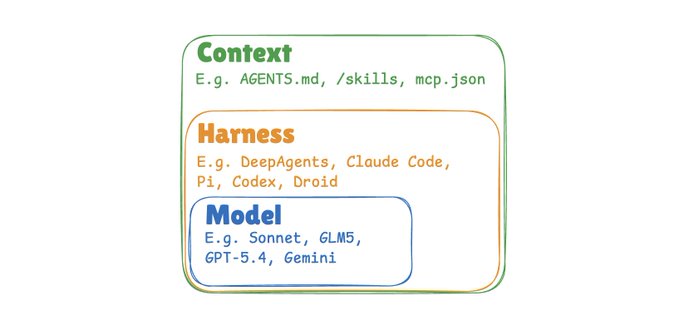 Example #1: Mapping this a coding agent like Claude Code: - Model: claude-sonnet, etc - Harness: Claude Code - User context: CLAUDE.md, /skills, mcp.json Example #2: Mapping this to OpenClaw: - Model: many - Harness: Pi + some other scaffolding - Agent context: SOUL.md, skills from clawhub When we talk about continual learning, most people jump immediately to the model. But in reality - an AI system can learn at all three of these levels. ## Continual learning at the model layer When most people talk about continual learning, this is what they most commonly refer to: updating the model weights. Techniques to update this include SFT, RL (e.g. GRPO), etc. A central challenge here is catastrophic forgetting — when a model is updated on new data or tasks, it tends to degrade on things it previously knew. This is an open research problem. When people do train models for a specific agentic system (e.g. you could view the OpenAI codex models as being trained for their Codex agent) they largely do this for the agentic system as a whole. In theory, you could do this at a more granular level (e.g. you could have a LORA per user) but in practice this is mostly done at the agent level. ## Continual learning at the harness layer As defined earlier, the harness refers to the code that drives the agent, as well as any instructions or tools that are always part of the harness. As harnesses have become more popular, there have been several papers that talk about how to optimize harnesses. A recent one is **Meta-Harness: End-to-End Optimization of Model Harnesses.** The core idea is that the agent is running in a loop. You first run it over a bunch of tasks, and then evaluate them. You then store all these logs into a filesystem. You then run a coding agent to look at these traces, and suggest changes to the harness code. 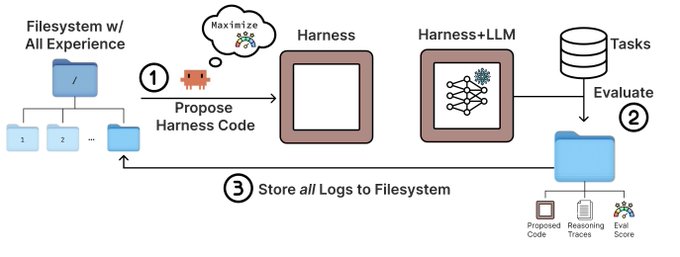 Similar to continual learning for models, this is usually done at the agent level. You could in theory do this at a more granular level (e.g. learn a different code harness per user). ## Continual learning at the context layer “Context” sits outside the harness and can be used to configure it. Context consists of things like instructions, skills, even tools. This is also commonly referred to as memory. This same type of context exists inside the harness as well (e.g. the harness may have base system prompt, skills). The distinction is whether it is part of the harness or part of the configuration. Learning context can be done at several different levels. Learning context can be done at the agent level - the agent has a persistent “memory” and updates its own configuration over time. A great example is OpenClaw which has its own SOUL.md that gets updated over time. Learning context is more commonly done at the tenant level (user, org, team, etc). In this case each tenant gets their own context that is updated over time. Examples include Hex’s Context Studio, Decagon’s Duet, Sierra’s Explorer. You can also mix and match! So you could have an agent with agent level context updates, user level context updates, AND org level context updates. These updates can be done in two ways: - After the fact in an offline job. Similar to harness updates - run over a bunch of recent traces to extract insights and update context. This is what OpenClaw calls “dreaming”. - In the hot path as the agent is running. The agent can decided to (or the user can prompt it to) update its memory as it is working on the core task. 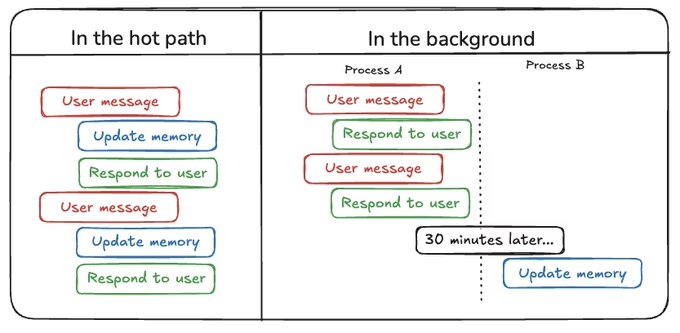 Another dimension to consider here is how explicit the memory update is. Is the user prompting the agent to remember, or is the agent remembering based on core instructions in the harness itself? ## Comparison 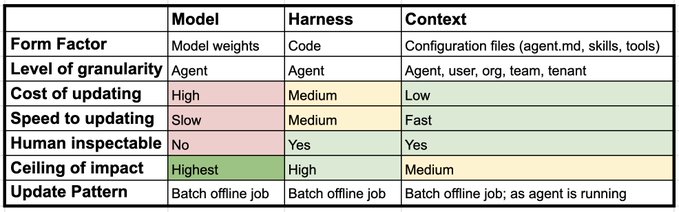 ## Traces are the core All of these flows are powered by traces - the full execution path of what an agent did. LangSmith is our platform that (among other things) helps collect traces. You can then use these traces in a variety of different ways. If you want to update the model, you can collect traces and then work with someone like Prime Intellect to train your own model. If you want to improve the harness, you can use LangSmith CLI and LangSmith Skills to give a coding agent access to these traces. This pattern is how we improved Deep Agents (our open source, model agnostic, general purpose base harness) on terminal bench. If you want to learn context over time (either at the agent, user, or org level) - then your agent harness needs to support this. Deep Agents - our harness of choice - supports this in a production ready way. See the documentation there for examples of how to do user-level memory, background learning, and more. Thank you to @sydneyrunkle @Vtrivedy10 @nfcampos for review and feedback on this article ## 相关链接 - [Harrison Chase](https://x.com/hwchase17) - [@hwchase17](https://x.com/hwchase17) - [39K](https://x.com/hwchase17/status/2040467997022884194/analytics) - [CLAUDE.md](http://claude.md/) - [SOUL.md](http://soul.md/) - [SFT](https://cameronrwolfe.substack.com/p/understanding-and-using-supervised) - [GRPO](https://cameronrwolfe.substack.com/p/grpo) - [LORA](https://unsloth.ai/docs/get-started/fine-tuning-llms-guide/lora-hyperparameters-guide) - [harnesses](https://blog.langchain.com/the-anatomy-of-an-agent-harness/) - [**Meta-Harness: End-to-End Optimization of Model Harnesses](https://yoonholee.com/meta-harness/) - [SOUL.md](https://docs.openclaw.ai/concepts/soul) - [Hex’s Context Studio](https://hex.tech/product/context-studio/) - [Decagon’s Duet](https://decagon.ai/blog/introducing-duet) - [Sierra’s Explorer](https://sierra.ai/blog/explorer) - [“dreaming”](https://docs.openclaw.ai/concepts/memory-dreaming) - [traces](https://docs.langchain.com/langsmith/observability-concepts#traces) - [LangSmith](https://docs.langchain.com/langsmith/home) - [Prime Intellect](https://www.primeintellect.ai/) - [LangSmith CLI](https://docs.langchain.com/langsmith/langsmith-cli) - [LangSmith Skills](https://github.com/langchain-ai/langsmith-skills) - [how we improved](https://blog.langchain.com/improving-deep-agents-with-harness-engineering/) - [Deep Agents](https://github.com/langchain-ai/deepagents) - [documentation there](https://docs.langchain.com/oss/python/deepagents/memory) - [user-level memory](https://docs.langchain.com/oss/python/deepagents/memory#user-scoped-memory) - [background learning](https://docs.langchain.com/oss/python/deepagents/memory#background-consolidation) - [@sydneyrunkle](https://x.com/@sydneyrunkle) - [@Vtrivedy10](https://x.com/@Vtrivedy10) - [@nfcampos](https://x.com/@nfcampos) - [Upgrade to Premium](https://x.com/i/premium_sign_up) - [12:34 AM · Apr 5, 2026](https://x.com/hwchase17/status/2040467997022884194) - [39.6K Views](https://x.com/hwchase17/status/2040467997022884194/analytics) - [View quotes](https://x.com/hwchase17/status/2040467997022884194/quotes) --- *导出时间: 2026/4/5 03:47:28*
A Agent Memory Framework: Remember, Cite, Forget 本文提出了一个智能体记忆系统的可靠框架,该框架需同时完成三个核心任务:记住该记的、引用可信的、遗忘过期的。文章详细介绍了记忆的六个层级(如会话状态、项目记忆、索引检索等),阐述了如何通过权威排序解决冲突,并强调了通过硬过期、双时序或软衰减等机制让旧记忆失效的重要性。 技术 › Agent ✍ Vox🕐 2026-05-23 AgentMemoryRAGLangGraphMem0ZepGBrainLLM系统架构工程实践
D Deep Agents 新功能:为 AI 代理添加解释器 Deep Agents 推出了嵌入式解释器功能,允许 AI 在循环内编写和执行代码。它介于单次工具调用和完整沙箱之间,提供了受限的运行时环境。通过显式桥接外部能力,它能更安全、可预测地处理中间状态和复杂逻辑,提升代理的上下文管理能力。 技术 › Agent ✍ Hunter Lovell🕐 2026-05-21 Deep Agents代码解释器Agent系统架构运行时安全
P Production Deep Agents 运行时指南:弹性执行、内存与多租户 本文探讨了将长运行周期的 Deep Agents 部署到生产环境所需的运行时基础设施。文章指出,除了 Agent 的 Harness(提示词、工具)外,更关键的是底层的 Runtime,它提供了弹性执行、持久化内存、多租户隔离、人在回路(HITL)和可观测性。文章详细介绍了如何通过检查点机制实现故障恢复与状态恢复,区分了短期与长期内存的存储策略,并阐述了在 Agent Server 中实现数据隔离与鉴权的多租户方案。 技术 › Harness Engineering ✍ LangChain🕐 2026-05-06 LangChainAgentRuntime多租户系统架构持久化HITL生产环境Deep Agents
解 解析器:智能体的路由表 本文探讨了构建高效 Agent 系统中的关键组件“Resolver”(解析器)。作者指出,与将所有知识塞入系统提示词导致性能下降不同,Resolver 作为一个上下文路由表,能根据任务类型动态加载相关文档。文章通过纠正文件分类错误的实例,展示了如何利用 Resolver 管理技能调用,解决“技能不可见”问题,并通过评估测试确保路由的准确性,从而实现智能体的持续记忆与有效检索。 技术 › Agent ✍ Garry Tan🕐 2026-04-16 AgentResolver系统架构Claude技能路由上下文管理Harness Engineering
本 本周顶级 AI 论文精选 文章精选了本周 6 篇顶级 AI 论文,涵盖 Harness Handbook、MSCE 记忆技能框架、PRO-LONG 长程记忆机制、Anthropic 全局工作空间解释性研究、Meta 的 GAMUT 完整性基准测试以及渐进式披露模式。 技术 › LLM ✍ DAIR.AI🕐 2026-07-27 AI论文AgentMemoryInterpretabilityAnthropicMetaLLMResearch
T The Graph Engineering Setup Guide 本文介绍了图工程如何为Agent提供复合记忆。通过双时态模型和MCP配置,Claude可获得持久的图记忆,相比向量搜索,多跳任务准确率提升36-46%,幻觉减少40%以上。 技术 › Agent ✍ darkzodchi🕐 2026-07-24 Graph EngineeringGraph RAGMemoryMCPClaude CodeNeo4jKnowledge GraphAgent
梁 梁文锋投资人会议语录 本文记录了梁文锋在投资人会议上的核心观点,涵盖AGI发展路线、开源与商业化策略、团队管理及愿景驱动等方面。他强调产品是AGI的副产物,现阶段的重点是Coding Agent和持续学习能力,开源与克制是长期战略,目标是实现AGI而非追求短期利益。 技术 › LLM ✍ Orange AI🕐 2026-07-23 AGI开源Agent持续学习商业模式愿景驱动克制大模型技术路线团队管理
T Towards Automating Eval Engineering 文章介绍了Eval Engineering Skill,这是一个帮助编码代理使用仓库上下文和代理跟踪构建评估的技能。该技能通过检查代理结构、挖掘模式并与用户交互,生成可执行的Harbor格式评估。文章还强调了迭代设计评估的重要性,以及容器化评估在持续学习中的作用。 技术 › Skill ✍ Viv🕐 2026-07-23 Eval EngineeringAgentLangChainHarbor自动化评估容器化持续学习编码代理
A AI 产品经理的系统思维:从种花到构建智能系统 文章阐述了 AI 产品的有机特性,强调系统思维对 AI 产品经理的重要性。核心观点包括:系统行为源于组件交互、结构与规则比参数更具杠杆效应、新演员(Agent)出现时价值流向接口。实践层面建议通过分解产品、定义契约和设计反馈循环,将 Agent 深度融入产品,以建立竞争壁垒。 技术 › Agent ✍ Christine Zhu🕐 2026-07-23 AI产品系统思维Agent产品设计PM系统架构反馈循环SaaS
O OpenCode 番外篇:驾驭 AI 的法典、军团与薄壳 文章指出 AI 编程的核心不是工具安装,而是建立权力结构与规则。作者通过 AGENTS.md、模型路由、MCP 和 Team Mode 等 OpenCode 机制,阐述如何通过立法、感官建立和验收来驾驭 AI 军团,强调开发者应成为立法者而非单纯的批准按钮。 技术 › OpenCode ✍ AI最严厉的父亲🕐 2026-07-22 AI编程OpenCodeAgent工程方法论模型路由AGENTSMCPTeamMode系统架构技术哲学
H Hermes Agent 大师课程:完整指南 本文是一份关于 Hermes Agent 的 12 部分系列课程汇总,涵盖了从工作流程、学习系统、技能管理到多平台集成、浏览器控制等核心功能,详细介绍了该系统的架构设计与最佳实践。 技术 › Hermes ✍ Tony Simons🕐 2026-07-20 AgentHermesLLM教程系统架构工具集成多代理自动化
L Let's build Claude Code's harness (step-by-step) 本文深入解析了Claude Code的“harness”架构,解释了为何简单的模型调用不足以构建可靠的代码代理。作者通过CrewAI框架逐步重建了包括核心循环、工具管理、规划机制在内的关键组件,揭示了通过工程化手段弥补模型差距的方法。 技术 › Claude Code ✍ Akshay🕐 2026-07-16 Claude CodeAgentCrewAIHarness Engineering代码代理工具调用LLM工程实践架构设计Context Engineering