# AI Adoption Is an Architecture Problem
**作者**: Luke Pierce
**日期**: 2026-08-24T12:03:24.000Z
**来源**: [https://x.com/lukepierceops/status/2091858914757190013](https://x.com/lukepierceops/status/2091858914757190013)
---

Enterprises are learning the hard way that most of their employees will never get good at AI. Companies doing [$2M-](https://x.com/search?q=%242M-&src=cashtag_click)$50M can still do something enterprises physically can't. This is the full argument, and it's the reason the ROI math tilts so hard in your favor right now.
Somewhere this month, a 50-person company is renewing its AI subscriptions. Nobody will question the invoice, because everybody agrees AI matters. And if you pulled the usage data, you'd find four people who live in it, ten who paste things in occasionally, and thirty-six seats that went untouched since the week they were bought.
Nothing about how that company operates has changed. The invoice renews anyway.
Multiply that across the entire economy and you get the strangest numbers in business: 88% of organizations now use AI, about 6% make real money from it, and 1% of executives call their rollout mature. When McKinsey tested 25 factors to find what separates the winners, the biggest driver of bottom-line impact was whether the company had fundamentally redesigned its workflows around AI. Only 21% have done it.
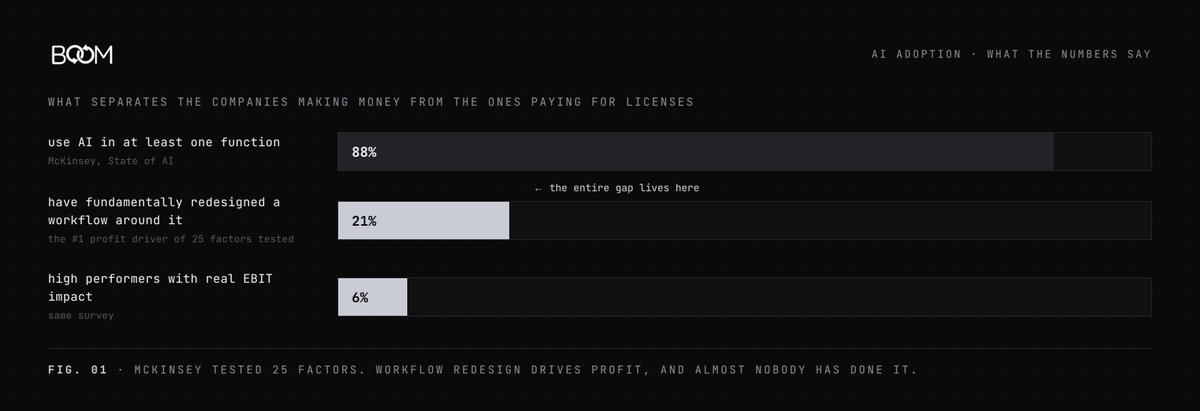
FIGURE 1: adopted vs redesigned vs profiting
Buying AI does nothing. Rebuilding how work flows through the company is everything. The gap is architectural, and once you see that, you can't unsee it in your own company.
For context, I'm the founder and CEO of [@boomautomations](https://x.com/@boomautomations). Over the last 4 years we've built custom AI and automation operating systems for 90+ companies across many industries, replacing fragmented tool stacks with unified systems that run at near 100% adoption. So I've watched this exact pattern play out at every company size, and the enterprise version of it is just the most expensive version.
## What "adopted AI" actually looks like inside a company
I talk to founders and operators every week, and when we dig into what "we use AI" actually means at their company, it's almost always the same picture.
Someone bought ChatGPT or Claude seats for the team. One or two people, usually the ones who were already curious about AI on their own time, use it constantly and swear by it. A handful more paste things in occasionally and get mediocre results back. And the rest of the team logged in once, asked it something, shrugged, and went back to the spreadsheet (AKA the work gulag). The subscription renews every month either way.
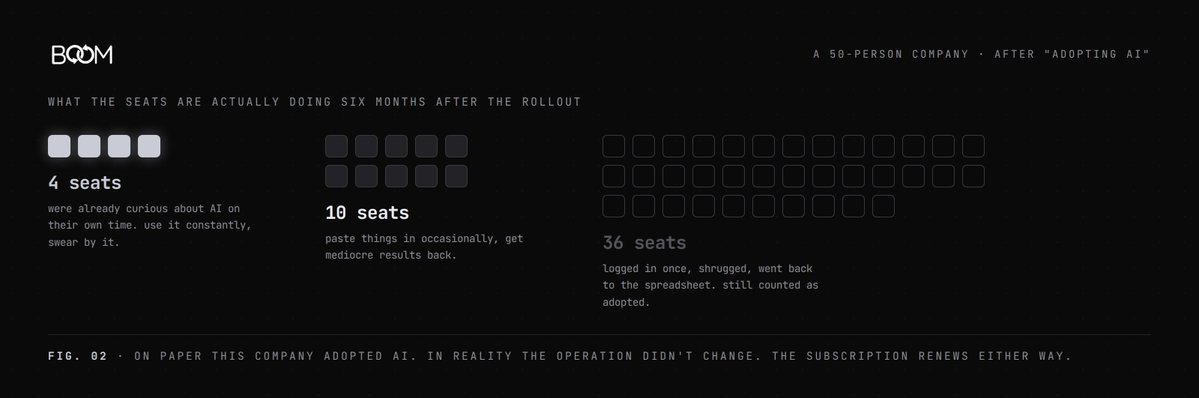
FIGURE 2: the rollout split
On paper, that company adopted AI. The seats exist, the logins happened, the box is checked. In reality, one or two people got a little faster and the operation didn't change at all. Nothing about how work flows through the company is different, because a chat window sitting next to the work was never going to change how the work flows.
That's how you get 88% adoption and 6% impact in the same survey. Both numbers are real. One of them just doesn't mean anything.
## Why training doesn't fix it
The instinctive response is training. Run workshops, teach prompting, hire an AI champion. Every company tries some version of it, and it keeps failing for a reason I've been saying for a while now in a different context:
The tech barrier is basically zero. The real barriers are systems thinking, time, and process discipline.
Anyone can open a chat window and get an answer. That was never the hard part. Getting real value out of AI means knowing which parts of a workflow need judgment and which should just be deterministic code, how to structure a task so the output is checkable, and where AI fits in a process versus where it breaks one. That's systems thinking, and systems thinking is a discipline people build over years, not in a workshop.
Expecting a warehouse coordinator or an account manager to develop it is expecting them to pick up a second profession on top of their first one. Their job was never "use AI." Their job is getting projects out the door, keeping clients happy, closing the books. And even for the ones with the aptitude, there's the time problem: nobody doing a full-time operational job has hours every week to iterate on how they use a model. The workshop ends, the real work is still piled up, and the chat window goes back to being a tab they don't open.
So the skill gap isn't a phase the company grows out of. It's a permanent feature of every team, at every size. Which means any AI strategy that depends on most of your people becoming skilled AI users is dead before it starts.
## The question everyone should be asking instead
Once you accept that most of the team will never be good at AI, the question changes shape completely.
The old question: "how do we get the team to adopt AI?"
The right question: "how do we build systems where the team gets the full benefit of AI without needing any AI skill at all?"
That's an architecture question. And here's the thing that took me a while to see clearly: your ability to answer it depends almost entirely on what your company is already locked into.
## Enterprise has to retrofit. You don't.
Think about what a billion-dollar company can actually do about this.
They can't rip out their systems of record. There are two decades of process, compliance, integrations, and politics fused into Salesforce, NetSuite, SAP, and the forty tools around them. Thousands of employees have muscle memory in those screens. Any change that breaks a workflow breaks it for a division, and someone's bonus is tied to that division.
So their only real move is threading AI into the existing systems, carefully, over years, without breaking anything. Build agents in the background of the tools people already use, keep the humans approving and editing, and never ask the 70% to change how they work. For that segment it's the right answer. It's basically the only answer.
Now look at a company doing [$2M-](https://x.com/search?q=%242M-&src=cashtag_click)$50M. Maybe that's departments scattered across Monday, a CRM, and spreadsheets. Maybe it's a heavier picture, twenty tools deep, with an ERP somebody half-implemented two years ago that a third of the team quietly works around. The stack varies. The thing that matters doesn't: the whole operation is still small enough to move.
Your entire team fits on one call. The decision to change systems is one conversation, usually with yourself. Migrating the data is a project measured in weeks, whatever it's coming out of. And the "decades of process fused into the software" problem barely exists, because the processes mostly live in people's heads and a few dozen accounts, and the muscle memory is two years deep instead of twenty.
Everyone frames small as being behind. I'm telling you it's the single biggest advantage in the entire AI transition, and most founders sitting on it have no idea. The enterprise constraint is mass, and you don't have any.
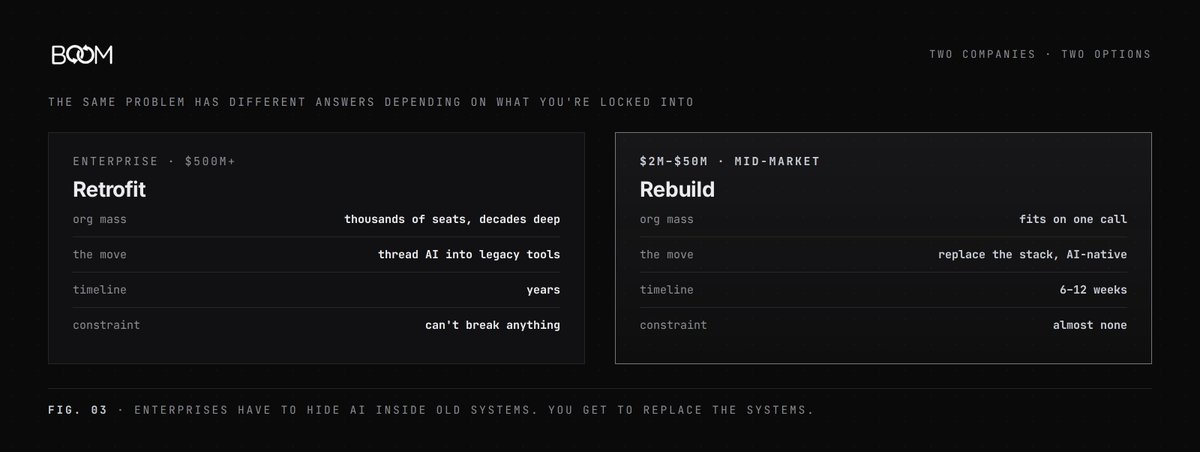
FIGURE 3: retrofit vs rebuild
You have nothing to retrofit. No decades of process fused into legacy software, compliance archaeology, or division politics. Nothing to carefully thread AI into, because nothing you're running deserves that kind of care. While enterprises spend years hiding AI inside old systems, you can replace the systems entirely with one built AI-native from the first line of code.
The enterprise fix is a workaround. Yours is an upgrade.
## What zero-skill AI actually looks like
We've built 90+ of these systems at Boom, and the design goal on every single one is the same sentence: nobody on the team should need to be good at AI for the AI to work.
Here's what that means mechanically. First, everything gets consolidated into one system with one database. Clients, projects, tasks, invoices, documents, all structured, all connected by shared keys. This matters for the AI more than anything else, because AI is only as useful as the data it can see, and when your operation lives across 7 disconnected tools, no model on earth can see the full picture.
Then the AI gets built into the workflows themselves, and the team interacts with outcomes instead of prompts:
An invoice hits the inbox. AI reads it, extracts the vendor, the amounts, the line items, and files a structured record against the right client and project. The person who used to retype it out of the PDF now sees a filled-in record waiting for a yes.
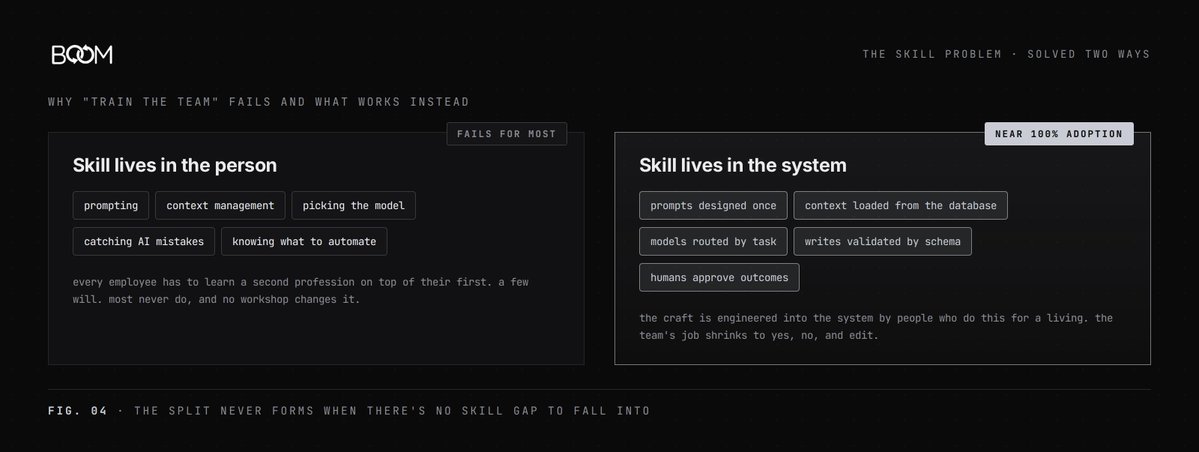
FIGURE 4: skill in the person vs skill in the system
A project hits a milestone. The client update email drafts itself from the actual project data, in the company's voice, with the real numbers. Someone glances at it and hits send.
A request comes in. It's already read, categorized, prioritized, and sitting in the right person's queue before anyone looked at it.
Someone needs to know which invoices are overdue, or what a client was billed last quarter. They ask in plain English and get an answer from the database in seconds, scoped to what they're allowed to see.
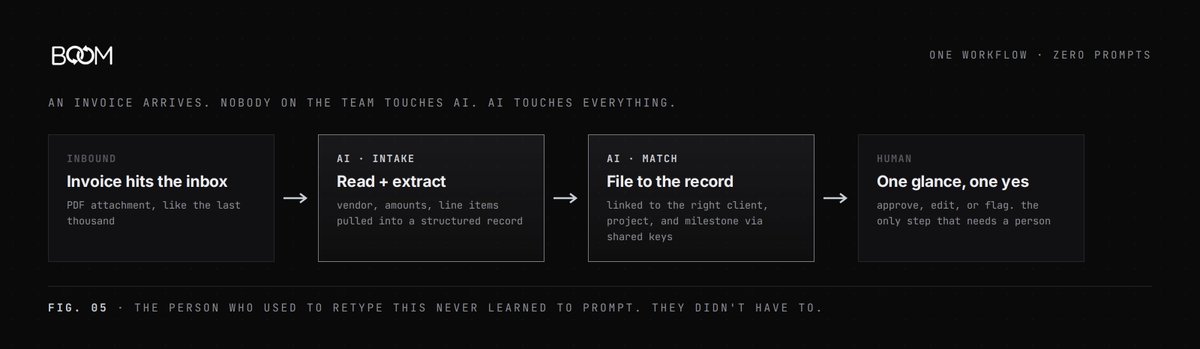
FIGURE 5: the zero-skill workflow
Now notice everything that's missing from those four paragraphs: prompting. Context management. Picking the right model. Knowing how to check AI output. All of that skill still exists, but it lives in the system, engineered once, by people who do this for a living. The prompts are designed and versioned. The context loads automatically from the database. Models get routed by task, cheap ones for extraction and classification, frontier ones for reasoning and drafting. Every AI write gets validated against the data structure before it lands.
The team's job shrinks to yes, no, and edit. Which, if you ask them, is the job they always wanted.
This is a thing I've written before about companies in general, and it applies double to their teams: they don't want more tools, they want less friction. Handing someone an AI chat window is handing them another tool. Building AI into the system so the work arrives already done is removing friction. The difference between those two moves is the entire difference between the 6% of companies seeing ROI and everyone else buying licenses.
## The adoption numbers prove the architecture
Here's the part I can back with our own results instead of surveys: adoption on these systems runs near 100%, and there's no motivational secret behind it. The barbell never forms because there's nothing for it to form around.
Three reasons, all architectural.
The system replaces 7 tools instead of becoming an 8th. Every rollout that adds a tool is asking the team to do more. This one makes their day simpler on day one, and simpler always wins.
The views are rebuilt from how the team already works. Before we build anything, we map the actual workflows, then the board stays a board and the pipeline stays a pipeline, just connected to everything else now. Day one feels familiar because it was designed from how they operate, so there's no new mental model to resist.
And the AI never asks anyone to be good at it. There's no prompt box the 70% will quietly avoid. The AI ran before they got to their desk.
One warehousing client came to us running 450 active projects across Airtable, Excel, Dropbox, and Adobe, with 5 project managers each doing the workflow their own way. Today the entire company runs on one system: 130,000 lines of code, 41 screens, 28 automations working in the background. AI reads every inbound receipt, estimate, and invoice. SOWs generate in one click. Billing runs three separate rate models on its own.
Nobody on that team took a prompting course. Everybody on that team uses AI all day. Most of them would probably tell you they don't use AI at all, which is exactly the point.
## The math only works like this at your size
There's a reason I keep pointing at the [$2M-](https://x.com/search?q=%242M-&src=cashtag_click)$50M range instead of claiming this for everyone. The dividing line is organizational mass. Past a certain headcount, the cost of moving the whole company off its systems outgrows the benefit, and threading AI into what already exists becomes the smarter play. Below that line, replacement stays cheaper than the retrofit, whatever you're currently running. A 60-person company migrating off a half-adopted ERP is a bigger project than one coming off spreadsheets, but it's still weeks, and it's still a rebuild.
At enterprise scale, the AI rollout is an eight-figure license commitment spread across thousands of seats that mostly go unused, followed by years of careful retrofitting. The absolute dollars are big and the relative impact is small.
At your scale it inverts. One build consolidates most of the stack, which alone claws back a real chunk of monthly software spend. The founder gets 10+ hours a week back. The team stops living in copy-paste work between apps. Dozens of hours of weekly manual work disappear from a company small enough that it changes what the company is. Removing 60 hours of weekly manual work from a 30-person company transforms it. The same 60 hours at a 5,000-person company is a rounding error nobody notices.
And the growth math is the part that compounds: when the operational layer runs itself, you can grow revenue without growing headcount at the same rate. That's the difference between scaling and just getting bigger.
## The window
You also get to skip a generation. Most companies in this range never fully committed to a legacy ERP, and even the ones that did can unwind it in weeks instead of years. Either way you go straight to AI-native, the same way countries that never finished building landlines went straight to mobile.
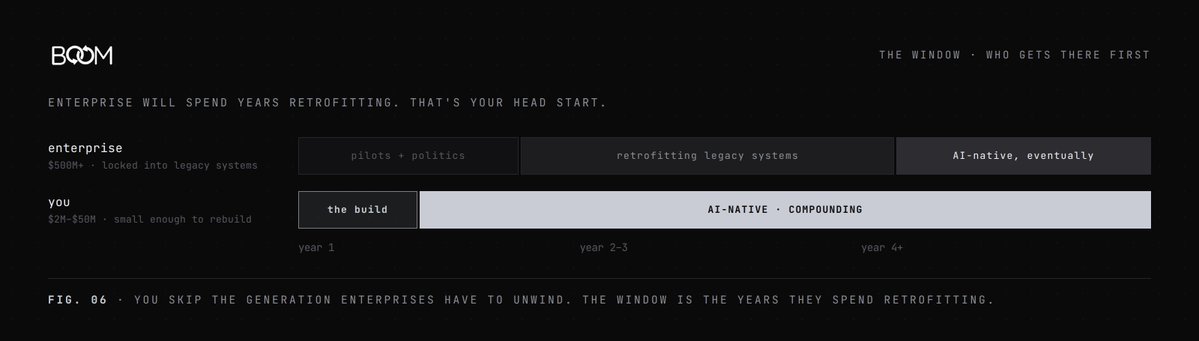
FIGURE 6: the window
The enterprises will get there eventually. They have the money, the consultants, and they've already accepted it will take years. Your window is exactly those years. Right now, running on an AI-native operating system is a competitive advantage in your market. In a few years it's table stakes, and the companies that built early will have spent that whole time compounding while their competitors were still comparing project management tools.
## Where this leaves you
If you take one thing from the enterprise adoption story, take this: the companies waiting for their teams to get good at AI will be waiting forever, at every size, and the surveys prove it. The 6% didn't win by training harder. They won by making the skill irrelevant, building it into systems the team uses without ever thinking about AI.
At [$2M-](https://x.com/search?q=%242M-&src=cashtag_click)$50M, you're in the segment that can still do that cleanly, right now, without a retrofit, because the company is small enough to move. The sequence is the one we run on every build: map the workflows, consolidate the stack, put the data in one place, and let the AI run inside the system instead of sitting next to it.
Your team doesn't need to adopt AI. Your company needs to be rebuilt so adoption stops being a thing anyone has to do.
Want to see what this looks like for your company?
This is what my team at Boom Automations builds every day. Book a call and we'll walk through your current stack, where the biggest opportunities sit, and what an AI-native operating system would look like for your business.
Apply here: [https://boomautomations.com/apply](https://boomautomations.com/apply)
## 相关链接
- [Luke Pierce](https://x.com/lukepierceops)
- [@lukepierceops](https://x.com/lukepierceops)
- [3.1K](https://x.com/lukepierceops/status/2091858914757190013/analytics)
- [$2M-](https://x.com/search?q=%242M-&src=cashtag_click)
- [@boomautomations](https://x.com/@boomautomations)
- [$2M-](https://x.com/search?q=%242M-&src=cashtag_click)
- [$2M-](https://x.com/search?q=%242M-&src=cashtag_click)
- [$2M-](https://x.com/search?q=%242M-&src=cashtag_click)
- [https://boomautomations.com/apply](https://boomautomations.com/apply)
- [Upgrade to Premium](https://x.com/i/premium_sign_up)
- [8:03 PM · Aug 24, 2026](https://x.com/lukepierceops/status/2091858914757190013)
- [3,180 Views](https://x.com/lukepierceops/status/2091858914757190013/analytics)
- [View quotes](https://x.com/lukepierceops/status/2091858914757190013/quotes)
---
*导出时间: 2026/8/24 22:35:17*
---
## 中文翻译
# AI 采用是一个架构问题
**作者**: Luke Pierce
**日期**: 2026-08-24T12:03:24.000Z
**来源**: [https://x.com/lukepierceops/status/2091858914757190013](https://x.com/lukepierceops/status/2091858914757190013)
---

企业正在以惨痛的方式认识到:它们的大多数员工永远也学不好 AI。而营收在 [$2M-](https://x.com/search?q=%242M-&src=cashtag_click)$50M 之间的公司,仍然能做企业物理上无法做到的事。这是完整的论证,也是为什么现在 ROI 的数学公式如此强烈地倾向于你这一边。
本月某处的某家 50 人公司正在续订它的 AI 订阅。没人会质疑这张账单,因为所有人都认同 AI 很重要。而如果你去拉取使用数据,你会发现有四个人重度使用,十个人偶尔粘贴点东西进去,还有三十六个席位自购买那一周起就从未被碰过。
这家公司的运作方式没有任何改变。但账单照样续订。
把这个现象乘以整个经济,你就会得到商业世界中最奇怪的一组数字:88% 的组织在使用 AI,只有大约 6% 从中真正赚到了钱,而只有 1% 的高管认为他们的部署已经成熟。当麦肯锡测试了 25 个因素来找出赢家与众不同的原因时,对利润影响最大的驱动因素是公司是否围绕 AI 从根本上重新设计了工作流程。只有 21% 的公司做到了这一点。

图 1:已采用 vs 已重新设计 vs 已盈利
购买 AI 毫无用处。重建工作在公司内部的流转方式才是一切。这个差距是架构性的,一旦你看到了它,你就无法在自己公司里对它视而不见。
先介绍一下背景:我是 [@boomautomations](https://x.com/@boomautomations) 的创始人兼 CEO。在过去的 4 年里,我们为跨多个行业的 90 多家公司构建了定制的 AI 与自动化操作系统,用接近 100% 采用率的统一系统取代了碎片化的工具组合。所以我在各种规模的公司里都目睹过这一模式的上演,而企业版本只是其中最昂贵的版本。
## “已采用 AI”在公司内部的真实模样
我每周都会和创始人及运营者交流,当我们深挖“我们用 AI”在他们公司到底意味着什么时,画面几乎总是相同的。
有人为团队购买了 ChatGPT 或 Claude 的席位。一两个人——通常是那些本来就在业余时间对 AI 感兴趣的人——频繁使用并对其赞不绝口。还有几个人偶尔粘贴点东西进去,得到平庸的结果。而团队的其他人登录过一次,问了点什么,耸耸肩,然后回到了电子表格(也就是工作的古拉格)。无论如何,订阅每月照常续费。

图 2:部署的分化
从纸面上看,这家公司采用了 AI。席位存在,登录发生过,格子打上了勾。而实际上,只有一两个人稍微快了一点,整个运营完全没有改变。工作在公司内流转的方式没有任何不同,因为一个摆在工作旁边的聊天窗口,本来就不可能改变工作的流转方式。
这就是同一份调查中出现 88% 采用率和 6% 影响率的方式。两个数字都是真实的。只是其中一个毫无意义。
## 为什么培训解决不了问题
本能的反应是培训。办工作坊、教提示词、招一个 AI 布道者。每家公司都试过某种版本的做法,而它不断失败,原因是我一段时间以来一直在另一个语境中说的:
技术门槛基本上为零。真正的门槛是系统性思维、时间和流程纪律。
任何人都能打开聊天窗口得到答案。这从来都不是难点。从 AI 中获得真正的价值意味着:知道工作流的哪些环节需要人的判断、哪些应该只是确定性代码;如何结构化任务使输出可被检验;以及 AI 在哪些地方适配流程、在哪些地方破坏流程。这是系统性思维,而系统性思维是人们需要多年才能建立的学科,不是一场工作坊能做到的。
期望一个仓库协调员或客户经理发展出这种能力,等于期望他们在本职工作之外再掌握第二职业。他们的工作从来不是“使用 AI”。他们的工作是把项目交付出去、让客户满意、结账关账。而且即使对于那些有天赋的人,还有时间问题:一个全职做运营工作的人不可能每周都有几个小时去迭代他们使用模型的方式。工作坊结束了,真正的工作还堆积如山,聊天窗口又变回了那个他们不打开的标签页。
所以技能差距不是公司会成长着跨越的一个阶段。它是每个团队、每种规模的永久特征。这意味着任何依赖大多数员工变成熟练 AI 用户的 AI 战略,在起步之前就已经死了。
## 每个人都应该问的正确问题
一旦你接受团队中大多数人永远学不好 AI,问题的形状就彻底改变了。
旧问题:“我们如何让团队采用 AI?”
正确的问题:“我们如何构建这样的系统:团队无需任何 AI 技能就能获得 AI 的全部好处?”
这是一个架构问题。而有一点我花了很久才看清:你回答这个问题的能力,几乎完全取决于你的公司已经被什么锁死了。
## 企业只能改造,你不用。
想想一家十亿美元级的公司对此实际上能做什么。
它们无法拔掉自己的记录系统。Salesforce、NetSuite、SAP 以及它们周围的四十个工具里,熔铸着二十年的流程、合规、集成和政治。数千名员工对这些界面有肌肉记忆。任何破坏工作流程的变更都会破坏整个部门,而某个人的奖金和那个部门绑定在一起。
所以它们唯一真正的行动,是小心翼翼地、历经数年地把 AI 编织进现有系统而不破坏任何东西。在人们已经在用的工具后台构建智能体,让人类继续审批和编辑,绝不要求那 70% 的人改变工作方式。对那类公司来说这是正确答案。也基本上是唯一的答案。
现在看一家营收 [$2M-](https://x.com/search?q=%242M-&src=cashtag_click)$50M 的公司。也许它的各个部门分散在 Monday、一个 CRM 和一堆电子表格里。也许画面更沉重些:二十个工具之深,还有一个两年前某人只实施了一半的 ERP,团队里有三分之一的人悄悄绕着它工作。技术栈各有不同。但重要的东西不变:整个运营仍然小到可以整体搬迁。
你的整个团队能装进一个电话会议。更换系统的决定就是一次对话,通常是和你自己的对话。迁移数据是一个以周计的项目,无论从什么系统迁出。而“数十年流程熔进软件”的问题几乎不存在,因为流程大多存在于人的脑子和几十个账户里,肌肉记忆只有两年深,而不是二十年。
所有人都把“小”定义为落后。我要告诉你的是,这是整个 AI 转型中最大的单一优势,而大多数坐拥这一优势的创始人毫无察觉。企业的约束是质量惯性,而你根本没有。

图 3:改造 vs 重建
你没有什么需要改造的。没有熔进遗留软件的数十年流程,没有合规考古学,没有部门政治。没有什么需要小心翼翼地把 AI 编织进去,因为你正在运行的任何东西都不配得到那种小心。当企业花数年时间把 AI 藏进旧系统时,你可以彻底更换系统,换成一个从第一行代码起就以 AI 原生方式构建的系统。
企业的修复方案是一种权宜之计。你的则是一次升级。
## 零技能 AI 的真实模样
我们在 Boom 已经构建了 90 多个这样的系统,每一个的设计目标都是同一句话:团队中没有人需要擅长 AI,AI 也能发挥作用。
从机制上讲,这意味着以下内容。首先,一切都被整合进一个系统、一个数据库。客户、项目、任务、发票、文档,全部结构化,全部通过共享键连接。这对 AI 的重要性超过其他一切,因为 AI 的有用程度取决于它能看到的数据,而当你的运营散布在 7 个互不连通的工具里时,世界上没有任何模型能看到全貌。
然后 AI 被构建进工作流本身,团队与之交互的是结果,而不是提示词:
一张发票到达邮箱。AI 读取它,提取供应商、金额、行项目,并把一条结构化记录归档到正确的客户和项目下。过去从 PDF 里重新打字录入了这件事的那个人,现在看到的是一条已填好、只等他确认的记录。

图 4:技能在人 vs 技能在系统
一个项目到达里程碑。客户更新邮件从真实的项目数据中自动起草,用公司的口吻,带着真实的数字。有人扫一眼,点击发送。
一个请求进来。在任何人看到它之前,它已经被读取、分类、排定优先级,并放进了正确的人的队列里。
有人想知道哪些发票逾期了,或者某客户上个季度被开了多少账单。他们用普通英语提问,几秒钟内就从数据库得到答案,且范围限定在他们被允许看到的权限内。

图 5:零技能工作流
现在注意这四段话中缺失的一切:提示词、上下文管理、选择合适的模型、知道如何检验 AI 输出。所有这些技能依然存在,但它们存在于系统中,由以此为生的人一次性地工程化进去。提示词被设计和版本化。上下文从数据库自动加载。模型按任务路由:便宜的处理提取和分类,前沿模型处理推理和起草。每一次 AI 写入在落地前都会对照数据结构进行校验。
团队的工作缩减为:是、否、编辑。如果你问他们,这正是他们一直想要的工作。
这是我之前写过的关于公司的一点,对它们的团队加倍适用:他们不想要更多工具,他们想要更少的摩擦。递给某人一个 AI 聊天窗口是递给他又一个工具。把 AI 构建进系统、让工作到达时已经完成,是消除摩擦。这两者之间的差别,正是那 6% 看到回报的公司和其他所有在买许可证的公司之间的全部差别。
## 采用率数字证明了架构的正确性
这部分我可以用我们自己的结果而不是调查来支撑:这些系统的采用率接近 100%,背后没有任何激励秘诀。“哑铃分布”从未形成,因为没有让它形成的基础。
三个原因,全部是架构性的。
系统取代了 7 个工具,而不是成为第 8 个。每一个增加工具的部署都是在要求团队做得更多。而这个系统在第一天就让他们的日子更简单,而更简单总是赢家。
界面是根据团队已有的工作方式重建的。在构建任何东西之前,我们先绘制实际的工作流,然后看板还是看板,管道还是管道,只是现在和其他一切连接起来了。第一天感觉熟悉,因为它是从他们的运作方式出发设计的,没有需要抗拒的新心智模型。
而 AI 从不要求任何人擅长它。没有那 70% 的人会悄悄回避的提示词输入框。在他们走到办公桌之前,AI 已经运行过了。
一个仓储客户找到我们时,正用着 Airtable、Excel、Dropbox 和 Adobe 运行 450 个活跃项目,5 个项目经理各自按自己的方式做工作流。今天整个公司运行在一个系统上:13 万行代码,41 个界面,28 个在后台运行的自动化。AI 读取每一份入库的收货单、估价单和发票。SOW 一键生成。账务自动按三种不同的费率模型运行。
那个团队里没人上过提示词课程。那个团队里每个人整天都在用 AI。他们中的大多数人大概会告诉你他们根本没用 AI——而这恰恰是重点。
## 这个数学只在你的规模上成立
我之所以一直指向 [$2M-](https://x.com/search?q=%242M-&src=cashtag_click)$50M 这个区间,而不是声称人人皆可,是有原因的。分界线是组织惯性。超过一定的员工人数,把整个公司迁出其系统的成本就会超过收益,把 AI 编织进现有系统就成了更聪明的打法。在那条线以下,无论你现在运行什么,替换都比改造便宜。一家 60 人的公司从一个半途采用的 ERP 迁出,比一家从电子表格迁出的公司项目更大,但仍然只需几周,仍然是一次重建。
在企业规模上,AI 部署是一笔八位数的许可承诺,摊在数千个大多闲置的席位上,随后是数年小心翼翼的改造。绝对金额巨大,相对影响微小。
在你的规模上,这一切反转了。一次构建整合了技术栈的大部分,仅此一项就能收回每月软件支出中实实在在的一块。创始人每周找回 10 多个小时。团队不再活在应用之间的复制粘贴里。每周几十个小时的手工工作从一家公司里消失,而这家公司小到这能改变它是什么。从一家 30 人的公司中消除每周 60 小时的手工工作会彻底改变它。同样的 60 小时在一家 5000 人的公司里,是没人注意到的四舍五入误差。
而增长的数学才是复利所在的部分:当运营层自动运行时,你可以在不以同等速率增加人头的情况下增长营收。这是“扩展”与“单纯变大”之间的区别。
## 时间窗口
你还可以跳过一代。这个区间的大多数公司从未完全投入某个遗留 ERP,即使投入了,也能在几周而非几年内解套。无论哪种情况,你都直达 AI 原生,就像那些没建完固定电话网络的国家直接跳到了移动电话一样。

图 6:时间窗口
企业最终会走到那一步。它们有钱、有顾问,而且已经接受了要花好几年。你的窗口恰恰就是那几年。现在,运行在 AI 原生操作系统上是你市场中的竞争优势。几年后它将成为入场券,而早期构建的公司在这段时间里一直在复利增长,与此同时它们的竞争对手还在比较项目管理工具。
## 这把你置于何处
如果你要从企业采用的故事中带走一件事,请带走这个:等待团队学好 AI 的公司将永远等下去,无论规模大小,调查已经证明了这一点。那 6% 的赢家不是靠更努力的培训赢的。他们是靠让技能变得无关紧要赢的——把技能构建进团队在使用的系统里,而团队从未想过 AI。
在 [$2M-](https://x.com/search?q=%242M-&src=cashtag_click)$50M 区间,你正处于现在还能干净利落地做到这一点的细分市场,无需改造,因为公司还小到可以整体搬迁。流程就是我们每次构建都执行的流程:绘制工作流、整合技术栈、把数据放到一个地方,然后让 AI 在系统内部运行,而不是坐在系统旁边。
你的团队不需要采用 AI。你的公司需要被重建,让“采用”不再是一件任何人都必须去做的事。
想看看这对你的公司意味着什么?
这就是我在 Boom Automations 的团队每天构建的东西。预约一次通话,我们会一起过一遍你当前的技术栈、最大的机会在哪里,以及一个 AI 原生操作系统对你的业务会是什么样子。
在此申请:[https://boomautomations.com/apply](https://boomautomations.com/apply)
## 相关链接
- [Luke Pierce](https://x.com/lukepierceops)
- [@lukepierceops](https://x.com/lukepierceops)
- [3.1K](https://x.com/lukepierceops/status/2091858914757190013/analytics)
- [$2M-](https://x.com/search?q=%242M-&src=cashtag_click)
- [@boomautomations](https://x.com/@boomautomations)
- [$2M-](https://x.com/search?q=%242M-&src=cashtag_click)
- [$2M-](https://x.com/search?q=%242M-&src=cashtag_click)
- [$2M-](https://x.com/search?q=%242M-&src=cashtag_click)
- [https://boomautomations.com/apply](https://boomautomations.com/apply)
- [Upgrade to Premium](https://x.com/i/premium_sign_up)
- [8:03 PM · Aug 24, 2026](https://x.com/lukepierceops/status/2091858914757190013)
- [3,180 Views](https://x.com/lukepierceops/status/2091858914757190013/analytics)
- [View quotes](https://x.com/lukepierceops/status/2091858914757190013/quotes)
---
*导出时间: 2026/8/24 22:35:17*