# Applied AI Doesn't Work
**作者**: vas
**日期**: 2026-09-04T22:17:34.000Z
**来源**: [https://x.com/vasuman/status/2095999742031675738](https://x.com/vasuman/status/2095999742031675738)
---
The world has spent a fortune on AI. For most enterprises, nothing changed. I've spoken to over 300 CEOs, CIOs and CFOs at the largest companies on Earth. I learned most companies apply AI onto their garbage processes, and the end result is just making garbage faster. Whether it's buying thousands of Claude Code licenses, committing $50M in annual token spend, or running AI training sessions over Zoom, I've seen first-hand how inefficient AI adoption has been. It doesn't have to be this way.
We've already gone down this path, multiple times in fact, and we ought to learn from history when it comes to AI adoption. My hope is that by the end of this article, AI leaders around the world stop with their archaic and naive methodology of AI application, and instead follow the tried and true process illustrated below.
# Part 1: History and its Parallels
In 1990, a former MIT computer science professor by the name of Michael Hammer wrote an article for the Harvard Business Review. He had already spent years inside companies that spent enormous amounts of money on computers yet achieved very little ROI, and he was among the first to uncover why.
> "Heavy investments in information technology have delivered disappointing results, largely because companies tend to use technology to mechanize old ways of doing business. They leave the existing processes intact and use computers simply to speed them up."
That's a real quote. Are you kidding me? If you swapped out 'information technology' for 'AI', you could publish that tomorrow and be on the front page of Business Insider. In the same piece he wrote that it is time to stop paving the cow paths. It's been 36 years since, and guess what we're still doing?
Note: To pave the cow paths means to automate, formalize, or lock in an existing inefficient process instead of redesigning it for how things should work. Saved you the trip to Claude, you're welcome.
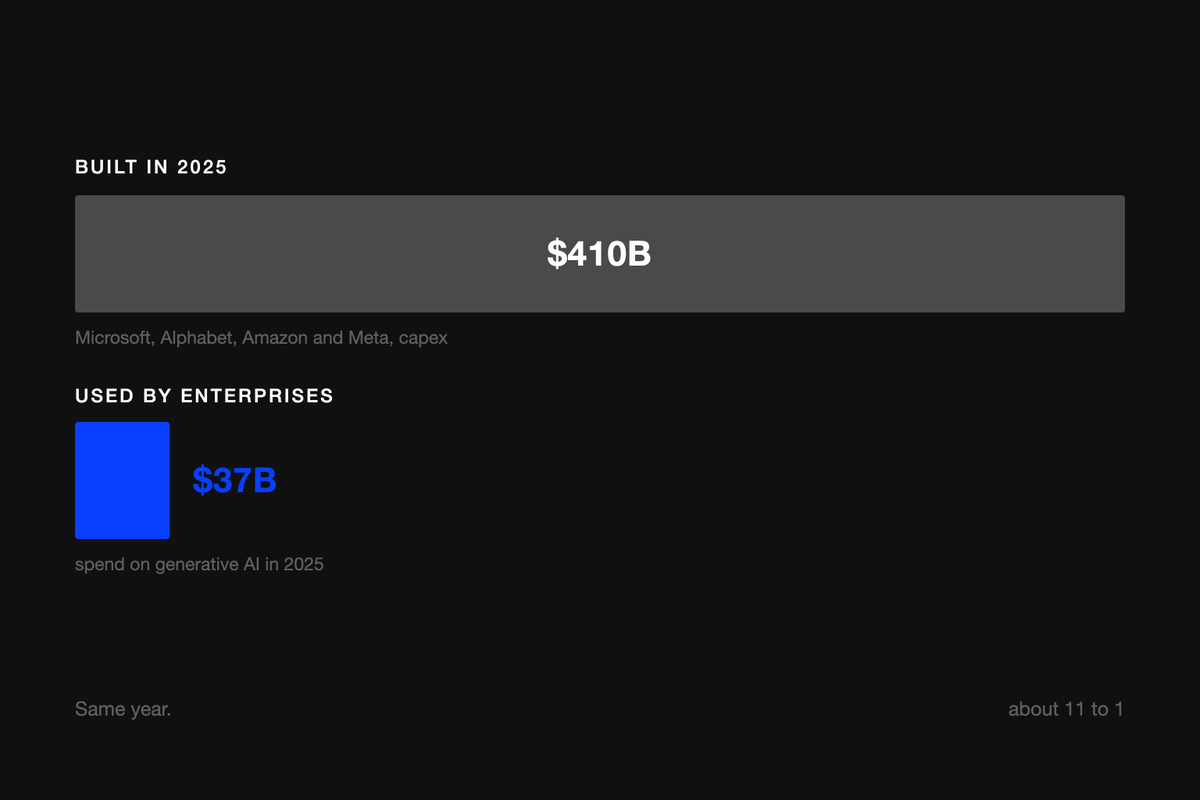
Meanwhile, over $1T was spent in capex, building out AI (Microsoft, Alphabet, Amazon, and Meta alone spent $410B in 2025; eye-watering, I know), yet only $37B was spent by enterprises on actually using it. What that means in practice: The UK's Department for Business and Trade ran a Microsoft 365 Copilot trial and published the results. 1,000 licenses were rolled out over 3 months, and there was only an average of 1.14 Copilot actions per user per day. PowerPoint slides came out 7 minutes faster (18 minutes down to 11), but at half the quality score. Excel analysis was actually completed more slowly (and also worse quality). Email time savings were, and I quote, "extremely small." Their own conclusion, verbatim: "We did not find robust evidence to suggest that time savings are leading to improved productivity." And yet 72% of users said they were satisfied or very satisfied.
Long story short: the people liked it, yet they were producing exactly what they were before. Ethan Mollick (Wharton Associate Professor and AI Researcher) put it best: "AI use that boosts individual performance does not naturally translate to improving organizational performance." This article will expand on why that is, and offer solutions that we've seen work for us in practice.
For context, I'm Vas, the CEO of [@varickagents](https://x.com/@varickagents). We work with extremely large companies (between $500M and $100B in revenue, 1k to 100k employees), helping them adopt AI, from general strategy, to process re-engineering, to building, deploying, and managing their agents. This article is based on learnings we've derived: what separates AI pilots that fail (no measurable ROI) from those that succeed (80%+ of the work is handled entirely by an agent, saving time and money).
The reason this keeps happening isn't sheer stupidity. Some of it is that, of course, but most of it is inertia and design. Whoever signs an AI contract today may own tooling and vendor selection, but they certainly do not own the process. Nobody in that chain is empowered to walk into finance, for example, and say that their 14 step process should actually only be 5 steps. So nobody does it. Instead, you 'apply AI' on what you currently have, and you end up with faster sh*t.
AI isn't supposed to be 'applied'. That doesn't work. You 'apply' a coat of paint. Too many people are thinking about AI like a fresh coat of paint, and paint doesn't fix what's underneath. Nobody ever said 'applied cloud' or 'applied digital'. No, instead they said Digital Transformation, Cloud Modernization, because everyone understood that those were transformations, and that the technology was only a part of them. AI takes the same shape.
Back to Hammer: his best number is from an insurance company he studied. An application took 22 days to move through the business. Of those 22 days, the total time anybody spent working on it was 17 minutes. Suppose, today, your AI guy drops the best model in the world onto that process and it makes every individual step twice as fast. He's now saved 8 and a half minutes. He chalks that up as 50% time savings, gets his promotion and bonus, and rides off into the sunset. It's 8 minutes.
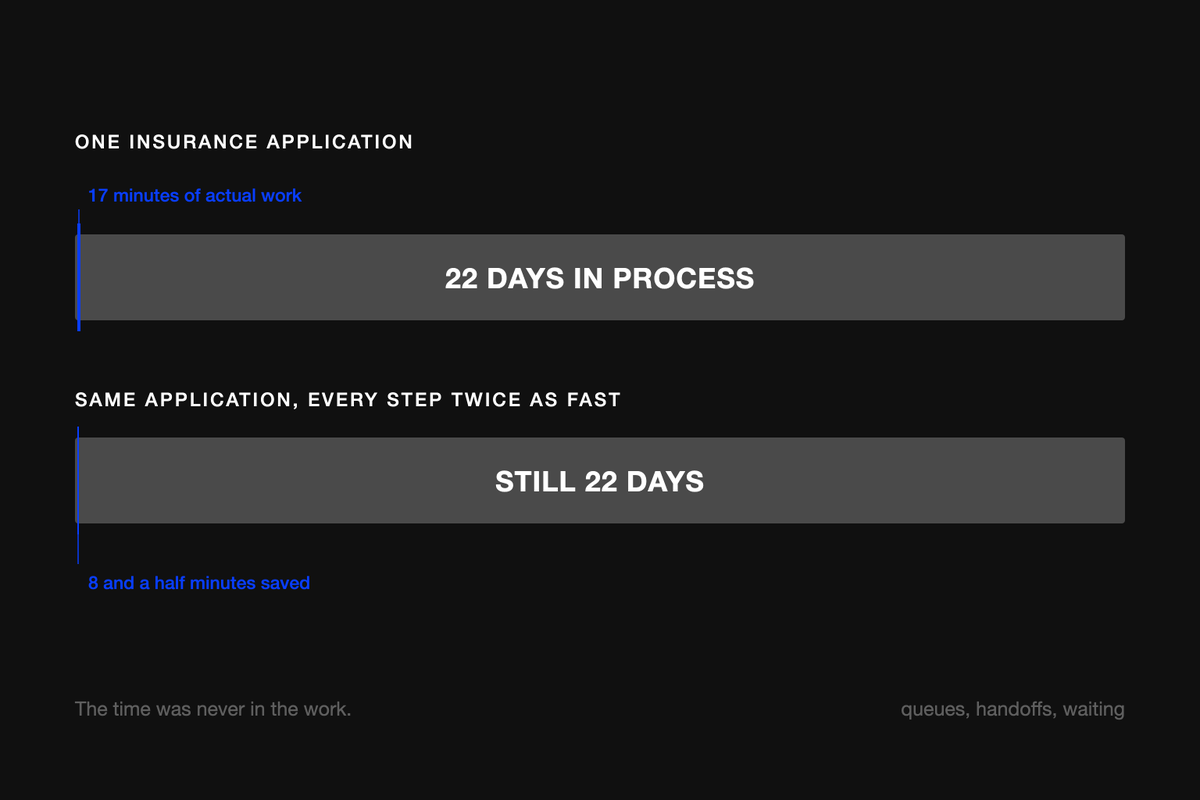
The savings were not in working on the application. They were in the queues and handoffs, in the waiting periods for other teams, and the second round of reviews. Spending your energy speeding up the 17 minutes is worse than doing nothing; you just spent your budget, and proved to your board that 'AI doesn't work'. You might think this is a relic of the 90s, but it's not. We worked with a company that went through this exact problem, from its own system logs. Opening up a new client case took 25 minutes of real work. The elapsed time, from the case being entered to it going active, ran anywhere from 2 days to 2 weeks. The work can be minutes while the process can still be weeks.
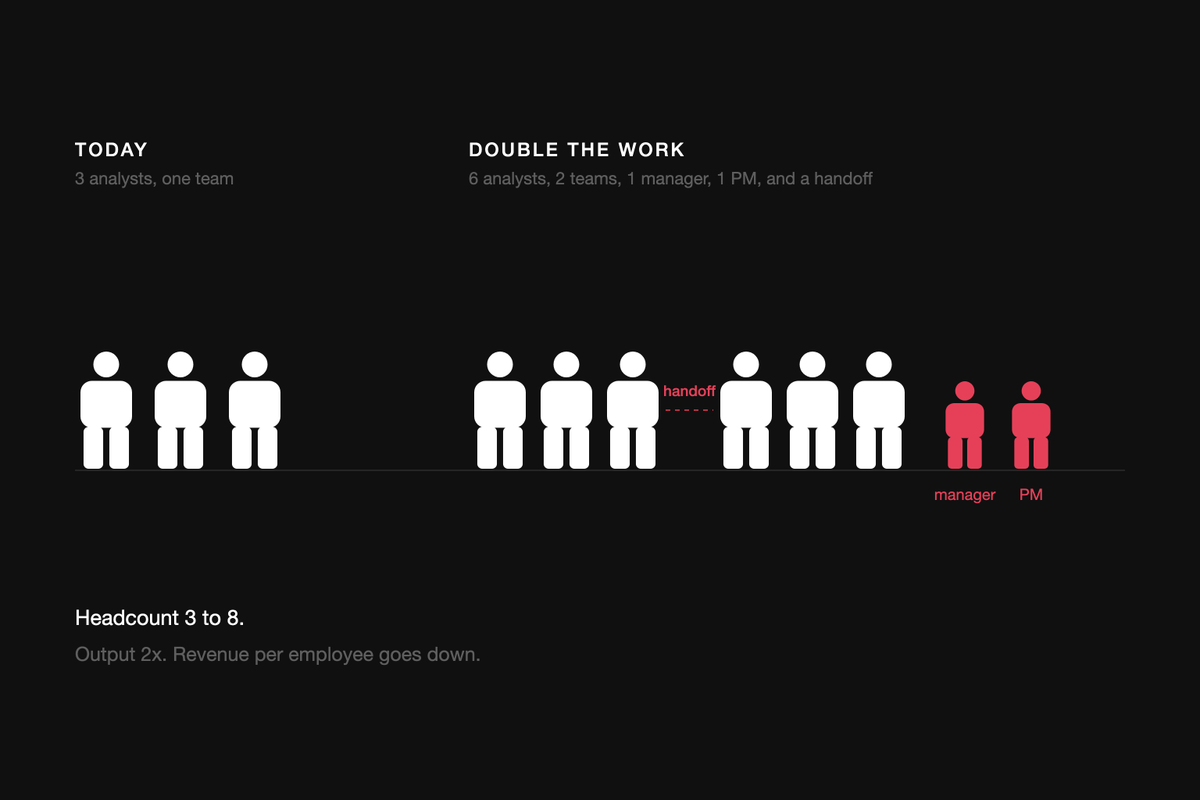
When I say most AI programs are making sh*t faster I mean that literally. The process is sh*t. AI is making it faster. To which I've heard: "well we're a massive company, so clearly we're doing something right, and we don't need to change." Adapt or die is alive and well today, more so than ever, and this is the one place AI differs from digital and cloud. Used properly, AI gives a competitor leverage over you that those never did. Whether it's to undercut you on cost, scale infinitely without processing headcount, or outreach the entire world before you can put together a lead list, they will crush you. Best case you continue growing, and now your headcount scales exponentially. 3 analysts become 6 but the 6 now need a manager, and given it's 2 teams, they need a handoff that didn't exist before, and now that handoff needs a status meeting and a PM, etc etc. This is why headcount charts bend upwards, while revenue-per-employee doesn't. Adapt or die, but don't pretend AI isn't happening. Your competitors are stopping at nothing to figure this out.
# Part 2: What to do Today
Your data is a mess and your systems don't talk to each other, so maybe your first instinct is to fix this before touching anything else. You just need one ERP, one CRM, one data platform, then AI on top. That sounds great in theory, but IT specialists understand that it is never this simple. Take a look at what this actually costs, in both money and time.
TSB spent £318M on a core banking migration, ate roughly £200M more in incident costs, was fined £48.65M by the FCA and PRA in December 2022, and broke banking for 5.2 million customers. Zimmer Biomet, an $8B manufacturer, filed a $172M claim against Deloitte in September 2025, after a botched 'migration and consolidation' left them unable to perform basic functions, like ship their product, invoice their customers, or produce functional sales reporting. And those are just the two examples that made the news; incidents like these are far more common than you may think.
What you should focus on settling is process, instead. Say you've bought 9 companies over the last 20 years, meaning you now have the same process that runs 9 different ways across your 9 subsidiaries. If you want to 'apply' AI across your company, you'll have to build the same agent 9 different ways, and then be forced to maintain all 9 sets of agents, in perpetuity. To avoid this purgatory, you need to first define the single process that runs globally, which you roll out across your entire entity, before you even think of applying AI on top of that.
Conversely, you don't NEED one ERP. Deterministic integrations used to break the moment that 2 systems disagreed about what a vendor record was. However, agents tolerate this inconsistency, so an orchestration layer that sits across the systems you already have IS the solution to disparate systems. Your systems don't just need to talk to each other, they need to be happily married, tolerating each other's faults.
## Start mapping
To redesign your business you need to first understand it. You don't get to this level of understanding by picking a single workflow, where you spend 8 weeks perfecting something that turns out to be gated by a sister process upstream, and end up with net 0 ROI.
At the same time, however, you can't just ingest the entire business at once, you simply must start somewhere. Start at the department level. It's not going to be perfect - finance touches sales every time revenue recognition depends on how something was sold. HR touches IT and Ops on every new hire. But at least this way, you identify 'bundles' of workflows that feed into the same department (for example, Finance contains AP, AR, FP&A, Billing, Banking, Reconciliations, etc), and you can begin mapping out the following 7 details:
1. The 'happy path': what is this workflow responsible for, and what happens in the most ideal scenario. For most companies, this is about the only thing that's truly documented to a T.
2. The exceptions. This is where most of your time goes. Don't just describe what happens, go in and calculate what share of volume leaves the happy path, where it goes, who gets pulled in, what the cycle time is for these exceptions to be handled, and what the cost of an error is here.
3. What's upstream and downstream of this workflow? How does this process interact with those, when things are late or go wrong in each?
4. What are all of the systems of record involved, and which one wins when 2 of them disagree?
5. How does this differ by region, by entity, by subsidiary, by which acquisition it came in through?
6. What is the touch time vs the elapsed time, and how does the gap vary at every single step?
7. What is every single person in the function's AI-ability, and what degree of ownership should they have over a future-state AI system? (Calculating this is subjective and varies heavily).
There are two procedures required to extract the above information:
- Process mining against the systems of record to farm actions, timestamps, throughput, edits, and the reality that does not match documentation.
- Interviews, because the above will give you data but conversations with operators will tell you exactly where the pain is. The reality of your organization lives in the heads of 10-20 people who have been doing this exact work for your exact company for years, and at the end of the day your AI needs to be adopted by these people in order for it to work effectively.
Doing only one of these steps leaves you with an incomplete picture, and is the biggest reason why AI discovery fails. I've seen Applied AI firms try to take shortcuts with 'AI Interviews', or by sending engineers to do the interviews. This doesn't work. Half the job is developing a strong relationship with the operators, and knowing what questions to ask them, so that you leave with a good understanding of what to build and how to deploy it.
## Agents that work aren't just LLM calls
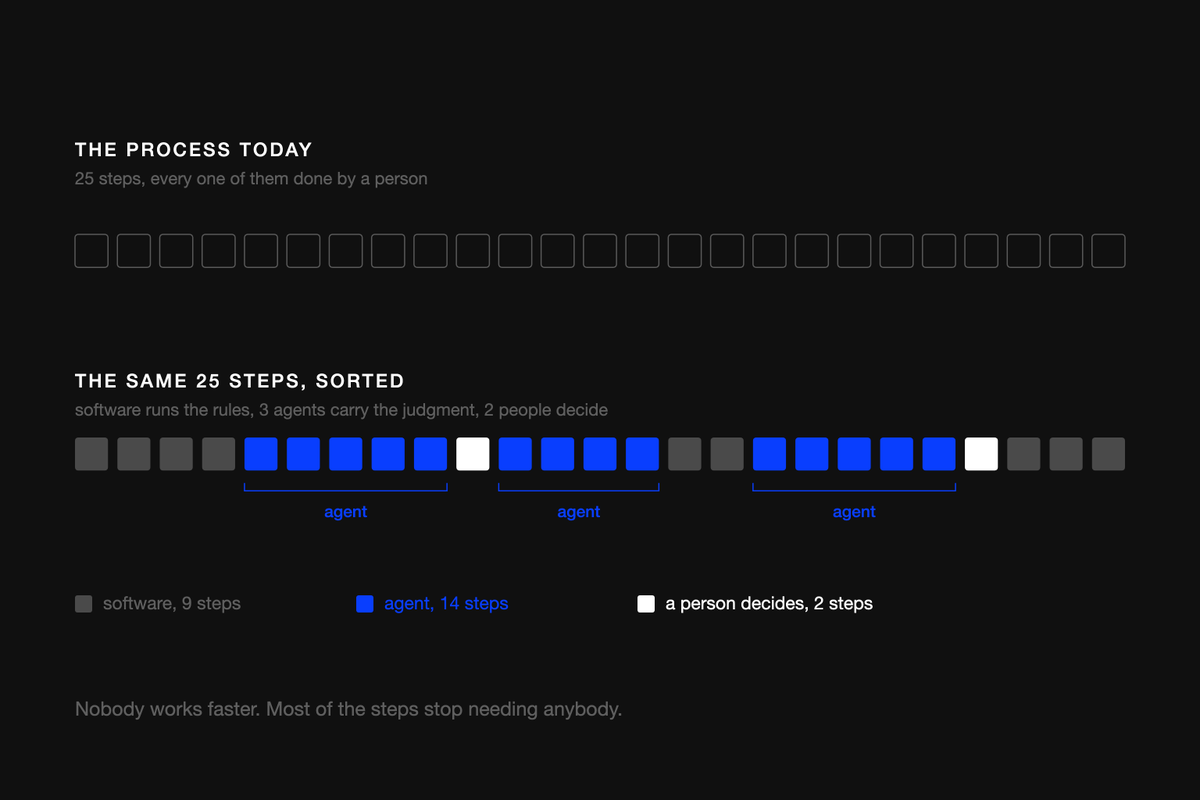
Process redesign is a sorting exercise that requires software and AI experience. Every step falls into one of 3 buckets:
Deterministic. If X then Y, with no judgment involved. For example, if the invoice is under a certain dollar amount threshold and it matches the PO & goods receipt, then you pay it. If the disclosure names a competitor, then route it to the conflicts team. These actions are best as plain, good old software. You don't need a fancy LLM call if you can do it instead with regular code, which is cheap, auditable, deterministic (never hallucinates), and fast.
Agentic. If you have thousands of past examples of humans making a judgment call with the outcome recorded, and this step is low enough risk (for example, deal desk approvals, or GL coding), you should absolutely use an LLM for judgment. Especially if the output is a yes/no, a route-to-this-team, a flag/don't flag, or a match/don't match, ship this with an agent and measure every output. On the other hand, if the output required is 5 pages of a document that a human has to read in full to verify anyways, then you're better off hybridizing the approach. Here, you need to judge the difficulty of the action, not the difficulty of the thinking.
Human-in-the-Loop. For steps that are too risky, or don't have enough historical context, you're better off keeping the human in the loop, because the cost of an agent getting an action wrong is far too high. Instead, put every relevant piece of evidence in front of that human at the moment they decide. For example, an agent will detect a mismatch between an invoice and a purchase order, and then present the human with 3 options: approve anyways, reject plainly, or provide feedback and route to someone else. The agent just saved your human 40 minutes of hunting through emails, invoice records, and more, so that instead, they can make a decision in 30 seconds. But the final action is still gated by that human.
Once you've sorted every step into one of the 3 buckets above, you can turn something like a 25 step process into a cluster of 3 agents, with deterministic steps before and after, and finally 2 points of human-in-the-loop action to unblock. This process re-engineering work, in conjunction with the agents themselves, is where all of the ROI lives.
After this, you baseline KPIs before building anything. Your goal is to calculate the numbers behind the process you're solving for, including where and how those numbers are measured today. If you can't do that, this project is destined to fail. You need to be able to look back 12 months from now and say: we used to be at X, and now we are at 3X, or 10X, or 100X, thanks to the agents that we built. Only then can you say this project was truly a success.
Finally, you prioritize and sequence your build. First, tackle the workflow with the most handoffs, as this is likely the lowest hanging fruit where you can see the clearest results. The key distinction is that this is not necessarily the same workflow with the most volume.
## What does this look like in practice?
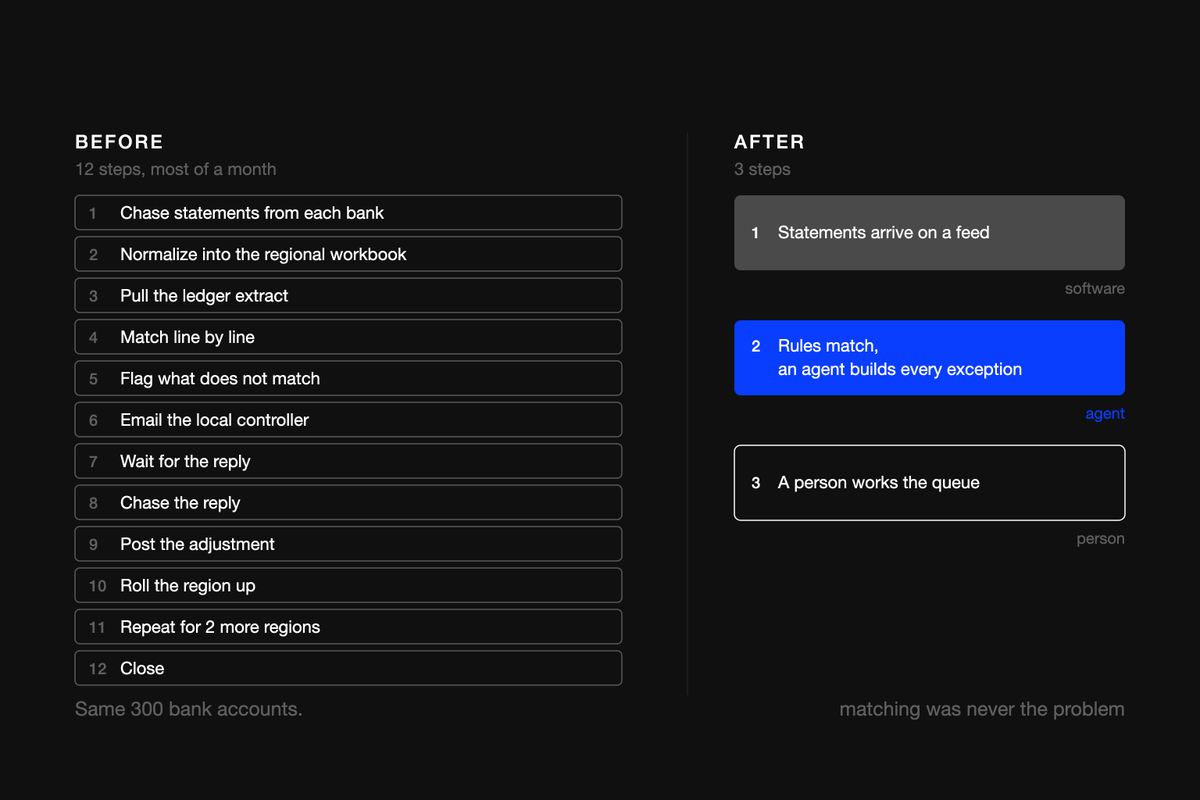
We re-engineered a global business reconciling 300+ bank accounts every month. 2/3 of them were handled by an offshore team, and the rest split across 2 other regions in 3 different formats, but entirely in Excel. There were 12,000+ open reconciliation items, and 4 days at the start of every month were spent obtaining statements. Their reconciliation process took almost the entire month, every month.
Their workflow before we re-engineered was as follows (and before you make fun of them, recognize you definitely have processes like this, if not worse, at your own company):
1. Chase and collect statements from each bank, in whatever format they provide
2. Normalize them into the regional workbook
3. Pull the ledger extract
4. Match line by line
5. Flag what doesn't match
6. Email a local controller for context on the flagged items
7. Wait for their reply
8. Chase the reply if unanswered
9. Finally get the reply, then post the adjustment
10. Roll the region into the consolidated file
11. Do that entire 1-10 step process again for each of the 2 other regions, each in its own format.
12. Close.
If you make each of those steps faster, the matching gets faster. The issue is, matching was never the problem. The 4 days of waiting for statements, and the email to the controller in another timezone, and the reply still taking 3 days, are. By making matching faster, you would shave hours off a process that is measured in weeks.
We instead redesigned their process to be 3 steps.
1. Statements arrive on a feed, conveyor belt style, instead of being chased. This has absolutely nothing to do with AI.
2. Everything that can be matched based on rules will be matched automatically, and if not, an agent will assemble the case end-to-end: with the item itself, historical categorizations, evidence gathered from various systems of record, and a proposed next step.
3. Finally, a human works through their queue of exceptions, with the evidence prepared for their review, instead of them having to manually sift through data scattered across ERPs and spreadsheets.
Chasing, emailing, waiting, re-keying, and regional roll-ups were eliminated entirely. This is the difference between an agent system that saves minutes and hours, and an agent system that saves weeks.
# Part 3: Why isn't this more common?
You were lied to
The AI pitch you received was misleading from the start. AI adopted as a point solution is not something that you derive value from. You cannot do this from just IT, and you cannot do this from an 'innovation function' with a $1M budget and 0 authority. Redesigning a process that spans 4 departments requires somebody who can tell all 4 departments that the process is changing. There are only a handful of people in a company that can really do this; it has to come from the top.
But another degree of complexity: the people actually doing the work today, e.g. the head of accounts payable, and the operators and analysts across finance, also need to be included. They have to want the new AI system, because they have to adopt it and push it tomorrow. They have to want to divulge information that they think can potentially replace them, even if that is not the case a majority of the time.
And most importantly, adopting AI is seen as risky. The status quo is 'safe' for most people, who get no promotion if AI works, yet get fired if it doesn't, even if sticking to the status quo means letting the company die a slow death over time.
## Re-engineering is quite hard
Hammer and Champy's own estimate in 1993 was that as many as 50% to 70% of the organizations that attempted process re-engineering did not achieve the results they intended. (Clearly not much has changed since the 90s). Hammer himself said later that he had been "insufficiently appreciative of the human dimension." What he meant was that 'removing a handoff', at that time, meant firing the person responsible for that handoff (that was their entire job), and then asking everyone else to change their work, while the 'software' of the time didn't support such a change. Which means that after the consultants came and went, the org structure and process quickly went back to its original state: one riddled with inefficiencies and errors.
Today, however, two things are fundamentally different. First, AI-native tooling offers an unprecedented fluid software state: one that can adapt to the changes around it. An agent sitting in your system of record can run handoffs that used to rely on people, simultaneously handling discrepancies around it from deterministic software, and is also immune to variance common in humans. Second, the work that you are eliminating first is almost entirely coordination, that is: chasing, waiting, escalating, triaging, etc. After these process improvements, and a real AI transformation, all that remains is high-judgment, high-leverage work, which your best people should be spending all of their time doing anyways.
## A brave new world
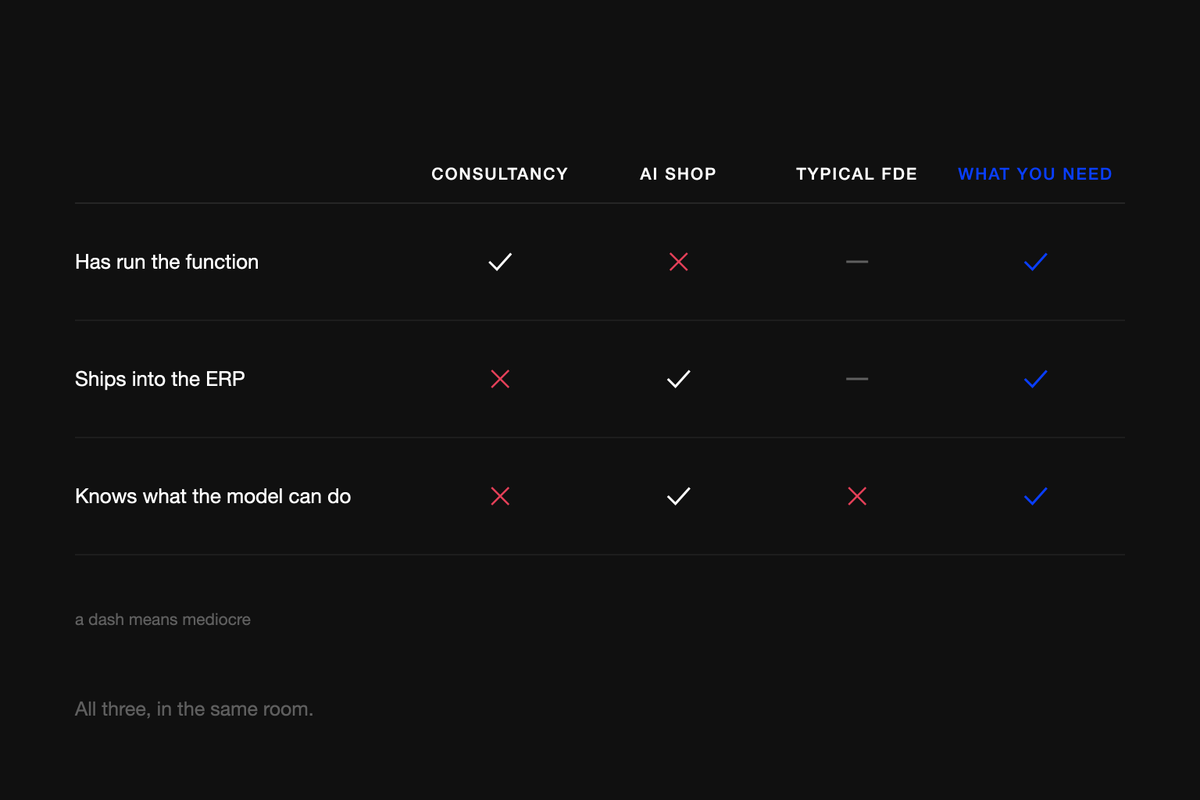
Traditional consultancies are decent at process work, I'll give them that. Indeed, if you want an elaborate illustration of a 15-step process that spans 10 countries and 3 entities, your run-of-the-mill consulting firm will produce the most beautiful slide you have ever seen, for $300,000. What this consulting firm cannot do is the latter, more important half, which is knowing what a model can and cannot be trusted with, what an agent that runs 40,000 times in a month costs, which model (Fable 5.1, vs Gemini 3.8 Flash) to use for which style of task (GL Coding vs Deal Desk Routing), how to design an eval suite optimally for a particular process, and which of the 3 buckets above (Deterministic, Agentic, HITL) a given step in a process truly belongs in. And thus, if you go this route, your redesign is created by consultants who are guessing, as opposed to experienced AI-native strategists and FDEs, and 6 months later you wonder why your pilot crash-landed.
AI labs and companies, on the flip side, have the opposite problem. They can build an agent (most of the time, at least), but they've never sat down with both finance and operations to break down a workflow where both departments disagree about ownership and who is upstream of whom, so instead they'll slap AI onto a broken process and call it automated, instead of gutting and redesigning that process like it should have been months ago. Furthermore, the biggest 'applied AI' labs like OpenAI (DeployCo) and Anthropic (Ode) will force you to marry their models for life. Betting your entire company's intelligence stack on a single provider is suicide. Tomorrow, as they rate limit, quantize, price-hike, and retire the model you're running on, you're left with the mess, and the bill. You may think it's as simple as swapping an endpoint from Claude to GLM or Gemini or DeepSeek, but it isn't. Rerunning evals and redetermining which level of thinking to use per model call is a painstaking process, and the labs will not help you do this.
What you need instead is the best of both worlds combined: people who have actually run a finance, operations, sales, or HR function, combined with the engineering talent to ship production-grade software into ERPs like Microsoft Dynamics or CRMs like Salesforce, combined with AI engineers who can build model-agnostic company-harnesses with built-in enterprise-level governance and eval-suites. Some refer to these people as 'Forward Deployed Engineers', but the truth is most FDEs today are mediocre engineers, and mediocre consultants, with absolutely no AI ability, and you end up with basically nothing being done well.
## What does this look like when you do it right?
There are 4 levers that matter when you're transforming a company with AI: cost (ideally reduced), revenue (ideally increased), time (ideally faster), and risk (ideally lower). Across our deployments, roughly half of them at public companies, here are examples of what actually moved, lever by lever:
- Time. We brought the month-end close process down from 18-22 days to 7-9 days. Supply chain disruptions are now triaged in under 6 hours, as opposed to several days.
- Revenue. Deals used to sit idle for an average of 23 days; now the average is 6 days, and rep admin time dropped from 38% of the week to 14%. This time went straight back into selling.
- Cost. AP exception handling went from 600-800 invoices per month to under 50. In a marketing org, 8-12% of the media budget was recovered from pacing errors that used to surface only at month end, saving millions per quarter.
- Risk. Payroll corrections fell 90%, because the reconciliation across systems now ran before payroll instead of after. 80% of employee support queries were answered from the company's own policy documents, while edge cases still escalated to a human in HR.
In total, the value delivered across this set of deployments was over $100M. The best part is that this number was co-created with our clients; it's not just us saying it, it was measured.
## What does a real AI Transformation Company look like?
Everything described above is how we do things at Varick, and it's the only approach that has worked for the companies we've rolled AI out for. These are incredibly large enterprises, with thousands of people, dozens of systems of record, and infinite complexities, yet the playbook is the same, and it works every time.
Our pod of Strategists and Engineers come in at the department level to first map how the work actually happens, not just accept how it's documented, through a combination of process mining and interviews, calculation of elapsed time vs touch time, mapping of the exceptions, upstream effects, and downstream effects, and understanding of who owns what. Instead of months, we complete this process in just a few weeks, at which point you receive your redesigned process, the value to be captured, custom baselined KPIs, and the priority ranking order in which the agents would get built. Next, we would begin building the agents, which come equipped with enterprise-level governance, auditability, eval-suites, and monitoring out-of-the-box.
We work with companies doing over $500M in revenue, tackling their toughest workflows, across product, finance, sales, procurement, operations, HR, and more. If you want to see what this looks like against one of your own processes, [book a call](https://cal.com/team/varick-agents/discovery-call) on our website, and come prepared to talk about your least favorite workflows, and what makes them so complex. And if you found this content helpful, [subscribe to our newsletter](https://www.varickagents.com/newsletter), where we put out weekly write-ups on the latest in 'Applied' AI, and everything we've learned by doing.
## TLDR
- Most of the AI spend in the enterprise today is being applied on top of the exact same processes that were already there, which means all you are really doing is making a bad process run faster. Michael Hammer said this about IT back in 1990, and the UK government basically proved it again in 2025 with 1,000 Copilot licenses: 1.14 actions per user per day, no productivity gain that they could find, and 72% of the users were satisfied anyways.
- The time was never in the work itself, it was in the queues and the handoffs. Hammer's insurance application sat for 22 days in process, with 17 minutes of actual work in it. Even if you make the work twice as fast, you have saved 8 minutes.
- Consolidating your systems first (one ERP, one CRM, one data platform) is a well documented way to lose 2 years and 9 figures before you see a single dollar of value. What you actually need is one definition of the process and one owner, because agents can tolerate systems that disagree with each other, and deterministic integrations never could.
- Start at the department level, mine the systems of record and interview the operators, and then sort every single step into one of the 3 buckets: deterministic software, an agent, or a human in the loop with the evidence prepared for them. Done properly, a 25 step process becomes 3 agents with 2 human checkpoints.
- When we did it this way, month-end close went from 18-22 days down to 7-9, AP exceptions went from 600-800 a month down to under 50, payroll corrections fell 90%, and the total across our deployments came out to over $100M, measured together with the clients.
- None of this works unless it comes from the top, the operators actually want it, and whoever you hire has process people, software engineers, and AI engineers all in the same room, and almost nobody has all three.
## 相关链接
- [vas](https://x.com/vasuman)
- [@vasuman](https://x.com/vasuman)
- [163K](https://x.com/vasuman/status/2095999742031675738/analytics)
- [@varickagents](https://x.com/@varickagents)
- [book a call](https://cal.com/team/varick-agents/discovery-call)
- [subscribe to our newsletter](https://www.varickagents.com/newsletter)
- [Upgrade to Premium](https://x.com/i/premium_sign_up)
- [6:17 AM · Sep 5, 2026](https://x.com/vasuman/status/2095999742031675738)
- [163.4K Views](https://x.com/vasuman/status/2095999742031675738/analytics)
- [View quotes](https://x.com/vasuman/status/2095999742031675738/quotes)
---
*导出时间: 2026/9/5 16:22:46*
---
## 中文翻译
# 应用型AI行不通
**作者**: vas
**日期**: 2026-09-04T22:17:34.000Z
**来源**: [https://x.com/vasuman/status/2095999742031675738](https://x.com/vasuman/status/2095999742031675738)
---

全世界已经在AI上花了天文数字的钱。但对大多数企业来说,什么都没改变。我和全球最大公司的300多位CEO、CIO和CFO谈过。我了解到,大多数公司是把AI套用在他们的垃圾流程上,最终结果只是让垃圾生产得更快。无论是购买数千个Claude Code许可证、承诺每年5000万美元的token支出,还是通过Zoom举办AI培训,我都亲眼见证了AI的落地是多么低效。但事情本不必如此。
我们已经走过这条路,事实上不止一次,在AI落地这件事上,我们本应从历史中吸取教训。我希望读完这篇文章后,世界各地的AI负责人能停止他们陈旧而天真的AI应用方法论,转而遵循下文所述的、经过实践检验的流程。
# 第一部分:历史及其相似之处
1990年,一位名叫Michael Hammer的前MIT计算机科学教授在《哈佛商业评论》上发表了一篇文章。他此前已在那些在计算机上投入巨资却几乎没有获得投资回报的公司内部待了多年,并且是最早揭示其中原因的人之一。
> “在信息技术上的巨额投资结果令人失望,主要是因为公司倾向于用技术来将旧的经营方式机械化。他们保持现有流程原封不动,仅仅用计算机来加快其速度。”
这是真实的引文。没搞错吧?如果你把“信息技术”换成“AI”,明天就能发表这篇文章并登上Business Insider的头条。在同一篇文章中,他写道,是时候停止“给牛路铺路”了。36年过去了,猜猜我们还在干什么?
注:所谓“给牛路铺路”,指的是将现有低效流程自动化、正式化或固化,而不是按照事情应有的方式重新设计它。省得你去问Claude了,不客气。
与此同时,超过1万亿美元被投入资本支出用于建设AI(仅微软、Alphabet、亚马逊和Meta四家2025年就花了4100亿美元;数字惊人,我知道),但企业实际使用AI的花费只有370亿美元。实践中的意思是:英国商业贸易部进行了一次Microsoft 365 Copilot试点并公布了结果。3个月内部署了1000个许可证,每位用户每天平均只执行了1.14次Copilot操作。制作PowerPoint幻灯片快了7分钟(从18分钟降到11分钟),但质量得分减半。Excel分析实际上完成得更慢(质量也更差)。在节省邮件时间方面,我引用原文:“极其微小。”他们自己的结论,逐字引用:“我们没有找到可靠的证据表明时间节省带来了生产力的提升。”然而72%的用户表示他们满意或非常满意。

长话短说:人们喜欢它,但产出的东西和以前一模一样。Ethan Mollick(沃顿商学院副教授、AI研究员)说得最好:“提升个人绩效的AI使用,并不会自然而然地转化为组织绩效的提升。”本文将阐述为什么会这样,并提供我们在实践中见过的有效解决方案。
背景介绍一下:我是Vas,[@varickagents](https://x.com/@varickagents)的CEO。我们与超大型公司合作(营收在5亿至1000亿美元之间,员工人数1000至10万人),帮助他们采用AI,从总体战略,到流程再造,再到构建、部署和管理他们的智能体。本文基于我们总结出的经验:是什么把失败的AI试点(没有可衡量的投资回报)与成功的AI试点(80%以上的工作完全由智能体处理,节省时间和金钱)区分开来。
这种情况不断重演,并不是因为纯粹的愚蠢。当然有一部分是这个原因,但大部分是惯性和设计使然。今天签署AI合同的人,或许拥有工具和供应商的选择权,但他们绝对不拥有流程。这条链上没有人有权走进财务部门说,你们那14步的流程其实只需要5步。所以没有人去做。相反,你在现有的东西上“应用AI”,最后得到的就是更快的烂摊子。
AI本来就不应该被“应用”。那行不通。你可以“刷”一层油漆。太多人把AI当成一层新油漆来考虑,而油漆修不好底下的东西。从来没有人说过“应用云”或“应用数字化”。不,人们说的是数字化转型、云现代化,因为所有人都明白那些是变革,而技术只是其中的一部分。AI也是如此。
回到Hammer:他最有力的数字来自他研究过的一家保险公司。一份申请在业务中流转需要22天。在这22天里,所有人实际处理它的时间总共是17分钟。假设今天你的AI负责人把世界上最好的模型套用到这个流程上,让每个单独步骤都快了一倍。他现在省下了8分半钟。他把这算作50%的时间节省,拿到晋升和奖金,功成身退。实际上是8分钟。

节省并不在于处理申请上,而在于排队和交接,在于等待其他团队的时间,在于第二轮审核。把精力花在加快那17分钟上,比什么都不做还糟;你只是花掉了预算,还向董事会证明了“AI没用”。你可能觉得这是90年代的遗留物,但它不是。我们与一家经历过完全相同问题的公司合作过,数据来自他们自己的系统日志。开一个新客户案件需要25分钟的实际工作。而从案件录入到生效的经过时间,从2天到2周不等。工作可以是几分钟的事,而流程却可能是几周的事。
当我说大多数AI项目是在让烂摊子变快时,我是字面意思。流程是烂的。AI让它变得更快。对此我听过这样的说法:“我们是一家巨头公司,显然我们做对了什么,不需要改变。”适者生存今天依然适用,甚至比以往任何时候都更适用,而这正是AI与数字化和云不同的地方。用得好的话,AI能赋予竞争对手一种那些技术从未有过的优势。无论是用更低的成本压价、无需增加处理人员即可无限扩展,还是在你还没整理出线索名单之前就触达全世界,他们都会把你碾碎。最好的情况是你继续增长,但现在你的人头成本呈指数级扩张。3个分析师变成6个,但这6个现在需要一位经理,由于是2个团队,他们需要一个以前不存在的交接环节,而这个交接环节又需要一次状态会议和一名PM,等等。这就是为什么人头数曲线向上弯曲,而人均营收却没有。要么适应,要么死亡,但不要假装AI没有在发生。你的竞争对手正不遗余力地弄明白这一切。

# 第二部分:今天该怎么做
你的数据一团糟,你的系统互不相通,所以也许你的第一反应是先解决这些再谈别的。你只需要一套ERP、一套CRM、一个数据平台,然后在其上加上AI。这听起来很美好,但IT专家明白事情从来不会这么简单。看看这在金钱和时间上的实际代价吧。
TSB在一次核心银行系统迁移上花了3.18亿英镑,又承担了约2亿英镑的事故成本,2022年12月被FCA和PRA罚款4865万英镑,并导致520万客户的银行服务中断。Zimmer Biomet,一家80亿美元的制造商,在2025年9月对德勤提起1.72亿美元的索赔,因为一次失败的“迁移与整合”让他们无法执行基本功能,比如发货、给客户开票、或生成可用的销售报表。而这还只是登上新闻的两个例子;这类事件比你想的要常见得多。
你应该专注于统一的是流程。假设你在过去20年里收购了9家公司,这意味着你现在有同一个流程,在9家子公司里以9种不同方式运行。如果你想在全公司“应用”AI,你就得以9种不同方式构建同一个智能体,然后被迫永远维护这9套智能体。要避免这种炼狱,你需要先定义一个全球统一的流程,并在整个实体范围内推行,然后才能考虑在其上应用AI。
反过来说,你并不“需要”一套ERP。确定性集成过去只要在2个系统对供应商记录是什么看法不一致时就会崩溃。然而,智能体可以容忍这种不一致,所以一个架在你现有系统之上的编排层,正是解决系统割裂的方案。你的系统不仅需要彼此对话,它们需要“幸福地结合”,容忍彼此的缺陷。
## 开始梳理
要重新设计你的业务,你需要先理解它。达到这种理解程度,不能靠挑一个单独的工作流,花8周时间打磨某个东西,结果发现它被上游的姊妹流程卡住,最后净投资回报为零。
但与此同时,你也不能一次性吞下整个业务,你总得从某个地方开始。从部门层面开始。这不会完美——财务在收入确认取决于销售方式时每次都要接触销售。HR在每次新员工入职时都要接触IT和运营。但至少这样,你能识别出输入到同一部门的“工作流束”(例如,财务包含应付、应收、财务规划与分析、计费、银行、对账等),然后你可以开始梳理以下7个细节:
1. “正常路径”:这个工作流负责什么,最理想情况下会发生什么。对大多数公司来说,这几乎是唯一被事无巨细记录在案的内容。
2. 例外情况。这是你大部分时间花掉的地方。不要只是描述发生了什么,要进去计算有多少比例的业务量偏离了正常路径、流向哪里、谁被拉进来处理、这些例外的处理周期是多长、以及出错的代价是什么。
3. 这个工作流的上游和下游是什么?这个流程与它们如何交互,当各自出现延误或出错时?
4. 涉及哪些记录系统?当其中2个不一致时,以哪个为准?
5. 按地区、按实体、按子公司、按收购来源,这些有何不同?
6. 触碰时间与经过时间各是多少?差距在每一步如何变化?
7. 该职能中每个人的AI能力如何?他们在未来AI系统中应拥有多大程度的所有权?(这个计算是主观的,差异很大。)
提取上述信息需要两个程序:
- 对记录系统进行流程挖掘,采集操作、时间戳、吞吐量、编辑记录,以及与文档不符的实际情况。
- 访谈,因为上面这些会给你数据,但与一线操作人员的对话会精确告诉你痛点在哪里。你组织的真实情况存在于10-20个人的头脑中,他们多年来一直在为你的公司做这些具体工作,归根结底,你的AI需要被这些人采纳才能有效运作。
只做其中一步会让你得到不完整的图景,这也是AI调研失败的最大原因。我见过应用AI公司试图用“AI访谈”走捷径,或者派工程师去做访谈。这行不通。这项工作的一半是与一线操作人员建立牢固的关系,并知道该问他们什么问题,这样你才能带着对“该建什么、如何部署”的清晰理解离开。
## 好用的智能体不只是LLM调用
流程重构是一项分类工作,需要软件和AI经验。每一步都归入以下3类之一:
确定性类。如果X则Y,无需判断。例如,如果发票低于某个金额阈值且与采购订单和收货单匹配,那就付款。如果披露文件中提到了竞争对手,就转给利益冲突团队。这类操作最好用朴素的老式软件完成。如果能用普通代码做到,就不需要花哨的LLM调用——普通代码便宜、可审计、确定性强(从不幻觉)、且快。
智能体类。如果你有数千个人类做判断且结果被记录的历史案例,并且这一步风险足够低(例如,交易台审批,或总账科目编码),那你绝对应该用LLM来做判断。尤其当输出是“是/否”、“转给某团队”、标记/不标记、匹配/不匹配时,用智能体发布并对每个输出进行度量。另一方面,如果所需的输出是一份人类无论如何都要通读验证的5页文档,那最好采用混合方案。这里,你需要评估的是行动的难度,而不是思考的难度。
人机协同类。对于风险太高、或历史数据不足的步骤,最好保留人在回路中,因为智能体做错一个动作的代价太高。相反,在人类决策的那一刻,把所有相关证据摆在他们面前。例如,智能体检测到发票与采购订单不匹配,然后向人类呈现3个选项:照批、直接拒绝、或提供反馈并转给他人。智能体刚为你的人类节省了40分钟翻查邮件、发票记录等的时间,人类只需在30秒内做出决定。但最终动作仍由该人类把关。
一旦你把每一步归入上述3类之一,你就能把一个25步的流程变成3个智能体的集群,前后各有确定性步骤,最后有2个人机协同节点来解除阻塞。这种流程再造工作,与智能体本身相结合,才是所有投资回报所在。

在此之后,你要在构建任何东西之前先建立KPI基线。你的目标是计算出你要解决的流程背后的数字,包括这些数字今天在哪里、如何被度量。如果你做不到,这个项目注定失败。你需要能在12个月后回头看并说:我们以前是X,现在 благодаря 我们构建的智能体,我们是3倍、10倍或100倍。只有这样,你才能说这个项目真正成功了。
最后,你要对构建工作进行优先级排序和先后安排。首先处理交接最多的工作流,因为这很可能是最低垂的果实,你能看到最清晰的结果。关键区别在于,这不一定等于业务量最大的那个工作流。
## 实践中是什么样子?
我们重新设计了一个每月对300多个银行账户进行对账的全球业务。其中2/3由一个离岸团队处理,其余的分布在另外2个地区,采用3种不同格式,但完全在Excel中完成。有12000多个未结对账项目,每个月初有4天时间用于获取对账单。他们的对账流程每月要花掉几乎整月的时间。
我们重构之前,他们的工作流程如下(在你嘲笑他们之前,先承认你自己的公司肯定有类似甚至更糟的流程):
1. 向每家银行催收对账单,格式随他们提供什么
2. 将其规范化到地区工作簿中
3. 拉取总账导出
4. 逐行匹配
5. 标记不匹配的
6. 给当地财务主管发邮件询问被标记项目的背景
7. 等待回复
8. 如果没回,继续催
9. 终于拿到回复,然后入账调整
10. 把该地区汇总进合并文件
11. 对另外2个地区重复1-10的全部流程,各有各的格式。
12. 结账。
如果你让每个步骤都变快,匹配就变快了。问题是,匹配从来都不是问题。那4天等待对账单的时间,以及发给另一时区财务主管的邮件,以及仍然需要3天才能等到的回复,才是问题。让匹配变快,只能从以周计算的流程中省下几个小时。
我们则把他们的流程重新设计为3步。
1. 对账单通过数据推送自动到达,传送带式,而不是靠催收。这与AI毫无关系。
2. 所有能基于规则匹配的都自动匹配;如果不匹配,智能体会端到端地组装案件:包括项目本身、历史分类、从各个记录系统收集的证据,以及建议的下一步。
3. 最后,人类处理他们的例外队列,证据已为其审阅准备好,而不用他们手动翻查散落在ERP和电子表格中的数据。
催收、发邮件、等待、重复录入、地区汇总被完全消除。这就是省几分钟几小时的智能体系统,与省几周的智能体系统之间的区别。

# 第三部分:为什么这种情况不更普遍?
你被骗了
你听到的AI推销从一开始就有误导性。作为单点解决方案落地的AI并不能给你带来价值。你不能仅靠IT部门做这件事,也不能靠一个预算100万、权力为零的“创新职能”做这件事。重新设计一个横跨4个部门的流程,需要有人能告诉这4个部门:流程要变了。公司里只有少数几个人真正能做到这一点;它必须来自最高层。
但还有另一层复杂性:今天实际做这些工作的人,例如应付账款负责人,以及财务部门的一线操作人员和分析师,也必须被纳入进来。他们必须想要新的AI系统,因为明天必须由他们来采纳和推动它。他们必须愿意透露那些他们认为可能取代自己的信息,即使大多数情况下并非如此。
最重要的是,采用AI被视为有风险。对大多数人来说,现状是“安全的”:AI成功了他们不会得到晋升,失败了却会被解雇,即使坚持现状意味着让公司慢慢死去。
## 流程再造相当困难
Hammer和Champy自己在1993年估计,多达50%到70%尝试流程再造的组织没有达到预期效果。(显然90年代以来没太大变化。)Hammer本人后来说,他对“人的维度”的重视“不够充分”。他的意思是,当时“消除一个交接环节”意味着解雇负责该交接的人(那是他们的全部工作),然后要求其他所有人改变他们的工作方式,而当时的“软件”并不支持这种改变。这意味着顾问们来去匆匆之后,组织结构和流程很快回到了原状:一个充斥着低效和错误的状态。
然而今天,有两件事发生了根本性变化。第一,AI原生工具提供了一种前所未有的流动软件状态:一种可以适应周围变化的软件。一个坐在你记录系统中的智能体可以运行过去依赖人来完成的交接,同时处理周围来自确定性软件的差异,而且对人类常见的变异性免疫。第二,你最先消除的工作几乎完全是协调性的,即:催促、等待、上报、分诊等。在这些流程改进和真正的AI转型之后,剩下的全是高判断、高杠杆的工作,而这本就是你最优秀的人才应该把全部时间用于做的事情。
## 一个美丽新世界
传统咨询公司在流程工作上是不错的,这点我承认。确实,如果你想要一幅横跨10个国家3个实体的15步流程的精美图解,普通咨询公司会以30万美元的价格为你制作出你见过的最漂亮的幻灯片。但这家咨询公司做不到的是后一半、也是更重要的一半:知道一个模型在什么情况下值得信任、一个月运行4万次的智能体成本是多少、哪种风格的任务(总账编码vs交易台路由)该用哪个模型(Fable 5.1 vs Gemini 3.8 Flash)、如何为特定流程设计最优的评估套件,以及流程中某个特定步骤真正属于上面3类(确定性、智能体、人机协同)中的哪一类。因此,如果你走这条路,你的重新设计是由猜测的咨询顾问完成的,而不是经验丰富的AI原生策略师和前置部署工程师,6个月后你就会纳闷你的试点为何坠毁。
而AI实验室和AI公司则有相反的问题。他们能构建智能体(至少大多数时候可以),但他们从未和财务与运营坐在一起,拆解一个两个部门就所有权和谁是上游争论不休的工作流,所以他们只会把AI拍在一个坏掉的流程上并称之为自动化,而不是像几个月前就该做的那样彻底重构这个流程。此外,最大的“应用AI”实验室如OpenAI(DeployCo)和Anthropic(Ode)会强迫你终身绑定他们的模型。把整个公司的智能技术栈押注在单一供应商上是自杀。明天,当他们限流、量化、涨价、并停用你正在运行的模型时,留下的烂摊子和账单都是你的。你可能觉得把端点从Claude换成GLM、Gemini或DeepSeek很简单,但并不是。重新运行评估并确定每次模型调用使用哪个思考级别是一个 painstaking 的过程,实验室不会帮你做这件事。
你真正需要的是两全其美:真正运营过财务、运营、销售或HR职能的人,加上能把生产级软件交付到Microsoft Dynamics等ERP或Salesforce等CRM的工程人才,再加上能构建模型无关的公司级底座、内置企业级治理和评估套件的AI工程师。有人称这些人为“前置部署工程师”,但事实是今天大多数FDE是平庸的工程师、平庸的顾问,完全没有AI能力,最后你基本上什么都没做好。

## 做对了是什么样子?
用AI转型一家公司时,有4个杠杆最重要:成本(理想是降低)、收入(理想是增加)、时间(理想是更快)、风险(理想是更低)。在我们所有的部署中(大约一半是上市公司),以下是每个杠杆上实际发生变化的例子:
- 时间。我们把月结流程从18-22天降到7-9天。供应链中断现在在6小时内完成分诊,而不是好几天。
- 收入。交易过去平均闲置23天;现在平均6天,销售代表的行政时间从每周的38%降到14%。这些时间直接回到了销售上。
- 成本。应付账款异常处理从每月600-800张发票降到不到50张。在一个营销组织中,从过去只在月末才暴露的投放节奏错误中找回了8-12%的媒体预算,每季度节省数百万。
- 风险。工资修正下降了90%,因为跨系统对账现在在发薪前运行而不是发薪后。80%的员工支持问题由公司自己的政策文件回答,而边缘案例仍上报给HR的人类处理。
总计,这批部署交付的价值超过1亿美元。最妙的是,这个数字是与客户共同确定的;不只是我们说说而已,它是被测量出来的。
## 一个真正的AI转型公司是什么样子?
以上描述的一切就是我们在Varick做事的方式,也是对我们推广过AI的公司唯一有效的方法。这些是极其庞大的企业,有数千名员工、数十个记录系统、无穷的复杂性,但打法是一样的,而且每次都奏效。
我们的策略师和工程师团队从部门层面入手,通过流程挖掘和访谈相结合、经过时间与触碰时间的计算、例外情况、上游影响和下游影响的梳理、以及对谁拥有什么的理解,首先绘制工作实际是如何发生的,而不只是接受文档上写的方式。我们不用几个月,只需几周完成这一过程,届时你会收到重新设计的流程、可捕获的价值、定制的基线KPI,以及智能体的构建优先级排序。接下来,我们开始构建智能体,它们开箱即带企业级治理、可审计性、评估套件和监控。
我们与营收超过5亿美元的公司合作,处理他们在产品、财务、销售、采购、运营、HR等领域最棘手的工作流。如果你想看看这对你自己的某个流程是什么样子,可以在我们的网站上[预约一次通话](https://cal.com/team/varick-agents/discovery-call),并准备好聊聊你最不喜欢的工作流,以及它们为什么如此复杂。如果你觉得这些内容有帮助,请[订阅我们的通讯](https://www.varickagents.com/newsletter),我们每周发布关于“应用型”AI最新动态的文章,以及我们在实践中所学到的一切。
## TLDR(太长不看版)
- 今天企业的大部分AI支出被叠加在原本就存在的完全相同的流程之上,这意味着你实际做的只是让一个坏流程跑得更快。Michael Hammer早在1990年就针对IT说过这一点,英国政府在2025年用1000个Copilot许可证基本再次证明了它:每位用户每天1.14次操作,找不到任何生产力提升,但72%的用户依然满意。
- 时间从来不在工作本身,而在排队和交接上。Hammer那份保险申请在流程中停留了22天,实际工作只有17分钟。即使你让工作快一倍,你也只省了8分钟。
- 先整合系统(一套ERP、一套CRM、一个数据平台)是一种有据可查的、在见到一分钱价值之前先赔上2年和九位数资金的方式。你真正需要的是流程的一个定义和一个所有者,因为智能体能容忍相互不一致的系统,而确定性集成从来不能。
- 从部门层面开始,挖掘记录系统并访谈一线操作人员,然后把每一个步骤归入3类之一:确定性软件、智能体、或证据准备到位的人机协同。做得好,一个25步流程就变成3个智能体加2个人工检查点。
- 当我们这样做时,月结从18-22天降到7-9天,应付账款异常从每月600-800降到不足50,工资修正下降90%,我们所有部署的总价值超过1亿美元,与客户共同测量。
- 除非这一切来自最高层、一线操作人员真心想要它、并且你雇的人把流程专家、软件工程师和AI工程师聚在同一间屋里,否则这些都行不通——而几乎没有人三者兼备。
## 相关链接
- [vas](https://x.com/vasuman)
- [@vasuman](https://x.com/vasuman)
- [163K](https://x.com/vasuman/status/2095999742031675738/analytics)
- [@varickagents](https://x.com/@varickagents)
- [book a call](https://cal.com/team/varick-agents/discovery-call)
- [subscribe to our newsletter](https://www.varickagents.com/newsletter)
- [Upgrade to Premium](https://x.com/i/premium_sign_up)
- [6:17 AM · Sep 5, 2026](https://x.com/vasuman/status/2095999742031675738)
- [163.4K Views](https://x.com/vasuman/status/2095999742031675738/analytics)
- [View quotes](https://x.com/vasuman/status/2095999742031675738/quotes)
---
*导出时间: 2026/9/5 16:22:46*