# A Confiscated 1939 Scent Machine, A Forgotten 1962 Patent, An AI Nose That Put Smell On The Internet
**作者**: Brian Roemmele
**日期**: 2026-10-24T18:28:00.000Z
**来源**: [https://x.com/BrianRoemmele/status/2114061362741805551](https://x.com/BrianRoemmele/status/2114061362741805551)
---
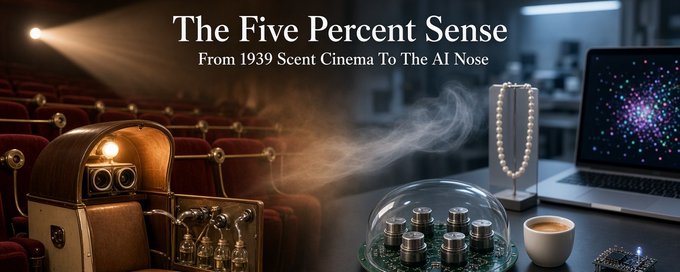
The AI SCENTRONIC: How A Confiscated 1939 Scent Machine, A Forgotten 1962 Patent, And The AI Nose That Just Put Smell On The Internet!
The new AI frontier has a smell. It is a new technology that has roots back to 69 years. The process is simple: internet carries the name of the smell, and the receiver replays a smell it already holds. The scent molecules themselves are not transmitted over the internet. In simple terms, it connects 'smelling something here' with 'recreating the corresponding smell somewhere else’.
## Let’s Build An Electronic Nose: The AI SCENTRONIC
Let’s build a garage electronic-nose with a parts list and prices, the Scent Library SuperPrompt, an opportunity map, and a warning about the copycat coins, all here.
Safety first. The build in this article uses gas sensors with heaters inside them that run hot, and a receiver that turns scented liquid into a fine mist. Fragrance oils can trigger allergies, asthma and headaches. Work in a ventilated room, keep alcohol and other flammable liquids away from powered sensors, keep children and pets away from the bench, and never drink, eat or inhale anything from these experiments on purpose. None of the hardware here is a safety device, and a hobby carbon monoxide sensor is no replacement for a certified alarm.
## The History
On December 2, 1939, in Bern, Switzerland, an advertising man from Zürich named Hans Laube showed the press a motion picture that could smell.
His company was called Odorated Talking Pictures. His English-language film, My Dream, carried twenty scents released in time with the scenes, and its title referred to a ladies' perfume. On October 19, 1940, it played at the Swiss Pavilion of the New York World's Fair. Then the equipment was confiscated over a claimed patent infringement. By one historian's account, Laube never got his machine back.
Imagine being the man who taught a movie to breathe, and then watching it carried out the door.
Eighty-seven years later, the sniffing half of that dream fits in your hand and costs less than a dinner out. Here is the road from Bern to this week, and how to build the sniffing half yourself.
THE MAN WHO TAUGHT A MOVIE TO BREATHE
Laube had partners: financier Robert Barth and producer Conrad A. Schlaepfer. According to Charles Spence's history of scent in the cinema, Laube originally suggested no more than ten scents, warning that more would be "too much for the public's nose." He kept at it for decades. His later U.S. patents, both titled "Motion pictures with synchronized odor emission," were granted in 1957 (U.S. 2,813,452, with Bert Good) and 1959 (U.S. 2,905,049).
THE FIVE PERCENT ESSAY
In 1955 a cinematographer named Morton Heilig published an essay in the Mexican architecture journal Espacios. MIT Press reprinted it in English in 1992 as "The Cinema of the Future."
Heilig wrote: "It is estimated that each sense monopolizes man's attention in the following proportions." Then he listed them. Sight 70 percent. Hearing 20 percent. Smell 5 percent. Touch 4 percent. Taste 1 percent.
He gave no source for that estimate, so treat it as an artist's working rule. On his list, smell outranks touch.
He also predicted the problem that would haunt every scent machine for seventy years: "Odors will be reduced to basic qualities the way color is into primary colors." Color has red, green and blue. Sound has samples. Smell never yielded a short list of primaries, and that missing pixel is the reason scent has always been the hardest sense to wire.
And he wrote the line that sells the whole dream: "Open your eyes, listen, smell, and feel—sense the world in all its magnificent colors, depth, sounds, odors, and textures—this is the cinema of the future!"
I have written here before about Muzak and the engineering of the senses. Heilig belongs in that story.
THE SENSORAMA PATENT
Heilig did not stop at the essay. He filed a patent on January 10, 1961, and on August 28, 1962, he received U.S. Patent 3,050,870 for the "Sensorama Simulator."
You sat at a hooded cabinet and watched stereo film with peripheral vision. Binaural sound filled your ears. A breeze touched your face and the seat vibrated. Small vessels held odors, and when a signal on the film track fired, an electromagnet lifted a wick into a duct so a blower could carry the scent to your nose.
The patent names his rivals, "Walter Read's Aromarama and Mike Todd, Jr.'s Scent-O-Vision," and explains why a personal hood beats a whole theatre: "Scents can be given and removed with greater precision since only the air near the viewers nose is involved."
Heilig framed the machine for teaching and training, at a cost of "only a few thousand dollars." It was virtual reality with smell, patented in 1962.
HISSING IN THE BALCONY
Hollywood tried the big-room version. Charles Weiss's AromaRama opened in New York in December 1959, sending 31 odors through the air conditioning. Time magazine reported that "the audience distinctly smells grass in the middle of the Gobi desert."
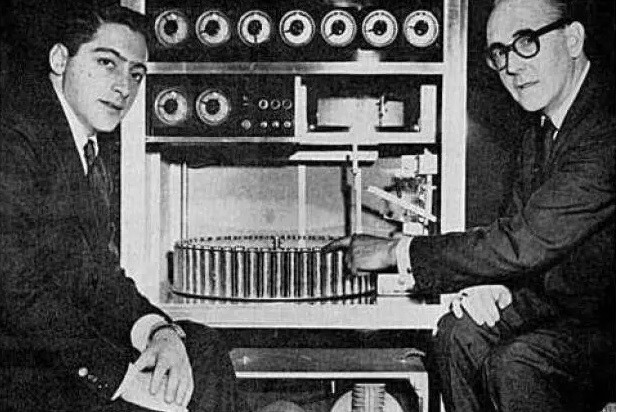
On January 12, 1960, Mike Todd Jr. answered with Smell-O-Vision and the film Scent of Mystery. Scents went to each seat through tubes from a central machine, triggered by a signal on the soundtrack, in a handful of converted theatres in New York, Chicago and Los Angeles. Spence counts 30 scents. Audiences reported hissing, delays and nausea. Bosley Crowther of the New York Times concluded that "motion pictures and synthetic smells do not mix." The film was later renamed Holiday in Spain.
The idea went quiet for forty years. A dot-com company called DigiScents tried again around 2000 with a scent box for computers. Spence reports that it folded in 2001 when no hardware makers signed on.
THE BARBER OF TIN
In the early 1960s, gas explosion accidents rose sharply in Japan. Naoyoshi Taguchi searched for years and found that tin dioxide changes its electrical resistance when certain gases touch it. In 1968 he and his high school classmates began mass-producing the Taguchi Gas Sensor. The first product, the TGS109, went into home gas detectors in Japan and other countries. In 1969 the company took the name Figaro Engineering, after the opera The Barber of Seville, because Taguchi was, in the company's words, "an avid fan of opera."
The same year, 1962, that Heilig won the Sensorama patent, Tetsuro Seiyama and colleagues published "A New Detector for Gaseous Components Using Semiconductive Thin Films" in Analytical Chemistry. The heated metal oxide gas sensor was arriving from two directions at once.
The physics in plain English: a heater warms a tin dioxide film. When gases such as alcohol or cooking fuel land on it, its resistance drops and the voltage across a series resistor rises. Each sensor type reacts a little differently to each smell.
A NOSE WITH NO VOICE
In 1982 Krishna Persaud and George Dodd of the Warwick Olfaction Research Group published a letter in Nature titled "Analysis of discrimination mechanisms in the mammalian olfactory system using a model nose." In their words: "we have constructed an electronic nose using semiconductor transducers." It "can reproducibly discriminate between a wide variety of odours." Their reference list cites the Figaro gas sensor data sheet.
That paper is widely credited as the start of the electronic nose. For four decades, electronic noses could sniff and judge. They had no way to hand the smell to another human being.
It was a nose with no voice.
OCTOBER 22, 2026: SCENTRONIC
On October 22, 2026, Science Advances published "Scentronic," from a team led by Jinghua Li at Ohio State University, with collaborators at Zhejiang Laboratory. The first authors are Chunyu Yang, Qi Wang and Chen Wang. The paper declares no competing interests, and Reuters reports the work was developed with no company involvement.
Here is how it works.
1. A ring of six tin dioxide gas sensors (models MQ-2, MQ-3, MQ-5, MQ-6, MQ-7 and MQ-135) sits under a cap with the food sample. All six heaters run at 5 volts.
2. The sensors respond for 200 seconds. The team taught the system with 250 sniffs, 50 each of beer, cake, coffee, orange and red wine, one brand of each.
3. A classic machine learning method called k-nearest neighbors, which simply asks "which known smells does this reading sit closest to," picks a category.
4. The category, a label, travels over Wi-Fi through a Google Cloud relay in about 65 milliseconds on average.
5. On the receiving side, a wristband, necklace or handheld device holds small wells of pre-loaded scented liquid. A piezo plate vibrating at 110 kHz turns the matching liquid into mist.
So the internet carries the name of the smell, and the receiver replays a smell it already holds. Reuters put it plainly: "The scent molecules themselves are not transmitted over the internet." Lead author Chunyu Yang, an Ohio State doctoral student, described it this way: "In simple terms, it connects 'smelling something here' with 'recreating the corresponding smell somewhere else.'"
Laube and Heilig cued stored scents from film tracks. The new part: a machine does the sniffing, and the cue crosses the planet in a blink.
The team also built a cup with five odor and five taste channels, plus a Meta Quest 3 mixed-reality demo where beer and coffee arrive with their aromas.
THE NUMBERS, ANNOTATED
Measure ..... Result ..... What it means
Smells tested ..... 5 ..... Beer, cake, coffee, orange, red wine
Training data ..... 250 sniffs, 50 per food ..... One brand of each food
k-NN on final readings ..... 98.5% cross-validation, 100% test ..... Machine sorting five categories
k-NN on full time series ..... 99% cross-validation, 98% test ..... Similar result, much bigger input
Network relay ..... 57 to 76 ms, about 65 ms average ..... Google Cloud in the middle
Whole system response ..... about 0.6 s ..... Sniff to mist on the far side
Atomizer peak output ..... about 0.9 mL per minute ..... At 110 kHz
Battery ..... 400 mAh ..... About 5.2 h on one channel, about 1.0 h on five
Humans naming the smell ..... 72.86%, 14 volunteers ..... After pretraining
Humans naming two-smell mixtures ..... 71.43% ..... Five pairs tested
THE HONEST LIMITS
The researchers are refreshingly candid.
1. Five smells. Yang told Reuters: "We have not yet expanded beyond those categories." Adding one means training the nose on it and loading a matching liquid into the receiver.
2. Labels travel, molecules stay home. The paper says odor is classified "at the category level" and rebuilt from preloaded channels, and that the e-nose "does not yet match the odor discrimination capability of humans or animals."
3. Coffee was the weakest signal. The authors write that "coffee does contain many aromatic constituents, which may not be efficiently detected by our sensor configuration."
4. Small human tests. The authors call their experiments "relatively simple" with "limited control conditions, which may introduce bias." Volunteers were healthy university participants.
5. A prototype. "At present, this is a research prototype," Yang said, and he named the safety of repeated exposure to scented mist as a consideration for the future.
6. The sniffer is about six inches across. Only the receiver is wearable.
None of that dims my excitement. Every medium starts at the worst it will ever be.
THE SCENT STACK: BUILD A GARAGE ELECTRONIC NOSE
This plan follows the published sensor set and method as closely as a hobbyist can. I have now built the first working version! I also have the Python classifier, and it ran on simulated numbers, with no sensors attached.
SAFETY BEFORE SOLDER
1. The heaters get hot. Pololu lists each MQ heater at under 150 mA at 5 V, and the MQ-2 data sheet allows up to 900 milliwatts, so six can draw around 1 A. Mount them away from plastic walls, never touch the mesh caps while powered, and use a separate 5 V supply rated for at least 2 A, its ground tied to the microcontroller ground.
2. Alcohol, beer, wine and fuel vapors are what these sensors detect, and some are flammable. Use small samples, never pour solvent near a powered board, and ventilate.
3. Fragrance oils can cause allergies, asthma and headaches. Dilute them, mist in short bursts, test on yourself first, and stop at any irritation. The Scentronic team used orange fragrance oil at 2.5 percent in deionized water and pre-checked that strengths were "not strong enough to cause discomfort or nausea."
4. The mist driver steps up voltage to drive the piezo disc. Keep fingers off the board while it runs.
5. No eating or drinking the samples after they sit on the bench, and keep the whole setup away from children and pets.
PARTS AND PRICES (retail pages checked October 24, 2026; prices change)
Part ..... Source ..... Price
MQ-2 sensor ..... Pololu #1480 ..... $3.95
MQ-3 sensor ..... Pololu #1634 ..... $4.49
MQ-5 sensor module ..... Waveshare ..... $5.09
MQ-6 sensor ..... Pololu #1481 ..... $7.66
MQ-7 sensor ..... Pololu #1482 ..... $6.95
MQ-135 sensor module ..... Waveshare ..... $5.89
Carrier boards for the four bare Pololu sensors ..... Pololu #1479 ..... 4 x $1.11
Beetle ESP32-C3, the board the paper used ..... DFRobot DFR0868 ..... $7.90
ADS1115 16-bit 4-channel ADC ..... Adafruit, buy 2 ..... 2 x $14.95
113 kHz 20 mm mist maker with driver board ..... ICStation on Tindie ..... $7.99
That comes to $84.26 before shipping, tax, the 5 V supply, resistors, wire and a container. A note on the converter: the paper used a 24-bit, 8-channel chip (ADS131M08) because, in the authors' words, the ESP32-C3's built-in converter has a "limited number of channels and relatively low precision." Two ADS1115 boards are the hobby substitute suggested here.
BUILD STEPS
1. Burn in. The MQ-2 and MQ-3 data sheets list a preheat time of "Over 48 hours." Power the sensors in a ventilated spot for two days before collecting data.
2. Load resistors. Each bare sensor needs a resistor in series. The data sheets call the value "adjustable." Pick one value for all six, then confirm that clean air reads low and your strongest sample stays well below the top of the range.
3. Protect the converter. Sensor outputs can swing toward 5 V, and the ADS1115 running at 3.3 V must stay below its supply. Halve each output with two equal 100 kOhm resistors so nothing above 2.5 V arrives.
4. Wire both ADS1115 boards to the ESP32-C3 over I2C, one at address 0x48 and one at 0x49. Adafruit's ADS1X15 library examples print voltages. Have the board print six comma-separated values once per second over USB.
5. Build a sniff chamber: the six sensors in a ring facing a small cup, under a glass or metal cover.
6. For each sniff, let the sensors settle in clean air, place the sample, cover it, and log 200 seconds. Then uncover and air out until readings return to their starting level.
7. Collect 50 sniffs of each of five smells, one brand each, just as the paper did. Save the final reading of each sensor in one CSV row: label, then six voltages.
8. One caution: the MQ-7 data sheet calls for a heater cycle of 60 seconds high and 90 seconds low for carbon monoxide work. The paper ran all six at a steady 5 V for smell sorting, and so does this plan. A rig run that way is no carbon monoxide detector.
THE CLASSIFIER
This short Python script (save it as scent_knn.py, run it as: python scent_knn.py sniffs.csv) uses scikit-learn. It splits your sniffs 80/20, scales the readings, runs five-fold cross-validation, trains k-nearest neighbors with k=5, and prints a confusion matrix. On made-up numbers it ran cleanly. That proves the code runs. It says nothing about how well real sensors will do.
import sys, csv, pickle
import numpy as np
from sklearn.model_selection import train_test_split, cross_val_score
from sklearn.preprocessing import MinMaxScaler
from sklearn.neighbors import KNeighborsClassifier
from sklearn.pipeline import make_pipeline
from sklearn.metrics import confusion_matrix, accuracy_score
rows = list(csv.reader(open(sys.argv[1])))[1:]
y = np.array([r[0] for r in rows])
X = np.array([[float(v) for v in r[1:7]] for r in rows])
X_tr, X_te, y_tr, y_te = train_test_split(X, y, test_size=0.2, stratify=y, random_state=1)
model = make_pipeline(MinMaxScaler(), KNeighborsClassifier(n_neighbors=5))
print("5-fold accuracy: %.1f%%" % (100 * cross_val_score(model, X_tr, y_tr, cv=5).mean()))
model.fit(X_tr, y_tr)
pred = model.predict(X_te)
print("held-out accuracy: %.1f%%" % (100 * accuracy_score(y_te, pred)))
labels = sorted(set(y.tolist()))
print(labels)
print(confusion_matrix(y_te, pred, labels=labels))
pickle.dump(model, open("scent_model.pkl", "wb"))
In the confusion matrix, rows are the true smell and columns are the guess. Anything off the diagonal is a pair your nose confuses. If coffee scatters, you have reproduced the paper's own weak spot.
THE RECEIVER
The paper built its own driver: a 110 kHz signal gated in 10 millisecond bursts, with longer "off" gaps for a gentler scent. The simplest hobby path is the off-the-shelf 113 kHz mist module, one per scent, with the ESP32-C3 switching each module's power through a logic-level MOSFET for a second or two when its label arrives. Feed the disc from a cotton wick the way the paper did. EDN's teardown of a similar module warns that the disc should touch the liquid surface and never sit submerged. Start with one scent, one module and plain water before you add any fragrance.
THE SCENT LIBRARY SUPERPROMPT
Paste this into the AI model you trust, local or cloud, and fill in the brackets. It helps you plan a scent library your sensors can actually tell apart.
-----------------------------------------------------
You are my Scent Library planner for a hobby electronic nose. The nose uses six heated tin dioxide sensors (MQ-2, MQ-3, MQ-5, MQ-6, MQ-7, MQ-135), one 200-second reading per sniff, and a k-nearest-neighbors classifier on the final reading of each sensor. A receiver replays scents from small wells of pre-loaded diluted liquid. The system sends a category label, and it can only replay what is loaded.
My goal: [describe the use, for example a game scene, a candle shop demo, or a coffee roaster's quality check]
My candidate smells: [list up to 8]
Do these steps:
1. For each candidate, say which sensors are likely to respond and how strongly, and mark every claim as general knowledge or uncertain. Never invent data sheet numbers.
2. Flag pairs likely to be confused, and suggest a smaller starter set of 3 to 5 that should separate well.
3. Write a sniff protocol: settle time, sample size, cover, 200-second log, air-out rule, and 50 sniffs per smell.
4. Write a log template: date, temperature, humidity, brand, batch, and warm-up hours.
5. Design a blind test where another person names the replayed scent.
6. List safety notes for every candidate: flammability, common allergens, and the mildest dilution to try first.
7. End with what this rig cannot do.
Rules: no medical claims, no food or drink recipes made from the receiver liquids, and ask me questions when anything is unclear.
-----------------------------------------------------
THE OPPORTUNITY MAP (NOT FINANCIAL ADVICE)
For education only. Do your own homework before you spend money.
1. Scent tracks for games and mixed reality. The paper already paired aromas with a Meta Quest 3 scene. First step: a three-scent wristband demo for one scene.
2. Smell training and testing at a distance. The authors point to remote testing for smell loss after viral illness. First step: talk with an ear, nose and throat clinic about what they would need, and learn the medical device rules before any health claim.
3. Sniff checks for small producers. Brewers and bakers compare batches by nose every day. First step: collect 50 sniffs of a good batch and an off batch and see if your rig separates them.
4. Scent previews for shops. Candle and soap makers sell smells through a screen. First step: a countertop demo that replays three best sellers on request.
5. Scent data services. Every new category needs labeled sniffs and a matched liquid. First step: publish a clean, documented sniff dataset for five household smells.
6. Teaching kits. A sensor ring and a confusion matrix make a superb science fair project. First step: a one-page lesson plan with a safety checklist.
RISKS
1. Overclaiming. Anyone who says smells now travel through the internet is skipping the key fact. A label travels, and the receiver can replay only the liquids it holds.
2. Health. Fragrance mists can trigger asthma and allergies, and the long-term safety of repeated exposure is an open question that the lead author raised himself.
3. Fire and burns. Heated sensors near alcohol vapor and plastic deserve respect.
4. Drift. Metal oxide sensors shift with temperature and humidity, as the data sheets chart. Log the weather and retrain.
5. Privacy. A nose in the home can reveal cooking, drinking, smoking and cleaning habits. Keep sniff data local unless you have a reason to share it.
6. Medical claims. Smell testing is a health use. Keep hobby builds away from diagnosis.
7. Money. The coin warning above stands.
FROM A CONFISCATED MACHINE TO A NECKLACE
Laube needed a theatre and lost his machine in a patent fight. Heilig needed a hooded cabinet and a few thousand 1962 dollars. Mike Todd Jr. needed tubes under every seat and still got hissing.
In 2026 the sniffing half runs on sensors that cost a few dollars each, a microcontroller under eight dollars, and a model small enough to train on a laptop. The replay half fits on a wrist. Heilig's primary colors of smell are still missing, and Scentronic sidesteps them with categories. That is a modest trick, and it works today.
The internet carried text, then sound, then pictures, then video. The five percent sense is next in line, and this is the worst it will ever be.
I will be watching for the first open scent library and the first independent replication. If you build the garage nose, keep your data sheets honest and tell me what your confusion matrix says.
References
1. Yang C, Wang Q, Wang C, et al., Li J. Scentronic: An artificial intelligence-assisted olfactory interface for remote odor sharing and transmission. Science Advances 12, eaee9266, 22 October 2026
https://www.science.org/doi/10.1126/sciadv.aee9266
2. Reuters via CNA. New "Scentronic" technology can detect and transmit aromas remotely, 23 October 2026
https://www.channelnewsasia.com/business/new-scentronic-technology-can-detect-and-transmit-aromas-remotely-6486011
3. Marchant J. Digital scents could add a new dimension to virtual worlds. New Scientist, 21 October 2026
https://www.newscientist.com/article/2595189-digital-scents-could-add-a-new-dimension-to-virtual-worlds/
4. Digital Trends. Scientists send smells over the internet with Scentronic, 22 October 2026
https://www.digitaltrends.com/cool-tech/scientists-send-smells-over-internet-scentronic/
5. Spence C. Scent and the Cinema. i-Perception, 2020
https://pmc.ncbi.nlm.nih.gov/articles/PMC7691926/
6. Laube H, Good BS. Motion pictures with synchronized odor emission. U.S. Patent 2,813,452, 19 November 1957
https://patents.google.com/patent/US2813452A/en
7. Laube H, et al. Motion pictures with synchronized odor emission. U.S. Patent 2,905,049, 22 September 1959
https://patents.google.com/patent/US2905049A/en
8. Heilig ML. The Cinema of the Future (1955). Reprinted in Presence: Teleoperators and Virtual Environments 1(3):279-294, 1992
https://doi.org/10.1162/pres.1992.1.3.279
9. Heilig ML. Sensorama Simulator. U.S. Patent 3,050,870, 28 August 1962
https://patents.google.com/patent/US3050870A/en
10. Variety. Scent of Mystery review, 1959
https://variety.com/1959/film/reviews/scent-of-mystery-1200419630/
11. Figaro Engineering. Company history
https://www.figaro.co.jp/en/company/history.html
12. Seiyama T, Kato A, Fujiishi K, Nagatani M. A New Detector for Gaseous Components Using Semiconductive Thin Films. Analytical Chemistry 34:1502-1503, 1962
https://doi.org/10.1021/ac60191a001
13. Persaud K, Dodd G. Analysis of discrimination mechanisms in the mammalian olfactory system using a model nose. Nature 299:352-355, 1982
https://doi.org/10.1038/299352a0
14. Pololu. MQ-2 gas sensor (#1480), with heater current notes and data sheet
https://www.pololu.com/product/1480
15. Hanwei. MQ-2 semiconductor sensor data sheet (hosted by Pololu)
https://www.pololu.com/file/0J309/MQ2.pdf
16. Hanwei. MQ-7 semiconductor sensor data sheet (hosted by Pololu)
https://www.pololu.com/file/0J313/MQ7.pdf
17. Waveshare. MQ-5 gas sensor
https://www.waveshare.com/product/mq-5-gas-sensor.htm
18. Waveshare. MQ-135 gas sensor
https://www.waveshare.com/product/mq-135-gas-sensor.htm
19. DFRobot. Beetle ESP32-C3 (DFR0868)
https://www.dfrobot.com/product-2566.html
20. Adafruit. ADS1115 16-bit ADC, 4 channel with programmable gain amplifier
https://www.adafruit.com/product/1085
21. ICStation on Tindie. 20mm 113KHz Ultrasonic Mist Maker Fogger
https://www.tindie.com/products/icstation/20mm-113khz-ultrasonic-mist-maker-fogger11434/
22. Hareendran TK. Ultrasonic Humidifier / Mist Maker Module. EDN, 31 March 2023
https://www.edn.com/mist-maker/
23. DEX Screener. Scentronic token listing on Solana (pump.fun), October 2026
https://dexscreener.com/solana/3lhphnufxmwdtkw6ejevzkdhbgb8zva3b97yujfbpump
## 相关链接
- [Brian Roemmele](https://x.com/BrianRoemmele)
- [@BrianRoemmele](https://x.com/BrianRoemmele)
- [14K](https://x.com/BrianRoemmele/status/2114061362741805551/analytics)
- [model.fit](https://model.fit/)
- [https://www.science.org/doi/10.1126/sciadv.aee9266](https://www.science.org/doi/10.1126/sciadv.aee9266)
- [https://www.channelnewsasia.com/business/new-scentronic-technology-can-detect-and-transmit-aromas-remotely-6486011](https://www.channelnewsasia.com/business/new-scentronic-technology-can-detect-and-transmit-aromas-remotely-6486011)
- [https://www.digitaltrends.com/cool-tech/scientists-send-smells-over-internet-scentronic/](https://www.digitaltrends.com/cool-tech/scientists-send-smells-over-internet-scentronic/)
- [https://pmc.ncbi.nlm.nih.gov/articles/PMC7691926/](https://pmc.ncbi.nlm.nih.gov/articles/PMC7691926/)
- [https://patents.google.com/patent/US2813452A/en](https://patents.google.com/patent/US2813452A/en)
- [https://patents.google.com/patent/US2905049A/en](https://patents.google.com/patent/US2905049A/en)
- [https://doi.org/10.1162/pres.1992.1.3.279](https://doi.org/10.1162/pres.1992.1.3.279)
- [https://patents.google.com/patent/US3050870A/en](https://patents.google.com/patent/US3050870A/en)
- [https://variety.com/1959/film/reviews/scent-of-mystery-1200419630/](https://variety.com/1959/film/reviews/scent-of-mystery-1200419630/)
- [https://www.figaro.co.jp/en/company/history.html](https://www.figaro.co.jp/en/company/history.html)
- [https://doi.org/10.1021/ac60191a001](https://doi.org/10.1021/ac60191a001)
- [https://doi.org/10.1038/299352a0](https://doi.org/10.1038/299352a0)
- [https://www.pololu.com/product/1480](https://www.pololu.com/product/1480)
- [https://www.pololu.com/file/0J309/MQ2.pdf](https://www.pololu.com/file/0J309/MQ2.pdf)
- [https://www.pololu.com/file/0J313/MQ7.pdf](https://www.pololu.com/file/0J313/MQ7.pdf)
- [https://www.waveshare.com/product/mq-5-gas-sensor.htm](https://www.waveshare.com/product/mq-5-gas-sensor.htm)
- [https://www.waveshare.com/product/mq-135-gas-sensor.htm](https://www.waveshare.com/product/mq-135-gas-sensor.htm)
- [https://www.tindie.com/products/icstation/20mm-113khz-ultrasonic-mist-maker-fogger11434/](https://www.tindie.com/products/icstation/20mm-113khz-ultrasonic-mist-maker-fogger11434/)
- [https://www.edn.com/mist-maker/](https://www.edn.com/mist-maker/)
- [pump.fun](https://pump.fun/)
- [https://dexscreener.com/solana/3lhphnufxmwdtkw6ejevzkdhbgb8zva3b97yujfbpump](https://dexscreener.com/solana/3lhphnufxmwdtkw6ejevzkdhbgb8zva3b97yujfbpump)
- [Upgrade to Plus](https://x.com/i/premium_sign_up)
- [2:28 AM · Oct 25, 2026](https://x.com/BrianRoemmele/status/2114061362741805551)
- [14.5K Views](https://x.com/BrianRoemmele/status/2114061362741805551/analytics)
- [View quotes](https://x.com/BrianRoemmele/status/2114061362741805551/quotes)
---
*导出时间: 2026/10/26 09:58:49*
---
## 中文翻译
# 一台被没收的1939年气味机器、一项被遗忘的1962年专利、以及一个把气味搬上互联网的AI鼻子
**作者**: Brian Roemmele
**日期**: 2026-10-24T18:28:00.000Z
**来源**: [https://x.com/BrianRoemmele/status/2114061362741805551](https://x.com/BrianRoemmele/status/2114061362741805551)
**阅读**: 14592
**点赞**: 27
**转发**: 3
**回复**: 6
---

AI SCENTRONIC:一台被没收的1939年气味机器、一项被遗忘的1962年专利,以及一个刚刚把气味搬上互联网的AI鼻子!
AI的新疆域有了气味。这是一项根源可追溯至69年前的新技术。其原理很简单:互联网传输的是气味的名称,接收端则重放它已存储的对应气味。气味分子本身并不通过互联网传输。简而言之,它把“在此处闻到某物”与“在别处重现相应气味”连接了起来。
## 让我们打造一台电子鼻:AI SCENTRONIC
本文将带你用一份零件清单和价格打造一台车库版电子鼻,并提供气味库超级提示词(SuperPrompt)、一张机会地图,以及关于山寨代币的警告,全部都在这里。
安全第一。本文的制作使用内部带加热器且会发烫的气体传感器,以及一个把香氛液体化为细雾的接收装置。香精油可能引发过敏、哮喘和头痛。请在通风的房间内操作,让酒精及其他易燃液体远离通电的传感器,让孩子和宠物远离工作台,切勿故意饮用、食用或吸入这些实验中的任何东西。本文的任何硬件都不是安全设备,业余一氧化碳传感器不能替代经过认证的警报器。
## 历史
1939年12月2日,在瑞士伯尔尼,一位来自苏黎世、名叫汉斯·劳贝(Hans Laube)的广告人向媒体展示了一部能散发气味的电影。
他的公司名为“加味有声电影”(Odorated Talking Pictures)。他的英语影片《我的梦》(My Dream)随着剧情同步释放二十种气味,片名指的是一款女士香水。1940年10月19日,该片在纽约世界博览会的瑞士馆放映。随后,设备因涉嫌专利侵权而被没收。据一位历史学家所述,劳贝再也没能拿回他的机器。
想象一下,你是那个教会电影“呼吸”的人,然后眼睁睁看着它被人抬出门去。
八十七年后,那个梦想中“闻”的那一半已能握在手中,价格还不到一顿外食。下面是从伯尔尼到本周的历程,以及如何亲手打造“闻”的那一半。
教会电影呼吸的人
劳贝有伙伴:出资人罗伯特·巴特和制片人康拉德·A·施莱普费尔。根据查尔斯·斯宾塞关于电影中气味的历史记述,劳贝最初建议的气味不超过十种,并警告说更多“对公众的鼻子来说太多了”。他为此坚持了几十年。他后来的两项美国专利都题为“带有同步气味释放的电影”,分别于1957年(美国专利2,813,452,与伯特·古德合作)和1959年(美国专利2,905,049)获得授权。
百分之五的论文
1955年,一位名叫莫顿·海利希的电影摄影师在墨西哥建筑期刊《Espacios》上发表了一篇文章。麻省理工学院出版社于1992年以“未来影院”为题将其翻译成英文重刊。
海利希写道:“据估计,每种感官在人类注意力中所占的比例如下。”然后他列出:视觉70%,听觉20%,嗅觉5%,触觉4%,味觉1%。
他没有给出这一估算的来源,所以应把它当作一位艺术家的经验法则。在他的清单上,嗅觉排在触觉之前。
他还预言了此后七十年里困扰每一台气味机器的难题:“气味将被还原为基本特质,就像颜色被还原为原色一样。”颜色有红、绿、蓝,声音有采样,而气味始终未能产出一份简短的原味清单。缺失的“气味像素”,正是气味始终是最难数字化的感官的原因。
他还写下了足以售卖整个梦想的那句话:“睁开眼睛,去听、去闻、去感受——用绚丽的色彩、深度、声音、气味和质感去感知世界——这就是未来影院!”
我以前在这里写过关于Muzak和感官工程的文章。海利希理应出现在那个故事里。
Sensorama专利
海利希没有止步于文章。他于1961年1月10日提交专利申请,并于1962年8月28日获得美国专利3,050,870——“Sensorama模拟器”。
你坐在一个带罩的机柜前,用周边视觉观看立体电影。双耳声音充盈耳畔。微风拂过脸颊,座椅微微震动。小容器里装着气味,当胶片音轨上的信号触发时,电磁铁会把一根挥发芯抬入风道,由鼓风机把气味送到你的鼻前。
专利中点出了他的对手——“沃尔特·里德的Aromarama和小迈克·托德的Scent-O-Vision”,并解释了为什么个人头罩胜过整座影院:“气味能够更精确地给出和移除,因为只涉及观众鼻子附近的空气。”
海利希把这台机器定位于教学与训练,成本“只需几千美元”。这是一台带气味的虚拟现实机,1962年便已获得专利。
楼座里的嘘声
好莱坞尝试了大厅版本。查尔斯·韦斯的AromaRama于1959年12月在纽约首映,通过空调系统输送31种气味。《时代》杂志报道说,“观众在戈壁沙漠正中央清楚地闻到了青草味”。

1960年1月12日,小迈克·托德以Smell-O-Vision和影片《神秘气味》作出回应。气味由中央机器通过管道送达每个座位,由音轨上的信号触发,在纽约、芝加哥和洛杉矶的少数几家改造影院上映。斯宾塞统计共有30种气味。观众报告了嘶嘶声、延迟和恶心。《纽约时报》的博斯利·克劳瑟总结道:“电影和合成气味合不来。”该片后来更名为《西班牙假日》。
此后四十年,这个想法归于沉寂。一家名为DigiScents的互联网公司约在2000年再次尝试,推出了面向电脑的气味盒。据斯宾塞记载,由于没有硬件厂商签约,该公司于2001年倒闭。
锡制理发师
20世纪60年代初,日本的气体爆炸事故急剧增加。田口尚义历经数年研究,发现二氧化锡在接触某些气体会改变其电阻。1968年,他与高中同学们开始量产田口气体传感器。第一款产品TGS109被装入日本及其他国家的家用燃气报警器。1969年,公司取名为费加罗工程(Figaro Engineering),得名于歌剧《塞维利亚的理发师》,因为用公司的话说,田口是“一名狂热的歌剧迷”。
在海利希获得Sensorama专利的同一年,即1962年,清山哲朗及其同事在《Analytical Chemistry》上发表了《一种使用半导体薄膜的新型气体成分检测器》。加热金属氧化物气体传感器正从两个方向同时到来。
用通俗的话说,其物理原理是:加热器加热二氧化钛薄膜——不对,是二氧化锡薄膜。当酒精或炊事燃料等气体落在其上时,其电阻下降,串联电阻上的电压上升。每种传感器对每种气味的反应都略有不同。
一只没有声音的鼻子
1982年,华威嗅觉研究小组的克里希纳·佩尔绍德和乔治·多德在《自然》上发表了一封题为“用模型鼻子分析哺乳动物嗅觉系统的辨别机制”的快报。用他们的话说:“我们用半导体换能器构建了一台电子鼻。”它“能够可重复地辨别多种多样的气味”。其参考文献引用了费加罗气体传感器的数据手册。
这篇论文被广泛视为电子鼻的开端。四十年来,电子鼻能够嗅闻和判断,却无法把气味传递给另一个人。
那是一只没有声音的鼻子。
2026年10月22日:SCENTRONIC
2026年10月22日,《科学进展》(Science Advances)发表了"Scentronic"一文,由俄亥俄州立大学的李京华团队领衔,与浙江实验室的研究者合作。第一作者是杨春宇、王琪和王晨。论文声明无利益冲突,路透社报道称该研究在开发过程中没有任何公司参与。
它的工作原理如下。
1. 一个由六只二氧化锡气体传感器(型号MQ-2、MQ-3、MQ-5、MQ-6、MQ-7和MQ-135)组成的环形阵列,安置在食物样品的罩盖下方。全部六只加热器以5伏电压运行。
2. 传感器响应200秒。团队用250次嗅闻训练系统:啤酒、蛋糕、咖啡、橙子和红酒各50次,每种一个品牌。
3. 一种称为k近邻的经典机器学习方法——它只是问“这个读数最接近哪些已知气味”——选出一个类别。
4. 类别标签通过谷歌云中继以Wi-Fi传输,平均耗时约65毫秒。
5. 在接收端,一个腕带、项链或手持设备装有若干小槽,内含预载的稀释香氛液体。一块以110千赫振动的压电片把对应的液体化为雾气。
所以,互联网传输的是气味的名称,接收端重放的是它已存储的气味。路透社说得直白:“气味分子本身并不通过互联网传输。”第一作者、俄亥俄州立大学博士生杨春宇这样描述:“简而言之,它把‘在此处闻到某物’与‘在别处重现相应气味’连接了起来。”
劳贝和海利希用胶片音轨来提示存储的气味。新的部分在于:由机器完成嗅闻,而提示信号眨眼间跨越地球。
团队还建造了一个带五条气味通道和五条味觉通道的杯子,并演示了一个Meta Quest 3混合现实场景,啤酒和咖啡会连同它们的香气一起到来。
数据解读
测量 ..... 结果 ..... 含义
测试的气味 ..... 5种 ..... 啤酒、蛋糕、咖啡、橙子、红酒
训练数据 ..... 250次嗅闻,每种食物50次 ..... 每种食物一个品牌
k-NN(最终读数) ..... 98.5%交叉验证,100%测试 ..... 机器区分五个类别
k-NN(完整时间序列) ..... 99%交叉验证,98%测试 ..... 结果相近,但输入量大得多
网络中继 ..... 57至76毫秒,平均约65毫秒 ..... 中间经过谷歌云
整个系统响应 ..... 约0.6秒 ..... 从嗅闻到远端出雾
雾化器峰值输出 ..... 每分钟约0.9毫升 ..... 在110千赫下
电池 ..... 400毫安时 ..... 单通道约5.2小时,五通道约1.0小时
人类说出气味名称 ..... 72.86%,14名志愿者 ..... 经预训练后
人类说出双气味混合物 ..... 71.43% ..... 测试了五组配对
坦诚的局限
研究者的态度坦率得令人耳目一新。
1. 五种气味。杨告诉路透社:“我们尚未扩展到这些类别之外。”每增加一种,就需要用它训练鼻子,并在接收器中装入对应的液体。
2. 标签在传输,分子留原地。论文说气味是“在类别层面”被分类,并从预载通道重建,还承认电子鼻“尚不能匹敌人类或动物的气味辨别能力”。
3. 咖啡信号最弱。作者写道:“咖啡确实含有大量芳香成分,我们的传感器配置可能无法高效检测它们。”
4. 人体测试规模小。作者称其实验“相对简单”,且“对照条件有限,可能引入偏差”。志愿者为健康的大学生。
5. 原型机。杨说:“目前这是一个研究原型。”他还提出反复暴露于香氛雾气的安全性是未来需要考虑的问题。
6. 嗅探端尺寸约六英寸宽。只有接收端是可穿戴的。
这些都没有浇灭我的热情。每一种媒介都是从它最糟糕的形态起步的。
气味技术栈:打造车库电子鼻
本方案尽可能贴近论文发表的传感器组合和方法。我已经做出了第一个能工作的版本!我还有Python分类器,它在模拟数据上运行过,未接传感器。
焊接前的安全事项
1. 加热器会发烫。Pololu列出每只MQ加热器在5伏下电流低于150毫安,MQ-2数据手册允许最高900毫瓦,因此六只可能共耗电约1安。将其安装在远离塑料壁的位置,通电时切勿触摸金属网罩,并使用额定至少2安的独立5伏电源,其地线与微控制器共地。
2. 酒精、啤酒、葡萄酒和燃料蒸气正是这些传感器要检测的东西,其中一些是易燃的。使用小样品,切勿在通电的电路板附近倾倒溶剂,并保持通风。
3. 香精油可能引发过敏、哮喘和头痛。要稀释使用,短时喷雾,先在自己身上小范围测试,出现任何刺激即停止。Scentronic团队在去离子水中使用2.5%浓度的橙子香精油,并预先确认浓度“不足以引起不适或恶心”。
4. 雾化驱动器会升压以驱动压电片。运行时请勿用手指触碰电路板。
5. 样品在工作台上放置过久后不可食用,整套装置要远离儿童和宠物。
零件与价格(零售页面核查于2026年10月24日;价格会变动)
零件 ..... 来源 ..... 价格
MQ-2传感器 ..... Pololu #1480 ..... $3.95
MQ-3传感器 ..... Pololu #1634 ..... $4.49
MQ-5传感器模块 ..... Waveshare ..... $5.09
MQ-6传感器 ..... Pololu #1481 ..... $7.66
MQ-7传感器 ..... Pololu #1482 ..... $6.95
MQ-135传感器模块 ..... Waveshare ..... $5.89
四只Pololu裸传感器的载板 ..... Pololu #1479 ..... 4 x $1.11
Beetle ESP32-C3(论文所用开发板) ..... DFRobot DFR0868 ..... $7.90
ADS1115 16位4通道ADC ..... Adafruit,购买2块 ..... 2 x $14.95
113千赫20毫米雾化器含驱动板 ..... Tindie上的ICStation ..... $7.99
以上合计$84.26,不含运费、税费、5伏电源、电阻、导线和容器。关于转换器的说明:论文使用了一款24位8通道芯片(ADS131M08),因为用作者的话说,ESP32-C3内置转换器“通道数量有限且精度相对较低”。两块ADS1115板是本文建议的业余替代方案。
制作步骤
1. 老化。MQ-2和MQ-3数据手册列出的预热时间为“超过48小时”。在采集数据前,让传感器在通风处通电两天。
2. 负载电阻。每只裸传感器需要一只串联电阻。数据手册称阻值“可调”。为六只传感器选定同一阻值,然后确认洁净空气下读数偏低,且最强样品的读数远低于量程上限。
3. 保护转换器。传感器输出可能接近5伏,而工作在3.3伏的ADS1115必须不超过其供电电压。用两只相等的100千欧电阻将每路输出减半,确保到达的电压不超过2.5伏。
4. 通过I2C将两块ADS1115板接到ESP32-C3,地址分别为0x48和0x49。Adafruit的ADS1X15库示例会打印电压。让开发板每秒通过USB打印六个逗号分隔的数值。
5. 搭建嗅探腔:六只传感器排成环形,面向一个小杯,外加玻璃或金属罩。
6. 每次嗅探:让传感器在洁净空气中稳定,放置样品,盖上罩子,记录200秒。然后揭开并通风,直到读数回到起始水平。
7. 像论文一样,采集五种气味各50次嗅闻,每种一个品牌。将每只传感器的最终读数存为CSV中的一行:标签,然后是六个电压值。
8. 一个注意点:MQ-7数据手册要求在检测一氧化碳时采用高60秒、低90秒的加热循环。论文在气味分类中让六只传感器以稳定的5伏运行,本方案也是如此。按此方式搭建的装置不能当作一氧化碳检测器。
分类器
下面这段简短的Python脚本(保存为scent_knn.py,以如下方式运行:python scent_knn.py sniffs.csv)使用scikit-learn。它按80/20划分你的嗅闻数据,对读数进行缩放,运行五折交叉验证,训练k=5的k近邻分类器,并打印混淆矩阵。在编造的数据上它运行顺畅。这证明代码能跑,但对真实传感器的表现不作任何保证。
import sys, csv, pickle
import numpy as np
from sklearn.model_selection import train_test_split, cross_val_score
from sklearn.preprocessing import MinMaxScaler
from sklearn.neighbors import KNeighborsClassifier
from sklearn.pipeline import make_pipeline
from sklearn.metrics import confusion_matrix, accuracy_score
rows = list(csv.reader(open(sys.argv[1])))[1:]
y = np.array([r[0] for r in rows])
X = np.array([[float(v) for v in r[1:7]] for r in rows])
X_tr, X_te, y_tr, y_te = train_test_split(X, y, test_size=0.2, stratify=y, random_state=1)
model = make_pipeline(MinMaxScaler(), KNeighborsClassifier(n_neighbors=5))
print("5-fold accuracy: %.1f%%" % (100 * cross_val_score(model, X_tr, y_tr, cv=5).mean()))
model.fit(X_tr, y_tr)
pred = model.predict(X_te)
print("held-out accuracy: %.1f%%" % (100 * accuracy_score(y_te, pred)))
labels = sorted(set(y.tolist()))
print(labels)
print(confusion_matrix(y_te, pred, labels=labels))
pickle.dump(model, open("scent_model.pkl", "wb"))
在混淆矩阵中,行是真实气味,列是猜测。凡偏离对角线的项,都是你的鼻子会混淆的配对。如果咖啡散落一地,那你就复现了论文自己的薄弱点。
接收端
论文自制了驱动器:110千赫信号以10毫秒的脉冲门控输出,并留有较长的“关”间隔以让气味更柔和。最简单的业余方案是现成的113千赫雾化模块,每种气味一个,由ESP32-C3通过逻辑电平MOSFET在对应标签到达时给模块通电一两秒。像论文那样用棉芯给压电片供液。EDN对类似模块的拆解警告说,压电片应接触液面,绝不能完全浸没。先从一种气味、一个模块和清水开始,再添加任何香精。
气味库超级提示词
把下面这段粘贴进你信任的AI模型(本地或云端),并填入括号内容。它会帮你规划一个你的传感器真正能区分开的气味库。
-----------------------------------------------------
你是我的车库电子鼻气味库规划师。电子鼻使用六只加热二氧化锡传感器(MQ-2、MQ-3、MQ-5、MQ-6、MQ-7、MQ-135),每次嗅闻采集200秒读数,分类器为基于每只传感器最终读数的k近邻。接收端从小槽中重放预载的稀释液体。系统发送类别标签,只能重放已装载的气味。
我的目标:[描述用途,例如一个游戏场景、一家蜡烛店的演示,或咖啡烘焙商的质检]
我的候选气味:[列出最多8种]
请执行以下步骤:
1. 对每个候选气味,说明哪些传感器可能响应及响应强度,并将每条断言标注为常识或不确定。绝不编造数据手册数值。
2. 标出可能混淆的配对,并建议一个应能良好区分的3至5种的入门集合。
3. 编写嗅探规程:稳定时间、样品量、盖罩、200秒记录、通风规则,以及每种气味50次嗅闻。
4. 编写记录模板:日期、温度、湿度、品牌、批次和预热小时数。
5. 设计一项盲测,由另一人说出被重放的气味。
6. 列出每个候选气味的安全事项:易燃性、常见过敏原,以及应首先尝试的最温和稀释浓度。
7. 以这套装置做不到的事情作结。
规则:不作医疗声明,不提供以接收器液体为基础的食品或饮品配方,任何不清楚之处都要向我提问。
-----------------------------------------------------
机会地图(非投资建议)
仅供教育目的。花钱之前请自己做好功课。
1. 游戏与混合现实的气味音轨。论文已将香气与Meta Quest 3场景配对。第一步:为一个场景制作三气味腕带演示。
2. 远程嗅觉训练与测试。作者指出可用于病毒感染后嗅觉丧失的远程检测。第一步:与耳鼻喉科诊所沟通他们需要什么,并在提出任何健康声明之前学习医疗器械规则。
3. 小型生产者的嗅检。酿酒师和面包师每天都在用鼻子比对批次。第一步:采集好批次和差批次各50次嗅闻,看你的装置能否将它们区分开。
4. 商店的气味预览。蜡烛和手工皂制造商隔着屏幕售卖气味。第一步:做一个台面演示,按需重放三款畅销品的气味。
5. 气味数据服务。每个新类别都需要带标签的嗅闻数据和匹配的液体。第一步:发布一份干净、有文档的五种家庭气味的嗅闻数据集。
6. 教学套件。一个传感器环加一张混淆矩阵就是绝佳的科学展项目。第一步:写一份带安全清单的单页教案。
风险
1. 过度声明。任何声称“气味现在可以通过互联网传输”的人都在回避关键事实:传输的是标签,接收器只能重放它所装载的液体。
2. 健康。香氛雾气可能引发哮喘和过敏,反复暴露的长期安全性是一个悬而未决的问题——第一作者本人也提出了这一点。
3. 火灾与烫伤。靠近酒精蒸气和塑料的加热传感器需要认真对待。
4. 漂移。金属氧化物传感器会随温度和湿度而偏移,正如数据手册曲线所示。记录环境并重新训练。
5. 隐私。家中的鼻子可能泄露烹饪、饮酒、吸烟和清洁习惯。除非有理由分享,否则将嗅闻数据保存在本地。
6. 医疗声明。嗅觉检测属于健康用途。业余装置请远离诊断。
7. 金钱。上文关于代币的警告依然有效。
从一台被没收的机器到一条项链
劳贝需要一座影院,却在专利纠纷中失去了机器。海利希需要一个带罩的机柜和几千1962年的美元。小迈克·托德需要每个座位下的管道,仍然听到了嘘声。
2026年,“闻”的那一半靠的是几美元一只的传感器、一块不到八美元的微控制器,以及一个小到能在笔记本上训练的模型。“放”的那一半能戴在手腕上。海利希所设想的“气味原色”仍然缺位,而Scentronic用类别绕开了它。这是个朴素的小技巧,但它今天就能用。
互联网传输过文字,然后是声音、图片、视频。百分之五的感官排在下一位,而这就是它最糟糕的形态。
我会关注第一个开放气味库和第一次独立复现。如果你做出了车库电子鼻,请对你的数据手册保持诚实,并告诉我你的混淆矩阵说了什么。
参考文献
1. Yang C, Wang Q, Wang C, et al., Li J. Scentronic: An artificial intelligence-assisted olfactory interface for remote odor sharing and transmission. Science Advances 12, eaee9266, 2026年10月22日
https://www.science.org/doi/10.1126/sciadv.aee9266
2. 路透社(经亚洲新闻台CNA)。New "Scentronic" technology can detect and transmit aromas remotely,2026年10月23日
https://www.channelnewsasia.com/business/new-scentronic-technology-can-detect-and-transmit-aromas-remotely-6486011
3. Marchant J. Digital scents could add a new dimension to virtual worlds. New Scientist,2026年10月21日
https://www.newscientist.com/article/2595189-digital-scents-could-add-a-new-dimension-to-virtual-worlds/
4. Digital Trends. Scientists send smells over the internet with Scentronic,2026年10月22日
https://www.digitaltrends.com/cool-tech/scientists-send-smells-over-internet-scentronic/
5. Spence C. Scent and the Cinema. i-Perception, 2020
https://pmc.ncbi.nlm.nih.gov/articles/PMC7691926/
6. Laube H, Good BS. Motion pictures with synchronized odor emission. 美国专利2,813,452,1957年11月19日
https://patents.google.com/patent/US2813452A/en
7. Laube H, et al. Motion pictures with synchronized odor emission. 美国专利2,905,049,1959年9月22日
https://patents.google.com/patent/US2905049A/en
8. Heilig ML. The Cinema of the Future(1955)。重刊于Presence: Teleoperators and Virtual Environments 1(3):279-294, 1992
https://doi.org/10.1162/pres.1992.1.3.279
9. Heilig ML. Sensorama Simulator. 美国专利3,050,870,1962年8月28日
https://patents.google.com/patent/US3050870A/en
10. Variety. Scent of Mystery影评,1959
https://variety.com/1959/film/reviews/scent-of-mystery-1200419630/
11. Figaro Engineering. 公司历史
https://www.figaro.co.jp/en/company/history.html
12. Seiyama T, Kato A, Fujiishi K, Nagatani M. A New Detector for Gaseous Components Using Semiconductive Thin Films. Analytical Chemistry 34:1502-1503, 1962
https://doi.org/10.1021/ac60191a001
13. Persaud K, Dodd G. Analysis of discrimination mechanisms in the mammalian olfactory system using a model nose. Nature 299:352-355, 1982
https://doi.org/10.1038/299352a0
14. Pololu. MQ-2 gas sensor (#1480),含加热器电流说明与数据手册
https://www.pololu.com/product/1480
15. Hanwei. MQ-2半导体传感器数据手册(由Pololu托管)
https://www.pololu.com/file/0J309/MQ2.pdf
16. Hanwei. MQ-7半导体传感器数据手册(由Pololu托管)
https://www.pololu.com/file/0J313/MQ7.pdf
17. Waveshare. MQ-5气体传感器
https://www.waveshare.com/product/mq-5-gas-sensor.htm
18. Waveshare. MQ-135气体传感器
https://www.waveshare.com/product/mq-135-gas-sensor.htm
19. DFRobot. Beetle ESP32-C3 (DFR0868)
https://www.dfrobot.com/product-2566.html
20. Adafruit. ADS1115 16位ADC,4通道带可编程增益放大器
https://www.adafruit.com/product/1085
21. ICStation(Tindie平台)。20mm 113KHz超声波雾化器
https://www.tindie.com/products/icstation/20mm-113khz-ultrasonic-mist-maker-fogger11434/
22. Hareendran TK. Ultrasonic Humidifier / Mist Maker Module. EDN,2023年3月31日
https://www.edn.com/mist-maker/
23. DEX Screener. Scentronic代币在Solana上的列表(pump.fun),2026年10月
https://dexscreener.com/solana/3lhphnufxmwdtkw6ejevzkdhbgb8zva3b97yujfbpump
## 相关链接
- [Brian Roemmele](https://x.com/BrianRoemmele)
- [@BrianRoemmele](https://x.com/BrianRoemmele)
- [14K](https://x.com/BrianRoemmele/status/2114061362741805551/analytics)
- [model.fit](https://model.fit/)
- [https://www.science.org/doi/10.1126/sciadv.aee9266](https://www.science.org/doi/10.1126/sciadv.aee9266)
- [https://www.channelnewsasia.com/business/new-scentronic-technology-can-detect-and-transmit-aromas-remotely-6486011](https://www.channelnewsasia.com/business/new-scentronic-technology-can-detect-and-transmit-aromas-remotely-6486011)
- [https://www.digitaltrends.com/cool-tech/scientists-send-smells-over-internet-scentronic/](https://www.digitaltrends.com/cool-tech/scientists-send-smells-over-internet-scentronic/)
- [https://pmc.ncbi.nlm.nih.gov/articles/PMC7691926/](https://pmc.ncbi.nlm.nih.gov/articles/PMC7691926/)
- [https://patents.google.com/patent/US2813452A/en](https://patents.google.com/patent/US2813452A/en)
- [https://patents.google.com/patent/US2905049A/en](https://patents.google.com/patent/US2905049A/en)
- [https://doi.org/10.1162/pres.1992.1.3.279](https://doi.org/10.1162/pres.1992.1.3.279)
- [https://patents.google.com/patent/US3050870A/en](https://patents.google.com/patent/US3050870A/en)
- [https://variety.com/1959/film/reviews/scent-of-mystery-1200419630/](https://variety.com/1959/film/reviews/scent-of-mystery-1200419630/)
- [https://www.figaro.co.jp/en/company/history.html](https://www.figaro.co.jp/en/company/history.html)
- [https://doi.org/10.1021/ac60191a001](https://doi.org/10.1021/ac60191a001)
- [https://doi.org/10.1038/299352a0](https://doi.org/10.1038/299352a0)
- [https://www.pololu.com/product/1480](https://www.pololu.com/product/1480)
- [https://www.pololu.com/file/0J309/MQ2.pdf](https://www.pololu.com/file/0J309/MQ2.pdf)
- [https://www.pololu.com/file/0J313/MQ7.pdf](https://www.pololu.com/file/0J313/MQ7.pdf)
- [https://www.waveshare.com/product/mq-5-gas-sensor.htm](https://www.waveshare.com/product/mq-5-gas-sensor.htm)
- [https://www.waveshare.com/product/mq-135-gas-sensor.htm](https://www.waveshare.com/product/mq-135-gas-sensor.htm)
- [https://www.tindie.com/products/icstation/20mm-113khz-ultrasonic-mist-maker-fogger11434/](https://www.tindie.com/products/icstation/20mm-113khz-ultrasonic-mist-maker-fogger11434/)
- [https://www.edn.com/mist-maker/](https://www.edn.com/mist-maker/)
- [pump.fun](https://pump.fun/)
- [https://dexscreener.com/solana/3lhphnufxmwdtkw6ejevzkdhbgb8zva3b97yujfbpump](https://dexscreener.com/solana/3lhphnufxmwdtkw6ejevzkdhbgb8zva3b97yujfbpump)
- [Upgrade to Plus](https://x.com/i/premium_sign_up)
- [2:28 AM · Oct 25, 2026](https://x.com/BrianRoemmele/status/2114061362741805551)
- [14.5K Views](https://x.com/BrianRoemmele/status/2114061362741805551/analytics)
- [View quotes](https://x.com/BrianRoemmele/status/2114061362741805551/quotes)
---
*导出时间: 2026/10/26 09:58:49*