Meet Scout: 开源的企业级上下文代理 ✍ Ashpreet Bedi🕐 2026-04-29📦 11.2 KB 🟢 已读 𝕏 文章列表 本文介绍了 Scout,一个开源的企业级“上下文代理”(Company Brain)。针对现有方案将所有数据存入向量数据库导致索引过时的问题,Scout 提出了“导航优于搜索”的理念,通过 Context Providers 连接 Slack、Google Drive 等实时数据源,像操作文件系统一样导航信息。它还能动态构建 Wiki 和 CRM,并通过持续学习形成闭环。 Agent开源RAG上下文提供商企业知识库SlackCRMLLM向量数据库自动化 # Meet Scout. The open-source company brain **作者**: Ashpreet Bedi **日期**: 2026-04-27T18:38:55.000Z **来源**: [https://x.com/ashpreetbedi/status/2049180168200106150](https://x.com/ashpreetbedi/status/2049180168200106150) ---  YC's Summer 2026 Requests for Startups named two ideas that point at the same thing from different angles. Company Brain: pull knowledge out of fragmented sources (Slack, email, tickets), structure it, keep it current, turn it into something AI can act on. > "Structure it, keep it current" is the wrong approach. > The trick is "navigation over search". More on this later. > **Y Combinator@ycombinator**: [原文链接](https://x.com/ycombinator/status/2048834293779378437) > > Company Brain > @t_blom > Every company has critical know-how scattered across people's heads, old Slack threads, support tickets, and databases, and AI agents can't operate like that. > We think every company in the world is going to need a new primitive: a living map of how the > >  AI Operating System for Companies: the connective layer that makes a company legible to AI by default. Closed-loop systems that watch what happens after a decision and adjust. > **Y Combinator@ycombinator**: [原文链接](https://x.com/ycombinator/status/2048834315539435657) > > The AI Operating System for Companies > @sdianahu > The best AI-native companies have made their entire company queryable: every meeting, ticket, and customer interaction legible to an intelligence layer that learns from it. > Building this today requires brutal integration work, > >  The brain is the data layer. The OS is what runs on top of it. Neither exists as a finished product today but the pieces are there (model capability, context providers, agentic SQL, MCP, persistent memory, scheduled execution). Let's see if we can stitch them into something useful. We'll build the company brain together, and see if we can turn it into the AI operating system. # Meet Scout Scout is a open-source context agent. It navigates live information sources to assemble context on demand. It connects the fragmented knowledge living in slack, google drive, linear using proven patterns like "navigation over search", "context providers", and "learning machines". Scout also builds its own wiki and CRM as it learns about your company. So you can share that "Josh from Anthropic shared this new paper on RLMs" and it'll add a note in the CRM, parse the paper and store it in the company wiki. You can also share that "a decision on v3 schema migration" is pending and it'll log a follow up in the CRM, ready to surface next time anyone asks what's open. Put follow-up review on a daily cron and the loop gets tighter. Let's talk through some of the design decisions that make Scout better than dump-everything-in-a-vector-db-and-pray-we-find-the-right-chunks. # Context Providers The first issue we run into when building a "company brain" is the ability for one agent to connect all the tools and work across information sources. The three problems that are currently unsolved: 1. Context pollution from too many tools 2. Degrading performance from overlapping scopes 3. Main agent stops working because its context is all tool quirks The solution which I have found to work is a thin layer between the agent and tools called Context Providers. Each information source (slack, drive, CRM) becomes a context provider and exposes two tools to the main agent: - query_<source> for natural-language reads - update_<source> for natural-language writes The first advantage of this approach is that the main agent doesn't see Slack's twelve tools. It just sees query_slack. The second advantage, which is the BIG WIN, is that behind the query_slack tool is a sub-agent that owns all of Slack's quirks (look up the user before you DM them, paginate by cursor, prefer conversations.replies for threads). This is extremely important because now the main agent's context is not polluted with instructions on how to use slack, or all the intermediate tool call results. And no, skills don't solve this. Skills are task-specific instructions ("here's how to use Slack") that the model loads on-demand. Skills move task knowledge out of the always-on prompt and into something more conditional. But when the module is loaded, the Slack tools will still land on the main agent, the intermediate tool call results are still in the main context. Load 2 skills with search capabilities and your agent dies immediately. Scout's tool surface today: - Web: query_web - Slack: query_slack, update_slack - Google Drive: query_gdrive - CRM: query_crm, update_crm (writes to contacts / projects / notes / follow-ups) - Knowledge wiki: query_knowledge, update_knowledge - Voice wiki: query_voice (read-only) - MCP servers: query_mcp_<server> (one per registered server) - Workspace: query_workspace - Cross-cutting: list_contexts The payoff: 1. You can actually use multiple context providers together. query_slack finds the discussion, query_gdrive finds the doc. 2. The routing is bare minimum, meaning Scout's instructions stay the same and adding more tools doesn't cause regressions. You can read a deeper post on Context Providers here: > **Ashpreet Bedi@ashpreetbedi**: [原文链接](https://x.com/ashpreetbedi/status/2048817143974613089) > # Navigation over search The default move when you're building a "company brain" is to ingest everything into a vector db, chunk, embed, and retrieve top-k. This DOES NOT WORK. The index is always stale. The chunks land at the wrong boundaries. The citations point at fragments that were true last Tuesday. Half the time the relevant content was in the Slack thread that never got indexed because who in their right mind indexes Slack! Here's the thing the coding agents figured out: dont search, navigate. They `ls` a directory. They `grep` for a function names. They open the file. They follow the import. They walk through the filesystem, just like humans do. This pattern transfers really well to context agents. Every information source already has the equivalent of ls, grep, and cat. They're exposed behind the context provider. The payoff: 1. Live State. The Slack message you sent thirty seconds ago is available to the agent. Yesterday's roadmap doc is current because it's the actual doc. 2. Real citations. Every reference is a path you can open. No fragment from an embedding boundary. 3. Permissions stay where they live. Drive enforces who can read what, Slack enforces channel membership. Scout sees what its credentials see. The trade off is more LLM calls per query. A vector lookup is one round trip; navigation is three or four. # The wiki, crm, and the closed loop Some things don't have a natural source home. "Josh from Anthropic shared an RLM paper last week" doesn't live anywhere obvious. It was probably mentioned in Slack, but you don't search Slack for "who is Josh". That's what the CRM and the knowledge wiki are for. Scout populates these as it learns. Josh becomes a contact in the CRM. The RLM paper becomes a wiki page linked from his contact note. The CRM ships with four tables: scout_contacts, scout_projects, scout_notes, scout_followups. Beyond those, the write sub-agent creates new scout_* tables on demand. "Track my coffee orders" becomes a scout_coffee_orders table with the right columns. Schema on demand. > If you think LLMs are good at bash, wait till you see them write SQL. # Scout in action Scout is open-source. Fork it, customize it, make it your own. Repo. ## Quickstart Clone the repo, add your API key and run scout locally using docker. ``` git clone https://github.com/agno-agi/scout && cd scout cp example.env .env # set OPENAI_API_KEY docker compose up -d --build ``` By default, scout comes with the web, CRM, knowledge wiki, voice wiki, and workspace context providers. Slack and Google Drive providers are wired up, you just need to set up the credentials. ## AgentOS Scout runs on Agno's AgentOS. You get a UI, multi-user sessions, scheduled tasks, and a FastAPI app that deploys anywhere Docker runs. Once you have Scout running locally, connect it to the AgentOS UI at os.agno.com. 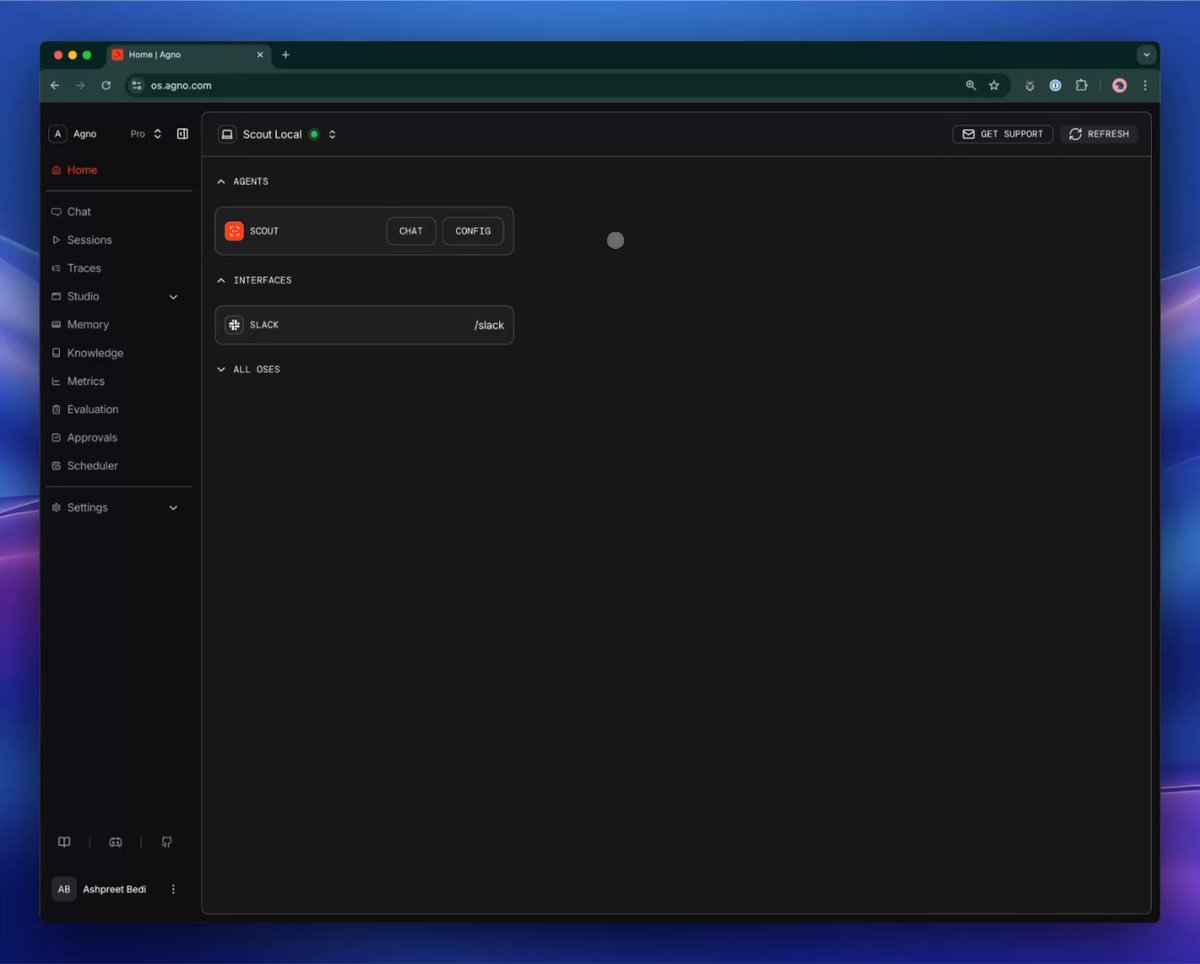 ## Slack Scout is part of your team, and integrating Slack is a ~5 minute setup. Each Slack thread becomes its own session, follow-ups carry the full history. See the SLACK_CONNECT.md file for the setup guide. 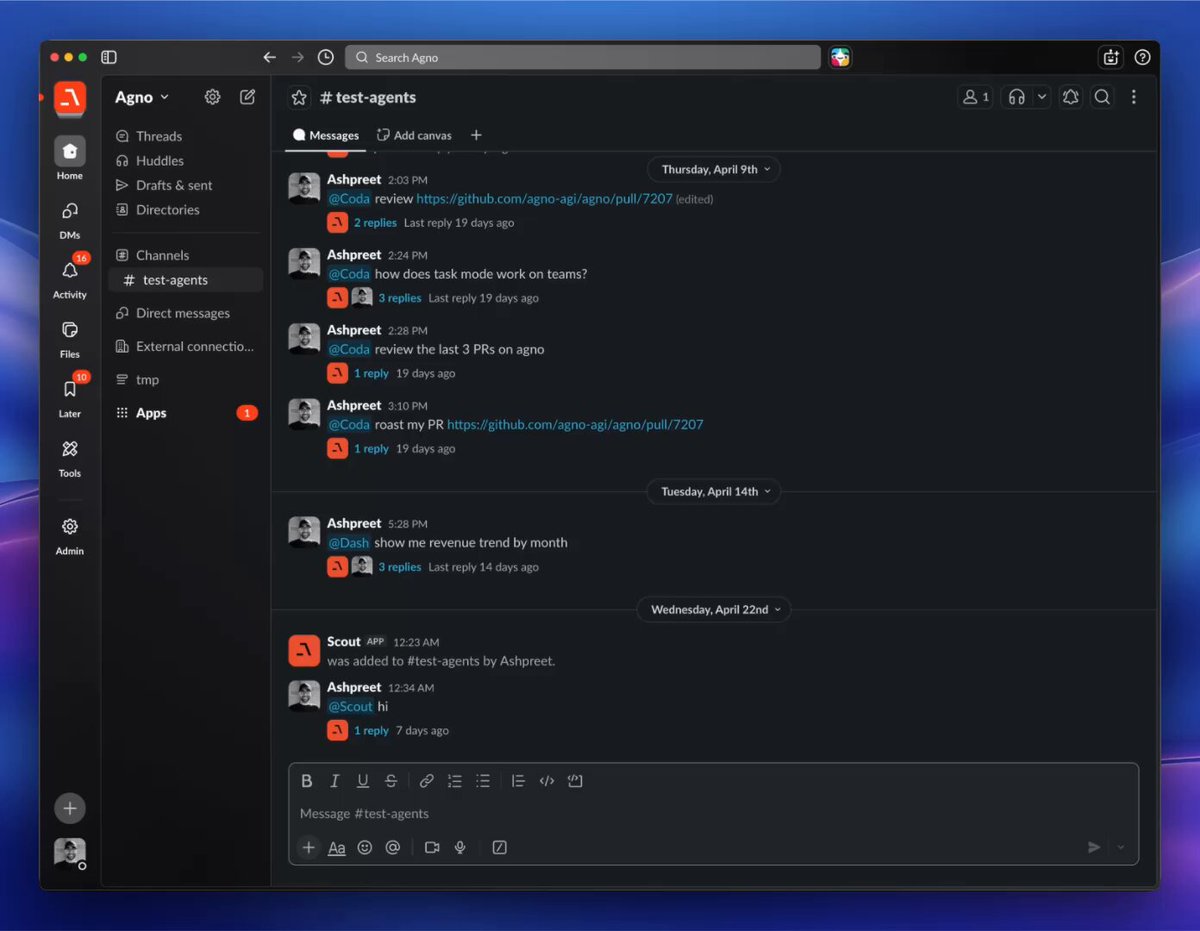 Some prompts to test with: - "Which contexts are you connected to?" - "Walk me through your codebase" - "Save a note: Josh from Anthropic shared a new RLM paper this week" - "The v3 schema migration decision is pending, surface it next Tuesday" - "Create a runbook for incident response — page on-call first, post status in #incidents, capture timeline as you go" - "Start tracking my coffee consumption. First one: flat white, extra shot" # What's next The roadmap from here: - Scheduled tasks. Surface pending follow-ups automatically. - Proactive actions per source. Run update_slack, update_github daily. - GitHub, Gmail, Calendar providers. Testing on a side branch. Links: - Scout - Agno Docs - Agno GitHub ## 相关链接 - [Ashpreet Bedi](https://x.com/ashpreetbedi) - [@ashpreetbedi](https://x.com/ashpreetbedi) - [71K](https://x.com/ashpreetbedi/status/2049180168200106150/analytics) - [Requests for Startups](https://www.ycombinator.com/rfs) - [Company Brain](https://www.ycombinator.com/rfs#company-brain) - [Apr 28](https://x.com/ycombinator/status/2048834293779378437) - [@ycombinator](https://x.com/ycombinator) - [@t_blom](https://x.com/t_blom) - [809K](https://x.com/ycombinator/status/2048834293779378437/analytics) - [AI Operating System for Companies](https://www.ycombinator.com/rfs#ai-operating-system-for-companies) - [Apr 28](https://x.com/ycombinator/status/2048834315539435657) - [@ycombinator](https://x.com/ycombinator) - [@sdianahu](https://x.com/sdianahu) - [89K](https://x.com/ycombinator/status/2048834315539435657/analytics) - [Scout is a open-source context agent](https://github.com/agno-agi/scout) - [Apr 28](https://x.com/ashpreetbedi/status/2048817143974613089) - [29K](https://x.com/ashpreetbedi/status/2048817143974613089/analytics) - [Scout is open-source.](https://github.com/agno-agi/scout) - [Repo](https://github.com/agno-agi/scout) - [AgentOS](https://docs.agno.com/) - [os.agno.com](https://os.agno.com/) - [SLACK_CONNECT.md](https://github.com/agno-agi/scout/blob/main/docs/SLACK_CONNECT.md) - [#incidents](https://x.com/search?q=%23incidents&src=hashtag_click) - [Scout](https://github.com/agno-agi/scout) - [Agno Docs](https://docs.agno.com/) - [Agno GitHub](https://github.com/agno-agi/agno) - [Upgrade to Premium](https://x.com/i/premium_sign_up) - [1:33 AM · Apr 29, 2026](https://x.com/ashpreetbedi/status/2049180168200106150) - [71.3K Views](https://x.com/ashpreetbedi/status/2049180168200106150/analytics) - [View quotes](https://x.com/ashpreetbedi/status/2049180168200106150/quotes) --- *导出时间: 2026/4/29 08:51:13* --- ## 中文翻译 # 介绍 Scout。开源的公司大脑 **作者**: Ashpreet Bedi **日期**: 2026-04-27T18:38:55.000Z **来源**: [https://x.com/ashpreetbedi/status/2049180168200106150](https://x.com/ashpreetbedi/status/2049180168200106150) ---  YC 2026 年夏季创业请求从不同角度指出了指向同一目标的两个想法。 公司大脑:从碎片化的来源(Slack、邮件、工单)中提取知识,将其结构化,保持其时效性,并将其转化为 AI 可以加以利用的内容。 > “将其结构化,保持其时效性”是错误的方法。 > 诀窍在于“导航优于搜索”。稍后会详细讨论。 > **Y Combinator@ycombinator**: [原文链接](https://x.com/ycombinator/status/2048834293779378437) > > 公司大脑 > @t_blom > 每家公司都有散落在人们的头脑、旧的 Slack 线程、支持工单和数据库中的关键知识,AI 智能体无法那样运作。 > 我们认为世界上的每家公司都需要一个新的原语:一张关于公司如何运转的活地图…… > >  公司 AI 操作系统:这是一个连接层,默认情况下使公司对 AI 可读。能够观察决策后发生的事情并进行调整的闭环系统。 > **Y Combinator@ycombinator**: [原文链接](https://x.com/ycombinator/status/2048834315539435657) > > 公司的 AI 操作系统 > @sdianahu > 最好的 AI 原生公司已使其整个公司都可查询:每一次会议、工单和客户交互对学习它们的智能层都是透明的。 > 今天构建此功能需要残酷的集成工作…… > >  大脑是数据层。操作系统是运行在数据层之上的东西。目前这两个都没有作为成品存在,但其组成部分已经具备(模型能力、上下文提供者、代理 SQL、MCP、持久记忆、定时执行)。 让我们看看能否将它们缝合在一起,变成有用的东西。我们将共同构建公司大脑,看看能否将其转化为 AI 操作系统。 # 介绍 Scout Scout 是一个开源的上下文智能体。它浏览实时信息源以按需组装上下文。它使用经过验证的模式,如“导航优于搜索”、“上下文提供者”和“学习机器”,将存在于 Slack、Google Drive、Linear 中的碎片化知识连接起来。 Scout 还会在了解公司的过程中构建自己的 Wiki 和 CRM。因此,你可以分享“Anthropic 的 Josh 分享了这篇关于 RLM 的新论文”,它就会在 CRM 中添加一条备注,解析该论文并将其存储在公司 Wiki 中。 你也可以分享“关于 v3 模式迁移的决定”尚未完成,它会在 CRM 中记录一个待办事项,以便下次有人询问有什么未决事项时能自动呈现。将待办审查设置为每日定时任务,闭环就会更加紧密。 让我们来谈谈一些设计决策,正是这些决策让 Scout 优于“把所有东西倒进向量数据库并祈祷我们能找到正确的片段”的做法。 # 上下文提供者 在构建“公司大脑”时,我们遇到的第一个问题是一个智能体连接所有工具并跨信息源工作的能力。目前有三个尚未解决的问题: 1. 工具过多导致的上下文污染 2. 范围重叠导致的性能下降 3. 主智能体停止工作,因为其上下文里全是工具的怪癖 我发现行之有效的解决方案是在智能体和工具之间建立一个名为“上下文提供者”的薄层。每个信息源(Slack、Drive、CRM)都变成一个上下文提供者,并向主智能体暴露两个工具: - query_<source> 用于自然语言读取 - update_<source> 用于自然语言写入 这种方法的第一个优点是主智能体不会看到 Slack 的十二种工具。它只能看到 query_slack。 第二个优点,也是最大的胜利,在于 query_slack 工具背后是一个拥有所有 Slack 怪癖(在发私信前查找用户、通过游标分页、对于线程优先使用 conversations.replies)的子智能体。这非常重要,因为现在主智能体的上下文不会被关于如何使用 Slack 的指令或所有中间工具调用结果所污染。 不,技能并不能解决这个问题。技能是模型按需加载的特定任务指令(“这是使用 Slack 的方法”)。技能将任务知识从始终开启的提示词转移到了更具条件性的东西中。但是当模块被加载时,Slack 工具仍然会落在主智能体上,中间工具调用结果仍然在主上下文中。加载 2 个具有搜索功能的技能,你的智能体会立即崩溃。 Scout 当前的工具界面: - Web: query_web - Slack: query_slack, update_slack - Google Drive: query_gdrive - CRM: query_crm, update_crm(写入联系人/项目/备注/待办) - Knowledge wiki: query_knowledge, update_knowledge - Voice wiki: query_voice(只读) - MCP servers: query_mcp_<server>(每个已注册服务器一个) - Workspace: query_workspace - Cross-cutting: list_contexts 回报: 1. 你实际上可以一起使用多个上下文提供者。query_slack 找到讨论,query_gdrive 找到文档。 2. 路由控制在最低限度,这意味着 Scout 的指令保持不变,添加更多工具不会导致回归。 你可以在这里阅读关于上下文提供者的更深入的文章: > **Ashpreet Bedi@ashpreetbedi**: [原文链接](https://x.com/ashpreetbedi/status/2048817143974613089) > # 导航优于搜索 构建“公司大脑”时的默认操作是将所有内容摄入向量数据库,进行分块、嵌入并检索 top-k。 这是行不通的。索引总是过时的。块落在错误的边界。引用指向上周二还真实的碎片。有一半的时间,相关内容在从未被索引的 Slack 线程中,因为谁会去索引 Slack 呢! 这里的诀窍是:不要搜索,要导航。它们 `ls` 一个目录。它们 `grep` 函数名。它们打开文件。它们跟随导入。它们遍历文件系统,就像人类一样。 这种模式非常适用于上下文智能体。每个信息源已经具有相当于 ls、grep 和 cat 的功能。它们暴露在上下文提供者背后。 回报: 1. 实时状态。你三十秒前发送的 Slack 消息可供智能体使用。昨天的路线图文档是当前的,因为它是实际文档。 2. 真正的引用。每个引用都是你可以打开的路径。没有来自嵌入边界的片段。 3. 权限保留在其所在位置。Drive 强制执行谁可以读取什么,Slack 强制执行频道成员资格。Scout 看到其凭据可以看到的内容。 代价是每次查询有更多的 LLM 调用。向量查找是往返一次;导航是三到四次。 # Wiki、CRM 和闭环 有些东西没有自然的来源归属。“Anthropic 的 Josh 上周分享了一篇 RLM 论文”并不存在于任何明显的地方。它可能是在 Slack 中提到的,但你不会在 Slack 中搜索“谁是 Josh”。 这就是 CRM 和知识 Wiki 的用途。Scout 在学习时会填充这些内容。Josh 成为 CRM 中的一个联系人。RLM 论文成为链接自他的联系人备注的 Wiki 页面。 CRM 附带四个表:scout_contacts、scout_projects、scout_notes、scout_followups。除此之外,写入子智能体会按需创建新的 scout_* 表。“跟踪我的咖啡订单”会变成一个具有正确列的 scout_coffee_orders 表。按需模式。 > 如果你认为 LLM 擅长 bash,等你看它们写 SQL。 # Scout 实战 Scout 是开源的。Fork 它,自定义它,把它变成你自己的。代码库。 ## 快速开始 克隆代码库,添加你的 API 密钥并使用 docker 在本地运行 scout。 ``` git clone https://github.com/agno-agi/scout && cd scout cp example.env .env # 设置 OPENAI_API_KEY docker compose up -d --build ``` 默认情况下,scout 附带 Web、CRM、知识 Wiki、语音 Wiki 和工作区上下文提供者。Slack 和 Google Drive 提供者已连接,你只需要设置凭据。 ## AgentOS Scout 运行在 Agno 的 AgentOS 上。你会获得一个 UI、多用户会话、定时任务和一个可以部署到任何运行 Docker 的地方的 FastAPI 应用。一旦你在本地运行了 Scout,将其连接到 os.agno.com 的 AgentOS UI。  ## Slack Scout 是你团队的一部分,集成 Slack 大约需要 5 分钟设置。每个 Slack 线程成为其自己的会话,待办事项带有完整的历史记录。 请参阅 SLACK_CONNECT.md 文件了解设置指南。  一些测试用的提示词: - “你连接到了哪些上下文?” - “带我浏览你的代码库” - “保存一条备注:Anthropic 的 Josh 本周分享了一篇新的 RLM 论文” - “v3 模式迁移的决定尚未完成,下周二将其呈现出来” - “为事件响应创建一个运行手册 —— 先寻呼值班人员,在 #incidents 中发布状态,随着进展捕获时间线” - “开始跟踪我的咖啡消费。第一杯:flat white(澳白),加一份浓缩” # 下一步 从这里开始的路线图: - 定时任务。自动呈现待处理的待办事项。 - 针对每个来源的主动操作。每天运行 update_slack、update_github。 - GitHub、Gmail、日历提供者。在侧分支上测试。 链接: - Scout - Agno Docs - Agno GitHub ## 相关链接 - [Ashpreet Bedi](https://x.com/ashpreetbedi) - [@ashpreetbedi](https://x.com/ashpreetbedi) - [71K](https://x.com/ashpreetbedi/status/2049180168200106150/analytics) - [Requests for Startups](https://www.ycombinator.com/rfs) - [Company Brain](https://www.ycombinator.com/rfs#company-brain) - [Apr 28](https://x.com/ycombinator/status/2048834293779378437) - [@ycombinator](https://x.com/ycombinator) - [@t_blom](https://x.com/t_blom) - [809K](https://x.com/ycombinator/status/2048834293779378437/analytics) - [AI Operating System for Companies](https://www.ycombinator.com/rfs#ai-operating-system-for-companies) - [Apr 28](https://x.com/ycombinator/status/2048834315539435657) - [@ycombinator](https://x.com/ycombinator) - [@sdianahu](https://x.com/sdianahu) - [89K](https://x.com/ycombinator/status/2048834315539435657/analytics) - [Scout is a open-source context agent](https://github.com/agno-agi/scout) - [Apr 28](https://x.com/ashpreetbedi/status/2048817143974613089) - [29K](https://x.com/ashpreetbedi/status/2048817143974613089/analytics) - [Scout is open-source.](https://github.com/agno-agi/scout) - [Repo](https://github.com/agno-agi/scout) - [AgentOS](https://docs.agno.com/) - [os.agno.com](https://os.agno.com/) - [SLACK_CONNECT.md](https://github.com/agno-agi/scout/blob/main/docs/SLACK_CONNECT.md) - [#incidents](https://x.com/search?q=%23incidents&src=hashtag_click) - [Scout](https://github.com/agno-agi/scout) - [Agno Docs](https://docs.agno.com/) - [Agno GitHub](https://github.com/agno-agi/agno) - [Upgrade to Premium](https://x.com/i/premium_sign_up) - [1:33 AM · Apr 29, 2026](https://x.com/ashpreetbedi/status/2049180168200106150) - [71.3K Views](https://x.com/ashpreetbedi/status/2049180168200106150/analytics) - [View quotes](https://x.com/ashpreetbedi/status/2049180168200106150/quotes) --- *导出时间: 2026/4/29 08:51:13*
阿 阿里开源 Zvec:像 SQLite 一样极简的嵌入式向量数据库 阿里开源了一款名为 Zvec 的向量数据库项目,主打“纯本地、内嵌式”极简体验,号称向量界的 SQLite。该项目基于 C++ 编写,支持零配置安装,性能强悍(毫秒级搜索数十亿向量),同时兼容稠密、稀疏向量及全文检索。它非常适合本地大模型、RAG 和个人知识库开发,彻底免去了部署繁琐的后端向量服务。 技术 › 后端 ✍ 智享🕐 2026-07-08 向量数据库阿里ZvecRAG本地大模型开源LLMAgent数据库工具
浪 浪费20亿Token之后,我做了一个帮自己定义目标的Skill 作者分享了一个名为Leader.skill的开源工具,旨在解决Agent交互中目标定义模糊的问题。该工具基于“目标七问”方法论,将模糊需求转化为清晰的目标任务书,支持多模型组合(如Claude规划、GPT执行),显著提升长程任务的完成率与Token利用率。 技术 › Skill ✍ 数字生命卡兹克🕐 2026-07-27 AgentGoal Engineering目标定义自动化开源LLM效率工具方法论ClaudeGPT
开 开源CC+Obsidian打造LLM Wiki内容创作3.0系统 文章介绍了一套基于LLM Wiki方法论的内容生产3.0系统,解决了2.0版本中知识库信息垃圾化的问题。通过“三步编译法”(浓缩、质疑、对标)将原始文档编译为持久化Wiki结构,实现知识资产的自动积累与进化,大幅降低维护成本并提升了内容创作与知识管理的效率。 技术 › LLM ✍ 饼干哥哥AGI🕐 2026-07-07 ClaudeObsidian知识管理内容创作Agent提示词自动化开源RAG方法论
P Pydantic fixed my Agent's Memory 文章探讨了如何解决 AI Agent 记忆系统的多跳推理问题。传统的向量数据库在处理跨块事实连接时失效,而通用知识图谱常因缺乏结构导致查询噪音。作者提出的解决方案是使用 Pydantic 提前定义本体(Schema),明确实体类型、关系和属性。通过 Zep 框架强制执行这些约束,可以显著提升提取的准确性和数据的可查询性,从而实现有效的多跳推理。 技术 › Agent ✍ Akshay🕐 2026-05-26 AgentPydantic知识图谱RAGLLMSchema多跳推理Zep向量数据库Ontology
S Superpowers:Claude Code 效率暴涨 10 倍的秘密 文章介绍了 Claude Code 的开源技能库 Superpowers,它如同 AI 的导航系统,通过头脑风暴、计划拆解、子代理驱动开发和测试驱动四大核心工作流,自动引导用户从构思到上线。该系统有效降低了认知负荷,并通过严格的审查机制确保代码质量,是提升企业 AI 交付效率的利器。 技术 › Skill ✍ Miles.🕐 2026-05-22 Claude CodeSuperpowers工作流Agent测试驱动自动化开源效率工具开发实践LLM
A Agentic Memory: 详解 Agent 记忆系统的架构与实现 文章通过生动的类比,指出缺乏记忆是当前 LLM Agent 的主要短板。作者详细拆解了 Agent 记忆系统的三个核心功能:连续性、上下文和学习。文章重点介绍了四种记忆类型:上下文记忆、外部记忆、情景记忆和参数记忆,并深入探讨了如何通过检索增强(RAG)和反思循环来构建持久的智能。 技术 › Agent ✍ Ramakrishna (techwith_ram)🕐 2026-05-17 AgentLLMMemoryArchitectureRAGVectorStoreContextEpisodic向量数据库系统设计
I Introducing SMFS: The Supermemory Filesystem SMFS 是一个结合了 RAG 和传统文件系统优势的新型可挂载文件系统。它允许 Agent 使用标准的 Unix 命令(如 grep)执行语义搜索,支持多格式文件的自动解析与提取,并提供本地优先的同步引擎。内部基准测试显示,SMFS 能显著减少 Token 消耗和工具调用次数,同时大幅提升检索准确率。 技术 › 工具与效率 ✍ Dhravya Shah🕐 2026-04-29 RAGAgentLLM文件系统开源语义搜索RustDevOps工具SMFS
6 69个最佳开源AI仓库推荐(2026年4月) 文章精选了69个经过实战验证、维护活跃的开源AI仓库,旨在替代昂贵的API订阅。内容涵盖完整的AI技术栈,包括本地大模型推理、RAG知识库构建、AI智能体框架、提示词与评估、模型微调、工具链及部署等十大领域,为开发者、研究人员和独立黑客提供免费的生产级AI工具清单。 技术 › 工具与效率 ✍ self.dll🕐 2026-04-29 开源AI工具LLMAgentRAG模型微调OllamaLangChain本地部署资源合集
A AI 记忆工具两大阵营:Memory Backends 与 Context Substrates 文章深入分析了 GitHub 上的 AI Agent 记忆工具,将其分为两大阵营:一是“记忆后端”,如 Mem0 和 Supermemory,主要提取事实并存储于向量数据库;二是“上下文基底”,如 OpenClaw,通过人类可读的结构化文件让会话在上下文中累积。作者指出,虽然 Camp 1 主导了市场,但 Camp 2 的架构才是支持连续、多会话工作的未来方向,例如 Zep 已开始从“记忆”转型为“上下文工程”。 技术 › Agent ✍ witcheer🕐 2026-04-17 AgentOpenClawMem0ContextMemoryRAGLLM向量数据库知识图谱
A AI Knowledge Layer (and why your agents are useless without it) 本文提出了一种让 AI 智能体变得更聪明的双层系统:AI 知识层。它包含动态的知识库层(KBL)和静态的品牌基础层(BF),通过编译而非检索(RAG)的方式,让智能体在执行任务前拥有上下文记忆。文章介绍了该系统的概念、与传统 RAG 的区别、以及如何利用开源框架 LLM Wikid 构建个人或企业的知识图谱,从而解决 AI 输出同质化、缺乏个性化的问题。 技术 › Agent ✍ Shann³🕐 2026-04-15 Agent知识管理LLM系统架构个人WikiRAG内容创作自动化知识图谱Obsidian
1 12个开源项目,4条技术路线:Agent记忆系统完整选型指南 针对 LLM 无状态导致的“失忆”痛点,文章深入探讨了当前 Agent 记忆系统的四条主流技术路线:纯文件存储、向量数据库+RAG、知识图谱及混合检索。文章梳理了从轻量级 hooks 集成到企业级独立平台的 12 个开源项目,涵盖 claude-memory-compiler、agentmemory、Hermes Agent 等代表性工具,并提供了针对不同用户阶段(新手、个人开发者、团队、企业)的选型建议。作者指出,未来的核心竞争将集中在“如何遗忘”、“保证正确性”和“控制成本”三个维度。 技术 › Agent ✍ Jason Zhu🕐 2026-04-09 Agent记忆系统RAG选型指南Claude Code知识图谱向量数据库开源项目开发工具LLM
自 自动辅助:具有自动评估功能的自改进代理系统 NeoSigma 开源了‘Auto-harness’系统,这是一个自改进循环框架,能将代理失败转化为评估结果并自动修复。实验显示,该系统使 Tau3 基准任务得分提升了 40%。文章探讨了故障聚类、回归门控和子代理管理等关键技术,标志着工程重心从编写代码转向构建能够自我维持和改进的系统。 技术 › Agent ✍ Gauri Gupta🕐 2026-04-05 Auto-harness自改进开源评估系统NeoSigmaLLM自动化Agent