# How I Quit Working for Sam Altman and Built a $7M Services-as-Software Agency
**作者**: Alex Vacca
**日期**: 2026-05-01T15:08:59.000Z
**来源**: [https://x.com/itsalexvacca/status/2050231011242594537](https://x.com/itsalexvacca/status/2050231011242594537)
---

I spent two years working at Sam Altman's company before I quit. It was one of the best business decisions I've ever made.
I got hired at Worldcoin in 2022. After two years of seeing what the corporate grind actually looks like, I decided to do things my own way. Four years later, ColdIQ is at $7M+ ARR. 70 clients. 30+ people across 10 countries. Bootstrapped, no VC, no angel round, no pitch deck. I work wherever I want and the only person I report to is myself.
What I ended up building looks like an agency on the contract and runs like a software business underneath. We call it services-as-software, and the version of that distinction I'll explain at the end is the entire reason the math works. I want to start where the story actually started, because the lessons matter in the order they happened.
## The two years inside Worldcoin
For people who don't know, Worldcoin is Sam's crypto company. The thesis was a physical device called the orb that scans your iris to give you a world ID. As AI gets indistinguishable from humans online, you'd want cryptographic proof that you're a real human on the internet and not a bot. Sam's read was that this problem only gets bigger as AI advances. Worldcoin was his answer to it. It was one of the fastest-growing startups in the world, and on day one I was all in.
At least, that's what I thought. The reality of corporate life hit fast. The hours were long. I was traveling constantly to launch in different European countries. Every single decision I made had to clear someone above me. The thing that really made me hate the job was my manager. When something went wrong, I was thrown under the bus. When something went right, he took the credit. The feeling of being powerless, of having your wins taken from you, is a specific kind of frustration I wouldn't wish on anyone.
On top of that, I was earning €80,000 a year in Germany. Top 10% of earners in the country. If I asked for a promotion, the most I could realistically get was a 4% bump, and that's assuming I got the raise at all. The €80,000 was good money. The frustrating part was the ceiling on how that number could grow, year after year, with someone above me deciding what my work was worth.
I hit a wall, and I still remember the exact moment it clicked into something I could act on instead of something I was just stewing in. I told myself I would never let someone above me decide what I could and couldn't do. I turned that frustration into the fuel to build something where I was the only person who could limit my own growth.
## How I joined Mich and got the first clients
Around the same time, my friend Michel had already started his own agency. He had a website and four clients. I started learning from him, and we ran our first joint engagement together: one of my best friends, Nicholas, runs a recruitment agency and needed help with his outbound. The collaboration worked. Mich and I joined forces officially, and from there everything changed.
The first stage of an agency is the one that kills most of them before they get off the ground. You have no case studies, no testimonials, and no track record to point at. Cold-reaching businesses with zero proof you can deliver is a chicken-and-egg problem. You need clients to build social proof and you need social proof to get clients. If you don't solve it intentionally, you'll spend months with nobody taking your calls.
This is where the playbook starts.
## Playbook 1: How to land clients with zero proof
You solve the proof problem on two fronts at the same time. Risk on one side, trust on the other. Get one without the other and the strategy collapses.
Front 1: Drop the price of saying yes until skeptics can't refuse.
Rules to follow:
- Anchor every guarantee to something measurable. Vague phrasing like "we'll try our best" falls flat with skeptical buyers. Specific commitments like "if we don't hit X by this date, you pay nothing" are what make the offer feel real to a prospect who has been burned before.
- Use free deliverables as the conversation starter. Free lead lists, free audits, free sample workflows. Whatever costs you the least and signals competence the most.
- Time-box every guarantee. Open-ended phrasing tends to read as desperation. A 30-day or 60-day window tied to a defined outcome is what flips the tone toward confidence.
- Refuse to compete on price alone. A guarantee is a risk-reversal tool. Keep your retainer floor at the level your delivery economics demand and let the guarantee do the work.
Front 2: Build trust in public so the prospect already knows you before the cold reach lands.
Rules to follow:
- Pick one platform and post daily for 6 months minimum. For us it was LinkedIn. The compounding only starts once you've shipped consistently long enough for the platform to learn you.
- Share the actual workflow. Frameworks, screenshots of real campaigns, the exact playbook you used last week with a client. Tactical specificity beats inspiration every time.
- Plan for the viral post; don't wait for it. One viral post is the realistic goal of consistent posting. Mich shipped one that produced our first real wave of inbound. That single post turned strangers into leads who already felt they knew us.
- Search yourself the way a prospect would. If they Google your name and land on nothing, the guarantee in your cold email gets discounted to zero. You're still a stranger.
The combination is what cracks the wall. Risk reversal in isolation gets you the meeting. Daily content in isolation gets you the follower. The two stacked together produce a paying client who arrives already half-sold on you.
## Playbook 2: The first-three-hires sequence
Two founders can do everything for a while, until they can't. Delivery quality slips, response times drag, and the trust you spent a year building starts leaking from the wrong end. The reflex is to hire fast. Resist it. Your first three hires set the standard every later hire recalibrates against, and getting those three right is what gives you a $7M business instead of a $1M one.
The hiring rule, non-negotiable:
- Only A players. People who can own a domain end-to-end, manage their own time, and deliver without being micromanaged.
- No exceptions for "nice to have" hires. If the candidate would need significant management to function, the cost of the wrong hire is higher than the cost of waiting another month for the right one.
- Hire slowly when growth is screaming at you to hire fast. That feeling of "leaving money on the table" is the trap. A wrong early hire damages the business actively, taking work that should compound and turning it into work that breaks.
What to look for in the first three:
- Hire 1: A delivery operator who can own multiple client accounts after a short shadowing period. Their job is execution and quality. Strategy stays with you.
- Hire 2: A second delivery operator of the same caliber. Two operators force you to write down what you do, because you can no longer rely on tribal knowledge passing across one person.
- Hire 3: A delivery lead who manages the first two and owns quality across the function. This is the role you, the founder, were doing in the first six months.
Hold off on hiring a marketer, an account executive, or a head of operations until the delivery layer can run without you. Every non-delivery hire before that point is friction at best and burn at worst. We scaled to $7M in three years on the back of this rule. There is no version of that growth that survives if we'd hired the wrong first three.
## Playbook 3: The churn defense at scale
Once the team is in place, you assume the messy part is over. It isn't. The next problem is churn, and almost no agency owner runs the math honestly until they're already inside it.
Run the math before you need to:
- At 10 clients with 10% monthly churn, you replace 1 client a month. Manageable.
- At 30 clients, you replace 3 a month just to stay flat.
- At 50 clients, 5 replacements a month.
- At 70 clients (where ColdIQ is now), 7 replacements every month. That is the workload of a full-time closer running at quota who contributes zero to net new growth. They're treadmilling so the rest of the business can catch its breath.
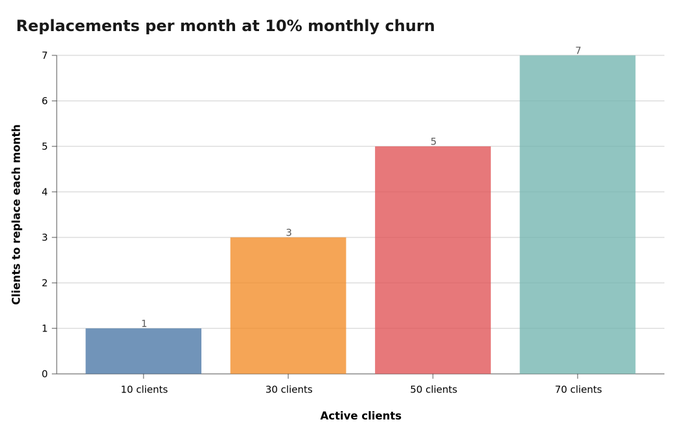
You cannot out-sell churn at scale. You attack it on three fronts simultaneously.
Front 1: Promise only what you are 99% sure you can deliver.
- Stop pitching outcomes you are 60-70% sure of, even when the prospect is asking for them. Walk away from the deal sooner.
- Re-anchor every commitment as an under-promise. The conservative target goes in the proposal, and the over-delivery shows up in the QBR.
- Track the gap between what you promised and what you delivered, monthly, per account. The instant that ratio flips, churn moves up weeks before cancellations show up in the dashboard.
Front 2: Own the meeting cadence and never lose control of the room.
- Walk into every client meeting with the next plan already in front of you. The moment a client senses you don't know what to do next, the trust is already gone, and nothing recovers it.
- Set a fixed weekly or bi-weekly cadence per account. Skipping a check-in is a churn signal you create yourself.
- Treat speed as the deliverable. Speed is trust in an agency. The faster you respond and the faster you ship, the longer clients stay.
- Send a written recap within 24 hours of every meeting. The client should never have to ask "what did we agree on?"
Front 3: Add a revenue layer that doesn't depend on more delivery headcount.
This is where ColdIQ stopped being a normal agency. We launched our cold accelerator. The accelerator is structural revenue we built on purpose, with its own scaling logic. It scales with content. When the agency has a rough month on churn, the accelerator margin keeps the overall business healthy. Margin compounds at the content layer, and that compounding is what carries the business across the cyclicality of services.
## Playbook 4: What to document so the business survives without you
The last thing we did is the part most agencies never even get to. Nothing in the business should depend on a single person showing up. The agency has to run when the A players are out, when a founder is sick, when a key teammate resigns.
What to document, by format:
- Workflow files in Markdown. One file per repeatable task: onboarding a new client, running a deliverability audit, escalating a billing dispute. Written for someone who started Monday with zero context.
- Loom videos for anything visual. Cursor-driven work, dashboard navigation, anything that loses meaning in text. Title each Loom with the task and the date.
- Decision logs per client. Every "why did we do it this way" note, dated and tied to the client. This is what protects you when staff turns over.
- Escalation protocols for failure modes. What happens when deliverability tanks. What happens when a client misses a kickoff. What happens when an A player resigns mid-engagement.
Once the workflows are written, automate the parts that don't need a human in the loop. With Claude Code now, internal tools that used to cost tens of thousands of dollars to build are weekend projects we ship ourselves. The same workflow that used to require real headcount now runs in the background. We move as fast at 70 clients today as we did at a fraction of that scale.
Automation is the byproduct here. The point is that no person in the business is structurally required for the business to keep running. That is the version of an agency that survives a bad week, a sick founder, or a key resignation, and it is the version most agencies never reach because they spend all their energy treadmilling at the churn wall.
## Why I call it a services-as-software business
The contract still says services. The infrastructure underneath runs like software. The accelerator is the layer on top of both, and its margin compounds with content.
That is the shape of the agency I think survives the next few years. Pricing pressure on hour-based work is going to compress every operator who hasn't built infrastructure underneath the human layer. Tasks an LLM can do for twenty dollars are going to get priced like that, and the agencies still selling them by the hour are going to have a hard time. The work that holds its value is judgment, relationship, taste, and accountability. Those are the things a human still gets paid for. Everything else should run on its own underneath.
I'm four years in and we've changed the shape of the business three times to get here. We'll change it again. The work I'm doing this year already looks different from the work that built the first $7M, and the work next year will look different again. That's the trade you make when you decide to run an agency as software underneath. The math compounds, and so does the rate at which you have to keep rebuilding the thing.
If you're sitting at a corporate job with a 4% raise ceiling, or running an agency that's stopped scaling at a number you don't want to live at, the playbook is the one I just walked you through. Land clients with risk reversal and content. Hire the first three carefully. Defend churn before you need to. Document everything until the business runs without you in the room. Then build the layer on top that compounds with content.
I packaged the rest of the playbook into a 12-week program at aiagency.io.
It's the same operating system we run inside ColdIQ, handed to someone who wants to launch their own AI service agency without spending four years figuring it out the hard way. We've analyzed 239 clients and run 2,216 campaigns to build it. 155 agencies have already launched on this stack. Eleven AI agents from our internal stack ship to every member.
The program is built for operators, not spectators. If you're looking for passive income, you don't want to do client work, or you just want to learn about AI for fun, it won't land for you. If you have domain expertise you want to package as an agency, you're stuck below $20K a month and want a system that scales, or you're sitting at a corporate job with an idea you haven't acted on yet, book a strategy call at aiagency.io and we'll see if it's a fit.
## 相关链接
- [Alex Vacca](https://x.com/itsalexvacca)
- [@itsalexvacca](https://x.com/itsalexvacca)
- [19K](https://x.com/itsalexvacca/status/2050231011242594537/analytics)
- [$7M](https://x.com/search?q=%247M&src=cashtag_click)
- [$7M](https://x.com/search?q=%247M&src=cashtag_click)
- [$1M](https://x.com/search?q=%241M&src=cashtag_click)
- [$7M](https://x.com/search?q=%247M&src=cashtag_click)
- [$7M](https://x.com/search?q=%247M&src=cashtag_click)
- [aiagency.io](http://aiagency.io/)
- [$20K](https://x.com/search?q=%2420K&src=cashtag_click)
- [aiagency.io](http://aiagency.io/)
- [11:08 PM · May 1, 2026](https://x.com/itsalexvacca/status/2050231011242594537)
- [19.1K Views](https://x.com/itsalexvacca/status/2050231011242594537/analytics)
- [View quotes](https://x.com/itsalexvacca/status/2050231011242594537/quotes)
---
*导出时间: 2026/5/2 09:56:17*
---
## 中文翻译
# 我如何不再为 Sam Altman 工作并建立了一家价值 700 万美元的服务即软件机构
**作者**: Alex Vacca
**日期**: 2026-05-01T15:08:59.000Z
**来源**: [https://x.com/itsalexvacca/status/2050231011242594537](https://x.com/itsalexvacca/status/2050231011242594537)
---

我在 Sam Altman 的公司工作了两年,然后辞职了。这是我做过的最好的商业决策之一。
2022 年,我入职了 Worldcoin。在见识了两年真正的职场磨砺是什么样子后,我决定按自己的方式做事。四年后,ColdIQ 的年度经常性收入(ARR)达到了 700 万美元以上。我们要服务 70 个客户,在 10 个国家拥有 30 多名员工。自力更生,没有风险投资(VC),没有天使轮融资,也没有融资路演用的 PPT。我可以在任何我想工作的地方工作,唯一需要我汇报的人就是我自己。
我最终建立起来的业务,在合同上看起来像一家代理机构,但在底层运作上像一家软件公司。我们称之为“服务即软件”,而我将在最后解释这种区别,这正是这套模式之所以行得通的全部原因。我想从故事真正开始的地方讲起,因为这些经验教训按其发生的顺序来看才更有意义。
## 在 Worldcoin 的两年
对于不了解的人来说,Worldcoin 是 Sam 的加密货币公司。其核心论点是一个叫做“球”的物理设备,它扫描你的虹膜以此发放世界 ID(World ID)。随着人工智能在网络上的表现越来越像人类,你会需要一种加密证明来表明你是互联网上的真实人类而不是机器人。Sam 的判断是,随着 AI 的进步,这个问题只会越来越严重。Worldcoin 是他给出的答案。它是当时世界上增长最快的初创公司之一,而在第一天,我就全身心投入了。
至少,我当时是这么想的。企业生活的现实来得很快。工作时间很长。为了在不同的欧洲国家发布产品,我不断地出差。我做的每一个决定都必须经过上级的批准。真正让我痛恨这份工作的是我的经理。当出了问题时,我会被推出去背锅。当事情顺利时,他却揽下功劳。那种无力感,那种你的胜利被人夺走的感觉,是一种我不希望任何人遭遇的特定的挫败感。
除此之外,我在德国的年薪是 8 万欧元。处于该国收入的前 10%。如果我要求升职,现实中最理想的情况也不过是加薪 4%,而且这还是假设我真的能加薪的话。8 万欧元是一笔不错的收入。令人沮丧的是这个数字增长的上限,年复一年,由我上面的某个人来决定我的工作价值几何。
我碰壁了,但我仍然记得那个确切的时刻,这种情绪转化为了我可以付诸行动的动力,而不仅仅是我内心郁结的情绪。我告诉自己,我永远不会让上级决定我能做什么、不能做什么。我将这种挫败感转化为燃料,去建立一种我才是唯一能限制自己成长的业务。
## 我是如何加入 Mich 并获得第一批客户的
大约在同一时间,我的朋友 Michel 已经开始了自己的代理机构业务。他有一个网站和四个客户。我开始向他学习,我们一起开展了第一次合作:我最好的朋友之一 Nicholas 经营着一家招聘机构,需要外拓开发方面的帮助。这次合作很成功。Mich 和我正式联手,从那以后一切都改变了。
代理机构的第一阶段扼杀了大多数尚未起步的公司。你没有案例研究,没有客户评价,也没有过往业绩可以展示。带着零证据向企业冷启动开发(Cold outreach)是一个“先有鸡还是先有蛋”的问题。你需要客户来建立社会认同,而你需要社会认同来获得客户。如果你不刻意解决这个问题,你会花上好几个月的时间,没人愿意接你的电话。
这就是剧本开始的地方。
## 剧本 1:如何在毫无凭据的情况下拿下客户
你需要同时在两个战线上解决信任问题。一边是风险,另一边是信任。只得到其中另一个而忽略另一个,策略就会崩溃。
战线 1:降低说“是”的价格,直到怀疑者无法拒绝。
需要遵守的规则:
- 将每一个保证都锚定在可量化的指标上。像“我们会尽力而为”这样模糊的说法会让持怀疑态度的买家无动于衷。具体的承诺,如“如果在那个日期前我们没有达到 X,你无需付款”,才是让那些曾经吃过亏的潜在客户觉得这提议真实可靠的原因。
- 使用免费的交付成果作为开启对话的契机。免费的销售线索列表、免费的审计、免费的示例工作流。任何成本最低且最能彰显能力的东西。
- 为每一个保证设定时间限制。开放式的时间限制往往会让人读出一种绝望感。一个与明确结果挂钩的 30 天或 60 天的时间窗口,才能将基调转向自信。
- 拒绝仅仅在价格上竞争。保证是一种风险逆转工具。将你的底薪保持在交付经济模型要求的水平,让保证去发挥作用。
战线 2:在公开场合建立信任,以便在冷启动触达到达之前,潜在客户就已经了解你了。
需要遵守的规则:
- 选择一个平台,并至少每天发布内容,持续 6 个月。对我们来说是 LinkedIn。只有当你持续发布足够长的时间,让平台算法了解你之后,复利效应才会开始。
- 分享实际的工作流程。框架、真实活动的截图、你上周与客户使用的确切剧本。战术上的具体性每次都能胜过空洞的灵感。
- 规划爆款帖子;不要等待。现实地说,持续发布的目标就是出现一篇爆款帖子。Mich 发了一篇,带来了我们的第一波真正的入站咨询。那单一的一篇帖子将陌生人变成了已经觉得了解我们的潜在客户。
- 像潜在客户那样搜索你自己。如果他们 Google 你的名字却什么也没找到,你冷启动邮件中的保证就会被归零。你依然是个陌生人。
两者的结合才是打破壁垒的关键。孤立的风险逆转能让你获得会议。孤立的日常内容能让你获得粉丝。两者叠加在一起,就能带来一位已经对你有一半认同的付费客户。
## 剧本 2:前三名员工招聘顺序
两位创始人可以包揽所有事情,直到他们做不到了。交付质量下滑,响应时间拖长,你花了一年时间建立的信任开始从错误的端点流失。本能的反应是快速招聘。请抵制这种冲动。你的前三名招聘设定的标准,是之后每一次招聘都要重新校准的基准,而找对这三个人,正是让你拥有一家 700 万美元的企业,而不是一家 100 万美元企业的原因。
不可协商的招聘规则:
- 只招 A 级选手。那些能够端到端负责某个领域、管理自己的时间、并且不需要微观管理就能交付的人。
- 对于“锦上添花”的招聘不做例外。如果候选人需要大量的管理才能运作,那么招错人的成本比等待一个月招到对的人的成本更高。
- 当增长对你大吼着要快速招聘时,你要慢慢地招。那种“把钱留在桌上”的感觉是一个陷阱。一个错误的早期招聘会积极地损害业务,将本应复利增长的工作变成了破坏性的工作。
前三名要寻找的目标:
- 第 1 名招聘:一名交付运营人员,在短暂的跟岗期后能独立负责多个客户账户。他们的工作是执行和质量。策略掌握在你手中。
- 第 2 名招聘:一名同等水平的第二位交付运营人员。两名运营人员会强迫你写下你做的事情,因为你不能再依赖通过一个人的口耳相传。
- 第 3 名招聘:一名交付负责人,管理前两名人员并对整个职能部门的质量负责。这是你,作为创始人,在前六个月所担任的角色。
在交付层级能够离你自动运转之前,暂缓招聘营销人员、客户主管或运营负责人。在那之前的每一个非交付类招聘,往好了说是阻力,往坏了说是资源浪费。我们在三年内依靠这条规则将规模扩大到了 700 万美元。如果我们当初招错了前三名,就不可能有这种增长。
## 剧本 3:规模化的流失防御
一旦团队到位,你会认为混乱的部分结束了。其实没有。下一个问题是客户流失,而且几乎没有任何代理机构主会诚实地算这笔账,直到他们深陷其中。
在你需要之前,先算笔账:
- 在有 10 个客户、月流失率 10% 的情况下,你每个月要更换 1 个客户。这还能控制。
- 在 30 个客户时,为了保持持平,你每个月要更换 3 个。
- 在 50 个客户时,每个月更换 5 个。
- 在 70 个客户时(ColdIQ 目前的水平),每个月要更换 7 个。这是一名达到配额的全职销售人员的工作量,但他对净新增增长没有任何贡献。他们在原地踏步,好让业务的其他部分喘口气。

在规模化阶段,你无法用销售来战胜流失。你必须同时在三条战线上发起攻击。
战线 1:只承诺你有 99% 把握能交付的事情。
- 停止推销你只有 60-70% 把握的结果,即使潜在客户在要求。早点放弃这笔交易。
- 将每一个承诺重新锚定为“低承诺”。保守的目标写入提案,超额交付的部分出现在季度业务回顾(QBR)中。
- 每月、按账户追踪你承诺的和你交付的之间的差距。一旦这个比率翻转,流失就会上升,远早于取消出现在仪表盘上的时间。
战线 2:掌控会议节奏,永远不要失去对局面的控制。
- 走进每一个客户会议时,都要把下一步的计划摆在面前。当客户感觉到你不知道下一步该做什么时,信任就已经消失了,没有任何东西能挽回它。
- 为每个账户设定固定的每周或每两周一次的节奏。跳过一次检查是你自己发出的流失信号。
- 将速度视为交付物。速度就是代理机构的信任。你响应越快、发货越快,客户留得越久。
- 在每次会议后 24 小时内发送书面总结。客户永远不应该问“我们同意了什么?”
战线 3:增加一个不依赖于更多交付人手的收入层。
这就是 ColdIQ 停止成为一家普通代理机构的地方。我们推出了我们的冷启动加速器。加速器是我们有意构建的结构性收入,拥有自己的扩展逻辑。它随内容扩展。当代理机构在流失方面经历艰难的一个月时,加速器的利润能保持整体业务的健康。利润在内容层复利,而这种复利正是支撑业务跨越服务周期性的关键。
## 剧本 4:要记录什么才能让业务在没有你的情况下生存
我们要做的最后一件事,是大多数代理机构甚至从未触及的部分。业务中的任何事物都不应依赖于单个人的到场。当 A 级选手不在、当创始人生病、当关键团队成员辞职时,代理机构必须能运转。
按格式记录的内容:
- Markdown 格式的工作流文件。每一个可重复的任务一个文件:新客户入职、运行交付能力审计、升级账单争议。写给那些周一刚入职、毫无背景信息的人看。
- 任何可视化内容都用 Loom 视频。光标驱动的操作、仪表盘导航、任何在文字中会丢失含义的东西。用任务和日期命名每个 Loom。
- 每个客户的决策日志。每一个“我们为什么这样做”的备注,都要注明日期并与客户关联。这是在人员变动时保护你的东西。
- 针对失败模式的升级协议。当交付能力崩溃时会发生什么。当客户错过了启动会时会发生什么。当一名 A 级选手在项目中期辞职时会发生什么。
一旦工作流程写好了,就自动化那些不需要人工干预的环节。现在有了 Claude Code,过去需要花费数万美元构建的内部工具,成了我们自己可以在周末完成的项目。过去需要真实人力的工作流现在在后台运行。我们现在拥有 70 个客户时的速度与规模只有那时的几分之一时一样快。
自动化只是这里的副产品。关键在于,业务中的任何人在结构上都不是业务持续运行所必需的。这就是那种能够挺过糟糕的一周、生病的创始人或关键辞职的代理机构版本,也是大多数代理机构从未达到的版本,因为它们把所有的精力都花在了流失壁垒的跑步机上。
## 为什么我称之为服务即软件业务
合同上依然写着服务。底层的基础设施像软件一样运行。加速器是叠加在两者之上的层级,它的利润随内容复利。
这就是我认为能挺过未来几年的代理机构形态。针对按小时计费工作的价格压力,将挤压每一个未在人工层之下建立基础设施的运营商。大语言模型(LLM)只需 20 美元就能完成的任务,会被定价在这个水平,而那些仍然按小时出售这些任务的代理机构将举步维艰。能保持价值的工作是判断力、关系、品味和问责制。这些是人类仍然能获得报酬的东西。其他一切都应该在底层自动运行。
我走了四年,我们三次改变了业务的形态才走到这里。我们会再次改变它。我今年做的工作看起来已经与建立前 700 万美元收入的工作不同了,而明年的工作又会再次不同。这就是当你决定以软件作为底层运营代理机构时所做的交易。数学在复利,你必须不断重建这一事物的速度也在复利。
如果你正坐在一份加薪上限只有 4% 的企业工作中,或者经营着一家规模停滞在你并不满意的数字的代理机构,这个剧本就是我刚刚带你走过的那个。用风险逆转和内容拿下客户。谨慎地招聘前三名。在你需要之前防御流失。记录一切,直到业务在没有你到场的情况下也能运转。然后构建那个随内容复利的顶层。
我将剧本的其余部分打包成了 aiagency.io 上的一个 12 周项目。
这就是我们在 ColdIQ 内部运行的同一套操作系统,把它交给那些想 launching 自己的 AI 服务代理机构、而不愿花四年时间去艰难摸索的人。我们分析了 239 个客户并运行了 2,216 个活动来构建它。已有 155 家代理机构基于这套技术栈启动。我们内部技术栈中的 11 个 AI 代理会向每一位成员发货。
这个项目是为实干者设计的,而不是为旁观者。如果你在寻找被动收入,你不想做客户工作,或者你只是想为了好玩学习 AI,它就不适合你。如果你有想打包成代理机构的专业领域,你被困在每月 2 万美元以下并想要一套可扩展的系统,或者你坐在一份有着尚未付诸实践的想法的企业工作中,请在 aiagency.io 预约一次战略通话,我们会看看是否合适。