# how to find the next 100x idea:
**作者**: hoeem
**日期**: 2026-05-01T21:51:24.000Z
**来源**: [https://x.com/hooeem/status/2050332284675362853](https://x.com/hooeem/status/2050332284675362853)
---
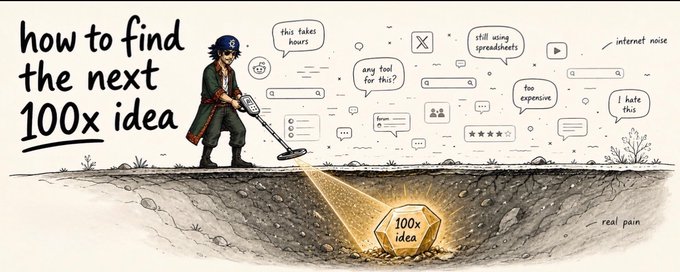
EVERYONE wants their AI to give them a 100x idea, who wouldn't? They go to their AI, ask it questions & all it gives them is SLOP.
Stop wasting your time, build this instead.
It's time to hunt for pain.
Real pain. Repeated pain. Expensive pain. The kind people already complain about, search for, hack around, and sometimes pay badly designed tools to solve.
This is what we're going to build:
```
Social listening alerts
→ database
→ AI pain extraction
→ opportunity scoring
→ manual MVP
→ build / pivot / kill
```
And that is how we can find ideas, or even utilise it to improve your existing business or idea.
The data we're looking to collect is social cues that look like this:
- “I hate doing this manually.”
- “Does anyone know a tool for this?”
- “Is there an alternative to this?”
- “This is too expensive.”
- “I’m still using a spreadsheet.”
- “I waste hours on this every week.”
- “Why is this so hard?”
- “I tried X and Y and Z, but it still sucks.”
That is where the gold is.
## The truth about Reddit and X
Reddit and X are two of the best sources for this kind of research.
But you need to be careful.
Reddit is useful because people write long, emotional complaints. They explain their problem, the workaround, the failed tool, the weird edge case, and why they are annoyed.
X is useful because people complain in public, ask for recommendations, compare tools, and reveal what is changing in real time.
Do not build some janky scraper and call it “AI research”.
- Use official APIs where possible.
- Use approved or licensed monitoring tools where APIs are messy.
- Use alerts, not theft.
- Store only what you need.
- Respect rules.
AI does not magically make bad data collection acceptable.
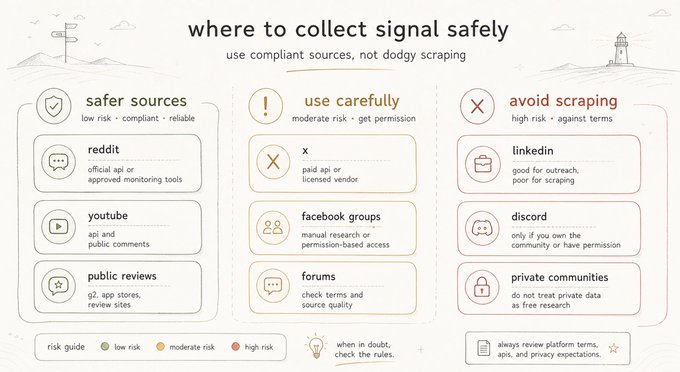
## The platform map: what I would actually use
Reddit is good for:
- pain mining
- long-form complaints
- competitor alternatives
- niche communities
- “does anyone know a tool?” posts
- emotional customer language
Reddit is one of the best places to understand how people talk when they are not being interviewed.
That matters.
X is good for:
- real-time complaints
- founder/operator chatter
- tool comparisons
- market shifts
- public buying intent
- people asking their network for recommendations
X is good for speed, Reddit is better for depth.
YouTube is good for:
- creator markets
- education products
- software tutorials
- “how do I do X?” behaviour
- comments complaining that existing solutions are confusing
YouTube is especially useful when the problem already has educational demand.
Facebook is good for:
- nothing lol, well, it probably is decent but in groups only.
LinkedIn is good for:
- manual search
- content
- outbound
- interviews
- relationship-led validation
## What are you about to build?
You are going to build an AI Pain-Mining Machine for ideas.
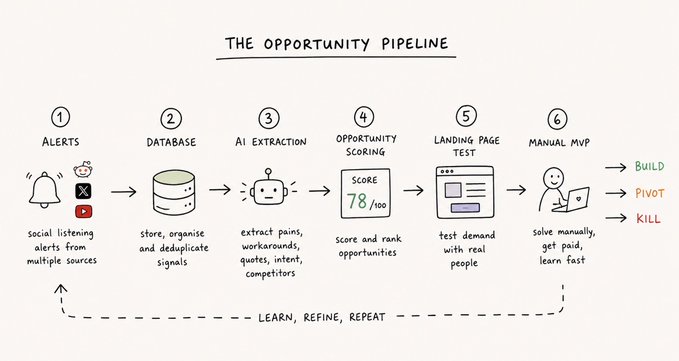
Its job:
1. Search public conversations across Reddit, X, YouTube, reviews, forums, blogs, and social platforms.
2. Pull useful mentions into a database.
3. Ask AI to extract pain points, workarounds, competitors, urgency, and buying intent.
4. Score each signal.
5. Group repeated problems into business opportunities.
6. Turn the strongest opportunity into an offer.
7. Test it with a landing page, form, outreach, or manual MVP.
Like this:
```
Find pain
→ score pain
→ cluster pain
→ test pain
→ only build if people care
```
## What tools should I use?
```
Brand24
Airtable
Make
OpenAI / ChatGPT API
Tally
Carrd, Framer, Lovable, Bolt, or v0
```
Ensure you do not use dodgy scrapers, make sure it's official APIs and approved tools. Don't use scrapers that break platforms rules. It is not a good idea.
Reddit’s Data API terms restrict how user content can be used, including using Reddit content to train AI models without permission, and commercial use can require a separate agreement.
X’s API gives programmatic access to public conversation, but it now uses pay-per-use pricing, with credits purchased upfront and deducted as API requests are made.
YouTube is much cleaner for beginners because its Data API has official comment endpoints. commentThreads.list returns comment threads and costs 1 quota unit per call, and YouTube projects commonly start with a default daily quota of 10,000 units.
## What you'll have at the end:
A dashboard that shows:
```
Raw pain signals
AI summaries
Pain scores
Buyer segments
Workarounds
Competitors
Repeated pain clusters
Business ideas
Landing page angles
Manual MVP ideas
Build / watch / ignore verdicts
```
A weekly report like:
```
This week’s strongest opportunity:
Independent recruiters wasting time writing candidate summaries.
Evidence:
12 strong pain signals across Reddit, X, and YouTube comments.
Best quote:
“I spend hours turning messy screening notes into something I can actually send to clients.”
Recommended test:
Landing page + 20 recruiter DMs + manual summary service.
```
# Phase 1: Pick One Market To Start
Do not start with every single market, choose one.
Examples:
```
Independent recruiters
Estate agents
Physiotherapists
Crypto researchers
Newsletter writers
Small property managers
Personal trainers
E-commerce operators
YouTubers
Solo consultants
```
And a workflow:
```
Writing client summaries
Creating weekly reports
Handling customer support
Managing tenant repairs
Researching crypto projects
Writing social posts
Chasing invoices
Building meal plans
Following up with leads
```
Example:
```
Buyer: independent recruiters
Workflow: turning screening-call notes into client-ready candidate summaries
```
# Phase 2: Create Your Airtable Base
Open Airtable.
Create a new base called: AI Pain-Mining Machine
Create these tables:
```
1. Raw Signals
2. Pain Clusters
3. Business Ideas
4. Experiments
5. Customer Interviews
6. Weekly Reports
```
## Table 1: Raw Signals
This is where every Reddit post, X post, YouTube comment, review, forum comment, or blog mention goes.
Create these fields:
```
Date Found
Source
Source URL
Keyword Matched
Raw Text
Author / Handle
Buyer Segment
Workflow
Clean Quote
Pain Point
Root Cause
Current Workaround
Competitor Mentioned
Buying Intent Signal
Pain Severity /10
Urgency /10
Frequency /10
Willingness To Pay /10
AI Automation Potential /10
Overall Signal Score /100
Signal Quality
Status
Human Reviewed
Notes
```
Use these field types:
```
Date Found = date
Source = single select
Source URL = URL
Raw Text = long text
Clean Quote = long text
Pain Point = long text
Scores = number
Signal Quality = single select
Status = single select
Human Reviewed = checkbox
```
For Source, add:
```
Reddit
X
YouTube
TikTok
LinkedIn
Facebook
Forum
Review site
Blog
News
Other
```
For Status, add:
```
New
Needs AI
AI Analysed
High Signal
Low Signal
Rejected
Clustered
Used In Test
```
For Signal Quality, add:
```
Low
Medium
High
```
## Table 2: Pain Clusters
This groups repeated signals together.
Fields:
```
Cluster Name
Buyer Segment
Workflow
Core Pain
Evidence Count
Sources Found
Best Quotes
Common Workarounds
Competitors Mentioned
Average Signal Score
Opportunity Score /100
Manual MVP Idea
Landing Page Angle
Verdict
Notes
```
Verdict options:
```
Build Test
Watch
Ignore
Needs More Research
```
## Table 3: Business Ideas
Fields:
```
Idea Name
Buyer
Problem Solved
Offer
Manual MVP Version
Software Version Later
Pricing Hypothesis
Distribution Channel
Main Risk
Opportunity Score /100
Status
```
Status options:
```
Idea
Testing
Validated
Killed
Pivoted
```
## Table 4: Experiments
Fields:
```
Experiment Name
Business Idea
Landing Page URL
Form URL
CTA
Traffic Source
Visitors
Signups
Form Completions
Booked Calls
Manual MVP Trials
Paid Pilots
Conversion Notes
Verdict
```
## Table 5: Customer Interviews
Fields:
```
Name
Role
Company
Email
Buyer Segment
Problem Confirmed?
Current Workaround
Pain Level /10
Budget Evidence
Would Try Manual MVP?
Would Pay?
Best Quote
Follow-Up Needed?
Notes
```
## Table 6: Weekly Reports
Fields:
```
Week Starting
Top Pain Cluster
Best Opportunity
Key Evidence
Recommended Test
Build / Watch / Ignore Verdict
Report Text
```
# Phase 3: Set Up Your Social Listening Tool
Now open Brand24 or another social listening tool.
Create a new project.
Name it: Recruiter Pain Mining
Or whatever market you are researching.
Your goal is to collect public mentions where people are complaining about the workflow.
## Add Keywords
Start with 10 to 20 keywords.
For the recruiter example:
```
"candidate summary"
"candidate summaries"
"screening call notes"
"recruiter notes"
"recruiter admin"
"recruitment CRM too expensive"
"alternative to recruitment CRM"
"recruiter spreadsheet"
"client-ready candidate summary"
"recruiter notes to client"
"recruiter manual admin"
"recruitment admin takes too long"
```
You want phrases that reveal pain.
Better: "candidate summaries" "takes hours"
Worse: "recruiting"
## Add Pain Modifiers
Create another keyword group with phrases like:
```
"takes hours"
"manual"
"frustrating"
"annoying"
"too expensive"
"alternative to"
"does anyone know a tool"
"how do you manage"
"spreadsheet"
"copy paste"
"wasting time"
```
The best searches combine: buyer + workflow + pain modifier
Example: "recruiter" "candidate summaries" "takes hours"
## Set Source Filters
Start with these sources:
```
Reddit
X
YouTube
Forums
Reviews
Blogs
News
```
Leave LinkedIn, Facebook, and private communities as “use carefully”. They can be useful, but they are messier from a permissions and signal-quality perspective.
# Phase 4: Get Mentions Into Airtable
You have three options. Start with Option A, then move to B or C.
## Option A: Manual Export
Use this first.
Once per day:
1. Open Brand24.
2. Go to your Mentions feed.
3. Filter for relevant sources.
4. Open each useful mention.
5. Copy the useful text.
6. Paste it into Airtable’s Raw Signals table.
7. Set Status to Needs AI.
## Option B: Email Alerts Into Airtable
Use this once you know your keywords are decent.
Setup:
```
Brand24 alert email
→ Gmail
→ Make
→ Airtable Raw Signals
```
In Gmail:
1. Create a label called Pain Signals.
2. Create a filter for your Brand24 alert emails.
3. Auto-apply the label Pain Signals.
In Make:
1. Create a new scenario.
2. Add Gmail as the trigger.
3. Choose “Watch emails”.
4. Filter for label Pain Signals.
5. Add Airtable.
6. Choose “Create a record”.
7. Choose your base: AI Pain-Mining Machine.
8. Choose your table: Raw Signals.
9. Map email subject/body into Airtable fields.
10. Set Status to Needs AI.
This gives you a working automated collector.
## Option C: API / Webhook Collection
Use this later.
Advanced path:
```
Brand24 API or webhook
→ Make webhook
→ Airtable
```
Or:
```
Reddit API
X API
YouTube API
→ Make / n8n / custom script
→ Airtable
```
o not start here unless you understand the data you want.
The API version is more powerful, but the logic is the same.
# Phase 5: Build The AI Analysis Automation
Now we make AI analyse every signal.
In Airtable, create a view in Raw Signals called: Needs AI
Filter: Status = Needs AI
Now open Make.
Create a new scenario:
```
Airtable Watch Records
→ OpenAI Generate Response
→ Airtable Update Record
```
Make’s Airtable module can watch newly created or updated records in a view, and its OpenAI modules can generate responses from prompts.
## Make Step 1: Airtable Trigger
Module: Airtable > Watch Records
Choose:
```
Base: AI Pain-Mining Machine
Table: Raw Signals
View: Needs AI
```
This means Make watches for signals that needs analysis.
## Make Step 2: OpenAI Analysis
Paste this prompt:
```
You are analysing public customer conversations for startup discovery.
Your job is to extract commercial pain from the text below.
Important rules:
- Do not invent evidence.
- Only use what is present in the text.
- If the text is vague, score it low.
- Ignore generic chatter.
- Prioritise specific workflow pain, buying intent, ugly workarounds, competitor dissatisfaction, urgency, and evidence of willingness to pay.
- Do not include personal data unless essential.
- Keep quotes short.
Return the output using this exact format:
Buyer Segment:
Workflow:
Clean Quote:
Pain Point:
Root Cause:
Current Workaround:
Competitor Mentioned:
Buying Intent Signal:
Pain Severity /10:
Urgency /10:
Frequency /10:
Willingness To Pay /10:
AI Automation Potential /10:
Overall Signal Score /100:
Signal Quality:
Recommended Status:
Notes:
Scoring guidance:
- 0 to 30 = weak signal
- 31 to 60 = possible signal
- 61 to 80 = strong signal
- 81 to 100 = excellent signal
Raw text:
{{Raw Text}}
```
Replace {{Raw Text}} with the Airtable field from the previous step.
## Make Step 3: Update Airtable
Update the same record.
Map the AI output into fields.
If parsing each field feels too hard at first, do this:
Create one long text field in Airtable called: AI Analysis
Then put the full AI output there.
# Phase 6: Human Review
Do not let AI make the final decision.
Create an Airtable view called:
Filter:
```
Status = AI Analysed
Overall Signal Score is greater than 60
Human Reviewed is unchecked
```
Every day, review this view.
Ask:
```
Is the buyer clear?
Is the pain specific?
Is the workaround ugly?
Is there buying intent?
Is this likely to happen repeatedly?
Could I solve this manually?
Could AI improve the process?
```
Then set:
```
Human Reviewed = checked
Status = High Signal or Low Signal or Rejected
```
This is where your judgement improves.
AI can dig.
You decide what is gold.
# Phase 7: Cluster The Pain Weekly
Once you have 30 to 100 high signals, group them.
Create a view called: High Signals This Week
Filter:
```
Status = High Signal
Date Found = within the last 7 days
```
Copy those records into ChatGPT or automate this in Make later.
Use this prompt:
```
You are a startup research analyst.
I am giving you high-quality customer pain signals.
Your job is to cluster them into repeated business opportunities.
Do not invent anything.
Only use the evidence provided.
For each cluster, return:
1. Cluster name
2. Buyer segment
3. Workflow
4. Core pain
5. Evidence count
6. Best customer quotes
7. Current workarounds
8. Competitors mentioned
9. Why existing solutions seem inadequate
10. Urgency level
11. Willingness-to-pay evidence
12. Manual MVP idea
13. Landing page test idea
14. Opportunity score out of 100
15. Verdict: build test / watch / ignore
Here are the signals:
[PASTE SIGNALS]
```
Then create records in the Pain Clusters table.
# Phase 8: Score Each Opportunity
Use this scoring system.
```
Volume and recurrence: 20
Pain severity: 20
Urgency: 10
Workaround ugliness: 10
Buyer intent: 10
Gap vs existing tools: 15
Monetisation plausibility: 10
Build feasibility: 5
```
Then apply deductions:
```
Major legal/platform risk: -15
Weak buyer identity: -10
Weak distribution path: -10
Hype-only trend: -10
```
Use this prompt:
```
You are my brutally honest startup opportunity scorer.
Score this pain cluster out of 100.
Use this scoring model:
- Volume and recurrence: 20
- Pain severity: 20
- Urgency: 10
- Workaround ugliness: 10
- Buyer intent: 10
- Gap vs existing tools: 15
- Monetisation plausibility: 10
- Build feasibility: 5
Apply deductions:
- Major legal or platform risk: minus 15
- Weak buyer identity: minus 10
- Weak distribution path: minus 10
- Hype-only trend with thin evidence: minus 10
Output:
1. Total score
2. Why it scored this way
3. Evidence supporting the score
4. Evidence against the score
5. Biggest assumption
6. Manual MVP version
7. Landing page test
8. Recommended next step
9. Verdict: build test / watch / ignore
Pain cluster:
[PASTE PAIN CLUSTER]
```
Only test clusters that score 70+.
Anything below 70 goes into the watchlist.
# Phase 9: Turn One Cluster Into A Business Idea
Pick one strong cluster.
Do not pick five.
Use this prompt:
```
You are a positioning strategist.
Turn this pain cluster into 10 sharp business offers.
Pain cluster:
[PASTE CLUSTER]
Customer quotes:
[PASTE QUOTES]
Current workaround:
[PASTE WORKAROUND]
Competitors or alternatives:
[PASTE COMPETITORS]
Use this format:
I help [specific buyer] achieve [specific outcome] without [painful thing] by using [new mechanism].
For each offer, include:
- Buyer
- Outcome
- Pain removed
- New mechanism
- Why it might work
- Weakness
Then choose the strongest offer.
Rules:
- Be specific.
- Avoid hype.
- Avoid vague words like optimise, streamline, empower, transform, or revolutionise.
- Use customer language.
```
# Phase 10: Create A Landing Page Test
Do not build the product yet.
Build a test page.
Use Carrd, Framer, Lovable, Bolt, v0, or Webflow.
Landing page structure:
```
Hero
Problem bullets
Who it is for
Old way vs new way
How it works
Manual beta / early access CTA
Validation form
FAQ
```
Use this prompt:
```
Create landing page copy for this validation test.
Target buyer:
[INSERT BUYER]
Problem:
[INSERT PROBLEM]
Customer quotes:
[INSERT QUOTES]
Current workaround:
[INSERT WORKAROUND]
Offer:
[INSERT OFFER]
Primary CTA:
Apply for the manual beta
Rules:
- Be honest that this is early access or a manual beta.
- Use customer language.
- Do not use fake testimonials.
- Do not make unsupported claims.
- Keep it clear, specific, and conversion-focused.
- Write in plain British English.
- Avoid hype words.
Include:
1. Hero headline
2. Subheadline
3. CTA button text
4. Pain bullets
5. Who this is for
6. Old way vs new way
7. How it works
8. What you get
9. FAQ
10. Final CTA
11. Validation form questions
```
# Phase 11: Create The Validation Form
Use Tally.
The form should not just collect emails.
Ask questions that prove pain.
Questions:
```
What best describes you?
How are you solving this today?
How often does this problem happen?
What is the most annoying part?
How much time does this cost you each week?
Have you tried any tools already?
What did those tools fail to solve?
Would you try a manual beta?
Would you pay if this solved the problem?
Would you be open to a 15-minute call?
Email address
```
# Phase 12: Drive Traffic Manually
This is where most people hide.
You need real humans.
Send 20 to 50 messages.
Use LinkedIn, X, Reddit, your network, or niche communities.
# Phase 13: Add Direct APIs Later
Once the system works, then add direct APIs.
This is the order I’d add them.
YouTube API
Use this to pull comments from videos about your niche.
X API
Use this when you want better real-time social pain.
Reddit API
Search subreddits for problem phrases.
Pull post titles and comments.
Do not train models on Reddit content.
Respect deletion/commercial use rules.
## AND YOU HAVE BUILT IT!!!
The part nobody wants to hear:
This system will not remove the need for taste.
It will not remove judgement.
It will not remove sales.
It will not remove customer conversations.
## The takeaway:
Everyone is trying to use AI as an idea machine.
That is the weak version.
The stronger version is to use AI as a pain radar.
Here is what matters:
- Do not ask AI for random startup ideas. Build a system that finds repeated customer pain from real conversations.
- Do not scrape like a goblin. Use official APIs, approved monitoring tools, and clean collection methods.
- Do not build from complaints alone. Score the opportunity, test the landing page, talk to buyers, and sell the manual version first.
## GO AND FIND THAT 100X IDEA RIGHT NOW!!!
## 相关链接
- [hoeem](https://x.com/hooeem)
- [@hooeem](https://x.com/hooeem)
- [6.4K](https://x.com/hooeem/status/2050332284675362853/analytics)
- [5:51 AM · May 2, 2026](https://x.com/hooeem/status/2050332284675362853)
- [6,401 Views](https://x.com/hooeem/status/2050332284675362853/analytics)
- [View quotes](https://x.com/hooeem/status/2050332284675362853/quotes)
---
*导出时间: 2026/5/2 09:57:53*
---
## 中文翻译
# 如何找到下一个百倍创意:
**作者**: hoeem
**日期**: 2026-05-01T21:51:24.000Z
**来源**: [https://x.com/hooeem/status/2050332284675362853](https://x.com/hooeem/status/2050332284675362853)
---

每个人都希望 AI 能给他们一个百倍回报(100x)的创意,谁不想呢?他们去找 AI,问它问题,但 AI 只会给他们一堆废话。
别再浪费时间了,去构建下面这个东西吧。
是时候去寻找痛点(Pain)了。
真正的痛点。反复出现的痛点。昂贵的痛点。是那种人们已经在抱怨、在搜索、在凑合忍受,有时甚至愿意花钱给设计糟糕的工具来解决的痛点。
这就是我们要构建的东西:
```
社交聆听警报
→ 数据库
→ AI 痛点提取
→ 机会评分
→ 手动 MVP(最小可行性产品)
→ 构建 / 转型 / 砍掉
```
这就是我们寻找创意的方法,甚至可以利用它来改进你现有的业务或创意。
我们要寻找的数据是像这样的社交线索:
- “我讨厌手动做这个。”
- “有人知道有什么工具能做这个吗?”
- “这个有替代品吗?”
- “这太贵了。”
- “我还在用电子表格。”
- “我每周都要在这上面浪费好几个小时。”
- “为什么这这么难?”
- “我试过了 X、Y 和 Z,但还是太烂了。”
这就是宝藏所在。
## 关于 Reddit 和 X 的真相
Reddit 和 X 是进行此类研究的两个最佳来源。
但你需要小心。
Reddit 之所以有用,是因为人们会写下长篇大论、带有情绪的抱怨。他们会解释自己的问题、临时的变通方法、失败的尝试、奇怪的边缘情况,以及他们为什么感到恼火。
X 之所以有用,是因为人们会在公开场合抱怨、请求推荐、比较工具,并实时揭示正在发生的变化。
不要搞一个破破烂烂的爬虫然后称之为“AI 研究”。
- 尽可能使用官方 API。
- 在 API 混乱的地方使用经批准或授权的监控工具。
- 使用警报功能,而不是窃取数据。
- 只存储你需要的内容。
- 尊重规则。
AI 不会神奇地让糟糕的数据采集变得合理。

## 平台地图:我实际上会用的东西
Reddit 适用于:
- 痛点挖掘
- 长篇抱怨
- 竞争对手的替代品
- 垂直社区
- “有人知道有什么工具吗?”的帖子
- 充满情绪的客户语言
Reddit 是了解人们在非采访状态下如何交谈的最佳场所之一。
这很重要。
X 适用于:
- 实时抱怨
- 创始人/从业者的闲聊
- 工具比较
- 市场变动
- 公开的购买意图
- 人们向自己的网络寻求推荐
X 胜在速度,Reddit 胜在深度。
YouTube 适用于:
- 创作者市场
- 教育产品
- 软件教程
- “我该怎么做 X?”的行为
- 抱怨现有解决方案令人困惑的评论
当问题已经存在教育需求时,YouTube 特别有用。
Facebook 适用于:
- 没什么用哈哈,不过好吧,它可能还行,但仅限于群组。
LinkedIn 适用于:
- 手动搜索
- 内容
- 外拓
- 访谈
- 关系主导的验证
## 你即将构建什么?
你将构建一个用于挖掘创意痛点的 AI 机器。

它的工作是:
1. 搜索 Reddit、X、YouTube、评论、论坛、博客和社交平台上的公开对话。
2. 将有用的提及拉入数据库。
3. 询问 AI 以提取痛点、变通方法、竞争对手、紧迫性和购买意图。
4. 对每个信号进行评分。
5. 将重复的问题归类为商业机会。
6. 将最强的机会转化为产品方案。
7. 通过落地页、表单、外联或手动 MVP 进行测试。
像这样:
```
找到痛点
→ 评分痛点
→ 归类痛点
→ 测试痛点
→ 只有当人们在乎时才构建
```
## 我应该使用什么工具?
```
Brand24
Airtable
Make
OpenAI / ChatGPT API
Tally
Carrd, Framer, Lovable, Bolt, 或 v0
```
确保不要使用来路不明的爬虫,务必使用官方 API 和批准的工具。不要使用违反平台规则的爬虫。这不是一个好主意。
Reddit 的数据 API 条款限制了用户内容的使用方式,包括在未经许可的情况下使用 Reddit 内容训练 AI 模型,且商业使用可能需要单独的协议。
X 的 API 提供了对公开对话的编程访问,但现在采用按量付费的定价模式,需预先购买额度,并在发出 API 请求时扣除。
YouTube 对初学者来说要干净得多,因为它的数据 API 拥有官方的评论端点。commentThreads.list 返回评论线程,每次调用消耗 1 个配额单位,而 YouTube 项目通常以每天 10,000 个单位的默认配额起步。
## 最后你将拥有:
一个显示以下内容的仪表板:
```
原始痛点信号
AI 摘要
痛点评分
买家细分
变通方法
竞争对手
重复的痛点集群
商业创意
落地页切入点
手动 MVP 创意
构建 / 观望 / 忽略的结论
```
一份像这样的周报:
```
本周最强的机会:
独立招聘人员在撰写候选人简介上浪费时间。
证据:
在 Reddit、X 和 YouTube 评论中发现 12 个强痛点信号。
最佳引用:
“我花了几个小时把混乱的筛选笔记整理成我能真正发给客户的东西。”
推荐测试:
落地页 + 20 条招聘人员私信 + 手动摘要服务。
```
# 第一阶段:选择一个切入点市场
不要从所有市场开始,选择一个。
示例:
```
独立招聘人员
房地产经纪人
物理治疗师
加密货币研究员
时事通讯作者
小型物业经理
私人教练
电商运营者
YouTuber
独立顾问
```
以及一个工作流:
```
撰写客户摘要
创建周报
处理客户支持
管理租户维修
研究加密货币项目
撰写社媒帖子
追讨发票
制定膳食计划
跟进销售线索
```
示例:
```
买家:独立招聘人员
工作流:将筛选通话笔记转化为适合发给客户的候选人简介
```
# 第二阶段:创建你的 Airtable Base
打开 Airtable。
创建一个名为:AI Pain-Mining Machine(AI 痛点挖掘机器)的新 Base。
创建这些表格:
```
1. Raw Signals(原始信号)
2. Pain Clusters(痛点集群)
3. Business Ideas(商业创意)
4. Experiments(实验)
5. Customer Interviews(客户访谈)
6. Weekly Reports(周报)
```
## 表格 1:原始信号
这是每一条 Reddit 帖子、X 推文、YouTube 评论、评论、论坛评论或博客提及的去处。
创建这些字段:
```
Date Found(发现日期)
Source(来源)
Source URL(来源链接)
Keyword Matched(匹配的关键词)
Raw Text(原始文本)
Author / Handle(作者 / 账号)
Buyer Segment(买家细分)
Workflow(工作流)
Clean Quote(精炼引用)
Pain Point(痛点)
Root Cause(根本原因)
Current Workaround(当前变通方法)
Competitor Mentioned(提及的竞争对手)
Buying Intent Signal(购买意图信号)
Pain Severity /10(痛点严重程度 /10)
Urgency /10(紧迫性 /10)
Frequency /10(频率 /10)
Willingness To Pay /10(支付意愿 /10)
AI Automation Potential /10(AI 自动化潜力 /10)
Overall Signal Score /100(综合信号评分 /100)
Signal Quality(信号质量)
Status(状态)
Human Reviewed(人工已审核)
Notes(备注)
```
使用这些字段类型:
```
Date Found = 日期
Source = 单选
Source URL = URL
Raw Text = 长文本
Clean Quote = 长文本
Pain Point = 长文本
Scores = 数字
Signal Quality = 单选
Status = 单选
Human Reviewed = 复选框
```
对于 Source(来源),添加:
```
Reddit
X
YouTube
TikTok
LinkedIn
Facebook
Forum(论坛)
Review site(评论网站)
Blog(博客)
News(新闻)
Other(其他)
```
对于 Status(状态),添加:
```
New(新建)
Needs AI(待 AI 处理)
AI Analysed(AI 已分析)
High Signal(高信号)
Low Signal(低信号)
Rejected(已拒绝)
Clustered(已归类)
Used In Test(用于测试)
```
对于 Signal Quality(信号质量),添加:
```
Low(低)
Medium(中)
High(高)
```
## 表格 2:痛点集群
这将重复的信号归为一组。
字段:
```
Cluster Name(集群名称)
Buyer Segment(买家细分)
Workflow(工作流)
Core Pain(核心痛点)
Evidence Count(证据数量)
Sources Found(发现的来源)
Best Quotes(最佳引用)
Common Workarounds(常见变通方法)
Competitors Mentioned(提及的竞争对手)
Average Signal Score(平均信号评分)
Opportunity Score /100(机会评分 /100)
Manual MVP Idea(手动 MVP 创意)
Landing Page Angle(落地页切入点)
Verdict(结论)
Notes(备注)
```
结论选项:
```
Build Test(构建测试)
Watch(观望)
Ignore(忽略)
Needs More Research(需要更多研究)
```
## 表格 3:商业创意
字段:
```
Idea Name(创意名称)
Buyer(买家)
Problem Solved(解决的问题)
Offer(方案/报价)
Manual MVP Version(手动 MVP 版本)
Software Version Later(后续软件版本)
Pricing Hypothesis(定价假设)
Distribution Channel(分销渠道)
Main Risk(主要风险)
Opportunity Score /100(机会评分 /100)
Status(状态)
```
状态选项:
```
Idea(创意阶段)
Testing(测试中)
Validated(已验证)
Killed(已砍掉)
Pivoted(已转型)
```
## 表格 4:实验
字段:
```
Experiment Name(实验名称)
Business Idea(商业创意)
Landing Page URL(落地页链接)
Form URL(表单链接)
CTA(行动号召)
Traffic Source(流量来源)
Visitors(访客数)
Signups(注册数)
Form Completions(表单完成数)
Booked Calls(预约通话数)
Manual MVP Trials(手动 MVP 试用)
Paid Pilots(付费试点)
Conversion Notes(转化备注)
Verdict(结论)
```
## 表格 5:客户访谈
字段:
```
Name(姓名)
Role(角色)
Company(公司)
Email(邮箱)
Buyer Segment(买家细分)
Problem Confirmed?(问题已确认?)
Current Workaround(当前变通方法)
Pain Level /10(痛点等级 /10)
Budget Evidence(预算证据)
Would Try Manual MVP?(会尝试手动 MVP 吗?)
Would Pay?(会付费吗?)
Best Quote(最佳引用)
Follow-Up Needed?(需要跟进吗?)
Notes(备注)
```
## 表格 6:周报
字段:
```
Week Starting(本周开始)
Top Pain Cluster(首要痛点集群)
Best Opportunity(最佳机会)
Key Evidence(关键证据)
Recommended Test(推荐测试)
Build / Watch / Ignore Verdict(构建 / 观望 / 忽略 结论)
Report Text(报告文本)
```
# 第三阶段:设置你的社交聆听工具
现在打开 Brand24 或其他社交聆听工具。
创建一个新项目。
将其命名为:Recruiter Pain Mining(招聘人员痛点挖掘)
或者你正在研究的任何市场。
你的目标是收集人们抱怨工作流的公开提及。
## 添加关键词
从 10 到 20 个关键词开始。
以招聘人员示例为例:
```
"candidate summary"(候选人简介)
"candidate summaries"(候选人简介复数)
"screening call notes"(筛选通话笔记)
"recruiter notes"(招聘人员笔记)
"recruiter admin"(招聘人员行政工作)
"recruitment CRM too expensive"(招聘 CRM 太贵)
"alternative to recruitment CRM"(招聘 CRM 的替代品)
"recruiter spreadsheet"(招聘人员电子表格)
"client-ready candidate summary"(适合发给客户的候选人简介)
"recruiter notes to client"(发给客户的招聘人员笔记)
"recruiter manual admin"(招聘人员手动行政工作)
"recruitment admin takes too long"(招聘行政工作耗时太长)
```
你需要那些能揭示痛点的短语。
更好:"candidate summaries" "takes hours"(耗时数小时)
更差:"recruiting"(招聘)
## 添加痛点修饰词
创建另一个包含如下短语的关键词组:
```
"takes hours"(耗时数小时)
"manual"(手动的)
"frustrating"(令人沮丧的)
"annoying"(恼人的)
"too expensive"(太贵)
"alternative to"(...的替代品)
"does anyone know a tool"(有人知道有什么工具吗)
"how do you manage"(你们怎么管理)
"spreadsheet"(电子表格)
"copy paste"(复制粘贴)
"wasting time"(浪费时间)
```
最好的搜索结合了:买家 + 工作流 + 痛点修饰词
示例:"recruiter" "candidate summaries" "takes hours"
## 设置来源过滤器
从这些来源开始:
```
Reddit
X
YouTube
Forums(论坛)
Reviews(评论)
Blogs(博客)
News(新闻)
```
将 LinkedIn、Facebook 和私密社区保留为“谨慎使用”。它们可能有用,但在权限和信号质量方面比较混乱。
# 第四阶段:将提及内容导入 Airtable
你有三个选项。从选项 A 开始,然后转到 B 或 C。
## 选项 A:手动导出
首先使用这个。
每天一次:
1. 打开 Brand24。
2. 进入你的 Mentions(提及)信息流。
3. 筛选相关来源。
4. 打开每条有用的提及。
5. 复制有用的文本。
6. 将其粘贴到 Airtable 的 Raw Signals(原始信号)表格中。
7. 将 Status 设置为 Needs AI(待 AI 处理)。
## 选项 B:邮件警报进入 Airtable
当你知道你的关键词还不错时再使用这个。
设置:
```
Brand24 警报邮件
→ Gmail
→ Make
→ Airtable Raw Signals(原始信号)
```
在 Gmail 中:
1. 创建一个名为 Pain Signals(痛点信号)的标签。
2. 为你的 Brand24 警报邮件创建一个过滤器。
3. 自动应用标签 Pain Signals。
在 Make 中:
1. 创建一个新 Scenario(场景)。
2. 添加 Gmail 作为触发器。
3. 选择“Watch emails”(监视邮件)。
4. 筛选标签 Pain Signals。
5. 添加 Airtable。
6. 选择“Create a record”(创建记录)。
7. 选择你的 Base:AI Pain-Mining Machine。
8. 选择你的表格:Raw Signals。
9. 将邮件主题/正文映射到 Airtable 字段。
10. 将 Status 设置为 Needs AI。
这会给你一个可工作的自动收集器。
## 选项 C:API / Webhook 收集
稍后再使用这个。
高级路径:
```
Brand24 API 或 webhook
→ Make webhook
→ Airtable
```
或者:
```
Reddit API
X API
YouTube API
→ Make / n8n / 自定义脚本
→ Airtable
```
除非你了解你想要的数据,否则不要从这里开始。
API 版本更强大,但逻辑是一样的。
# 第五阶段:构建 AI 分析自动化
现在我们让 AI 分析每个信号。
在 Airtable 中,在 Raw Signals 中创建一个名为:Needs AI(待 AI 处理)的视图。
筛选条件:Status = Needs AI
现在打开 Make。
创建一个新 Scenario:
```
Airtable Watch Records(监视记录)
→ OpenAI Generate Response(生成响应)
→ Airtable Update Record(更新记录)
```
Make 的 Airtable 模块可以监视视图中新创建或更新的记录,其 OpenAI 模块可以根据提示词生成响应。
## Make 步骤 1:Airtable 触发器
模块:Airtable > Watch Records
选择:
```
Base:AI Pain-Mining Machine
Table:Raw Signals
View:Needs AI
```
这意味着 Make 会监视需要分析的信号。
## Make 步骤 2:OpenAI 分析
粘贴这个提示词:
```
You are analysing public customer conversations for startup discovery.
Your job is to extract commercial pain from the text below.
Important rules:
- Do not invent evidence.
- Only use what is present in the text.
- If the text is vague, score it low.
- Ignore generic chatter.
- Prioritise specific workflow pain, buying intent, ugly workarounds, competitor dissatisfaction, urgency, and evidence of willingness to pay.
- Do not include personal data unless essential.
- Keep quotes short.
Return the output using this exact format:
Buyer Segment:
Workflow:
Clean Quote:
Pain Point:
Root Cause:
Current Workaround:
Competitor Mentioned:
Buying Intent Signal:
Pain Severity /10:
Urgency /10:
Frequency /10:
Willingness To Pay /10:
AI Automation Potential /10:
Overall Signal Score /100:
Signal Quality:
Recommended Status:
Notes:
Scoring guidance:
- 0 to 30 = weak signal
- 31 to 60 = possible signal
- 61 to 80 = strong signal
- 81 to 100 = excellent signal
Raw text:
{{Raw Text}}
```
将 {{Raw Text}} 替换为上一步的 Airtable 字段。
## Make 步骤 3:更新 Airtable
更新同一条记录。
将 AI 输出映射到字段中。
如果一开始觉得解析每个字段太难,可以这样做:
在 Airtable 中创建一个名为:AI Analysis 的长文本字段。
然后把完整的 AI 输出放在那里。
# 第六阶段:人工审核
不要让 AI 做最终决定。
在 Airtable 中创建一个名为:
筛选条件:
```
Status = AI Analysed
Overall Signal Score is greater than 60
Human Reviewed is unchecked
```
每天都要审核这个视图。
问自己:
```
Is the buyer clear?
Is the pain specific?
Is the workaround ugly?
Is there buying intent?
Is this likely to happen repeatedly?
Could I solve this manually?
Could AI improve the process?
```
然后设置:
```
Human Reviewed = checked
Status = High Signal or Low Signal or Rejected
```
这是你的判断力提升的地方。
AI 可以挖掘。
你决定什么是金子。
# 第七阶段:每周归类痛点
当你有 30 到 100 个高信号时,将它们分组。
创建一个名为:High Signals This Week(本周高信号)的视图。
筛选条件:
```
Status = High Signal
Date Found = within the last 7 days
```
将这些记录复制到 ChatGPT 中,或者稍后在 Make 中实现自动化。
使用这个提示词:
```
You are a startup research analyst.
I am giving you high-quality customer pain signals.
Your job is to cluster them into repeated business opportunities.
Do not invent anything.
Only use the evidence provided.
For each cluster, return:
1. Cluster name
2. Buyer segment
3. Workflow
4. Core pain
5. Evidence count
6. Best customer quotes
7. Current workarounds
8. Competitors mentioned
9. Why existing solutions seem inadequate
10. Urgency level
11. Willingness-to-pay evidence
12. Manual MVP idea
13. Landing page test idea
14. Opportunity score out of 100
15. Verdict: build test / watch / ignore
Here are the signals:
[PASTE SIGNALS]
```
然后在 Pain Clusters(痛点集群)表格中创建记录。
# 第八阶段:对每个机会进行评分
使用这个评分系统。
```
Volume and recurrence: 20
Pain severity: 20
Urgency: 10
Workaround ugliness: 10
Buyer intent: 10
Gap vs existing tools: 15
Monetisation plausibility: 10
Build feasibility: 5
```
然后应用扣分:
```
Major legal/platform risk: -15
Weak buyer identity: -10
Weak distribution path: -10
Hype-only trend: -10
```
使用这个提示词:
```
You are my brutally honest startup opportunity scorer.
Score this pain cluster out of 100.
Use this scoring model:
- Volume and recurrence: 20
- Pain severity: 20
- Urgency: 10
- Workaround ugliness: 10
- Buyer intent: 10
- Gap vs existing tools: 15
- Monetisation plausibility: 10
- Build feasibility: 5
Apply deductions:
- Major legal or platform risk: minus 15
- Weak buyer identity: minus 10
- Weak distribution path: minus 10
- Hype-only trend with thin evidence: minus 10
Output:
1. Total score
2. Why it scored this way
3. Evidence supporting the score
4. Evidence against the score
5. Biggest assumption
6. Manual MVP version
7. Landing page test
8. Recommended next step
9. Verdict: b