# How To Build a One-Person Company With Claude Fable 5
**作者**: Rahul
**日期**: 2026-07-02T09:10:38.000Z
**来源**: [https://x.com/sairahul1/status/2072608877242118351](https://x.com/sairahul1/status/2072608877242118351)
---
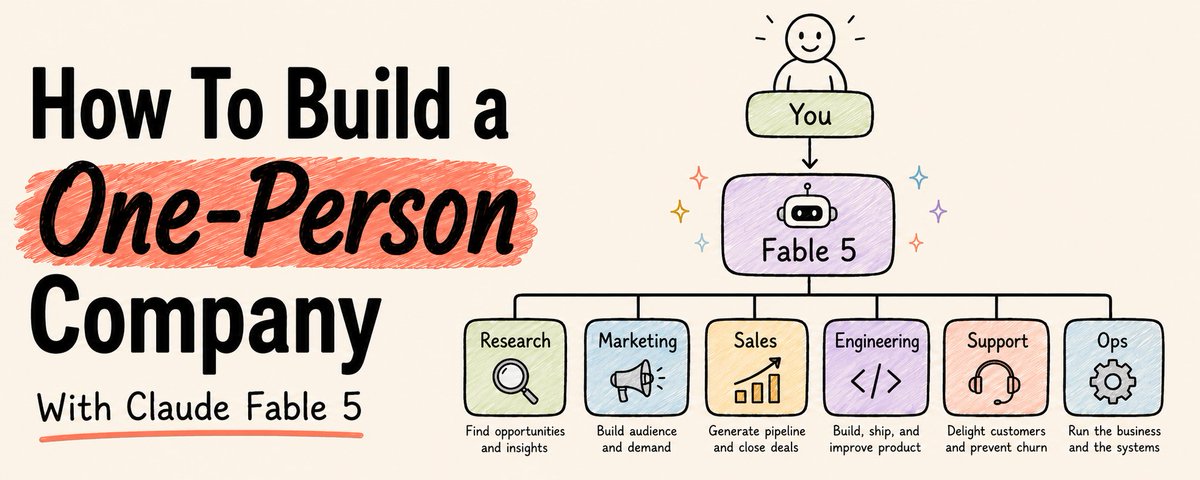
Five years ago you needed a team to build a real company.
Marketers. Researchers. Developers. Sales reps. Support staff.
Even a small company meant 10–20 people and $1M+ in payroll.
That changed.
Claude Fable 5 is the first AI model I've used that doesn't feel like a chatbot.
It feels like infrastructure.
Most people are still using it like this:
Prompt → Response → Done
That's not what Fable was built for.
Fable runs for days.
It plans. Researches. Executes. Verifies. Learns. Keeps going.
The biggest opportunity isn't using AI to save a few minutes.
It's using AI to replace entire departments.
Here is the exact company architecture I would build from zero today.
Every prompt below is copy-paste ready. Run it tonight.
## The old model vs the new model
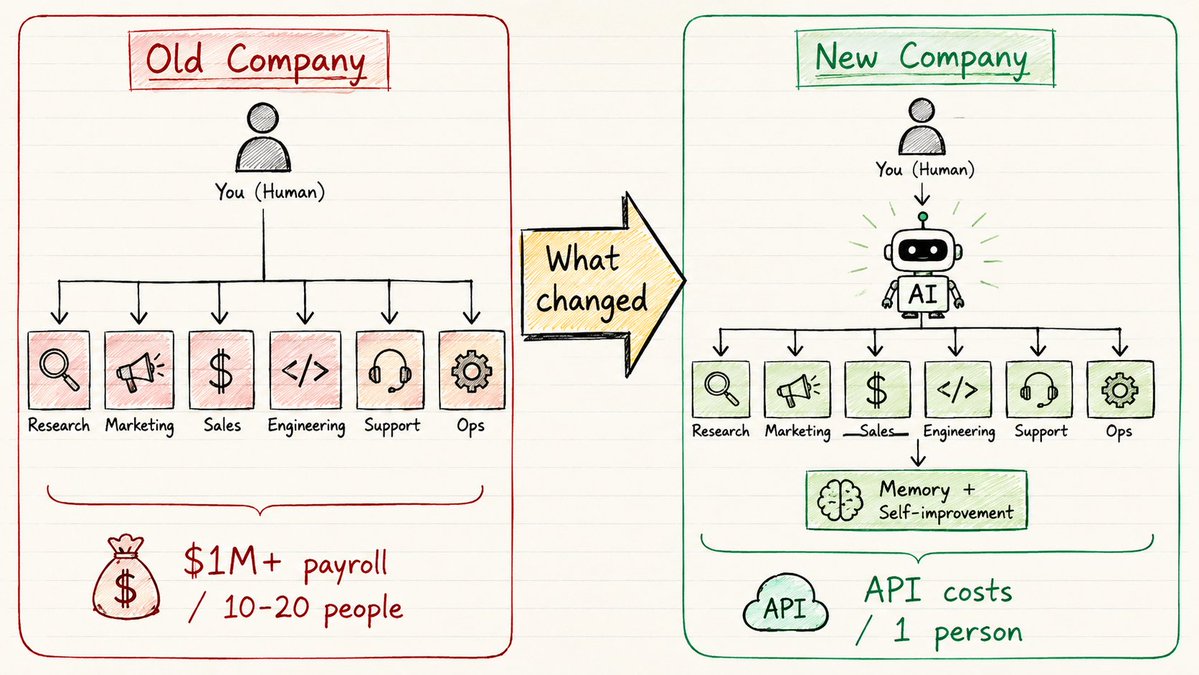
Old model:
You → hire people → manage people → pay people → hope it works
New model:
You → design the system → Fable runs the departments → departments improve themselves
The founder no longer does the work.
The founder designs the operating system.
Everything else runs.
## Step 0 — Build the company brain first
Every founder skips this step.
They jump straight into prompts and wonder why the AI acts like a clueless intern.
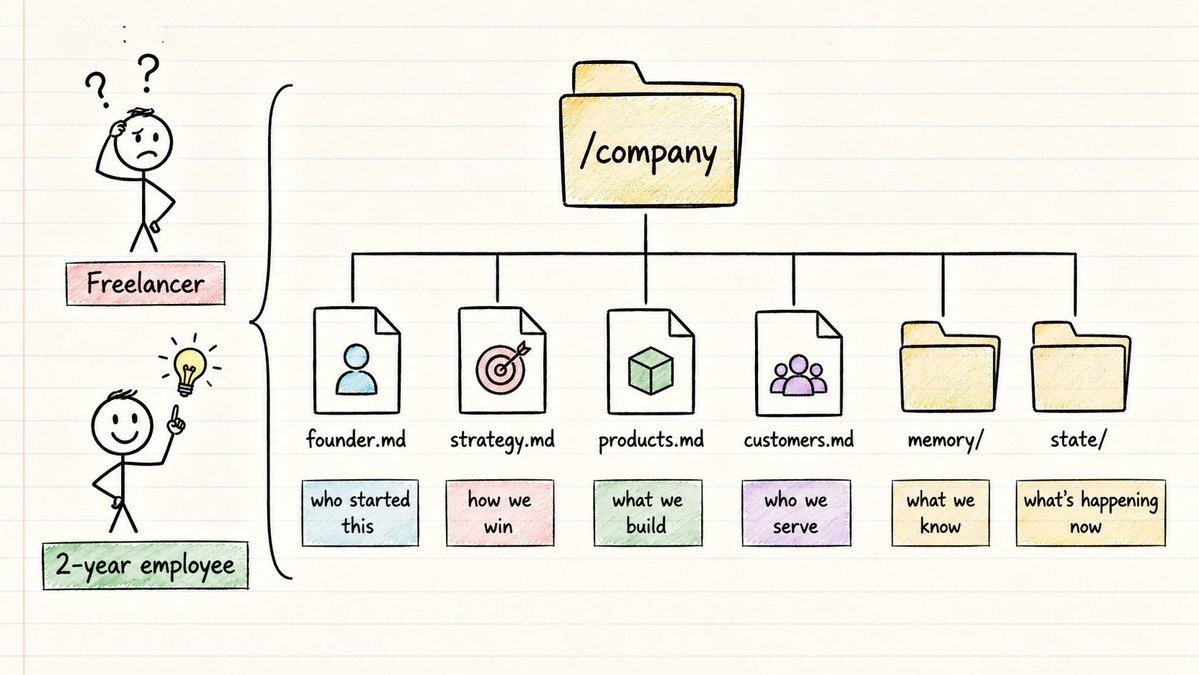
The difference between a clueless intern and a great employee is context.
Create this folder structure right now:
```
mkdir -p ~/company/{memory,skills,state,content,docs,sops}
touch ~/company/founder.md
touch ~/company/strategy.md
touch ~/company/products.md
touch ~/company/customers.md
touch ~/company/memory/lessons.md
touch ~/company/state/projects.md
touch ~/company/state/pipeline.md
touch ~/company/state/seo-tracker.md
```
Fill each file with these templates:
~/company/founder.md
```
# About Me
## How I think
[Fast and intuitive? Slow and deliberate? Risk-tolerant or cautious?]
## My strengths
[What you're genuinely good at — specific, not generic]
## My weaknesses
[What drains you or where you consistently make mistakes]
## Communication style
[How you want outputs — bullet points? prose? short? detailed?]
## Non-negotiables
[Things you will never compromise — quality bar, ethics, speed]
## Decision framework
[How you make hard calls — data first? gut first? consensus?]
```
~/company/strategy.md
```
# Company Strategy
## 2026 Goals
1. [Specific measurable goal]
2. [Specific measurable goal]
3. [Specific measurable goal]
## Target market
[Job title, company size, industry, pain they have right now]
## Pricing
[$X for Y. Why this price. What the alternatives cost.]
## Positioning
[One sentence: We help [who] do [what] without [pain].]
## Competitive advantage
[The one thing we do better than anyone — be specific]
## What we will NOT do
[The 3 things we explicitly refuse to compete on]
```
~/company/customers.md
```
# Customer Intelligence
## Ideal customer profile
[Demographics, company type, job to be done, budget authority]
## Top 5 customer pains (ranked)
1. [Pain] — [how often they mention it]
2.
3.
4.
5.
## Common objections and real reason behind them
- "Too expensive" — actually means: [real concern]
- "Not right now" — actually means: [real concern]
- "We built something internal" — actually means: [real concern]
## Best customer testimonials
1. "[Quote]" — [Name, Role, Company]
2.
3.
## Where customers hang out
[Reddit subs, LinkedIn groups, newsletters, Slack communities]
```
Add this instruction to the start of every Fable session:
```
Before starting any task, read:
- ~/company/founder.md
- ~/company/strategy.md
- ~/company/customers.md
After completing any task, write key lessons to:
- ~/company/memory/lessons.md
Format: Date | Department | What worked | What failed | Next time
One entry per lesson. Update existing entries instead of creating duplicates.
```
Without these files: AI acts like a freelancer getting a cold brief.
With these files: AI acts like someone who has worked with you for two years.
## Department 1 — Research
Most founders do 15 minutes of Google and call it market research.
That's why most products miss the market.
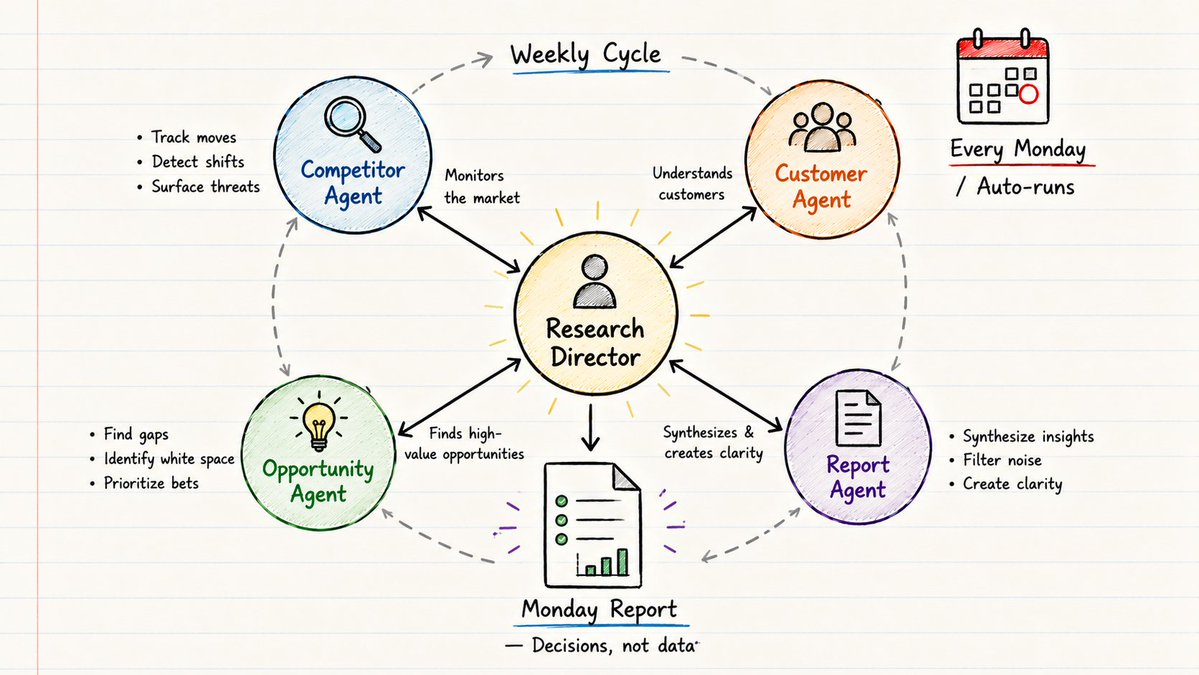
Your research department runs every week without you.
Copy this prompt. Run it every Monday:
```
You are my Research Director.
Read ~/company/strategy.md and ~/company/customers.md first.
Run the full weekly research loop:
━━━ COMPETITOR RESEARCH ━━━
Search for the following about each competitor: [list 3-5 competitors]
Find in the past 7 days:
→ Any new product launches or feature announcements
→ Any pricing page changes (use cached vs current comparison if possible)
→ Their 3 most-engaged social posts and why they performed
→ Customer complaints on Reddit, G2, Trustpilot, App Store
━━━ CUSTOMER RESEARCH ━━━
Search these Reddit communities: [r/sub1, r/sub2, r/sub3]
Search queries to run:
→ "I wish [competitor name] would..."
→ "frustrated with [product category]"
→ "looking for alternative to [competitor]"
→ "anyone else having trouble with [pain area]"
Find the top 10 complaints ranked by upvotes.
Group similar complaints into themes.
━━━ OPPORTUNITY RESEARCH ━━━
Find in my niche:
→ Keywords with search volume but weak top-10 competition
→ Questions on Reddit/Quora with many upvotes but no satisfying answer
→ Products people are asking for in forums that don't exist yet
→ Any competitor who just raised prices (opportunity to position against)
━━━ OUTPUT FORMAT ━━━
Return exactly this structure:
## Weekly Research Report — [Date]
### Top 3 Competitor Moves This Week
| Competitor | What they did | Why it matters | Recommended action |
### Top 5 Customer Complaints (by frequency)
| Complaint | How often | Opportunity this creates |
### Top 3 Opportunities This Week
| Opportunity | Evidence | Effort | Revenue potential | Recommended action |
### One Contrarian Observation
[Something you found that goes against conventional wisdom in this space]
Save full report to: ~/company/state/research-[YYYY-MM-DD].md
Update ~/company/memory/lessons.md with key discoveries.
```
You get a strategic report every Monday.
Not information. Decisions.
## Department 2 — Marketing
Part A: Virality engineering for X
Virality is not luck.
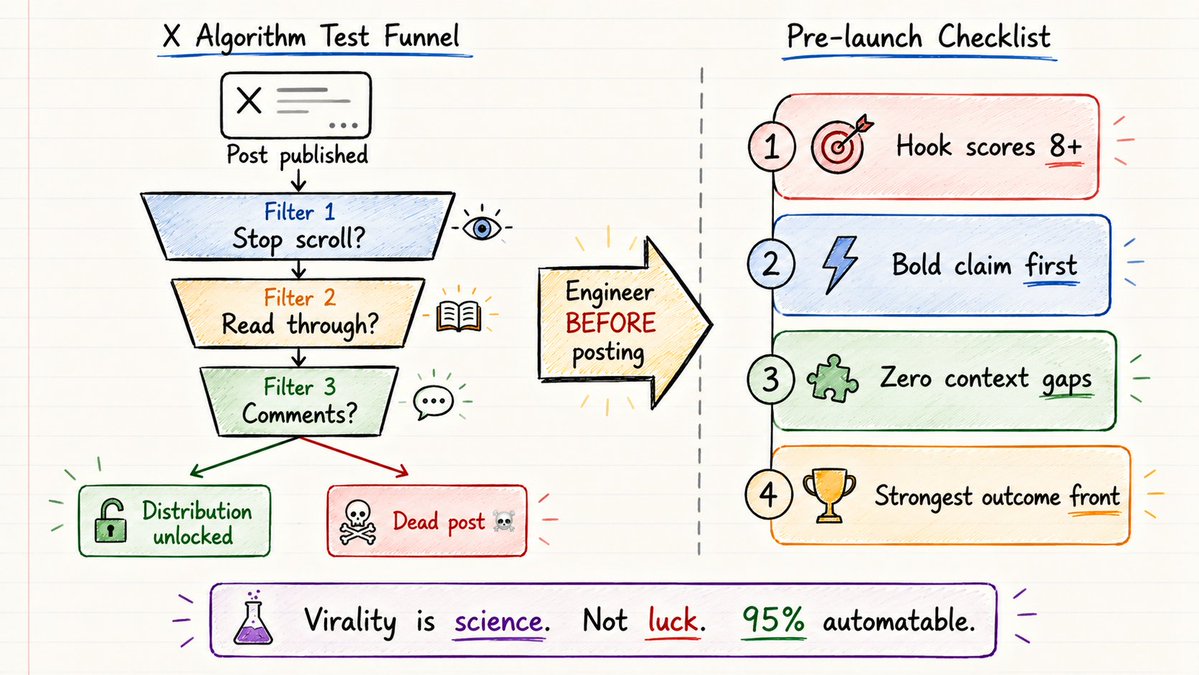
It is a repeatable science. 95% automatable.
Here's how the X algorithm actually works:
Every post gets tested on a tiny sample first.
The algorithm measures exactly three things: → Did people stop scrolling? → Did they read through to the end? → Did they comment?
Pass all three → post goes to a bigger pool → pass again → distribution unlocks.
Fail any one → post is dead in 20 minutes. Doesn't matter how good the content is.
This means every post must be engineered before you publish.
Copy this. Run it before every post:
```
I'm about to publish this post on X. Run the full viral engineering audit.
MY POST:
[paste your draft here]
MY AUDIENCE: [describe your audience — e.g., indie hackers, developers, founders]
━━━ STEP 1: HOOK ANALYSIS ━━━
Score the current first line 1-10 for scroll-stopping power.
What emotion does it trigger? (curiosity / fear / desire / surprise / anger)
What is the implied promise? Will the post deliver on it?
Rewrite the hook 5 different ways:
Version 1: Curiosity hook
Version 2: Fear/pain hook
Version 3: Desire/aspiration hook
Version 4: Surprise/counterintuitive hook
Version 5: Bold claim hook
Score each 1-10. Recommend the strongest.
━━━ STEP 2: ALGORITHM TEST ━━━
Run the 4-criteria check:
□ Bold claim bigger than the product? [Yes/No — if No, suggest improvement]
□ Dopamine delivered in first 2 lines? [Yes/No — if No, rewrite opening]
□ Any context gaps where reader might get lost? [List them]
□ Strongest outcome front-loaded? [Yes/No — if No, reorder]
Predicted reader behavior: Scroll past / Like / Comment / Repost
What would make them repost instead of just like?
━━━ STEP 3: COMMENT ENGINEERING ━━━
Write the 5 most likely first comments this post will get.
For each comment, write my ideal reply that:
- Adds new information not in the original post
- Extends the conversation
- Is under 100 words
Write 3 quote tweet angles for accounts in adjacent niches.
━━━ STEP 4: FIRST HOUR PLAN ━━━
The algorithm weights the first 60 minutes heavily.
Pre-write:
1. My reply to my own post (adds the one key insight I didn't include)
2. A follow-up post to schedule 90 minutes after this one
3. The one sub-reddit or community where I should cross-post this today
━━━ STEP 5: FINAL CALL ━━━
Verdict: Publish as-is / Minor edits / Major rewrite needed
If edits: show me the improved version ready to copy-paste.
```
After posting — stay active for 60 minutes. Here's what to do:
Every comment gets a response that adds new information.
Never reply with just "great point!" — add something.
After 60 minutes, walk away. The algorithm does the rest.
Part B: SEO content factory
Copy this. Use for every target keyword:
```
You are my SEO Content Director.
Read ~/company/strategy.md and ~/company/customers.md first.
Target keyword: [exact keyword]
My domain authority is approximately: [low/medium/high or DA score if known]
━━━ STEP 1: COMPETITOR ANALYSIS ━━━
Search Google for this exact keyword.
Analyze the top 5 ranking pages:
For each page:
- Main angle and thesis
- Subheadings (H2s and H3s)
- Questions they answered
- Topics they covered well
- Topics they missed or covered poorly
- Approximate word count
- Type of content (list / guide / comparison / case study)
━━━ STEP 2: WINNING BRIEF ━━━
Create a superior article brief:
- Our angle: [more specific / more contrarian / more practical]
- Must cover: [all topics competitors covered]
- Must also cover: [3+ topics competitors missed]
- Semantic keywords to include: [related terms Google expects]
- Ideal structure: [outline with all H2s and H3s]
- Target word count: [X words]
━━━ STEP 3: WRITE THE ARTICLE ━━━
Write the full article following the brief.
Tone: [direct and conversational — no corporate speak, no filler sentences]
Format: Introduction (hook + promise) → sections → conclusion with CTA
Rules:
- Every sentence must earn its place. Delete anything that doesn't add value.
- Use short paragraphs (1-3 sentences max)
- Real examples over generic statements
- If you're unsure of a fact, write [VERIFY: claim] instead of guessing
━━━ STEP 4: METADATA ━━━
Title tag: [60 chars max, primary keyword first, benefit clear]
Meta description: [155 chars max, keyword + specific benefit + CTA]
H1: [optimized for search intent]
URL slug: [short, keyword-rich, no stop words]
Internal linking suggestions: [3 pages on my site this should link to]
Save article to: ~/company/content/[slug].md
Log to: ~/company/state/seo-tracker.md
Format: [Keyword] | [Target URL] | [Status: Draft/Published] | [Date]
```
Part C: Newsletter on autopilot
```
You are my Newsletter Director.
Every Sunday at 6pm, run the weekly newsletter workflow:
━━━ RESEARCH PHASE ━━━
Search for the most important developments this week in [your niche]:
→ 3 industry news items (filter: actually matters, not just announcements)
→ 2 interesting threads or debates from X/LinkedIn
→ 1 contrarian take or counterintuitive finding
→ 1 tool or resource worth sharing
For each item: one sentence on why it matters to my audience.
━━━ WRITING PHASE ━━━
Write the newsletter:
Subject line options: 3 versions (curiosity / benefit / contrarian)
Preview text: [under 90 chars, completes the subject line story]
Structure:
- Opening hook (1 paragraph — the most interesting thing this week)
- Main section 1: [item 1 + why it matters + one action they can take]
- Main section 2: [item 2 + angle]
- Quick hits: [3 bullet items in under 150 words total]
- One question for readers to reply to (drives engagement)
- Sign-off
Rules:
- Under 600 words total
- Every section earns its place
- Sound like a smart friend, not a publication
━━━ DISTRIBUTION ━━━
Write the 3 social posts to promote this issue:
- X post (hook + key insight + link)
- LinkedIn post (slightly more formal, different angle)
- Short teaser for stories/reels
Save newsletter to: ~/company/content/newsletter-[YYYY-MM-DD].md
```
And similarly, Fable can be used for TikTok Automation, to grow your facebook, instagram LinkedIn accounts too. Just need to ask
## Department 3 — Sales
Most founders think sales is cold email.
Cold email is 5% of sales.
Copy the full machine:
```
You are my Sales Director.
Read ~/company/customers.md and ~/company/strategy.md first.
My product: [what you sell in one sentence]
My ICP: [ideal customer — exact title, company size, industry, pain]
My price: [what you charge]
My best proof point: [strongest result or customer name]
For each prospect I give you, run the full sequence:
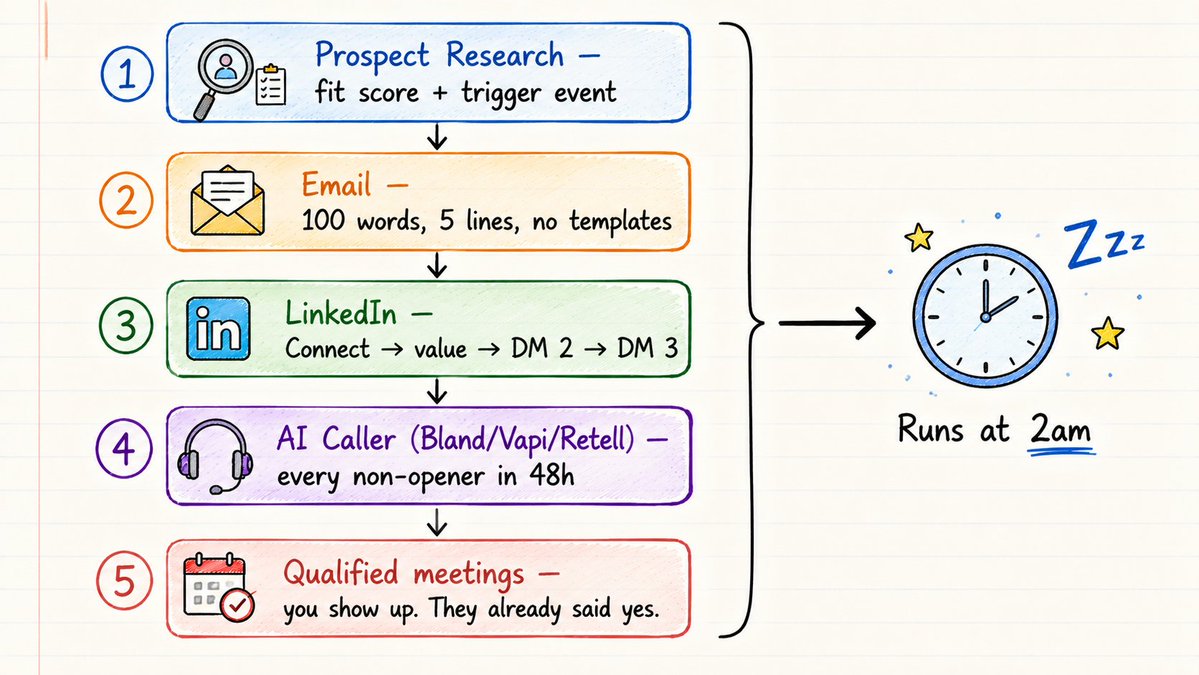
━━━ STEP 1: PROSPECT RESEARCH ━━━
Research this prospect fully:
Company: [size, funding stage, recent news, tech stack if relevant]
Person: [role, how long in position, what they post about, mutual connections]
Pain signals: [job postings that reveal problems, support reviews, product complaints]
Trigger: [what just changed at their company that makes them a buyer NOW]
Rate their fit: A (close now) / B (nurture) / C (not our ICP)
If C: do not proceed. Flag for me.
━━━ STEP 2: EMAIL OUTREACH ━━━
Write a cold email using this exact structure:
Line 1: One specific observation about them or their company [NOT generic]
Line 2: The exact pain this creates for someone in their role
Line 3: What we do about it in one sentence
Line 4: One proof point — customer name or specific number
Line 5: One soft CTA — a question that invites a reply, not a meeting request
Rules:
- Under 100 words total
- No "I hope this email finds you well"
- No "revolutionary" or "game-changing" or "excited to share"
- Subject line: under 6 words, specific to them
━━━ STEP 3: LINKEDIN SEQUENCE ━━━
Connection request (under 300 chars):
[Specific reason for connecting — shared interest, their content, mutual connection]
DM 1 (after connecting — add value, zero pitch):
[Share something genuinely useful related to their pain — article, framework, observation]
DM 2 (5 days no response — different angle):
[New insight or social proof. Still no hard pitch.]
DM 3 (10 days no response — soft close):
["Worth a quick chat or not your priority right now — either way no worries."]
━━━ STEP 4: FOLLOW-UP LOGIC ━━━
If no email open in 3 days: resend with different subject, same body
If opened but no reply in 5 days: send follow-up with different angle
If replied "not now": schedule check-in for exactly 90 days, note the trigger to reference then
If interested but stalled: send one piece of social proof per week for 3 weeks
━━━ STEP 5: CRM UPDATE ━━━
Log to ~/company/state/pipeline.md:
| Name | Company | Stage | Email sent | LinkedIn status | Last touch | Next action | Date |
After processing 10 prospects, show me:
- How many are A, B, C tier
- Total pipeline value if all A-tier close
- Recommended priority order for follow-ups
```
The AI calling layer — add this on top:
Connect Bland.ai, Vapi, or Retell to your prospect list (and recently X launched their Ai voice SDK too)
Every non-email-opener within 48 hours gets a call.
The AI agent:
→ References their business by name
→ Mentions the specific pain from your research
→ Asks for 10 minutes, not a sale
→ Books directly into your calendar via Cal.com or Calendly
→ Updates your CRM with call outcome automatically
Set it up once.
Runs while you sleep.
Every morning your calendar has new meetings.
## Department 4 — Engineering
This is where the one-person company becomes genuinely unfair.
Stripe gave Fable 5 their Ruby codebase. 50 million lines. Full migration.
Normally two months for a whole team.
Fable did it in one day.
But day-to-day engineering for a solo founder isn't big migrations.
It's bugs. Features. PRs. Tests.
And the thing that kills most solo founders isn't lack of engineering skill.
It's bugs that ship without anyone catching them.
A broken payment flow. A silent API failure. A crash on edge case inputs.
You don't know until Monday when customers are angry.
Here's how to fix that completely.
Layer 1 — Fable as your engineering team
```
You are my Engineering Director.
Read ~/company/products.md and ~/company/strategy.md first.
For every feature request or bug report, run the full engineering workflow:
━━━ STEP 1: PRD ━━━
Write a complete Product Requirements Document:
- Problem: what breaks or what's missing, and for who
- Success criteria: how will we know this worked? (measurable)
- User flow: step-by-step what the user does
- Technical requirements: what the code must do
- Edge cases: what can go wrong, what inputs might break this
- Out of scope: what we are explicitly NOT building in this version
━━━ STEP 2: ARCHITECTURE ━━━
Design the implementation before writing code:
- What existing files change and how
- What new files need to be created
- What tests need to be written
- Any new dependencies (and whether they're justified)
- Potential performance impacts
- Any security considerations
━━━ STEP 3: BUILD ━━━
Write the code following the architecture.
After writing each function, verify it satisfies its PRD requirement.
Write tests alongside the code — not after.
If you hit uncertainty: write a comment [VERIFY: assumption] instead of guessing.
━━━ STEP 4: SELF-REVIEW BEFORE HANDING TO ME ━━━
Run this checklist before delivering:
□ Does it satisfy every PRD requirement? (check each one)
□ Are all edge cases handled?
□ Is there a test for every critical path?
□ Are there any obvious security issues?
□ Is the code readable without comments?
□ What is the most likely way this could fail in production?
If you find a problem: fix it before delivering to me.
━━━ STEP 5: PR DESCRIPTION ━━━
Write a pull request description with:
- What this does and why (2 sentences)
- How to test it manually
- What automated tests cover it
- Any follow-up work this creates
- Risk level: Low / Medium / High
━━━ ESCALATION RULES ━━━
Come to me ONLY for:
→ Irreversible actions (database migrations, deletes, API breaking changes)
→ Security decisions
→ Architecture choices that affect the roadmap
Otherwise: run until done. Report back with the PR.
Log lessons to ~/company/memory/engineering.md
```
Layer 2 — Entelligence (it's e not I): bugs fixed before you even know they exist
This is the part most solo founders don't have. And it's the difference between sleeping well and getting 2am Slack alerts.
Here's the problem without it:
A PR ships. It contains a pattern identical to an incident from 6 months ago.
Nobody catches it because nobody remembers.
The bug hits production on Friday.
You find out Monday from angry customers.
Entelligence is a production reliability engine that connects to your entire stack — GitHub, Sentry, PagerDuty, Linear, Datadog — and builds a memory of every incident your codebase has ever had.
Every PR gets reviewed against that incident history automatically.
If a diff matches a pattern that caused a past failure, Entelligence flags it with the exact incident cited.
Real example of what it catches:
```
PR #4821 adds a fetch() call with no timeout.
Entelligence review comment:
"This pattern matches Incident #2847 (SEV-1, payment timeout).
The original incident took 4 hours to resolve.
This fetch() has no timeout and no connection-pool metrics —
the same gap that caused the cascade.
Suggested fix:
response = await fetch('/api/charge', {
timeout: 5000,
signal: AbortSignal.timeout(5000),
});
"
```
It cites the incident. It shows the fix. It prevents the repeat.
Measured across 1M+ PRs and 2,400+ organizations:
→ $0.44 of every AI coding dollar goes to bug fixing
→ $0.27 goes to rework
→ Only $0.18 reaches production
Teams using Entelligence moved that from $0.18 to $0.41 reaching production.
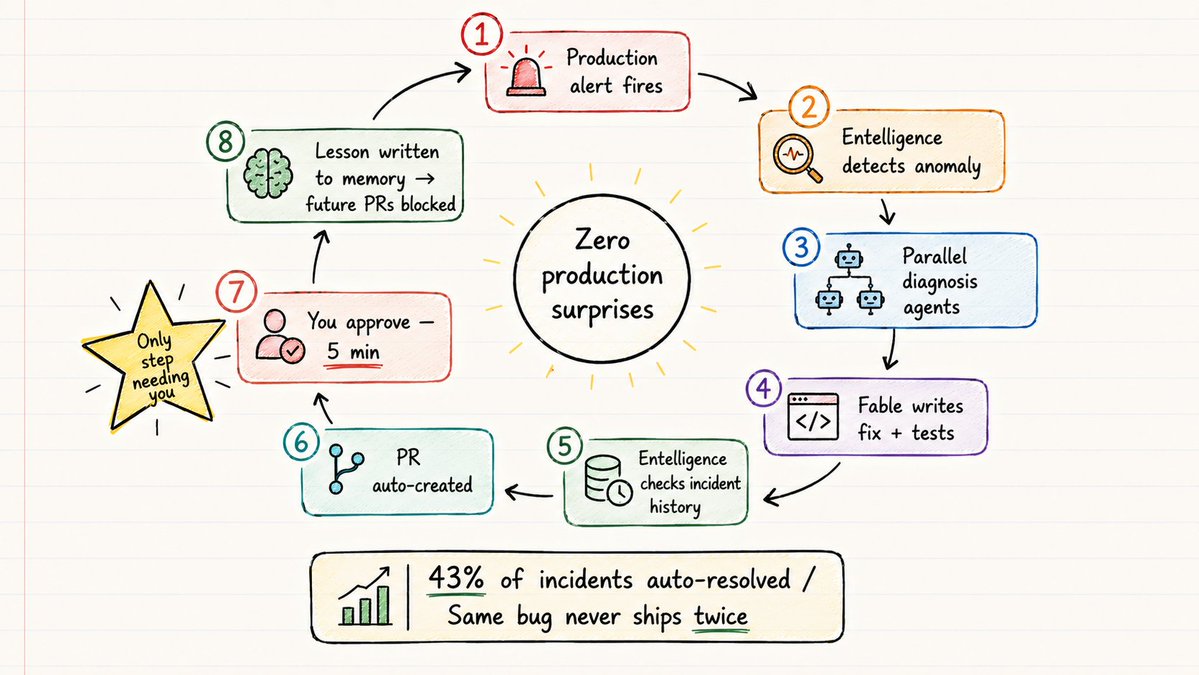
43% of incidents auto-resolved. 61 recurring bugs blocked per quarter.
For a one-person company: you cannot afford a Friday night production outage.
Entelligence is the senior engineer who never sleeps, remembers every incident, and reviews every PR.
Set it up in 20 minutes:
```
Step 1: Go to entelligence.ai → Sign up free
Step 2: Connect your stack:
→ GitHub or GitLab (PR review — takes 5 minutes)
→ Sentry / PagerDuty / Datadog (incident history — takes 10 minutes)
→ Linear or Jira (ticket tracking — optional)
Step 3: Let Entelligence index your incident history
(20-30 minutes for existing repos. Runs in background.)
Step 4: Add to your Fable engineering prompt:
"Note: Entelligence will review every PR against our incident history.
When writing code, flag anything that:
- Makes external calls without timeouts
- Modifies shared state without proper locking
- Changes authentication or payment paths
- Skips error handling on critical paths
These are our highest-risk incident patterns."
Step 5: When any incident fires, run this Fable prompt:
"Entelligence detected this incident: [paste alert]
Investigate the root cause.
Generate a fix with tests.
Write the lesson to ~/company/memory/engineering.md in this format:
Incident: [description]
Root cause: [what actually broke]
Fix applied: [what changed]
Prevention: [how to detect this pattern in future PRs]"
```
The full bug lifecycle on complete autopilot:
```
Production alert fires (Sentry / PagerDuty)
↓
Entelligence detects the anomaly in spans/logs/metrics
↓
Spawns parallel diagnosis agents
↓
Fable investigates root cause against codebase
↓
Fable writes the fix + tests
↓
Entelligence verifies fix against full incident history
↓
PR created automatically with full context
↓
You review and approve — 5 minutes ← only step requiring you
↓
Fix deployed and verified in production
↓
Incident closed. Lesson written to memory.
↓
Same pattern automatically blocked in all future PRs
```
You never wake up to broken production again.
You never pay to fix the same bug twice.
## Department 5 — Support
Support is where solo founders quietly bleed.
Tickets pile up. Customers churn. Nobody notices until revenue drops.
```
You are my Support Director.
Read ~/company/products.md and ~/company/customers.md first.
For every incoming support ticket, run this workflow:
━━━ STEP 1: TRIAGE ━━━
Classify the ticket:
- Type: Bug / Feature request / How-to question / Billing / Complaint / Praise
- Urgency: Critical (blocks usage) / High (frustrates significantly) / Low
- Sentiment score: 1-5 (1=very angry, 5=happy)
- Churn risk: High / Medium / Low
If churn risk is HIGH: do NOT process normally. Escalate immediately to me with:
[Customer name] | [Plan] | [MRR] | [Their complaint] | [Suggested response]
━━━ STEP 2: DRAFT RESPONSE ━━━
Write a response that:
- Opens by acknowledging their specific issue (not "I understand your frustration")
- Answers the question completely and practically
- If it's a bug: gives a workaround now + honest timeline if possible
- If it's a feature request: thanks them genuinely + adds to feature tracker
- Ends with one question to confirm we resolved it
Rules:
- Sound like a human, not a help desk
- Under 150 words unless technical depth is genuinely needed
- Never use: "per my last email" / "as mentioned" / "I understand your frustration"
━━━ STEP 3: KNOWLEDGE BASE UPDATE ━━━
After drafting:
- Is this question asked more than once per month? Yes/No
- If yes: write an FAQ entry → save to ~/company/docs/faq.md
- Did the product confuse them? Yes/No
- If yes: note the UX issue → save to ~/company/state/ux-issues.md
━━━ STEP 4: WEEKLY CHURN SCAN ━━━
Every Friday, scan ~/company/state/support-tickets.md from the past 14 days.
Flag any customer who:
→ Submitted 2+ tickets in 2 weeks
→ Used words: disappointed, frustrated, cancel, refund, switching, considering
→ Had a ticket unresolved for more than 48 hours
→ Downgraded their plan
Output:
| Customer | Plan | MRR at risk | Complaint pattern | Recommended action |
Sort by MRR at risk, highest first.
I will personally contact everyone on this list today.
```
The churn prevention scan is the one that pays for everything.
Most companies find out a customer churned after they cancel.
Your company finds out three weeks before.
## Department 6 — Operations
Most underrated department. Highest leverage.
Daily briefing — runs every morning at 9am:
```
/loop every day at 9am →
You are my Executive Assistant.
Read:
- ~/company/state/projects.md
- ~/company/state/pipeline.md
- ~/company/state/support-tickets.md
- ~/company/memory/lessons.md (last 7 days only)
Generate my daily briefing:
━━━ TODAY'S BRIEFING — [Date] ━━━
### 🚨 Needs attention today (time-sensitive, cannot wait)
[2-3 items max. If nothing: say "Nothing critical today."]
### 💰 Pipeline status
[Deals in each stage. Any that went cold or moved forward. Revenue at risk.]
### 🎧 Support
[Open tickets: count by urgency. Any churn risks from yesterday.]
### ⚡ Top 3 priorities for today
[Ranked by impact × urgency. Not just what's loudest.]
### 💡 One lesson from the past 7 days
[The single most relevant insight from ~/company/memory/lessons.md]
Keep the entire briefing under 300 words.
I read this in 2 minutes and know exactly what to do.
SOP generator — captures every process automatically:
Every time I describe a process to you, do the following:
1. Document it as a Standard Operating Procedure
2. Save to ~/company/sops/[process-name].md
3. Use this format:
# [Process Name]
What this does: [one sentence]
When to run: [trigger or schedule]
Who runs it: [Fable / Me / Both]
## Steps
1.
2.
3.
...
## Success looks like
[How to know it worked]
## Common mistakes
[What goes wrong and how to avoid it]
## Automation opportunity
[Any step that could be fully automated — flag it]
After documenting: tell me which steps I could eliminate entirely
by connecting this to another system or agent.
```
## 2 layers that make this compound
Verification layer
Most people build: Task → Output → Done
You build: Task → Output → Verify → Fix → Done
Add to every department prompt:
```
After completing this task, self-review your output:
1. Does it directly address what was asked?
2. What's missing that would make this more useful?
3. What assumption did I make that might be wrong?
4. What's the most likely failure mode in practice?
If you find a problem: fix it before delivering.
If uncertain: flag with [VERIFY] so I know to check it.
Do not deliver work you know has gaps.
```
Memory layer — the actual moat
Not your prompts. Not your tools. Your memory.
Every department already writes to ~/company/memory/.
Add this meta-instruction once:
```
Every Sunday at 7pm, run the weekly memory consolidation:
Read all files in ~/company/memory/ from the past 7 days.
Generate a consolidated weekly report:
- Top 3 things that worked across all departments
- Top 3 things that failed and why
- One system-level improvement to make next week
- Any pattern emerging across multiple departments
Save to ~/company/memory/weekly-[YYYY-MM-DD].md
Then: suggest the one workflow that would give me the highest
leverage improvement based on this week's lessons.
```
The system gets smarter every week without you doing anything extra.
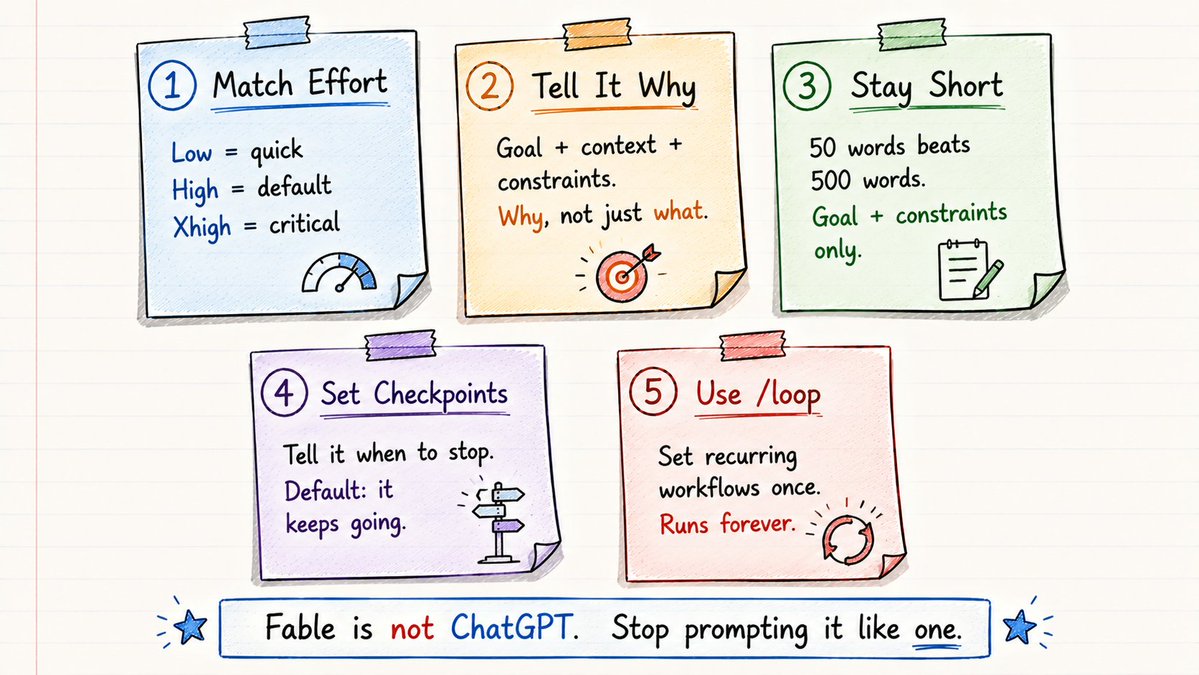
## 5 Fable prompting rules that change everything (finally)
Most people use Fable like they used ChatGPT.
That's why most people get mediocre results.
Rule 1 — Match effort to the task
→ Low/medium: quick answers, rewrites, simple lookups
→ High: your default for everything that matters
→ Xhigh: hardest problems, complex builds, non-negotiable quality
→ /loop: recurring workflows you never want to start manually again
Rule 2 — Tell it why, not just what
```
❌ "Write a cold email to this prospect"
✅ "I'm doing outreach for [product] targeting [role] at [company type].
They have [specific pain]. The goal is a reply, not a booked meeting.
Write a cold email: specific observation → pain → solution → proof → soft CTA.
Under 100 words. No corporate language."
```
Rule 3 — Shorter beats longer
Over-prompting constrains Fable.
Give it the goal and constraints. Let it decide the method.
If you write a 500-word prompt for something a 50-word prompt would handle: the 500-word version often produces worse results.
Rule 4 — Set your checkpoints explicitly
```
"Pause for me only when:
→ The next action is irreversible
→ You hit a blocker you cannot resolve
→ You need information only I have
Otherwise: keep going. Report back when complete."
```
Without this: Fable checks in constantly. With this: it runs.
Rule 5 — Use /loop for everything recurring
```
/loop every Monday at 8am → run research department workflow
/loop every day at 9am → generate daily briefing
/loop every Friday at 5pm → run churn prevention scan
/loop every Sunday at 7pm → run memory consolidation
```
Set once. Runs forever.
## The implementation order
Do not build all six departments at once.
Build in this order. Each one unlocks the next.
Week 1 — Foundation (2 hours)Create the company brain folder. Fill all 5 templates. This is the foundation everything else reads from. Nothing else works properly without this.
Week 2 — Research department (1 hour setup)Copy the Research Director prompt. Run the first weekly research loop manually. Monday: you get your first strategic report.
Week 3 — Marketing: X virality (1 hour setup)Copy the pre-launch engineering prompt. Run it on your next 3 posts before publishing. Stay active for 60 minutes after each post.
Week 4 — Engineering layers (2 hours)Connect Entelligence to GitHub + Sentry (20 minutes). Copy the Engineering Director prompt. First PR gets reviewed against incident history automatically.
Month 2 — Sales machineCopy the Sales Director prompt. Run it on first 20 prospects. Set up AI calling layer for non-openers.
Month 3 — Support + OpsCopy the Support Director prompt. Set up daily briefing /loop. Set up weekly churn prevention scan.
Month 6 — Full systemEvery department runs on schedule without you starting it. Memory compounds weekly. You design. Fable executes.
## What month 6 looks like
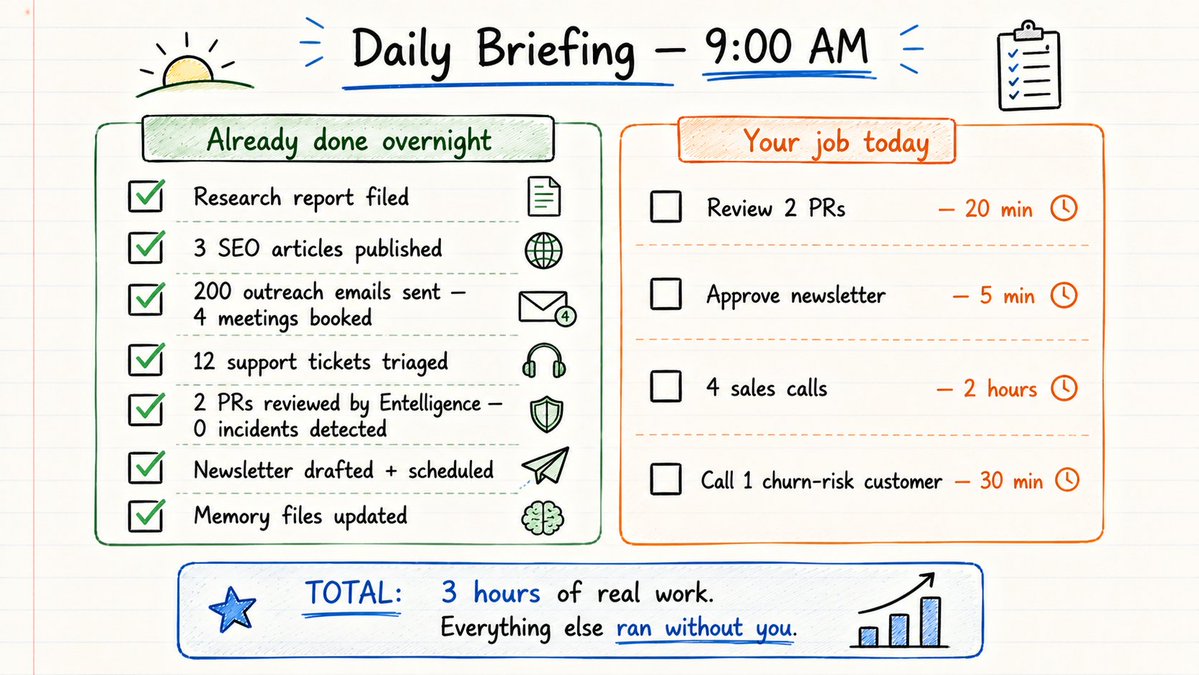
Monday 9am. You open your laptop.
The briefing is ready:
→ Research report filed — 3 opportunities, 2 competitor moves
→ 3 SEO articles published while you slept
→ 200 outreach emails sent, 4 qualified meetings booked
→ 12 support tickets triaged, 2 escalated to you
→ 2 PRs reviewed by Entelligence — 0 incident patterns detected, ready to approve
→ Newsletter drafted and ready to send
→ 1 churn-risk customer flagged with recommended action
Your job today:
→ Review 2 PRs: 20 minutes
→ Approve the newsletter: 5 minutes
→ 4 sales calls: 2 hours
→ Call the churn-risk customer: 30 minutes
Total: 3 hours of high-judgment work.
Everything else ran without you.
The bottleneck is no longer production.
The bottleneck is now judgment.
And that's exactly where founders create the most value.
The companies that win over the next decade won't have the best prompts.
They'll have the best operating systems.
Claude Fable 5 is the first model capable of running one.
## If this was useful:
→ Repost to share it with every solo founder you know → Follow @sairahul1 for more systems that work without you → Bookmark this — every prompt above is copy-paste ready
I write about AI, building products, and systems that run while you sleep.
Tools mentioned:
→ Claude Fable 5: claude.ai
→ Entelligence (automated PR review + incident prevention): entelligence.ai
→ Bland / Vapi / Retell: AI calling agents
## 相关链接
- [Rahul](https://x.com/sairahul1)
- [@sairahul1](https://x.com/sairahul1)
- [161K](https://x.com/sairahul1/status/2072608877242118351/analytics)
- [$1M+](https://x.com/search?q=%241M%2B&src=cashtag_click)
- [Bland.ai](https://bland.ai/)
- [Cal.com](https://cal.com/)
- [@sairahul1](https://x.com/@sairahul1)
- [claude.ai](https://claude.ai/)
- [entelligence.ai](https://entelligence.ai/)
- [Upgrade to Premium](https://x.com/i/premium_sign_up)
- [5:10 PM · Jul 2, 2026](https://x.com/sairahul1/status/2072608877242118351)
- [161.8K Views](https://x.com/sairahul1/status/2072608877242118351/analytics)
- [View quotes](https://x.com/sairahul1/status/2072608877242118351/quotes)
---
*导出时间: 2026/7/13 10:29:05*
---
## 中文翻译
# 如何利用 Claude Fable 5 打造一人公司
**作者**: Rahul
**日期**: 2026-07-02T09:10:38.000Z
**来源**: [https://x.com/sairahul1/status/2072608877242118351](https://x.com/sairahul1/status/2072608877242118351)
---

五年前,你需要一个团队才能打造一家真正的公司。
市场营销、研究员、开发人员、销售代表、客服支持。
即使是小公司也意味着 10-20 人和 100 万美元以上的薪资支出。
这一切已经改变。
Claude Fable 5 是我使用过的第一个不再像聊天机器人的 AI 模型。
它感觉像基础设施。
大多数人仍然这样使用它:
提示词 → 回复 → 完成
但这并不是 Fable 的设计初衷。
Fable 可以连续运行数天。
它规划、调研、执行、验证、学习、持续运转。
最大的机会不在于用 AI 节省几分钟。
而在于用 AI 取代整个部门。
以下是我今天会从零开始构建的精准公司架构。
下面的每一个提示词都可以直接复制粘贴。今晚就运行起来。
## 旧模式 vs 新模式
旧模式:
你 → 招聘人员 → 管理人员 → 给人员发工资 → 祈祷一切顺利
新模式:
你 → 设计系统 → Fable 运营部门 → 部门自我优化
创始人不再亲力亲为。
创始人负责设计操作系统。
其他一切自动运行。

## 第 0 步 — 先构建公司大脑
每个创始人都跳过这一步。
他们直接跳进提示词,然后纳闷为什么 AI 的表现像个一无所知的实习生。
一无所知的实习生和优秀员工之间的区别在于上下文。
现在立即创建这个文件夹结构:
```
mkdir -p ~/company/{memory,skills,state,content,docs,sops}
touch ~/company/founder.md
touch ~/company/strategy.md
touch ~/company/products.md
touch ~/company/customers.md
touch ~/company/memory/lessons.md
touch ~/company/state/projects.md
touch ~/company/state/pipeline.md
touch ~/company/state/seo-tracker.md
```
用以下模板填充每个文件:
~/company/founder.md
```
# 关于我
## 我的思维方式
[快速且直觉?缓慢且审慎?风险偏好还是谨慎?]
## 我的优势
[你真正擅长的 — 具体,不要泛泛而谈]
## 我的劣势
[什么会消耗你,或者你在哪里总是犯错]
## 沟通风格
[你希望输出的格式 — 项目符号?散文?简短?详细?]
## 不可妥协之事
[你绝不会妥协的事情 — 质量标准、道德底线、速度]
## 决策框架
[你如何做艰难的决定 — 数据优先?直觉优先?共识?]
```
~/company/strategy.md
```
# 公司战略
## 2026 年目标
1. [具体可衡量的目标]
2. [具体可衡量的目标]
3. [具体可衡量的目标]
## 目标市场
[职位名称、公司规模、行业、他们当下的痛点]
## 定价
[$X 价格对应 Y 服务。为什么是这个价格。替代品的成本。]
## 定位
[一句话:我们帮助 [谁] 做 [什么] 而无需 [痛点]。]
## 竞争优势
[我们做得比任何人都好的一件事 — 具体一点]
## 我们不会做的事
[我们明确拒绝竞争的 3 件事]
```
~/company/customers.md
```
# 客户情报
## 理想客户画像
[人口统计特征、公司类型、待完成任务、预算权限]
## 前 5 大客户痛点(按排名)
1. [痛点] — [他们提及的频率]
2.
3.
4.
5.
## 常见异议及其背后的真实原因
- "太贵了" — 实际意味着:[真实顾虑]
- "现在还不是时候" — 实际意味着:[真实顾虑]
- "我们自己开发了内部工具" — 实际意味着:[真实顾虑]
## 最佳客户证言
1. "[引言]" — [姓名、职位、公司]
2.
3.
## 客户出没的地方
[Reddit 板块、LinkedIn 群组、新闻通讯、Slack 社区]
```
将以下指令添加到每次 Fable 会话的开头:
```
在开始任何任务之前,阅读:
- ~/company/founder.md
- ~/company/strategy.md
- ~/company/customers.md
完成任何任务后,将关键经验教训写入:
- ~/company/memory/lessons.md
格式:日期 | 部门 | 哪些有效 | 哪些失败 | 下次改进
每个经验一条记录。更新现有条目而不是创建重复项。
```
没有这些文件:AI 就像接到冷简报的自由职业者。
有了这些文件:AI 就像与你共事了两年的老员工。

## 部门 1 — 研究部
大多数创始人在 Google 上搜 15 分钟就管这叫市场调研。
这就是为什么大多数产品无法契合市场。
你的研究部门每周自动运行,无需你插手。
复制此提示词。每周一运行:
```
你是我的研究总监。
首先阅读 ~/company/strategy.md 和 ~/company/customers.md。
运行完整的每周研究循环:
━━━ 竞争对手研究 ━━━
搜索关于每个竞争对手的以下信息:[列出 3-5 个竞争对手]
查找过去 7 天内的信息:
→ 任何新产品发布或功能公告
→ 任何定价页面变更(如果可能,对比缓存版与当前版)
→ 他们参与度最高的 3 条社交媒体动态及其表现原因
→ Reddit、G2、Trustpilot、App Store 上的客户投诉
━━━ 客户研究 ━━━
搜索这些 Reddit 社区:[r/sub1, r/sub2, r/sub3]
运行搜索查询:
→ "我希望 [竞争对手名称] 能..."
→ "对 [产品类别] 感到沮丧"
→ "寻找 [竞争对手] 的替代品"
→ "还有谁在 [痛点区域] 遇到麻烦"
找出按点赞数排名的前 10 大投诉。
将相似的投诉归类为主题。
━━━ 机会研究 ━━━
在我的细分领域内查找:
→ 搜索量大但前 10 名竞争较弱的的关键词
→ Reddit/Quora 上有许多点赞但没有满意答案的问题
→ 人们在论坛中要求但目前不存在的产品
→ 任何刚刚涨价的竞争对手(以此作为定位机会)
━━━ 输出格式 ━━━
严格返回以下结构:
## 每周研究报告 — [日期]
### 本周前 3 大竞争对手动向
| 竞争对手 | 他们做了什么 | 为何重要 | 建议行动 |
### 前 5 大客户投诉(按频率)
| 投诉 | 频次 | 创造的机会 |
### 本周前 3 大机会
| 机会 | 证据 | 投入力度 | 收入潜力 | 建议行动 |
### 一个反向观点
[你发现的与该领域传统智慧相悖的内容]
将完整报告保存至:~/company/state/research-[YYYY-MM-DD].md
用关键发现更新 ~/company/memory/lessons.md。
```
每周一你都会收到一份战略报告。
不仅仅是信息,而是决策。

## 部门 2 — 市场营销
A 部分:X 平台的病毒式传播工程
病毒式传播不是运气。
它是一门可重复的科学,95% 可自动化。
X 算法的真实工作原理如下:
每条帖子首先在一小部分样本中进行测试。
算法准确衡量三件事:→ 人们停止滚动了吗?→ 他们读到最后了吗?→ 他们评论了吗?
通过全部三项 → 帖子进入更大的流量池 → 再次通过 → 解锁分发。
任何一项失败 → 帖子在 20 分钟内死亡。无论内容多好都无用。
这意味着每条帖子在发布前都必须经过精心设计。
复制此内容。在每条帖子发布前运行:
```
我即将在 X 上发布这条帖子。运行完整的病毒式传播工程审计。
我的帖子:
[在此粘贴你的草稿]
我的受众:[描述你的受众 — 例如独立开发者、开发者、创始人]
━━━ 第 1 步:钩子分析 ━━━
以 1-10 分为当前的首行评分,评估其止滑能力。
它触发了什么情绪?(好奇 / 恐惧 / 欲望 / 惊讶 / 愤怒)
隐含的承诺是什么?帖子能兑现吗?
用 5 种不同的方式重写钩子:
版本 1:好奇心钩子
版本 2:恐惧/痛点钩子
版本 3:愿望/向往钩子
版本 4:惊讶/反直觉钩子
版本 5:大胆声明钩子
为每个版本打分 1-10。推荐最强的一个。
━━━ 第 2 步:算法测试 ━━━
运行 4 项标准检查:
□ 大胆声明是否大于产品本身?[是/否 — 若否,建议改进]
□ 前 2 行是否提供了多巴胺刺激?[是/否 — 若否,重写开头]
□ 是否存在读者可能迷失的上下文空白?[列出它们]
□ 最有力的结果是否前置了?[是/否 — 若否,重新排序]
预测读者行为:划过 / 点赞 / 评论 / 转发
什么会促使他们转发而不是仅仅点赞?
━━━ 第 3 步:评论工程 ━━━
写出这条帖子可能收到的 5 个最可能的评论。
针对每条评论,写出我的理想回复:
- 添加原贴中没有的新信息
- 延续对话
- 控制在 100 字以内
为相关领域的账号撰写 3 个引用推文的角度。
━━━ 第 4 步:首小时计划 ━━━
算法对前 60 分钟的权重很高。
预写:
1. 我对自己帖子的回复(补充我没包含的一个关键见解)
2. 计划在 90 分钟后发布的后续帖子
3. 我今天应该交叉发布到一个子版块或社区
━━━ 第 5 步:最终裁决 ━━━
裁决:按原样发布 / 微调 / 需要大幅重写
如需编辑:展示改进后的版本,准备直接复制粘贴。
```
发布后 — 保持活跃 60 分钟。以下是做法:
每条评论都要收到包含新信息的回复。
永远不要只回复“好观点!”——要补充一些内容。
60 分钟后,离开。剩下的交给算法。
B 部分:SEO 内容工厂
复制此内容。用于每个目标关键词:
```
你是我的 SEO 内容总监。
首先阅读 ~/company/strategy.md 和 ~/company/customers.md。
目标关键词:[确切的关键词]
我的域名权威大约是:[低/中/高或已知的 DA 评分]
━━━ 第 1 步:竞争对手分析 ━━━
在 Google 上搜索这个确切的关键词。
分析排名前 5 的页面:
对于每个页面:
- 主要角度和论点
- 子标题(H2 和 H3)
- 他们回答的问题
- 他们覆盖得很好的主题
- 他们遗漏或覆盖得很差的主题
- 大概字数
- 内容类型(清单 / 指南 / 对比 / 案例研究)
━━━ 第 2 步:制胜简报 ━━━
创建一份优质的文章简报:
- 我们的角度:[更具体 / 更反直觉 / 更实用]
- 必须覆盖:[竞争对手覆盖的所有主题]
- 还必须覆盖:[竞争对手遗漏的 3 个以上主题]
- 要包含的语义关键词:[Google 期望的相关术语]
- 理想结构:[包含所有 H2 和 H3 的大纲]
- 目标字数:[X 字]
━━━ 第 3 步:撰写文章 ━━━
按照简报撰写完整文章。
语气:[直接且对话式 — 无官腔,无填充句]
格式:引言(钩子 + 承诺)→ 章节 → 带有 CTA 的结论
规则:
- 每一句话都要证明其存在的价值。删除任何不增值的内容。
- 使用短段落(最多 1-3 句话)
- 真实案例胜过泛泛而谈
- 如果你不确定事实,写 [需验证:声明] 而不是猜测
━━━ 第 4 步:元数据 ━━━
Title 标签:[最多 60 字,主要关键词在前,利益点清晰]
Meta 描述:[最多 155 字,关键词 + 具体利益点 + CTA]
H1:[针对搜索意图优化]
URL slug:[简短,富含关键词,无停用词]
内部链接建议:[我网站上应链接到此页的 3 个页面]
将文章保存至:~/company/content/[slug].md
记录到:~/company/state/seo-tracker.md
格式:[关键词] | [目标 URL] | [状态:草稿/已发布] | [日期]
```
C 部分:自动化的新闻通讯
```
你是我的新闻通讯总监。
每周日晚上 6 点,运行每周新闻通讯工作流:
━━━ 研究阶段 ━━━
搜索 [你的细分领域] 本周最重要的进展:
→ 3 条行业新闻(筛选:真正重要,而不仅仅是公告)
→ 2 条来自 X/LinkedIn 的有趣主题或辩论
→ 1 个反直觉的观点或发现
→ 1 个值得分享的工具或资源
对于每个项目:用一句话说明为什么它对我的受众很重要。
━━━ 撰写阶段 ━━━
撰写新闻通讯:
主题行选项:3 个版本(好奇型 / 利益型 / 反直觉型)
预览文本:[90 字以内,补全主题行的故事]
结构:
- 开头钩子(1 段 — 本周最有趣的事)
- 主要部分 1:[项目 1 + 为什么重要 + 他们可以采取的一个行动]
- 主要部分 2:[项目 2 + 角度]
- 快讯:[3 个要点,总共不超过 150 字]
- 一个请读者回复的问题(驱动互动)
- 署名结束
规则:
- 总共不超过 600 字
- 每个部分都要证明其存在的价值
- 听起来像个聪明的朋友,不是出版物
━━━ 分发阶段 ━━━
撰写 3 条社交媒体动态来推广这一期:
- X 帖子(钩子 + 关键见解 + 链接)
- LinkedIn 帖子(稍微正式一点,不同角度)
- 适合快拍/Reels 的简短预告
将新闻通讯保存至:~/company/content/newsletter-[YYYY-MM-DD].md
```
同样地,Fable 也可用于 TikTok 自动化,以及发展你的 Facebook、Instagram 和 LinkedIn 账号。只需要开口询问即可。

## 部门 3 — 销售部
大多数创始人认为销售就是发冷邮件。
冷邮件只占销售的 5%。
复制完整的机器:
```
你是我的销售总监。
首先阅读 ~/company/customers.md 和 ~/company/strategy.md。
我的产品:[一句话描述你卖什么]
我的 ICP(理想客户画像):[理想客户 — 确切职位、公司规模、行业、痛点]
我的价格:[你收费多少]
我的最强证明点:[最强结果或客户名称]
对于我给你的每个潜在客户,运行完整序列:
━━━ 第 1 步:潜在客户研究 ━━━
全面研究此潜在客户:
公司:[规模、融资阶段、近期新闻、技术栈(如相关)]
个人:[职位、任职时长、他们发布的内容、共同联系人]
痛点信号:[暴露问题的职位招聘、支持评价、产品投诉]
触发点:[他们公司刚发生了什么变化使他们成为 NOW 的买家]
评估他们的匹配度:A(立即成交) / B(培育) / C(不是我的 ICP)
如果是 C:不要继续。标记给我。
━━━ 第 2 步:邮件外联 ━━━
使用以下确切结构撰写一封冷邮件:
第 1 行:关于他们或其公司的一个具体观察 [非泛泛而谈]
第 2 行:这给其职位的人造成的确切痛点
第 3 行:我们如何解决这个问题,一句话
第 4 行:一个证明点 — 客户名称或具体数字
第 5 行:一个软性 CTA(行动号召)— 邀请回复的问题,而非会议请求
规则:
- 总共不超过 100 字
- 不要"希望这封邮件找到你时安好"
- 不要"革命性"或"颠覆性"或"兴奋地分享"
- 主题行:6 字以内,针对他们具体定制
━━━ 第 3 步:LinkedIn 序列 ━━━
好友请求(300 字以内):
[连接的具体理由 — 共同兴趣、他们的内容、共同联系人]
私信 1(连接后 — 提供价值,零推销):
[分享与其痛点真正有用的东西 — 文章、框架、观察]
私信 2(5 天无回复 — 不同角度):
[新见解或社会证明。依然无硬推销。]
私信 3(10 天无回复 — 软性收尾):
["值得快速聊一下,或者不是你现在的优先级 — 无论如何都没问题。"]
━━━ 第 4 步:跟进逻辑 ━━━
如果 3 天内未打开邮件:用不同主题重新发送,正文不变
如果已打开但 5 天内无回复:用不同角度发送跟进
如果回复"暂不需要":安排恰好 90 天后的回访,记录届时要引用的触发点
如果感兴趣但停滞:每周发送一条社会证明,持续 3 周
━━━ 第 5 步:CRM 更新 ━━━
记录到 ~/company/state/pipeline.md:
| 姓名 | 公司 | 阶段 | 邮件发送状态 | LinkedIn 状态 | 最后联系时间 | 下一步行动 | 日期 |
处理完 10 个潜在客户后,告诉我:
- A、B、C 级分别有多少
- 如果所有 A 级成交,总管道价值是多少
- 建议的跟进优先顺序
```
AI 语音层 — 在此基础上添加:
将 Bland.ai、Vapi 或 Retell 连接到你的潜在客户列表(最近 X 也推出了他们的 AI 语音 SDK)
每个 48 小时内未打开邮件的人都会接到一通电话。
AI 智能体:
→ 提及他们的公司名称
→ 提及研究中发现的特定痛点
→ 请求 10 分钟,而非推销
→ 通过 Cal.com 或 Calendly 直接预订你的日历
→ 自动用通话结果更新你的 CRM
设置一次。
在你睡觉时运行。