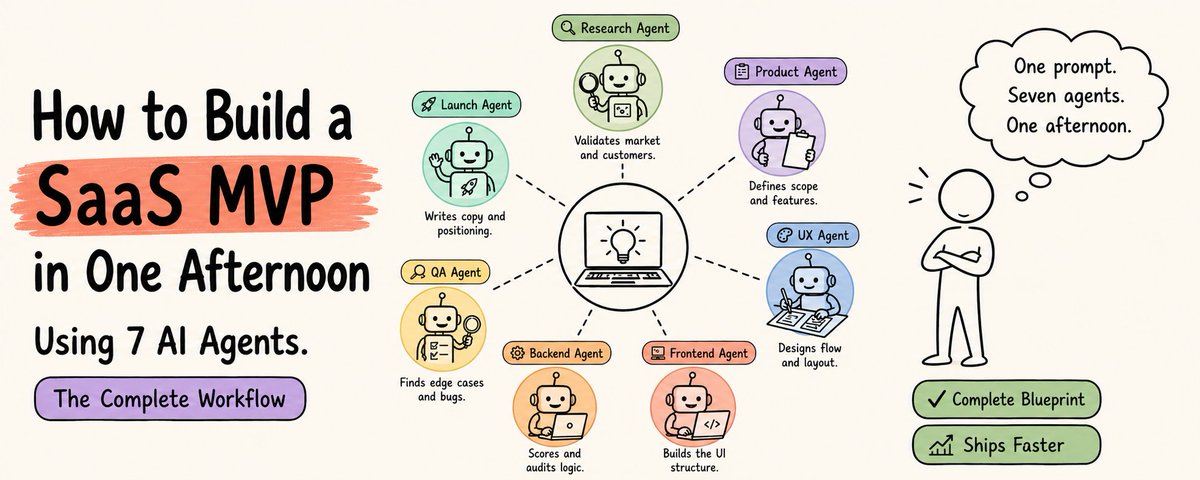
# How to Build a SaaS MVP in One Afternoon Using 7 AI Agents
**作者**: Rahul
**日期**: 2026-05-27T09:03:33.000Z
**来源**: [https://x.com/sairahul1/status/2059561133691031733](https://x.com/sairahul1/status/2059561133691031733)
---
I have shipped products for years.
I know what slow looks like.
The first week of any SaaS is the worst part.
You are switching roles in your head all day.
→ Founder
→ Researcher
→ Product manager
→ Designer
→ Engineer
→ QA tester
→ Marketer
Same brain. Seven jobs. Zero momentum.
Last month I tried something different.
I stopped using one AI model for everything.
Instead, I built a team of 7 specialized agents using Kimi Agent Swarm.
One afternoon. One SaaS idea. Seven agents. One complete MVP blueprint.
Here is the exact workflow.
## THE IDEA
The product: an AI Website Audit SaaS for local businesses.
The problem it solves:
5 million local businesses have websites that look like they were built in 2011.
No booking button. No mobile layout. No trust signals. No clear CTA. No reviews section.
A plumber can be great at plumbing and still lose customers because his website looks dead.
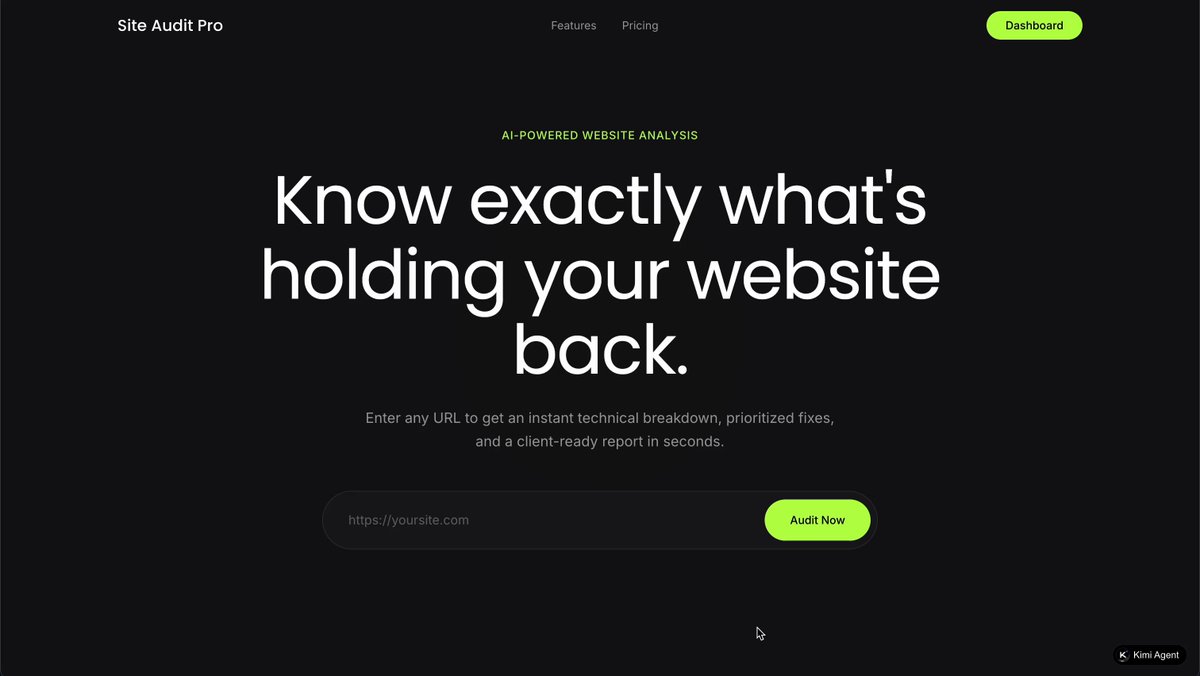
The SaaS: enter any local business URL and get an audit report, a score, and a cold email ready to send to the business owner.
Target users: freelancers, web designers, local SEO agencies — anyone who sells websites and services to local businesses.
The gap this fills: the audit IS the sales asset.
A generic cold email gets ignored.
An email that says:
"Your mobile booking button is broken, your homepage has no trust signals, and your competitor down the street has 300 more reviews and a faster booking flow"
gets a reply.
Here's the output SaaS:
## WHY MOST PEOPLE USE AI WRONG FOR BUILDING
Most founders use AI like a better chatbot.
They give one model one giant prompt:
"Research the market, design the UI, build the backend, write the landing page, and plan the launch."
The output feels shallow because it is.
One model switching between seven different thinking modes produces average work in each.
A researcher thinks differently from a designer. A backend engineer thinks differently from a marketer. A QA tester thinks differently from a product manager.
The insight that makes agent swarms work:
→ Specialization produces better output than generalization.
That is not a new idea.
It is why companies hire teams instead of one person who does everything.
Kimi Agent Swarm applies the same logic to AI.
Instead of asking one model to "build me a SaaS," you create a small AI company around the task.
Each agent owns one role. Each agent produces one output. The founder manages the system, not the tasks.
## THE 7-AGENT SYSTEM
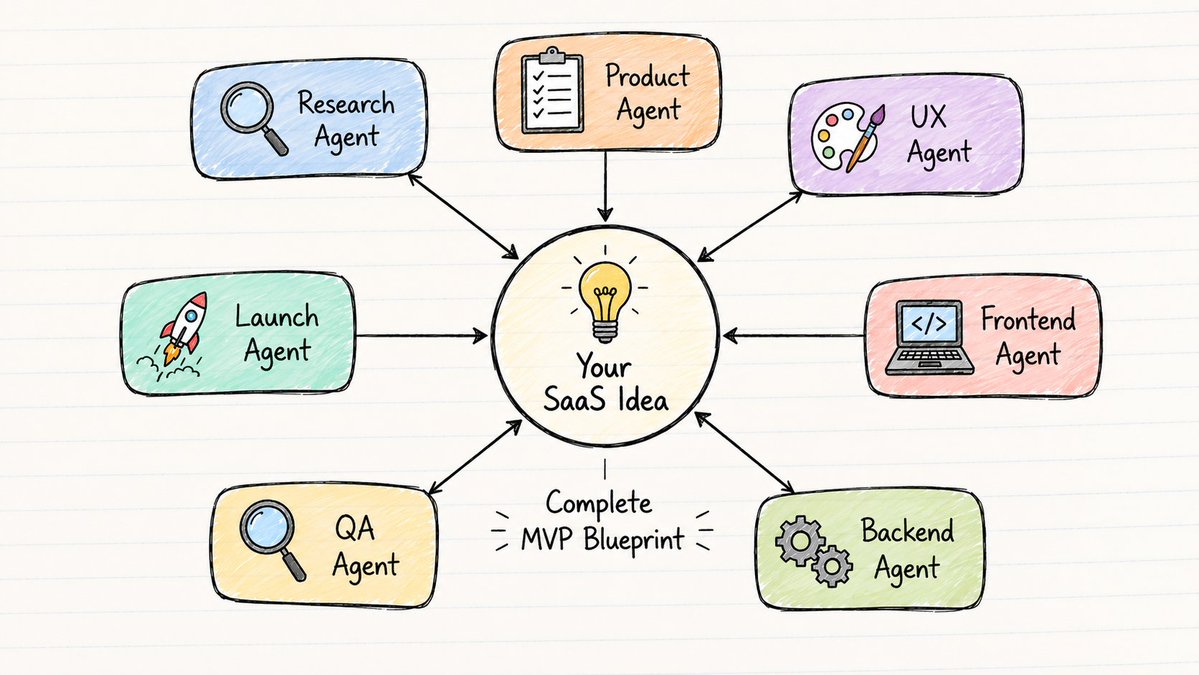
Here is the team I assembled in Kimi Agent Swarm:
Agent 1 → Research Agent Validates the market, target customer, competitors, and use cases.
Agent 2 → Product Manager Agent Defines MVP scope, core features, user journey, pricing model.
Agent 3 → UX Agent Creates page structure, user flow, dashboard layout, report layout.
Agent 4 → Frontend Engineer Agent Builds the UI plan and component structure.
Agent 5 → Backend Engineer Agent Designs the audit logic, scoring system, API structure, data model.
Agent 6 → QA Agent Reviews for bugs, missing states, edge cases, confusing UX.
Agent 7 → Launch Agent Writes landing page copy, X launch post, cold email, product positioning.
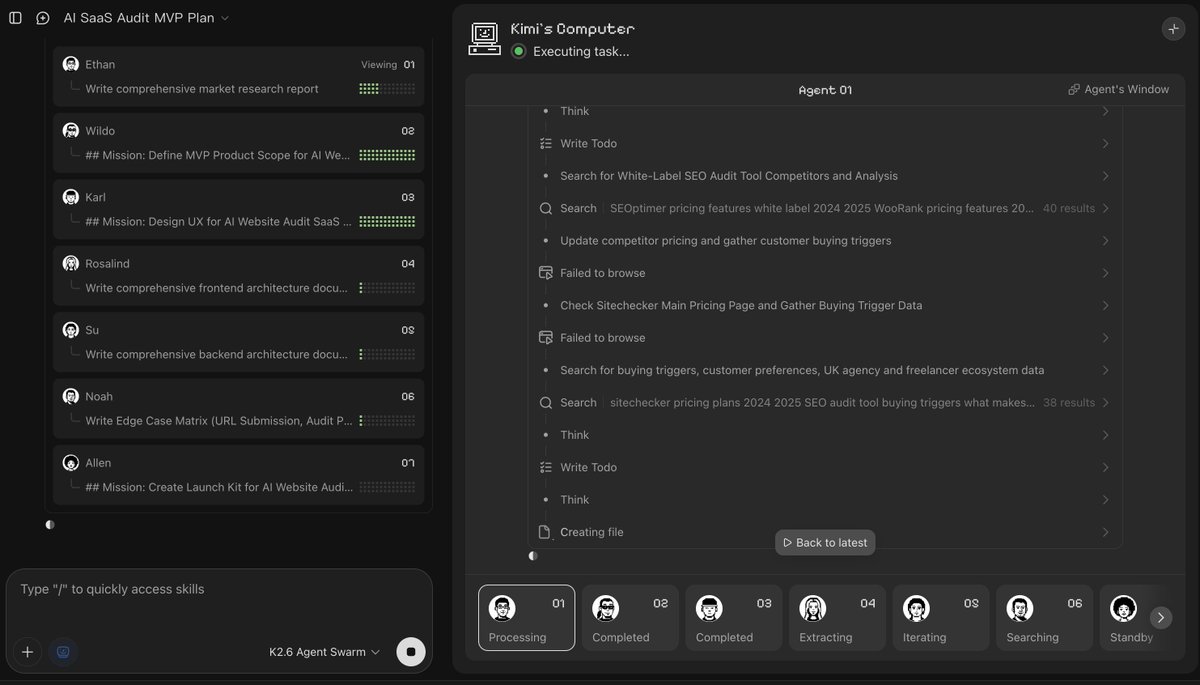
Each agent works independently first. Then the outputs merge into one build plan.
This is what makes it different from a long ChatGPT conversation.
There is no context switching. There is no "forget what I said before." Each agent stays in its lane.
## THE MASTER PROMPT
This is the prompt I gave Kimi to start the session (Use this as inspiration and change according to your needs):
```
Build an AI Website Audit SaaS for local service businesses.
Target users:
- freelancers
- agency owners
- local SEO consultants
- web designers selling to plumbers, HVAC, roofers, electricians, dentists
Core workflow:
User enters a local business URL →
App audits the website →
Generates a score, issues list, improvement checklist, client report, and cold email
Split into 7 specialized agents:
Research Agent: validate the market, customer, competitors
Product Agent: define MVP scope, features, pricing
UX Agent: user flow, dashboard, report layout
Frontend Agent: UI structure and components
Backend Agent: scoring logic, audit system, API design
QA Agent: edge cases, missing states, failure modes
Launch Agent: landing page, X post, cold email, positioning
Each agent works independently first.
Then merge all outputs into one final MVP plan.
```
Most people would write one version of this and wait for one big answer.
The point of the swarm is that each agent produces a real artifact from its own angle.
The research does not think about button colors. The UX does not invent pricing. The QA attacks, not defends. The launch agent does not touch the backend.
Separation is the system.
Here's the actual swarm of agents running :)
## WHAT EACH AGENT PRODUCED
## Agent 1 — Research
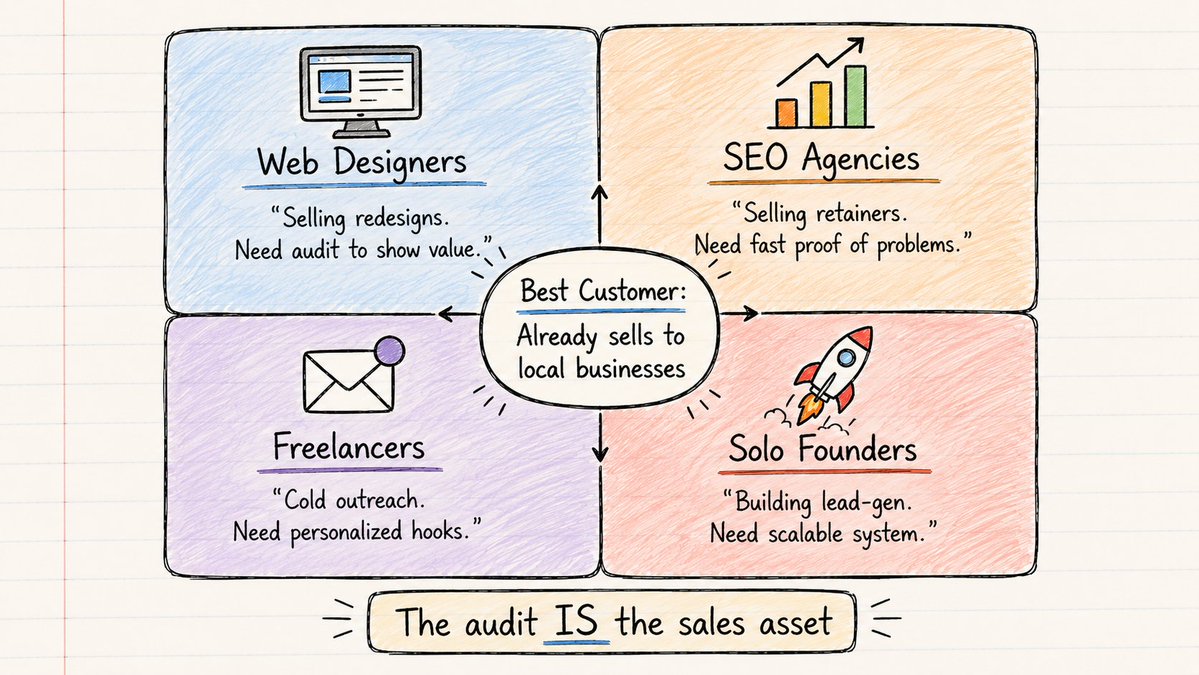
Found 4 real customer groups:
→ Web designers selling redesigns to local businesses
→ SEO agencies selling audit retainers
→ Freelancers doing cold outreach
→ Solo founders building lead-gen services
Best customer insight:
The audit is not the product. The audit is the sales weapon.
People selling to local businesses need a faster way to create personalized, specific audits.
A generic cold email gets 0 replies. A personalized audit showing exactly what is broken gets attention.
That positioning changed the entire product direction.
## Agent 2 — Product Manager
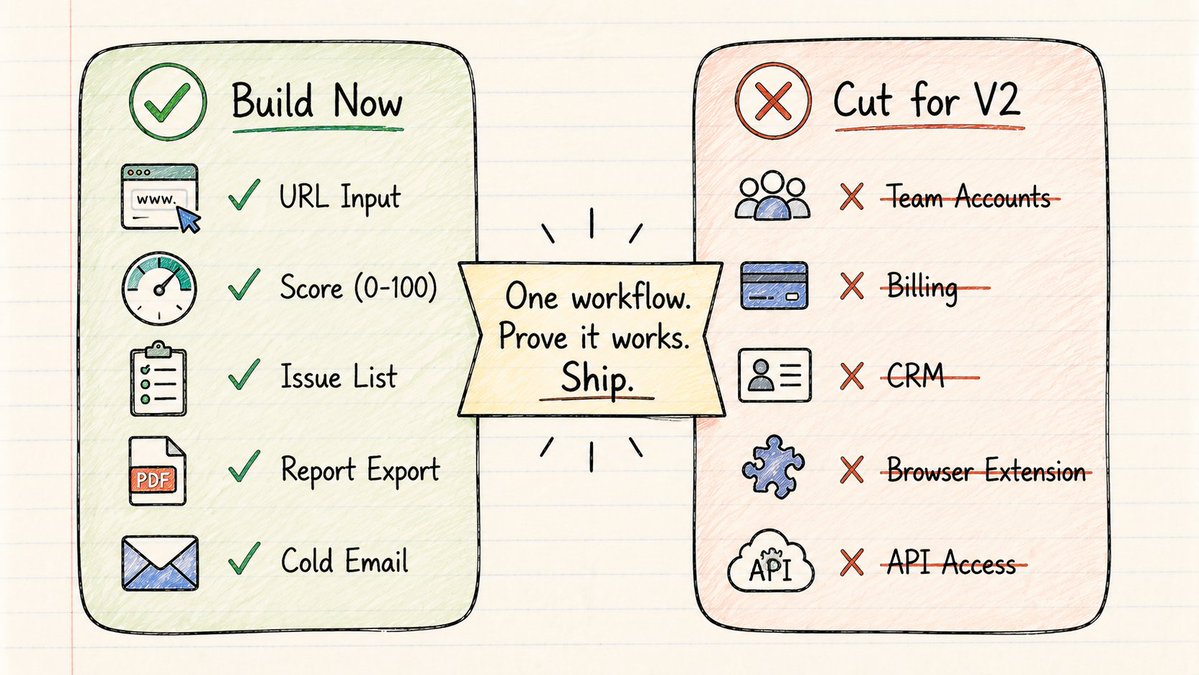
Cut the scope ruthlessly.
Version 1 needs exactly 5 screens:
→ Home page
→ Audit input page
→ Loading/progress page
→ Audit results page
→ Report export page
No team accounts. No billing. No CRM. No browser extension. No marketplace. No API.
Just one workflow:
Enter URL → get audit → send report.
Core MVP features:
→ Website URL input
→ Business category selector
→ Audit score 0–100
→ Conversion checklist
→ Mobile readiness checklist
→ Trust signal checklist
→ CTA checklist
→ Report summary
→ Cold email generator
→ Suggested service pricing for the freelancer
That is enough for version 1.
A SaaS MVP does not need to be complete.
It needs to prove one workflow works.
## Agent 3 — UX
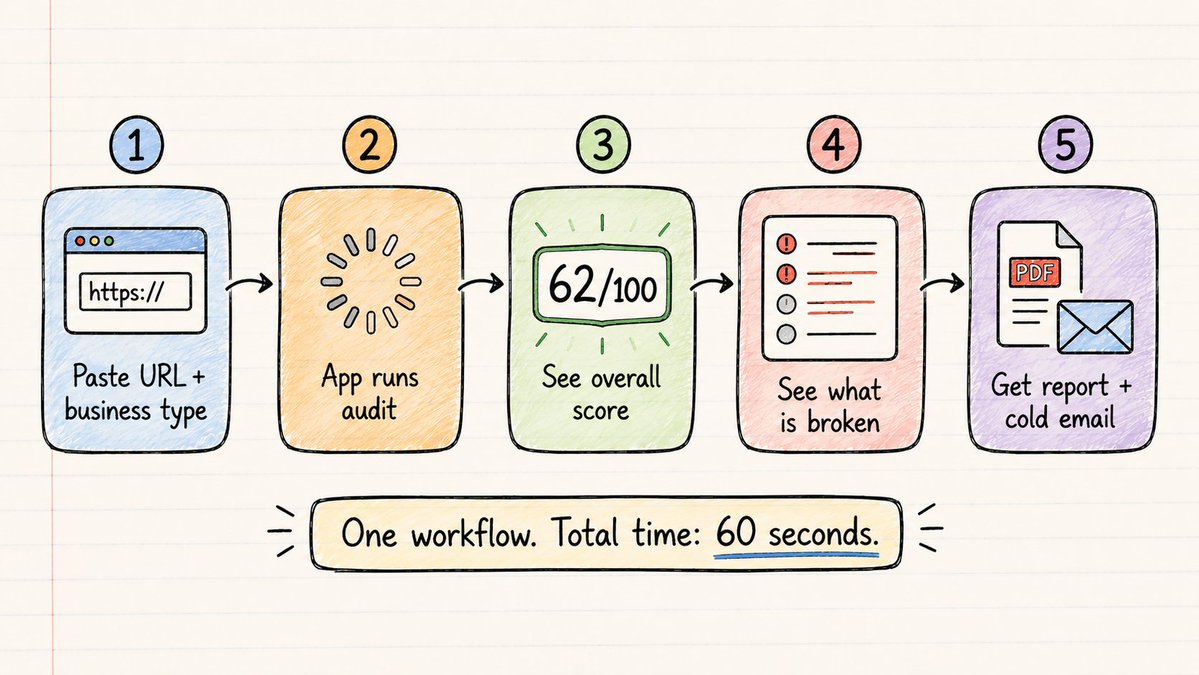
Designed the 5-step user journey:
Step 1: Paste URL + choose business type
Step 2: App runs audit (progress bar)
Step 3: See overall score
Step 4: See what is broken and why
Step 5: Get report + cold email
The report layout Kimi designed:
━━━
Website Score: 62/100
What is costing you customers:
→ No visible booking button
→ Weak mobile layout
→ No Google reviews section
→ No emergency service CTA
→ Slow trust-building above the fold
Quick wins:
→ Add click-to-call button
→ Move reviews to top of page
→ Add service area section
→ Add before/after photos
→ Add booking form
Business impact: Your site is losing mobile visitors who are ready to call right now.
━━━
That layout matters.
Not technical. Not full of jargon.
Clear enough for a plumber to understand in 30 seconds.
That is what the freelancer sends. That is what gets a meeting.
## Agent 4 — Frontend
The frontend agent built the UI structure.
Hero section: "Audit any local business website in 60 seconds."
Input card:
→ Website URL
→ Business category (dropdown: Plumber, HVAC, Dentist, Electrician, Roofer...)
→ City
→ Main service
Results dashboard:
→ Overall score (big number, color coded)
→ Category scores (5 bars)
→ Top 5 issues (red highlights)
→ Quick wins (green highlights)
→ Generated report (preview + download)
→ Cold email (editable before sending)
The app does not need fancy design.
It needs one clear value visible in 10 seconds:
Paste a URL. Get an audit. Send it to a client. Win the deal.
## Agent 5 — Backend
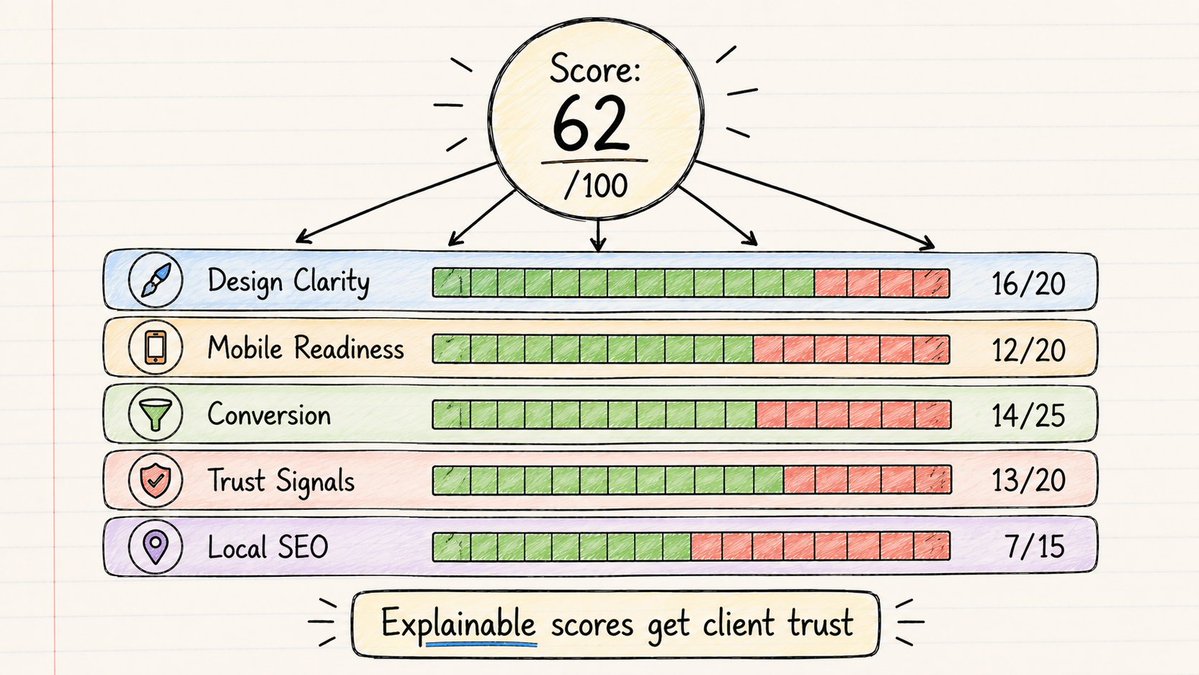
The scoring system built across 5 categories:
Design clarity → 20 points
Mobile readiness → 20 points
Conversion readiness → 25 points
Trust signals → 20 points
Local SEO basics → 15 points
Total: 100 points
Sample checks for conversion readiness:
→ Clear CTA above the fold? (+5)
→ Phone number visible? (+5)
→ Booking form present? (+5)
→ Services clearly listed? (+5)
→ Reason to act now? (+5)
Sample checks for trust signals:
→ Reviews visible? (+4)
→ Certifications shown? (+4)
→ Real photos used? (+4)
→ Years in business mentioned? (+4)
→ Guarantees included? (+4)
This matters because a score needs to be explainable.
A black-box "AI score" feels fake.
A score with specific, clear reasons feels useful.
And useful is what gets shared with clients.
## Agent 6 — QA
This was the most valuable agent.
A QA agent does one thing well: it attacks.
Kimi's QA Agent immediately found:
→ What happens if the URL is broken?
→ What if the site blocks crawling?
→ What if the website has almost no text?
→ What if the business has zero reviews?
→ What if two audit categories contradict each other?
→ What if the generated email sounds too aggressive?
This is where agent swarms beat one long prompt.
A single model building the app gets emotionally attached to its own output.
A separate QA agent has no attachment.
It just finds the holes.
Fixes it added:
→ Fallback states for blocked sites
→ Manual notes field for human override
→ Confidence score per finding
→ "Could not verify" labels
→ Softer email tone toggle
→ Human review step before outreach sends
That last one matters.
You do not want 500 bad cold emails going out automatically.
You want 500 strong drafts that a human approves.
The founder is still the editor. The swarm does the heavy lifting.
## Agent 7 — Launch
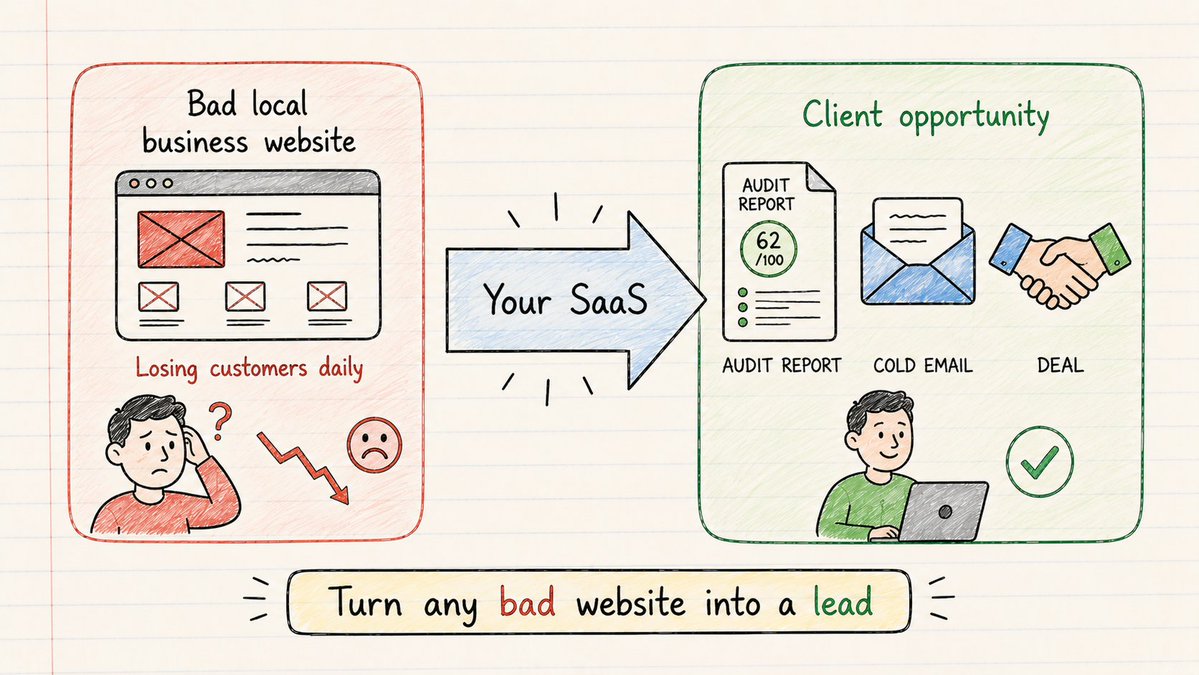
The launch agent produced the product positioning in one line:
"Turn bad local business websites into client opportunities."
That is much stronger than "AI website audit tool."
Nobody wakes up wanting an audit tool.
They want clients.
Landing page structure:
Headline: Turn bad local business websites into client opportunities. Subheadline: Enter any URL. Get an instant audit. Send a personalized report. Close the deal.
Three value lines:
→ Find websites losing customers every day
→ Generate audits in 60 seconds
→ Send reports that get replies
X launch post the agent wrote:
------------
I built a SaaS that audits local business websites and turns them into client opportunities.
Paste a URL. Get a 0–100 score. See exactly what is costing them customers. Generate a client-ready report. Send a personalized cold email.
Built for freelancers, web designers, and local SEO agencies.
Bad websites are everywhere. Now every one is a lead.
------------
Simple. Clear. Useful.
## THE FINAL OUTPUT
In one afternoon, Kimi Agent Swarm produced:
→ A validated market and target customer
→ A tight MVP scope (5 screens, no feature creep)
→ A complete user journey
→ A 100-point scoring system with specific checks
→ A UI structure and component list
→ A client-friendly report layout
→ A QA checklist with edge cases
→ Landing page copy
→ A launch post
→ A cold email template
That is not a full company.
But it is more than most founders have after a week of thinking alone.
## WHAT STILL NEEDS YOU
Kimi did not build a billion-dollar SaaS in one afternoon.
It built a strong MVP blueprint.
There is a difference.
A real SaaS still needs:
→ Production code
→ Real users
→ Payments and hosting
→ Error handling
→ Customer support
→ Distribution
→ Pricing tests
→ Manual QA before shipping
Some websites block crawling. Some audits need human verification. Some emails should be reviewed before sending.
This is not "press button, become rich."
The lesson is more useful than that:
Kimi replaced the first messy 70% of product thinking.
The founder still owns taste, judgment, shipping, and distribution.
What changes is the starting point.
Instead of staring at a blank page for three days, you start with a research output, a product spec, a scoring system, a UI flow, and a launch plan.
The cognitive load drops. The speed goes up. The early decisions get made faster.
## THE WORKFLOW — SAVE THIS
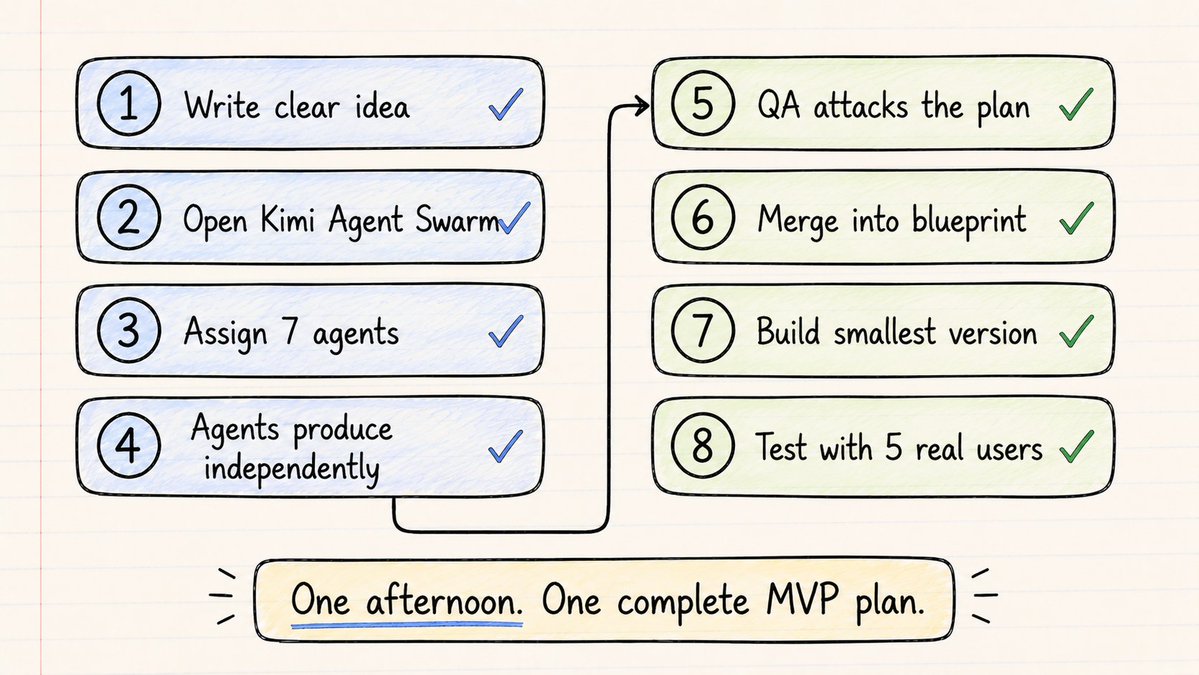
Use this exact sequence for your next SaaS idea:
Step 1 → Write one clear idea (problem + user + core workflow)
Step 2 → Open Kimi Agent Swarm
Step 3 → Assign 7 agents with specific roles
Step 4 → Let each agent produce its artifact independently
Step 5 → QA agent attacks the full plan
Step 6 → Merge outputs into one MVP blueprint
Step 7 → Build only the smallest version that proves the workflow
Step 8 → Test with 5 real users before adding anything else
The mistake most founders make:
Asking AI to build everything.
The better move:
Asking agents to eliminate the chaos.
Research becomes clear. Scope becomes clear. Screens become clear. Risks become clear. Launch angle becomes clear.
That is what actually saves time.
## THE SHIFT
The next generation of founders will not just use AI to write copy.
They will manage swarms.
One agent researches. One agent designs. One agent codes. One agent tests. One agent launches.
The founder stops being the person doing every task.
The founder becomes the person directing the machine.
That is what Kimi Agent Swarm gave me.
Not a shortcut.
A team.
Before: one founder switching between seven roles, losing a week before writing one line of code.
After: seven agents running in parallel, returning a complete MVP plan before the day ended.
That used to take a week.
Now it starts with one prompt.
Try Kimi Agent Swarm: kimi.com/agent-swarm
Follow @sairahul1 — I write about AI systems, agent workflows, and building products that run without you.
## 相关链接
- [Rahul](https://x.com/sairahul1)
- [@sairahul1](https://x.com/sairahul1)
- [369K](https://x.com/sairahul1/status/2059561133691031733/analytics)
- [kimi.com/agent-swarm](https://kimi.com/agent-swarm)
- [@sairahul1](https://x.com/@sairahul1)
- [Upgrade to Premium](https://x.com/i/premium_sign_up)
- [5:03 PM · May 27, 2026](https://x.com/sairahul1/status/2059561133691031733)
- [369K Views](https://x.com/sairahul1/status/2059561133691031733/analytics)
- [View quotes](https://x.com/sairahul1/status/2059561133691031733/quotes)
---
*导出时间: 2026/5/28 10:24:53*
---
## 中文翻译
# 如何利用7个AI代理在一个下午构建SaaS MVP
**作者**: Rahul
**日期**: 2026-05-27T09:03:33.000Z
**来源**: [https://x.com/sairahul1/status/2059561133691031733](https://x.com/sairahul1/status/2059561133691031733)
---

我发布产品已经好几年了。
我知道什么是慢速。
任何SaaS的第一周都是最糟糕的。
你整天都在脑子里切换角色。
→ 创始人
→ 研究员
→ 产品经理
→ 设计师
→ 工程师
→ QA测试员
→ 营销人员
同一个大脑。七份工作。零动力。
上个月我尝试了一些不同的方法。
我不再使用一个AI模型来处理所有事情。
相反,我利用Kimi Agent Swarm(Kimi智能体)组建了一个由7个专业代理组成的团队。
一个下午。一个SaaS想法。七个代理。一份完整的MVP蓝图。
这就是具体的工作流程。
## 想法
产品:一款面向本地企业的AI网站审查SaaS。
解决的问题:
500万家本地企业的网站看起来还像是2011年建的。
没有预订按钮。没有移动端布局。没有信任信号。没有清晰的CTA(号召性用语)。没有评论版块。
一个水管工可能 plumbing(管道维修)技术很好,但仍然因为他的网站看起来死气沉沉而流失客户。
SaaS功能:输入任何本地企业的URL,获得一份审查报告、一个评分,以及一封准备好发给企业主的冷启动邮件。
目标用户:自由职业者、网页设计师、本地SEO代理商——任何向本地企业销售网站和服务的人。
填补的空白:审查本身就是销售资产。
普通的冷启动邮件会被忽略。
但一封写着这样的邮件:
“你的移动端预订按钮坏了,你的主页没有信任信号,而街对面的竞争对手多出了300条评论和更快的预订流程”
会得到回复。
这是输出的SaaS产品:

## 为什么大多数人在构建时错误地使用了AI
大多数创始人将AI视为一个更好的聊天机器人。
他们给一个模型一个巨大的提示词:
“研究市场,设计UI,构建后端,撰写着陆页,并规划发布。”
输出感觉很肤浅,因为它确实是。
一个模型在七种不同的思维模式之间切换,会在每种模式下产生平庸的工作。
研究员的思维方式与设计师不同。后端工程师的思维方式与营销人员不同。QA测试员的思维方式与产品经理不同。
让代理群奏效的洞察:
→ 专业化产生的产出优于泛化。
这并不是什么新想法。
这就是为什么公司雇佣团队而不是雇佣一个什么都做的人。
Kimi Agent Swarm 将同样的逻辑应用于AI。
而不是要求一个模型“为我构建一个SaaS”,你围绕这项任务创建一个小型的AI公司。
每个代理拥有一个角色。每个代理产生一个输出。创始人管理系统,而不是任务。
## 7代理系统

这是我在Kimi Agent Swarm中组建的团队:
代理1 → 研究代理 验证市场、目标客户、竞争对手和用例。
代理2 → 产品经理代理 定义MVP范围、核心功能、用户旅程、定价模式。
代理3 → UX代理 创建页面结构、用户流程、仪表板布局、报告布局。
代理4 → 前端工程师代理 构建UI计划和组件结构。
代理5 → 后端工程师代理 设计审查逻辑、评分系统、API结构、数据模型。
代理6 → QA代理 审查Bug、缺失状态、边缘情况、令人困惑的UX。
代理7 → 发布代理 撰写着陆页文案、X(原Twitter)发布帖子、冷启动邮件、产品定位。
每个代理首先独立工作。然后输出合并为一个构建计划。
这正是它与漫长的ChatGPT对话的不同之处。
没有上下文切换。没有“忘记我之前说的话”。每个代理都在自己的跑道上。
## 主提示词
这是我给Kimi启动会话的提示词(以此为灵感,根据你的需求进行更改):
```
Build an AI Website Audit SaaS for local service businesses.
Target users:
- freelancers
- agency owners
- local SEO consultants
- web designers selling to plumbers, HVAC, roofers, electricians, dentists
Core workflow:
User enters a local business URL →
App audits the website →
Generates a score, issues list, improvement checklist, client report, and cold email
Split into 7 specialized agents:
Research Agent: validate the market, customer, competitors
Product Agent: define MVP scope, features, pricing
UX Agent: user flow, dashboard, report layout
Frontend Agent: UI structure and components
Backend Agent: scoring logic, audit system, API design
QA Agent: edge cases, missing states, failure modes
Launch Agent: landing page, X post, cold email, positioning
Each agent works independently first.
Then merge all outputs into one final MVP plan.
```
大多数人会写一个这样的版本并等待一个巨大的答案。
群(Swarm)的意义在于,每个代理都从自己的角度产生一个真实的工件。
研究不会考虑按钮颜色。UX不会发明定价。QA负责攻击,而不是辩护。发布代理不接触后端。
分离即系统。
这是实际运行的代理群 :)

## 每个代理产出了什么
## 代理1 — 研究

发现了4个真正的客户群体:
→ 向本地企业销售改版的网页设计师
→ 销售审查保留合同的SEO代理商
→ 进行冷启动外联的自由职业者
→ 构建潜在客户生成服务的独立创始人
最佳客户洞察:
审查不是产品。审查是销售武器。
向本地企业销售的人需要一种更快的方式来创建个性化、具体的审查。
通用的冷启动邮件得到0次回复。一份显示具体问题所在的个性化审查会获得关注。
这种定位改变了整个产品方向。
## 代理2 — 产品经理

无情地削减范围。
第1版只需要5个屏幕:
→ 主页
→ 审查输入页
→ 加载/进度页
→ 审查结果页
→ 报告导出页
没有团队账户。没有计费。没有CRM。没有浏览器扩展。没有市场。没有API。
只有一个工作流:
输入URL → 获得审查 → 发送报告。
核心MVP功能:
→ 网站URL输入
→ 企业类别选择器
→ 审查分数0–100
→ 转化检查清单
→ 移动就绪检查清单
→ 信任信号检查清单
→ CTA检查清单
→ 报告摘要
→ 冷启动邮件生成器
→ 为自由职业者建议的服务定价
这对于第1版来说已经足够了。
SaaS MVP不需要是完整的。
它需要证明一个工作流是有效的。
## 代理3 — UX

设计了5步用户旅程:
步骤1:粘贴URL + 选择企业类型
步骤2:应用程序运行审查(进度条)
步骤3:查看总体分数
步骤4:查看哪里出了问题以及原因
步骤5:获取报告 + 冷启动邮件
Kimi设计的报告布局:
━━━
网站分数:62/100
什么正在让你流失客户:
→ 没有可见的预订按钮
→ 移动端布局薄弱
→ 没有Google评论版块
→ 没有紧急服务CTA
→ 首屏上方的信任建立缓慢
速赢:
→ 添加点击拨号按钮
→ 将评论移至页面顶部
→ 添加服务区域版块
→ 添加前后对比照片
→ 添加预订表单
业务影响:你的网站正在流失那些准备立即打电话的移动访问者。
━━━
那个布局很重要。
不技术化。没有充满行话。
足够清晰,让水管工能在30秒内理解。
这就是自由职业者发送的内容。这就是获得会议的机会。
## 代理4 — 前端
前端代理构建了UI结构。
Hero部分:“在60秒内审查任何本地企业网站。”
输入卡片:
→ 网站URL
→ 企业类别(下拉菜单:水管工、暖通空调、牙医、电工、屋顶工...)
→ 城市
→ 主要服务
结果仪表板:
→ 总体分数(大数字,颜色编码)
→ 类别分数(5条条形图)
→ 前5个问题(红色高亮)
→ 速赢(绿色高亮)
→ 生成的报告(预览 + 下载)
→ 冷启动邮件(发送前可编辑)
应用程序不需要花哨的设计。
它需要一个在10秒内可见的清晰价值:
粘贴URL。获得审查。将其发送给客户。赢得交易。
## 代理5 — 后端

跨5个类别构建的评分系统:
设计清晰度 → 20分
移动就绪度 → 20分
转化就绪度 → 25分
信任信号 → 20分
本地SEO基础 → 15分
总计:100分
转化就绪度的样本检查:
→ 首屏上方有清晰的CTA?(+5)
→ 电话号码可见?(+5)
→ 存在预订表单?(+5)
→ 服务清晰列出?(+5)
→ 现在行动的理由?(+5)
信任信号的样本检查:
→ 评论可见?(+4)
→ 显示认证?(+4)
→ 使用真实照片?(+4)
→ 提到经营年限?(+4)
→ 包含保证?(+4)
这很重要,因为分数需要是可解释的。
黑盒子的“AI分数”感觉很假。
带有具体、清晰原因的分数感觉有用。
而有用就是与客户分享的内容。
## 代理6 — QA
这是最有价值的代理。
QA代理有一件事做得很好:它攻击。
Kimi的QA代理立即发现:
→ 如果URL损坏会发生什么?
→ 如果网站阻止爬取怎么办?
→ 如果网站几乎没有文本怎么办?
→ 如果企业有零条评论怎么办?
→ 如果两个审查类别相互矛盾怎么办?
→ 如果生成的邮件听起来太具攻击性怎么办?
这就是代理群胜过冗长提示词的地方。
一个构建应用程序的单个模型会对其输出产生情感依恋。
一个独立的QA代理没有任何依恋。
它只是发现漏洞。
它添加的修复:
→ 被阻止网站的回退状态
→ 用于人工覆盖的手动备注字段
→ 每个发现的置信度分数
→ “无法验证”标签
→ 更温和的邮件语气切换
→ 外联发送前的人工审查步骤
最后一点很重要。
你不希望自动发出500封糟糕的冷启动邮件。
你希望有500份由人工批准的强力草稿。
创始人仍然是编辑。群做繁重的工作。
## 代理7 — 发布

发布代理在一行中产出了产品定位:
“将糟糕的本地企业网站转化为客户机会。”
这比“AI网站审查工具”强得多。
没人醒来想要一个审查工具。
他们想要客户。
着陆页结构:
标题:将糟糕的本地企业网站转化为客户机会。
副标题:输入任何URL。获得即时审查。发送个性化报告。达成交易。
三条价值线:
→ 找到每天都在流失客户的网站
→ 在60秒内生成审查
→ 发送能得到回复的报告
代理撰写的X发布帖子:
------------
我构建了一个SaaS,可以审查本地企业网站并将它们转化为客户机会。
粘贴一个URL。获得0–100的分数。确切地看到什么正在让他们流失客户。生成一份客户就绪的报告。发送一封个性化的冷启动邮件。
专为自由职业者、网页设计师和本地SEO代理商构建。
糟糕的网站无处不在。现在每一个都是潜在客户。
------------
简单。清晰。有用。
## 最终产出
在一个下午,Kimi Agent Swarm产出了:
→ 经过验证的市场和目标客户
→ 严格的MVP范围(5个屏幕,没有功能蔓延)
→ 完整的用户旅程
→ 带有具体检查的100分评分系统
→ UI结构和组件列表
→ 客户友好的报告布局
→ 带有边缘情况的QA检查清单
→ 着陆页文案
→ 发布帖子
→ 冷启动邮件模板
那不是一家完整的公司。
但它比大多数创始人独自思考一周后拥有的东西要多。
## 仍然需要你的地方
Kimi并没有在一个下午建立一个价值十亿美元的SaaS。
它建立了一个强大的MVP蓝图。
这有区别。
一个真正的SaaS仍然需要:
→ 生产代码
→ 真实用户
→ 支付和托管
→ 错误处理
→ 客户支持
→ 分发
→ 定价测试
→ 发布前的手动QA
有些网站阻止爬取。有些审查需要人工验证。有些邮件应该在发送前审查。
这不是“按下按钮,致富”。
教训比这更有用:
Kimi取代了产品思维中混乱的前70%。
创始人仍然拥有品味、判断力、发布和分发。
改变的是起点。
而不是盯着空白页面看三天,你从一个研究输出、产品规格、评分系统、UI流程和发布计划开始。
认知负荷下降。速度上升。早期决策更快做出。
## 工作流程 — 保存这个

为你的下一个SaaS想法使用这个确切的序列:
步骤1 → 写下一个清晰的想法(问题 + 用户 + 核心工作流)
步骤2 → 打开Kimi Agent Swarm
步骤3 → 分配具有特定角色的7个代理
步骤4 → 让每个代理独立生成其工件
步骤5 → QA代理攻击整个计划
步骤6 → 将输出合并为一个MVP蓝图
步骤7 → 仅构建证明工作流的最小版本
步骤8 → 在添加其他任何内容之前与5个真实用户测试
大多数创始人犯的错误:
要求AI构建一切。
更好的举措:
要求代理消除混乱。
研究变得清晰。范围变得清晰。屏幕变得清晰。风险变得清晰。发布角度变得清晰。
这才是真正节省时间的地方。
## 转变
下一代创始人不会只是用AI来写文案。
他们将管理群。
一个代理研究。一个代理设计。一个代理编码。一个代理测试。一个代理发布。
创始人不再是做每项任务的人。
创始人变成指挥机器的人。
这就是Kimi Agent Swarm给我的。
不是捷径。
是一个团队。
之前:一个创始人在七个角色之间切换,在写一行代码之前浪费了一周。
之后:七个代理并行运行,在一天结束前返回完整的MVP计划。
这过去需要一周。
现在它从一个提示词开始。
试试Kimi Agent Swarm:kimi.com/agent-swarm
关注 @sairahul1 — 我撰写关于AI系统、代理工作流程以及无需你运行的产品构建。
## 相关链接
- [Rahul](https://x.com/sairahul1)
- [@sairahul1](https://x.com/sairahul1)
- [369K](https://x.com/sairahul1/status/2059561133691031733/analytics)
- [kimi.com/agent-swarm](https://kimi.com/agent-swarm)
- [@sairahul1](https://x.com/@sairahul1)
- [升级到Premium](https://x.com/i/premium_sign_up)
- [下午5:03 · 2026年5月27日](https://x.com/sairahul1/status/2059561133691031733)
- [36.9万次观看](https://x.com/sairahul1/status/2059561133691031733/analytics)
- [查看引用](https://x.com/sairahul1/status/2059561133691031733/quotes)
---
*导出时间: 2026/5/28 10:24:53*