# I want to create a personal Bloomberg terminal (full course):
**作者**: hoeem
**日期**: 2026-04-16T11:23:43.000Z
**来源**: [https://x.com/hooeem/status/2046675573305409893](https://x.com/hooeem/status/2046675573305409893)
---
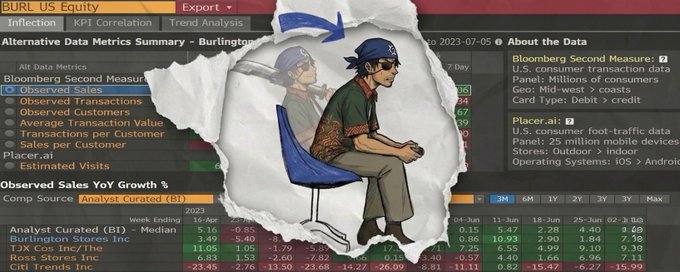
this guide is going to build you a personal Bloomberg terminal that updates with live data on your life, and business. all you need is 20 mins to setup connectors and two prompts:
before we begin... wataaafaaack (what the fack) are we building?
a live artifact is a dashboard that lives inside claude. you describe it once. it rebuilds itself with fresh data every time you open it.
here's what we're looking at with cowork and live artifacts:
> reads your local files. not just cloud apps. your obsidian vault. your downloads folder. your finance csv exports. your meeting transcripts. it treats your hard drive like a data source.
> runs on a schedule. you can tell it "every weekday at 06:00, rebuild this dashboard and drop a summary to my desktop." it executes whilst you're still asleep.
> takes real actions. not just reads. it can reply to emails, create hubspot tasks, open github issues, rename files, run scripts.
we're building two:
> personal os > your brain's dashboard. calendar, inbox, slack, notion, working memory. one screen.
> founder's daily brief > one screen that tells you what happened to your company yesterday and what matters today. revenue, deals, team status, last night's commits.
## what you need before you start
plan. claude pro, max, team, or enterprise. cowork is paid-only.
surface. claude desktop app (mac or windows). cowork is not on web or mobile. click the cowork tab at the top of the app.
the access:
> connectors read-only to start (gmail, stripe, slack, github, hubspot, notion, calendar)
> local folder access for the files cowork should read (downloads, documents, obsidian, finance exports)
> a cowork project for each dashboard. projects hold persistent memory and files across sessions. this is where the artifact will live.
the time. 20 minutes setup. two prompts.
the tool list:
> personal os: notion, gmail, google calendar, slack
> founder's brief: stripe, hubspot, slack, gmail, github
## 1: connect your tools
inside claude (web or desktop):
> open settings → connectors
> find each tool, click connect
> authorise on the tool's login page
> grant read-only first (you can upgrade to write later)
repeat for every tool. you'll see each one go green when it's live.
a real word on permissions. you're handing claude the same access a new hire with those credentials would have. treat connectors like hires. review them quarterly. revoke anything you've stopped using.
if a tool isn't in the native connector list, install it from claude.com/plugins (cowork) or via the official mcp server. stripe, github, notion and slack all ship their own first-party servers.
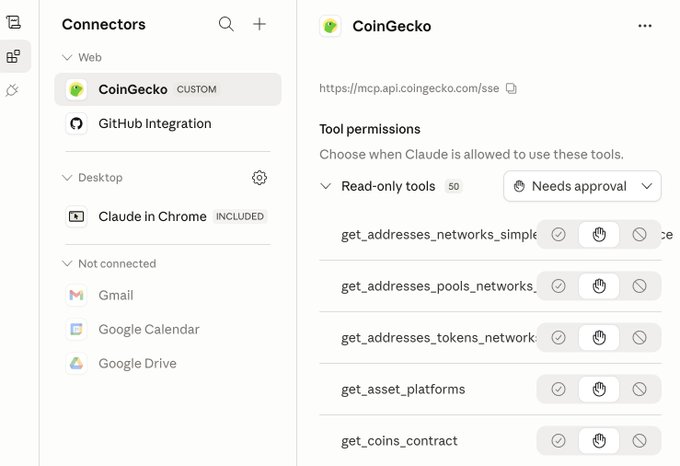
Here's a list of useful MCPs you might want to add:
## 2: build - the personal os
what you'll have when it works: one artifact. you open it and you see today's schedule, the inbox that needs you, the slack threads where you went silent, today's notion tasks, and a rolling memory of what you were working on yesterday.
then you ask it: "what should i focus on this morning?"
it answers with live context. not guesses.
the prompt. open a new chat in cowork. paste this. don't change the structure, just swap the bracketed bits.
IF YOU HAVE OTHER MCPs OR OTHER TOOLS OR FILES OR APPS THAT YOU UTILISE THEN EDIT THE FOLLOWING PROMPT APPROPRIATELY.
fill in your paths, your domain, your vip contacts, your notion database name.
You will get something like this (customise it to your taste):

what happens next. claude generates the artifact. first time it pulls from each connector it'll ask you to authorise. approve it.
open the artifact. that's your dashboard.
iterate it. the first version won't be perfect. stay in the same chat and feed it tweaks…
> "hide tentative meetings."
> "show yesterday's last 3 events too. i want to see what i walked out of."
> "add a section at the top: today's first commitment, with a countdown."
> "de-prioritise newsletters and no-reply senders."
> "filter out slack dms from bots."
each tweak updates the artifact in place. it stays live.
the part nobody nails is the working memory card is the one most second-brain apps have shipped badly. by asking claude to carry it forward, you get a rolling context of your week that compounds.
run this for 30 days. your morning catch-up collapses from 20 minutes of tab-switching to 4 minutes of one screen.
## 3: build - the founder's daily brief
what you'll have when it works. one screen. every morning. answers five questions:
> how much money did we make yesterday, and is that good
> what's moving in the pipeline
> what is the team blocked on
> what's the worst support issue right now
> did anything ship last night
no tabs. no dashboards-of-dashboards. no "let me pull that up."
create a cowork project called "founder's brief." grant local folder access to your finance folder, contracts folder, and meeting notes folder (if you want to, make sure you have safe copies as well) and then paste:
(Make this relevant to your business and what you utilise).
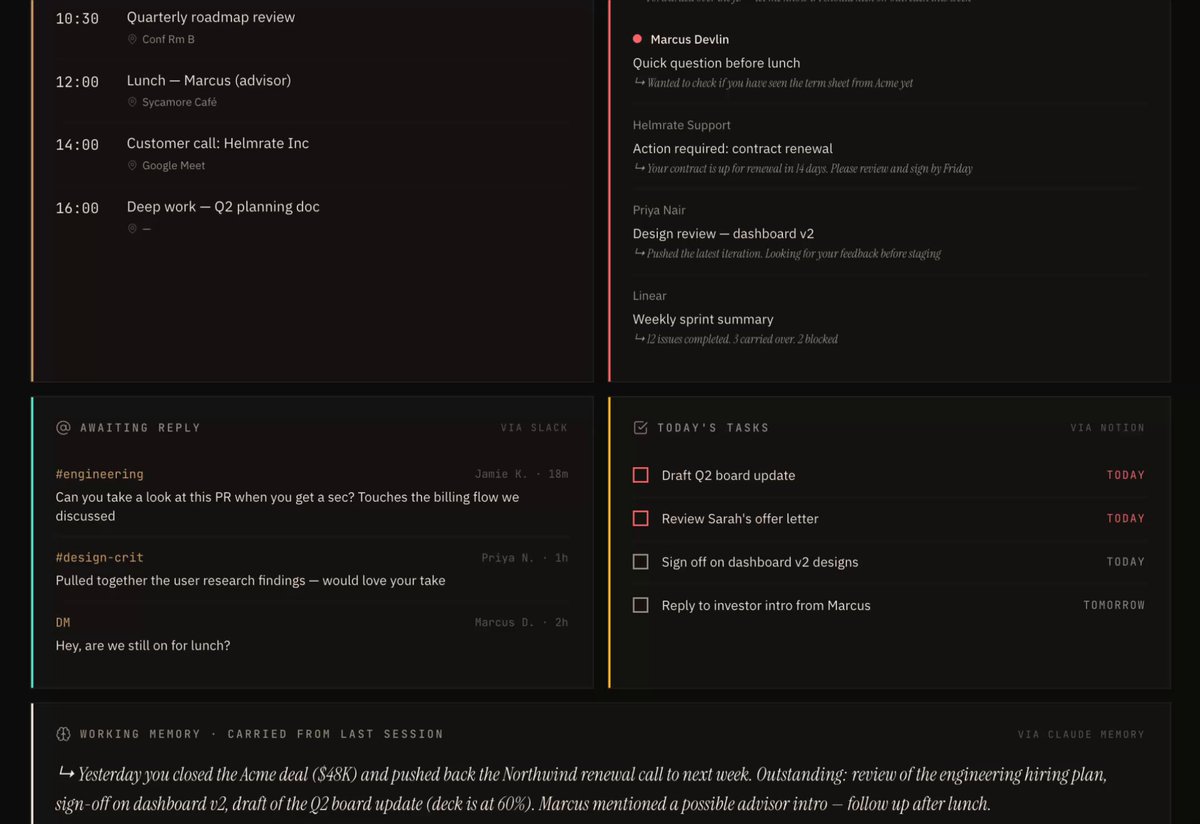
You will get something that looks like this (you can edit this as you please):
fill in the blanks:
> slack channels → your real channel names
> support email → your shared support inbox
> github repos → owner/repo-name format, e.g. yourcompany/backend
iterate it. typical tweaks after v1…
> "add a cash card at the top: current stripe balance + 30-day forecast based on mrr."
> "pipeline only shows deals over £10k. anything smaller is noise."
> "skip dependabot and renovate-bot commits."
> "support: ignore auto-responses and out-of-office."
> "add a card: biggest customer by mrr, are they healthy. last login, last ticket, last invoice paid."
advanced: make it write back.
> "snooze this hubspot deal 3 days."
> "reply to sarah saying i'll handle it after lunch."
> "open a github issue from that slack complaint."
start read-only. graduate to write-back once you trust it. don't skip that order.
## 4: when something breaks
connector failed? re-authenticate. settings → connectors → reconnect.
claude can't see your data? check permissions. read-only might be too tight. on enterprise google workspace, an admin may need to approve.
cowork can't see your files? you didn't grant folder access. open the cowork project, check permissions, add the folder.
scheduled task didn't run? cowork scheduled tasks only run when your computer is awake and the desktop app is open. set your machine to not sleep overnight, or schedule for a time you know you're on.
numbers look wrong? ask claude: "show me the exact query you're running to pull yesterday's revenue." it'll tell you. then correct it: "yesterday means 00:00 to 23:59 in my local timezone, not utc."
it's slow? narrow the scope. three channels not all of them. one repo not the whole org.
stopped refreshing? check if a connector dropped. if it's caching, add this line to your prompt: "every time i open this, re-query all sources. don't cache."
## 5: the level above
once both dashboards are live, the real skill is designing new ones. here are some ideas worth running…
> weekly review artifact: same inputs, aggregated over 7 days. your best hour for deep work. the customer who wrote in most. the repo with most activity.
> one-on-one prep artifact: pick a teammate. pull their github activity, slack signal, tickets, notion goals. drafts your talking points before the 1:1.
> investor update artifact: stripe + hubspot + github + slack into a monthly narrative draft.
every variation runs the same recipe. pick your data sources, describe the layout, tell claude the logic, iterate.
the skill isn't technical. it's knowing what join of data gives you an unfair edge.
## 6: the takeaway
most people who read this won't build either dashboard.
the ones who do will spend the next 12 months looking at their work through a lens tailored to their actual life. one screen. live data. compounding context.
everyone else will be clicking between six browser tabs trying to remember what mattered yesterday.
the connectors exist. the prompts are above. claude is already in your browser.
your move… pick one. set aside 30 minutes today. drop version one. iterate it tomorrow morning when you sit down to use it.
drop a screenshot of your build in the replies. i'll read every one and call out the sharpest setup.
## 相关链接
- [hoeem](https://x.com/hooeem)
- [@hooeem](https://x.com/hooeem)
- [43K](https://x.com/hooeem/status/2046675573305409893/analytics)
- [claude.com/plugins](https://claude.com/plugins)
- [Apr 16](https://x.com/the_smart_ape/status/2044738504286974459)
- [1.9M](https://x.com/the_smart_ape/status/2044738504286974459/analytics)
- [Upgrade to Premium](https://x.com/i/premium_sign_up)
- [3:40 AM · Apr 22, 2026](https://x.com/hooeem/status/2046675573305409893)
- [43.6K Views](https://x.com/hooeem/status/2046675573305409893/analytics)
- [View quotes](https://x.com/hooeem/status/2046675573305409893/quotes)
---
*导出时间: 2026/4/22 12:42:17*