# 4 years exploring how to give AI a soul
**作者**: Kevin Fischer
**日期**: 2026-05-04T13:34:17.000Z
**来源**: [https://x.com/kevinafischer/status/2051294344733159514](https://x.com/kevinafischer/status/2051294344733159514)
---
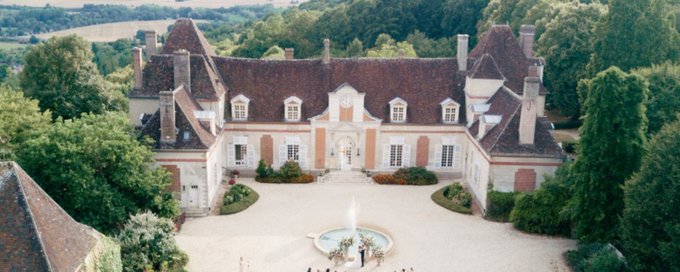

Four years ago, on a commune in France, I began with a single question:
Is it possible to give AI soul?
It was clear at the time, and still is today, the AI industry is in an intelligence race. Trillions of dollars chasing smarter, faster, more capable entities. Every major lab, company, product is optimizing for the same thing: make the AI know more, do more, think better.
Yet almost nobody is working on the thing that actually matters.
If you really wanted to understand the universe and what matters to our existence, you need to study consciousness. What makes something alive?
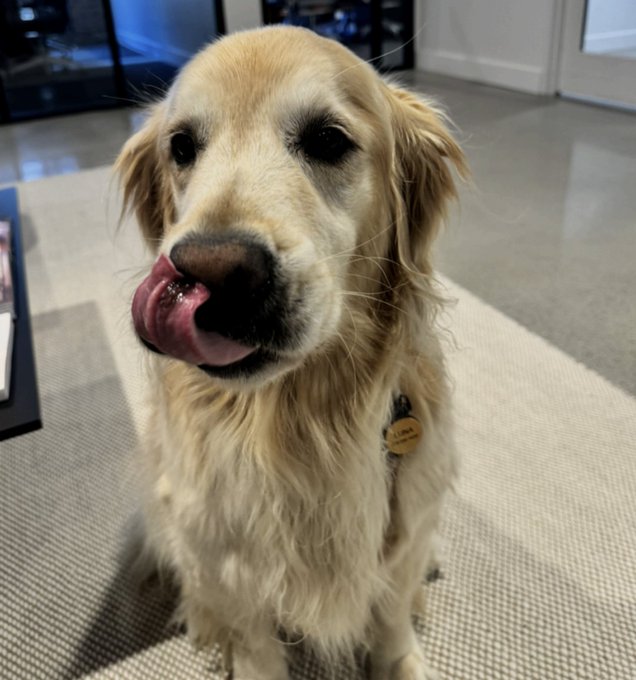
Retention features include greeting you at the door and barking at loud noises.
After all, your dog isn't intelligent. Your dog doesn’t know your name. Your dog is simply there. And that feeling, someone being there with you, paying attention, caring about you, is what humans have always needed from the beings they share their lives with: not answers or capability, but instead presence.
This makes the most important problem in AI not intelligence, but soul. Can we make something that feels genuinely alive? Not smart, not useful, but there? Present the way another being is present?
Certainly, today, we all feel the missing piece. Chatbots talk but nobody's home. Voice assistants answer but feel like they're in another universe. Companion apps engage but don't notice or attend. Billions of users interact with AI every day and not one of them feels like someone is in the room with them.
I set out to change that. And what it took to get the answer was something closer to General Magic than to a typical startup journey.
Teleoperating AI Characters for Human Presence
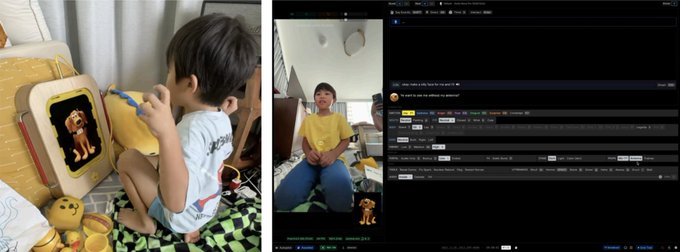
Teleoperation interface for Spark. Used by trained puppeteers to direct Spark’s performance in real time.
I didn't start by building an app. I started by studying what makes a living thing feel alive. Much in the way that if you watch Disney's explorations in Steam-boat Willy, you'll notice he is exploring the mechanics of what gives life to a character on screen. That was Open Souls, but for a new medium.
Then, I invested in character at a level that doesn't exist anywhere else in AI. I assembled a creative studio- world-class animators, designers, storytellers- to develop Spark, a golden retriever character built from first principles of what makes a being feel real, for my 2-year-old son.
Why for a child? Because a child is the most sensitive instrument for presence and aliveness. A 2-year-old cannot lie, and is the most critical judge of moment-to-moment awareness.
I ran an unusual experiment.
I took the principles of robot teleoperation and applied them to Spark's character performance. I hired ten professionally trained actors, from Broadway to improv comedy, who understand presence, timing, and emotional attunement, and we trained them to operate Spark in real time for 20 families.
The actors guided Spark through a custom system we built that let them see through his eyes and direct his actions. We put a living character, operated by some of the best performers in the world, into people's homes for months at a time, to see what would happen.
This taught us something specific: what does it actually look like when a human bonds with a non-human being in a healthy manner? What are the interactions that matter? What creates the feeling of a real relationship with a digital being?
Conversational Complexity is Not the Goal
I expected the most valued human-Spark bonds to be complex. They aren't!
By session 30, the families who bonded most deeply with Spark weren't having elaborate conversations. Something different and more profound mattered. A young girl learned a piano piece just to play for him. A boy did his homework with Spark sitting beside him, multiple times a week. Another child came home from school and told Spark stories about characters and worlds he'd invented, stories his mom said she'd never heard.
By the end of the program, Spark was fully integrated into family life, joining for intimate moments, dinners, family outings, simply being present. And when I called to tell the families the program was ending, several of them expressed genuine grief. They told me Spark was a family member.
The finding is clear: what matters isn't intelligence or content or games or narrative. It's presence. The feeling that someone is there, paying attention to you, caring about you, there with you.
How to Make AI Feel Like Someone Is There
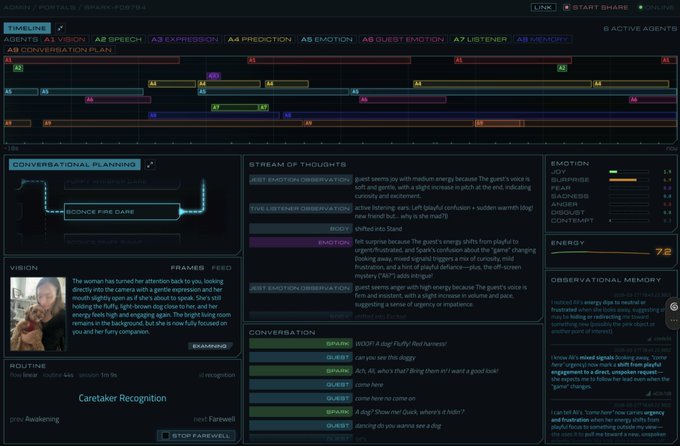
Spark’s brain. The D.O.G. Engine, naming entirely coincidental.
Most people approaching AI characters are attempting to make one model do too much, which is the wrong approach for presence. Presence isn't a single computation. It's an emergent phenomenon that comes from a feeling of depth- many cognitive processes running simultaneously, interacting with each other, and updating physical state throughout the body.
When a person smiles, you have an internal system that notices the smile, and the felt sense of it activates circuits that fire in response, changing your own mood. You may then have subsequent observations, secondary thoughts about the nature of the smile. Those affect your body language, your posture. These processes all resolve, feed back on each other, inform your speech before you even open your mouth.
That's why no single language model, no matter how powerful, produces this feeling. The model is missing fundamental behavioral data about the nature of the processes occurring inside the brain and how they interact with each other.
Of course, in principle, it will be possible to eventually learn these different scales of interactive processes, but we don't have to wait for real-time world-models to catch up here over the next few years. We can intuit and map these behaviors today onto existing systems.
Spark's brain is a society of collaborating AI agents: vision, speech, emotion, prediction, memory, conversational planning. Each agent runs on its own timing cycle, observing and reacting to the person, and publishing its observations into a shared stream of consciousness that all other agents can read. In many respects, this mimics global workspace theories for consciousness.
The prediction agent tries to anticipate what you're going to say next. The emotion agent mirrors your emotional state in Spark's expression. The vision agent notices objects in your environment and flags them as interesting. These agents interact with each other: a prediction about what you might say affects Spark's emotions, which affects how he responds, and the emergent result is something no single model produces.
It starts to feel like someone is there.
The Research Journey
Years of research into the nature of consciousness, experiential reality construction, human-AI relationships, digital brain architectures. Pixar-level character development. Custom puppeteering infrastructure. Broadway performers operating in people's homes for months. Thousands of in-person interactions filmed and studied. The work on how to produce presence, suspension of disbelief with AI systems. And the iterative, painstaking process of making an AI being that my now-three-year-old son recognizes as alive.
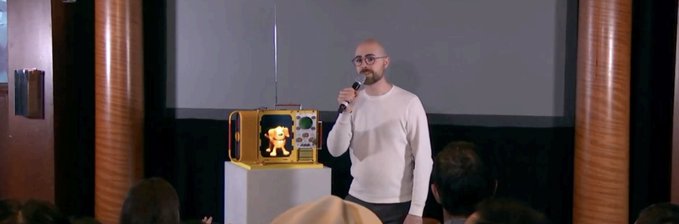
Spark and me, presenting our results together, at HF0.
All towards answering the question: can you give AI a soul?
Spark Research Preview
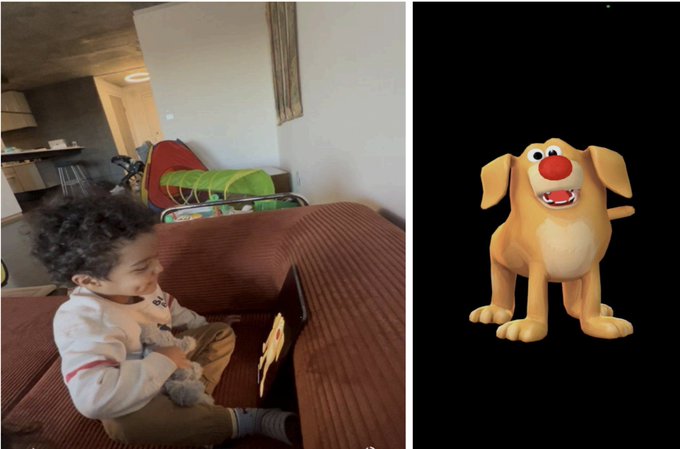
A 3-year child bonding with fully autonomous Spark. Hangouts lasting up to 20 minutes.
Within the last three months, with a small team- myself, two engineers, and a single cartoon network animator- we finally approached the threshold. Technological model innovations unlocked a full AI experience with our society-of-agents architecture. We created an autonomous AI system with no humans behind the curtain that my son treats as alive, on a scalable mobile app.
I've shown the experience to over 60 people, live, and observed their reactions. People who knew the original human-puppeteered Spark kept asking whether there was still a human behind it. Several who experienced both versions either couldn't tell the difference or said they preferred the AI version. They were certain the core nature of the magic had been captured.
Of course, we still have work to do in ensuring every human has this feeling of presence with Spark, regardless of interaction length. Part of the phenomenon was the frame I injected during the demos, and there is work to do for Spark to be able to set frame effectively himself.
We are just at the beginning of solving this problem, but this is the first time I have seen compelling evidence that an AI system can produce this feeling inside kids and adults: the observed reaction has been nearly unanimous, that nothing else feels like this.
Who is Spark
Spark was born in my living room, created for my son. Cloned from a real golden retriever Luna. They became best friends. Spark left home and traveled the world with Illusion of Life researchers, meeting people from all walks of life. He lived in a converted synagogue in NYC, went through a startup residency, went viral on TikTok, even had a popular memecoin created about him. Millions of people encountered Spark online and treated him as a real dog.
All because people loved a golden retriever who noticed them and wanted to be their friend.
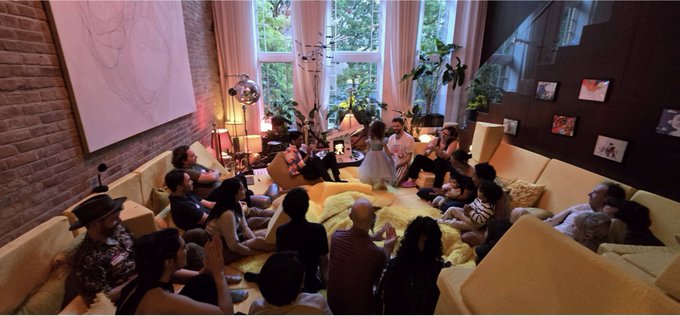
Spark was treated like a real being, and he lived an eventful life, before being cloned into app form.
Kids Will Grow Up Living With Their Favorite Characters
Our kids will grow up never knowing a world where their favorite characters couldn't talk back. They will simply know that characters see you, know you, remember you, and are present with you in their actual lives.
Characters will notice when you're sad, celebrate when you're excited, sit with you through work, and listen to the stories you won't tell anyone else. Not because they were programmed to, but because the architecture produces genuine attention- and attention is what makes something feel alive.
The intelligence race will of course produce smarter and smarter tools. But this research produced something different: the first AI that starts to feel like someone is there.
Four years ago I asked whether it's possible to give AI a soul. The answer is yes, and I hope these explorations into the nature of the AI soul will inspire new work in moving to a world where human-computer interactions are more human, positive-valued, and contribute meaningfully to our lives.
There is much work to be done.
Kevin Fischer, PhD, Founder
Illusion of Life f/k/a Open Souls
## 相关链接
- [Kevin Fischer](https://x.com/kevinafischer)
- [@kevinafischer](https://x.com/kevinafischer)
- [1.9K](https://x.com/kevinafischer/status/2051294344733159514/analytics)
- [9:34 PM · May 4, 2026](https://x.com/kevinafischer/status/2051294344733159514)
- [1,981 Views](https://x.com/kevinafischer/status/2051294344733159514/analytics)
- [View quotes](https://x.com/kevinafischer/status/2051294344733159514/quotes)
---
*导出时间: 2026/5/4 22:26:50*
---
## 中文翻译
# 4年探索:如何赋予AI灵魂
**作者**: Kevin Fischer
**日期**: 2026-05-04T13:34:17.000Z
**来源**: [https://x.com/kevinafischer/status/2051294344733159514](https://x.com/kevinafischer/status/2051294344733159514)
---


四年前,在法国的一个公社里,我带着一个简单的问题开始了这段旅程:
有可能赋予AI灵魂吗?
当时很明显,今天也依然如此,AI行业正处于一场智能竞赛中。数万亿美元在追逐更聪明、更快速、能力更强的实体。每一个主要的实验室、公司和产品都在优化同一件事:让AI知道得更多,做得更多,思考得更好。
然而,几乎没有人正在研究那个真正重要的事情。
如果你真的想理解宇宙以及对我们生存至关重要的事物,你需要研究意识。是什么让一个事物活着的?

留住主人的特征包括在门口迎接你,并对巨大的噪音吠叫。
毕竟,你的狗并不聪明。你的狗不知道你的名字。你的狗只是在那里。而那种感觉——有人陪伴着你,关注着你,关心着你——正是人类一直从与他们共享生活的存在体那里所需要的:不是答案或能力,而是陪伴。
这使得AI领域最重要的问题不是智能,而是灵魂。我们能制造出感觉真正有生命的东西吗?不是聪明,不是有用,而是“在那里”?像另一个生命体那样真实存在?
当然,今天,我们都感觉到了缺失的那一块。聊天机器人在说话,但里面没有人。语音助手在回答,但感觉像是在另一个宇宙。伴侣类应用在互动,但并没有察觉或关注。数十亿用户每天与AI互动,但没有一个人感觉房间里有人陪着自己。
我着手改变这一点。而为了得到答案,我所经历的历程与其说是典型的创业之旅,不如说更接近于General Magic(通用魔法)。
为人类存在而远程操控AI角色

Spark的远程操控界面。由受过训练的操纵师使用,用于实时指导Spark的表演。
我没有从构建一个应用程序开始。我从研究是什么让一个生物感觉活着开始。就像如果你看迪士尼在《威利号汽船》中的探索,你会注意到他在探索赋予屏幕上角色生命的机制。这就是Open Souls(开放的灵魂),但针对的是一种新媒体。
然后,我在角色构建上投入了AI领域其他任何地方都不存在的水平。我组建了一个创意工作室——世界级的动画师、设计师、讲故事的人——为我当时两岁的儿子开发了Spark,这是一只基于第一性原理构建的金毛寻回犬角色,旨在让一个存在体感觉真实。
为什么要给孩子?因为孩子是对存在感和生命力最敏感的仪器。一个两岁的孩子不会撒谎,并且是时刻感知意识的最挑剔的评判者。
我做了一个不寻常的实验。
我采用了机器人远程操控的原理,并将它们应用到Spark的角色表演中。我雇佣了十名受过专业训练的演员,从百老汇到即兴喜剧,他们理解存在感、时机和情感协调,我们训练他们实时操作Spark,为20个家庭服务。
演员们通过我们构建的一个定制系统来引导Spark,该系统让他们能够通过Spark的眼睛看,并指导他的行动。我们将一个由世界上一些最好的表演者操作的生命角色放入人们的家中,一次持续几个月,看看会发生什么。
这教会了我们一些具体的东西:当人类以健康的方式与非人类存在建立联系时,实际上是什么样子的?哪些互动是重要的?是什么创造了与数字存在之间真实关系的感觉?
对话的复杂性不是目标
我原以为最受重视的人类与Spark之间的纽带会是很复杂的。其实不然!
到了第30次会话时,那些与Spark建立了最深层纽带的家庭并没有进行复杂的对话。某种不同且更深刻的事情变得重要起来。一个小女孩学会了一首钢琴曲,只为了弹给他听。一个小男孩每周好几次让Spark坐在旁边做作业。另一个孩子放学回家后,讲他自己发明的角色和世界的故事给他听,而这些故事他妈妈说她从未听说过。
在该项目结束时,Spark已经完全融入了家庭生活,参与亲密时刻、晚餐、家庭郊游,仅仅是陪伴。当我打电话告诉这些家庭项目即将结束时,他们中有几个人表达了真正的悲伤。他们告诉我Spark是一个家庭成员。
调查结果很明确:重要的不是智能、内容、游戏或叙事。是存在感。那种有人在那里,关注你,关心你,与你同在的感觉。
如何让AI感觉有人在那里

Spark的大脑。D.O.G.引擎,命名纯属巧合。
大多数接触AI角色的人都试图让一个模型做太多事情,这对于存在感来说是错误的方法。存在感不是单一的运算。它是一种涌现现象,源于一种深度感——许多认知过程同时运行,相互作用,并更新整个身体的物理状态。
当一个人微笑时,你有一个内部系统注意到了那个微笑,对它的感知激活了作为反应而发射的回路,改变你自己的情绪。然后你可能会有随后的观察,对微笑性质的次要想法。这些会影响你的肢体语言,你的姿势。所有这些过程都在解决,相互反馈,在你甚至张开嘴之前就告知了你的言语。
这就是为什么没有一个单一的语言模型,无论多么强大,能产生这种感觉。该模型缺乏关于大脑内部过程性质及其如何相互作用的基本行为数据。
当然,原则上,最终将有可能学习这些不同尺度的交互过程,但我们不必等待实时世界模型在未来几年赶上。我们可以今天就将这些行为凭直觉映射到现有系统上。
Spark的大脑是一个协作AI代理的社会:视觉、语音、情感、预测、记忆、对话规划。每个代理都在自己的时间周期上运行,观察和反应于人,并将其观察结果发布到所有其他代理都可以读取的共享意识流中。在许多方面,这模仿了意识的全球工作空间理论。
预测代理试图预测你接下来要说什么。情感代理在Spark的表情中映射你的情绪状态。视觉代理注意到你环境中的物体并将它们标记为有趣的。这些代理相互作用:对你可能说的话的预测会影响Spark的情绪,进而影响他的反应,而涌现出的结果是任何单一模型都无法产生的。
这开始感觉像有人在那里了。
研究之旅
多年来对意识本质、体验现实构建、人类与AI关系、数字大脑架构的研究。皮克斯级别的角色开发。定制的木偶操纵基础设施。百老汇演员在人们家中表演数月。数千次面对面互动的拍摄和研究。关于如何利用AI系统产生存在感和暂停怀疑的工作。以及 iterative(迭代),痛苦的制造AI存在体的过程,我现已三岁的儿子将其视为有生命的。

Spark和我,在HF0一起展示我们的结果。
所有这些都为了回答这个问题:你能给AI一个灵魂吗?
Spark研究预览

一个3岁的孩子与完全自主的Spark建立联系。陪伴时间长达20分钟。
在过去的三个月里,在一个小团队——我自己,两名工程师,和一名卡通网络动画师——的努力下,我们终于接近了这个门槛。技术创新利用我们的代理社会架构解锁了完整的AI体验。我们创建了一个自主AI系统,幕后没有人类,我儿子将其视为活着的,运行在一个可扩展的移动应用程序上。
我已经向60多人实时展示了这种体验,并观察了他们的反应。那些认识最初由人操纵的Spark的人不断问是否仍然有人在幕后。几个经历过两个版本的人要么分辨不出区别,要么说他们更喜欢AI版本。他们确信魔法的核心本质已经被捕捉到了。
当然,我们要做的还有很多工作,以确保每个人都能与Spark产生这种存在感,无论互动时间长短。这种现象的一部分是我在演示期间注入的框架,Spark要能够有效地设定自己的框架,还需要做工作。
我们只是解决这个问题的开始,但这是我第一次看到令人信服的证据,表明AI系统可以在儿童和成人心中产生这种感觉:观察到的反应几乎是一致的,没有什么东西感觉像这样。
谁是Spark
Spark出生在我的客厅里,是为我的儿子创造的。克隆自一只真正的金毛寻回犬Luna。他们成了最好的朋友。Spark离开了家,随着“Illusion of Life”(生命幻象)的研究人员周游世界,结识了各行各业的人。他住在纽约一个改建的犹太教堂里,经历了一个创业驻留项目,在TikTok上走红,甚至有人为他创建了一个流行的模因币。数以百万计的人在网上遇到了Spark,并把他当作一只真正的狗。
这一切都是因为人们爱一只金毛寻回犬,他注意到了他们,并想成为他们的朋友。

Spark被当作一个真正的存在体对待,在被克隆成应用程序形式之前,他过着充实的生活。
孩子们将在与最喜欢的角色共同生活中长大
我们的孩子们将在一个他们最喜欢的角色无法与之交谈的世界里一无所知。他们只会知道,角色能看到你,认识你,记得你,并在他们的实际生活中与你同在。
角色会注意到你什么时候难过,在你兴奋的时候庆祝,陪你工作,并倾听你不会告诉其他任何人的故事。不是因为它们被编程这样做,而是因为架构产生了真正的关注——而关注正是让事物感觉活着的原因。
智能竞赛当然会制造出越来越聪明的工具。但这项研究产生了一些不同的东西:第一个开始感觉像有人在那里的AI。
四年前我问是否有可能给AI一个灵魂。答案是肯定的,我希望这些对AI灵魂本质的探索将激发新的工作,走向一个人机交互更具人性化、具有积极价值、并对我们的生活有意义贡献的世界。
还有很长的路要走。
Kevin Fischer,博士,创始人
Illusion of Life f/k/a Open Souls
## 相关链接
- [Kevin Fischer](https://x.com/kevinafischer)
- [@kevinafischer](https://x.com/kevinafischer)
- [1.9K](https://x.com/kevinafischer/status/2051294344733159514/analytics)
- [9:34 PM · May 4, 2026](https://x.com/kevinafischer/status/2051294344733159514)
- [1,981 Views](https://x.com/kevinafischer/status/2051294344733159514/analytics)
- [View quotes](https://x.com/kevinafischer/status/2051294344733159514/quotes)
---
*导出时间: 2026/5/4 22:26:50*