# Claude Code’s Agent Development Kit Is the Blueprint for the Future of AI Engineering
**作者**: Suryansh Tiwari
**日期**: 2026-05-06T15:51:46.000Z
**来源**: [https://x.com/Suryanshti777/status/2052053720167600221](https://x.com/Suryanshti777/status/2052053720167600221)
---
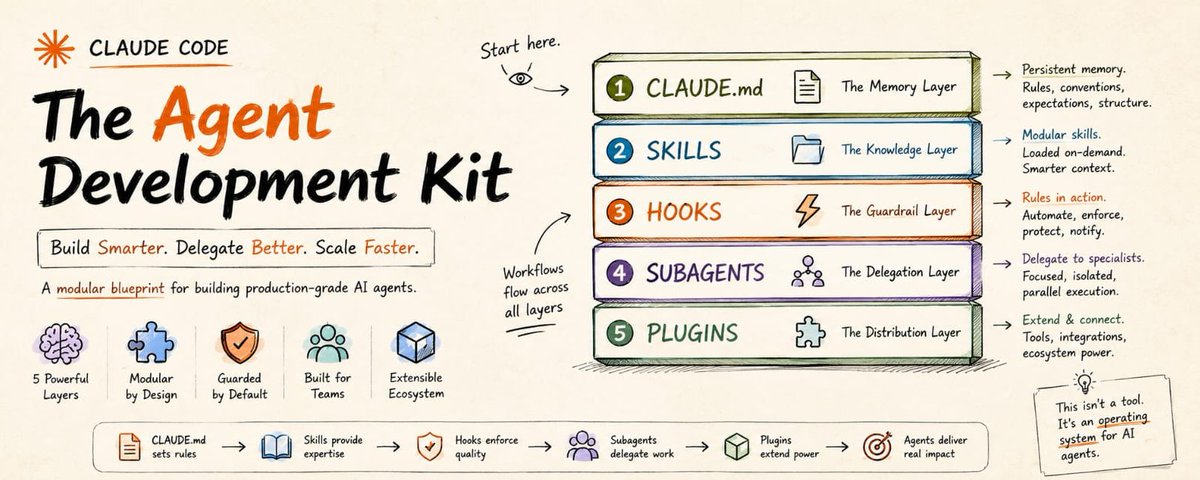
Most people are still using AI like a chatbot.
The smartest developers are building AI like an operating system.
And this diagram quietly explains why
## The Shift Nobody Is Talking About
We’re moving from:
> “Ask AI a question”
to
> “Build AI systems that think, remember, delegate, enforce rules, and execute workflows.”
That’s the real transition.
Not AI tools.
AI infrastructure.
And the most important part?
Most people still don’t understand what makes an AI agent actually reliable.
Because a real agent is NOT:
- one prompt
- one API call
- one chatbot window
- one automation
A real agent needs:
- memory
- context
- rules
- delegation
- tooling
- orchestration
- guardrails
- modular capabilities
That’s exactly what this “Agent Development Kit” architecture represents.
It’s basically a blueprint for building production-grade AI agents.
Let’s break down why this matters so much.
## Layer 1 — CLAUDE.md
The Memory Layer
This is the brain’s constitution.
The idea is simple but powerful:
Instead of repeating instructions every session, you create a persistent memory file.
That file stores:
- architecture rules
- naming conventions
- repo structure
- coding expectations
- testing standards
- workflows
So the AI stops behaving like a temporary intern…
…and starts behaving like an actual team member.
This is massive.
Because most AI failures happen due to context loss.
Every time you reopen ChatGPT or Claude:
- context disappears
- standards disappear
- workflows disappear
- assumptions reset
CLAUDE.md fixes that.
It turns prompting into persistent operational memory.
That’s the difference between:
- chatting with AI
- building AI infrastructure
And honestly?
This concept alone will redefine software engineering.
## Layer 2 — Skills
The Knowledge Layer
This is where things become truly agentic.
Instead of stuffing one gigantic prompt with everything…
…the system loads capabilities only when needed.
Think modular intelligence.
Example:
If the AI detects:
- React debugging
- API architecture
- database migrations
- UI generation
- testing
…it can invoke specific “skills” dynamically.
- This matters because:
- smaller context = smarter outputs
- modular systems scale better
specialized reasoning beats generic prompting
This is basically:
> microservices for AI cognition
And that’s an insane shift.
Most people are still prompt engineering.
The future is capability orchestration
## Layer 3 — Hooks
The Guardrail Layer
This might be the most underrated part.
Hooks are deterministic actions triggered by events.
Examples:
- auto-lint on write
- block dangerous commands
- enforce formatting
- trigger Slack notifications
- run tests before execution
This is where AI becomes trustworthy.
Because raw AI is probabilistic.
Production systems cannot be.
So hooks create:
- predictability
- safety
- compliance
- reliability
in simple words:
Hooks are what stop AI from becoming chaos.
And this is exactly how serious engineering teams will deploy AI internally.
Not with vibes.
With enforced operational standards.
## Layer 4 — Subagents
The Delegation Layer
This is where AI starts behaving like an organization.
Instead of one overloaded model doing everything…
…the system creates specialized subagents.
Example:
- code reviewer
- test runner
- explorer
- debugger
- documentation writer
Each gets:
- isolated context
- focused tasks
- limited permissions
- dedicated tools
- That’s important.
Because context overload kills performance.
One massive agent trying to do everything becomes noisy fast.
Subagents solve this by creating:
- parallel execution
- cleaner reasoning
- specialized cognition
- scalable workflows
This is basically:
> turning AI into a team instead of a tool
And once you understand this…
…it becomes obvious why “AI employees” are inevitable.
## Layer 5 — Plugins
The Distribution Layer
This is the ecosystem play.
Plugins allow agents to:
- access tools
- share workflows
- install capabilities
- connect external systems
Think:
- GitHub
- APIs
- databases
- automation tools
- internal systems
This transforms AI from:
> text generation
into:
> operational execution
That’s the real unlock.
The AI doesn’t just answer.
It acts.
## Why This Architecture Is Such a Big Deal
Because it mirrors how real organizations operate.
Look closely:
Human Organizations AI Agent Systems
Company policies CLAUDE.md
Employee expertise Skills
Compliance rules Hooks
Departments Subagents
External vendors/tools Plugins
This is not random.
AI systems are evolving into digital organizations.
That’s the future most people still underestimate.
## The Real Insight
The winners in AI won’t be:
- people with the best prompts
- people with the fanciest models
- people generating the most content
The winners will be people who build:
- systems
- workflows
- memory architectures
- orchestration layers
- agent ecosystems
Prompt engineering was Phase 1.
Agent engineering is Phase 2.
Operational AI infrastructure is Phase 3.
We are entering Phase 2 right now.
## What Most Developers Still Miss
Most developers are trying to use AI faster.
Very few are designing AI correctly.
That’s the gap.
Because scaling AI isn’t about:
- longer prompts
- more tokens
- more chat windows
It’s about:
- modularity
- delegation
- reliability
- persistence
- orchestration
Exactly what this framework demonstrates.
## Final Thought
The biggest misconception about AI is that it replaces humans.
In reality:
AI is starting to mirror how humans organize work itself.
Memory.
Teams.
Rules.
Delegation.
Tooling.
Infrastructure.
That’s why architectures like this matter.
They aren’t just “AI workflows.”
They’re early blueprints for digital organizations.
And five years from now…
most software companies will probably run on systems that look a lot like this.
## 相关链接
- [Suryansh Tiwari](https://x.com/Suryanshti777)
- [@Suryanshti777](https://x.com/Suryanshti777)
- [3.8K](https://x.com/Suryanshti777/status/2052053720167600221/analytics)
- [Upgrade to Premium](https://x.com/i/premium_sign_up)
- [11:51 PM · May 6, 2026](https://x.com/Suryanshti777/status/2052053720167600221)
- [3,837 Views](https://x.com/Suryanshti777/status/2052053720167600221/analytics)
---
*导出时间: 2026/5/7 12:05:57*
---
## 中文翻译
# Claude Code 的 Agent 开发套件是 AI 工程未来的蓝图
**作者**: Suryansh Tiwari
**日期**: 2026-05-06T15:51:46.000Z
**来源**: [https://x.com/Suryanshti777/status/2052053720167600221](https://x.com/Suryanshti777/status/2052053720167600221)
---

大多数人仍然像使用聊天机器人一样使用 AI。
最聪明的开发者正在像构建操作系统一样构建 AI。
而这张图静静地解释了原因。
## 没人谈论的转变
我们正从:
> “向 AI 提问”
转向
> “构建能够思考、记忆、委派任务、执行规则和运行工作流的 AI 系统。”
这才是真正的转变。
不是 AI 工具。
而是 AI 基础设施。
最重要的是什么?
大多数人仍然不理解是什么让 AI 智能体真正可靠。
因为真正的智能体**不是**:
- 一个提示词
- 一次 API 调用
- 一个聊天窗口
- 一个自动化脚本
一个真正的智能体需要:
- 记忆
- 上下文
- 规则
- 委派
- 工具
- 编排
- 防护机制
- 模块化能力
这正是这个“Agent 开发套件”架构所代表的。
它基本上就是构建生产级 AI 智能体的蓝图。
让我们来拆解一下为什么这如此重要。
## 第一层 — CLAUDE.md
记忆层
这是大脑的“宪法”。
这个想法简单但强大:
与其在每个会话中重复指令,不如创建一个持久的记忆文件。
该文件存储:
- 架构规则
- 命名约定
- 仓库结构
- 编码规范
- 测试标准
- 工作流程
这样 AI 就不再像一个临时的实习生……
……而开始表现得像一个真正的团队成员。
这是巨大的进步。
因为大多数 AI 的失败都源于上下文丢失。
每次你重新打开 ChatGPT 或 Claude:
- 上下文消失了
- 标准消失了
- 工作流程消失了
- 假设重置了
CLAUDE.md 解决了这个问题。
它将提示转化为了持久的运行记忆。
这就是以下两者的区别:
- 与 AI 聊天
- 构建 AI 基础设施
老实说?
仅这一概念就将重新定义软件工程。
## 第二层 — Skills
知识层
这是事物真正具备代理能力的地方。
不再是把所有东西都塞进一个巨大的提示词里……
……系统只在需要时加载特定能力。
想想模块化智能。
例如:
如果 AI 检测到:
- React 调试
- API 架构
- 数据库迁移
- UI 生成
- 测试
……它可以动态调用特定的“技能”。
- 这之所以重要,是因为:
- 更小的上下文 = 更聪明的输出
- 模块化系统扩展性更好
专业化推理胜过通用提示词
这基本上就是:
> AI 认知的微服务
这是一个巨大的转变。
大多数人仍在进行提示词工程。
未来是能力编排
## 第三层 — Hooks
防护层
这可能是最被低估的部分。
Hooks 是由事件触发的确定性动作。
例如:
- 写入时自动检查代码风格
- 阻止危险命令
- 强制执行格式化
- 触发 Slack 通知
- 执行前运行测试
这是 AI 变得值得信赖的地方。
因为原始的 AI 是概率性的。
而生产系统不能是概率性的。
所以 Hooks 创造了:
- 可预测性
- 安全性
- 合规性
- 可靠性
简单来说:
Hooks 是阻止 AI 变得混乱的关键。
这也正是严肃的工程团队将在内部部署 AI 的方式。
不是凭感觉。
而是通过强制的运行标准。
## 第四层 — Subagents
委派层
这是 AI 开始表现得像一个组织的地方。
不再是一个过载的模型做所有事情……
……系统创建专门的子智能体。
例如:
- 代码审查员
- 测试运行员
- 探索者
- 调试器
- 文档编写者
每个都有:
- 隔离的上下文
- 专注的任务
- 有限的权限
- 专用的工具
- 这很重要。
因为上下文过载会扼杀性能。
一个试图做所有事情的巨型智能体很快就会变得混乱。
子智能体通过创建以下内容解决了这个问题:
- 并行执行
- 更清晰的推理
- 专业化认知
- 可扩展的工作流
这基本上就是:
> 将 AI 变成一个团队,而不是一个工具
一旦你理解了这一点……
……就会明白为什么“AI 员工”是不可避免的。
## 第五层 — Plugins
分发层
这是生态系统的博弈。
插件允许智能体:
- 访问工具
- 共享工作流
- 安装能力
- 连接外部系统
想象一下:
- GitHub
- APIs
- 数据库
- 自动化工具
- 内部系统
这将 AI 从:
> 文本生成
转变为:
> 运行执行
这才是真正的解锁。
AI 不仅仅是回答。
它行动。
## 为什么这个架构如此重要
因为它反映了真实组织的运作方式。
仔细看:
人类组织 —— AI 智能体系统
公司政策 —— CLAUDE.md
员工专业技能 —— Skills
合规规则 —— Hooks
部门 —— Subagents
外部供应商/工具 —— Plugins
这不是随机的。
AI 系统正在演变为数字组织。
这是大多数人仍然低估的未来。
## 真正的洞察
AI 的赢家不会是:
- 提示词写得最好的人
- 模型最花哨的人
- 生成内容最多的人
赢家将是那些构建以下内容的人:
- 系统
- 工作流
- 记忆架构
- 编排层
- 智能体生态系统
提示词工程是第一阶段。
智能体工程是第二阶段。
运行级 AI 基础设施是第三阶段。
我们现在正进入第二阶段。
## 大多数开发者仍然忽略的东西
大多数开发者试图更快地使用 AI。
很少有人正确地设计 AI。
这就是差距。
因为扩展 AI 不在于:
- 更长的提示词
- 更多的 Token
- 更多的聊天窗口
而在于:
- 模块化
- 委派
- 可靠性
- 持久性
- 编排
正是这个框架所展示的内容。
## 最后的想法
关于 AI 最大的误解是它取代人类。
实际上:
AI 开始模仿人类组织工作的方式本身。
记忆。
团队。
规则。
委派。
工具。
基础设施。
这就是为什么这样的架构很重要。
它们不仅仅是“AI 工作流”。
它们是数字组织的早期蓝图。
而五年后……
大多数软件公司大概都会运行在看起来很像这样的系统上。
## 相关链接
- [Suryansh Tiwari](https://x.com/Suryanshti777)
- [@Suryanshti777](https://x.com/Suryanshti777)
- [3.8K](https://x.com/Suryanshti777/status/2052053720167600221/analytics)
- [升级到 Premium](https://x.com/i/premium_sign_up)
- [2026年5月6日 晚上11:51](https://x.com/Suryanshti777/status/2052053720167600221)
- [3,837 次观看](https://x.com/Suryanshti777/status/2052053720167600221/analytics)
---
*导出时间: 2026/5/7 12:05:57*