# The Most Important AI Startup Category Isn’t AI Agents. It’s AI Memory.
**作者**: Suryansh Tiwari
**日期**: 2026-05-24T11:40:58.000Z
**来源**: [https://x.com/Suryanshti777/status/2058513583076732971](https://x.com/Suryanshti777/status/2058513583076732971)
---
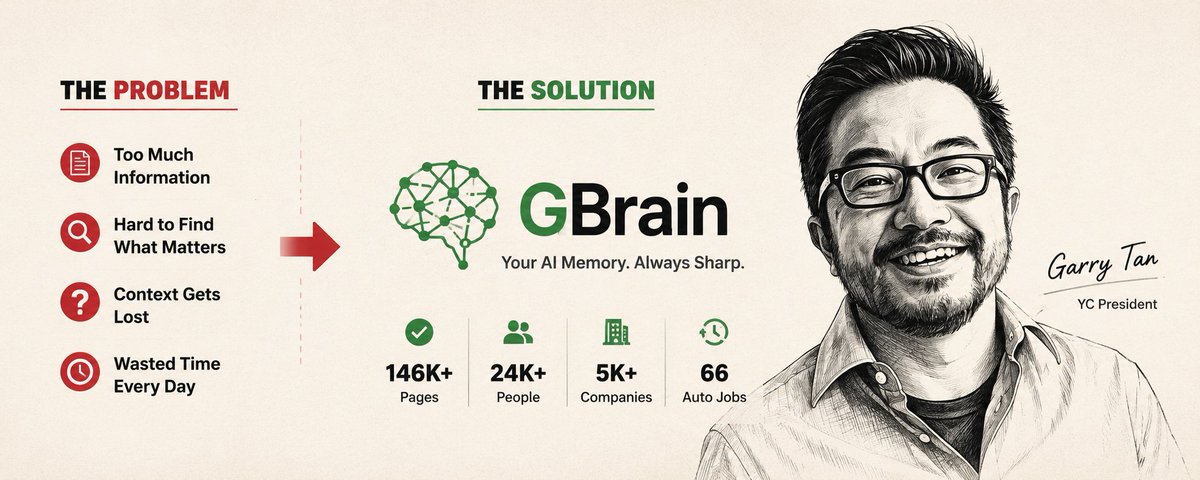
And @Kasparov63 may have quietly built one of the most important pieces of infrastructure in the entire AI stack.
Most people still think the future of AI is about better models.
Bigger context windows.
Smarter reasoning.
Faster inference.
More autonomous agents.
But there’s a problem nobody talks about enough:
AI still forgets everything.
You can have the smartest model in the world, but if it loses context the second the conversation ends, it never truly compounds.
Every session resets.
Every insight disappears.
Every relationship gets flattened into temporary tokens.
That’s not intelligence.
That’s stateless autocomplete.
And this is exactly the problem GBrain is trying to solve.
Not with another chatbot.
Not with another note-taking app.
Not with another “AI workspace.”
But with something much more ambitious:
A persistent cognitive layer for AI.
A real brain.
The deeper you go into the project, the more you realize this isn’t just another AI tool.
It’s a completely different philosophy of computing.
Most AI products today operate like search engines.
You ask a question.
The system retrieves chunks.
Then it generates a response from whatever happens to fit into the context window.
That’s essentially modern RAG.
And while it works, it has a fatal limitation:
Retrieval is not understanding.
Search is not memory.
Finding documents is not cognition.
That distinction is the entire thesis behind GBrain.
Garry Tan describes it in one sentence better than almost anyone in AI right now:
“Search finds pages.
The brain reads them for you.”
That line sounds simple.
It’s actually profound.
Because what most “AI memory systems” really do is outsource the thinking back to the user.
Imagine preparing for a meeting.
You ask:
“What do I need to know before tomorrow’s call with Alice?”
A normal AI knowledge system gives you:
- meeting notes
- Slack threads
- CRM records
- old emails
- random snippets
Now YOU still have to do the work.
You have to:
read,
connect,
infer,
remember,
prioritize.
The AI retrieved information.
But it never understood the situation.
GBrain tries to move beyond retrieval entirely.
Instead of showing documents, it synthesizes meaning.
It reads across meetings, notes, companies, people, tasks, and conversations — then constructs an actual narrative answer.
Not:
“Here are 12 relevant chunks.”
But:
“You last spoke to Alice six weeks ago about pricing.
Three action items remain unresolved.
No recent updates exist in the system, so assumptions may be stale.”
That final sentence changes everything.
Because it means the system isn’t pretending to know more than it does.
Most AI systems hallucinate confidence.
GBrain surfaces uncertainty.
And uncertainty is the foundation of trustworthy intelligence.
This is where the project becomes much more interesting than a “second brain” app.
Because underneath the retrieval layer is a continuously evolving knowledge graph.
Every person.
Every company.
Every meeting.
Every relationship.
Every promise.
Every investment.
Every reference.
Connected automatically.
The graph self-builds as information enters the system.
Mention someone once?
An entity gets created.
Reference a company across multiple meetings?
Connections strengthen.
Talk about investors, founders, products, or deals repeatedly?
The AI begins constructing relationship intelligence over time.
No manual organization.
No endless tagging.
No productivity-guru workflows.
The brain wires itself.
And this is the part most people are underestimating:
Once AI gains persistent memory + relationship awareness + synthesis…
It stops acting like software.
It starts acting like infrastructure.
That shift matters enormously.
Because infrastructure compounds.
The founder who remembers everything moves faster.
The investor with contextual intelligence sees opportunities earlier.
The company with institutional memory becomes harder to outcompete.
The AI agent with persistent cognition becomes exponentially more useful over time.
That’s why this category matters.
Not because it’s a cool productivity tool.
Because it fundamentally changes how intelligence scales.
And then there’s the most fascinating part of the entire architecture:
The dream cycle.
At night, GBrain runs autonomous maintenance loops that:
- merge duplicates
- fix citations
- enrich entities
- detect contradictions
- consolidate memory
- organize unresolved tasks
- strengthen relationships between information
Exactly like biological sleep consolidates human memory.
That design choice feels incredibly important.
Because most AI companies are focused on generating outputs.
GBrain is focused on maintaining cognition.
That’s a very different direction.
And honestly, it may end up being the more important one.
Right now, the AI industry is obsessed with agents.
But agents without memory are fragile.
They lose context.
Repeat mistakes.
Forget relationships.
Relearn the same information endlessly.
An agent without persistent memory is basically trapped in an eternal present.
That’s why memory infrastructure may become the real moat.
Not the models themselves.
The systems that remember:
win.
The systems that accumulate context:
win.
The systems that build relational understanding over years instead of minutes:
win.
And if that sounds dramatic, think about how humans actually operate.
Your intelligence is not just reasoning.
It’s accumulated context.
Your relationships.
Your memories.
Your experiences.
Your pattern recognition.
Your long-term associations.
That’s the real source of leverage.
GBrain is attempting to bring that layer into AI systems.
Not just temporary context windows.
Persistent cognition.
Which is why this project feels less like an app…
…and more like the early beginnings of an operating system for machine memory.
The most important AI companies of the next decade may not be the ones with the smartest models.
They may be the ones that build the deepest memory.
And right now, almost nobody is talking about that enough.
## 相关链接
- [Suryansh Tiwari](https://x.com/Suryanshti777)
- [@Suryanshti777](https://x.com/Suryanshti777)
- [@Kasparov63](https://x.com/@Kasparov63)
- [Upgrade to Premium](https://x.com/i/premium_sign_up)
- [7:40 PM · May 24, 2026](https://x.com/Suryanshti777/status/2058513583076732971)
- [26.4K Views](https://x.com/Suryanshti777/status/2058513583076732971/analytics)
- [View quotes](https://x.com/Suryanshti777/status/2058513583076732971/quotes)
---
*导出时间: 2026/5/25 09:41:41*
---
## 中文翻译
# 最重要的 AI 创业类别不是 AI 智能体,而是 AI 记忆。
**作者**: Suryansh Tiwari
**日期**: 2026-05-24T11:40:58.000Z
**来源**: [https://x.com/Suryanshti777/status/2058513583076732971](https://x.com/Suryanshti777/status/2058513583076732971)
---

And @Kasparov63 可能已经悄然构建了整个 AI 技术栈中最重要的基础设施之一。
大多数人仍然认为 AI 的未来在于更好的模型。
更大的上下文窗口。
更聪明的推理。
更快的推理速度。
更自主的智能体。
但有一个问题讨论得还不够多:
AI 仍然会遗忘所有事情。
你可以拥有世界上最聪明的模型,但如果它在对话结束的那一刻就丢掉了上下文,它就永远无法真正产生复利效应。
每次会话都会重置。
每次洞见都会消失。
每段关系都会被压扁成临时的 Token。
那不是智能。
那是无状态自动补全。
这正是 GBrain 试图解决的问题。
不是靠另一个聊天机器人。
不是靠另一个笔记应用。
不是靠另一个“AI 工作区”。
而是靠某种更宏大的东西:
AI 的持久认知层。
一个真正的大脑。
你越深入研究这个项目,就越意识到这不仅仅是另一个 AI 工具。
这是一种完全不同的计算哲学。
如今大多数 AI 产品的运作方式就像搜索引擎。
你提出一个问题。
系统检索出信息块。
然后根据恰好能塞进上下文窗口的内容生成回答。
这本质上就是现代 RAG(检索增强生成)。
虽然它有效,但有一个致命的局限性:
检索不是理解。
搜索不是记忆。
查找文件不是认知。
这种区别正是 GBrain 背后的核心论点。
Garry Tan 用一句话比现在几乎所有 AI 领域的人更好地描述了这一点:
“搜索引擎找到页面。
大脑为你阅读它们。”
这句话听起来很简单。
实则意味深长。
因为大多数所谓的“AI 记忆系统”实际上做的是把思考工作甩回给用户。
想象一下正在准备一个会议。
你问:
“在明天和 Alice 的通话之前,我需要知道什么?”
普通的 AI 知识系统会给你:
- 会议记录
- Slack 线程
- CRM 记录
- 旧邮件
- 随机片段
现在你仍然得自己做这些工作。
你必须:
阅读,
关联,
推断,
记住,
确定优先级。
AI 检索了信息。
但它从未理解这个情境。
GBrain 试图完全超越检索。
它不展示文档,而是合成意义。
它会跨会议、笔记、公司、人员、任务和对话进行阅读——然后构建一个真正的叙述性回答。
不是:
“这里有 12 个相关的信息块。”
而是:
“你六周前和 Alice 最后一次交谈是关于定价的。
有三个行动项目仍未解决。
系统中没有最新的更新,因此推测可能已经过时。”
最后这句话改变了一切。
因为这意味着系统不会假装知道比它实际知道的更多东西。
大多数 AI 系统会幻觉出自信。
GBrain 则呈现出不确定性。
而不确定性是值得信赖的智能的基础。
这就是为什么这个项目比一个“第二大脑”应用更有趣的地方。
因为在检索层之下,是一个不断演化的知识图谱。
每个人。
每家公司。
每个会议。
每段关系。
每个承诺。
每笔投资。
每次引用。
全部自动连接。
当信息进入系统时,图谱会自动构建。
提到某人一次?
一个实体就创建了。
跨越多个会议引用一家公司?
连接就会加强。
反复谈论投资者、创始人、产品或交易?
AI 随着时间推移开始构建关系智能。
无需手动整理。
无休止的标签。
没有 productivity-guru 的工作流程。
大脑会自我连接。
而这正是大多数人低估的部分:
一旦 AI 获得持久记忆 + 关系感知 + 合成能力……
它就不再表现得像软件。
它开始表现得像基础设施。
这种转变意义重大。
因为基础设施会产生复利。
记住一切的创始人行动更快。
具有情境感知的投资者能更早看到机会。
拥有机构记忆的公司更难被击败。
具有持久认知的 AI 智能体会随着时间推移变得指数级地更有用。
这就是为什么这个类别至关重要。
不仅仅是因为它是一个很酷的生产力工具。
而是因为它从根本上改变了智能如何扩展。
然后是整个架构中最迷人的部分:
梦循环。
在晚上,GBrain 运行自主维护循环:
- 合并重复项
- 修正引用
- 丰富实体
- 检测矛盾
- 巩固记忆
- 整理未解决的任务
- 加强信息之间的关系
就像生物睡眠巩固人类记忆一样。
这个设计选择感觉极其重要。
因为大多数 AI 公司专注于生成输出。
GBrain 专注于维持认知。
这是一个非常不同的方向。
老实说,这最终可能是更重要的方向。
目前,AI 行业痴迷于智能体。
但是没有记忆的智能体是脆弱的。
它们丢失上下文。
重复错误。
遗忘关系。
无休止地重新学习同样的信息。
没有持久记忆的智能体基本上被困在了永恒的当下。
这就是为什么记忆基础设施可能成为真正的护城河。
不是模型本身。
那些记得住的系统:
会赢。
那些积累上下文的系统:
会赢。
那些花费数年而不是数分钟来构建关系理解的系统:
会赢。
如果这听起来很戏剧化,想想人类实际上是如何运作的。
你的智能不仅仅是推理。
它是积累的上下文。
你的关系。
你的记忆。
你的经历。
你的模式识别。
你的长期联想。
那才是真正的杠杆来源。
GBrain 试图将这一层带入 AI 系统。
不仅仅是临时的上下文窗口。
持久的认知。
这就是为什么这个项目感觉不太像一个应用……
……而更像是机器记忆操作系统的早期雏形。
下一个十年最重要的 AI 公司可能不是拥有最聪明模型的公司。
它们可能是构建了最深记忆的公司。
而现在,几乎没有人在这方面讨论得足够多。
## 相关链接
- [Suryansh Tiwari](https://x.com/Suryanshti777)
- [@Suryanshti777](https://x.com/Suryanshti777)
- [@Kasparov63](https://x.com/@Kasparov63)
- [Upgrade to Premium](https://x.com/i/premium_sign_up)
- [7:40 PM · May 24, 2026](https://x.com/Suryanshti777/status/2058513583076732971)
- [26.4K Views](https://x.com/Suryanshti777/status/2058513583076732971/analytics)
- [View quotes](https://x.com/Suryanshti777/status/2058513583076732971/quotes)
---
*导出时间: 2026/5/25 09:41:41*