# The Anatomy of an AI Agent Harness (And Why Your Agents Break in Production)
**作者**: Suryansh Tiwari
**日期**: 2026-04-26T15:20:59.000Z
**来源**: [https://x.com/Suryanshti777/status/2048422091066867903](https://x.com/Suryanshti777/status/2048422091066867903)
---
A lot of people think they’re building “AI agents.”
In reality, they’re wiring a model to a few tools and calling it done.
It works in demos. It breaks in production.
The model forgets what just happened, tool calls fail quietly, and the context window fills up with noise. At that point, it’s tempting to blame the model.
That’s usually the wrong diagnosis.
The real issue is everything around the model.
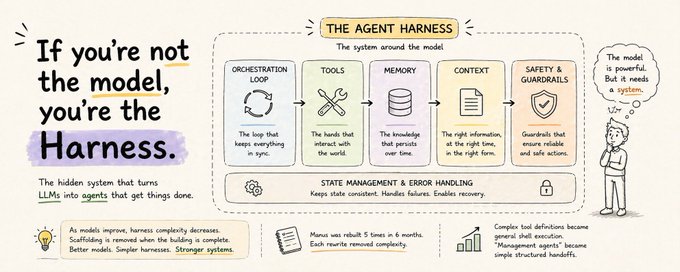
This surrounding system now has a name: the agent harness.
What Is an Agent Harness?
The agent isn’t a single component. It’s an emergent behavior — something that appears when multiple systems work together.
The harness is the machinery that produces that behavior.
If you strip things down, a raw LLM is just a computation engine. It doesn’t have persistent memory, it doesn’t interact with the outside world, and it doesn’t manage state across steps.
The harness fills in those gaps.
It handles orchestration, tool execution, memory, context, safety, and state. In other words, it turns a stateless model into something that can act.
There’s a useful analogy here: a raw model is like a CPU without an operating system. The harness is the OS that makes it usable.
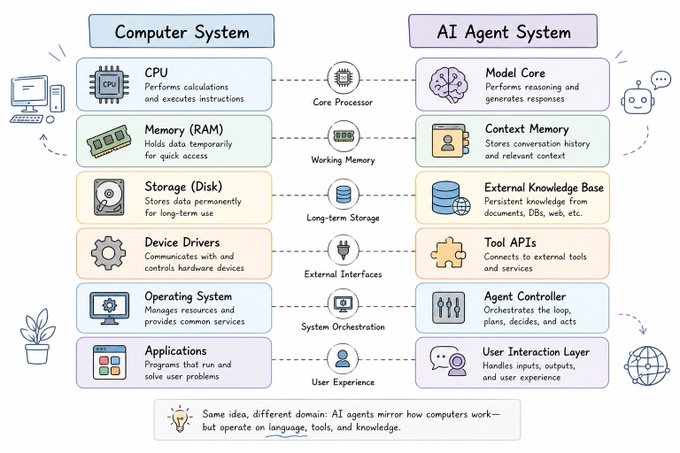
This framing also clarifies a common confusion. When someone says they built an “agent,” what they usually built is a harness, and then connected it to a model.
Three Layers of Engineering
To understand where the harness fits, it helps to separate three layers:
Prompt engineering: what instructions the model receives
Context engineering: what information the model sees and when
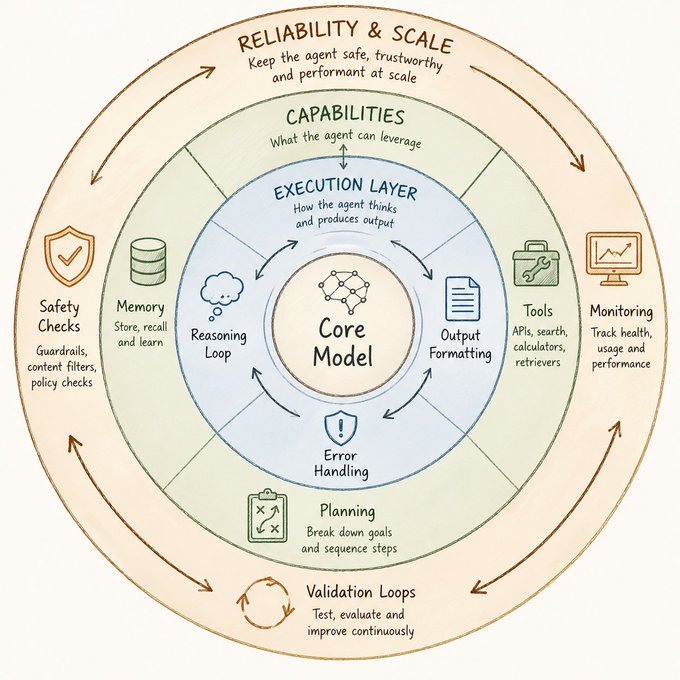
Harness engineering: everything else — orchestration, tools, memory, state, safety
Most people focus on the first layer. Strong systems are built in the third.
The harness is not a thin wrapper around prompts. It is the system that makes iterative, goal-directed behavior possible.
The Orchestration Loop
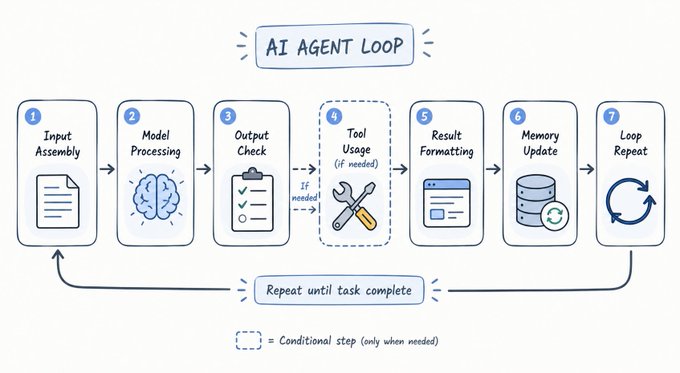
At the center of every agent is a loop.👉
It’s often described as a Thought–Action–Observation cycle:
assemble the prompt
call the model
interpret the output
execute any tool calls
feed results back into context
repeat until done
Conceptually, this is simple. In many implementations, it’s literally a while loop.
The complexity doesn’t come from the loop itself. It comes from everything the loop has to manage correctly.
The Loop in Motion
To see how the pieces fit together, it helps to walk through a single cycle.
First, the system builds the full prompt. This includes system instructions, available tools, relevant memory, conversation history, and the current user request.
Next, the model generates an output. That output might be a final answer, or it might include structured tool calls.
If tools are requested, the harness validates inputs, executes them in a controlled environment, and captures the results.
Those results are then formatted back into messages the model can understand. The system updates its context and runs the loop again.
This continues until a termination condition is met — for example, no more tool calls, a maximum number of steps, or a safety constraint.
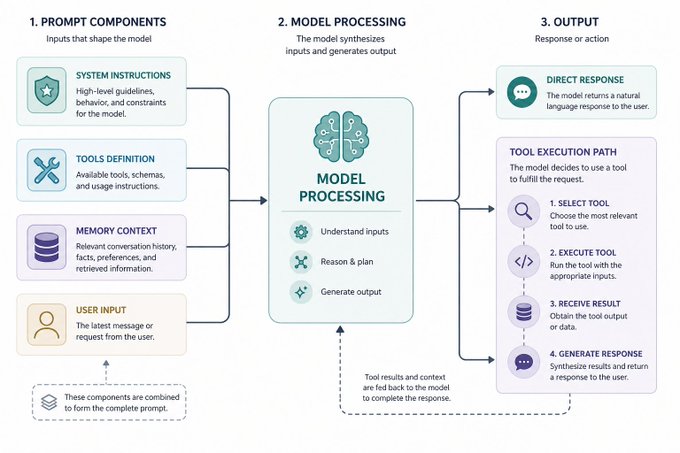
What looks like a simple loop is actually coordinating multiple subsystems: context management, error handling, permissions, and state tracking.
Where Systems Actually Break
Most failures in agent systems don’t come from the model’s reasoning ability. They come from system design.
Common failure points include:
context windows filling with low-signal data
tools returning inconsistent or malformed outputs
lack of retry or recovery mechanisms
no verification of intermediate results
These issues compound across steps. Even a small per-step failure rate can collapse a multi-step workflow.
The takeaway is straightforward: reliability is a systems problem, not just a model problem.
Context Management Is the Real Constraint
One of the most underestimated challenges is context.
As more information is added to the prompt, performance doesn’t improve linearly. In many cases, it degrades. Important details get buried, and the model becomes less consistent.
Effective systems treat context as a limited resource.
Instead of dumping everything into the prompt, they:
summarize past interactions
retrieve only relevant information when needed
separate short-term and long-term memory
delegate subtasks to smaller, focused loops
The goal is not more context. It’s better context.
Memory Beyond Chat History
Memory in agent systems operates at multiple levels.
Short-term memory is the current conversation. It provides immediate continuity.
Long-term memory persists across sessions — files, databases, or structured stores.
There’s also a form of working memory: task-specific state that evolves during execution.
A key design principle is that memory should not be blindly trusted. Strong systems treat stored information as a hint and verify it against the current state before acting on it.
Tools as the Agent’s Interface
Tools are how the agent interacts with the external world.
They are typically defined through schemas that describe what each tool does and what inputs it expects. The model uses these descriptions to decide when and how to call them.
The harness is responsible for everything around that decision:
registering available tools
validating inputs
executing safely (often in a sandbox)
formatting outputs back into the loop
Poorly designed tools can degrade performance just as much as poor prompts.
How Frameworks Implement the Pattern
Different frameworks converge on the same underlying structure, but make different architectural choices.
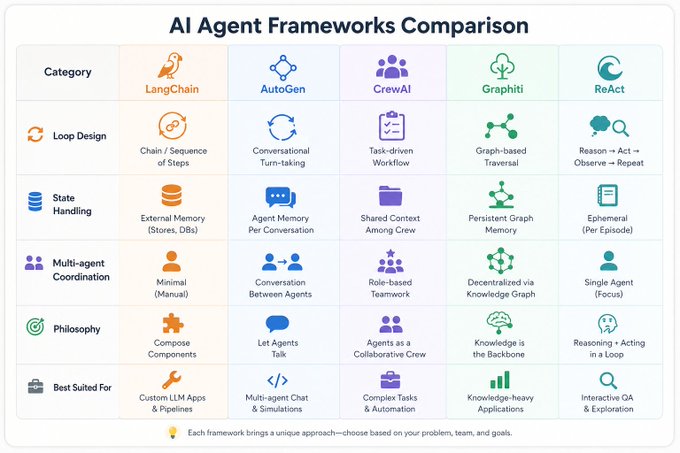
Despite these differences, the core pattern remains consistent: a loop, a set of tools, managed context, and stateful execution.
The Scaffolding Perspective
A useful way to think about the harness is as scaffolding.
It enables the model to operate beyond its raw capabilities. It provides structure, reach, and stability.
But it doesn’t do the actual work.
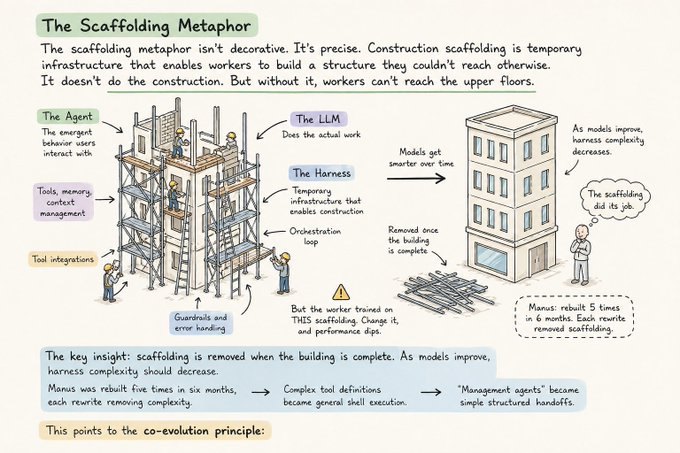
As models improve, some responsibilities shift away from the harness and into the model itself. Systems tend to evolve toward simpler orchestration with more capable underlying models.
This suggests a direction: the best designs don’t hardcode too much logic. They allow the system to become simpler as the model becomes stronger.
Thin vs Thick Harnesses
One of the core design decisions is how much control lives in the harness versus the model.
A thinner harness delegates more decisions to the model. A thicker harness encodes more logic explicitly.
Both approaches work, but they involve trade-offs between flexibility, reliability, and complexity.
Over time, there’s a noticeable trend toward thinner systems, as models become better at handling planning and execution internally.
The Key Insight
Two systems can use the same model and produce completely different results.
The difference is not the model.
It’s the harness.
The harness determines how context is managed, how tools are used, how errors are handled, and how decisions are verified.
That’s where most of the engineering leverage lives.
Closing Thought
If an agent fails, the instinct is often to swap the model.
In many cases, the better move is to examine the system around it.
Because the model is only one part of the story.
The harness is what turns it into something that actually works.
## 相关链接
- [Suryansh Tiwari](https://x.com/Suryanshti777)
- [@Suryanshti777](https://x.com/Suryanshti777)
- [5.6K](https://x.com/Suryanshti777/status/2048422091066867903/analytics)
- [Upgrade to Premium](https://x.com/i/premium_sign_up)
- [11:20 PM · Apr 26, 2026](https://x.com/Suryanshti777/status/2048422091066867903)
- [5,637 Views](https://x.com/Suryanshti777/status/2048422091066867903/analytics)
---
*导出时间: 2026/4/27 09:17:19*