# RAG Is a Lie We Tell Ourselves — Karpathy's LLM Wiki Changes Everything
**作者**: Suryansh Tiwari
**日期**: 2026-05-01T15:00:44.000Z
**来源**: [https://x.com/Suryanshti777/status/2050228936270037068](https://x.com/Suryanshti777/status/2050228936270037068)
---
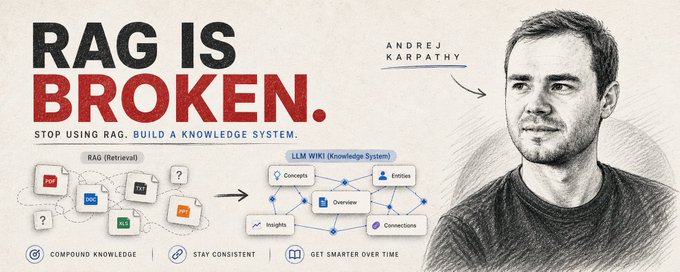
Most people's AI + knowledge workflow has a dirty secret: it doesn't actually accumulate anything.
You upload your documents, ask a question, and the LLM scans raw chunks to assemble an answer. It feels productive—until you close the tab. Everything the system figured out disappears. Next session, it starts from zero again. Forever.
This is RAG. It powers NotebookLM, ChatGPT file uploads, and almost every “chat with your docs” product. It works—but it has a hard ceiling: there is no compounding. The system doesn’t get smarter about your knowledge; it just keeps re-deriving the same insights again and again.
Andrej Karpathy proposes a pattern that breaks this ceiling: LLM Wiki.
Core Idea
Instead of retrieving from raw documents every time, the LLM builds and maintains a persistent wiki—a structured, interlinked set of markdown files sitting between you and your sources.
When you add a document, the LLM doesn’t just index it. It reads, extracts, and integrates it into the wiki—updating entity pages, refining summaries, flagging contradictions, and strengthening the overall synthesis.
The key shift: knowledge is compiled once and continuously updated, not recreated on every query.
This makes the wiki a compounding system. Cross-references already exist. Contradictions are already surfaced. Insights evolve over time. Even your questions can become new pages—so exploration compounds too.
Architecture
Raw Sources
Your documents, papers, and transcripts remain unchanged. This is the ground truth layer.
The Wiki
A structured collection of LLM-generated markdown pages—summaries, entities, concepts, comparisons, and a running synthesis. The LLM maintains this layer.
The Schema
A guiding configuration (like CLAUDE.md or AGENTS.md) that defines structure, conventions, and workflows. This turns the LLM into a disciplined knowledge maintainer.
How It Works in Practice
Ingestion
Adding a source triggers deep integration, not storage. The LLM reads it, extracts insights, writes summaries, updates multiple pages, and links everything together. One document can impact 10–15 pages.
Querying
Questions are answered from the wiki, not raw files. The LLM navigates structured knowledge, synthesizes responses, and can store valuable answers back into the system as new pages.
Linting
The system self-checks: detecting contradictions, outdated claims, missing links, and underdeveloped concepts. It actively improves itself over time.
Why This Actually Works
The real bottleneck in knowledge systems isn’t thinking—it’s maintenance. Updating links, resolving contradictions, and keeping everything consistent is tedious.
Humans abandon systems because upkeep becomes overwhelming.
LLMs don’t.
They don’t forget, get bored, or avoid repetitive work. They can update dozens of pages instantly and consistently. This drops maintenance cost to near zero—so the system stays alive and reliable.
Your role becomes clear: curate inputs, guide thinking, ask better questions.
The LLM handles everything else.
Use Cases
This pattern applies far beyond research:
Personal development: structured tracking of goals, habits, and insights
Deep research: evolving thesis built across papers and reports
Reading: chapter-by-chapter breakdowns forming a rich companion wiki
Team knowledge: internal systems built from meetings, chats, and calls
Any domain where knowledge accumulates over time and needs structure
The Memex Moment
The idea echoes Vannevar Bush’s 1945 vision of the Memex—a personal knowledge system with linked ideas and associative trails.
That vision failed on one problem: maintenance.
Now, that problem is solved.
Takeaway
RAG is useful, but limited. It retrieves—it doesn’t learn or evolve.
LLM Wiki is different. It’s a knowledge system that compounds, improves over time, and maintains itself.
It’s not a finished product—it’s a pattern. You design the structure, schema, and workflow with the LLM.
That’s the real shift:
Stop retrieving. Start compiling.
Karpathy’s original gist with full implementation details is available on GitHub.
## 相关链接
- [Suryansh Tiwari](https://x.com/Suryanshti777)
- [@Suryanshti777](https://x.com/Suryanshti777)
- [11:00 PM · May 1, 2026](https://x.com/Suryanshti777/status/2050228936270037068)
- [6,693 Views](https://x.com/Suryanshti777/status/2050228936270037068/analytics)
---
*导出时间: 2026/5/2 09:55:47*
---
## 中文翻译
# RAG 是我们对自己撒的谎 —— Karpathy 的 LLM Wiki 改变一切
**作者**: Suryansh Tiwari
**日期**: 2026-05-01T15:00:44.000Z
**来源**: [https://x.com/Suryanshti777/status/2050228936270037068](https://x.com/Suryanshti777/status/2050228936270037068)
---

大多数人的 AI + 知识工作流都有一个不可告人的秘密:它实际上并没有积累任何东西。
你上传文档,提出问题,然后 LLM 扫描原始片段以拼凑出答案。这感觉很有成效——直到你关闭标签页。系统推导出的所有内容都会消失。下一次会话时,它又从零开始。永远如此。
这就是 RAG。它驱动着 NotebookLM、ChatGPT 文件上传以及几乎所有的“与文档对话”类产品。它有效——但它有一个硬性上限:没有复利效应。系统对你的知识并没有变得更聪明;它只是一遍又一遍地重新推导相同的见解。
Andrej Karpathy 提出了一种打破这一上限的模式:LLM Wiki。
核心理念
不再每次都从原始文档中检索,而是由 LLM 构建并维护一个持久的 wiki——一组结构化的、相互链接的 markdown 文件,位于你和你的原始资料之间。
当你添加文档时,LLM 不仅仅是索引它。它会阅读、提取并将其整合到 wiki 中——更新实体页面、完善摘要、标记矛盾并加强整体综合。
关键转变在于:知识只需编译一次并持续更新,而不是在每次查询时重新创建。
这使得 wiki 成为一个复利系统。交叉引用已经存在。矛盾已经被揭示。见解会随着时间的推移而演变。甚至你的问题也可以变成新的页面——因此探索也会产生复利。
架构
原始资料
你的文档、论文和录音逐字稿保持不变。这是事实层。
Wiki
LLM 生成的结构化 markdown 页面集合——包括摘要、实体、概念、比较以及持续的综合。LLM 维护这一层。
架构模式
一种指导性配置(如 CLAUDE.md 或 AGENTS.md),定义结构、约定和工作流。这将 LLM 变成了一名严谨的知识维护者。
实际运作方式
摄入
添加资料会触发深度整合,而不仅仅是存储。LLM 阅读它,提取见解,撰写摘要,更新多个页面,并将所有内容链接在一起。一个文档可以影响 10 到 15 个页面。
查询
问题的回答来自 wiki,而不是原始文件。LLM 导航结构化知识,综合响应,并可以将有价值的答案作为新页面存储回系统中。
检查(Linting)
系统进行自检:检测矛盾、过时的主张、缺失的链接和未充分发展的概念。它随着时间的推移主动改进自身。
为什么这真的有效
知识系统中真正的瓶颈不是思考——而是维护。更新链接、解决矛盾并保持一切一致是枯燥乏味的。
人类放弃系统是因为维护变得不堪重负。
LLM 不会。
它们不会忘记、感到厌烦或逃避重复性工作。它们可以瞬间且一致地更新数十个页面。这将维护成本降至近乎为零——因此系统保持活力和可靠。
你的角色变得清晰:策划输入,引导思考,提出更好的问题。
LLM 处理其余的一切。
用例
这种模式的应用远不止于研究:
个人发展:对目标、习惯和见解的结构化跟踪
深度研究:跨论文和报告构建的演进论题
阅读:章节分解形成丰富的伴侣 wiki
团队知识:从会议、聊天和通话中构建的内部系统
任何知识随时间积累并需要结构的领域
Memex 时刻
这一想法呼应了 Vannevar Bush 1945 年对 Memex 的愿景——一个具有链接思想和联想路径的个人知识系统。
那个愿景因一个问题而失败:维护。
现在,这个问题解决了。
要点
RAG 很有用,但很有限。它检索——它不学习也不进化。
LLM Wiki 则不同。它是一个具有复利效应、随时间改进并自我维护的知识系统。
它不是一个成品——它是一种模式。你与 LLM 一起设计结构、架构模式和工作流。
这才是真正的转变:
停止检索。开始编译。
Karpathy 原始的 gist(包含完整的实现细节)可在 GitHub 上获取。
## 相关链接
- [Suryansh Tiwari](https://x.com/Suryanshti777)
- [@Suryanshti777](https://x.com/Suryanshti777)
- [11:00 PM · May 1, 2026](https://x.com/Suryanshti777/status/2050228936270037068)
- [6,693 Views](https://x.com/Suryanshti777/status/2050228936270037068/analytics)
---
*导出时间: 2026/5/2 09:55:47*