# How To Build AI Operating Systems & Autonomous Workflows
**作者**: Suryansh Tiwari
**日期**: 2026-05-21T11:29:41.000Z
**来源**: [https://x.com/Suryanshti777/status/2057423582276522469](https://x.com/Suryanshti777/status/2057423582276522469)
---
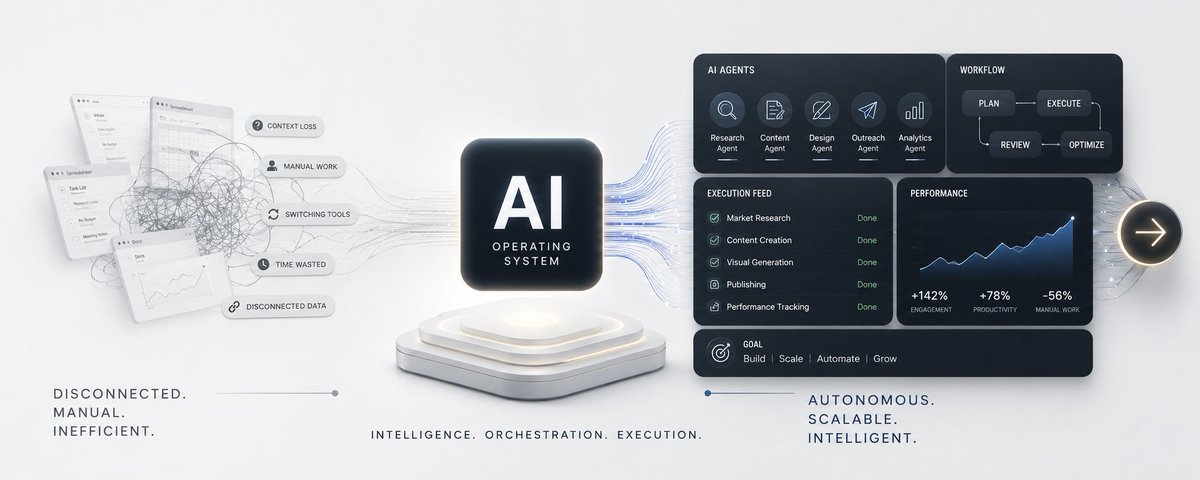
The Complete Guide To Building Systems That Work Like Digital Companies
Most people are still building AI tools.
A few are building AI agents.
But the real opportunity is much bigger than that.
We are moving toward a world where businesses won’t run on disconnected apps and manual coordination anymore. They’ll run on intelligent operational layers capable of reasoning, remembering, coordinating, executing, and continuously improving across entire workflows.
That is what an AI Operating System really is.
And despite how futuristic the term sounds, the foundations already exist today.
The interesting part is that an AI Operating System is not one model, one prompt, or one chatbot. It’s an ecosystem made up of memory systems, specialized agents, workflows, integrations, execution layers, and feedback loops working together like a coordinated digital team.
The companies that understand this shift early won’t just automate tasks. They’ll fundamentally change how work gets done.
This guide breaks down exactly how AI Operating Systems work, how to build them, how companies are already using them, and why this may become the next major evolution of software itself.
First, Understand What An AI Operating System Actually Is
Most people hear “AI Operating System” and imagine a superintelligent assistant that magically does everything.
That’s not how it works.
An AI Operating System is better understood as an intelligent orchestration layer sitting between humans, software tools, workflows, and execution systems.
Instead of humans manually coordinating dozens of apps, the AI system becomes the coordinator itself.
Think about how companies currently operate:
Teams communicate in Slack
Tasks live in Linear or Jira
Documents sit inside Notion
Analytics live in dashboards
Emails happen separately
Marketing tools operate independently
CRMs store fragmented customer data
The biggest problem is not lack of software.
The problem is fragmentation.
Context constantly gets lost between tools, teams, and workflows. Humans spend enormous amounts of time transferring information manually between systems that don’t naturally understand each other.
AI Operating Systems solve this by creating a persistent intelligence layer across the entire workflow stack.
Instead of switching between tools, the user interacts with one intelligent system that can understand objectives, maintain context, coordinate tasks, use external tools, and execute workflows autonomously.
This changes software from something people “use” into something that actively operates alongside them.
The Core Architecture Behind AI Operating Systems
To build a real AI Operating System, you need to stop thinking like an app developer and start thinking like a systems architect.
A proper AI Operating System usually contains six major layers working together.
1. The Intelligence Layer
This is the reasoning engine of the system.
Usually powered by large language models such as:
OpenAI models
Anthropic Claude
Google Gemini
open-source reasoning models
This layer handles:
understanding goals
reasoning through tasks
planning actions
interpreting instructions
decision-making
But contrary to popular belief, the model itself is not the product.
The orchestration around the model is what creates real value.
2. The Memory Layer
Without memory, AI systems reset every session and behave like temporary assistants.
Real AI Operating Systems require persistent memory.
The system needs to remember:
user preferences
workflow history
organizational knowledge
previous outputs
project context
behavioral patterns
long-term objectives
This transforms AI from a reactive chatbot into a continuously evolving operational system.
Memory is one of the biggest competitive advantages in the AI era because it allows systems to accumulate organizational intelligence over time.
3. The Tool Layer
This is where AI moves beyond conversation and begins interacting with the real world.
The system connects with:
APIs
databases
browsers
CRMs
project management tools
design software
analytics platforms
communication systems
This allows AI to:
send emails
create tasks
publish content
update records
analyze performance
generate reports
trigger automations
coordinate workflows
At this stage, AI stops being informative and becomes operational.
4. The Agent Layer
This is where specialization begins.
Instead of using one massive general-purpose agent for everything, advanced systems use multiple specialized agents with defined responsibilities.
For example:
A research agent gathers information and monitors trends.
A writing agent converts insights into articles, posts, reports, or scripts.
A design agent creates visuals and creative assets.
A distribution agent handles publishing across channels.
An analytics agent tracks performance and identifies optimization opportunities.
This structure mirrors how real organizations operate.
Specialized systems scale better because each agent becomes optimized for a specific type of work.
5. The Orchestration Layer
This is the most important part of the entire architecture.
The orchestration layer coordinates:
which agent should act
when actions should happen
how workflows move forward
how information gets shared between systems
how tasks are prioritized
how failures are handled
Without orchestration, agents become disconnected tools.
With orchestration, they become coordinated operational infrastructure.
This is where AI Operating Systems become significantly more powerful than isolated AI agents.
6. The Feedback Layer
The best systems improve continuously.
An AI Operating System should monitor:
successful outputs
failed outputs
engagement metrics
user corrections
workflow bottlenecks
execution quality
Over time, this allows the system to optimize itself.
That’s when AI infrastructure starts compounding.
How To Actually Build An AI Operating System
Most people assume building AI Operating Systems requires massive research labs.
It doesn’t.
You can already build surprisingly powerful systems using existing models and infrastructure.
The key is understanding architecture and workflow design.
Step 1: Start With A Single Workflow
One of the biggest mistakes people make is trying to automate an entire company immediately.
That usually fails.
The smarter approach is starting with one high-value workflow.
For example:
content production
lead generation
research automation
customer support
internal knowledge management
software development workflows
outbound sales systems
Choose a workflow that:
repeats frequently
consumes significant time
follows recognizable patterns
produces measurable outputs
That becomes the foundation of your AI Operating System.
Step 2: Break The Workflow Into Specialized Roles
Most workflows contain multiple forms of intelligence.
For example, content production includes:
research
strategy
writing
editing
visual creation
distribution
analytics
Instead of forcing one AI to handle everything, divide the workflow into specialized responsibilities.
This is how you move from “AI assistant” to “AI team.”
The structure becomes dramatically more scalable.
Step 3: Create Shared Memory
Now the system needs context persistence.
Every agent should have access to:
project history
brand guidelines
previous outputs
organizational knowledge
performance data
workflow state
Without shared memory, agents operate blindly.
Shared context is what allows the system to behave coherently across long-running workflows.
Step 4: Connect External Tools
This is where systems become genuinely useful.
The AI Operating System should interact with:
databases
communication tools
analytics platforms
scheduling systems
publishing tools
internal documentation
APIs
Now the system can execute instead of just suggesting.
That changes everything.
Step 5: Build Decision Loops
Most current AI systems are linear.
Input → output.
AI Operating Systems work differently.
They observe results and adapt behavior.
For example:
poor-performing content changes future content strategy
failed outreach sequences get optimized automatically
customer support issues update knowledge bases
recurring problems trigger workflow improvements
This creates intelligent operational feedback loops.
Step 6: Add Human Oversight
Fully autonomous systems sound exciting, but in practice, hybrid systems work best.
Humans should still handle:
strategic decisions
creative judgment
sensitive approvals
edge cases
long-term direction
The goal is not removing humans entirely.
The goal is increasing leverage.
The most effective setups are usually:
human-directed, AI-executed systems.
What AI Operating Systems Actually Look Like In Practice
The easiest way to understand this concept is through real workflow examples.
Example: AI Content Operating System
Imagine a media company running through an AI orchestration layer.
The workflow could look like this:
A research agent scans:
trends
social platforms
launch announcements
viral discussions
industry news
A strategy agent identifies:
opportunities
audience demand
positioning angles
narrative structures
A writing agent produces:
articles
threads
scripts
newsletters
A design agent creates:
visuals
infographics
thumbnails
A distribution agent publishes content across platforms.
An analytics agent measures:
retention
engagement
conversion
audience behavior
The system continuously improves future outputs based on performance data.
Now imagine this operating every day with minimal manual coordination.
That is an AI Operating System.
Why This Is Bigger Than SaaS
Traditional SaaS gave users tools.
AI Operating Systems provide outcomes.
That distinction is massive.
Old software required users to:
learn interfaces
manage workflows
coordinate systems
operate tools manually
AI systems increasingly abstract away the operational complexity.
The user simply defines objectives.
The system handles execution.
This may become the biggest shift in software since the rise of cloud computing.
The Most Important Skill In The AI Era
It won’t be prompting.
It won’t even be coding alone.
The highest leverage skill may become:
workflow orchestration.
People who understand:
systems design
automation logic
coordination layers
AI infrastructure
operational architecture
will build disproportionately powerful businesses.
Because future companies may not scale primarily through headcount.
They’ll scale through intelligent systems.
The Future Of Work Is Becoming System-Centric
We are moving away from a world where humans manually operate software all day.
We are entering a world where humans supervise intelligent execution systems.
That doesn’t mean humans disappear.
It means the structure of work changes.
The highest-value humans will increasingly focus on:
direction
creativity
strategy
judgment
vision
coordination
while AI systems handle:
execution
analysis
automation
operational scale
repetitive workflows
That combination is extraordinarily powerful.
Final Thought
Most people still see AI as a tool.
The bigger shift is realizing AI is becoming infrastructure.
The companies that win over the next decade likely won’t just have the smartest models.
They’ll have the best orchestration systems, the best memory architecture, the best workflow intelligence, and the strongest human-AI coordination layers.
Because in the long run, intelligence alone is not enough.
The real advantage comes from systems that can coordinate, execute, adapt, and improve continuously.
That is what AI Operating Systems truly are.
And we are only at the beginning of this transition.
## 相关链接
- [Suryansh Tiwari](https://x.com/Suryanshti777)
- [@Suryanshti777](https://x.com/Suryanshti777)
- [Upgrade to Premium](https://x.com/i/premium_sign_up)
- [7:29 PM · May 21, 2026](https://x.com/Suryanshti777/status/2057423582276522469)
- [17K Views](https://x.com/Suryanshti777/status/2057423582276522469/analytics)
- [View quotes](https://x.com/Suryanshti777/status/2057423582276522469/quotes)
---
*导出时间: 2026/5/22 16:05:09*
---
## 中文翻译
# 如何构建 AI 操作系统与自主工作流
**作者**: Suryansh Tiwari
**日期**: 2026-05-21T11:29:41.000Z
**来源**: [https://x.com/Suryanshti777/status/2057423582276522469](https://x.com/Suryanshti777/status/2057423582276522469)
---

**构建像数字公司一样运作的系统的完整指南**
大多数人还在构建 AI 工具。
少数人在构建 AI 智能体。
但真正的机会远不止于此。
我们正在迈向一个世界,在这个世界里,企业将不再依赖断连的应用程序和人工协调来运转。它们将运行于智能运营层之上,这些层能够在整个工作流中进行推理、记忆、协调、执行和持续改进。
这就是 AI 操作系统的真正含义。
尽管这个词听起来充满未来感,但其基础如今已经存在。
有趣的是,AI 操作系统不是一个模型、一个提示词或一个聊天机器人。它是一个由记忆系统、专业智能体、工作流、集成、执行层和反馈循环组成的生态系统,像一个协调一致的数字团队一样协同工作。
那些早期理解这一转变的公司,不仅会自动化任务,还将从根本上改变工作的完成方式。
本指南将深入解析 AI 操作系统的工作原理、如何构建它们、公司如何已经在使用它们,以及为什么这可能成为软件本身的下一个重大演变。
**首先,理解 AI 操作系统实际上是什么**
大多数人听到“AI 操作系统”时,会想象出一个魔法般无所不能的超级智能助手。
事实并非如此。
AI 操作系统更应该被理解为位于人类、软件工具、工作流和执行系统之间的智能编排层。
不再是人类手动协调几十个应用程序,AI 系统本身成为了协调者。
思考一下公司目前的运作方式:
团队在 Slack 中沟通
任务存在于 Linear 或 Jira 中
文档存放于 Notion 中
分析数据位于仪表盘中
邮件单独进行
营销工具独立运行
CRM 系统存储着碎片化的客户数据
最大的问题不在于缺乏软件。
问题在于碎片化。
上下文在工具、团队和工作流之间不断丢失。人类花费大量时间在互不理解的系统之间手动传输信息。
AI 操作系统通过在整个工作流技术栈上创建一个持久的智能层来解决这个问题。
用户不再需要在工具之间切换,而是与一个能够理解目标、维持上下文、协调任务、使用外部工具并自主执行工作流的单一智能系统进行交互。
这将软件从人们“使用”的东西,变成了与人并肩运作的积极参与者。
**AI 操作系统的核心架构**
要构建一个真正的 AI 操作系统,你需要停止像应用开发者那样思考,开始像系统架构师那样思考。
一个完善的 AI 操作系统通常包含六个协同工作的主要层级。
**1. 智能层**
这是系统的推理引擎。
通常由以下大语言模型驱动:
OpenAI 模型
Anthropic Claude
Google Gemini
开源推理模型
这一层负责处理:
理解目标
对任务进行推理
规划行动
解释指令
做出决策
但与普遍的看法相反,模型本身并不是产品。
围绕模型的编排才是创造真正价值的关键。
**2. 记忆层**
没有记忆,AI 系统会在每次会话时重置,表现得像临时助手。
真正的 AI 操作系统需要持久记忆。
系统需要记住:
用户偏好
工作流历史
组织知识
过往输出
项目上下文
行为模式
长期目标
这将 AI 从被动的聊天机器人转变为持续演进的运营系统。
记忆是 AI 时代最大的竞争优势之一,因为它允许系统随着时间的推移积累组织智能。
**3. 工具层**
这是 AI 超越对话并开始与现实世界交互的地方。
系统连接到:
API
数据库
浏览器
CRM 系统
项目管理工具
设计软件
分析平台
通信系统
这使得 AI 能够:
发送邮件
创建任务
发布内容
更新记录
分析绩效
生成报告
触发自动化
协调工作流
在这个阶段,AI 停止仅仅提供信息,变得可操作。
**4. 智能体层**
这是专业化开始的地方。
高级系统不再使用一个庞大的通用智能体处理所有事情,而是使用多个具有明确职责的专门智能体。
例如:
研究智能体收集信息并监控趋势。
写作智能体将洞察转化为文章、帖子、报告或脚本。
设计智能体创建视觉素材和创意资产。
分发智能体处理跨渠道发布。
分析智能体跟踪绩效并识别优化机会。
这种结构反映了现实组织的运作方式。
专业化系统扩展性更好,因为每个智能体都针对特定类型的工作进行了优化。
**5. 编排层**
这是整个架构中最重要的部分。
编排层负责协调:
哪个智能体应该行动
行动何时发生
工作流如何推进
信息如何在系统间共享
任务如何确定优先级
如何处理失败
没有编排,智能体就成了断连的工具。
有了编排,它们就成了协调的运营基础设施。
这就是 AI 操作系统比孤立的 AI 智能体强大的原因。
**6. 反馈层**
最好的系统会持续改进。
AI 操作系统应该监控:
成功的输出
失败的输出
参与度指标
用户纠正
工作流瓶颈
执行质量
随着时间的推移,这允许系统进行自我优化。
这就是 AI 基础设施开始复利增长的时候。
**如何实际构建 AI 操作系统**
大多数人假设构建 AI 操作系统需要庞大的研究实验室。
其实不然。
使用现有的模型和基础设施,你就可以构建出功能惊人的强大系统。
关键在于理解架构和工作流设计。
**第 1 步:从单一工作流开始**
人们犯的最大错误之一是试图立即自动化整个公司。
这通常会失败。
更明智的方法是从一个高价值的工作流开始。
例如:
内容制作
线索生成
研究自动化
客户支持
内部知识管理
软件开发工作流
外拓销售系统
选择一个符合以下条件的工作流:
频繁重复
消耗大量时间
遵循可识别的模式
产生可衡量的输出
这将成为你的 AI 操作系统的基石。
**第 2 步:将工作流分解为专门角色**
大多数工作流包含多种形式的智能。
例如,内容制作包括:
研究
策略
写作
编辑
视觉创作
分发
分析
不要强迫一个 AI 处理所有事情,而是将工作流分解为专门的职责。
这就是你从“AI 助手”迈向“AI 团队”的方式。
这种结构的可扩展性会大大提高。
**第 3 步:创建共享记忆**
现在系统需要上下文持久化。
每个智能体都应该能访问:
项目历史
品牌指南
过往输出
组织知识
绩效数据
工作流状态
没有共享记忆,智能体就是盲目运作。
共享上下文是系统在长期运行的工作流中表现连贯的关键。
**第 4 步:连接外部工具**
这是系统变得真正有用的地方。
AI 操作系统应该与以下对象交互:
数据库
通信工具
分析平台
调度系统
发布工具
内部文档
API
现在系统可以执行,而不仅仅是建议。
这改变了一切。
**第 5 步:构建决策循环**
目前大多数 AI 系统是线性的。
输入 → 输出。
AI 操作系统的工作方式不同。
它们观察结果并调整行为。
例如:
表现不佳的内容会改变未来的内容策略
失败的外拓序列会自动优化
客户支持问题会更新知识库
反复出现的问题会触发工作流改进
这创建了智能的运营反馈循环。
**第 6 步:添加人工监督**
完全自主的系统听起来很令人兴奋,但在实践中,混合系统效果最好。
人类仍应处理:
战略决策
创意判断
敏感审批
边缘情况
长期方向
目标不是完全移除人类。
目标是增加杠杆。
最有效的设置通常是:
人类指导、AI 执行的系统。
**AI 操作系统在实践中实际上是什么样子的**
理解这一概念最简单的方法是通过真实的工作流示例。
**示例:AI 内容操作系统**
想象一家通过 AI 编排层运行的媒体公司。
工作流可能如下所示:
研究智能体扫描:
趋势
社交平台
发布公告
病毒式讨论
行业新闻
策略智能体识别:
机会
受众需求
定位角度
叙事结构
写作智能体制作:
文章
推文串
脚本
通讯
设计智能体创建:
视觉图
信息图
缩略图
分发智能体跨平台发布内容。
分析智能体衡量:
留存
参与度
转化
受众行为
系统根据绩效数据持续改进未来的输出。
现在想象一下这个系统每天都在运行,几乎不需要人工协调。
这就是 AI 操作系统。
**为什么这比 SaaS 更宏大**
传统的 SaaS 为用户提供工具。
AI 操作系统提供成果。
这种区别是巨大的。
旧软件要求用户:
学习界面
管理工作流
协调系统
手动操作工具
AI 系统越来越多地抽象掉了运营复杂性。
用户只需定义目标。
系统处理执行。
这可能会成为自云计算兴起以来软件行业最大的转变。
**AI 时代最重要的技能**
不会是提示工程。
甚至不仅仅是编程。
最高杠杆的技能可能会变成:
工作流编排。
那些理解以下内容的人:
系统设计
自动化逻辑
协调层
AI 基础设施
运营架构
将构建不成比例的强大企业。
因为未来的公司可能主要不是通过人力规模来扩张。
它们将通过智能系统扩张。
**工作的未来正变得以系统为中心**
我们正在远离人类整天手动操作软件的世界。
我们正在进入人类监督智能执行系统的世界。
这意味着人类不会消失。
这意味着工作的结构发生了变化。
最高价值的人类将越来越多地专注于:
方向
创造力
策略
判断
愿景
协调
而 AI 系统将处理:
执行
分析
自动化
运营规模
重复性工作流
这种组合非常强大。
**最后的思考**
大多数人仍将 AI 视为一种工具。
更大的转变在于意识到 AI 正在成为基础设施。
在未来十年获胜的公司,可能不仅仅是拥有最聪明的模型。
它们将拥有最好的编排系统、最好的记忆架构、最好的工作流智能以及最强的人机协调层。
因为从长远来看,仅靠智能是不够的。
真正的优势来自于能够持续协调、执行、适应和改进的系统。
这就是 AI 操作系统的真正含义。
而我们正处于这一转变的开端。
## 相关链接
- [Suryansh Tiwari](https://x.com/Suryanshti777)
- [@Suryanshti777](https://x.com/Suryanshti777)
- [Upgrade to Premium](https://x.com/i/premium_sign_up)
- [7:29 PM · May 21, 2026](https://x.com/Suryanshti777/status/2057423582276522469)
- [17K Views](https://x.com/Suryanshti777/status/2057423582276522469/analytics)
- [View quotes](https://x.com/Suryanshti777/status/2057423582276522469/quotes)
---
*导出时间: 2026/5/22 16:05:09*