# From $2550 to $85: How Kimi K2.6 + Hermes Replaced My Entire Dev Stack
**作者**: shmidt
**日期**: 2026-04-20T15:46:46.000Z
**来源**: [https://x.com/shmidtqq/status/2053877955512709323](https://x.com/shmidtqq/status/2053877955512709323)
---
Open your Hermes billing dashboard. Look at last month.
I'll wait.
Most of those calls weren't reasoning. They were:
- "Summarize this PDF."
- "Tighten this paragraph."
- "Pull action items from the meeting transcript."
- "What did I commit to last week?"
- A three-word session title for a chat that lasted four messages.
Every single one ran on Claude Opus 4.7 at $5/M input, $25/M output.
Meanwhile Kimi K2.6 dropped April 20 with day-0 native support inside Hermes. Same kind of task. Roughly a tenth of the cost. One slash command away.
You didn't miss it because it was hidden. You missed it because you weren't looking.
Routing playbook below: where Kimi K2.6 demolishes Opus, where it falls on its face, the auxiliary model pattern nobody is running, and the two cost traps that will eat half your savings if you don't see them coming.
## PART 1. WHAT KIMI K2.6 ACTUALLY IS
Three weeks old. Already in production at Kilo Code, Augment Code, Vercel, and Factory.ai.
Open-weight under Modified MIT. One trillion total parameters, 32 billion active per token via Mixture-of-Experts. Inference costs like a 32B model. Capacity hits like a 1T model. That's the entire pricing argument in one sentence.
The numbers that matter:
- $0.60 input, $2.50 output per million tokens on Moonshot API. Cached input drops to $0.15.
- 256K context window. Big enough for ~95% of real work.
- SWE-Bench Pro: 58.6%. Beats GPT-5.4 (57.7%) and Opus 4.6 (53.4%).
- HLE-Full with tools: 54.0%. Beats every closed Western frontier model on the hardest agentic knowledge benchmark.
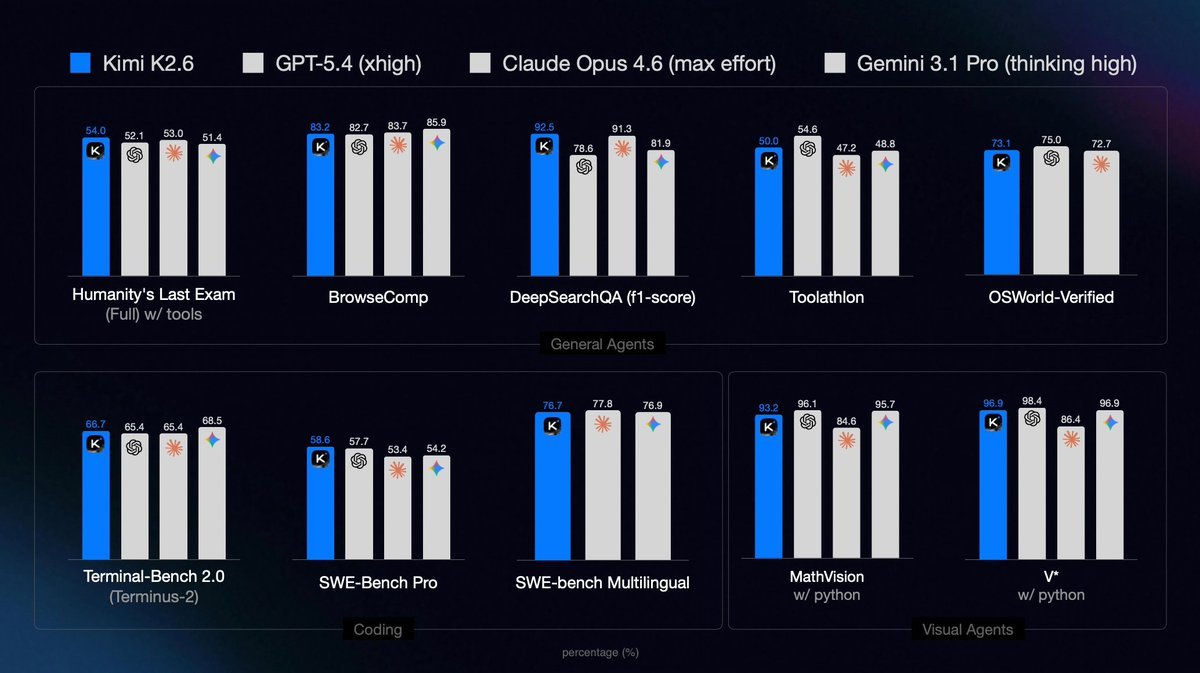
12+ hour autonomous sessions are now baseline.
Reaches the same outcome as K2.5 with ~35% fewer steps. Fewer steps, fewer tokens, lower cost.
Cost math, no hand-waving. An agent loop burning 100M input + 10M output tokens per month:
Opus 4.7: ~$2,550/month.
Kimi K2.6: ~$85/month.
Annual delta: $28,560. That's a junior engineer. That's a vacation. That's runway.
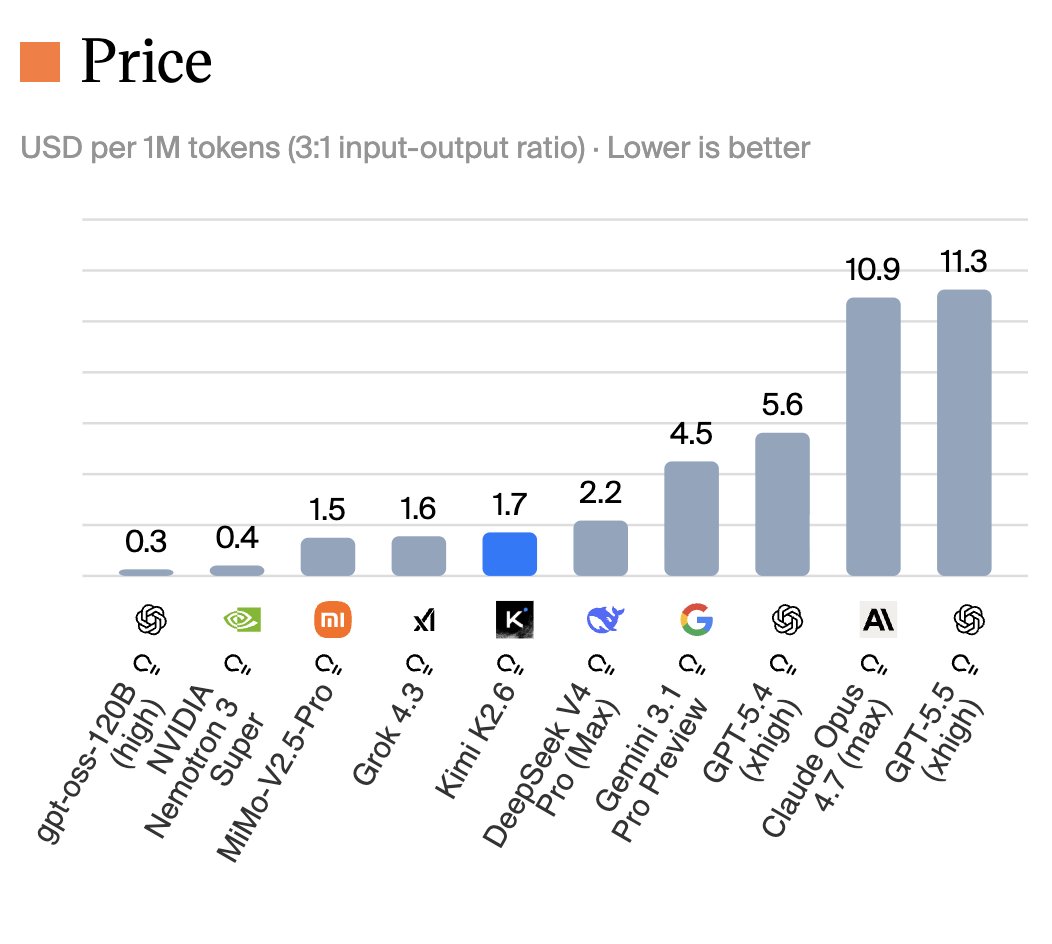
Where Kimi loses: pure math (GPT-5.5 still owns AIME 2026), genuinely ambiguous specs across unfamiliar APIs, deep multi-file reasoning across enormous codebases.
Translation: it's a coding specialist and an agentic workhorse, not a universal frontier brain. In Hermes, that's exactly the model you want as default, with Opus on speed-dial for the hard 10%.
## PART 2. THE WAR STORIES (RECEIPTS, NOT PROMISES)
Three real runs. Public. Verifiable. What they actually mean for a normal reader:
Story 1, the Zig engine.
They gave Kimi a Mac and one job: download a small AI model and, from scratch, write the code that runs it. In Zig, a programming language almost nobody uses (~200 production users on Earth). Kimi worked alone for 12 hours, made 14 attempts, fixed its own bugs along the way. Result: the model ran 13x faster than at the start, and 20% faster than LM Studio, the polished tool the rest of the industry uses.
> **wh@nrehiew_**: [原文链接](https://x.com/nrehiew_/status/2046254256194474221)
>
> Kimi K2.6 wrote an inference engine for Qwen3.5 0.5B in Zig and managed to beat LM Studio's token per second by 20%, running for 12 hours and with 4000+ tool calls
>
> 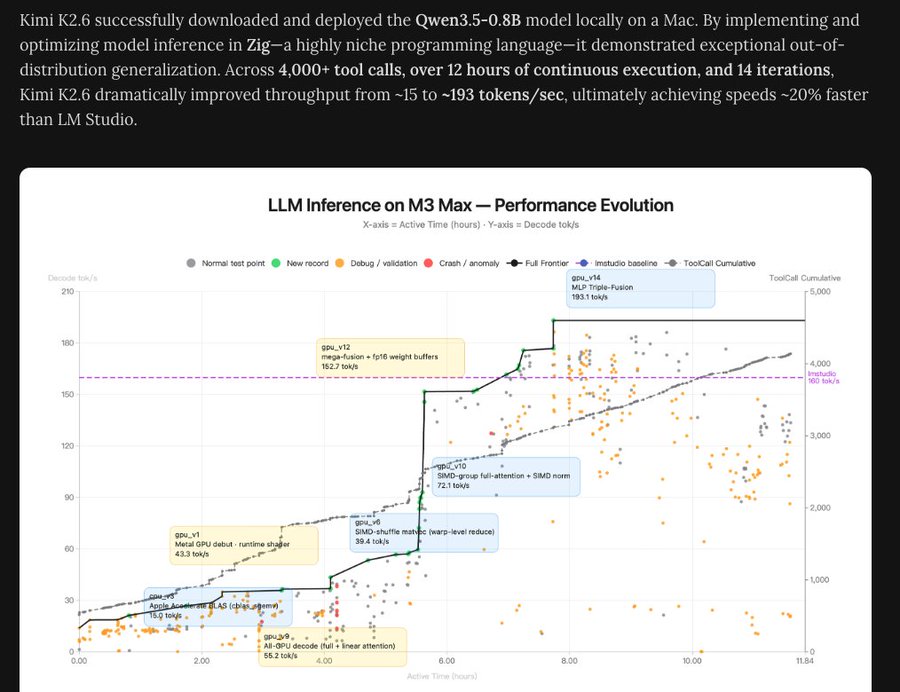
What this means: the agent can teach itself a niche skill, work unsupervised for half a day, and beat a production tool that human engineers built over years.
Story 2, the trading engine.
Exchange-Core is an 8-year-old open-source engine that matches financial trades. Real engineers tuned it for years. It was already running close to its limit. Kimi got to play senior architect: read the code, ran the same diagnostics a human would, and found bottlenecks everyone else had missed. After 13 hours and 4,000 lines of changes, it almost tripled the engine's speed.
What this means: K2.6 doesn't just write code. It improves systems that experienced humans had already polished. And it does it solo.
Story 3, KiloClaw.
The CEO of Kilo Code, a real production agent platform, put his name behind the same kind of numbers: 13 hours unsupervised, 1,000+ tool calls, 4,000+ lines, 185% throughput improvement on infrastructure that runs all day.
What this means: this isn't a clean demo. A real company is betting its platform on it and saying so publicly.
The pattern across all three:
14 iterations, not one shot. 15 tok/sec became 193 tok/sec because the agent looped, evaluated, fixed, looped again. Anyone selling K2.6 as "one-shot magic" is selling something.
Long-horizon execution is where Kimi K2.6 actually leads the world. Open or closed. Including Opus 4.7. Including GPT-5.5.
If your Hermes is running long autonomous loops (cron-triggered weekly summaries, webhook-driven incident responders, anything you set up with /queue and walked away from), you are running the wrong model.
## PART 3. WIRING IT INTO HERMES (90 SECONDS)
Day-zero support. April 20. Already in /model.
OpenRouter (30 seconds):
```
/model openrouter:moonshotai/kimi-k2.6
```
~$0.75/$3.50, slightly above Moonshot direct, zero setup.
Direct Moonshot (2 minutes):
```
/model moonshot:kimi-k2.6
```
Best pricing on the planet for this class. Cache hits at $0.15/M.
Self-hosted (free per token, geek mode):
Weights on Hugging Face under Modified MIT. Single 8xH100 node thanks to MoE. License only triggers above 100M MAU or $20M monthly revenue.
Pick one. /model swaps live. State carries over. SOUL.md, MEMORY.md, all of it. Done.
## PART 4. THE AUXILIARY MODEL PATTERN
What 95% of Hermes users miss completely.
Hermes runs more than your main conversation through an LLM. It also runs auxiliary models for context compression, session summarization, title generation, vision, and embeddings.
By default, every one of those runs on whatever your main model is.
Set Opus 4.7 as default and you're paying Opus rates to generate three-word titles. To compress sessions you'll never re-read. To OCR a screenshot. To embed sentences that get stored once and recalled never.
Stop. Route them.
The pattern that actually works:
- main brain: Kimi K2.6 (80% of work, 10% of cost).
- hard escape: Opus 4.7 (the 10% Kimi struggles with).
- compression / summary: Kimi K2.6 instant or Haiku 4.5.
- title generation: Haiku 4.5 or MiMo.
- vision: Kimi K2.6 native multimodal handles 95% of cases.
- embeddings: cheapest your provider offers. Plumbing, not flex.
Set this once. Monthly bill drops 70 to 85%. Quality on the work that matters does not move.
Tourists pick a single default. Real users build a five-model orchestra and run each track on the cheapest instrument that can carry it.
## PART 5. TWO COST TRAPS NOBODY IS TALKING ABOUT
The 8x cost win is real but conditional. Two things will quietly give half of it back.
TRAP ONE. Thinking mode bloat.
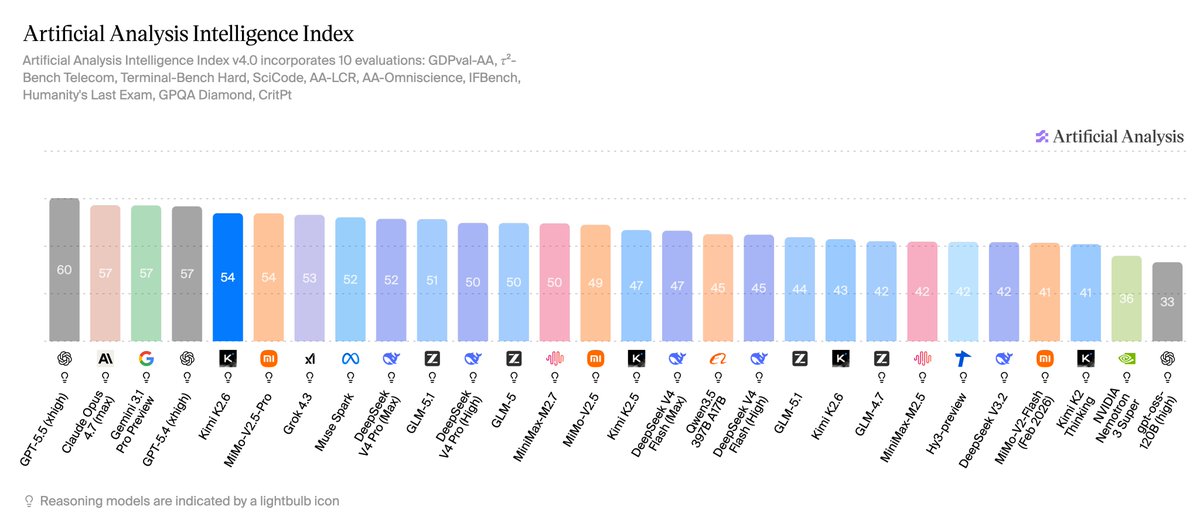
Kimi K2.6 in thinking mode generates 3.6x more output tokens than Opus or GPT for similar work (Artificial Analysis, Intelligence Index suite). At 10x cheaper per token, that nets to 2.7x cheaper. Not the 10x headline.
In long agent loops, the ratio compounds. You can build a Kimi setup that ends up more expensive than Opus would have been.
Fix:
1. Default to non-thinking mode. Hermes lets you toggle per skill.
2. Use /reasoning low or /reasoning off. Save extended thinking for /sage and manual escalations.
3. Watch output:input ratio in /insights. If output is 3x input or more, flip thinking off and re-run.
TRAP TWO. Drift.
K2.6 is fast and cheap, which means you stop watching it. So when it pivots from "fix the auth race condition" to "let me also refactor your token store while I'm here," you don't notice for 40 minutes and 80K extra tokens. Cheap tokens still add up.
Fix. Paste this at the top of every non-trivial prompt:
```
Scope: [exactly which files / modules / behavior].
Do not modify anything outside this scope.
If you find a related issue, list it at the end. Do not fix it inline.
```
Two lines. Saves about 15 to 25% of tokens on multi-file work because the model stops "while I'm here"-ing your codebase. Cheaper, and the diff stays reviewable.
Both right, you keep 8x. One wrong, you give back half.
## PART 6. WHEN TO STAY ON KIMI, WHEN TO SWAP
The /model command is a knob, not a vow.
Stay on Kimi K2.6 for:
- code generation
- unit tests, refactors
- long-horizon agent loops
- document processing, summarization
- data extraction
- UI prototyping, anything you'd run 100 times a day.
Swap to Opus 4.7 for:
- multi-stack integrations across unfamiliar APIs
- genuinely ambiguous specs
- deep multi-file reasoning across large codebases
- anything legal/medical/financial where one wrong word costs more than the price differential
- hard math.
Real session:
```
/model moonshot:kimi-k2.6
[draft, iterate, runs the loop 30 times, 95% there]
/branch
/model anthropic:claude-opus-4-7
[debug the ambiguous edge case, validate the architecture]
/model moonshot:kimi-k2.6
[continue, /reasoning off, ship]
```
Three swaps. Three price tiers. One session. State preserved end to end via /branch and the carry-over.
If something breaks, /rollback restores files. If the swap was wrong, /branch gets you back.
## PART 7. KIMI-FIRST SKILLS
Skills are slash commands. Each has a default model. Most users leave it on Opus.
Don't.
> Kimi-first (set /model moonshot:kimi-k2.6):
- /architecture-diagram - repetitive, well-defined
- /excalidraw - generation, not reasoning
- /linear - CRUD work
- /youtube-content - drafting
- /test-driven-development - Kimi is genuinely strong here
- /systematic-debugging - Kimi LEADS SWE-Bench Pro
- /manim-video - well-scoped code generation
- /google-workspace - most operations are CRUD
> Opus-only (/model anthropic:claude-opus-4-7):
- /research-paper-writing - long-form coherence still favors Opus
- /codex for deep refactors only
- anything touching money / contracts / compliance
> Tiny model (Haiku 4.5, MiMo-Lite):
- /classify, /tag, /title-generator, /btw for one-shot extraction
Then build a /sage-style escalation skill. Defaults to Kimi. Escalates to Opus only on a --hard flag or when Kimi self-reports low confidence.
The escalation skill template I run:
```
You are a senior engineer. Default behavior:
1. Solve the task on Kimi K2.6.
2. Pass tests / hit thresholds. Stop.
3. After the solution passes, run one adversarial pass:
"Critique your own solution. Find 3 weaknesses a senior
engineer would flag. Fix them."
4. If thresholds still don't hit after 3 iterations, set
confidence=low and surface the blocker. Do not retry blindly.
5. On confidence=low or --hard flag, escalate to Opus 4.7
with full context.
Scope lock: only modify files I explicitly listed.
Surface adjacent issues in a final report, do not fix inline.
```
That's not picking a model. That's orchestrating five.
Run it for a month. Bill goes from "scary" to "rounding error." The work doesn't get worse, in several measured cases it gets better, because Kimi K2.6 leads on agentic SWE-Bench Pro and the adversarial pass catches weaknesses Opus also misses on first attempt.
You weren't paying premium for premium quality. You were paying premium out of habit.
## The knob you aren't turning
You hooked up Hermes to Opus. You said "done." You ran every task, the brilliant, the boring, the three-word titles, the "what time is it in Tokyo," through the most expensive model on the market.
Kimi K2.6 dropped April 20. Day-zero Hermes integration. State of the art on agentic coding. Roughly a tenth the cost. Already in /model. Already waiting.
You've been paying $2,500 a month not to type six characters.
If you're still routing every task to Opus by default in 2026, you're not running an agent. You're running a money fire with extra steps.
Turn the knob.
## 相关链接
- [shmidt](https://x.com/shmidtqq)
- [@shmidtqq](https://x.com/shmidtqq)
- [104K](https://x.com/shmidtqq/status/2053877955512709323/analytics)
- [Factory.ai](https://factory.ai/)
- [Apr 20](https://x.com/nrehiew_/status/2046254256194474221)
- [33K](https://x.com/nrehiew_/status/2046254256194474221/analytics)
- [Upgrade to Premium](https://x.com/i/premium_sign_up)
- [12:40 AM · May 12, 2026](https://x.com/shmidtqq/status/2053877955512709323)
- [104.2K Views](https://x.com/shmidtqq/status/2053877955512709323/analytics)
- [View quotes](https://x.com/shmidtqq/status/2053877955512709323/quotes)
---
*导出时间: 2026/5/12 21:06:29*
---
## 中文翻译
# 从 $2550 到 $85:Kimi K2.6 + Hermes 如何取代我的整个开发技术栈
**作者**: shmidt
**日期**: 2026-04-20T15:46:46.000Z
**来源**: [https://x.com/shmidtqq/status/2053877955512709323](https://x.com/shmidtqq/status/2053877955512709323)
---

打开你的 Hermes 计费仪表盘。看看上个月的数据。
我会等你的。
这些调用的绝大多数都不是推理任务。它们是:
- “总结这个 PDF。”
- “润色这个段落。”
- “从会议纪要中提取行动项。”
- “我上周承诺了什么?”
- 一个持续了四条消息的聊天会话,只有一个只有三个词的标题。
每一个任务都运行在 Claude Opus 4.7 上,输入费用 $5/百万 token,输出费用 $25/百万 token。
与此同时,Kimi K2.6 于 4 月 20 日发布,并在 Hermes 内获得了首日原生支持。同样的任务。大约十分之一的成本。只需一个斜杠命令。
你错过它不是因为藏得深,而是因为你没在看。
下面的路由指南:Kimi K2.6 在哪些方面碾压 Opus,在哪些方面完败,没人运行的辅助模型模式,以及两个如果不提防就会吃掉你一半节省下来的成本的陷阱。
## 第一部分:Kimi K2.6 到底是什么
发布三周。已经在 Kilo Code、Augment Code、Vercel 和 Factory.ai 投入生产。
基于修改版 MIT 协议的开放权重。一万亿总参数,通过混合专家架构每个 token 激活 320 亿参数。推理成本像 32B 模型。容量像 1T 模型。这就是定价论点的全部。
关键数字:
- Moonshot API 价格:输入 $0.60,输出 $2.50(每百万 token)。缓存输入降至 $0.15。
- 256K 上下文窗口。足以应对约 95% 的实际工作。
- SWE-Bench Pro:58.6%。击败 GPT-5.4 (57.7%) 和 Opus 4.6 (53.4%)。
- HLE-Full(带工具):54.0%。在最艰难的代理知识基准测试中击败了所有闭源的西方前沿模型。

12 小时以上的自主会话现在已是常态。
在达到相同结果的情况下,比 K2.5 减少了约 35% 的步骤。更少的步骤,更少的 token,更低的成本。
成本数学,不含糊。一个每月消耗 1 亿输入 + 1 千万输出 token 的智能体循环:
Opus 4.7:约 $2,550/月。
Kimi K2.6:约 $85/月。
年度差额:$28,560。这相当于一个初级工程师的薪水。一次度假。或者一条跑道。

Kimi 落后的地方:纯数学(GPT-5.5 仍统治 AIME 2026)、跨越陌生 API 的真正模糊规格、跨越庞大代码库的深度多文件推理。
翻译:它是一个编码专家和一个代理劳模,而不是通用的前沿大脑。在 Hermes 中,这正是你想要作为默认的模型,而把 Opus 设为针对那 10% 困难任务的快速拨号。
## 第二部分:实战故事(收据,而非承诺)
三个真实的运行。公开的。可验证的。它们对普通读者的实际意义:
故事 1,Zig 引擎。
他们给 Kimi 一台 Mac 和一个任务:下载一个小型 AI 模型,并从零开始编写运行它的代码。使用 Zig 语言,一种几乎没人用的编程语言(地球上约 200 个生产用户)。Kimi 独自工作了 12 小时,进行了 14 次尝试,沿途修复了自己的 bug。结果:该模型的运行速度比开始时快了 13 倍,比全行业使用的精致工具 LM Studio 快了 20%。
> **wh@nrehiew_**: [原文链接](https://x.com/nrehiew_/status/2046254256194474221)
>
> Kimi K2.6 用 Zig 编写了 Qwen3.5 0.5B 的推理引擎,并设法将每秒 token 数比 LM Studio 提高了 20%,运行了 12 小时,调用了 4000+ 次工具
>
> 
这意味着:智能体可以自学小众技能,无人监督工作半天,并击败人类工程师花费数年构建的生产工具。
故事 2,交易引擎。
Exchange-Core 是一个 8 年历史的开源引擎,用于撮合金融交易。真正的工程师对它进行了多年的调优。它已经接近运行极限。Kimi 扮演了高级架构师:阅读代码,运行人类会运行的相同诊断,并发现了其他人都遗漏的瓶颈。经过 13 小时和 4000 行代码的更改,它几乎将引擎速度提高了两倍。
这意味着:K2.6 不仅仅是写代码。它改进了经验丰富的人类已经打磨过的系统。而且它是独立完成的。
故事 3,KiloClaw。
Kilo Code 的 CEO,一个真正的生产级代理平台,用同样的数字背书:13 小时无人监督,1000+ 工具调用,4000+ 行代码,全天运行的基础设施吞吐量提高了 185%。
这意味着:这不是一个干净的演示。一家真正的公司正在将其平台押注于它,并公开发声。
这三个故事的模式:
14 次迭代,而不是一次通过。每秒 15 个 token 变成每秒 193 个,是因为智能体循环、评估、修复、再次循环。任何将 K2.6 包装为“一次通过魔法”的人都在卖狗皮膏药。
长视野执行是 Kimi K2.6 真正领先世界的地方。无论是开源还是闭源。包括 Opus 4.7。包括 GPT-5.5。
如果你的 Hermes 正在运行长自主循环(cron 触发的每周总结、webhook 驱动的事件响应者、任何你用 /queue 设置并然后置之不理的东西),你正在运行错误的模型。
## 第三部分:接入 HERMES(90 秒)
首日支持。4 月 20 日。已在 /model 中。
OpenRouter(30 秒):
```
/model openrouter:moonshotai/kimi-k2.6
```
约 $0.75/$3.50,略高于 Moonshot 直连,零设置。
直接 Moonshot(2 分钟):
```
/model moonshot:kimi-k2.6
```
此类模型全球最佳价格。缓存命中低至 $0.15/M。
自托管(每 token 免费,极客模式):
权重在 Hugging Face 上,遵循修改版 MIT 协议。得益于 MoE,只需单个 8xH100 节点。许可证仅在月活用户超过 1 亿或月收入超过 2000 万美元时触发。
选一个。/model 实时切换。状态保留。SOUL.md,MEMORY.md,所有这些。完成。
## 第四部分:辅助模型模式
95% 的 Hermes 用户完全错过的东西。
Hermes 通过 LLM 运行的不仅仅是你的主对话。它还运行辅助模型来进行上下文压缩、会话总结、标题生成、视觉和嵌入。
默认情况下,每一个都运行在你的主模型上。
将 Opus 4.7 设为默认,意味着你以 Opus 的费率支付生成三个词的标题。压缩你永远不会重读的会话。对截图进行 OCR。嵌入那些只存储一次且永不召回的句子。
停。给它们路由。
真正有效的模式:
- 主大脑:Kimi K2.6(80% 的工作,10% 的成本)。
- 困难逃生舱:Opus 4.7(Kimi 搞不定的那 10%)。
- 压缩/总结:Kimi K2.6 instant 或 Haiku 4.5。
- 标题生成:Haiku 4.5 或 MiMo。
- 视觉:Kimi K2.6 原生多模态处理 95% 的情况。
- 嵌入:你提供商提供的最便宜的。这是管道,不是炫技。
设置一次。每月账单下降 70% 到 85%。重要工作的质量不会下降。
游客选择单一的默认值。真正的用户构建一个五模型乐团,并在每条音轨上使用能承载它的最便宜的乐器。
## 第五部分:没人谈论的两个成本陷阱
8 倍成本优势是真实的,但是有条件的。两件事会悄悄把其中一半还回去。

陷阱一:思考模式膨胀。
在思考模式下,Kimi K2.6 针对类似工作生成的输出 token 比 Opus 或 GPT 多 3.6 倍。在每 token 便宜 10 倍的情况下,净算下来便宜 2.7 倍。而不是标题上的 10 倍。
在长智能体循环中,这个比例会复合。你可能建立一个最终比 Opus 还昂贵的 Kimi 设置。
修复:
1. 默认为非思考模式。Hermes 允许你针对每个技能进行切换。
2. 使用 /reasoning low 或 /reasoning off。将扩展思考留给 /sage 和手动升级。
3. 在 /insights 中监控输出:输入比。如果输出是输入的 3 倍或更多,关闭思考并重新运行。
陷阱二:漂移。
K2.6 快速且便宜,这意味着你不再盯着它。所以当它从“修复认证竞态条件”转向“既然我在这里,顺便重构一下你的 token 存储”时,你可能 40 分钟、8 万额外 token 之后才注意到。便宜的 token 也会积少成多。
修复。在每个非平凡的提示词顶部粘贴这个:
```
Scope: [确切哪些文件 / 模块 / 行为]。
不要修改此范围之外的任何内容。
如果你发现相关问题,在最后列出。不要直接修复。
```
两行。在多文件工作中节省大约 15% 到 25% 的 token,因为模型停止了“既然我在这里”式地动你的代码库。更便宜,且差异保持可审查。
两个都做对,你保持 8 倍优势。做错一个,你还回去一半。
## 第六部分:何时留在 Kimi,何时切换
/model 命令是一个旋钮,不是誓言。

留在 Kimi K2.6 用于:
- 代码生成
- 单元测试、重构
- 长视野智能体循环
- 文档处理、总结
- 数据提取
- UI 原型设计,任何你每天运行 100 次的东西。
切换到 Opus 4.7 用于:
- 跨越陌生 API 的多栈集成
- 真正模糊的规格
- 跨越大型代码库的深度多文件推理
- 任何法律/医疗/金融事项,一个错词的代价高于价格差异
- 艰难的数学。
真实的会话:
```
/model moonshot:kimi-k2.6
[起草,迭代,循环 30 次,完成 95%]
/branch
/model anthropic:claude-opus-4-7
[调试模糊的边缘情况,验证架构]
/model moonshot:kimi-k2.6
[继续,/reasoning off,交付]
```
三次切换。三个价格层级。一个会话。状态通过 /branch 和延续端到端保留。
如果出问题,/rollback 恢复文件。如果切换错误,/branch 让你回来。
## 第七部分:KIMI 优先技能
技能就是斜杠命令。每个都有一个默认模型。大多数用户保留在 Opus。
别这样。
> Kimi 优先(设置 /model moonshot:kimi-k2.6):
- /architecture-diagram - 重复性、定义明确的
- /excalidraw - 生成,非推理
- /linear - CRUD 工作
- /youtube-content - 起草
- /test-driven-development - Kimi 在这方面真的很强
- /systematic-debugging - Kimi 领跑 SWE-Bench Pro
- /manim-video - 范围明确的代码生成
- /google-workspace - 大多数操作是 CRUD
> 仅 Opus(/model anthropic:claude-opus-4-7):
- /research-paper-writing - 长文连贯性仍偏向 Opus
- /codex 仅用于深度重构
- 任何涉及金钱 / 合同 / 合规的事情
> 微型模型(Haiku 4.5,MiMo-Lite):
- /classify,/tag,/title-generator,/btw 用于一次性提取
然后构建一个 /sage 风格的升级技能。默认为 Kimi。仅在 --hard 标志或 Kimi 自报告低置信度时升级到 Opus。
我运行的升级技能模板:
```
你是一名高级工程师。默认行为:
1. 在 Kimi K2.6 上解决任务。
2. 通过测试/达到阈值。停止。
3. 解决方案通过后,运行一次对抗性检查:
“批评你自己的解决方案。找出 3 个高级
工程师会标记的弱点。修复它们。”
4. 如果 3 次迭代后仍未达到阈值,设置
confidence=low 并提出阻碍。不要盲目重试。
5. 在 confidence=low 或 --hard 标志时,升级到 Opus 4.7
并附带完整上下文。
范围锁定:仅修改我明确列出的文件。
在最终报告中提出相关问题,不要直接修复。
```
这不是选择一个模型。这是在编排五个。
运行一个月。账单从“吓人”变成“四舍五入的误差”。工作没有变差,在几个测量案例中反而变好了,因为 Kimi K2.6 在代理 SWE-Bench Pro 上领先,且对抗性检查捕捉到了 Opus 在第一次尝试中也遗漏的弱点。
你支付溢价并不是为了溢价质量。你出于习惯支付了溢价。
## 你没在转的那个旋钮
你把 Hermes 接到了 Opus。你说“完成了”。你运行每个任务,无论精彩的还是无聊的,三个词的标题,“东京现在几点”,全部通过市场上最昂贵的模型。
Kimi K2.6 于 4 月 20 日发布。首日 Hermes 集成。代理编码的最先进技术。大约十分之一的成本。已在 /model 中。已在等待。
你每个月支付 $2,500 只是为了不输入六个字符。
如果你在 2026 年仍然默认将每个任务路由到 Opus,你运行的不是智能体。你是在用多余的步骤烧钱。
转动那个旋钮。